The Chris Hedges Report to discuss the Fort McMurray Fire, the tar sands industry responsible for the conditions that produced it, and the tinderbox world Big Oil has made in its all-consuming pursuit of profit.
TRANSCRIPT
The following is a rushed transcript and may contain errors. A proofread version will be made available as soon as possible.
Chris Hedges:
In May 2016, a monster wildfire engulfed the city of Fort McMurray in the Canadian province of Alberta, destroying thousands of homes and forcing the evacuation of 88,000 people. The freakishly destructive conflagration which tore into the town with such speed that residents barely escaped in their cars as their houses flared and vaporized, is a harbinger of the new normal; The climate catastrophe that will become commonplace as the climate heats up and monster storms, heat waves, and wildfires proliferate. Fort McMurray is in the heart of the Alberta tar sands, one of the largest concentrations of crude oil in the world. The tar sands produce 98% of Canada’s oil and are the US’s largest source of imported oil. This oil, among the dirtiest fossil fuels on earth, is a leading cause of atmospheric pollution, releasing massive amounts of carbon dioxide. The production and consumption of one barrel of tar sands crude oil releases 17% more carbon dioxide than production and consumption of a standard barrel of oil.
Tar sands oil is a thick, mucky, clay-like substance that is infused with a hydrocarbon called bitumen. The oil is extracted by a process known as steam-assisted gravity drainage which occurs under the earth and is similar to fracking. In the northern part of the province, extraction is done by strip-mining the remote boreal forest of Alberta, 2 million acres of which have already been destroyed. The destruction of vast forests sold to timber companies and the scraping away of the topsoil have left behind poisoned wastelands. This industrial operation, perhaps the largest such project in the world, is rapidly accelerating the release of the carbon emissions that will, if left unchecked, soon render the planet uninhabitable for humans and most other species.
The oil is transported thousands of miles, to refineries as far away as Houston, through pipelines and in tractor trailer trucks or railroad cars. More than 100 climate scientists have called for a moratorium on the extraction of tar sands oil. Former NASA scientist, James Hansen, has warned that if the tar sands oil is fully exploited, it will be “game over for the planet.” He’s also called for the CEOs of fossil fuel companies to be tried for high crimes against humanity. Joining me to discuss the suicidal folly of our continued extraction of fossil fuels and the consequences for the planet is John Vaillant, author of Fire Weather: A True Story from a Hotter World which is a finalist for the National Book Award.
So let’s begin. I’m going to read this passage from the beginning of your book. It describes the fire itself. “Within hours, Fort McMurray was overtaken by a regional apocalypse that drove a serial firestorms through the city from end to end — for days. Entire neighborhoods burned to their foundations beneath a towering pyrocumulus cloud typically found over erupting volcanoes. So huge and energetic was this fire-driven weather system that it generated hurricane-force winds and lightning that ignited still more fires many miles away. Nearly 100,000 people were forced to flee in what remains the largest, most rapid single-day evacuation in the history of modern fire.” This incident that you build your book around, at one point you compare it to the firebombing of Hamburg. Lay out first, the preconditions that are there including you write about it, the nature of the forest itself. You wrote the trees don’t grow because it’s designed or it’s expected to burn. Before we get into what happened, lay out the antecedents.
John Vaillant:
Join thousands of others who rely on our journalism to navigate complex issues, uncover hidden truths, and challenge the status quo with our free newsletter, delivered straight to your inbox twice a week:
Yeah, sure. It’s good to be with you, Chris. The boreal forest system is the largest such forest system on earth. It circumnavigates the Northern Hemisphere. It goes all the way across Canada, all the way across Alaska, through Russia where it’s known as the “taiga,” into Scandinavia, touches down on Iceland, picks up again in Newfoundland, and heads off westward again across Canada, completing the circle. Alberta is about half boreal forest, and one way to understand Alberta is it’s basically the Texas of Canada. So a lot of the same values, interests, economy, religious emphasis, alienation from federal government, and all of that can be found in Alberta too, along with this very naturally flammable forest system.
In May of 2016 when this fire broke out, you could say erupted, we were seeing a landmark in a steady trend of heating and drying. So the boreal forest system has more sources of freshwater than any other biome, including the tropical jungle. It’s been slowly warming and slowly drying out, and on May 3, 2016, there were five separate wildfires burning around Fort McMurray. The conditions were extraordinary, in the low 90s. And again, we’re in the subarctic here. We’re 600 miles north of the US border, so 90 degrees is a very unusual temperature. Not only that, we have a relative humidity of about 11%, and to find a similar environment, you have to go to Death Valley in Southern California to find a steady relative humidity like that.
So now you have this naturally explosive fire system, the boreal forest, heated to Southern California temperatures and dried to desert dryness. You put a fire in there and you put a wind blowing in the wrong direction and you don’t have a normal wildfire — you have a firestorm. A quick science lesson here; Radiant heat is the heat coming off the fire. It’s the heat that tells you not to touch the candle or put your hand in the fire. The heat that day coming toward Fort McMurray out of this wildfire was about 950 degrees Fahrenheit, and that’s hotter than Venus.
Chris Hedges:
Let’s talk about the natural cycle within the ecological system. You write one of the reasons the trees never get very big or very old is because in spite of all that water, they burn down on a regular basis. They’re designed to.
John Vaillant:
Yeah. The boreal forest system, we don’t think about it too much because it’s so far north. It’s very sparsely inhabited up there, so enormous fires are natural. You could have a thousand-square-mile-fire that would be headline news if it was in California and it will pass without a ripple in the Canadian news cycle because they’re relatively common. But this is where Fort McMurray is an anomaly: It’s a city of 90,000 permanent and temporary workers. 600 miles north of the US border, in the middle of this forest system that is typically uninhabited and generally left to burn on its own. So to put a large, permanent city that has enormous economic value to the country in the way of a fire-prone environment is asking for trouble. And they had managed to deflect it in the past and their number came up in May 2016.
Chris Hedges:
Let’s talk about the extraction. As I told you before we went on the air, I visited Fort McMurray and driven up through the tar sands and it’s very hard to grasp the size of the operation and these monster trucks, and it is something out of a moonscape. But talk a little bit about the extraction, both in terms of this special equipment in the book but also of how vast it is.
John Vaillant:
Yeah. When Canada talks about its petroleum industry, we think of oil wells, drilling rigs, and things like that, and we really have to forget all that. What it’s closer to is a massive coal-mining project. Bitumen is sand; It’s sand soaked in bitumen which is basically tar. And no ordinary person would ever imagine extracting oil from that but —
Chris Hedges:
You write in the book that it’s only 10% bitumen.
John Vaillant:
— Yeah, yeah. So it’s about 90% or 85% quartzite sand which is a hard mineral, 5% water, bits of clay, and then this tiny percentage of bitumen which has to be dug up with giant machines. When I say giant machines, I’m talking about cranes and shovels that have scoops about the size of a garage, and the trucks that they then fill with this material weigh 400 tons empty so that the trucks themselves are the size of three-story houses. The wheels are 13 feet tall. Everything is steroidally large and it’s because the landscape itself is so vast. It’s very hard to even find a scale for it until you stand a person next to it and people just disappear in that environment.
So you have these massive shovels digging up this bituminous sand which grows under the boreal forest. So before you can even dig anything, you have these even larger bulldozers that plow the forest up into heaps. Then the shovels come in, the trucks are driving across this blackened landscape, and they come to these upgrading facilities where they heat up this bituminous sand and melt the tar out of it. The goal here is to make a petroleum product but they literally squander, in my view, billions of cubic feet of natural gas every day to melt the bitumen out of the sand. All you have after you’ve burnt all that natural gas are vats full of tar which is essentially driveway sealant. Then to render it into something like petroleum, you have to heat it again in these pressurized tanks, and that takes more natural gas and produces extraordinary amounts of pollution.
In the petroleum industry, you’re fractionating usable elements of whatever petroleum product you’re trying to render, and here they get this oil-like substance that then has to be piped or trucked south to American refineries that can handle heavy, dirty oil, and then it needs to be heated again. So when you think of the amount of fossil fuel that is used simply to get this to the factory where it can be turned into something resembling oil. It’s called synthetic crude — it is cheap and abundant but extraordinarily wasteful. I spent some time in the book trying to explain the business case but no ordinary business person would take it on because it’s so extraordinarily inefficient and wasteful.
Chris Hedges:
Here’s your description of what it looks like, and a pretty good one having been there myself. “Mile upon mile of black and ransacked earth pocked with stadium-swallowing pits and dead, discolored lakes guarded by scarecrows in cast-off rain gear and overseen by flaming stacks and fuming refineries, the whole laced together by circuit board mazes of dirt roads and piping, patrolled by building-sized machines that, enormous as they are, appear dwarfed by the wastelands they have made. The tailings ponds alone cover well over a hundred square miles and contain more than a quarter of a trillion gallons of contaminated water and effluent from the bitumen upgrading process. There is no place for this toxic sludge to go except into the soil, or the air, or, if one of the massive earthen dams should fail, into the Athabasca River. For decades, cancer rates have been abnormally high in the downstream community.” What you’re leaving behind, especially because this is such a large source of fresh water, is this gigantic poisoned landscape that’s probably irrecoverable.
John Vaillant:
Yeah, I think so. The petroleum companies working up there will be long gone by the time any serious reclamation has to happen. So in a sense, it’s a sacrifice zone in the making. There are high rates of asthma in town. There are elevated rates of cancer, not just downstream, but in Fort McMurray itself. The smell of bitumen is in the air and people there joke, well, you smell that tarry smell when the wind’s blowing the right direction, and you say that smells like money but it also smells like cancer.
Chris Hedges:
Well, there is money to be made. The markets declined a bit with the drop-in crude but what I think you had in the book that the average salary in Fort McMurray or household was $200,000 a year.
John Vaillant:
It’s like a hot house up there. All kinds of people from across Canada — There are some depressed parts of Canada, especially in the Maritimes on the east coast — Ever since the cod fishery collapse, people have struggled to make a living there. A third of the population of Fort McMurray is from the east coast of Canada, from Newfoundland, Labrador, Nova Scotia, and places like that. This is the only place they can simulate a middle class lifestyle, and they do it hundreds, and in that case thousands, of miles from their families. But they’ve created these simulacra of suburbia in these subarctic forestscapes. It works for them but it’s a very artificial construct because it’s completely dependent on the bitumen industry which is completely dependent on the global oil price. And bitumen, because everybody in the industry understands that it’s a third-rate material, it’s a stepchild of the industry so it has to accept lower prices and deal with a lot of abuse from people who are drilling oil out of the ground.
Chris Hedges:
A lot of these people may have their family in Fort McMurray but they’re put on buses. I saw the buses because it’s so vast, the area, go up to these man camps where I don’t know how many days they work before they get to come back. So they’re not living in Fort McMurray.
John Vaillant:
There are different tiers of inhabitants. These camp workers and these camps are like gulags; It’s really cold up there in the winter, as you can imagine, 40-50 below zero. These are insulated trailers that are stacked up, they look a little bit like polar research stations except they’re surrounded by heavy fencing and patrolled by guards. Everybody has to wear an RFID device so that they can be tracked wherever they go. They work 12-hour shifts. These facilities run 24/7, 365. They never stop. These men have a look to them; After a few weeks in that environment, there’s a pallor and a weariness that sets in, and as good as the money is that they’re making, the toll on the soul is heavy.
There’s another population that lives in town in nicer houses and they’re able to have their families with them. They’ve thrown in their whole lot and moved everything up to Fort McMurray. They’re permanent residents. So there are these two tiers of laborers up there but ultimately they’re all serving this giant machine whose sole purpose is to excavate, melt, process, and transport bitumen.
Chris Hedges:
Why is the security so heavy around the camps?
John Vaillant:
There is anxiety around protestors. The bitumen industry has been a pariah in the petroleum industry for decades now, and it’s been a target of environmental groups and environmental activists. They honestly don’t have that much to worry about because it’s so remote, it’s so hard to get there, there’s only one road in one road out, and again, there are police everywhere. I’ve never been — Certainly in North America — In a place that felt like it had such a heavy police/security presence. There’re many different private companies working up there along with the RCMP and the city police.
The workers, because it’s so… And you hear about this in Williston, North Dakota and other boom towns in Texas. When you get that many men together far from their families, working extraordinarily hard, paid extraordinarily well, the incidents of drug use and other kinds of violence — Internal and external — Are elevated; The normal governors aren’t there, there’s a lack of civility, and the normal stabilizing characteristics of a multi-gender, multi-generational society are substituted by police order, fencing, and rigorous systems of control. You check in, you check out. It’s like a low-security prison, I would say. Comparable to that.
Chris Hedges:
Let’s talk about wildfires. You write that they’re not single entities and you divide them into three distinct parts. What are those parts and how do they work?
John Vaillant:
Yeah. The behavior of wildfire is varied and depends on its stage of growth and what the nature of the fuel is. So we’ve all seen a cigarette fire on the side of the road which is a slow spreading blackness that might glow at night but in the daytime you might not see it except for the smoke on the leading edge. Then as it gets into larger fuels, leaves, underbrush, you might see actual flame. Depending on heat and wind — And heat and wind really are the deciding factors for whether a fire will succeed or not — If you’ve got hot conditions and windy conditions and you get into some good fuel underbrush and susceptible trees — Especially conifer trees which are in abundance in the boreal forest — You’ll get those flames climbing up into the architecture of the trees and then the forest.
As it climbs — Fire wants to climb, we all know heat rises — It’s rising up into the treetops and it’s sucking in wind from underneath because it needs oxygen all the time. So the fire, it’s helpful to think of it as a breathing entity; It’s pulling oxygen in from all around and rising up into the architecture of the trees and so there’s this rushing chimney-like effect. Where the fire is in a way happiest, most energetic, most charismatic, and dynamic is up in the treetops, and then it’s pulling in wind from down below. As that heat builds, as the whole tree is engaged, you have this increasing heat and increasing wind which then builds on itself so it becomes almost a self-perpetuation machine. If you have hot enough, dry enough, and windy enough conditions, those flames will then begin to leap from treetop to treetop.
Why it’s hot, what the heat does is it releases vapor, it releases hydrocarbons from the fuels around it. That’s the purpose of the heat. So what the fire is sensing that we can’t see is vapor and that’s why you see these explosive fireballs and massive surges of flame coming out of big boreal fires because that’s the superheated vapor rising up and being ignited. Imagine an empty gas can — Even though there might not be a lot of liquid in it, it will still explode in a spectacular fashion. That’s what the fire is enabling in the forest, for all those hydrocarbons to release in this gaseous cloud that then ignites. That’s when you see, especially a boreal fire, in full run; It’s called a Rank 6. It’s comparable to a Category 5 hurricane.
These flames can be 300 feet tall. They can send fireballs rolling up into the smoke column for another 1,000 feet. The fire front can be many miles wide. They’re less like fires and more like tidal waves of flame rolling across the landscape. They are charismatic, terrifying, and impossible to stop once they get running like that.
Chris Hedges:
You have this amazing story from, is it the Chisholm fire in 1950? I’ll let you tell it. NASA or NORAD or somebody is monitoring global weather from a satellite feed, but you can pick it up from there.
John Vaillant:
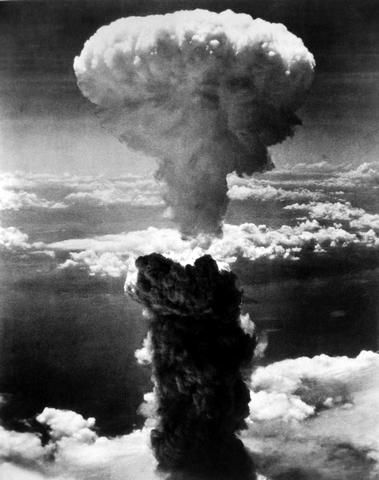
Yeah, yeah. This was in 2001 and about a 100 miles or so south of Fort McMurray, in the boreal forest. This fire ignited under similarly hot, dry conditions. I think it was a Navy satellite observer in DC, he saw this aerosol injection, this giant smoke plume erupting out of the forest of Alberta. He knew there are no volcanoes there, so what else could send up a jet of smoke like that with that much ferocity and energy into the stratosphere? The only other thing he could think of that could do that is a nuke. So they inquired to the authorities in Alberta, have you just detonated a nuclear device? And they said no, we haven’t.
When the fellow in DC identified the zone on the map where this was happening, that was the Chisholm fire which has gone down in the record books as the most energetic, intense, and ferocious wildfire ever measured on earth. It’s got a lot of competition, not just from Alberta, but from California, Australia, and even Siberia. So it was an extraordinary event, but it was in a way, a bellwether for what was to come. And Alberta has produced some of the most intense fires ever measured since then.
Chris Hedges:
In the book, you ask us to look at fires from a different perspective, and at the top of chapter 12, you quote Ray Rasker, the co-founder of Community Planning Assistance for Wildfire. He says, “We don’t have a forest fire problem. We have a home ignition problem. As soon as you come to that realization, it changes your view on wildfire.”
John Vaillant:
Yeah. People talk about human beings being people of the corn And I think more apt, and certainly in the 21st century, we are people of the hydrocarbon. Not only is our entire economy — Or 80% of it, anyway — Driven by fossil fuels at this point, but an extraordinary percentage of the things that we interact with and even wear are derived from petroleum products. Our clothes, our shoes, our mattresses, our playground furniture. We have tar shingles, we have vinyl siding, we have vinyl windows, we have all plastic laminates in our flooring. Most of us go to bed at night on petroleum products in terms of what our bedsheets might be made out of, what our mattresses are made out of.
So the home, which is this sanctuary for us, it’s thought of as this inviolable space where you can safely raise your family. When you heat it up to temperature, it begins to off-gas hydrocarbons like the forest does, like a gas can does. The modern home is more flammable than a log cabin or a 19th century home that’s made mostly out of wood, mostly furnished with cotton-stuffed furniture or horse hair stuffed furniture, things that we think of as antiques now. But the modern home is a giant gas can and we don’t think of that when it’s 75 degrees. But when it’s 300 degrees because of the radiant heat coming off a fire, or 1,000 degrees because of the radiant heat coming off a boreal wildfire, it turns into something completely different. Firefighters discovered that in some painful ways in May 2016.
Chris Hedges:
Well, that’s what you call flashover.
John Vaillant:
Yes. Again, the point of the heat and fire is to release the hydrocarbons in a potential fuel, and the fuels that fire interacts with are in vapor form. Fire can’t burn solids. It needs to heat the solids up until they begin to vaporize. So when you have 1,000-degree heat coming out of a wildfire, like the one that came into Fort McMurray on May 3, entire houses were heating up to 600, 700, 800 degrees. All the vinyl siding, all the glues and laminates in the plywood, everything was vaporizing. Firefighters couldn’t see it, homeowners couldn’t see it, but the fire could sense these giant billows of flammable gas in and around these homes.
When I was speaking to firefighters afterward, they said, yeah, houses were burning to the basement in five minutes. I was sure that they were exaggerating, and not because they were untruthful but there was a lot of adrenaline, there was a lot of fatigue; A lot of these guys didn’t sleep for days on end because the fire never let up so I assumed it was the fog of war type of a situation. And then I spoke to a physicist who specialized in home destruction and home flammability, a guy named Vyto Babrauskas in Seattle, and he said, yeah, no, that is possible to get those incredible burn times. I said, but can you explain it? And he said, well, you should probably look at the Hamburg firestorm from World War II and that will give you an idea of the energy and circumstances that were to be found in Fort McMurray in May of 2016.
Chris Hedges:
I didn’t know this until I read it in your book, that that firestorm was completely engineered where they, in preparation, erected buildings that replicated German construction styles right down to sofa stuffing and the placement of babies’ cribs.
John Vaillant:
Yeah. It was diabolical, yeah.
Chris Hedges:
Yeah. But you really liken that engineering of the firestorm in Hamburg to our own, the engineering that we live in.
John Vaillant:
This is what is strange and sinister about this. Standard Oil, now Exxon, has and had a sideline in incendiary weapons. And they partnered with the US Army to develop a bombing program to ignite the city of Hamburg. Before doing that, they hired architects, set designers, and carpenters to simulate German homes and then they tested these incendiary devices on these homes in Utah, some other bombing ranges around the country, and in the UK to see what combination of thermite and other products would work best for setting these houses on fire and engineering a firestorm. So it was one of the most extraordinary and premeditated acts of state-sanctioned arson ever perpetrated on a civilian population, and it was repeated numerous times in Germany but also in Japan. Scores of cities were bombed this way in Japan as well during World War II.
There’s this quite bizarre irony that now the modern home is its own incendiary device in the sense that it is filled with petrochemicals and sheathed in many cases with petroleum products like vinyl siding and tar shingles. It just kind of makes sense when you look at the petroleum industry. Its business is fire. We think of it as oil. We might think of it as natural gas or bitumen, but its sole purpose is to burn, and that’s the business that these companies are in. And so everything they touch in a way, whether it’s a plastic garbage can or a rubber tire or a beautiful modern home, at the root of it is this extraordinarily flammable substance which is petroleum products.
And so that, it took me a while of researching and thinking about it to realize and look around my own home that I’m basically sitting inside a kind of incendiary device, and that is a strange feeling, and then it kind of makes you wonder whose side is the petroleum company on really. It really changed my view of how we live and how we power our lives, and the strange ease we have with extraordinarily explosive substances, not to mention a gas can full of, sorry, a gas tank full of gas basically set right behind our child’s car seat, gas grills, we have flames burning in our basement with a water heater and furnaces. We have an eerie comfort with this really destructive energy.
Chris Hedges:
You ask what role does the petroleum industry play in promoting and approving building materials that are supposed to shelter families from harm.
John Vaillant:
Yeah, there are fire retardancy ratings for all kinds of products, including mattresses and things like that. Many of those fire-retardant substances are actually quite carcinogenic, and they only work up to a certain point. So no amount of fire retardancy will stop a house that’s fully engulfed in fire and certainly won’t stop a house from burning if it is confronted with the kind of energy coming out of a forest fire that we saw in Fort McMurray and that we’ve also seen though… Boulder, Colorado has had similar fires, California, Montana. Lahaina was a really tragic example of that. Canada has been burning literally all summer long, almost from coast to coast, and communities have been evacuated throughout the country, and several of them have burnt to the ground. It’s an energy that is really enhanced and enabled by the high petroleum content in our lives, in every aspect of our lives.
Chris Hedges:
Well, you call the age we live in the petro scene.
John Vaillant:
Yeah. Yeah, the petroleum age, and I would date that really from around 1859 when the gusher at Titusville was released, the first industrial oil well. Standard Oil, now Exxon, and many other petroleum companies was founded in 1870. That’s when the kerosene industry really took off. That was kind of the precursor of the petroleum industry as we know it, and then obviously the automobile really set it in motion, so to speak. There’s evidence to suggest that the petroleum age is peaking right now, that we’re hitting peak oil. There is a transition underway, if uneven. There’s a lot of pushback from a deeply, deeply entrenched petroleum industry and all the systems that are enabled by it and financed by it, including our politics.
Chris Hedges:
Here’s a point that I guess I knew, but once you articulated it I thought it was kind of interesting. You said exhaust fumes, like the atmosphere that they flow into, are mostly invisible and easy to keep out of mind, but if that Silverado’s tailpipe were directed back into the vehicle, the driver and all her passengers would be dead in minutes. If the Silverado’s exhaust were piped to the driver’s living room, she and her family would be dead in an hour. But somehow, when we run our cars “outside,” in quotes, in our shared atmosphere, all of a sudden toxic gas is magically disappeared is really…
John Vaillant:
Yeah. Yeah, no, all of us alive today have grown up in the petroleum age, and it feels normal to us the way I think people smoking on airplanes and in doctors’ waiting rooms felt normal to people in the 1950s. We’re completely habituated to it, to the point that it’s invisible to us. But if you really stop and think about how petroleum is rendered and what it in fact is, it’s literally toxic at every stage of its life, from the moment it’s drawn from the ground through the incredibly polluting refining process into our cars and where it’s burned, and so if you look at… Petroleum will kill you in every form, whether as a liquid, as a toxic spill, as a gas, as an emission, and it’s strange to think that we have surrounded ourselves and persuaded ourselves that this profoundly toxic substance is an ally to us and an enabler of this wonderful lifestyle that we live that is now being compromised in measurable and visible ways by that very energy source.
Chris Hedges:
Well, let’s talk a little bit about that. You write about it. I think Ronald Wright called us the future eaters, but you also deal with this issue of convenience and luxury and power, the kind of power that fossil fuels give us. You talk about a woman driving a car, but talk about… So the science is there, and not just the science but the breakdown of the climate itself is visible and yet we don’t react in any meaningful way, and that is an issue you deal with in the book. Explain why or why you think we don’t react.
John Vaillant:
The ease, the sense of there’s a kind of disassociation that we’re engaged in in our daily lives, and we might see the headlines. Now pretty much everybody in Canada knows somebody personally who’s been evacuated due to wildfire. That’s how ubiquitous it is up here now after this terrible summer we’ve had. Certainly many people in the States are no strangers to this either. At the same time, we continue to drive. We may continue even to invest in the petroleum industry. We accept it.
First of all, I think humans have a kind of adaptive genius for compartmentalizing and dissociating and managing risk, but I think also there is this allegiance to the status quo that compromises our good judgment and compromises even our capacity for self-preservation. And so a really good illustration of this can be seen in Alberta which has suffered terrible fires, but where the industry is heavily dependent on petroleum extraction, and so folks up there… I think there was this thought that when people went through climate disasters, they would become climate activists. They would kind of wake up. In Alberta, people have gone through some of the worst fires you can imagine, really terrifying events. Many of them have PTSD, many of them have health issues as a result of this, but they will still vote for a climate-denying government who is pro-petroleum. I think their lifestyle is so dependent on remaining allegiant to the industry and to all of its benefits in terms of just the cash rewards of being associated with that industry that it seems too expensive and frankly impossible to envision not being associated with it.
It made me look at petroleum executives in a different way. It’s easy to see them in all kinds of negative lights, but if you think of that, the petroleum industry is their status quo. Their entire professional life, their status, their friends, their whole social structure is built around a close affiliation with an acceptance of the petroleum industry as it is with that status quo. To disconnect yourself from it, to depart from it, to criticize it could almost be seen as a kind of social suicide and certainly a professional suicide. And so I think that’s where our clannishness, and I mean this in the best sense, we’re family oriented, community oriented species. We evolved in small groups, intimately depended on each other’s approval and acceptance, and that lasts to this day. Our affiliation with the group, allegiance to the group trumps everything else. And so if that stability is dependent on petroleum or on the industry, it would be counterintuitive and almost insane to turn against it or reject it.
I think all of us, even those of us who think of ourselves as quite green, we’re still underpinned, the foundation of our society is still petroleum driven, petroleum enabled. It gives us this incredible mobility through travel. It’s enabled extraordinary wealth because everything we do is multiplied. I think that it’s easy to forget that, but when you have an internal combustion engine or a jet engine or fossil fuel powered electricity, everything you do is enhanced and multiplied so it’s really like having a retinue of servants at your beck and call, but they’re machines instead of human beings or animals, but all of that goes back to energy. Most of that energy thus far is fossil fuel driven, and so it’s hard for people to imagine an alternative, and most of us are unwilling to give that up, especially when our financial system and our economy are so dependent on our continuing to buy, continuing to mortgage, continuing to invest ourselves, and cantilever ourselves forward into debt and into consumption.
So we’re really part of this larger machine that also enables us to live really quite beautiful lives in many ways and to provide our children and our families with things that most people would want their families to have, and so it’s not a… I don’t think it’s all cynical or malicious or anything like that. I think it’s really, this is this lifestyle that we’ve become dependent on. That status quo, it generates its own allegiance, and we need to put up certain blinders to maintain a comfort with it. It’s a really interesting psychological issue, and spending time with people in Fort McMurray really illuminated that because these are really good, hardworking, earnest people who want the best for their families and were terrifically honest with me and open with me and yet they are… It’s kind of like golden handcuffs. Collectively as a civilization, we have golden handcuffs linking us to the petroleum industry as it exists now, and transitioning out of that is going to really take a conscious effort.
Chris Hedges:
Well, I saw the same thing in Southern West Virginia in the coal fields. Joe Sacco and I wrote Days of Destruction, Days of Revolt. Well, they’re golden handcuffs. It’s completely suicidal.
John Vaillant:
Yeah. No, I mean, you’re chained, in a way you’re kind of handcuffed to the bumper of this juggernaut, and so you have to keep running behind it. You have to keep up with it, but it’s going to keep going, and it is suicidal. What a hallmark I feel of the 2020s is this increasingly extreme dissonance that we find ourselves in. Almost everybody alive now is experiencing climate disruption of one kind or another. The deluge-like floods that would’ve been a normal thunderstorm 20 years ago and now cars are floating around, and then the analog or the corollary to that are these terrible fires, terrible droughts and heat waves, all of which are directly traceable to our appetite for fossil fuels, and yet separating ourselves from that, stopping that, getting off that wheel, if you will, seems impossible for so many. Indeed, for many it is, especially if you’re beholden to a bank or any other debt carriers.
Chris Hedges:
Well, as you point out in the book, the fossil fuel industry is very aggressive against people who say precisely what you’ve just been saying.
John Vaillant:
Yeah, yeah. No, they’re so entrenched, not just in our psyche, but in every aspect of our government, really our religion too, and our media. To call it out feels like it’s going against our best interests, and that is in the best interest of the petroleum industry to kind of maintain that illusion, I think, and maintain that anxiety in us that you don’t go against us. In Alberta when people criticize the industry there, they’ll say, “Well, without us you’d all freeze in the dark.” There’s that fear.
It really took me years of thinking about this to realize, well, the petroleum industry is actually only about five generations old and human civilization is many millennia old, and we have lived without petroleum, and we’ve lived beautiful productive lives that in fact were much healthier, much more intimately connected to nature and its rhythms than we are now, than we do now. And so that’s something I really tried to do in Fire Weather is invite the reader to kind of step back and look at this really anomalous time that we live in. This is the aberration. This isn’t actually normal. We’re in a strange and very disruptive experiment right now, and that experiment is an economy fueled by flammable, highly toxic substances.
Chris Hedges:
Well, we took, as you write in the book, 500 million years of energy and decided to set it alight in a century and a half.
John Vaillant:
Yeah. I mean, nobody has ever burned through a trust fund that quickly.
Chris Hedges:
Right.
John Vaillant:
In a way, that’s really what petroleum is. It has enormous utility, I think it always will, but the profligacy with which we’ve burnt it is really unconscionable. The egregiousness of the waste that continues to this day where it’s almost a virtue to burn as much as you can is so twisted, and yet we’ve been persuaded through advertising and just the momentum of the culture that this is normal and desirable. I think the SUV is a beautiful illustration of that. That was a fabricated need that arose out of the 1990s and they’ve been growing ever since. This idea that you need to have this gigantic vehicle that requires vast quantities of natural resources and huge amounts of fuel to operate in order to feel safe and like you belong in the world, it’s an illusion, but it’s so ubiquitous that it’s hard to see it.
Chris Hedges:
Great. That was John Vaillant, author of Fire Weather: A True Story from a Hotter World. I want to thank The Real News Network and its production team, Cameron Granadino, Adam Coley, David Hebden, and Kayla Rivara. You can find me chrishedges.substack.com




_64496.jpg)
_71232.jpg)
_36717.jpg)
_83475.jpg)
_78957.jpg)

_55942.jpg)
_24027.jpg)
