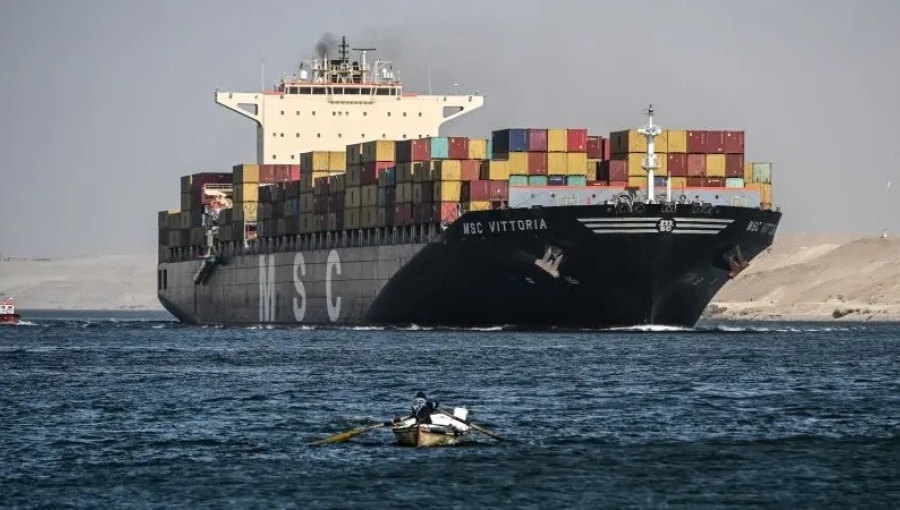
The global container shipping industry is increasingly concentrated in the hands of a few large companies—almost all of them headquartered in Europe or Asia. While US ports play a vital role as a global trade hub, it directly owns only a few of the ships that power the world’s maritime logistics network.
The top ten container shipping companies now control over 85% of global container capacity, measured in twenty-foot equivalent units (TEUs), according to data compiled by LeghornGroup and shipping analytics firms Alphaliner.
The market leader is the Mediterranean Shipping Company (MSC), a privately held Swiss-Italian group, which in 2022 overtook Denmark’s Maersk as the world’s number one ship operator. MSC’s fleet of 780 ships with more than 5.6mn TEU capacity, compared with Maersk’s 730 container ships with 4.1mn TEU capacity.
France’s CMA CGM, China’s COSCO Shipping, and Germany’s Hapag-Lloyd round out the top five. Other major players include Evergreen and Yang Ming (Taiwan), ONE (Japan), and HMM (South Korea). The US doesn’t feature at all in the top 20 ranking, preferring to hire the services of one of the global players rather than build its own fleets.
The dominance of these operators reflects two trends that have reshaped global maritime trade over the past two decades: corporate consolidation and the rise of ultra-large container vessels. Strategic alliances such as 2M (MSC and Maersk) and Ocean Alliance (CMA CGM, COSCO, Evergreen) have allowed carriers to coordinate schedules, reduce costs, and deploy increasingly larger ships that require fewer port calls but deliver higher volumes and so further tighten their grip on the business.
The economics of container shipping now favour scale over flexibility. The capital investment required to build and operate 24,000-TEU ships means the business is effectively limited to a handful of global players, with the financial power to build and maintain large fleets.
While the US plays little direct role in this monopolistic structure, it remains one of the most important consumption and logistics markets in the world. Major ports such as Los Angeles, Long Beach, New York/New Jersey, and Savannah are among the busiest globally in terms of throughput. However, the US merchant fleet handles less than 5% of its own international container trade.
Domestic shipping routes are served by a small number of Jones Act-compliant vessels that do not participate in the global fleet. The Jones Act closes off US domestic shipping to the international players. It requires that all goods transported by water between US ports must be carried on vessels that are made in the US and owned by US citizens, use a US crew and flagged in the US. The idea is to ensure a reliable merchant marine that can serve in times of war or national emergency, but has had the side effect that the closed US maritime market is expensive and has made itself uncompetitive with the global players.
By contrast, Europe retains considerable influence through its corporate ownership. Four of the top five container lines are European: MSC (Switzerland), Maersk (Denmark), CMA CGM (France), and Hapag-Lloyd (Germany). These companies not only operate extensive global routes but also own stakes in port terminals and inland logistics networks worldwide.
China, meanwhile, combines state-backed shipping power with an expansive port and manufacturing base. COSCO Shipping is both a top-tier container line and a major global port operator, through its subsidiary China COSCO Shipping Ports, which has investments in over 30 ports worldwide, including in Piraeus, Greece and Valencia, Spain. China’s Belt and Road Initiative has further expanded its maritime reach, reinforcing COSCO’s role as a tool of state-led trade policy.
The US container shipping footprint is indirect. While companies like Crowley and Matson serve domestic and Pacific island routes, and US firms dominate logistics, warehousing, and overland transport, they have no presence in the upper ranks of ocean carriers. US-based firms do, however, benefit from the infrastructure and volume of the country’s massive import economy.
This division of roles is emblematic of the larger structure of global trade. As manufacturing remains concentrated in Asia, especially China and Southeast Asia, and vessel ownership in Europe and East Asia, the United States has become the primary destination—and a central hub for container flows—without owning the vessels that connect them.
America is the engine of global demand, but Europe and Asia control the vehicles that deliver the goods.
Leading global shipping companies
1. MSC (Mediterranean Shipping Company)
Based in Switzerland, MSC is the largest container shipping company in the world, with over 5.6mn TEU capacity and more than 780 ships.
2. Maersk
A Danish company, long the industry leader before being overtaken by MSC, now holds second place with around 4.1mn TEU and 730 ships.
3. CMA CGM
Headquartered in France, CMA CGM operates over 625 vessels and has a fleet capacity of about 3.6mn TEU.
4. COSCO Shipping
A Chinese state-owned giant, combining several former companies, with a capacity of nearly 3mn TEU and 450 container ships.
5. Hapag-Lloyd
Based in Germany, Hapag-Lloyd has a capacity of over 1.8mn TEU, operating around 250 vessels.
Other major players include ONE (Japan), Evergreen Line (Taiwan), HMM (South Korea), and Yang Ming (Taiwan).
Many companies are part of strategic alliances, such as 2M (MSC & Maersk) and Ocean Alliance (CMA CGM, COSCO, Evergreen), to optimise routes and reduce costs.

No comments:
Post a Comment