
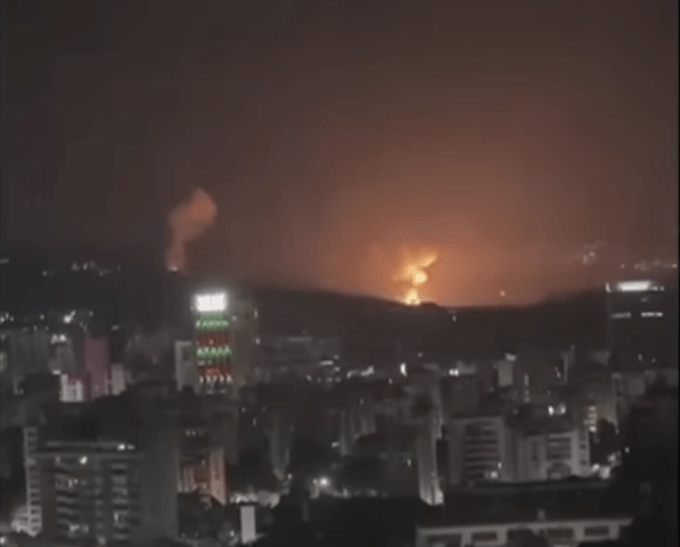
Airstrikes on Caracas, screengrab from video posted to X.
A little after 2am, Venezuela time, on 3 January 2026, in violation of Article 2 of the United Nations Charter, the United States began an attack on several sites in the country, including Caracas, the capital. Residents awoke to loud noises and flashes, as well as large helicopters in the sky. Videos began to appear on social media, but without much context. Confusion and rumor flooded social media.
Within an hour, the sky was quiet. US President Donald Trump announced that his forces had conducted attacks on Venezuela and had seized President Nicolas Maduro Moro and his wife Cilia Flores. A short while later, Venezuela’s Vice President Delcy Rodriquez confirmed that the whereabouts of Maduro and Flores are unknown. The US Attorney General Pamela Bondi confirmed that Maduro and Flores were in the United States and had been charged with ‘Narco-Terrorism Conspiracy’.
The outcome of this attack on Venezuela is unclear. The government remains in control, even with the President having been kidnapped and with the people of Venezuela in shock but defiant; it is unclear if the United States will strike again, or if the US government has a clear political plan for the aftermath of this strike.
The War Against Venezuela
The attack on 3 January is not the first against Venezuela. In fact, the pressure campaign began in 2001 when the government of Hugo Chávez enacted a Hydrocarbons Law in accordance with the sovereignty provisions in the Bolivarian Constitution of 1999. That campaign had the following aspects (this is an illustrative and not a comprehensive list):
+ (2001) US funding of anti-Bolivarian social and political groups through the National Endowment for Democracy and USAID.
+ (2002) US role in the attempted coup d’état.
+ (2002) Creation by USAID’s Office of Transition Initiatives of a Venezuela program.
+ (2003-2004) Funding and political direction for the work of Súmate (led by Maria Corina Machado) to recall Chávez by referendum.
+ (2004) Development of a 5-Point Strategy to ‘penetrate’ Chávez’s base, ‘divide’ Chavismo, ‘isolate’ Chávez, build up groups such as Súmate, and ‘protect vital US business interests’.
+ (2015) US President Barack Obama signs an executive order that declares Venezuela to be an ‘extraordinary threat’, which is the legal basis for the sanctions that follows.
+ (2017) Venezuela banned from access to US financial markets.
+ (2018) International banks and shipping companies pressured to over-comply with illegal US sanctions, while Bank of England seized the Venezuelan Central Bank gold reserves.
+ (2019) Create an ‘interim’ government by ‘appointing’ Juan Guaidó as the US authorized president and organize a (failed) uprising, and freeze Venezuela’s ability to sell oil as well as seize its oil assets overseas.
+ (2020) Attempt to kidnap Maduro through Operation Gideon (and by placing a bounty for his capture), while the US put a ‘maximum pressure’ campaign on Venezuela during the pandemic (including International Monetary Fund denial of Venezuela’s own reserves).
+ (2025) Gift of the Nobel Peace Prize to Maria Corina Machado with the Nobel Committee saying that Maduro should leave office.
+ (2025-2026) The attacks on small boats off the coast of Venezuela, the positioning of an armada to form an embargo of Venezuela, and the seizure of oil tankers from Venezuela.
The attack on 3 January is part of this war that began in 2001 and will continue long after the engines of the Chinook helicopters cool down.
The Eagle is Angry
When the United States government decides to act unilaterally, whether against Iraq in 2003 or Venezuela between 2001 and 2026, no other force has been able to stop it currently. In 2003, millions of people—including in the United States—marched on the streets to demand no war, and most governments in the world cautioned against the war, but the governments of George W. Bush and Tony Blair (of the United Kingdom, acting as his no. 2) went ahead with their illegal war. This time, major powers informed the United States that a war in South America and the Caribbean would be immensely destabilizing: this was the view of leaders who govern countries that neighbor Venezuela (Brazil and Colombia) and major powers such as China (whose special envoy—Qiu Xiaoqi—met with Maduro only hours before the US attack). Not only could the world not stop the US in 2003, but it has also been unable to stop the US between 2001 and now in its obsessive war for oil against Venezuela.
The attack on Venezuela was timed so that Trump could stand before the US houses of Congress on 4 January, when he will give his annual address, and claim that he has scored a major victory. This is not a victory. It is just another example of unilateralism that will not improve the situation in the world. The US illegal war on Iraq ended with the US forced to withdraw after a million civilians had been killed in a ruthless decade; the same transpired in Afghanistan and Libya—two countries ruined by the American Eagle.
It is impossible to imagine a different future for Venezuela if the United States continues with its bombing and sends ground troops into the country. No good comes from these ‘regime change wars’, and none will come here either. There is a reason why Brazil and Colombia are uneasy with this attack, because they know that the only outcome will be long-term destabilization in the entire northern half of South America, if not in the entire region of Latin America. This is precisely what has transpired in the northern half of Africa (Trump’s bombing of Nigeria is part of the detritus of the 2011 NATO bombing of Libya).
Trump will get his standing ovation at the US Congress, but the price for that has already been paid by hundreds of dead civilians in Venezuela and millions more who are struggling to survive the long-term hybrid war imposed by the United States on Venezuela for the past two decades.
This article was produced by Globetrotter.
With the Attack on Venezuela, Trump Has
Put the Death of International Law in Plain
Sight
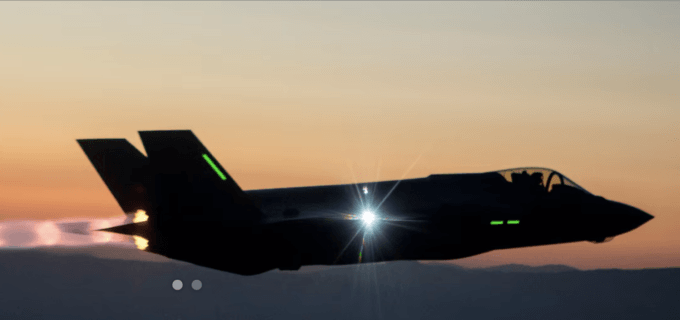
F-35 in flight. Photo: US Air Force.
What the United States is signaling in Venezuela is not merely a dispute over one government, one election, or one leader. It is a warning to the world that international law—already fragile, already selectively enforced—has now been openly pushed aside. And this warning comes from a man who presents himself as a global peacemaker, a would-be Nobel laureate, a self-styled dealmaker who claims to have “ended” nearly twenty wars that exist largely in his own imagination.
The contradiction is not incidental. It is the point.
Under Donald Trump, the United States has not merely returned to coercive foreign policy; it has hyper-normalised it. Practices once associated with rogue states—economic strangulation, collective punishment, political blacklisting—have been repackaged as routine tools of diplomacy. Sanctions are no longer instruments of last resort; they are weapons deployed reflexively, indiscriminately, and punitively.
European Union officials have been sanctioned for the offence of disagreement. International human rights advocates have seen their insurance canceled and their travel restricted after criticizing U.S. policy. Palestinian officials have been barred from entering the United States altogether. These are not measures aimed at resolving conflict or protecting civilians. They are warnings—meant to intimidate, isolate, and silence.
On the other hand, European NATO members are trapped in a relationship they refuse to name. Security is outsourced upward; responsibility is displaced outward. When Washington acts illegally, allies are expected to align—or at least not resist. This is not collective defence. It is asymmetric dependence.The has resulted is moral paralysis.
The threat to forcibly remove—or effectively kidnap—a foreign head of state crosses an even darker line. It is a clear violation of international law and the United Nations Charter, which explicitly prohibits the threat or use of force against the political independence of any state. Sovereignty is not a favour bestowed by Washington, nor is it conditional on ideological alignment. Yet the Trump administration has behaved as if these principles no longer exist, projecting a confidence born not of legitimacy, but of impunity. Just imagine Putin kidnapping Zelensky, or Xi Jinping snatching Lai Ching-te of Taiwan. What will the international community do then?
This impunity is reinforced at home. Trump has openly asserted that the U.S. War Powers Act is unconstitutional—a claim that may take years to resolve in American courts, if it is resolved at all. In the meantime, the institutional safeguards designed to restrain executive overreach have been steadily dismantled. Career diplomats sidelined. Inspectors general purged. Congress bypassed. The result is a presidency with extraordinary freedom to act first, escalate fast, and justify later—or simply dare the system to stop it.
The criminal charges levelled against Venezuela’s president, Nicolás Maduro, including allegations of large-scale drug trafficking, have been widely disputed by international legal experts. But even if they were not, the method matters. Unilateral indictments issued outside international courts, followed by sweeping sanctions that collapse entire economies, are not justice. They are punishment without trial. They are collective penalties imposed on civilian populations who have no power over the decisions being made in their name.
Hospitals lose medicine. Food systems collapse. Migration accelerates. And then the resulting humanitarian crisis is cited as proof that the targeted government has failed.
The consequences of this behaviour extend far beyond Venezuela. When the United States openly flouts international law, it does not merely weaken one norm—it hollows out the entire framework meant to restrain state violence. Russia’s invasion of Ukraine, Saudi Arabia’s devastation of Yemen and China’s growing pressure on Taiwan all unfold in a world where rules are applied selectively and enforcement depends on power, not principle.
In such a world, legality becomes a talking point, not a constraint.
Trump frequently invokes the language of peace, but his understanding of it is dangerously superficial. He confuses ceasefires with peace, dominance with stability, and submission with order. Starving economies, collapsing health systems, and political blackmail do not resolve conflict. They freeze it temporarily, radicalise it permanently, and export it elsewhere.
Cuba has lived under economic siege for more than six decades for refusing to submit to U.S. demands. Venezuela is now subjected to the same logic. Any state that resists risks financial isolation, diplomatic erasure, and economic suffocation. Only China currently possesses the scale and leverage to resist such pressure, a reality that should alarm U.S. allies rather than reassure them.
What happens to Ukraine—or to Europe—when American power itself is exercised without restraint? What does “rules-based order” mean when the chief architect of that order ignores its rules? Why has the international community failed to develop collective defences against coercion by its own supposed guarantor of stability?
History offers little comfort. U.S. intervention in Central and South America is not an aberration; it is a pattern. From the Monroe Doctrine onward, Latin America was treated less as a constellation of sovereign nations than as a zone of extraction and control. Nicaragua, Haiti, and the Dominican Republic endured prolonged occupation or domination. During the Cold War, Washington backed coups and military dictatorships in Chile, Brazil, Argentina, and beyond—crushing leftist movements, silencing civil society, and installing regimes that tortured, disappeared, and murdered their own citizens while American economic interests flourished.
Long before Vietnam or Iraq, the United States financed proxy militias, death squads, and covert operations across the region. The “dirty wars” of the 1970s and 1980s left tens of thousands dead and entire societies traumatised. Venezuela does not represent a departure from this history. It represents its continuation—updated for a sanctions-based age.
If the United States continues down this path, domestic unrest and international protest will be repurposed as pretexts for further confrontation—perhaps with Iran—deepening global instability and empowering hard-line actors everywhere. The lesson being taught is simple and corrosive: that might makes right, and law exists only when it is convenient.
International law survives only if the strong are willing to restrain themselves. The United States no longer even pretends to try. By discarding the very rules it helped create, it exposes the “rules-based order” as a fiction—useful only when it serves American interests, disposable the moment it does not. What follows is not peace, but global cynicism; not justice, but revenge politics; not security, but endless escalation. The world is being taught a brutal lesson: that law means nothing, and power means everything. The question facing the international community and the European Union and NATO is particular is no longer abstract. It is whether it will continue to live under American impunity—or finally say no.
Trump’s Venezuelan Coup: Criminal Attacks
by a Criminal Empire
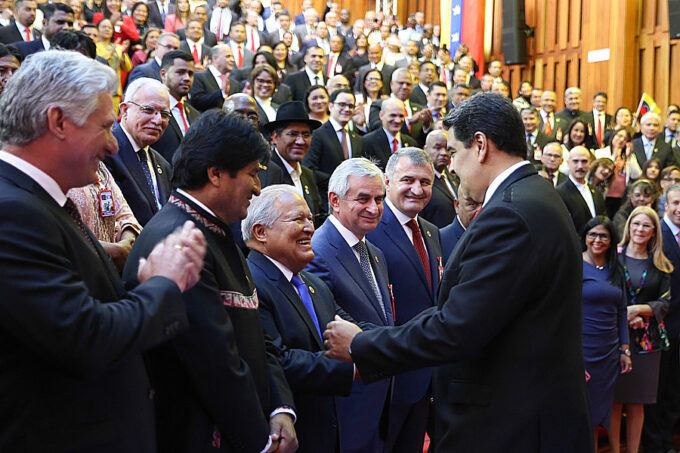
World leaders greet Maduro at Maduro’s second inauguration on 10 January 2019. Photo: Office of the President of El Salvador.
There is only one word to describe the US attacks on Venezuela. That word is criminal. It is the only word that describes the act of invading another nation and kidnapping its president. Of course, it is also a word that describes the essential nature of the US empire—an empire currently run by a band of psychopaths whose actions are only outdone by their equally psychotic comrades in Tel Aviv. Let’s be clear, Donald Trump may have pulled the trigger, so to speak, but Washington has been pointing a loaded gun at Venezuela since its people elected Hugo Chavez in 1998. By electing Chavez, the Venezuelan popular majority instituted a process that redistributed wealth inside the country, bringing popular education and free health care to the millions of Venezuelans previously denied these human rights–human rights which are under serious attack in the heart of the US empire as I write, by the way.
This attack, and any further military action by the US against Venezuela, must be opposed by those around the world who care about peace. If those who support a more peaceful version of the US Empire in the mainstream parties oppose this escalation, they should speak up in Congress, the media and in the streets. Those on the Left who disagree with Maduro for reasons real or manufactured by the consent organs of the Empire need to set those concerns aside and oppose these attacks. Folks whose concerns tend towards the concerns of family and their home should resolve to voice their opposition to a White House whose go-to solution is murder, war and repression. Already, those with loved ones in the US military—from the Air Force to the Air Guard, the Marines to the Coast Guard—have seen them sent to kill people in Venezuela, Iran, Palestine and the Caribbean (for starters).
Here in Vermont, where I live, the skies above my home no longer resound with the inhuman noise of the F-35s that are based five miles away; those planes and their crews are now involved in attacking Venezuelans just minding their own business. The basing of the planes in Vermont was supported by its entire Congressional delegation, including Bernie Sanders. The National Guard spokespeople and their hacks in the media called the planes’ deafening sound the “sound of freedom.” I can assure you, that’s not what the Venezuelans are calling that noise. The last seventy years of history makes it clear that the only freedom the US military brings is the freedom to exploit the country being invaded. The Empire’s “sound of freedom” is the sound of death and repression to those who bear the brunt of its bombs, its troops, and its economic strangulation.
Let’s be clear. Although it is the Trump White House that has launched this attack on Venezuela and apparently kidnapped its president, these actions are the result of an ongoing bipartisan assault on Venezuela. Bill Clinton began the attacks in 1998, mostly keeping his opposition to words and providing money to the wealthy comprador right-wing opposition in Venezuela. His wife, Hillary, accepted a million-dollar donation to her presidential campaign in 2015 from Gustavo Cisneros, a leading figure in Venezuela’s far-right politics. In 2002, the George W. Bush administration helped fund and plan a coup attempt that ultimately failed despite Washington’s immediate support for the coup plotters.
After Hugo Chavez died in 2013 and Maduro was elected, Barack Obama intensified the sanctions against the government in Caracas and in 2015, labeled Venezuela as a clear and present danger. Donald Trump continued the threats and sanctions against Venezuela, as did Joe Biden (although his administration did make a short-lived deal to purchase gas from the country). Meanwhile, Washington’s sanctions intensified the economic problems being experienced by the Venezuelan people. One might say the sanctions were the straw that broke the camel’s back.
Despite the hardships, Venezuela persevered, refocusing its efforts on organizing responses to the US offensive by working towards self-sufficiency. Trump pulled the trigger, but every administration that preceded his provided ammunition and paved the way for Trump’s illegal and immoral assault.
While the main focus of this short piece is the attacks on Venezuela, it is essential that we pay attention to what’s going on elsewhere in the world. Trump had the US military attack Nigeria on Christmas Day; he has once again threatened Iran and the US recently approved millions more dollars in arms shipments to Israel, which continues to murder Palestinians in Gaza and the West Bank, while also bombing Lebanon and Syria.
It’s been a long time since the world was so close to a global conflict. Indeed, it seems reasonable to say that the last time we stood so close to world war was when Hitler’s armies invaded its neighbors to the east. His actions were considered rash and dangerous when they happened. One can say the same about the actions of Donald Trump today.
Brazil’s President Lula condemns US
Bombing and Kidnapping in Venezuela

The following statement was made by President Lula on the morning of January 3, in response to the US government’s attack against Venezuela.
The bombings on Venezuelan territory and the capture of its president cross an unacceptable line. These acts represent an extremely serious affront to Venezuela’s sovereignty and yet another extremely dangerous precedent for the entire international community.
Attacking countries, in flagrant violation of international law, is the first step toward a world of violence, chaos, and instability, where the law of the strongest prevails over multilateralism.
The condemnation of the use of force is consistent with the position Brazil has always adopted in recent situations in other countries and regions.
This action recalls the worst moments of interference in the politics of Latin America and the Caribbean and threatens the preservation of the region as a zone of peace.
The international community, through the United Nations, must respond vigorously to this episode. Brazil condemns these actions and remains ready to promote the path of dialogue and cooperation.
This first appeared on De-Linking Brazil

No comments:
Post a Comment