WAIT, WHAT?!
Report: White House Draws Up List of Sanctions Relief Measures for Russia
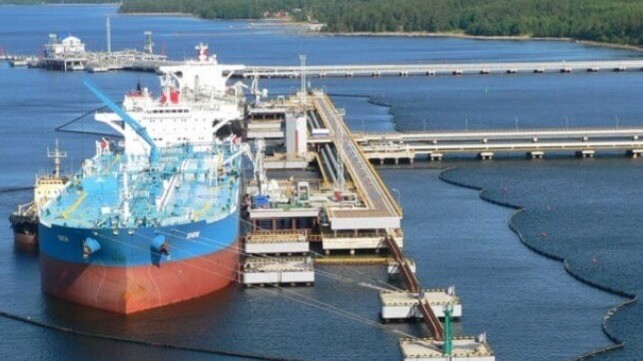
Just as the Biden administration's tanker sanctions are beginning to affect Russian oil exports, the Trump White House has begun looking at options to lift U.S. restrictions on Russian entities, according to Reuters. The State Department and Treasury Department have been asked to draft a list of measures for potentially easing stringent U.S. sanctions, which have been the most effective tools of economic persuasion that the West has deployed against Moscow.
The news aligns with a personal falling-out between President Donald Trump and Ukrainian President Volodymyr Zelensky, which burst into public view with a contentious news conference at the White House on Friday. After a heated exchange with Trump and Vice President JD Vance, Zelensky was asked to leave the building. Trump subsequently announced a suspension of all military aid to Ukraine, a profound blow for Ukraine's front-line forces.
Sources close to the White House told Reuters that the sanctions relief measures under consideration would be for individual Russian citizens and companies. Ukraine's government responded with a call for the White House to wait for more progress in peace talks, in order to maintain leverage to bring an end to the invasion. However, Russia has indicated that negotiations over Ukraine are only part of the discussion with the Trump administration: the bilateral talks also cover something else - "normalizing" relations between Moscow and Washington.
"Of course, if we are talking about normalizing bilateral relations, then [Russian interests] need to be freed from this negative burden of so-called sanctions," said Dmitri Petrov, spokesman for Russian President Vladimir Putin. "It is probably too early to talk about anything [being lifted] . . . we have not heard any official statements."
Current U.S. sanctions include significant restrictions on Russia's energy sector and its tankers. The previous administration's effort to target Russia-linked "shadow fleet" of aging tankers has forced Russian Urals exporters to drop their prices below $60 per barrel for the first time in more than a year, and tanker rates from Russian loading ports have soared.
Greek Tanker Owners Are Returning to the Russian Oil Trade
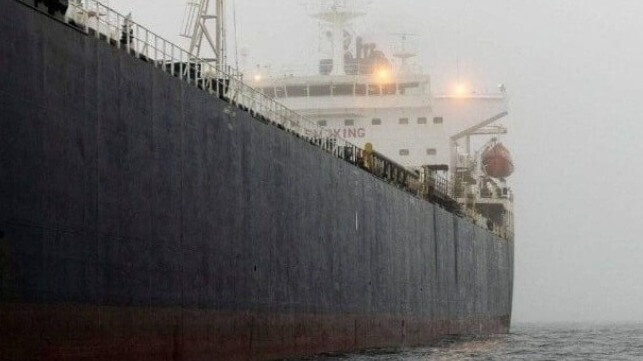
American sanctions have reduced Russia's ability to ship oil on lightly-regulated "shadow fleet" tankers, but Moscow is maintaining its fossil fuel export revenues at about $700 million per day, in part thanks to the renewed participation of Greek tanker owners. Greek owners have emerged as crucial players in keeping Russian crude flowing to global markets, particularly to India and Turkey, according to Vortexa.
"Preliminary February data is showing Russian crude volumes carried by Greek operators at a 12-month high," said Mary Melton, a senior freight analyst at Vortexa, in a new research note. "Russian crude exports to India and Turkey will need to be offered below the price cap so that Greek operators can facilitate these volumes."
Bloomberg confirms that Russian Urals crude is now trading below $60 per barrel, a deep discount to Brent - and enough of a discount to allow Western tankers to legally participate in Russian energy exports.
The need for a discount is clear. The U.S. Treasury Department sanctioned 183 Russia-linked vessels in January, targeting approximately one-third of Russia's "shadow fleet" — a collection of aging vessels that were purchased, renamed and reflagged in order to circumvent Western shipping restrictions. Until recently, that strategy has largely worked, allowing Russia to get around the $60 per barrel "price cap" imposed on Russian energy shipping by the G7 nations. Russian energy revenue has been stable since 2023, despite sanctions.
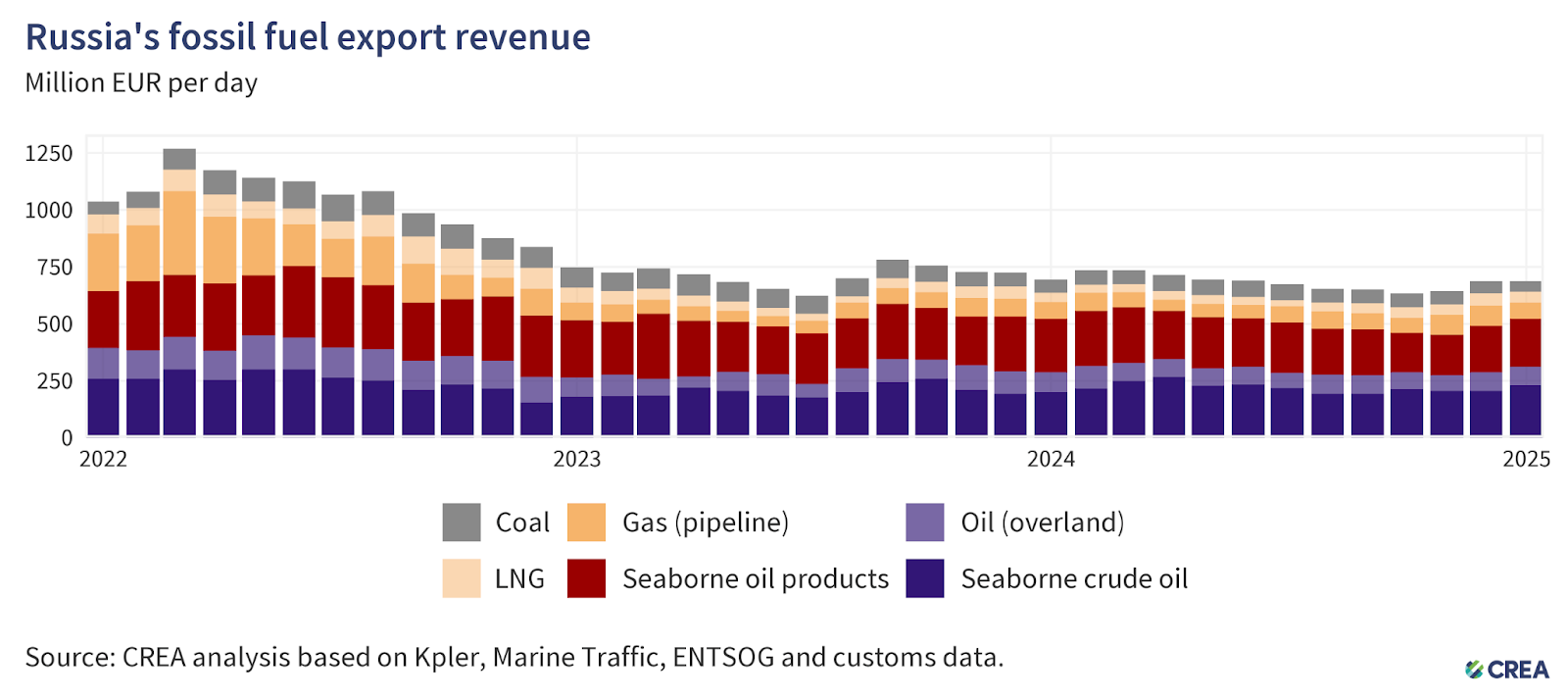
According to the Centre for Research on Energy and Clean Air (CREA), Russia's seaborne crude oil revenues surged by 13 percent in January compared to December, reaching $240 million daily. This suggests that Russia found ways to command higher prices despite the sanctions regime, according to the center's researchers. China is the country's largest buyer, and Russia has put particular emphasis on ensuring the continued flow of premium ESPO grade crude from the Russian Far East to China.
Shadow fleet tankers transported 84 percent of the total volume of Russian seaborne crude oil in January, according to CREA, but in February, above-board Greek operators had an increasing share. "These Greek-operated vessels have migrated out of mostly Atlantic Basin trade, especially in the Mediterranean," Vortexa's Melton noted. "This could lead to significant tightening in Atlantic Basin Aframax supply, and higher earnings for vessel operators in those regions.
Polish Researchers Detect Ship-Based GPS Jammers in Baltic Sea
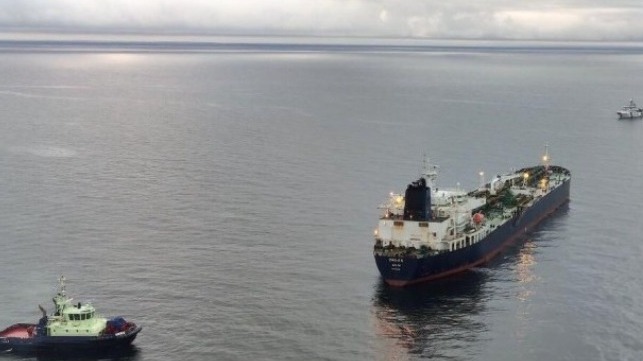
A study carried out by Polish GNSS researchers has determined that the GPS interference observed in the Baltic recently exhibits capabilities beyond commercial grade, and it appears to emanate from ships in transit - not from a fixed land-based source in Kaliningrad, as some analysts have speculated. If accurate, the apparent discovery of powerful ship-mounted transmitters would help explain the shifting pattern of GPS disruption in the region. It would also align with past reports of high-power radio equipment fitted aboard vessels in the Russian "shadow fleet."
The study monitored GPS disruption at ground level with a sensor installed at Gdynia Maritime University, 75 miles east of central Kaliningrad. It was mounted high enough for a line-of-sight radio horizon of about 20 nautical miles offshore (depending on transmitter antenna height). This is enough to reach out into the Gulf of Gdansk, but not far enough to cover the main east-west sea lanes of the central Baltic, where the vast majority of the region's traffic occurs.
Over a period of six months beginning in June 2024, the sensor picked up 84 hours of GNSS interference, including 29 hours in October alone. Events lasted for up to seven hours at a time, and caused horizontal positioning errors of up to 100 feet - enough to affect navigation in confined waterways.
Multi-constellation jamming (GPS, GLONASS, BeiDou and Galileo) was observed through September 2024; the pattern changed to multi-tone interference from October onwards. This interference "likely originated from a mobile maritime source, given its periodic occurrence and movement patterns," the researchers wrote.
The ground-level disruption affects maritime interests, and did not correlate with observations of ADS-B aircraft navigational system disruption at higher altitude. Since the ground-level GNSS events aren't detected by airborne ADS-B monitoring, the team called for setting up a terrestrial sensor network for GNSS disruption with geolocation capabilities, which would be used to spot the offending vessels and identify them for possible enforcement action.
"The interference . . . exhibited noticeable fluctuations in power levels, suggesting that the jamming source was in motion. Given the system's radio horizon, which primarily covers a portion of the Baltic Sea, and assuming that the interference source was not located within Poland’s borders, the most plausible explanation is that the jamming originated from a vessel in international waters," the researchers concluded.

No comments:
Post a Comment