EV
California Awards $15M Grant to Build Two Electric Ferries for San Diego
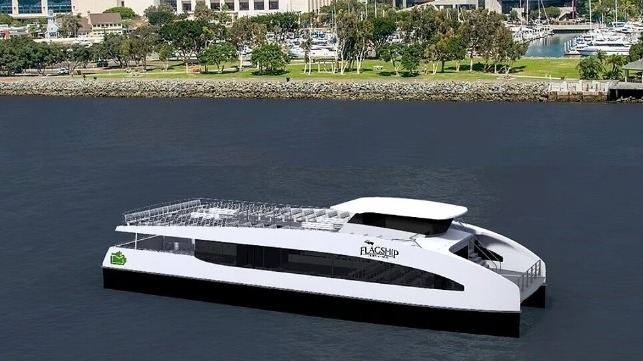
The California Air Resources Board has granted a dinner-cruise company a substantial award build two battery-electric ferries for service in San Diego. The ferries will reduce emissions from maritime transport, supporting the city's air pollution reduction goals.
The two new ferries will be built for Flagship Cruises and Events, the largest leisure-boat operator in San Diego. The firm has nearly a dozen passenger vessels of varying sizes, from charter yachts to dinner cruise vessels. The new ferries will operate on a route from downtown San Diego to Coronado, home of the West Coast's largest naval base.
The grant is a CARB Advanced Technology Demonstration and Pilot Project award, funded by the California Climate Investments program. The total project cost for the two ferries comes to about $21 million, and work should begin later this year. Delivery is slated for as early as Q3 2026.
“We are thrilled to partner with Flagship and the San Diego County Air Pollution Control District to deliver zero emission ferry services on San Diego Bay,” said Danielle Moore, chair of the Port of San Diego Board of Port Commissioners. “As a Port of progress anchored in people, we are committed to doing our part to improve public health and advance zero emission transportation."
CMA CGM Orders Electric Inland Container Barge for Nike Goods in Vietnam
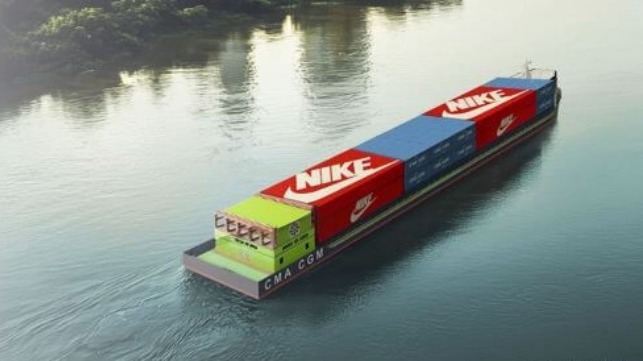
CMA CGM Group is moving forward with the project it announced in December 2024 to develop and operate fully electric container barges on inland routes in Vietnam. The group placed an order for the first barge to be built by China’s Shandong Xinneng Shipbuilding.
The group called the order an important step to promote green inland river operations in the Asian market. The first barge was co-designed by CMA CGM’s New Build and R&D teams in partnership with China’s CATL for the battery technology. They are also working with China’s Jining Energy Group for the energy system which will include a solar-powered recharging facility to be located at the Gemalink terminal in Cai Mep, Vietnam.
The plan calls for an 80-meter (262-foot) barge. It will have a capacity of approximately 180 TEU. It is designed to sail entirely on battery power between Bihn Duong Province inland in Vietnam and the Gemalink terminal, a route of approximately 180 kilometers (112 miles). Annually they project the barge will transport more than 50,000 TEU annually. The operation is projected to start in 2026 and Nike has previously announced it would be using the barge to transport its products made in Vietnam.
Shandong Xinneng Shipbuilding was developed starting in May 2022 as China’s first domestic inland new energy shipbuilder. With this order, the yard has an orderbook of 165 ships. They highlight a capacity to annually build 400 inland ships in the size range of 1,000 to 5,000 tons. The company started construction in October 2022 and trial production in October 2023.
Vietnam is seen as a fast-growing market as the country develops its manufacturing capabilities. CMA CGM highlights that it has been in Vietnam since 1989 and currently operates 29 weekly mainline services from seven ports in Vietnam. The group says the new inland solution is part of its long-term commitment and decarbonization ambitions, along with Vietnam’s goal of being carbon net zero by 2050. The goal of the electric barge operation is to also create a model that can be replicated in other markets.
Zero-Emissions Ports
Government grants are boosting the use of battery-electric technologies at U.S. ports and terminals.
(Article originally published in Nov/Dec 2024 edition.)
[By Tom Peters]
When the great scientific minds of Benjamin Franklin, Nikola Tesla and Michael Faraday started experimenting with electricity, it’s highly unlikely any of them saw their work as contributing to the logistics of moving marine cargo. But electrification, which has been key in the reefer world, is now becoming a priority in the employment of clean, green container-moving machines.
The Port of Los Angeles recently reached a milestone in its quest to become a zero-emissions (ZE) port by deploying the first commercially available, battery-powered electric cargo top handlers in the U.S. Top handlers are off-road vehicles used to load, unload and stack containers and resemble oversized forklifts.
The five electric Taylor ZLC 996 top handlers will replace diesel-powered equipment and are powered by a 650V, all-electric, battery-powered drive train capable of running two-full shifts under normal work cycles. They can be recharged with a five-hour boost using a 180W recharger.
Promoting the commercial use of ZE top handlers is one of many strategies underway at the port to boost the market for new emissions-free technologies.
Toward that end, the port received a $412 million grant from the U.S. Environmental Protection Agency (EPA) to support the deployment of 424 pieces of ZE cargo-handling equipment, 250 ZE drayage trucks and $50 million for community ZE initiatives. The EPA grant is being matched by an additional $236 million from the port and private sector partners.
Electrification Technologies
The Port of San Diego has a solid footing in reefer cargo through its long-time relationship with Dole Fresh Fruit and handled 76,869 FEUs (40-foot equivalent units) of reefer cargo in 2023.
Dole is the port’s primary reefer importer, mainly bananas and pineapples, and it’s the anchor tenant at the Tenth Avenue Marine Terminal. Dole is the largest importer of bananas and the second largest importer of pineapples to North America. Most vessels operate on a three-week tour that call on ports in Ecuador, Costa Rica and Guatemala.
Dole has followed the electrification trend and was the first importer on the West Coast to use battery electric utility tractor rigs (UTRs) for cargo handling. Dole currently has seven electric UTRs with plans to convert its remaining 10 diesel UTRs to electric and add one more electric UTR for a total of 18.
“Dole is a long-time and valued Port of San Diego tenant that has been an early adopter of electrification technologies and supporter of our accelerated efforts to significantly reduce harmful air emissions,” said Michael LaFleur, Vice President of Maritime.
The port was recently awarded a $59 million grant from the EPA to support an $86 million project for remaining improvements to the Tenth Avenue Marine Terminal’s (TAMT) legacy 12-kilovolt electrical distribution system. It will also advance a proposed ZE truck stop and purchase and deploy battery electric ZE equipment, vehicles and charging infrastructure.
Infrastructure Upgrades
The Port of New York and New Jersey is the East Coast’s busiest container port, handling 7.8 million TEUs (twenty-foot-equivalent units) in 2023 and up 14 percent over that number through September of this year.
Logistically, it’s making changes to improve cargo flow.
The ongoing Port Street Corridor Improvement Project is modernizing a main interchange in the Port Newark-Elizabeth complex, leading to safer and more efficient operations as well as significant time savings for truckers.
Earlier this year, the port and the U.S. Army Corps of Engineers outlined a package of significant investments including more resources for maintenance dredging and berth rehabilitation and additional funding to advance planning for deepening the harbor channel from 50 to 55 feet.
In October, Port Liberty Bayonne took delivery of four, new ship-to-shore (STS) gantry cranes that are now the largest in the port. APM Terminals expects to receive more new STS cranes in a few months. All new cranes will be operational in the first half of 2025.
Intermodally, the port will ramp up work on the Southbound Connector Project, allowing for more efficient freight-rail movement through its on-dock express rail system. The Southbound Connector will expedite train movement and expand the system’s capacity.
With the awarding of a $347 million EPA grant, the port expects to see several new pieces of ZE cargo-handling equipment come online and four new electric truck chargers to be operational at the Port Newark Truck Welcome Center.
“Our goal this year has been to continue setting the industry standard for efficiency and reliability while laying the foundation for a future that accommodates growing cargo demands through more environmentally friendly operations,” stated Port Director Bethann Rooney. “Through strategic investments in our infrastructure, strong collaboration with our government and private sector partners and a historic federal grant enabling us to make significant progress on our sustainability efforts, the East Coast’s busiest seaport is well-positioned to continue serving as a linchpin for the regional and national economy well into the future.”
Port Tampa Bay’s Omniport Project received a funding boost with a $22 million grant from the U.S. Department of Transportation for multimodal freight and highway projects. Omniport, one of Tampa Bay's newest port complexes, will create a deepwater berth capable of supporting a variety of cargoes.
Together with container terminal operator Ports America, Port Tampa Bay is making significant investments to expand capacity and improve cargo flow with the addition of three STS gantry cranes for a total of five and plans to acquire two more.
Adding to the improved logistics of cargo movement, an expanded, state-of-the-art gate complex is now open. Additional paved storage space is under development that will bring the container terminal’s footprint to 100 acres. Construction will soon begin on an on-dock, rail-served transload warehouse.
Paul Anderson, Port Tampa Bay CEO & President, said the East Port Omniport Project will create nearly 1,700 new jobs in the first year of operation and generate nearly $100 million in business revenue, state and local taxes and local purchases.
Down South
“Port Pascagoula is embracing an exciting new era of progress with the completion of a master plan that will shape the port’s future growth and strengthen our position as a vital shipping gateway on the Gulf Coast,” says Port Director Bo Ethridge. “This strategic plan focuses on enhancing infrastructure, optimizing operations and paving the way for long-term expansion.”
Key intermodal initiatives at the Mississippi bulk port include restoring and expanding over 3,000 feet of rail at the West Bank terminal, ensuring seamless, multimodal connectivity for customers and increasing warehouse and storage capacity at both the Pascagoula River and Bayou Casotte harbors.
Future projects include the construction of a 45,000-square-foot rail cargo-handling facility and the development of a 6.4-acre storage and staging yard to support the growing number of heavy lift and breakbulk shipments at South Terminal, one of the highest-rated docks on the Gulf Coast with a capacity of 4,000 lbs. per square foot.
Port Pascagoula is currently ranked 27th in the U.S. in total gross tonnage with 32 million tons of cargo annually.
Delivering the Goods
Coincidentally, container ports are not alone in making ocean cargo movement smoother, safer and more efficient. Container lines also protect cargo as it moves through the supply chain.
Atlantic Container Line (ACL) is a prime example of how a ship’s infrastructure can provide a safe logistical environment for containers.
ACL operates the world’s largest combination ro-ro/container ships to and from Europe and North America. Its unique, steel cell guide-racking system allows ACL to protect containers from rough seas and is key to extending the company’s record of never losing a container overboard in over 40 years of operation.
Ports columnist Tom Peters writes from Halifax, Nova Scotia.
The opinions expressed herein are the author's and not necessarily those of The Maritime Executive.

No comments:
Post a Comment