By Micah McCartney
China News Reporter
 Newsweek Is A Trust Project Member
China's top two shipbuilders are finalizing a merger that began in 2019, creating the world's biggest shipbuilding company.
The $16 billion deal is expected to further widen China's lead over the United States, as President Donald Trump pushes to revive the nation's stagnant shipbuilding industry.
Why It Matters
China has vaulted to the forefront of global shipbuilding over the past two decades. The country's largest state-owned shipbuilder, China State Shipbuilding (CSSC), delivered more commercial vessels by tonnage in 2024 than the entire U.S. shipbuilding industry has produced since the end of World War II, according to Washington, D.C., think tank the Center for Strategic and International Studies.
China's shipbuilding capacity also increasingly extends to sea power. The People's Liberation Army Navy now boasts the world's largest fleet by hull count and is producing nearly three ships for every one launched by the U.S. Navy, according to Admiral Samuel Paparo, head of the Indo-Pacific Command.
This week, the CSSC is absorbing the country's second-largest shipbuilder, China Shipbuilding Industry Corporation, with trading in both companies' shares suspended on Tuesday.
Together, the two companies accounted for nearly 17 percent of the global market in 2024, according to data on new orders from maritime analysis firm Clarksons Research.
Originally part of the same organization, the two firms were split in 1999 under Chinese Communist Party reforms aimed at introducing limited competition among state-owned enterprises
Beijing hopes the merger will reduce costs and cushion the blow of U.S. trade actions.
State media have hailed the deal as a step to eliminate inefficiencies, optimize resource allocation, and strengthen China's prospects in the global shipbuilding market amid geopolitical tensions and competition from competitors such as South Korea and Japan.
"In recent years, the U.S. has launched crackdowns against China's shipbuilding industry, such as the so-called Section 301 action targeting China's maritime, logistics, and shipbuilding sectors, and the port fee plan," said the Global Times.
This Trump administration has begun phasing in new port fees on Chinese vessels, claiming unfair trade practices and state subsidies.
These measures appear to be having an effect. According to global trade association the Baltic and International Maritime Council, China's share of new shipbuilding orders declined to 52 percent from 72 percent in the first half of this year.
What People Are Saying
Anna Kelly, White House deputy press secretary, told Newsweek: "American shipbuilding was neglected for decades under failed presidents like Joe Biden, but President Trump is prioritizing this vital industry to strengthen our country's economic and national security— including by securing a historic $43 billion shipbuilding investment in The One, Big, Beautiful Bill."
Tom Shugart, an adjunct senior fellow at the Center for a New American Security, told Newsweek: "China's already massive shipbuilding capacity remains under a single, state-controlled enterprise.
"That scale, coupled with the integration of military and commercial production, will remain a central enabler of China's naval expansion—and a key factor in the eroding U.S.–China maritime balance."
Xu Yi, an analyst at Shanghai-based risk management firm Haitong Futures, told the South China Morning Post: "This merger marks the largest strategic restructuring in China's shipbuilding history, aimed at optimizing resource allocation and enhancing competitiveness in the global market."
President Donald Trump said in his March 6 address to Congress: "We used to make so many ships. We don't make them anymore very much, but we're going to make them very fast, very soon. It will have a huge impact."
What Happens Next
Trump has pledged to "resurrect" both commercial and military shipbuilding in the United States, lamenting that only 0.2 percent of the world's ships are built domestically compared with nearly three-quarters in China.
CSSC and CSIC Pause Trading a Shipbuilding Mega-Merger Nears Finale
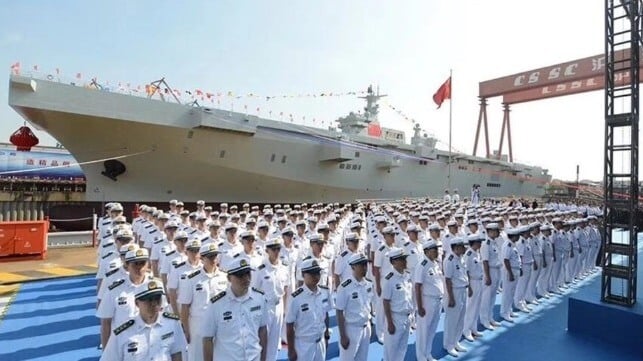
China's two state shipbuilding giants are moving ahead with the maritime mega-merger of the century. CSSC and CSIC, once one entity, have halted trading in their respective shares in anticipation of becoming one combined company, CSSC.
The much-anticipated merger has been a long time developing, and it brings CSSC full-circle. The company spun off CSIC as a separate entity in 1999, giving the newly-formed firm control of government-owned yards in northern China and creating new competition in the domestic industry. CSIC's assets include Dalian Shipyard, Bohai Shipyard, Wuchang Shipyard and a wide variety of associated support infrastructure. Its yards hold a large share of the giant PLA Navy warship construction portfolio, as well as a full docket of commercial orders.
CSIC came under the CSSC umbrella in 2019, but it retained its separate management structure and its constellation of design, R&D, administration and supply-chain departments. This duplicated many of the same costs and functionalities found within CSSC, preventing the combined entity from realizing savings from the re-merger.
In September 2024, CSSC announced that it would be consolidating the two groups' giant corporate structures into a single entity. Anticipated gains include cost savings, better coordination on supply ordering and production sequencing, strengthened defense shipbuilding, and reduced competition.
To re-merge, CSSC will swap shares with CSIL shareholders in the largest absorption merger ever conducted in China's A-share listed market. CSIC will be incorporated into CSSC and will disappear as a separate brand, and CSSC will become the world's largest unified shipbuilding company by assets and revenue (it was already the world's largest shipbuilding group).
As of the end of 2024, Chinese yards held more than 60 percent of the world's shipbuilding orders, with CSSC/CSIC accounting for the largest share.
Yangzijiang Shipbuilding Posts Record Profit
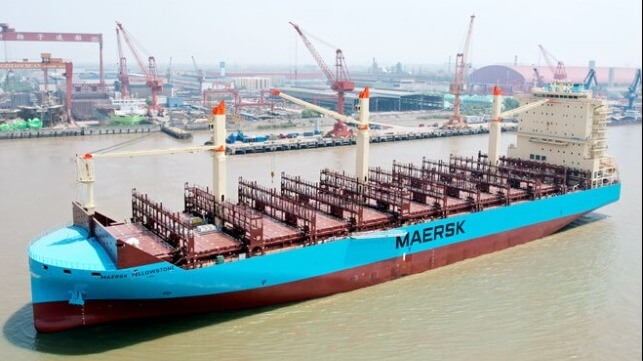
China's shipbuilding industry has grown by leaps and bounds over the last year, and so have its profits. Last week, privately-held Yangzijiang Shipbuilding reported a record-setting profit of $580 million in the first half, up by 37 percent year-on-year.
Yangzijiang is China's largest private shipbuilder, and a bellwether for its commercial shipbuilding industry. The yard's revenue was slightly down in the first half, due to a lower share of container ships in its mix of projects during the period. This was offset in part by a higher share of dual-fuel orders in its boxship portfolio, since the technology is more expensive and yields better margins for the shipbuilder. Dual-fuel vessel orders account for about three-quarters of the yard's orderbook.
In addition to performance at its own yards, profits were driven in part by operations at two Japanese joint ventures, Zhoushan Tsuneishi Shipbuilding and Yangzi Mitsui Shipbuilding, which contributed a combined $67 million in profits.
New orders are coming in a bit more slowly than expected this year, Yangzijiang reported. The shipbuilder received just 14 new orders worth a combined $540 million in the first half, less than a tenth of its full-year order target for 2025. However, the full-year outlook is still good, as it is holding more than $2 billion worth of letters of intent for more orders, according to ratings agency CGS International.
This is not an immediate issue - Yangzijiang has a backlog of 236 ships worth a combined $23 billion on order, near a record high, giving it a long runway in almost any market - but the slowdown is a change compared to last year's ordering boom. The Trump administration's planned port fees on Chinese-built ships (as proposed by the U.S. Office of the Trade Representative) is giving shipowners a reason to look at alternative shipbuilders outside of China; at the same time, tariff concerns have prompted some owners to rethink their ordering plans or wait for more clarity.
Yangzijiang broke ground on a wholly new shipyard, Yangzi Hongyuan, in February 2025. However, it has shelved a plan for a greenfield expansion yard, Jiangsu Yangzi Runze Shipbuilding, which was to be located next to the existing Yangzi Mitsui Shipbuilding JV facility, according to CGS International's latest advisory. The pause is among the few signs of any letup in the relentless growth of Chinese shipbuilding. Since 2023, the strong demand for Chinese-built ships has driven a wave of restarts at yards that were shuttered during the shipbuilding downturn of the 2010s, reviving old names under new ownership.

No comments:
Post a Comment