It’s possible that I shall make an ass of myself. But in that case one can always get out of it with a little dialectic. I have, of course, so worded my proposition as to be right either way (K.Marx, Letter to F.Engels on the Indian Mutiny)
Thursday, August 14, 2025
‘Revolutionary’ seafloor fiber sensing reveals how falling ice drives glacial retreat in Greenland
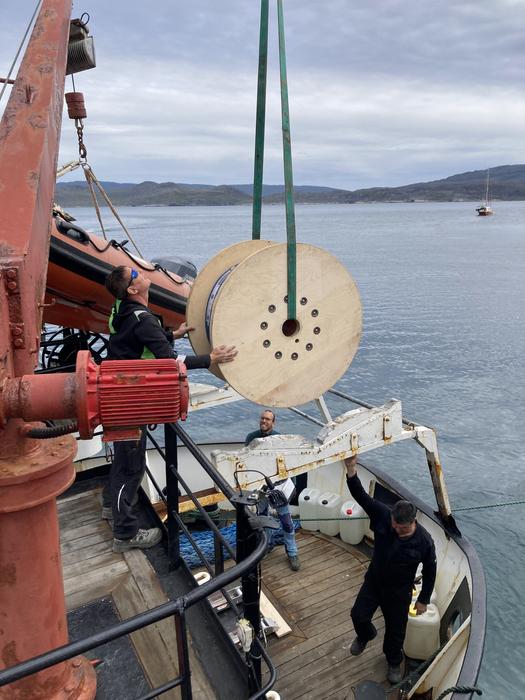
Dominik Gräff, a University of Washington postdoctoral researcher in Earth and space sciences (pictured in the center), and two crew members load the fiber optic cable, spooled around a large drum, onto the back of the research vessel Adolf Jensen.
As glaciers melt, huge chunks of ice break free and splash into the sea, generating tsunami-size waves and leaving behind a powerful wake as they drift away. This process, called calving, is important for researchers to understand. But the front of a glacier is a dangerous place for data collection.
To solve this problem, a team of researchers from the University of Washington and collaborating institutions used a fiber-optic cable to capture calving dynamics across the fjord of the Eqalorutsit Kangilliit Sermiat glacier in South Greenland. Data collected from the cable allowed them to document — without getting too close — one of the key processes that is accelerating the rate of glacial mass loss and in turn, threatening the stability of ice sheets, with consequences for global ocean currents and local ecosystems.
“We took the fiber to a glacier, and we measured this crazy calving multiplier effect that we never could have seen with simpler technology,” said co-author Brad Lipovsky, a UW assistant professor in Earth and space sciences. “It’s the kind of thing we’ve just never been able to quantify before.”
The data provides, for the first time, a deeper look at the relationship between ice and the water it collapses into, from surface waves to disturbances within the water column.
The Greenland ice sheet — a frozen cap about three times bigger than Texas — is shrinking. Scientists have documented its retreat for the past 27 years as they scramble to understand the consequences of continued mass loss. If the Greenland ice sheet were to melt, it would release enough water to raise global sea levels by about 25 feet, inundating coastlines and displacing millions of people.
Researchers also speculate that ice loss is weakening a global current system that controls the climate and nutrient distribution by circulating water between northern and southern regions, called the Atlantic meridional overturning circulation.
“Our whole Earth system depends, at least in part, on these ice sheets,” said lead author Dominik Gräff, a postdoctoral researcher in Earth and space sciences. “It’s a fragile system, and if you disturb it even just a little bit, it could collapse. We need to understand the turning points, and this requires deep, process-based knowledge of glacial mass loss.”
For the researchers, that meant taking a field trip to South Greenland — where the Greenland ice sheet meets the Atlantic Ocean — to deploy the fiber-optic cable. In the past decade, researchers have been exploring how these cables can be used for remote data collection through technology called Distributed Acoustic Sensing, or DAS, that records ground motion based on cable strain. Before this study, no one had attempted to record glacial calving with a submarine DAS cable.
“We didn’t know if this was going to work,” said Lipovsky. “But now we have data to support something that was just an idea before.”
Researchers dropped a 10-kilometer cable from a boat near the mouth of the glacier. They connected it to a small receiver and collected ground motion data and temperature readings along the length of the cable for three weeks.
The backscatter pattern from photons passing through the cable gave researchers a window beneath the surface. They were able to make nuanced observations about the enormous chunks of ice speeding past their boat. Some of which, said Lipovsky, were the size of a football stadium and humming along at 15 to 20 miles per hour.
Glaciers are huge, and most of their mass sits below the surface of the water, where ice melts faster. As warm water eats away at the base, the glacier becomes top-heavy. During a calving event, chunks of the overhanging portion break off, forming icebergs. Calving can be gradual, but every so often, the glacier heaves a colossal chunk of ice seaward. The researchers witnessed a large event every few hours while conducting their field work.
“When icebergs break off, they excite all sorts of waves,” said Gräff.
Following the initial impact, surface waves — called calving-induced tsunamis — surged through the fjord. This stirs the upper water column, which is stratified. Seawater is warmer and heavier than glacial melt and thus settles at the bottom. But long after the splash, when the surface had stilled, researchers observed other waves, called internal gravity waves, propagating between density layers.
Although these underwater waves were not visible from the surface, the researchers recorded internal waves as tall as skyscrapers rocking the fjord. The slower, more sustained motion created by these waves prolonged water mixing, bringing a steady supply of warmer water to the surface while driving cold water down to the fjord bottom.
Gräff compared this process to ice cubes melting in a warm drink. If you don’t stir the drink, a cool layer of water forms around the ice cube, insulating it from the warmer liquid. But if you stir, that layer is disrupted, and the ice melts much faster. In the fjord, researchers hypothesized that waves, from calving, were disrupting the glacier’s boundary layer and speeding up underwater melt.
Researchers also observed disruptive internal gravity waves emanating from the icebergs as they moved across the fjord. This type of wave is not new, but documenting them at this scale is. Previous work relied on site specific measurements from ocean bottom sensors, which capture just a snapshot of the fjord, and temperature readings from vertical thermometers. The data could help improve forecasting models and support early warning systems for calving-induced tsunamis.
“There is a fiber-sensing revolution going on right now,” said Lipovsky. “It’s become much more accessible in the past decade, and we can use this technology in these amazing settings.”
This research was funded by the U.S. National Science Foundation, the University of Washington's FiberLab, the Murdock Charitable Trust, the Swiss Polar Institute, the University of Zurich, ETH Zurich, and the German Research Center for Geosciences GFZ.
For more information, contact Dominik Gräff at graeffd@uw.edu.
Calving-driven fjord dynamics resolved by seafloor fibre sensing
Article Publication Date
13-Aug-2025
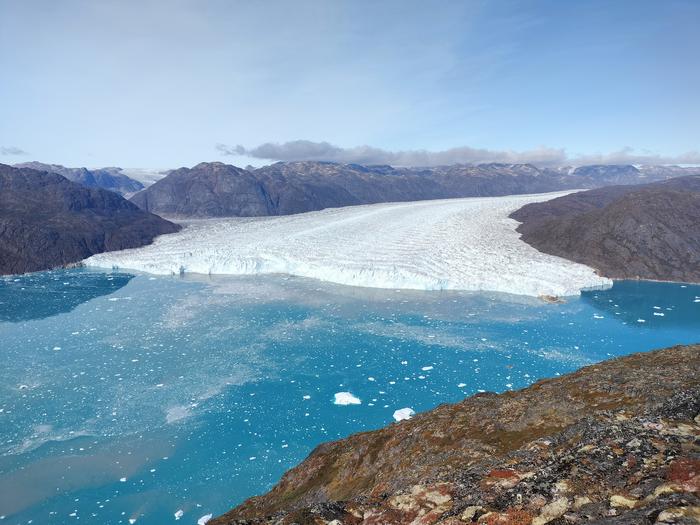
The calving front of Eqalorutsit Kangilliit Sermiat in South Greenland. Researchers deployed the fiber optic cable several hundred meters from the glacier’s mouth.
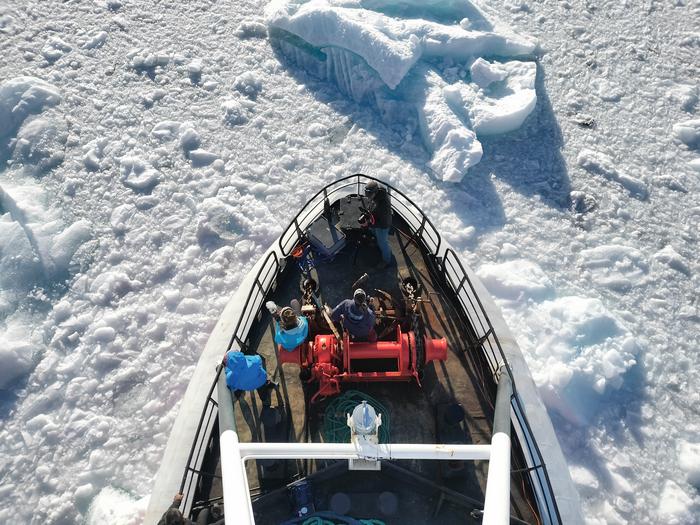
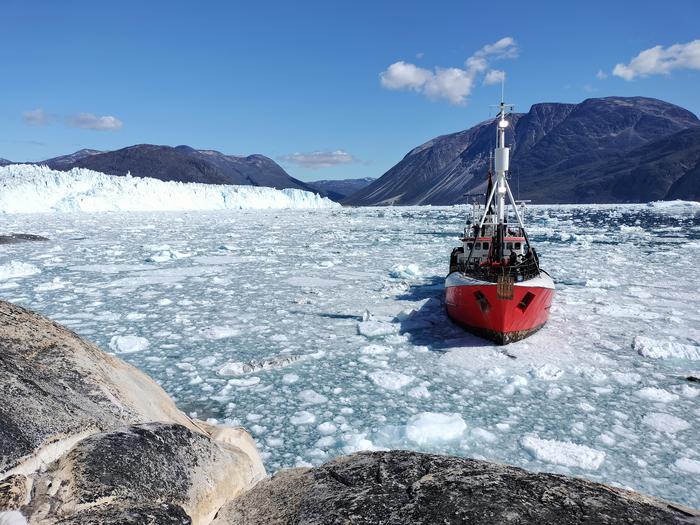
The bow of the field crew's research vessel Adolf Jensen cutting through the ice of the fjord.
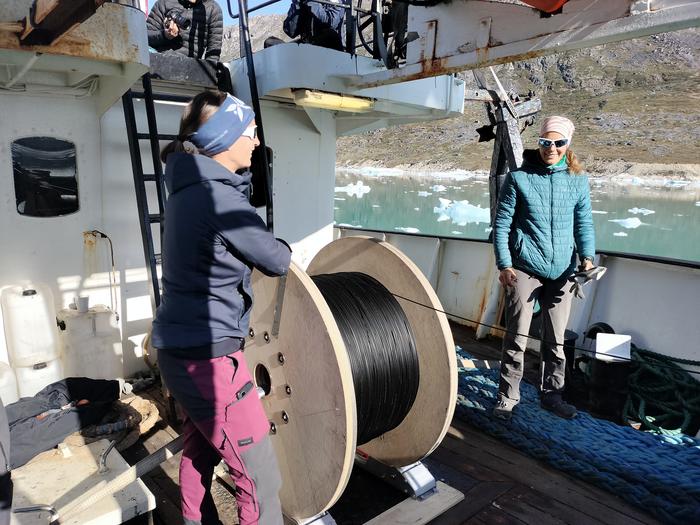
ulia Schmale, an assistant professor at École Polytechnique Fédérale de Lausanne (left), and Manuela Köpfli, a University of Washington graduate student in Earth and space science (right) unspool the fiber optic cable from a large drum, sending it down to the fjord-bottom to record data.
The field crew’s research vessel, Adolf Jensen, sitting in the fjord during the fiber-optic cable deployment. The calving front is pictured to the left of the ship.
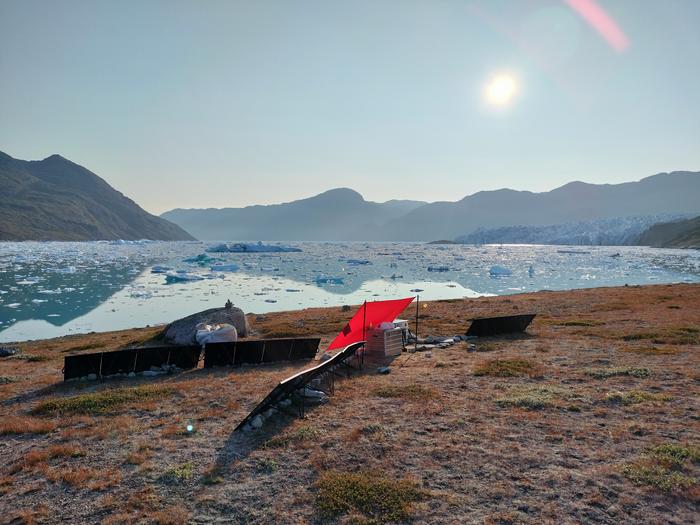
On the shore of the fjord in Greenland, the equipment that records signals from the fiber optic cables recharges with solar panels.
Credit
Dominik Gräff/University of Washington
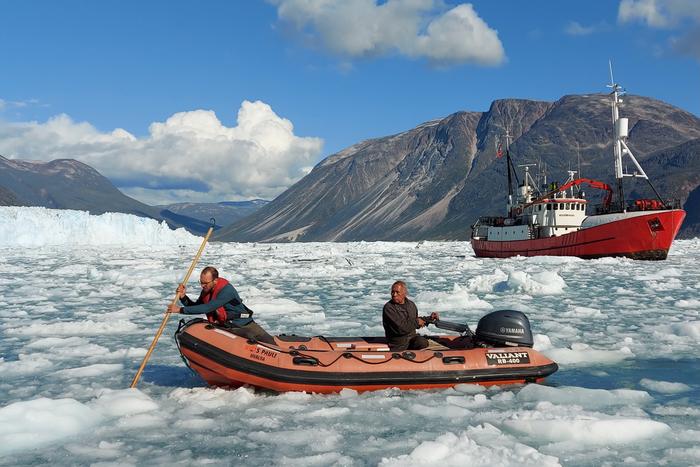
University of Washington researcher Dominik Gräff (pictured on the left) and a crew member head for shore on a Zodiak boat. The research vessel Adolf Jensen floats on the fjord’s icy surface in the background and the calving front is visible on the left.
Blick auf den Fjord und die drei Kilometer breite Kalbungsfront des Eqalorutsit Kangilliit Sermiat in Südgrönland. Das Glasfaserkabel wurde einige hundert Meter von der Eiswand entfernt durch das 300 Meter tiefe Wasser auf dem Meeresgrund verlegt. Im Vordergrund ist das Radargerät der UZH zu sehen, das Kalbungsereignisse und Eisbewegungen misst, um die Daten des Glasfaserkabels zu interpretieren.
Iceberg calving occurs when masses of ice break away from the edge of glaciers and crash into the ocean. This process is one of the major drivers of the rapid mass loss currently affecting the Greenland ice sheet. An international research team led by the University of Zurich (UZH) and the University of Washington (UW) has now used fiber-optic technology to measure for the first time how the impact of falling ice and its subsequent drift is driving the mixing of glacial melt with warmer subsurface seawater.
“The warmer water increases seawater-induced melt erosion and eats away at the base of the vertical wall of ice at the glacier’s edge. This, in turn, amplifies glacier calving and the associated mass loss from ice sheets,” says Andreas Vieli, a professor at UZH’s Department of Geography and co-author of the study. Vieli heads the Cryosphere cluster, one of six clusters in the interdisciplinary GreenFjord project in southern Greenland, supported by the Swiss Polar Institute. These new insights into the dynamics of glacier ice and seawater are featured on the cover of the latest issue of Nature.
Wave measurements using fiber-optic cable on seafloorAs part of the GreenFjord project, UZH and UW were joined by other Swiss institutions to conduct an extensive field study into the dynamics of glacier calving. The researchers deployed a ten-kilometer-long fiber-optic cable onto the seafloor across the fjord of the Eqalorutsit Kangilliit Sermiat glacier. This large, fast-flowing glacier in South Greenland releases around 3.6 km3 of ice into the sea every year – almost three times the volume of the Rhône glacier at the Furka mountain pass in Switzerland.
The researchers used a technology called Distributed Acoustic Sensing (DAS), which detects ground motion by monitoring cable strain caused by crevasses forming in the ice, falling ice blocks, ocean waves or changes in temperature. “This enables us to measure the many different types of waves that are generated after icebergs break off,” says lead author Dominik Gräff, a UW postdoctoral researcher affiliated with ETH Zurich.
Underwater waves amplify glacier melt and erosionFollowing the initial impact, surface waves, known as calving-induced tsunamis, surge through the fjord, initially mixing the upper layers of water. As seawater in Greenland’s fjords is warmer and denser than glacial meltwater, it sinks to the bottom.
But the researchers also observed other waves propagating between density layers long after the splash, when the surface had stilled. These underwater waves, which can be as tall as skyscrapers, are not visible from the surface but prolong water mixing, bringing a steady supply of warmer water to the surface. This process increases melting and erosion at the glacier’s edge and drives ice calving. “The fiber-optic cable allowed us to measure this incredible calving multiplier effect, which wasn’t possible before,” says Gräff. The data collected will help document iceberg calving processes and improve our understanding of the accelerating loss of ice sheets.
A fragile and threatened system
Scientists have long recognized the significance of seawater and calving dynamics. However, measuring the relevant processes on site presents considerable challenges, since the vast number of icebergs along the fjords poses a constant risk from falling chunks of ice. In addition, conventional remote sensing methods based on satellites cannot penetrate below the water’s surface, where interactions between glaciers and seawater take place. “Our previous measurements have often merely scratched the surface, so a new approach was needed,” says Andreas Vieli.
The Greenland ice sheet is a vast body of ice that covers an area roughly 40 times the size of Switzerland. If it were to melt, it would release enough water to raise global sea levels by approximately seven meters. The substantial meltwater volumes released by retreating glaciers can weaken ocean currents such as the Gulf Stream, with far-reaching consequences for Europe’s climate. In addition, the loss of these calving glaciers also affects the local ecosystem of Greenland’s fjords. “Our entire Earth system depends, at least in part, on these ice sheets. It’s a fragile system that could collapse if temperatures rise too high,” warns Dominik Gräff.
Literature
Dominik Gräff et al. Calving-driven fjord dynamics resolved by seafloor fibre sensing. Nature. 13 August 2025 DOI: 10.1038/s41586-025-09347-7
GreenFjord project
Prof. Dr. Julia Schmale (GreenFjord project leader)

No comments:
Post a Comment