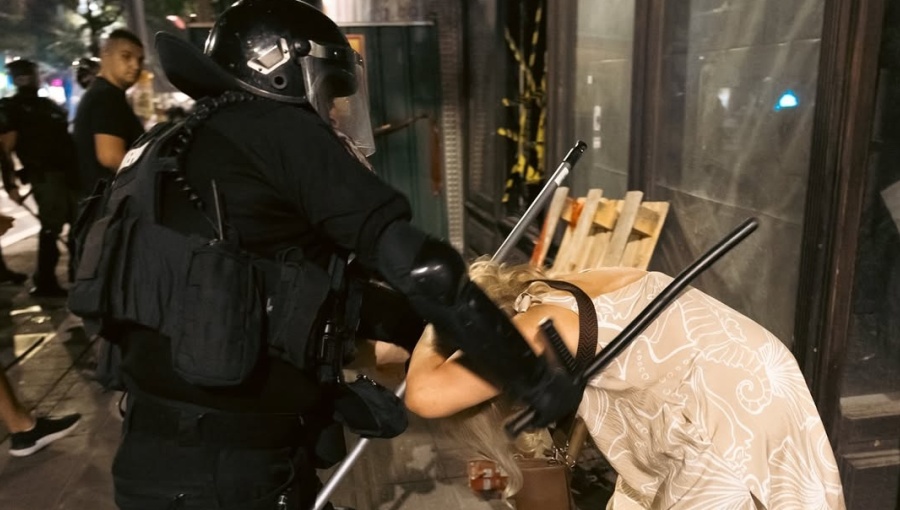
Clashes erupted across Serbia for a second consecutive night on August 13, as anti-government demonstrators and supporters of the ruling Serbian Progressive Party (SNS) confronted one another in several cities, deepening a political crisis that has simmered for months.
The unrest follows more than nine months of largely peaceful protests against President Aleksandar Vucic and his administration, with tensions boiling over after violence broke out between government loyalists and protesters in the northern towns of Vrbas and Backa Palanka late on August 12.
Student-led demonstrations, under the banner “Serbia, Wake Up”, were held in over 30 towns and cities on August 13-14, including Belgrade, Novi Sad, Nis and Kragujevac. Organisers are calling for an end to police violence and early parliamentary elections.
In Novi Sad, Serbia’s second-largest city, the situation quickly escalated when SNS supporters launched fireworks and flares at demonstrators outside party headquarters. Protesters responded by smashing windows and confronting riot police, who deployed tear gas to disperse the crowd.
The Ministry of Defence said that seven members of the Serbian Armed Forces were injured in the clashes, four of them seriously. Lieutenant General Duro Jovanic, head of the Military Security Agency, said the soldiers were caught in the unrest while attempting to manage the situation.
Interior Minister Ivica Dacic said that an armed man pictured at the scene, later identified as Serbian Army ensign Vladimir Brkusanin, was acting in an official capacity by holding his gun in the air. Dacic denied accusations that SNS supporters had drawn weapons, stating that the soldier was protecting a “designated person” and had used his service pistol lawfully.
Violence also flared in Belgrade, where riot police deployed tear gas and attempted to contain demonstrators near SNS offices in New Belgrade. Protesters clashed with officers, some throwing objects and pushing past police lines. N1 television reported that officers were occasionally forced to retreat.
Journalists covering the protests were also injured. Nikola Bilic of Novi Sad’s 192 portal was beaten, while Razglas reporter Zarko Bogosavljevic was struck in the head with a baton.
Footage shared on social media showed Andrej Vucic, the president’s brother, leading a group of SNS activists through Pioneers’ Park in central Belgrade. The park has become a symbol of the contra-protest movement, hosting a tent encampment maintained by party supporters.
Opposition figures accused the government of encouraging violence through selective enforcement and the use of convicted criminals to intimidate demonstrators. Critics can point to a string of controversial pardons by President Vucic, including the August 1 release of Milica Stojanovic, who had faced attempted murder charges for driving into a crowd of protesters in January.
In another instance, Vucic granted clemency to four SNS activists convicted of assaulting a protester earlier this year in Novi Sad.
Interior Minister Dacic has called for the "return of law and order", while President Vucic described the demonstrators as “thugs”, echoing past government rhetoric labelling protesters as “terrorists”.
The protests were initially triggered by a deadly infrastructure collapse in November 2024, when a train station canopy in Novi Sad collapsed, killing 16 people. The tragedy prompted allegations of corruption and mismanagement in state-run projects.
Since then, university students have spearheaded a wave of civil disobedience and public gatherings demanding accountability and democratic reforms. Protesters are now pressing for early parliamentary elections.
President Vucic has indicated snap elections could be held before the scheduled 2027 deadline, but has yet to commit to a specific timeline. On August 13 the president confirmed he would not stand for re-election at the end of his term, allaying fears he might attempt to change the Constitution to extend his rule.
As violence escalates, pressure is mounting on the government to de-escalate tensions. Without calling early elections, Serbia risks sliding further into authoritarianism and civil unrest.
New clashes in Serbia as political crisis escalates
Belgrade (AFP) – Clashes between rival groups of protesters in Serbia flared again late Thursday, police said, as months of anti-government demonstrations boiled over into street violence this week.
Issued on: 15/08/2025 - FRANCE24
A wave of anti-corruption protests has gripped Serbia since November, when the collapse of the Novi Sad railway station roof killed 16 people, a disaster widely blamed on entrenched corruption.
Anti-graft protesters again gathered in several cities across Serbia late Thursday.
That was mainly in response to a previous attack by governing party supporters on demonstrators Tuesday in the town of Vrbas, about 160 kilometres (100 miles) north of the capital Belgrade.
Large groups of pro-government supporters, most wearing masks, confronted protesters on Wednesday, and the two groups hurled bottles, stones and fireworks at each other.
Police had arrested nearly 50 people across the country on Wednesday, and around 30 riot police were injured.
On Thursday, protestors vandalised the Novi Sad headquarters of the ruling Serbian Progressive Party (SNS) and two other SNS offices in the city, RTS television reported, during protests spread across Serbia.
In the capital Belgrade, protestors massed in front of government buildings and the army headquarters, before heading toward nearby SNS offices.
But a heavy riot police deployment kept them from reaching the offices using teargas.
"These are no longer peaceful student protests but people who want to provoke violence... This is an attack on the state," Interior Minister Ivica Dacic told a news conference.
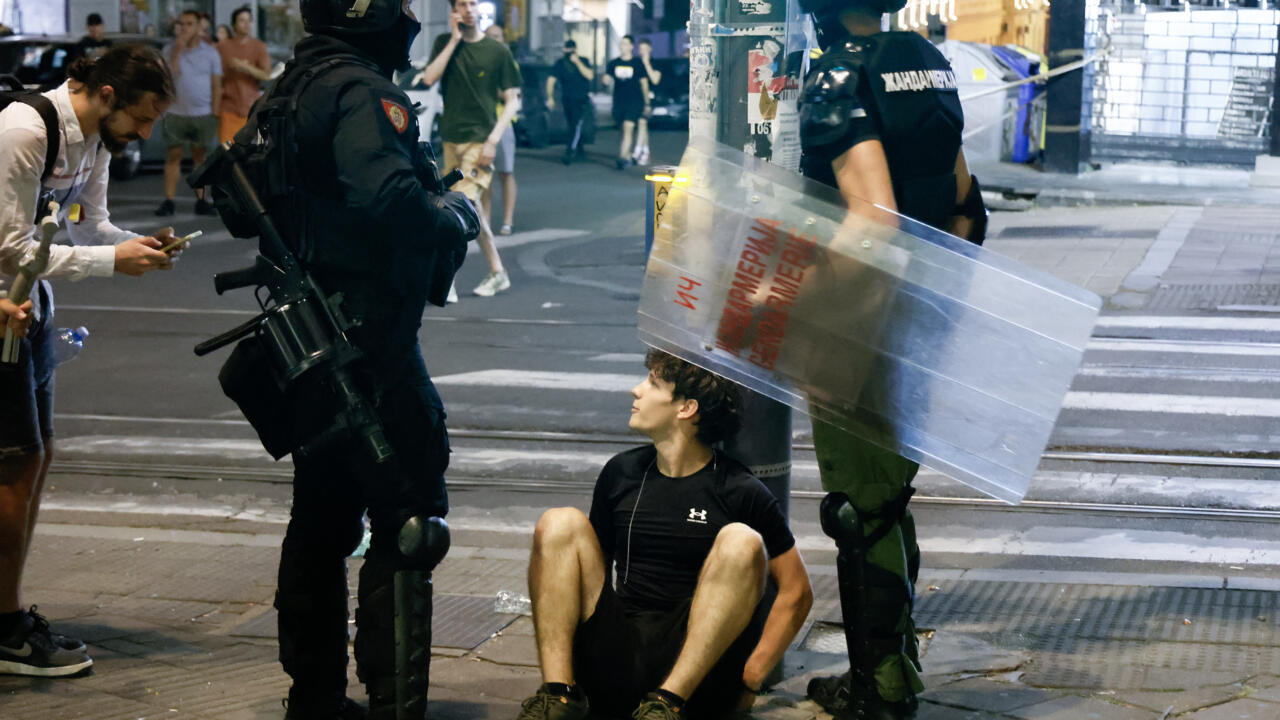
At least five police officers were injured on Thursday evening and 14 protesters were arrested, the ministry said.
-'Intensifying crackdown'-
Frustrated with government inaction, protesters have demanded an investigation into the Novi Sad tragedy and piled pressure on right-wing President Aleksandar Vucic to call early elections.
Over the past nine months, thousands of mostly peaceful, student-led demonstrations have been held, some attracting hundreds of thousands.
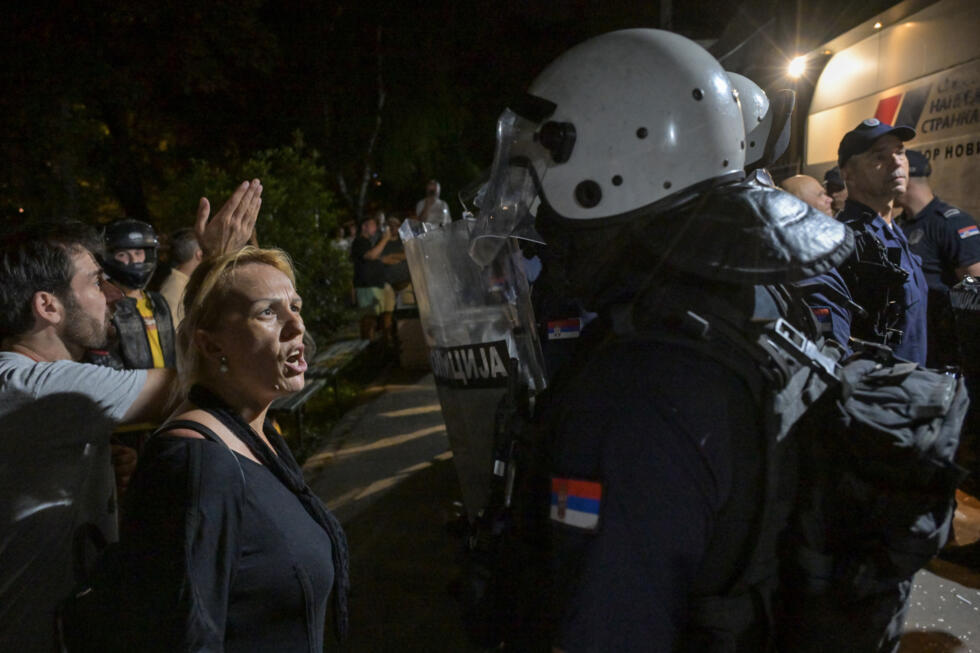
But this week's violence marks a significant escalation and indicates the increasing strain on Vucic's populist government, in power for 13 years.
Since June 28, when around 140,000 demonstrators gathered in Belgrade, the government has responded with an "intensifying crackdown" on activists, according to a statement by UN human rights experts released earlier this month.
Protesters and those linked to the movement have faced a "troubling pattern of repression" including excessive police force, intimidation and arbitrary arrest, the experts said.
Vucic has remained defiant, repeatedly rejecting calls for early elections and denouncing the demonstrations as part of a foreign plot to overthrow him.
Student protesters have accused the police of protecting pro-government supporters while doing little to stop the attacks on their own gatherings.
"The authorities tried to provoke a civil war last night," the students wrote on their official Instagram page.
Vucic, who had visited pro-government encampments overnight Wednesday, denied his supporters had started the violence.
"No one attacked them anywhere," he said of the anti-government protesters, speaking at a late-night press conference.
"They went everywhere to attack those who think differently," he added.
While the protests have so far led to the resignation of the prime minister and the collapse of his cabinet, Vucic remains at the helm of a reshuffled government.
© 2025 AFP
Months of protests in Serbia reached a new intensity Wednesday night as riot police intervened to separate rival demonstrations of anti-government protesters and supporters of President Aleksandar Vucic. The president once again accused unnamed foreign powers of orchestrating the protests, which first began after the deadly collapse of a subway station sparked accusations of widespread government corruption.
Issued on: 14/08/2025 -
By: FRANCE 24
01:38
Supporters of the ruling Serbian Progressive Party (SNS) threw flares and firecrackers at anti-government protesters in Novi Sad on Wednesday evening, prompting police to intervene to end the standoff, a major escalation of nine-month-long protests in Serbia.
The student-led protests in Serbia first started in November after a train station canopy collapsed in Novi Sad, killing 16 people and triggering accusations of corruption in state infrastructure projects.
Protests have since drawn hundreds of thousands of people, shaking President Aleksandar Vucic’s firm grip on power. His supporters have recently started organising counter-demonstrations, fuelling fears of possible violence.
At a news conference late on Wednesday, Vucic, flanked by Interior Minister Ivica Dacic, said 16 police officers and around 60 SNS backers have been injured in Novi Sad. He also accused unidentified foreign powers of orchestrating riots and pledged arrests.
"Persons who violated the law will be apprehended ... Tonight, we have averted a catastrophic scenario planned by someone from abroad," he said.
Vucic did not provide evidence to substantiate his allegations.
Footage by private N1 TV showed flares and firecrackers being thrown at protesters in Novi Sad from the direction of the SNS offices. It also showed anti-government protesters, some with bloody faces, saying Vucic's backers used sticks and truncheons to attack them.
Protesters then smashed office windows as riot police were deployed outside to guard the building.
Opposition Move-Change movement said Vucic's loyalists have been responsible for the clashes.
"Attacks on people with pyrotechnic devices violate their right to life and protest," it said in a statement.
Tens of thousands of protesters rally against populist Serbian government

01:42
In the capital city of Belgrade, police in full riot gear blocked anti-government protesters from approaching the area in a park near the parliament building where Vucic's supporters have been camping since March.
Elsewhere in Belgrade, anti-government protesters clashed with police who prevented them from approaching local SNS offices.
The protesters have blamed corruption for the Novi Sad railway roof collapse and have demanded early elections that they hope would remove Vucic and his party from power after 13 years.
Students, opposition, and anti-corruption watchdogs have accused Vucic and his allies of ties to organised crime, violence against rivals and curbing media freedoms, something they deny.
On Wednesday evening, students who are leading the protests called supporters to protest in front of SNS offices in major cities in Serbia, including Belgrade, Novi Sad, Kragujevac, Cacak and Nis, after several protesters were injured in clashes with SNS in the town of Vrbas on Tuesday evening.
(FRANCE 24 with Reuters and AP)

No comments:
Post a Comment