“He should have died in The Hague,” said one journalist.
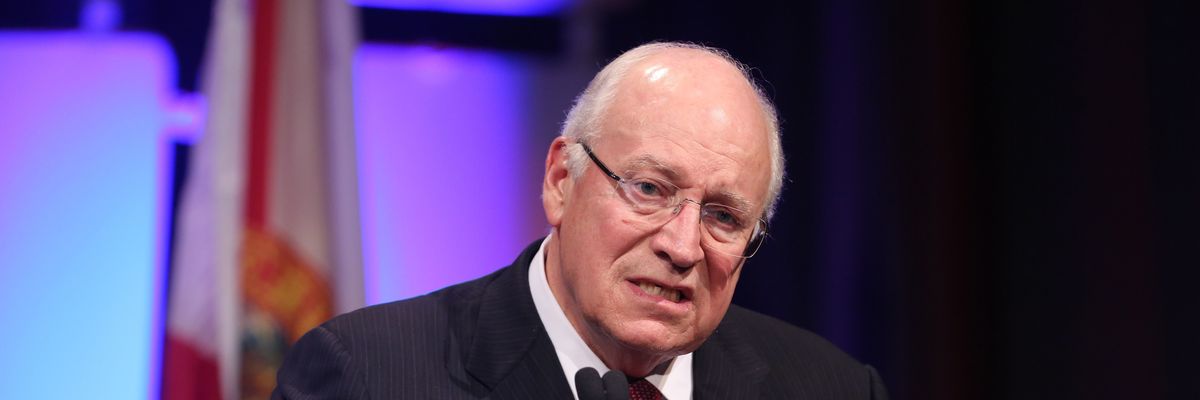
Former Vice President Dick Cheney spoke at an event on November 12, 2015 in Orlando, Florida.
(Photo by Tom Benitez/Pool/Getty Images)
Nov 04, 2025
Dick Cheney, a chief architect of the US invasion of Iraq and broader “war on terror” that has killed millions of people since its inception, has died at 84, his family announced in a statement Tuesday.
Cheney was best known for his central role in the administration of former President George W. Bush, under whom Cheney served as vice president.

An unapologetic advocate of preemptive war and torture in the wake of the September 11, 2001 terrorist attacks on the United States, Cheney was widely regarded as a war criminal who should have faced international prosecution.
“He should have died in The Hague,” journalist Mehdi Hasan wrote in response to the news of Cheney’s death.
Cheney’s family said he died “due to complications of pneumonia and cardiac and vascular disease.”
“The only legacy we have to remember,” said the Maine candidate for US Senate about the former vice president, “is that he wasted thousands of young American lives, hundreds of thousands of Iraqi lives, and trillions of dollars for absolutely nothing.”
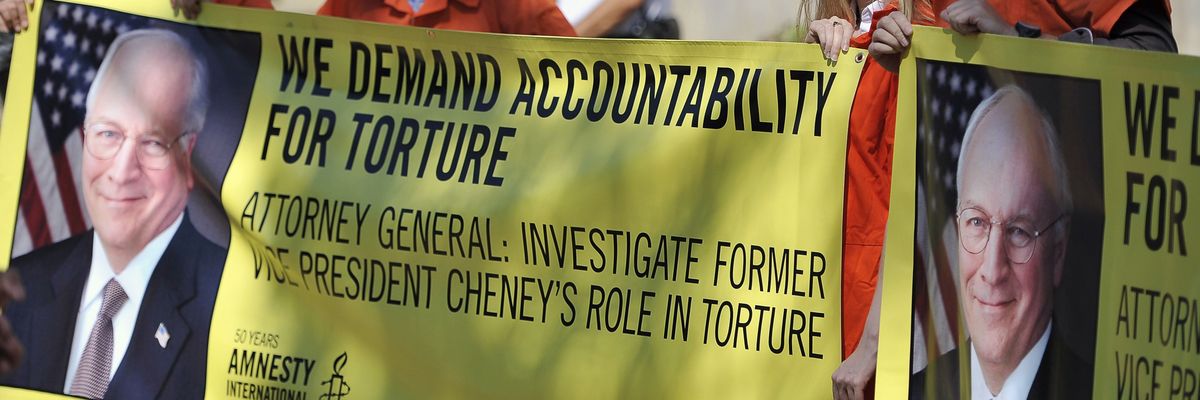
Activists of Amnesty International hold banners of former US Vice President Dick Cheney as they demonstrate in front of the US Justice Department in Washington, DC, on August 30, 2011.
(Photo: Mladen Antonov/Getty Images via Getty Images)
Jon Queally
Nov 05, 2025
Graham Platner, the US combat veteran and oyster farmer running for the Democratic nomination to defeat Republican US Senator Susan Collins of Maine in next year’s election, is not interested in mourning the life and legacy of reviled war criminal Dick Cheney, though he does have “some thoughts” on the subject.
While Democratic leaders of the old guard such as Barack Obama and Kamala Harris issued statements Tuesday fawning over Cheney’s service to country, contributing to the familiar hagiography that typically follows the demise of even the worst American leaders the nation has inflicted on the world, Platner stuck a distinctly different tone.
Allies Challenge Corporate Media Onslaught Against Working-Class Champion Graham Platner
‘The Establishment Is Spooked’: Poll Shows Platner With Big Lead Over Mills in Maine Democratic Primary
“Usually, when a former vice president passes, we all take some time to mourn,” Platner says in a video posted to social media Tuesday. “As a veteran of the Iraq war, I’m going to say: No, not this time.”
Platner, who served in the US Marines and in the US Army during multiple combat tours in both Iraq and Afghanistan, pushed back against the pattern of whitewashing the misdeeds of the dead, especially for elected leaders never held to account.
“Over the next couple days, I’m sure there are going to be thousands of think pieces about his legacy,” said Platner, “but the only legacy we have to remember is that he wasted thousands of young American lives, hundreds of thousands of Iraqi lives, and trillions of dollars for absolutely nothing.”
“If we take anything” from Cheney’s death, continued Platner, “it should be that we need to build a politics that keeps the politicians, like Susan Collins, who support illegal foreign wars like the one in Iraq, accountable and get them out of office.”
Platner has spoken at length about his time on the battlefields of Iraq and Afghanistan and how, after multiple tours, he became not only disillusioned with the wars but also incredibly angry over the foreign policy decisions that started them.
Cheney, who served as VP under former President George W. Bush, has long been seen as the chief architect and driving force behind the effort to manipulate the US public into backing the invasion of Iraq in the wake of the 9/11 attacks, despite Iraq having nothing to do with the plot.
Cheney infamously said after 9/11 it would be time to “take off the gloves,” which resulted in a torture regime operated by the CIA and war crimes across the Middle East, Afghanistan, Pakistan, and beyond at the direction of the Bush administration.
Bob Brigham, a self-identified progressive from Montana, was among those who applauded Platner for his statement.
“Dick Cheney was a war criminal who cost my buddy his life in Iraq,” said Brigham in a social media post. “Platner has a pitch-perfect remembrance of the a-hole. May Dick Cheney roast in hell!”
By AFP
November 4, 2025

US Vice President Dick Cheney takes to the stage on March 18, 2008 to deliver remarks to US troops stationed at Balad Air Base, Iraq - Copyright AFP/File Paul J. RICHARDS
Shaun TANDON
Dick Cheney achieved influence unrivaled for a vice president in shaping US foreign policy, ruthlessly pursuing military might and advocating pre-emptive war to reshape the world.
The descent of Cheney, who died Tuesday, was also spectacular. His hawkish brand of neoconservatism, including the invasion of Iraq, began to be repudiated even before he left office, and today both major US parties largely reject his views.
With America shellshocked by the September 11, 2001 attack, Cheney — his grim demeanor accentuated when he spoke from dark bunkers — advocated a doctrine of pre-emptive strikes, with the United States attacking first before threats materialize, toppling hostile regimes if needed.
Cheney also led the shattering of Western norms on treatment of prisoners, indefinitely jailing terrorism suspects without charges and approving “enhanced interrogation” techniques such as waterboarding that are widely considered torture.
Cheney, a veteran Washington insider with no ambition to be president himself, quickly towered over the less experienced commander-in-chief, George W. Bush.
“It would be hard to argue that he was not the most influential vice president,” said Aaron Mannes, a scholar of the American vice presidency who lectures at the University of Maryland School of Public Policy.
Cheney gained clout by focusing narrowly on national security and enabled Bush by “pushing an open door.”
“There were a lot of stories of him being a sort of secret president — the Darth Vader — running everything. I’m not sure that’s true,” Mannes said. “It was more a matter of where he put his weight.”
– Iraq bloodshed –
The decision to invade Iraq still reverberates across the Middle East and haunts American foreign policy.
Hundreds of thousands of civilians, as well as more than 4,000 US troops, died as the United States toppled Saddam Hussein and the country descended into sectarian bloodshed.
Cheney by the end of his 2001-2009 term began to lose policy debates.
Bush sided with his secretary of state, Condoleezza Rice, and pursued diplomatic options such as talks with North Korea defying Cheney’s motto, “We don’t negotiate with evil; we defeat it.”
Democrat Barack Obama swept to power rejecting Cheney’s worldview, offering an outstretched hand to those who “unclench your fist.”
Less expected, Cheney’s Republican Party shifted direction, as many veterans came home to struggling communities and drug addiction.
Donald Trump last year called Cheney “the King of Endless, Nonsensical Wars, wasting Lives and Trillions of Dollars,” though as president he has been eager to exert the swagger of force himself.
In another turn that would have been unthinkable when Cheney was vice president and a hate figure for Democrats, he said he voted for Democrat Kamala Harris last year over Trump.
He joined his daughter, former congresswoman Liz Cheney, who unlike many Republicans has spared no words in criticizing Trump as anti-democratic.
Danielle Pletka, a senior fellow at the conservative American Enterprise Institute who backed the Iraq war, nonetheless said she believed Americans still backed Dick Cheney’s idea that a “strong America is a power for good in the world.”
“And I don’t think Donald Trump would disagree with that characterization of his own stance,” she said.
– Never prosecuted –
Obama vowed on taking office that the United States “does not torture” but also decided not to prosecute anyone, hoping to turn the page.
The prison for indefinite detentions on Guantanamo Bay, Cuba — which Obama wanted to close within a year — remains open a decade and a half later, although with far fewer inmates.
Sarah Yager, Washington director of Human Rights Watch, which long urged an investigation against Cheney, said the US breaking of norms emboldened other nations to torture.
She also pointed to allegations of mistreatment of migrants sent by Trump to El Salvador.
“There is a direct line from Vice President Cheney to the torture that the US is now complicit in in El Salvador,” she said.
“It’s really a shame that accountability never closed the door for the United States on torture.”
Dick Cheney (1941–2025): The Dark Legacy of a War Criminal
Former U.S. vice president Richard “Dick” Cheney died on 3 November 2025 at age 84; his family said he had suffered from pneumonia and cardiac and vascular disease. Best known for steering national security policy after the 9/11 attacks, he became the dominant force behind a “war on terror” that unleashed torture, preventive war and mass surveillance. Amnesty International has described him as one of the principal architects of a program that amounted to torture, while the Brown University Costs of War project attributes more than 900,000 deaths and trillions of dollars in spending to the post‑9/11 wars he championed. Cheney’s legacy is one of unprecedented destruction and the erosion of civil liberties.
From prudence to preemption
During the 1991 Persian Gulf War, Defense Secretary Dick Cheney and Joint Chiefs chairman Colin Powell resisted calls to topple Saddam Hussein. Cheney argued that invading Baghdad would force the U.S. to occupy Iraq alone, risk its territorial integrity, and require unacceptable casualties: “It’s a quagmire if you go that far,” he told PBS’s Frontline in 1994, asking how many additional dead Americans Saddam was worth. Those words reflect a prudence that vanished after the attacks of September 11, 2001. Within days, the vice president laid out a radical new doctrine. On NBC’s Meet the Press he said America must operate on the “dark side,” spend time in the shadows, and use “any means at our disposal” to achieve its objectives.
Cheney’s longtime counsel, David Addington, and Justice Department lawyers John Yoo and Jay Bybee drafted memos arguing that the Geneva Conventions did not apply to detainees captured in the war on terror. The State Department’s legal advisor warned that claiming the president could suspend the Geneva Conventions was legally flawed and would reverse over a century of U.S. policy. Cheney pressed ahead, telling the Washington Times that he “signed off” on the CIA’s secret detention and rendition program and, as a principal participant in National Security Council meetings, he authorized the agency’s interrogation program, including waterboarding. In 2006 he called waterboarding a “no‑brainer,” and in 2009 he acknowledged knowing about the practice “as a general policy that we had approved.”
Torture and the repudiation of law
The vice president’s embrace of waterboarding ignored that the technique has long been treated as torture under U.S. and international law. Amnesty International notes that Japanese officials were convicted at the Tokyo War Crimes Trials for subjecting U.S. pilots to waterboarding, and U.S. courts have sentenced sheriffs to prison for using the technique. Amnesty stresses that its status as torture is “not a matter of opinion.” The Senate Armed Services Committee concluded that approving aggressive interrogation techniques sent a message that physical pressure and degradation were acceptable treatment for detainees. Amnesty calls Cheney “one of the principal architects of a policy that amounted to torture.”
Cheney’s legal defense of the program was rife with distortions. He misrepresented Justice Department opinions, falsely suggested Japanese waterboarders were never prosecuted, overstated detainee recidivism, insisted detainees had no rights under the Geneva Conventions, and repeated unproven claims of ties between Saddam Hussein and al‑Qaeda.
The road to Baghdad and the case for war
He cautioned against occupying Iraq in 1994 but became the administration’s leading voice for war nine years later. On March 16, 2003 he declared that Saddam had “reconstituted nuclear weapons” and that Americans would be greeted as liberators. These claims proved false. He insisted there was “no doubt” Iraq possessed weapons of mass destruction and ties to al‑Qaeda, yet evidence was lacking. Retired colonel Lawrence Wilkerson later alleged the administration manipulated intelligence to justify invasion and suggested that Cheney’s push to ignore the Geneva Conventions may constitute a war crime.
Cheney’s radicalism was not limited to Iraq. He championed a “unitary executive” theory contending that the president alone decides matters within the executive branch. Legal scholar Martin Lederman observed that he sidelined dissenting views in the military and intelligence agencies. Chip Gibbons, writing in Jacobin, describes him as an enemy of democracy whose agenda included war, indefinite detention, warrantless surveillance, and torture.
Human cost: war, death, and permanent surveillance
The human toll of Cheney’s policies is staggering. Brown University’s Costs of War project estimates that more than 940,000 people have been killed by direct post‑9/11 violence in Iraq, Afghanistan, Syria, Yemen and Pakistan, including over 432,000 civilians. Indirect deaths raise the toll into the millions. In Iraq alone, about 29,199 bombs were dropped, causing heavy civilian casualties, and a 2006 survey estimated over 600,000 civilian deaths. Current Affairs compares Cheney’s record to that of serial killer Samuel Little, concluding that “Little was strictly an amateur.”
The costs extended beyond foreign battlefields. Ryan McMaken of the Mises Institute writes that in a more reasonable world, people like Cheney would be forgotten, shamed, and disgraced. The post‑9/11 wars did nothing to enhance freedom, yet thousands of American families paid with their blood and millions continue to pay through taxes and inflation. McMaken lists domestic infringements such as the Patriot Act, warrantless surveillance, TSA groping, and FISA abuses, and none of the architects have been held accountable.
Colonel Wilkerson, Powell’s former chief of staff, told ABC News that Cheney “was president for all practical purposes” during Bush’s first term and feared being tried as a war criminal. The Washington Post dubbed him the “vice-president for torture,” and Wilkerson said his push to disregard the Geneva Conventions amounted to an international crime. Chip Gibbons asserts that he “reduced nations to rubble, shredded the Bill of Rights, and enacted programs of surveillance, abduction, detention, and torture.”
The culture of impunity Cheney helped foster has not faded. Politicians continued to accept his endorsements despite his record, while he insisted the CIA’s interrogation techniques did not violate international agreements and his allies still argued for expansive presidential war powers.
An opinion essay by law professor Ziyad Motala in Al Jazeera argues that Cheney is the architect of some of the most disastrous foreign and domestic policies of the early twenty‑first century. Motala contends that Cheney’s policies left “a trail of death and destabilization” and that the havoc unleashed by the Iraq War and the broader “war on terror” continues to reverberate, causing “suffering and instability far surpassing anything Trump has wrought.” He notes that estimates of Iraqi civilian deaths range from hundreds of thousands to well over a million and that the war destabilized an entire region, paving the way for extremist groups like ISIL and ongoing cycles of violence and displacement. The war drained trillions from the U.S. economy and left thousands of U.S. troops dead and many more with life‑altering physical and psychological wounds.
The economic burden of these wars is also staggering. Nearly twenty years after the United States invaded Afghanistan, the global war on terror had cost about $8 trillion. That figure includes not only Department of Defense spending but also State Department expenditures, care for veterans, Department of Homeland Security funds, and interest payments on war borrowing. Brown’s Cost of War Project Co‑director Catherine Lutz said the Pentagon now absorbs the majority of federal discretionary spending, yet most people do not realize the scale of this funding. She warned that these costs will continue for decades as the country pays for veterans’ care and the environmental damage wrought by the wars.
Cheney championed the Patriot Act as a key pillar of the “war on terror” and campaigned aggressively to renew its provisions. In January 2006 he and President Bush launched a “double‑barrelled assault” on critics of domestic surveillance and opponents of the law; Cheney told the Heritage Foundation that Americans could not afford “one day” without the Patriot Act. Civil liberties groups argue that the Patriot Act dramatically expanded government surveillance powers at the expense of constitutional freedoms. Under the law, investigators can monitor online communications on an extremely low legal standard, and secret court orders can compel companies to hand over lists of what people read or which websites they visit. The American Civil Liberties Union notes that the law is enforced in secret, weakens judicial review, and allows agents to seize business and communications records without probable cause. By 2004 the ACLU had filed lawsuits challenging these provisions and denounced the administration’s claim that there were no abuses as a “red herring.” The Patriot Act turned ordinary Americans into subjects of a vast dragnet, chilling free speech and giving the executive branch powers reminiscent of past crises.
Assessing the indictment
The case against Dick Cheney therefore does not rest on partisan vitriol but on the record of his own words and deeds. He reversed his warnings about occupying Iraq and promoted a war based on false claims; advocated operating on the “dark side;” authorized secret prisons and waterboarding despite the practice being recognized as torture; backed legal memos undermining Geneva protections; and misled the public about weapons of mass destruction and al‑Qaeda ties. He championed a unitary executive theory that sidelined constitutional checks. The wars he supported killed hundreds of thousands and created millions of refugees, while at home they ushered in surveillance and curbs on civil liberties. He is the poster child of a modern war criminal in the American neo-conservative tradition.
It would be facile to claim that Cheney alone bears responsibility for America’s post‑9/11 disasters. Presidents George W. Bush and Barack Obama signed off on the wars and the surveillance, Congress appropriated funds, and the courts often acquiesced. Yet Cheney’s imprint on U.S. foreign policy is unmistakable. Through his mastery of bureaucratic infighting and his ability to marginalize dissent, he institutionalized torture, preventive war, and executive supremacy as tools of statecraft. His death prompts reflection on whether the nation will continue to venerate officials whose legacies consist of bombed cities, dead civilians, shattered constitutions, and a global “war on terror” that has left the world less free and no safer.
Alan Mosley is a historian, jazz musician, policy researcher for the Tenth Amendment Center, and host of It’s Too Late, “The #1 Late Night Show in America (NOT hosted by a Communist)!” New episodes debut every Wednesday night at 9ET across all major platforms; just search “AlanMosleyTV” or “It’s Too Late with Alan Mosley.”
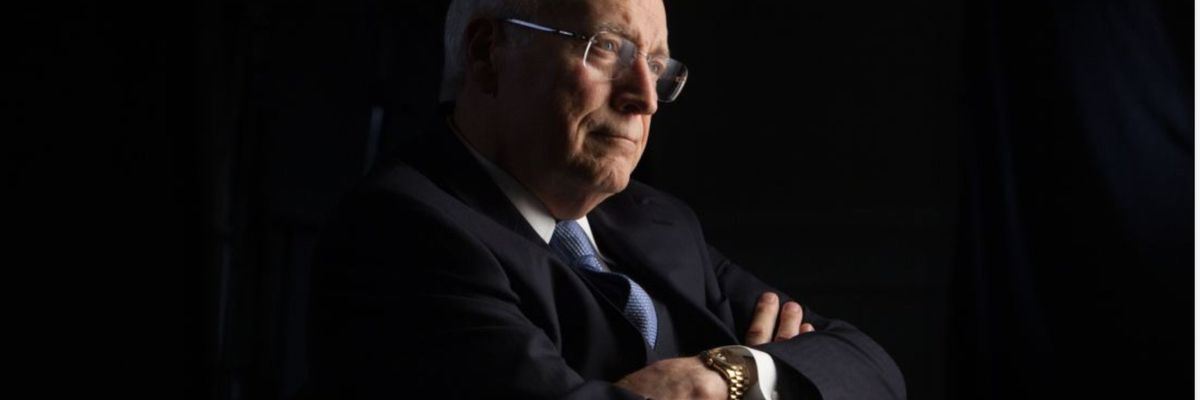
Cheney during a 2012 interview
Photo by David Hume Kennerly/Getty Images
Abby Zimet
Nov 05, 2025
COMMON DREAMS
Variously dubbed Darth Vader, the Prince of Darkness and “one of the most evil people to exist in modern history,” Dick Cheney, the lying, blood-stained architect of America’s calamitous War on Terror, brutal torture program and an Imperial Presidency that today still afflicts us has died “after a lifetime of people wishing he had died sooner” - and in a prison cell. The consensus on a war criminal who faced no punishment and expressed no remorse: “No hell is hot enough or eternal enough.”
The long-awaited death of Cheney, at 84, resists all but the most groveling and dissonant of the hagiographies that often greet the demise of contentious figures; in Cheney’s case, much like Kissinger’s, schadenfreude rules the day. After years of harsh mock headlines - “Cheney Is Still Undead” - and a website that daily asked, and answered, “Is Cheney Dead Yet?”, the actual death of an American supervillain instrumental in creating an iniquitous, ineffective, indefensible, deeply sadistic torture and rendition regime that “destroyed any shred of humanity the U.S. could ever lay claim to” was met with caustic dispatches like, “Dick Cheney No Longer Still Undead” and, from The Nation, “His Works Completed, Dick Cheney, Mass Murderer of Iraqis and American Democracy, Dies.”
Let Them Eat Marble and Big Beautiful Ballroom
They note today’s MAGA, and alas the rest of us, “walk a path paved by the most powerful vice president in US history,” a reminder Cheney’s crimes belong not in the past but in the hateful, largely untethered presidential here and now. In light of his “long, putrescent career,” notes one account, “let us remember who Richard Bruce Cheney really was.” Born in 1941, growing up in Wyoming, Cheney had an inauspicious youth - flunked out of Yale twice, racked up two drunk-driving arrests - so “who knew he’d one day turn his life around to grow up to be a war criminal?” Despite his zeal for enabling the killing of brown people around the world from an office in D.C., he got five deferments in the Vietnam War; he later vaguely said, “I had other priorities in the ‘60s than military service.”
Parlaying connections among the neo-cons, he was elected to the House in 1978; he served five terms, during which he voted against a Department of Education, a Martin Luther King holiday, Head Start, and freeing Nelson Mandela while supporting apartheid. After years of rising through the GOP ranks as “one of the most belligerent politicians of our lifetime,” he became the insipid George Bush’s right-hand man, savoring playing the “evil genius in the corner that nobody ever sees come out of his hole” while working to make Bush as legally untouchable as possible. Espousing the Unitary Executive Theory - an unencumbered presidency controlling all aspects of the executive branch - he helped shape the 2000-2008 Bush-Cheney administration, one of the worst in American history.
Sept. 11 “happened on his watch,” notes one account. “Everything that came afterward - Afghanistan, Iraq, torture, surveillance, toxic patriotism - was overcompensation for his own initial failure.” It was also a chance to achieve his longtime goal of amassing in the White House the might of U.S. war-making - which he thought showcased American power, not “weakness, avarice, futility and manic resource extraction.” Thus did he forge, with the help of Bush, Blair, Rumsfeld, oil-greedy corporate powers, a complicit CIA, the invasion and occupation of Iraq - concocting ties between Saddam and al-Qaeda, inventing weapons of mass destruction, attacking critics for their “pernicious falsehoods” - that ranks as “one of the worst strategic decisions in U.S. history.”
And, of course, one of the most brutal. Official estimates say the so-called War on Terror killed between 897,000 and 929,000 people, mostly civilians; those numbers are widely recognized as far too low, with totals likely reaching beyond a million. Among the victims were myriad thousands of “ghost detainees” disappeared to other countries in extra-judicial renderings - in handcuffs, blindfolds, diapers - to be tortured. They were beaten, cut, raped, waterboarded, set upon by dogs, burned, electrocuted, restrained in excruciating positions, put into coffins, threatened with execution, power drills, “rectal rehydration,” the killing of their families. Later, confronted in a Senate hearing with a 6,000-page report documenting the horrors, Cheney dismissed it as “a crock” and “hooey.”
All the shameless lies, the endless hubris, the crimes, screams, bodies, blood, the millions he made at Halliburton in exchange - for all that, Cheney never faced any legal or even political accountability. He never expressed even a sliver of doubt or regret. In a 2008 interview, asked about the fact that two-thirds of Americans said the war wasn’t worth fighting, he responded, “So?” “So? You don’t care American people think?” he’s asked. “No,” he said. “You cannot be blown off course by fluctuations in the public opinion polls.” At other times, he insisted, “I’d do it again in a minute,” “I have no problem as long as we achieve our objective,” and on a torture program that repeatedly proved to generate no documented, actionable information, “It worked. It absolutely did work.”Cheney had five heart attacks and underwent at least 7 heart procedures before finally dying of pneumonia and cardiac and vascular disease, "killed by a coalition of the diseases willing to invade him." In 2012, he got a heart transplant, becoming "the only human capable of using another person's heart without caring who it previously belonged to." In an interview about the gift, he proved "an even bigger monster" than previously thought by declaring, "It's my new heart, it's not someone else's old heart." He conceded many people "generically thank donors...but I don't spend time wondering who had it, what they’d done, what kind of person." When Cheney accidentally shot a 78-year-old lawyer friend in the face in a 2006 hunting accident, the victim felt obliged to apologize for blocking his shot.
In the end, ironies abound in his life and death. He reportedly voted in the last election for Kamala Harris, arguing, “In our nation’s 246-year history, there has never been an individual who was a greater threat to our republic than Donald Trump,” even though he was long deemed that threat and Trump committed the same crimes as Bush - lying to steal an election. He died on a day he helped facilitate that 25 years ago, and lived to see another president turn the same bloated executive powers against his own daughter. “Cheney never expected to be displaced by what he empowered,” notes The Nation of the Bush/Cheney history of violence and deceit. “He surely did not expect to die on a day when New Yorkers are poised to elect a Muslim socialist mayor in a repudiation of his legacy.”
All in all, “History’s verdict has been merciless on the ‘father’ of the Iraq invasion and the excesses of the war on terror.” The jokes are bitter. It’s time for the The Onion‘s Cheney Library in “a vast, dark, sulfurous cave” with its millions of legal documents justifying torture, noxious fumes, endless surveillance, Hall of Obfuscation, Pit of Yellowcake Uranium, Quagmire Wing, interactive waterboarding for kids, sprawling security state and exhibits representing “the huge part he played in destabilizing the Middle East for generations to come.” Some report the Cheney family hasn’t decided how to handle his remains, but may award Halliburton “a no-bid contract” for clean-up; his daughters, struggling with their loss, have taken to calling it “enhanced death.”
Others are outright celebrating. “I woke up today feeling kinda shitty, knowing I needed to go to the gym but not wanting to,” wrote one. “Then I saw the headline that Dick Cheney was dead, and suddenly everything was great. All my aches and pains disappeared. I was so happy! I wanted to run up to strangers at the gym and see if they’d celebrate Cheney’s death with me! I didn’t know I had this much schadenfreude in me.” One announced, “The man who if Kubrick had a time machine could have been the inspiration for Dr. Strangelove has harvested his last organ.” One vowed, “AND NOW WE DANCE.” But Islamic scholar Omar Suleiman, summoning all those lost and grieving and ravaged, spoke to the dark heart of the deceased: “May the 1 million murdered souls of Iraq haunt you for eternity.”

No comments:
Post a Comment