Mamdani Won New York City, But the Battle for Winning a Working-Class Agenda Has Just Begun
The battle for a more affordable and egalitarian society is just beginning. Leaders like Zohran Mamdani need to gain even deeper traction with working-class voters, no matter how working class is defined and no matter their racial identity—if they want to win.
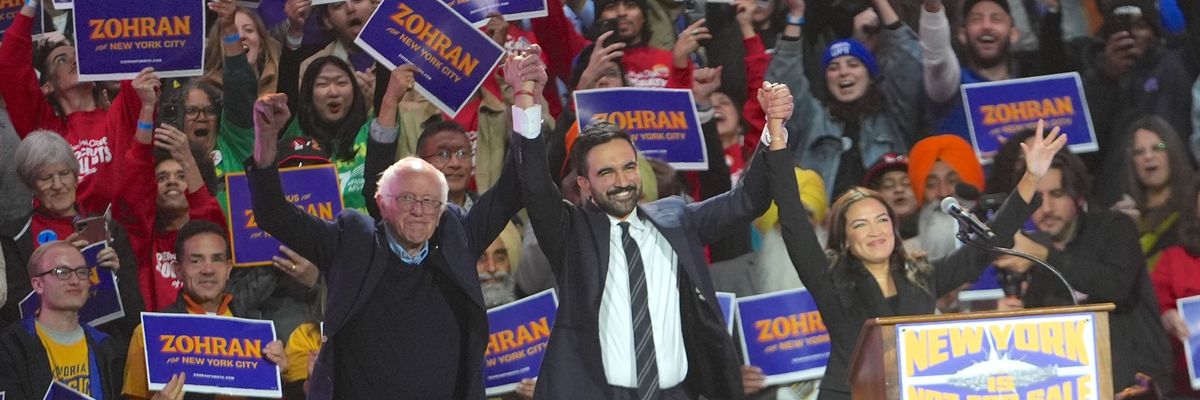
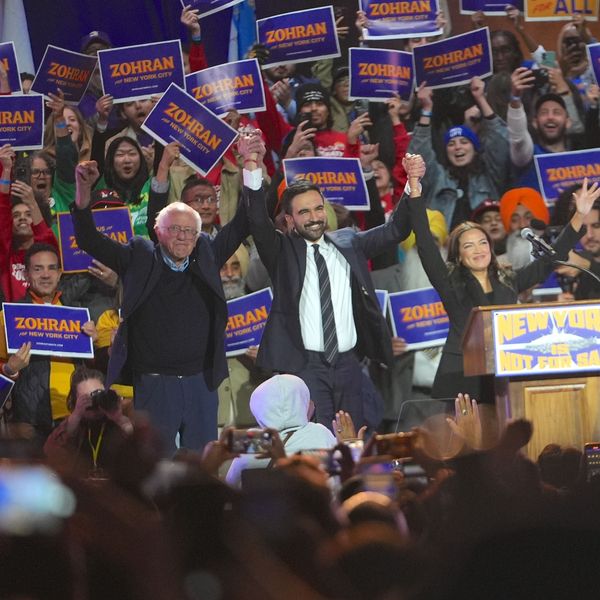
New York City mayoral candidate Zohran Mamdani speaks during the “New York is Not For Sale” rally alongside Senator Bernie Sanders, and Congresswoman Alexandria Ocasio-Cortez at Forest Hills Stadium in Queens, New York City, United States, on October 26, 2025.
(Photo by Selcuk Acar/Anadolu via Getty Images)
Les Leopold
Nov 07, 2025
Common Dreams
It truly is amazing that a Democratic Socialist has become mayor of the largest city in the United States, and that in the first line of his acceptance speech he quoted Eugene V. Debs, the brave socialist labor leader who was imprisoned in 1985 during the Pullman Strike and again in 1918 for his opposition to WWI:
“The sun may have set over our city this evening, but as Eugene Debs once said, ‘I can see the dawn of a better day for humanity.'”
It truly is amazing that a Democratic Socialist has become mayor of the largest city in the United States, and that in the first line of his acceptance speech he quoted Eugene V. Debs, the brave socialist labor leader who was imprisoned in 1985 during the Pullman Strike and again in 1918 for his opposition to WWI:
“The sun may have set over our city this evening, but as Eugene Debs once said, ‘I can see the dawn of a better day for humanity.'”

Mamdani’s youth, charisma, humor, and incredible organizational skills led to this remarkable achievement. He worked hard and he earned it, and so did the many progressive groups that supported him.
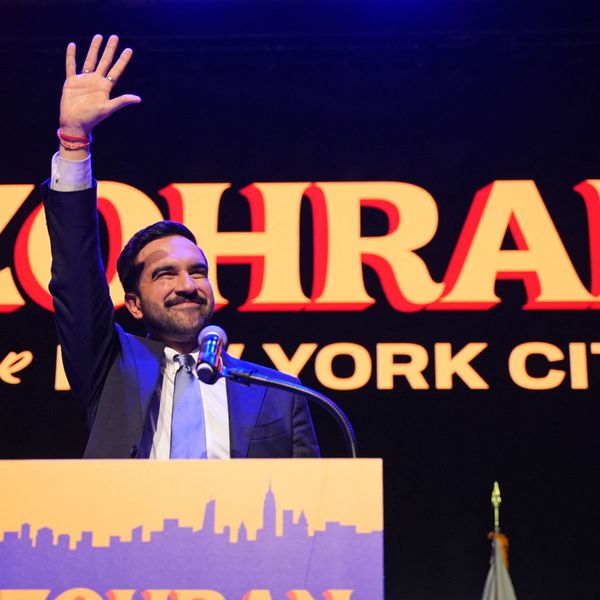
‘Hope Is Alive!’ Mamdani Victory in NYC Seen as Historic Turning Point
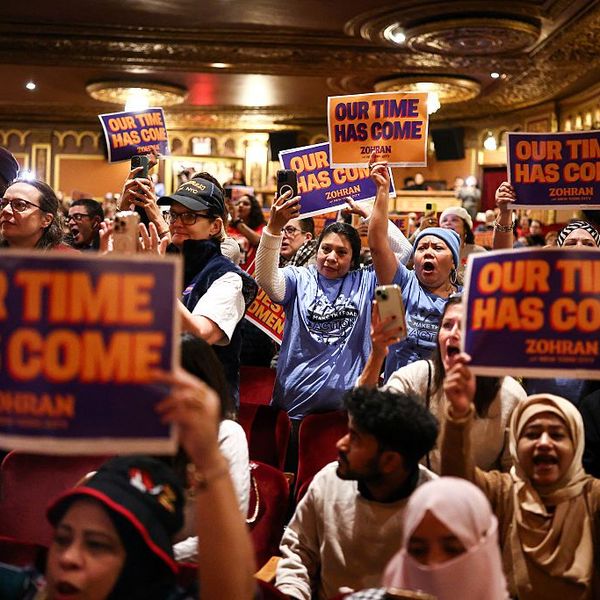
Raucous Mamdani Rally Reveals Political Battle Stretches Beyond New York City
Mamdani may have the abilities and the working-class agenda to become a major transformational political leader. Free buses, free childcare, and a rent freeze are concrete and achievable, but the opposition will be fierce, especially as he intends to increase taxes on the rich and corporations to pay for these programs. And powerful landlords will be up in arms. This is the definition of class struggle.
There will be major battles ahead that won’t be settled by Mamdani’s charisma and negotiating skills alone.
Mamdani is operating in the belly of the beast called runaway inequality. It’s nearly impossible to wrap our minds around the wealth that’s concentrated in New York. There are 123 billionaires living in NYC with a combined net worth more than three-quarters of a trillion dollars. And those numbers are surely an underestimate, given the many who have hidden their purchases of luxurious Manhattan apartments using shell companies.
To succeed against the rich and powerful, Mamdani will need a mass movement behind him, and that movement has to include enthusiastic support and the active participation of New York’s working class and labor unions.
Does he already have it? Is his victory the result of overwhelming support from highly educated liberals? Or has his working-class agenda also excited the working class more broadly, the way Eugene Debs did when he received nearly a million votes in his run for president in 1912?
All we have to go by, right now, are the exit polls, which aren’t really designed to include a clear demographic definition of the working class. But there is some suggestive information.
Let’s start with the standard media definition of working class based on education: You are often counted as being in the working class if you don’t have a four-year college degree. By this definition, Mamdani received most of his support from college-educated voters and ran behind Cuomo among working-class voters.New Yorkers are well educated: 58 percent of all the voters in this election had a four-year college degree or higher.
This highly educated group overwhelmingly supported Mamdani over Cuomo, 57 percent to 37 percent.
But Mamdani ran behind Cuomo among those who never attended college, 41 percent to 48 percent. One out of five voters are in this group.
The picture becomes blurrier if working-class is defined as having a lower income. New York voters are fairly evenly split between those whose family income is less than $100,000 year (58%), and those with $100,000 or more in family income (42%). And Mamdani’s support was identical between the two groups (51%), an almost exact match with his final vote of 51.5 percent.
But a closer look at the income brackets shows that Mamdani didn’t do as well with those with family incomes under $30,000. That group accounts for 16 percent of all voters. They favored Cuomo 50 percent to Mamdani’s 41 percent. But Mamdani won every other income bracket except those with family incomes of $300,000 or more, which he lost to Cuomo 61 percent to 34 percent. No way was a Democratic Socialist going to do well with the group he promised to tax more heavily to pay for his agenda.
Cutting it up into two income slices, Mamdani did slightly better with upper-income voters than lower-income voters. Those with family incomes of less than $50,000 gave 47 percent of their votes to Mamdani, and those with more than $50,000 supported him with 52 percent of their votes.
Revenge of the White Working Class?
Unlike Debs, Mamdani did not come out of the labor movement. He’s well-educated, an Asian immigrant born in Africa, and Muslim. Was that all too much for the allegedly racist white working-class? The exit polls don’t provide the crosstabs to give us definitive answers, but we can get some clues.
Here’s Mamdani’s support by ethnicity (of all educational and income groups):White 46 %
Black 55 %
Hispanic 49 %
Asian 61 %
Other 51 %
It’s hard to point the finger at white racism when support for Mamdani is almost identical between white voters and Hispanic voters. The big outlier is Asian, Mamdani’s own ethnic group.
The breakdown by gender shows less support among white men, but again the gaps are not gigantic:White men 43%
White women 48%
Black men 60%
Black women 52%
Hispanic men 52%
Hispanic women 48%
Since we don’t know the income or education levels of these white men it’s not possible to see if working-class white men were less supportive, but that’s probably the case given the overall lower Mamdani numbers among those without four-year college degrees. However, while it’s not possible to tease apart racial identity and class when it comes to working-class voters of all shades, nothing big jumps out to suggest that this contest was about racial identity.
Mamdani needs those working-class voters, no matter how working class is defined and no matter what their ethnicity. He’s developed enormous support among liberal, well-educated New Yorkers, and that’s all to the good. But to take on the world’s richest, most powerful elites, that enthusiasm must spread deeply into the working class, where—even in New York—MAGA festers.
There will be major battles ahead that won’t be settled by Mamdani’s charisma and negotiating skills alone. That will require a mass movement in support of the progressive ideas the city’s new mayor campaigned on, the kind of movement New York hasn’t seen since the 1930s. Let’s hope Mamdani can reach even more deeply into the working class to strengthen his support. He’s going to need them.
Our work is licensed under Creative Commons (CC BY-NC-ND 3.0). Feel free to republish and share widely.
Les Leopold is the executive director of the Labor Institute and author of the new book, “Wall Street’s War on Workers: How Mass Layoffs and Greed Are Destroying the Working Class and What to Do About It." (2024). Read more of his work on his substack here.
Full Bio >
‘Hope Is Alive!’ Mamdani Victory in NYC Seen as Historic Turning Point
Raucous Mamdani Rally Reveals Political Battle Stretches Beyond New York City
Mamdani may have the abilities and the working-class agenda to become a major transformational political leader. Free buses, free childcare, and a rent freeze are concrete and achievable, but the opposition will be fierce, especially as he intends to increase taxes on the rich and corporations to pay for these programs. And powerful landlords will be up in arms. This is the definition of class struggle.
There will be major battles ahead that won’t be settled by Mamdani’s charisma and negotiating skills alone.
Mamdani is operating in the belly of the beast called runaway inequality. It’s nearly impossible to wrap our minds around the wealth that’s concentrated in New York. There are 123 billionaires living in NYC with a combined net worth more than three-quarters of a trillion dollars. And those numbers are surely an underestimate, given the many who have hidden their purchases of luxurious Manhattan apartments using shell companies.
To succeed against the rich and powerful, Mamdani will need a mass movement behind him, and that movement has to include enthusiastic support and the active participation of New York’s working class and labor unions.
Does he already have it? Is his victory the result of overwhelming support from highly educated liberals? Or has his working-class agenda also excited the working class more broadly, the way Eugene Debs did when he received nearly a million votes in his run for president in 1912?
All we have to go by, right now, are the exit polls, which aren’t really designed to include a clear demographic definition of the working class. But there is some suggestive information.
Let’s start with the standard media definition of working class based on education: You are often counted as being in the working class if you don’t have a four-year college degree. By this definition, Mamdani received most of his support from college-educated voters and ran behind Cuomo among working-class voters.New Yorkers are well educated: 58 percent of all the voters in this election had a four-year college degree or higher.
This highly educated group overwhelmingly supported Mamdani over Cuomo, 57 percent to 37 percent.
But Mamdani ran behind Cuomo among those who never attended college, 41 percent to 48 percent. One out of five voters are in this group.
The picture becomes blurrier if working-class is defined as having a lower income. New York voters are fairly evenly split between those whose family income is less than $100,000 year (58%), and those with $100,000 or more in family income (42%). And Mamdani’s support was identical between the two groups (51%), an almost exact match with his final vote of 51.5 percent.
But a closer look at the income brackets shows that Mamdani didn’t do as well with those with family incomes under $30,000. That group accounts for 16 percent of all voters. They favored Cuomo 50 percent to Mamdani’s 41 percent. But Mamdani won every other income bracket except those with family incomes of $300,000 or more, which he lost to Cuomo 61 percent to 34 percent. No way was a Democratic Socialist going to do well with the group he promised to tax more heavily to pay for his agenda.
Cutting it up into two income slices, Mamdani did slightly better with upper-income voters than lower-income voters. Those with family incomes of less than $50,000 gave 47 percent of their votes to Mamdani, and those with more than $50,000 supported him with 52 percent of their votes.
Revenge of the White Working Class?
Unlike Debs, Mamdani did not come out of the labor movement. He’s well-educated, an Asian immigrant born in Africa, and Muslim. Was that all too much for the allegedly racist white working-class? The exit polls don’t provide the crosstabs to give us definitive answers, but we can get some clues.
Here’s Mamdani’s support by ethnicity (of all educational and income groups):White 46 %
Black 55 %
Hispanic 49 %
Asian 61 %
Other 51 %
It’s hard to point the finger at white racism when support for Mamdani is almost identical between white voters and Hispanic voters. The big outlier is Asian, Mamdani’s own ethnic group.
The breakdown by gender shows less support among white men, but again the gaps are not gigantic:White men 43%
White women 48%
Black men 60%
Black women 52%
Hispanic men 52%
Hispanic women 48%
Since we don’t know the income or education levels of these white men it’s not possible to see if working-class white men were less supportive, but that’s probably the case given the overall lower Mamdani numbers among those without four-year college degrees. However, while it’s not possible to tease apart racial identity and class when it comes to working-class voters of all shades, nothing big jumps out to suggest that this contest was about racial identity.
Mamdani needs those working-class voters, no matter how working class is defined and no matter what their ethnicity. He’s developed enormous support among liberal, well-educated New Yorkers, and that’s all to the good. But to take on the world’s richest, most powerful elites, that enthusiasm must spread deeply into the working class, where—even in New York—MAGA festers.
There will be major battles ahead that won’t be settled by Mamdani’s charisma and negotiating skills alone. That will require a mass movement in support of the progressive ideas the city’s new mayor campaigned on, the kind of movement New York hasn’t seen since the 1930s. Let’s hope Mamdani can reach even more deeply into the working class to strengthen his support. He’s going to need them.
Our work is licensed under Creative Commons (CC BY-NC-ND 3.0). Feel free to republish and share widely.
Les Leopold is the executive director of the Labor Institute and author of the new book, “Wall Street’s War on Workers: How Mass Layoffs and Greed Are Destroying the Working Class and What to Do About It." (2024). Read more of his work on his substack here.
Full Bio >
Time to Flex: Lessons for Mamdani From My Time With AOC
You can’t change a system by sending one or two people into it and hoping for the best. You have to build and use political power to break the system’s ability to resist you.
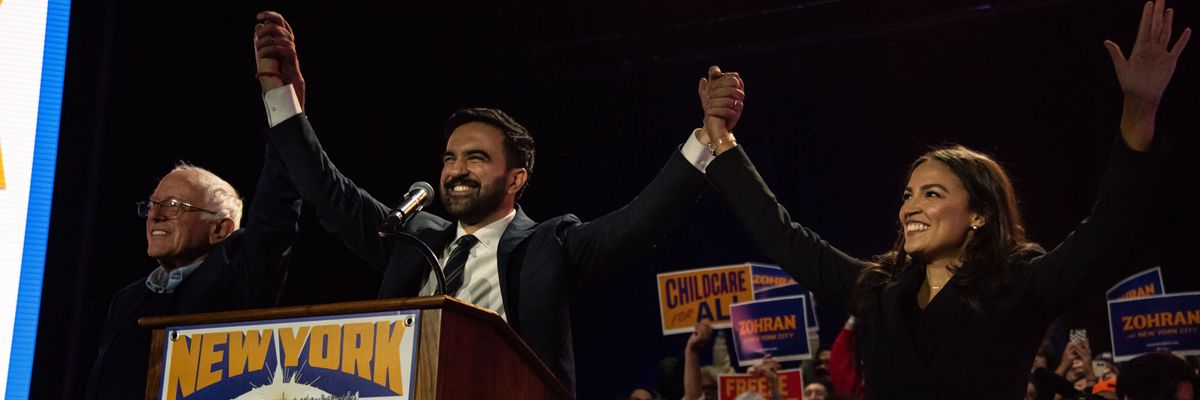
Sen. Bernie Sanders on stage with Zohran Mamdani and Rep. Alexandria Ocasio-Cortez as over 13,000 people packed Forest Hills Stadium in Queens, New York on October 26, 2025.
(Photo by Neil Constantine/NurPhoto via Getty Images)
Corbin Trent
Nov 07, 2025
Nov 07, 2025
Common Dreams
Lots of elections happened on Tuesday. Most of them good news for 2026. There are signs that the MAGA fever is breaking. It’s important that whatever we work to replace it with comes from a place of understanding how we got here, and builds the power necessary to repair the damage.
The most hopeful and potentially transformative victory of the night was that of Zohran Mamdani. He won the New York City mayoral race with over 50% of the vote, beating Andrew Cuomo for a second time. The turnout was amazing. More than 2 million people voted.
Lots of elections happened on Tuesday. Most of them good news for 2026. There are signs that the MAGA fever is breaking. It’s important that whatever we work to replace it with comes from a place of understanding how we got here, and builds the power necessary to repair the damage.
The most hopeful and potentially transformative victory of the night was that of Zohran Mamdani. He won the New York City mayoral race with over 50% of the vote, beating Andrew Cuomo for a second time. The turnout was amazing. More than 2 million people voted.
Raucous Mamdani Rally Reveals Political Battle Stretches Beyond New York City
‘Tax the Rich!’: Packed Mamdani Rally Features Sanders, AOC, and Hochul Ahead of Election Day
And here’s what should terrify the Democratic establishment: Mamdani didn’t just win the city. He won decisively in Hakeem Jeffries’ district. He won in Ritchie Torres’ district. These guys are vulnerable as hell in a primary, and they know it.
But I’ve been here before. I was there for AOC’s first primary victory. I helped recruit her to run, helped build her campaign, and then worked as her advisor and communications director. I can tell you with absolute certainty: this is just the beginning. And if the movement around Mamdani doesn’t understand that and act accordingly, this opportunity will slip away like so many others have.
I’m hopeful. Mamdani’s victory is real and it’s important. But my experience tells me that without active, aggressive political power-building, it won’t translate into anything more tangible.
The difference this time is that Mamdani doesn’t have to be one person alone. He’s an executive running the country’s largest city, which gives him powers and capacity that one member of Congress - one out of 535 - could never have. And NY has primary elections coming in June 2026. Federal races, state assembly, state senate—all of it.
The Democratic establishment is already moving to contain him. Obama is reaching out. Bill Ackman is extending olive branches. And they’ll succeed unless the movement around him understands that winning the election was just the starting line.
The Power Problem We Had With AOC
We won in 2018. We proved a grassroots movement could build a political operation to recruit and elect a new type of Democrat. But here’s what we didn’t do: we didn’t immediately use that victory to build more power. We didn’t flex.
We won one seat. We celebrated. We staffed up. We tried to work within the system. And while we were doing that, the establishment built a wall around her. Seniority rules shut her out of real committee power. Leadership froze her out. The party used her as a boogeyman to fundraise off while refusing to even look at her agenda.
We were taught the wrong lesson: that getting people in office was the goal. That was the mistake. You can’t change a system by sending one or two people into it and hoping for the best. You have to build and use political power to break the system’s ability to resist you.
What Actually Flexing Power Looks Like
Imagine if, right now, while Mamdani is being sworn in, AOC was publicly exploring a run for governor against Kathy Hochul in 2026. Not “maybe someday.” Now. Publicly. With rallies. With Bernie Sanders. With pressure.
Imagine if the movement announced tomorrow that they’re running a primary challenger against Hakeem Jeffries. Not quietly. Publicly. With resources. With a candidate who can actually compete. Imagine if Former DNC Vice Chair Michael Blake, the challenger who announced he is running against Torres yesterday, gets backed by Mamdani this week.
Imagine if the entire energy and machinery that just won a mayoral race with 2 million voters doesn’t go dormant. Imagine if it stays active, visible, and aggressive. Imagine if the message to every Democrat in New York is crystal clear: if you block Mamdani’s agenda, you will be primaried. You will be challenged. You will lose your seat.
That’s flexing power. That’s what we didn’t do. That’s what has to happen now.
Governor Hochul has already announced she won’t support tax increases on the wealthy—the foundation of Mamdani’s entire agenda. Hakeem Jeffries gave him the most tepid endorsement imaginable. Ritchie Torres called him “treacherously smart” and warned he’d make New York “ground zero for anti-Zionism.”
These people aren’t confused. They’re opposed to him. And they’ll stop him cold unless they fear losing their jobs. Not theoretically. Actually.
The Easy Enemy and the Hard One
When you’re fighting MAGA, it’s simple. They wear red hats. They’re loud. You know exactly who they are.
The Democratic establishment is different. They seem like they’re on your side. They talk about the same values. They talk about “pragmatism” and being “confined by what’s possible.” There’s always an explanation for why they couldn’t deliver.
I spent years wanting to believe those explanations meant something. That they were potential allies who just needed the right pressure.
But I don’t believe it anymore. I think they know their role. I think they know they are barriers to change, and they’re comfortable with that role.
If democratic socialism is shown to be productive, transformational, and beneficial to the vast majority of New Yorkers, it will have reverberations across the entire country. This is the front line. And they know it.
What This Actually Takes
One person can’t change something this entrenched alone. One person—no matter how brilliant—cannot overcome a system designed to resist them.
During the New Deal, it took three election cycles to build a supermajority. It can happen again in 2026, 2028, 2030. That’s the timeline.
When you’re fighting MAGA, it’s simple. They wear red hats. They’re loud. You know exactly who they are. The Democratic establishment is different. They seem like they’re on your side.
While Mamdani is picking up the trash and making the city function, the movement around him has to be simultaneously primarying Jeffries, running challengers against Torres, recruiting state legislators. It means rallies. Visibility. Making clear political risk to every Democrat in the state who opposes his agenda.
Yes, the infrastructure is collapsing. Yes, construction in New York costs seven times what it costs anywhere else. Yes, the MTA has a $62 billion backlog. Those problems require competent governance. But none of it matters if Hochul and the State Legislature just block him. So while Mamdani’s team is fixing potholes, the movement has to be in the streets, at the rallies, primarying the people in the way.
Where We Go From Here
I’m hopeful. Mamdani’s victory is real and it’s important. But my experience tells me that without active, aggressive political power-building, it won’t translate into anything more tangible.
The impulse will be to work within the system. Staff the administration. Make government function. That has to happen. But it can’t be all that happens. You’ve got to be running a political revolution simultaneously. You’ve got to use your platform. You’ve got to make it clear that opposing this agenda has political consequences.
Because the last 10 months aren’t a departure from the norm. They’re the natural evolution of the past 50 years. And if we want something different, we have to build it. Fast. Visibly. With political risk and political courage.
The impulse will be to work within the system. Staff the administration. Make government function. That has to happen. But it can’t be all that happens.
Starting Monday, November 10, I’m publishing four weeks of essays, supported by a series of videos, laying out exactly what this looks like. Not theory. Actual strategy. Actual targets. Actual timelines.
Then, on Tuesday December 9 - International Anti-Corruption Day - I’ll launch a new initiative designed to reframe and refocus our collective efforts toward meaningful change.
This is the work. This is what it takes. Whether this becomes a moment of transformative power, or just another progressive mayor and a handful of individual candidates fighting alone, depends on what happens in the next six months.
We’re just getting warmed up.
Our work is licensed under Creative Commons (CC BY-NC-ND 3.0). Feel free to republish and share widely.
Corbin Trent is an Appalachian-born general contractor and political organizer. He co-founded Brand New Congress and Justice Democrats, helped recruit AOC, and served as her first communications director. He publishes AmericasUndoing.com, a project exposing America’s economic decline and calling for bold, public-led rebuilding. Find morework on his TikTok, YouTube, and Facebook channels.
Full Bio >
By Paul Wallis
EDITOR AT LARGE
DIGITAL JOURNAL
November 5, 2025

Zohran Mamdani, who unashamedly describes himself as a socialist and campaigned on reducing costs for ordinary New Yorkers. - Copyright AFP Carlos Fabal
US politics is incredibly, inexcusably, ugly. Between the obscene self-interest and self-worship of billionaires, the nation is in unbelievably bad shape. Domestic realities make the political verbosity ridiculous.
Mamdani’s big mayoral win seems to draw a line after the blatant influence of unelected, very wealthy people dictating to the electorate. A large number of billionaires actively opposed Mamdani with big donations. The endorsement of both Trump and Musk didn’t make any difference.
It’s no surprise Americans are looking for better options. Any vestige of competence is hard to find in US news. Younger Americans are quite rightly and clearly tired of “Old White Guy Syndrome”. The perception is that the older guys have lost touch. Bernie Sanders seems to be the only exception.
The Democrats have been getting fully deserved flak for losing elections to the improbable Trump circus and the many seemingly inevitable train wrecks that followed.
That’s why this election is so very important. The Democrats have been given an unambiguous message regarding their performance. The Republicans have used their familiar strategies and failed utterly for the first time ever.
Mamdani, who bills himself as a Democratic Socialist. He couldn’t possibly have taken a position in more direct opposition to the obsolete, faded black and white political sides of US politics.
If you’re a billionaire, what do you want? Revenge?
The world doesn’t owe you a living, either.
Surely you can afford at least some sanity?
As total irresponsibility goes, such rich self-interest is insane. America needs more than geriatric rich egos to exist.
The rest of the world often wonders why the US is in such a mess and so very far behind the times. The incredibly advanced society and general prosperity everyone admired has been replaced by a few dismal egomaniacs.
American politics and the USA desperately need to modernize. The American idea of “socialism” is a huge problem. No universal health care, and medical bankruptcies are appallingly common. No free education, and you can see the results for yourself.
November 5, 2025
Zohran Mamdani, who unashamedly describes himself as a socialist and campaigned on reducing costs for ordinary New Yorkers. - Copyright AFP Carlos Fabal
US politics is incredibly, inexcusably, ugly. Between the obscene self-interest and self-worship of billionaires, the nation is in unbelievably bad shape. Domestic realities make the political verbosity ridiculous.
Mamdani’s big mayoral win seems to draw a line after the blatant influence of unelected, very wealthy people dictating to the electorate. A large number of billionaires actively opposed Mamdani with big donations. The endorsement of both Trump and Musk didn’t make any difference.
It’s no surprise Americans are looking for better options. Any vestige of competence is hard to find in US news. Younger Americans are quite rightly and clearly tired of “Old White Guy Syndrome”. The perception is that the older guys have lost touch. Bernie Sanders seems to be the only exception.
The Democrats have been getting fully deserved flak for losing elections to the improbable Trump circus and the many seemingly inevitable train wrecks that followed.
That’s why this election is so very important. The Democrats have been given an unambiguous message regarding their performance. The Republicans have used their familiar strategies and failed utterly for the first time ever.
Mamdani, who bills himself as a Democratic Socialist. He couldn’t possibly have taken a position in more direct opposition to the obsolete, faded black and white political sides of US politics.
If you’re a billionaire, what do you want? Revenge?
The world doesn’t owe you a living, either.
Surely you can afford at least some sanity?
As total irresponsibility goes, such rich self-interest is insane. America needs more than geriatric rich egos to exist.
The rest of the world often wonders why the US is in such a mess and so very far behind the times. The incredibly advanced society and general prosperity everyone admired has been replaced by a few dismal egomaniacs.
American politics and the USA desperately need to modernize. The American idea of “socialism” is a huge problem. No universal health care, and medical bankruptcies are appallingly common. No free education, and you can see the results for yourself.

New York City’s high-profile mayoral race features state assemblyman Zohran Mamdani (L) facing off against former New York governor Andrew Cuomo in the Democratic Party primary – Copyright AFP Cléa PÉCULIER, Paz PIZARRO, Frédéric BOURGEAIS, Clara MORINEAU
Socially, it’s just as bad, or worse. Meaningless elitist groups that might as well have come from the 18th century constantly infest the news. Organized crime, fraudsters, and the rest of the largely useless corporate sector are on holiday and making lots of money.
Tax laws that could have been written on stone tablets create revenue havoc. Tax evasion cripples revenue at all levels of government. There’s no general consumer tax, unlike most of the rest of the world. It’s primitive beyond description.
What does this have to do with anything, you ask?
That decay is exactly what people are voting against.
It’s hardly surprising that people don’t want to vote for anyone who accepts this ancient, repulsive mess.
That’s what the Mamdani win means. Never mind the politics. This was a vote against obsolescence.
_________________________________________________________
Disclaimer
The opinions expressed in this Op-Ed are those of the author. They do not purport to reflect the opinions or views of the Digital Journal or its members.
Champagne and cheers across New York as Mamdani soars to victory
By AFP
November 5, 2025

Supporters of New York City Mayoral candidate Zohran Supporters of New York City mayoral candidate Zohran Mamdani celebrate during an election night event at the Brooklyn Paramount Theater - Copyright AFP Angelina Katsanis
Socially, it’s just as bad, or worse. Meaningless elitist groups that might as well have come from the 18th century constantly infest the news. Organized crime, fraudsters, and the rest of the largely useless corporate sector are on holiday and making lots of money.
Tax laws that could have been written on stone tablets create revenue havoc. Tax evasion cripples revenue at all levels of government. There’s no general consumer tax, unlike most of the rest of the world. It’s primitive beyond description.
What does this have to do with anything, you ask?
That decay is exactly what people are voting against.
It’s hardly surprising that people don’t want to vote for anyone who accepts this ancient, repulsive mess.
That’s what the Mamdani win means. Never mind the politics. This was a vote against obsolescence.
_________________________________________________________
Disclaimer
The opinions expressed in this Op-Ed are those of the author. They do not purport to reflect the opinions or views of the Digital Journal or its members.
Champagne and cheers across New York as Mamdani soars to victory
By AFP
November 5, 2025
Supporters of New York City Mayoral candidate Zohran Supporters of New York City mayoral candidate Zohran Mamdani celebrate during an election night event at the Brooklyn Paramount Theater - Copyright AFP Angelina Katsanis
Maggy DONALDSON
Donald Trump had decisively won the US presidential election last November and very few people outside New York’s leftist circles knew Zohran Mamdani, who had just declared his longshot mayoral candidacy.
What a difference a year can make.
Crowds across the city chanted Mamdani’s name on Tuesday as champagne and tears flowed for the democratic socialist from Queens turned New York mayor-elect.
“Mamdaniiiiii,” one group exclaimed, substituting the 34-year-old’s name for the customary “cheese” as they posed for a photo at a Brooklyn bar watch party.
Voters gathered there in cautious optimism, sporting Mamdani merch as they anxiously awaited the evening’s results, classic songs such as Frank Sinatra’s “New York, New York” and edgier tracks from Lou Reed blasting from the speakers.
“It’s like, too scary to be hopeful,” Michelle Dimuzio told AFP with a nervous laugh before the polls closed.
However, Dimuzio’s trepidation proved unwarranted as early results began to roll in with Mamdani soundly in the lead.
The entire bar erupted in cheers and even a toddler joined in the applause, uttering a newly learned word that met the moment — “bravo!”
And when the race was called for New York’s first Muslim mayor, barely half an hour later, the excitement was palpable at bars across Brooklyn and Queens, where street parties raged, and in Manhattan, where the owner of a posh brasserie ordered celebratory glasses of champagne for everyone on the house.
It was a win by New Yorkers, for New Yorkers, Ben Parisi told AFP.
The 40-year-old said the night stood in stark contrast to Republican Trump’s election a year ago.
It was a “local victory” that offered a means of “resisting and pushing back” against the political establishment in Washington, Parisi said.
“A lot of us worked hard in one way or another to make this happen,” Parisi said, “and here we are… we get to celebrate.”
– ‘We are you’ –
Elsewhere in Brooklyn, a packed concert venue danced to Mamdani’s once-obscure, now-viral hip hop track “Nani”, which the young politician recorded years ago under his rap name “Mr. Cardamom.”
Supporters at Mamdani HQ greeted him with a deafening ovation as their incoming mayor walked onstage, flashing his megawatt smile that has lit up the city through his nonstop campaigning.
The once-improbable candidate claimed victory for his campaign but also for those who “made this movement their own” — his acknowledgements included Yemeni bodega owners, Mexican abuelas, and Uzbek nurses.
He also cited Eugene Debs, who at the turn of the 20th century was one of the best-known American socialists.
And he thanked young constituents who catapulted his candidacy, “the next generation of New Yorkers who refused to accept that the promise of a better future was a relic of the past.”
“We will fight for you,” Mamdani promised, “because we are you.”
He had criss-crossed the city again and again with his relentless ground game and, in his final days on the trail, Mamdani was seen traversing the Brooklyn bridge, doing tai chi with seniors and out at clubs till dawn.
Mamdani brought with him a message of affordability that 37-year-old Dimuzio said struck a chord with New Yorkers.
Dimuzio described living paycheck to paycheck despite a full-time job, and said Mamdani’s focus on making New York a more financially feasible place to live spoke to her in a way she said politicians on both sides of the aisle rarely do.
“He sticks to his message,” she said, and “he doesn’t just give the political tossed salad.”
Mamdani repeated that message Tuesday night, leading a raucous call-and-response of his promises, which include freezing rent and institutionalizing universal child care.
“Our greatness will be anything but abstract,” Mamdani told the crowd. “If tonight teaches us anything, it is that convention has held us back.”

No comments:
Post a Comment