“We’re not only out to defeat Trump, but to also win a vision for affordability, security, and freedom for our generation—both in higher education, and in our democracy,” said one student organizer.
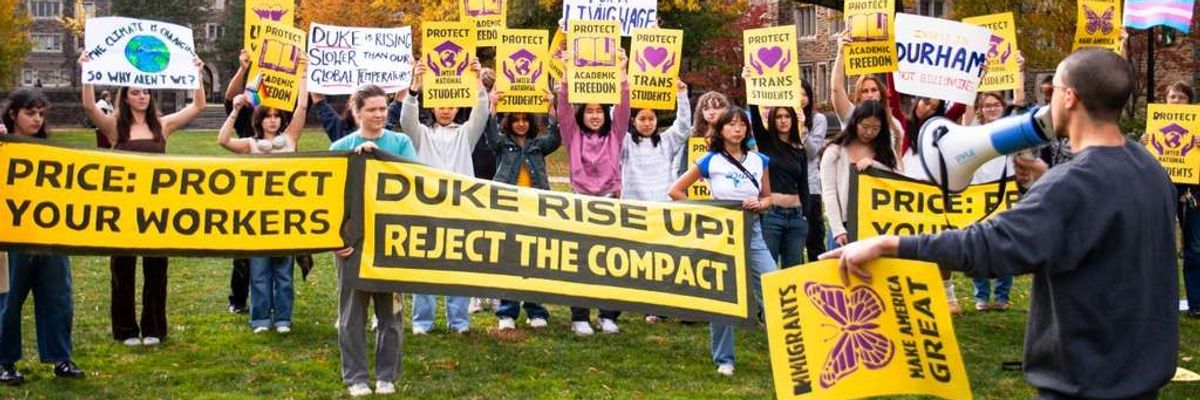
Students at Duke University in Durham, North Carolina joined nationwide protests against President Donald Trump’s attacks on higher education on November 7, 2025.
(Photo: Sunrise Movement/X)
Jessica Corbett
Nov 07, 2025
COMMON DREAMS
Students and professors at over 100 universities across the United States on Friday joined protests against President Donald Trump’s sweeping assault on higher education, including a federal funding compact that critics call “extortion.”
Crafted in part by billionaire financier Marc Rowan, Trump’s Compact for Excellence in Higher Education was initially presented to a short list of prestigious schools but later offered to other institutions as a way to restore or gain priority access to federal funding.
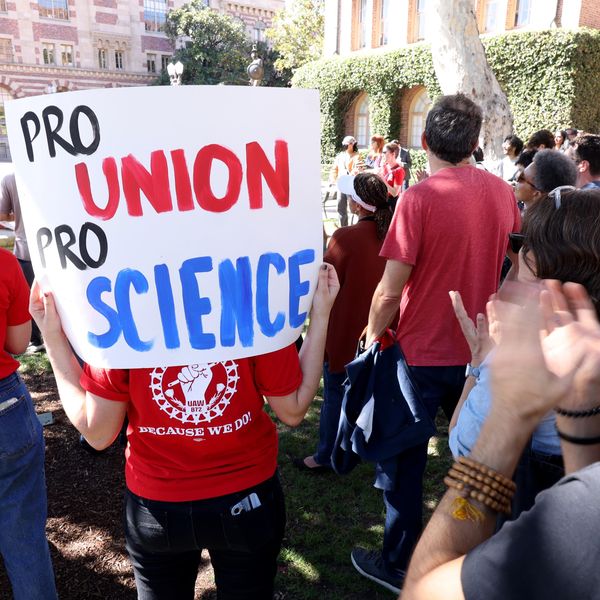
100+ US Campus Protests to Call Out Trump Attacks and Unaffordable Education
The compact requires signatories to commit to “transforming or abolishing institutional units that purposefully punish, belittle, and even spark violence against conservative ideas,” while also targeting trans student-athletes and diversity, equity, and inclusion (DEI) policies.
“The attacks on higher ed are attacks on truth, freedom, and our future. We’re organizing to protect campuses as spaces for learning, not control—for liberation, not censorship,” said Brianni Davillier, a student organizer with Public Citizen, which is among the advocacy groups and labor unions supporting the Students Rise Up movement behind Friday’s demonstrations.
At the Community College of Philadelphia, protesters stressed that “higher education research saves lives.” Duke University demonstrators carried signs that called for protecting academic freedom and transgender students. Roughly 10 miles away, at the University of North Carolina at Chapel Hill, they unfurled a banner that read, “Stand for Students | Reject Trump’s Compact.”
Professors from multiple schools came together for a rally at Central Connecticut State University, according to Connecticut Post.
“The compact would require universities submit to a system of government surveillance and policing meant to abolish departments that the government disapproves of, promote certain viewpoints over others, restrict the ability of university employees to express themselves on any major issue of the day,” said James Bhandary-Alexander, a Yale Law School professor and member of the university’s American Association of University Professors (AAUP) executive committee.
AAUP, also part of the coalition backing the protest movement, said on social media Friday: “Trump and Marc Rowan’s loyalty oath compact is [trash]!! Out with billionaires and authoritarians in higher ed! Our universities belong to the students and higher ed workers!”
Protesters urged their school leaders to not only reject Trump’s compact—which some universities have already publicly done—but also focus on other priorities of campus communities.
At the University of Kansas, provost Barbara Bichelmeyer confirmed last month to The University Daily Kansan that KU will not sign the compact. However, students still demonstrated on Friday.
“They did say ‘no’ but that’s like the bare minimum,” said Cameron Renne, a leader with the KU chapters of the Sunrise Movement and Young Democratic Socialists of America. “We’re hoping to get the administration to hear us and at least try to cooperate with us on some of our demands.”
According to The University Daily Kansan, “Renne said the groups are also pushing for divestment from fossil fuels, improvements in campus maintenance, and the removal of restrictions on gender ideology.”
Some schools have declined to sign on to the compact but reached separate agreements with the Trump administration. As the Guardian reported Friday:
At Brown University in Rhode Island—one of the first institutions to reach a settlement with the Trump administration earlier this year—passersby were invited to endorse a banner listing a series of demands by dipping their hands in paint and leaving their print, while a group of faculty members nearby lectured about the history of autocracy.
“Trump came to our community thinking we could be bullied out of our freedom,” said Simon Aron, a sophomore and co-president of Brown Rise Up. “He was wrong.”
Brown isn’t the only Ivy League school to strike a deal with Trump; so have Columbia University and the University of Pennsylvania, the alma mater of both Rowan and Trump. Cornell University followed suit on Friday amid nationwide demonstrations.
“November 7th is only the start,” said Kaden Ouimet, another student organizer with Public Citizen. “We’re building a movement of students, faculty, and campus workers to demand our colleges do not comply with the Trump regime, and its authoritarian campus compact.”
“We know that to fully take on autocracy, we have to take on the material conditions that gave rise to it,” the organizer added. “That is why we’re not only out to defeat Trump, but to also win a vision for affordability, security, and freedom for our generation—both in higher education, and in our democracy.”
Cornell Becomes Latest University to Submit to Trump’s ‘Extortion’ Over Student Protests
The government claimed that Cornell had violated civil rights law by allowing students to protest against Israel. Even though the agreement required the school to admit no wrongdoing, it still agreed to pay a $30 million fine.
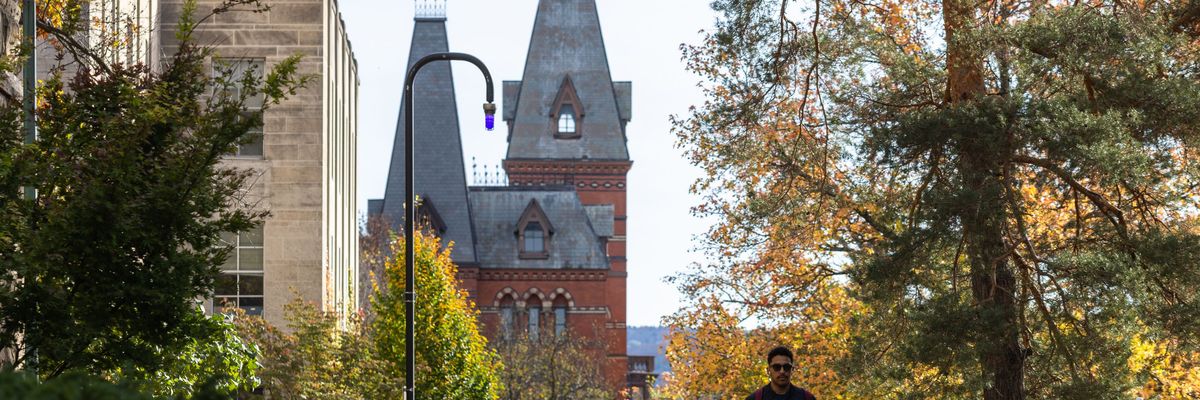
People walk through the Cornell University campus on November 3, 2023,
The government claimed that Cornell had violated civil rights law by allowing students to protest against Israel. Even though the agreement required the school to admit no wrongdoing, it still agreed to pay a $30 million fine.
People walk through the Cornell University campus on November 3, 2023,
in Ithaca, New York.
(Photo by Matt Burkhartt/Getty Images)
Stephen Prager
Nov 07, 2025
COMMON DREAMS
Cornell University became the latest school to cave to demands from the Trump administration on Friday, inking a deal that would restore $250 million in unpaid research funds stripped by the federal government as part of its crusade against higher education and efforts to punish schools that allowed students to freely express pro-Palestine views.
Following a months-long investigation by the government for allegedly violating Title VI of the Civil Rights Act, the Ivy League school agreed to pay a $30 million fine to the government, which claimed that Cornell had violated the law by not sufficiently cracking down on student protests against Israel’s genocide in Gaza. The administration accused the school of failing “to protect Jewish students.”
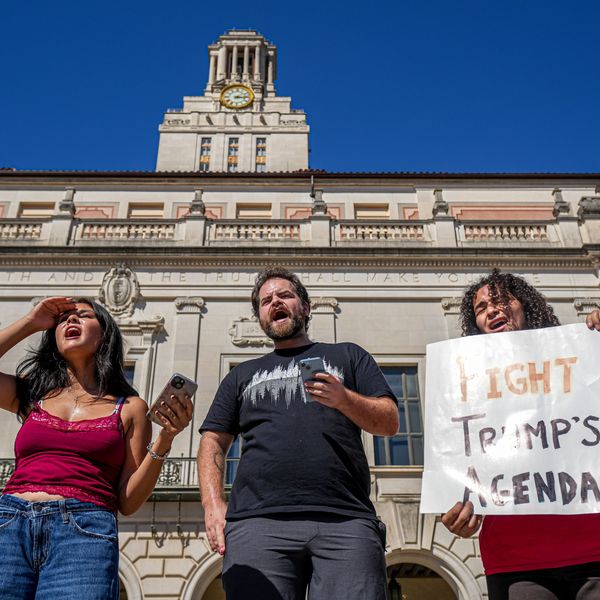
Three More Top Universities Reject Trump’s Extortion Compact for Funding
In March, the Department of Education launched investigations into 60 major US universities, with Education Secretary Linda McMahon describing students’ peaceful demonstrations against Israel that had swept campuses the previous year as “relentless antisemitic eruptions.”
As The Guardian reported earlier this week, the civil rights investigation at Cornell had been spurred by a nonspecific, anonymous complaint that a professor “is supporting Hammas [sic] and their beliefs. He is literally brain washing students to hate and discriminate towards a certain religions [sic]–Jews.” The complaint demanded that the professor be “black listed” from teaching.
Following this complaint, the Department of Education’s Office of Civil Rights announced an investigation into the school for “failing to respond to incidents of harassment.”
In a letter to the school community on Friday, Cornell’s president, Michael Kotlikoff, said that the resolution made explicit that its agreement to pay out the lofty fine to the Trump administration was “not an admission of wrongdoing” by the university.
In addition to paying the fine, the school also had to set aside another $30 million to invest in “research programs that will directly benefit US farmers through lower costs of production and enhanced efficiency.”
And while Kotlikoff said he would refuse a deal that allowed the government to “dictate our institution’s policies,” the agreement requires the school to comply with several of the Trump administration’s ideological goals.
It agreed to restrict its use of diversity, equity, and inclusion (DEI) policies and turn over data on the racial makeup of its student body to demonstrate that it is complying with the 2023 Supreme Court decision outlawing affirmative action. It also agreed to train staff using a Justice Department memo ordering colleges to abandon “transgender-friendly” policies.
Cornell also agreed to “conduct annual surveys to evaluate the campus climate for Cornell students, including the climate for students with shared Jewish ancestry.” The school specifically agreed to query students about “whether they believe the changes Cornell has made since October of 2023,” when Israel launched a two-year genocide in response to Hamas attack, “have benefited the Cornell community.”
The Trump administration has notably ordered schools to abide by a wide-ranging definition of “antisemitism” that not only punishes displays of bigotry against Jewish people, but also criticisms of Israel’s government and policies.
Cornell also agreed to seek out “experts on laws and regulations regarding sanctions enforcement, anti-money laundering, and prevention of terrorist financing,” suggesting that the school will be expected to discipline and investigate pro-Palestinian organizations on campus, which the administration has baselessly accused of “material support” for terrorism.
Cornell’s agreement with the administration comes as students at more than 100 campuses across the country have launched demonstrations against Trump’s efforts to coerce schools into signing his “Compact for Academic Excellence in Higher Education,” in exchange for priority federal funding and other “positive benefits.” Critics have described it as a “loyalty oath” and an “extortion agreement.”
Though several schools have declined to sign onto the compact, Cornell is not the first school to bend to the Trump administration’s demands to restart the flow of federal funding: Brown University, Columbia University, the University of Pennsylvania, and the University of Virginia have all cut similar deals.
Jameel Jaffer, the director of the Knight First Amendment Institute at Columbia University, has argued that there was little basis for Cornell to be fined for civil rights violations.
“If the Trump administration had evidence that Cornell systemically discriminated against Jewish students in violation of Title VI, it wouldn’t let the university off the hook for a $30 million investment in research about AI, robotics, and farming,” Jaffer said. “But, of course, there’s no such evidence. The settlement only confirms what we already knew—that the Trump administration’s Title VI allegations were baseless and made in bad faith.”
“That doesn’t mean there weren’t antisemitic incidents on Cornell’s campus. There were. But there’s just no support for the notion that Cornell or other major American universities were indifferent to antisemitism,” he continued. “The problem wasn’t that universities were indifferent to antisemitism, but that they allowed trustees, advocacy groups, demagogues, etc. to pressure them into treating as ‘antisemitism’ all kinds of political expression and advocacy that was entirely legitimate.”
A report from the American Association of University Professors and the Middle East Studies Association, which analyzed discrimination complaints sent to the Civil Rights Office found that “all but one of the 102 antisemitism complaint letters we have analyzed focus on speech critical of Israel; of these, 79% contain allegations of antisemitism that simply describe criticisms of Israel or Zionism with no reference to Jews or Judaism; at least 50% of complaints consist solely of such criticism.”
Though the payout was far less than the $200 million settlement Columbia agreed to pay earlier this year, Spencer Beswick, a postdoctoral associate at Cornell’s Humanities Scholars Program, wrote on social media that his university was guilty of “capitulation to extortion.”
Most Campus ‘Antisemitism’ Probes Target Criticism of Israel, Not Anti-Jewish Hate: Report
The report shows how a landmark civil rights law “is being cynically misused to squash political dissent and speech that advocates for the human rights of Palestinians,” said one AAUP leader.
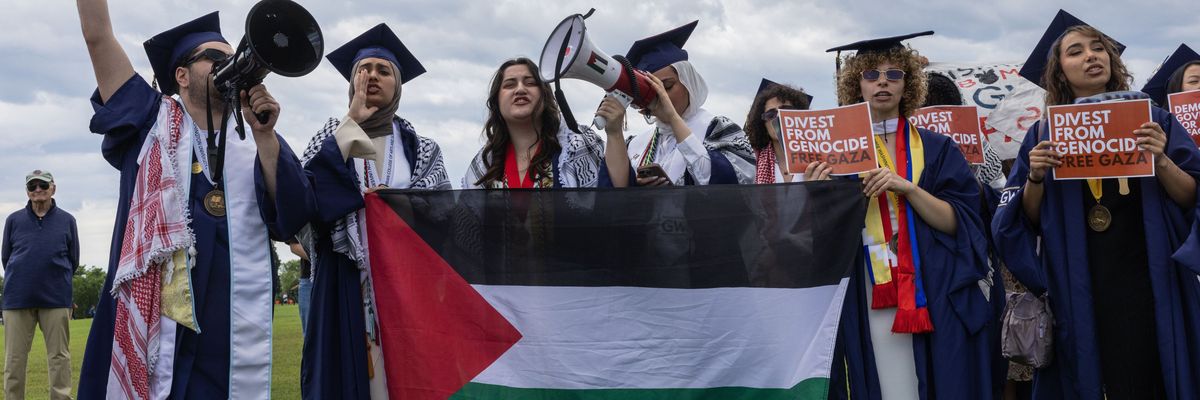
George Washington University students hold a walkout at the National Mall as the institution’s president, Ellen Granberg, delivers her commencement address on May 18, 2025 in Washington, DC.
(Photo by Probal Rashid/LightRocket via Getty Images)
Jessica Corbett
Nov 06, 2025
COMMON DREAMS
Under both the Biden and Trump administrations, pro-Israel and far-right advocacy groups have driven a surge of federal civil rights investigations conflating true antisemitism with university professors and students’ criticism of the US-backed Israeli government and its genocidal assault on the Gaza Strip.
That’s according to Discriminating Against Dissent: The Weaponization of Civil Rights Law to Repress Campus Speech on Palestine, a report published this week by the American Association of University Professors (AAUP) and the Middle East Studies Association (MESA).
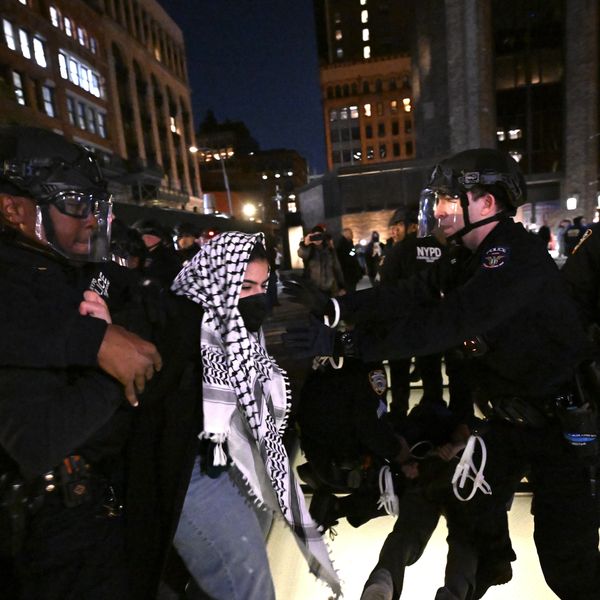
‘Solidarity as a Crime’: Report Details Crackdown on Pro-Palestine Protests Across West
“Our members, because of their expertise on the region, have long borne the brunt of allegations that falsely equate criticism of Israel with antisemitism,” MESA president Aslı Bâli said in a statement. “Complaints like these penalize scholars for teaching basic facts about the region.”
The report begins: “Over the past two years, the United States government has taken unprecedented steps to suppress campus speech—including scholarship, advocacy, and protest—opposing the state of Israel’s genocidal war against the Palestinian people in the Gaza Strip. This crackdown has paved the way for profound transformations in US colleges and universities.”
“A long-standing ‘Palestine exception’ to the First Amendment now threatens to give way to a new reality: Palestine is less an exception to academic freedom than it is a pretext for erasing the norm altogether, as part of an authoritarian assault on the autonomy of higher education and on the very idea of racial and gender equity,” the document warns.
The analysis comes as President Donald Trump continues his sweeping attack, aiming to shut down the Department of Education, deport foreign students critical of Israel, and bully campus leaders into signing an “extortion agreement” for federal funding.
“In effect, the Civil Rights Act of 1964 is no longer being used to address racial discrimination in higher education,” Bâli told the Guardian, which first reported on the findings. “Instead, Title VI has been repurposed as part of the administration’s broader effort to remake higher education in line with its right-wing political and cultural agenda.”
AAUP and MESA found that “more investigations were opened in the last two months of 2023 (25) than in all previous years combined (24). Investigations broke record numbers in 2024 (39) and are on track to do so again in 2025 (38, as of September 30).”
“All but one of the 102 antisemitism complaint letters we have analyzed focus on speech critical of Israel; of these, 79% contain allegations of antisemitism that simply describe criticisms of Israel or Zionism with no reference to Jews or Judaism; at least 50% of complaints consist solely of such criticism,” the document states.
The report highlights that “the Biden administration opened more antisemitism probes against colleges and universities (65) than for all other types of racial harassment combined (38),” and “the Trump administration appears to have halted racial harassment investigations altogether.”
The federal probes “are producing a new system of government surveillance and monitoring of campus speech,” the report notes, with over 20 schools agreeing to share internal data on discrimination complaints with the government.
Examining Trump’s Task Force to Combat Antisemitism, the researchers found that the Department of Education “has continued to open very high numbers of antisemitism probes even as its staff has been slashed by the Trump administration,” and “in its high-profile campaigns against prestigious universities, the task force has systematically ignored the procedural requirements of Title VI, unlawfully cutting off vast sums of funding before any meaningful investigation, let alone findings.”
For at least 78% of the complaints examined by AAUP and MESA, pro-Israel and right-wing advocacy organizations—including those without any campus presence—served as complainants or represented them. Such groups have also been involved with private lawsuits intended to redefine antisemitism as including criticism of Israel and restrict such criticism at universities.
“Antisemitism lawsuits surged after October 7, 2023 (two filed before that date, 26 since),” according to the analysis. “No court has yet made a final judgment in favor of plaintiffs. In nine cases, Title VI claims have been dismissed, including on free speech grounds; nine lawsuits have settled, some of which resulted in even more draconian policy changes on campuses than government investigations.”
AAUP general counsel Veena Dubal said that “the findings in this report underscore how the Civil Rights Act of 1964—which passed in response to years of nonviolent civil disobedience against racial injustice—is being cynically misused to squash political dissent and speech that advocates for the human rights of Palestinians.”
“This is a perverse outcome,” Dubal declared, as AAUP prepares for Friday protests pressuring leaders at over 100 institutions to reject the president’s “Compact for Academic Excellence in Higher Education” and make schooling more affordable.
As AAUP president Todd Wolfson said in a statement about the day of action earlier this week, “From attacks on academic freedom in the classroom to the defunding of lifesaving scientific research to surveilling and arresting peaceful student protesters, Trump’s higher education policies have been catastrophic for our communities and our democracy.”
“We’re excited to help build a coalition of students and workers united in fighting back for a higher education system that is accessible and affordable for all and serves the common good,” he added. Other supporting groups include Campus Climate Network, College Democrats of America, Gen-Z for Change, Indivisible, Jewish Voice for Peace, March for Our Lives, and Sunrise Movement.
(Photo by Matt Burkhartt/Getty Images)
Stephen Prager
Nov 07, 2025
COMMON DREAMS
Cornell University became the latest school to cave to demands from the Trump administration on Friday, inking a deal that would restore $250 million in unpaid research funds stripped by the federal government as part of its crusade against higher education and efforts to punish schools that allowed students to freely express pro-Palestine views.
Following a months-long investigation by the government for allegedly violating Title VI of the Civil Rights Act, the Ivy League school agreed to pay a $30 million fine to the government, which claimed that Cornell had violated the law by not sufficiently cracking down on student protests against Israel’s genocide in Gaza. The administration accused the school of failing “to protect Jewish students.”
Three More Top Universities Reject Trump’s Extortion Compact for Funding
In March, the Department of Education launched investigations into 60 major US universities, with Education Secretary Linda McMahon describing students’ peaceful demonstrations against Israel that had swept campuses the previous year as “relentless antisemitic eruptions.”
As The Guardian reported earlier this week, the civil rights investigation at Cornell had been spurred by a nonspecific, anonymous complaint that a professor “is supporting Hammas [sic] and their beliefs. He is literally brain washing students to hate and discriminate towards a certain religions [sic]–Jews.” The complaint demanded that the professor be “black listed” from teaching.
Following this complaint, the Department of Education’s Office of Civil Rights announced an investigation into the school for “failing to respond to incidents of harassment.”
In a letter to the school community on Friday, Cornell’s president, Michael Kotlikoff, said that the resolution made explicit that its agreement to pay out the lofty fine to the Trump administration was “not an admission of wrongdoing” by the university.
In addition to paying the fine, the school also had to set aside another $30 million to invest in “research programs that will directly benefit US farmers through lower costs of production and enhanced efficiency.”
And while Kotlikoff said he would refuse a deal that allowed the government to “dictate our institution’s policies,” the agreement requires the school to comply with several of the Trump administration’s ideological goals.
It agreed to restrict its use of diversity, equity, and inclusion (DEI) policies and turn over data on the racial makeup of its student body to demonstrate that it is complying with the 2023 Supreme Court decision outlawing affirmative action. It also agreed to train staff using a Justice Department memo ordering colleges to abandon “transgender-friendly” policies.
Cornell also agreed to “conduct annual surveys to evaluate the campus climate for Cornell students, including the climate for students with shared Jewish ancestry.” The school specifically agreed to query students about “whether they believe the changes Cornell has made since October of 2023,” when Israel launched a two-year genocide in response to Hamas attack, “have benefited the Cornell community.”
The Trump administration has notably ordered schools to abide by a wide-ranging definition of “antisemitism” that not only punishes displays of bigotry against Jewish people, but also criticisms of Israel’s government and policies.
Cornell also agreed to seek out “experts on laws and regulations regarding sanctions enforcement, anti-money laundering, and prevention of terrorist financing,” suggesting that the school will be expected to discipline and investigate pro-Palestinian organizations on campus, which the administration has baselessly accused of “material support” for terrorism.
Cornell’s agreement with the administration comes as students at more than 100 campuses across the country have launched demonstrations against Trump’s efforts to coerce schools into signing his “Compact for Academic Excellence in Higher Education,” in exchange for priority federal funding and other “positive benefits.” Critics have described it as a “loyalty oath” and an “extortion agreement.”
Though several schools have declined to sign onto the compact, Cornell is not the first school to bend to the Trump administration’s demands to restart the flow of federal funding: Brown University, Columbia University, the University of Pennsylvania, and the University of Virginia have all cut similar deals.
Jameel Jaffer, the director of the Knight First Amendment Institute at Columbia University, has argued that there was little basis for Cornell to be fined for civil rights violations.
“If the Trump administration had evidence that Cornell systemically discriminated against Jewish students in violation of Title VI, it wouldn’t let the university off the hook for a $30 million investment in research about AI, robotics, and farming,” Jaffer said. “But, of course, there’s no such evidence. The settlement only confirms what we already knew—that the Trump administration’s Title VI allegations were baseless and made in bad faith.”
“That doesn’t mean there weren’t antisemitic incidents on Cornell’s campus. There were. But there’s just no support for the notion that Cornell or other major American universities were indifferent to antisemitism,” he continued. “The problem wasn’t that universities were indifferent to antisemitism, but that they allowed trustees, advocacy groups, demagogues, etc. to pressure them into treating as ‘antisemitism’ all kinds of political expression and advocacy that was entirely legitimate.”
A report from the American Association of University Professors and the Middle East Studies Association, which analyzed discrimination complaints sent to the Civil Rights Office found that “all but one of the 102 antisemitism complaint letters we have analyzed focus on speech critical of Israel; of these, 79% contain allegations of antisemitism that simply describe criticisms of Israel or Zionism with no reference to Jews or Judaism; at least 50% of complaints consist solely of such criticism.”
Though the payout was far less than the $200 million settlement Columbia agreed to pay earlier this year, Spencer Beswick, a postdoctoral associate at Cornell’s Humanities Scholars Program, wrote on social media that his university was guilty of “capitulation to extortion.”
Most Campus ‘Antisemitism’ Probes Target Criticism of Israel, Not Anti-Jewish Hate: Report
The report shows how a landmark civil rights law “is being cynically misused to squash political dissent and speech that advocates for the human rights of Palestinians,” said one AAUP leader.
George Washington University students hold a walkout at the National Mall as the institution’s president, Ellen Granberg, delivers her commencement address on May 18, 2025 in Washington, DC.
(Photo by Probal Rashid/LightRocket via Getty Images)
Jessica Corbett
Nov 06, 2025
COMMON DREAMS
Under both the Biden and Trump administrations, pro-Israel and far-right advocacy groups have driven a surge of federal civil rights investigations conflating true antisemitism with university professors and students’ criticism of the US-backed Israeli government and its genocidal assault on the Gaza Strip.
That’s according to Discriminating Against Dissent: The Weaponization of Civil Rights Law to Repress Campus Speech on Palestine, a report published this week by the American Association of University Professors (AAUP) and the Middle East Studies Association (MESA).
‘Solidarity as a Crime’: Report Details Crackdown on Pro-Palestine Protests Across West
“Our members, because of their expertise on the region, have long borne the brunt of allegations that falsely equate criticism of Israel with antisemitism,” MESA president Aslı Bâli said in a statement. “Complaints like these penalize scholars for teaching basic facts about the region.”
The report begins: “Over the past two years, the United States government has taken unprecedented steps to suppress campus speech—including scholarship, advocacy, and protest—opposing the state of Israel’s genocidal war against the Palestinian people in the Gaza Strip. This crackdown has paved the way for profound transformations in US colleges and universities.”
“A long-standing ‘Palestine exception’ to the First Amendment now threatens to give way to a new reality: Palestine is less an exception to academic freedom than it is a pretext for erasing the norm altogether, as part of an authoritarian assault on the autonomy of higher education and on the very idea of racial and gender equity,” the document warns.
The analysis comes as President Donald Trump continues his sweeping attack, aiming to shut down the Department of Education, deport foreign students critical of Israel, and bully campus leaders into signing an “extortion agreement” for federal funding.
“In effect, the Civil Rights Act of 1964 is no longer being used to address racial discrimination in higher education,” Bâli told the Guardian, which first reported on the findings. “Instead, Title VI has been repurposed as part of the administration’s broader effort to remake higher education in line with its right-wing political and cultural agenda.”
AAUP and MESA found that “more investigations were opened in the last two months of 2023 (25) than in all previous years combined (24). Investigations broke record numbers in 2024 (39) and are on track to do so again in 2025 (38, as of September 30).”
“All but one of the 102 antisemitism complaint letters we have analyzed focus on speech critical of Israel; of these, 79% contain allegations of antisemitism that simply describe criticisms of Israel or Zionism with no reference to Jews or Judaism; at least 50% of complaints consist solely of such criticism,” the document states.
The report highlights that “the Biden administration opened more antisemitism probes against colleges and universities (65) than for all other types of racial harassment combined (38),” and “the Trump administration appears to have halted racial harassment investigations altogether.”
The federal probes “are producing a new system of government surveillance and monitoring of campus speech,” the report notes, with over 20 schools agreeing to share internal data on discrimination complaints with the government.
Examining Trump’s Task Force to Combat Antisemitism, the researchers found that the Department of Education “has continued to open very high numbers of antisemitism probes even as its staff has been slashed by the Trump administration,” and “in its high-profile campaigns against prestigious universities, the task force has systematically ignored the procedural requirements of Title VI, unlawfully cutting off vast sums of funding before any meaningful investigation, let alone findings.”
For at least 78% of the complaints examined by AAUP and MESA, pro-Israel and right-wing advocacy organizations—including those without any campus presence—served as complainants or represented them. Such groups have also been involved with private lawsuits intended to redefine antisemitism as including criticism of Israel and restrict such criticism at universities.
“Antisemitism lawsuits surged after October 7, 2023 (two filed before that date, 26 since),” according to the analysis. “No court has yet made a final judgment in favor of plaintiffs. In nine cases, Title VI claims have been dismissed, including on free speech grounds; nine lawsuits have settled, some of which resulted in even more draconian policy changes on campuses than government investigations.”
AAUP general counsel Veena Dubal said that “the findings in this report underscore how the Civil Rights Act of 1964—which passed in response to years of nonviolent civil disobedience against racial injustice—is being cynically misused to squash political dissent and speech that advocates for the human rights of Palestinians.”
“This is a perverse outcome,” Dubal declared, as AAUP prepares for Friday protests pressuring leaders at over 100 institutions to reject the president’s “Compact for Academic Excellence in Higher Education” and make schooling more affordable.
As AAUP president Todd Wolfson said in a statement about the day of action earlier this week, “From attacks on academic freedom in the classroom to the defunding of lifesaving scientific research to surveilling and arresting peaceful student protesters, Trump’s higher education policies have been catastrophic for our communities and our democracy.”
“We’re excited to help build a coalition of students and workers united in fighting back for a higher education system that is accessible and affordable for all and serves the common good,” he added. Other supporting groups include Campus Climate Network, College Democrats of America, Gen-Z for Change, Indivisible, Jewish Voice for Peace, March for Our Lives, and Sunrise Movement.

No comments:
Post a Comment