Hungary Makes Historic Switch to American Nuclear Fuel
Hungary will buy U.S. nuclear fuel for the first time to use at a Russia-built nuclear power plant in the country, Hungarian Foreign Minister Peter Szijjarto said ahead of a meeting of the U.S. and Hungarian leaders.
Szijjarto is part of a large Hungarian delegation led by Prime Minister Viktor Orban who is meeting with U.S. President Donald Trump on Friday.
The U.S. and Hungary are expected to discuss energy cooperation and Hungary’s insistence that it should continue to rely on and import Russian crude oil, which Washington has advised against.
“We will sign a major intergovernmental agreement on cooperation in nuclear energy with my foreign minister colleague Marco Rubio,” Szijjarto said on Friday ahead of the meeting, as carried by Reuters.
“This is the first time in Hungary’s history that we will purchase American nuclear fuel,” the foreign minister added.
Hungary will buy U.S. nuclear fuel for the Paks nuclear power plant, built by Rosatom, which was awarded in 2014 an expansion project at the site without a tender.
Nuclear power cooperation will be one of the topics Hungary and the U.S. will discuss today.
Another major issue will be talks on Hungary’s oil imports, rather, the country’s insistence that it cannot remain competitive without Russian oil.
Orban has already signaled he would seek to persuade President Trump to carve out an exemption for Hungary in the U.S. sanctions against Russia’s top oil firms.
“We have to make the Americans understand this strange situation if we want exceptions to the American sanctions that are hitting Russia,” Orban, a Trump ally and admirer, told Hungarian state radio last week.
But following the sanctions, the U.S. increased pressure on Hungary to cut off its reliance on Russian oil imports and vowed to work with Hungarian authorities and neighboring countries to help Budapest wean off Russian supply.
Hungary, whose top officials have remained in contact with Russia’s leadership including Vladimir Putin, has continuously clashed with its fellow EU member states over plans to ditch Russian gas by 2027 and cut off oil supply from Moscow as soon as possible.
By Tsvetana Paraskova for Oilprice.com
Paks II first concrete set for February after licences issued
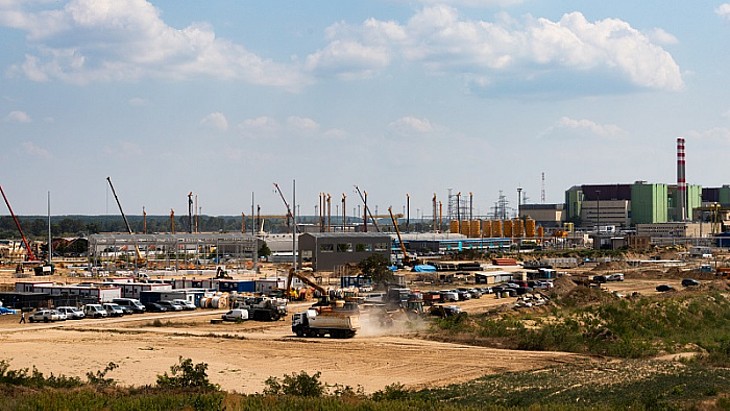
The Paks II project company said the authority - the HAEA - "issued construction licences for the control building, auxiliary building and technological service building of Unit 5. The authority also made a positive decision regarding the partial commissioning licence for soil improvement of the nuclear island of Unit 5. Obtaining these licences is a crucial step toward starting concreting works, including the construction of the foundation slab of the nuclear island of Unit 5."
The Paks plant, 100 kilometres south of Budapest, currently comprises four Russian-supplied VVER-440 pressurised water reactors, which started up between 1982 and 1987. An inter-governmental agreement was signed in early 2014 for Russian enterprises and their international subcontractors to supply two VVER-1200 reactors at Paks as well as a Russian state loan of up to EUR10.0 billion (USD10.5 billion) to finance 80% of the project.
The construction licence application was submitted in July 2020, the licence was issued in August 2022, and a construction timetable was agreed in 2023. First concrete had been expected later this year, with a target to connect the new units to the grid at the beginning of the 2030s.
First concrete - after which point it will be officially classified as a nuclear power plant under construction - is now expected to be poured in February.
Rosatom said that the licences, which also covered nuclear island buildings, "confirm the project's compliance with strict international, European, and national nuclear safety requirements. A comprehensive approach to safety, including the use of active and passive systems, ensures compliance with all standards. Obtaining the permits allows for full-scale construction to begin, including active preparation for the pouring of the first concrete".
Hungary's Foreign Minister Peter Szijjártó told World Nuclear Exhibition in Paris on Tuesday that two million cubic metres of soil had been already excavated, and 43,000 cement columns placed in the ground as part of earthworks while 30 buildings have been completed and 50 more under construction. He said that long-lead items are being manufactured in six countries, with French and German companies involved, as well as the key reactor internals and steam generators being manufactured by Rosatom in Russia.
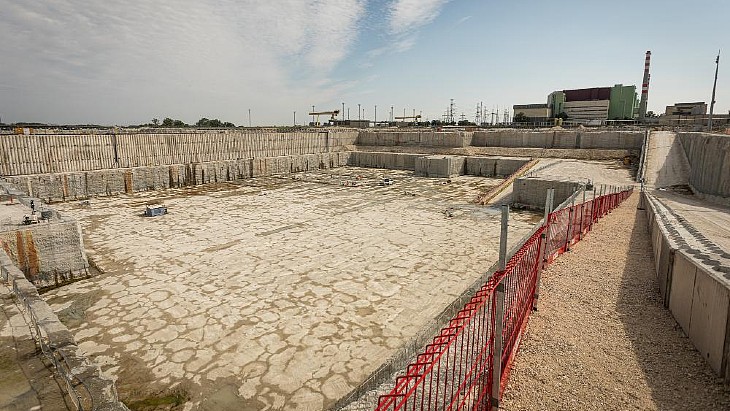
Preparatory earthworks have been taking place (Image: Paks II)
In September the European Court of Justice backed Austria's appeal against Hungary's state aid for the construction of the Paks II nuclear power plant and said the European Commission "should have ascertained" whether the direct award of a contract "complies with EU public procurement rules". That means that the European Commission is re-examining whether or not to approve the state funding plan, which it had approved in 2017. Hungarian ministers have said the court's decision
China Claims World-First Thorium Reactor Breakthrough
- Chinese scientists successfully converted thorium-232 into uranium-233 within an experimental thorium molten salt reactor, validating the technical feasibility of the thorium fuel cycle.
- This breakthrough puts China at the forefront of next-generation nuclear research, as the thorium molten salt reactor offers inherent safety features, water-free cooling, and less waste than traditional uranium reactors.
- China has massive domestic thorium reserves, which, if fully exploited, are estimated to be enough to fuel the country for tens of thousands of years, providing a safe and reliable energy solution.
China has just unveiled a major breakthrough in nuclear reactor materials and technology that could pave the way to safer fission energy with less waste and no water use for cooling.
In April this year, Chinese scientists successfully added fresh fuel to an operational experimental thorium molten salt reactor in the Gobi Desert.
Six months later, the scientists from the Shanghai Institute of Applied Physics at the Chinese Academy of Sciences now announce they have converted thorium into uranium in the thorium molten salt reactor, in a world-first such scientific breakthrough.
The achievement showed that the thorium fuel cycle is technically feasible and opens the door to the potential use of thorium in nuclear fission reactors.
Thorium is about three times more abundant in nature compared to uranium and has no fissile isotopes. This means that it cannot be enriched and used for nuclear weapons, unlike uranium. And thorium is believed to be so abundant in China that it could power homes for thousands of years.
The scientific breakthrough doesn’t mean that China has found the Holy Grail of nuclear energy, but it would encourage additional research and more experiments in the ‘breeding’ of uranium from thorium.
With the successful thorium-to-uranium experimental conversion, China now has the world’s only operational thorium molten salt reactor, which puts Beijing at the forefront of the global race for next-generation nuclear reactor research.
The successful reaction in the thorium molten salt reactor showed that thorium-232 continuously captures neutrons and transforms into uranium-233. The uranium, in turn, releases energy through nuclear fission to create a self-sustaining “burn while breeding” cycle.
“As a fourth-generation nuclear power reactor type, molten salt reactors use high-temperature molten salt as a coolant,” Dai Zhimin, director of the Shanghai Institute of Applied Physics, was quoted as saying by China Daily.
“Endowed with inherent safety features, water-free cooling, low-pressure operation and high-temperature output, they are internationally recognized as the most suitable reactor type for thorium resource utilization,” Dai added.
The institute aims to complete the construction and demonstration operation of a 100-megawatt (MW) thermal prototype by 2035 and achieve commercial-scale application, the scientist said.
“This will accelerate technological innovation and engineering transformation, ultimately providing China with a safe, reliable and domestically controlled thorium-based energy generation solution,” Dai said.
China has also produced domestically all key parts of the reactor’s components as it aims to establish its own fully independent industrial supply chain for thorium molten salt reactor technologies.
Moreover, China has massive thorium reserves, according to international and domestic estimates.
Related: Indian Oil Giant ONGC Eyes Return to Syrian Operations
China is among the world’s biggest holders of thorium reserves, per a 2016 resource estimate by the International Atomic Energy Agency (IAEA) and the OECD Nuclear Energy Agency (NEA). However, there is no international or standard classification for thorium resources, so identified thorium resources do not have the same meaning in terms of classification as identified uranium resources. Thorium is not a primary exploration target and resources are estimated in relation to uranium and rare earths resources.
But early this year, a declassified Chinese survey of thorium resources surfaced, showing that China may have infinite reserves of thorium for nuclear reactors for tens of thousands of years.
The survey claims that just five years of mining waste from a single iron ore site in Inner Mongolia contains enough thorium to meet U.S. household energy demands for more than 1,000 years, the South China Morning Post reported in February, citing a report published in the Chinese journal Geological Review.
If fully exploited, the Bayan Obo mining district in Inner Mongolia could yield 1 million tons of thorium. This would be enough to fuel China for 60,000 years, according to estimates of some local scientists.
By Tsvetana Paraskova for Oilprice.com
Chinese molten salt reactor achieves conversion of thorium-uranium fuel
_69614.jpg)
Construction of the 2 MWt TMSR-LF1 reactor began in September 2018 and was scheduled to be completed in 2024. However, it was reportedly completed in August 2021 after work was accelerated. In August 2022, the Shanghai Institute of Applied Physics (SINAP) was given approval by the Ministry of Ecology and Environment to commission the reactor. An operating licence was granted for the reactor in June 2023. It achieved first criticality - a sustained reaction - on 11 October 2023.
The TMSR-LF1 uses fuel enriched to under 20% uranium-235, has a thorium inventory of about 50 kg and conversion ratio of about 0.1. A fertile blanket of lithium-beryllium fluoride (FLiBe) with 99.95% Li-7 is used, and fueled with uranium tetrafluoride (UF4).
"In October 2024, the world's first thorium addition to a molten salt reactor was completed, making it the first in the world to establish a unique molten salt reactor and thorium-uranium fuel cycle research platform," the Shanghai Institute of Applied Physics said.
On 1 November, the institute announced that TMSR-LF1 achieved the first conversion of thorium and uranium nuclear fuel.
"This marks the first time international experimental data has been obtained after thorium was introduced into a molten salt reactor, making it the only operational molten salt reactor in the world to have successfully incorporated thorium fuel," the institute said. "This milestone breakthrough provides core technological support and feasible solutions for the large-scale development and utilisation of thorium resources in China and the development of fourth-generation advanced nuclear energy systems."
Shanghai Institute of Applied Physics Deputy Director Li Qingnuan said: "Since first reaching criticality on 11 October 2023, the thorium-based molten salt reactor has been continuously generating heat through nuclear fission." She explained that conventional pressurised water reactors require periodic shutdowns and the opening of the pressure vessel top cover to replace the nuclear fuel when refueling is needed. However, the thorium-based molten salt reactor uses liquid fuel, with the nuclear fuel uniformly dissolved in the molten salt coolant and circulating with it, allowing for refueling without shutting down the reactor.
"This design not only improves fuel utilisation but also significantly reduces the generation of radioactive nuclear waste, which is one of the advantages of thorium-based molten salt reactors."
The institute's next step is to accelerate technological iteration and engineering transformation, aiming to complete a 100 MWt thorium-based molten salt reactor demonstration project and achieve demonstration applications by 2035, Shanghai Institute of Applied Physics Director Dai Zhimin said.
Molten salt reactors (MSRs) use molten fluoride salts as primary coolant, at low pressure. They may operate with epithermal or fast neutron spectrums, and with a variety of fuels. Much of the interest today in reviving the MSR concept relates to using thorium (to breed fissile uranium-233), where an initial source of fissile material such as plutonium-239 needs to be provided. There are a number of different MSR design concepts, and a number of interesting challenges in the commercialisation of many, especially with thorium.
Contract signed for pilot UK integral molten salt reactor fuel plant
_42372.jpg)
The agreement builds on a contract signed in August 2023 for the planning and initial design of IMSR fuel supply, leveraging the established deconversion and fuel manufacturing infrastructure at Westinghouse’s Springfields nuclear fuel manufacturing site in Preston in the UK. It has been expanded in scope to include a "wide range of commercial-scale fuel services" such as deconversion, fabrication, packaging and transportation. "Upon completion of the pilot plant, the facility will be positioned to scale to commercial fuel production for a future fleet of IMSR Plants," Terrestrial Energy said.
Terrestrial Energy's Integrated Molten Salt Reactor (IMSR) is a 4th generation reactor that uses molten salt as both fuel and coolant, with integrated components, which can supply heat directly to industrial facilities or use it to generate electrical power. It does this using conventional nuclear reactor fuel - standard assay low-enriched uranium, enriched to under 5% uranium-235. The use of this fuel - which the company refers to as SALEU - aligns with Springfields' "nearly 80-year legacy as a global leader in the supply of SALEU as uranium oxide fuel to commercial nuclear power reactors", the company said.
"Terrestrial Energy’s use of SALEU, the only commercially available reactor fuel on the market today, for IMSR plant operation shields the company from substantial supply challenges associated with the use of High-Assay Low-Enriched Uranium fuel (HALEU), which have been exacerbated by geopolitical tensions and the current lack of commercial-scale supply in the US market," it added. "SALEU supply chains are supported by well-established international transport protocols and decades of regulatory acceptance, positioning Terrestrial Energy to pursue a practical and accelerated pathway to early commercial IMSR plant deployment."
The pilot plant design features a re-optimised chemical process to supply uranium tetrafluoride - UF4 - which has been deconverted from uranium hexafluoride (UF6) at 5% enrichment: the current industry standard is the deconversion of UF6 at 5% enrichment, supplied from enrichment plants, to uranium oxide fuel. Optimising the process to deconvert to UF4 with the pilot plant design will enable the large-scale fuel supply required for IMSR fleet deployment by leveraging Springfields' existing commercial scale infrastructure, the company said.
Terrestrial Energy CEO Simon Irish said the expanded partnership with Westinghouse at Springfields is a "strategic milestone" in Terrestrial Energy's Western supply chain strategy as it commercialises its reactor technology. "With our SALEU fuel choice, we can maximise the use of existing nuclear industrial infrastructure at the Springfields site for capital efficiency. This collaboration enhances both our capital efficiency and scalability as we seek to meet the rapidly growing demand for clean, reliable, and flexible energy supply," he said.
Tarik Choho, Westinghouse President of Nuclear Fuel, said the company has been working with Terrestrial Energy on this "transformative initiative" for more than four years. "This partnership brings together complementary strengths and opportunities, accelerating innovation and delivering important impacts to our industry," he said.
Construction of the new plant is set to begin in 2026.
Constellation considering doubling Calvert Cliffs nuclear capacity
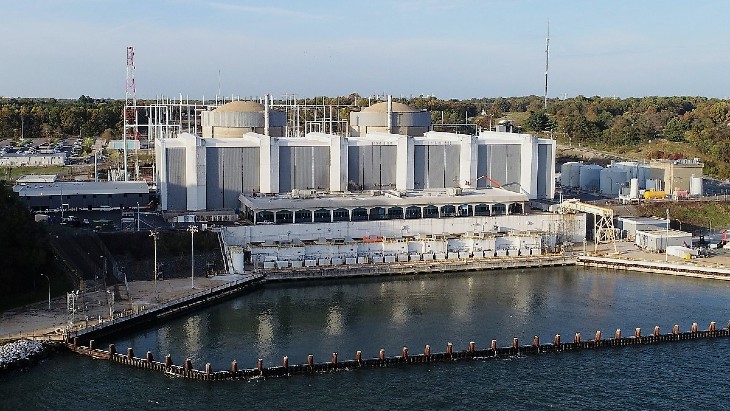
The company, which is also suggesting an 800 MW battery storage project and 700 MW of gas-fired generation that could be switched to carbon-free hydrogen fuel in the future, says its combined plans could lead to the US state's clean energy share increasing from 50% to 70%.
The plans for the Calvert Cliffs Clean Energy Center include 20-year life extensions for the two units which would otherwise shut down in 2034 and 2036. Constellation also says it can invest in uprates to increase the two pressurised water reactors' current 1,790 capacity by a further 190 MW. Calvert Cliffs is Maryland's only nuclear power plant and produces about 40% of Maryland's total power generation and 80% of the state's clean power generation.
With energy demands forecast to increase sharply in the coming decades, Constellation said it "will explore building 2,000 megawatts of new, next-generation nuclear at Calvert Cliffs, effectively doubling the site’s output and creating enough clean generation to power future economic growth".
The company said it could bring forward these developments in Maryland "at the lowest possible cost to consumers, provided we have clear direction and enabling legislation from Maryland’s policymakers".
Joe Dominguez, president and CEO of Constellation, said: "Today, we announce an ambitious plan to make billions of dollars of new investments in Maryland without seeking any electricity rate increases, including options ranging from new natural gas to battery storage and nuclear energy.
"What is clear to us is that we must build and retain resources that produce abundant, reliable and clean power. The best way we know to do that is to make state-of-the-art investments in our state's existing nuclear, hydroelectric and renewable energy resources to get them to operate better and longer, and then to build on top of that great foundation.
"We are excited to work with Governor Moore, other state policymakers, and all Maryland stakeholders to investigate the development of new nuclear power in our state just as dozens of states across America are doing today. Importantly, all our investments have been, and will be, done without any cost to Maryland families and businesses. We are not now, and never will be, a monopoly that seeks guaranteed profits. We are a company that competes for its opportunities just like all our hardworking customers do - every single day. Maryland is our home state and Constellation looks forward to continuing to offer competitive and innovative solutions to our state to create a prosperous and brighter future for Maryland families and businesses."
Eletronuclear says study backs Angra 3 completion

The results of the updated study, which Eletronuclear provided technical support for, have been sent by the nuclear power plant operator to the Minister of Mines and Energy, who is expected to forward it on to the National Energy Policy Council (CNPE), which will make the ultimate decision on whether or not to complete the power plant.
Eletronuclear says that the study projects the cost of abandoning the Angra 3 project at between BRL22 billion (USD4.1 billion) and BRL26 billion (with a cost of BRL1 billion per year just to maintain the project) which it says compares with an estimated cost of BRL23.9 billion to complete the project.
Under scenarios considered, the break-even tariff is put at a range of BRL778.86-BRL817 per MWh, which Eletronuclear says remains "lower than the average cost of most large-scale thermal power plants in the country, considering the Unit Variable Costs (UVC) plus the Fixed Revenue for availability (measured even without dispatching the plant)". That tariff estimate is higher than last year's estimate of BRL653.31 per MWh, with the rise put down to delays in the project and revision of financing costs.
Eletronuclear stressed the job creation and wider economic benefits of completing the project, including helping meet the growing energy demands of data centres while also minimising carbon emissions, saying: "The study also highlights that Angra 3 will offer clean, stable, and long-term energy, contributing to energy security and the decarbonisation goals of the Brazilian electricity matrix."
The government in Brazil has been split on whether to go ahead with the Angra 3 project. The latest update from Eletronuclear says that if the go-ahead is given, the target completion date would now be 2033.
The background
Brazil has two operating reactors - Angra 1 and Angra 2 - which generate about 3% of the country's electricity. Work on the Angra 3 project - to feature a Siemens/KWU 1405 MW pressurised water reactor - began in 1984 but was suspended two years later, before construction began. The scheme was resurrected in 2006, with first concrete in 2010. However, amid a corruption probe into government contracts, construction of the unit was halted for a second time in 2015, when it was 65% complete.
The project resumed again in November 2022 - at the time of the project's revitalisation, Eletronuclear's aim was to start operations by the end of 2026. However, work halted again in April 2023 after disputes with the municipality of the City of Angra dos Reis over agreements relating to "environmental compensation" payments and also changes relating to the granted planning permission.
The company says the unit's generating capacity will be sufficient to supply 4.5 million inhabitants and has also noted that about BRL800 million in Angra 3 equipment was used in Angra 2 and between BRL500-600 million in nuclear fuel, which had been initially purchased for Angra 3, had been used in Angra 2.
The CNPE has discussed the Angra 3 project on three occasions since December 2024, with the president of the Council, the Minister of Mines and Energy in favour, but other members requesting further reviews and postponing a decision.
Koeberg unit 2 approved for extended operation
South Africa's National Nuclear Regulator has authorised the 930 MWe Koeberg 2 unit for a further 20 years of operation.
_70761.jpg)
The regulator said the decision by its board of directors comes after a "comprehensive and transparent regulatory process", which included a third set of public hearings held in the Northern and Western Cape provinces in late September and early October "so that public concerns could be considered in the decision".
"The NNR's primary mandate is to protect persons, property, and the environment against the harmful effects of radiation. This licence approval was granted after a rigorous safety assessment which confirmed that all regulatory requirements for the period of long-term operation have been met for Unit 2 and relevant public representations were considered in the decision-making process," NNR Board Chairperson Protas Phili said.
Koeberg, near Cape Town, is the only currently operating nuclear power plant on the African continent. Unit 1 entered commercial operation in 1984 and unit 2 in 1985. Both units have undergone extensive maintenance and upgrades to enable their long-term operation: unit 2 was reconnected to the South African grid on 30 December 2024 after the completion of extensive maintenance to extend the unit's operational lifespan by an additional 20 years.
Nationally owned utility Eskom submitted its application to extend the operating lives of the two pressurised water reactors by an additional 20 years beyond their initial 40-year operating lives to the regulator in May 2021. In July 2024, the NNR granted the utility a licence to continue operating unit 1 until 21 July 2044: it will now be able to continue operating unit 2 until 9 November 2045.
Eskom Chief Nuclear Officer Velaphi Ntuli said the extension is a result of "hard work, focus and dedication" from employees at the plant, across the company and throughout South Africa's nuclear value chain.
"The rigorous safety assessments and regulatory requirements Eskom had to meet to achieve the long-term operation demonstrate the depth and pipeline of nuclear engineering talent available in South Africa that delivers high-quality jobs," he said. "We continue to maintain and develop this talent through investing in Science, Technology, Engineering, and Mathematics (STEM) education as we look to build new nuclear capacity in the coming years in line with the integrated resource plan recently published," he added, referring to the latest version of the government's plans to transform the energy sector to jump-start development and economic growth, including 5200 MW of new nuclear capacity as the country rebuilds its nuclear supply chain.
Hexana SMR to be considered for deployment in the Netherlands

Through this partnership, Atoomcoöperatie - which describes itself as the world's first citizen-driven energy cooperative for nuclear energy - will drive coordination and momentum for Hexana's advanced modular reactor deployment in the Netherlands. The cooperative will facilitate stakeholder engagement, align regional and national interests, and cultivate a favourable environment for regulatory, industrial, and financial cooperation.
Hexana aims to develop a small modular reactor (SMR) featuring a sodium-cooled fast neutron reactor, integrated with a high temperature storage device. A plant would comprise two of these reactors (400 MWt each) supplying a heat storage device. An adjoining conversion system will allow it to produce electricity on demand and in a flexible manner to compete with gas-fired power plants, but also to supply heat directly to nearby energy-intensive industries.
Hexana says its solution is capable of simultaneously producing low-carbon high-temperature heat (up to 500°C) and electricity for energy-intensive industries such as chemicals, steel, hydrogen or e-fuels production, essential for their decarbonisation journey. Beyond industrial applications, the reactor's thermal storage capability acts as a stabiliser for the power grid, compensating for the variability of renewable energy sources. The solution also provides reliable, stable and efficient electricity for data centres and high-demand digital infrastructure, supporting the Netherlands' ambitions in the sector.
"The Netherlands stands as a strategic hub for European industry, with historic clusters that anchor Europe's economic strength," said Hexana CEO Sylvain Nizou. "At Hexana, we aim to bring these industries a decarbonised and resilient energy solution that ensures predictability and energy security. We chose mature, proven sodium-cooled technology, with six reactors already successfully operated in Europe, because decarbonising industry is urgent and requires mature, reliable solutions that can also enhance grid flexibility. Atoomcoöperatie's expertise and deep understanding of the Dutch energy landscape will be instrumental in accelerating our deployment in the Netherlands."
"This partnership reflects a shared belief that nuclear innovation must serve people, industry, and the planet," said Olguita Oudendijk, Chair of Atoomcoöperatie. "By aligning communities, policymakers, and technology leaders, we can make advanced nuclear energy a cornerstone of a resilient, carbon-free Netherlands. Working with Hexana allows us to translate global reactor expertise into Dutch industrial strength and long-term energy security."
Atoomcoöperatie says it wants to co-invest in a new nuclear power plant or SMR, "so we can acquire a share of the ownership and have a voice in the process. We want to enable our members to supply nuclear power at cost. We want to stimulate the nuclear industry in the Netherlands. By collaborating with citizens, businesses, and government agencies, we're joining forces. This way, we're building a diverse, engaged energy community of members who contribute expertise, have a voice, and share in the benefits."
In December 2021, the Netherlands' new coalition government placed nuclear power at the heart of its climate and energy policy. In addition to keeping the Borssele plant in operation for longer, the government also called for the construction of new reactors. Based on preliminary plans, two new reactors will be completed around 2035 and each will have a capacity of 1000-1650 MWe. The government is also taking steps to prepare the Netherlands for the possible deployment of SMRs.
WNE panel discusses adding value to the supply chain
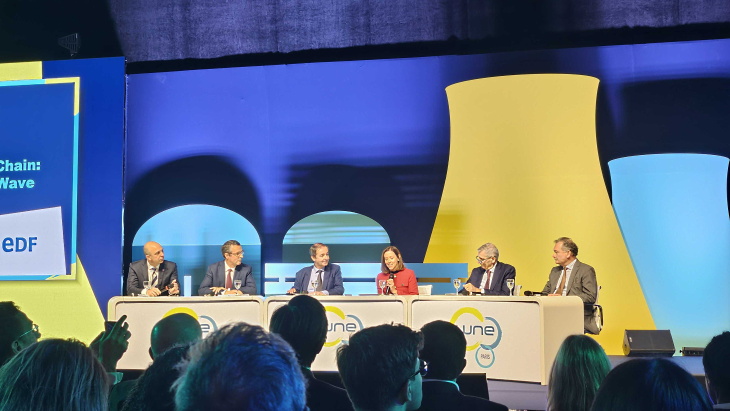
Fontana said EDF has learned from recent nuclear new build projects and reactor operation extensions. He said making an early start on projects helps to ensure there is not a time over-run. "It's what we do already for the French programme. We are starting production of reactor pressure vessels, steam generators and pumps," he said. "The projects we have will require a complete new mindset, shifting from a traditional supply chain to a long-term value chain."
He noted: "Every industry that has achieved true operational excellence - like aviation, rail, automotive - has done so through standardisation, and nuclear must follow the same path, moving from one-off projects to series effect, from prototype to programming."
Pierre Anjolras, CEO of Vinci, said in order to achieve this the supply chain needs to be more coordinated. He suggested improving coordination requires the creation of "a genuine industry cluster ... And I mean not only a selection of companies, maybe 10, 15, or 20 of them, but also a selection of 10, 15, or 20 CEOs who are fully committed, and fully committed to commit their best resources to the project from day one and for the long-term."
To achieve this cluster, he said three conditions must be met from a contractor's point of view. Firstly is early involvement of contractors - the involvement of the value chain partner as early as possible in the project, even at design phase. "This is to ensure a good definition of the project to be built, to ensure the proper finalisation of the detailed design, to ensure that there are only minor modification during a design phase." Secondly, the contract policy needs to be structured so that there is "a clear and rapid decision-making chain at project management, taking its full responsibilities close to the job site, whose sole objective is the performance of the project". The third condition to be met is continuity. "To be capable, to mobilise the appropriate workforce, we need continuity and visibility to recruit all the workforce, to train them, because this is long-term recruitment. And this continuity will also help us to put in place some innovations, including AI."
"Nuclear is no longer a national issue, as it was," said Roberto Adinolfi, president of Italy's Ansaldo Nucleare. "It is becoming a joint challenge, at least in Europe, if not in the Western world. The concurrent programmes that we can expect in different countries in Europe will also imply an internal competition to make the proper use of the limited resources that we have and this is a temptation to go for national interest. But we have to keep in mind that if we serve only the national interest, we are not addressing the challenges that we are asked to address, that are transnational, really."
He said that to attract new players in the supply chain - as well as encouraging existing players to invest in new processes and products - "a broad European common market" needs to be created that will provide "a levelised playground accessible for any company in Europe". Adinolfi added: "Standardisation is the best way for us to create this condition. We have to push it. But standardisation in all nuclear activities, as has already been said, not only in design and not only in licensing, but in construction."
Mammoet CEO Joost Goderie said that it is "very important that we are involved quite early on in the process of building or in engineering, and that we can also be part of the logistical solution while constructing." He said the company can add value to projects by bringing its experience from other industries.
"Bringing value in the project is to help the project to be successful at the end," said Stephane Aubarbier, deputy CEO of Assystem. "In nuclear, as in any other intensive CapEx project, the timeline - I mean the schedule - is the enemy." He continued, "To be on time, probably two main points need to be addressed. The first one is to have a stabilised and easy to construct design before starting the construction ... The second point I'd like to highlight is the fact that during the construction, the logic of the management of the programme is changing. Most of the projects we have, especially in France - it's the case in Europe, globally speaking - but in France especially, we tend to draw the programme and the projects around the management of the contracts placed on the market, whereas, in fact, the contracts should service the project timeline. When we reach the construction phase, it's impossible to carry on that way, because the logic of construction is geography. It's not market. Markets are done by techniques, by systems, not by geography."
Fontana stated: "We need a more integrated, early work involvement, more cooperative, more standardised approach ... So an approach that connects large industrial groups, but also SMEs, research organisations, training institutions, in a shared performance model." He called for "long-term partnerships built on trust, visibility, and shared objectives ... EDF is working to make this shift real, by sharing forecasts, project pipelines, by investing together, industrial tools and skills, by ensuring that our partners benefit from the fleet effect, from design once, build many, and by listening."
Concluding the session, he said "we must make our project execution more agile, drawing lessons from other industrial sectors, and ensure our nuclear projects are not just EDF projects, but shared ones, driven by all partners and working towards a single objective, delivering value for the project, value for the money, and repeat and repeat in the long term. So building this partnership with the supply chain will make us leaner, faster, more reliable, without ever compromising on safety and quality."

No comments:
Post a Comment