Israeli foreign minister visits Somaliland, angering Somalia

Israeli Foreign Minister Gideon Saar is on a visit to Somaliland in East Africa.
Israeli Foreign Minister Gideon Saar is on a visit to Somaliland in East Africa.
(File/AFP)
Arab News
January 06, 2026
Saar said that he had held talks “on the full range of relations” with Somaliland’s president, Abdirahman Mohamed Abdullahi, in the capital Hargeisa
Somalia’s foreign ministry said in a statement that Saar’s visit amounted to “unacceptable interference” in its internal affairs
MOGADISHU: Israeli Foreign Minister Gideon Saar visited Somaliland on Tuesday on a trip that was denounced by Somalia, 10 days after Israel formally recognized the self-declared republic as an independent and sovereign state.
Israel is the only country that has formally recognized Somaliland’s move to break away from Somalia, which described Israel’s decision on recognition as an “unlawful step” and said Saar’s visit as a “serious violation” of its sovereignty.
In a statement on X, Saar said that he had held talks “on the full range of relations” with Somaliland’s president, Abdirahman Mohamed Abdullahi, in the capital Hargeisa.
“We are determined to vigorously advance relations between Israel and Somaliland,” Saar wrote on X, alongside images of him meeting the Somaliland leader at the presidential palace.
Somaliland’s information ministry earlier said on X that Saar was leading a high-level delegation. It gave no further details but a senior Somaliland official told Reuters before the meeting with the president that the Israeli foreign minister was expected to discuss ways to enhance bilateral ties.
Saar said Abdullahi had accepted an invitation from Prime Minister Benjamin Netanyahu to make an official visit to Israel.
Abdullahi said last month that Somaliland would join the Abraham Accords, a deal brokered by Washington in 2020 that saw Gulf states the UAE, a close partner of Somaliland, and Bahrain establish ties with Israel.
Somalia’s foreign ministry said in a statement that Saar’s visit amounted to “unacceptable interference” in its internal affairs.
It condemned “in the strongest terms the unauthorized incursion by the Israeli Minister of Foreign Affairs into Hargeisa,” stressing that the city is “an integral and inseparable part of the sovereign territory of the Federal Republic of Somalia.”
The ministry said the visit of Saar represented “a serious violation of Somalia’s sovereignty, territorial integrity, and political unity.”
Reaffirming its position on Somaliland, Mogadishu said Hargeisa forms an “inalienable part” of the internationally recognized territory of Somalia, adding that any official engagement conducted within Somali territory without the approval of the federal government is unlawful.
“Any official presence, contact, or engagement undertaken within Somali territory without the explicit consent and authorization of the Federal Government of Somalia is illegal, null, and void, and carries no legal validity or effect,” the statement said.
Somalia said such actions were inconsistent with international law, citing the United Nations Charter, the Constitutive Act of the African Union and established norms governing relations between states, including the principles of sovereign equality, territorial integrity, and non-interference.
The federal government called on Israel to “immediately cease all actions that undermine Somalia’s sovereignty, unity, and territorial integrity,” and urged it to respect its obligations under international law.
It also appealed to the international community, including the UN, African Union, League of Arab States and the Organization of Islamic Cooperation, to “reaffirm, in clear and unequivocal terms, their principled support for Somalia’s sovereignty, unity, and internationally recognized borders.”
While reiterating its commitment to peaceful international engagement, constructive diplomacy, and adherence to international law, Somalia warned that it “reserves the right to take all appropriate diplomatic and legal measures” to safeguard its sovereignty, national unity and territorial integrity.
Strategic location
Somaliland, once a British protectorate, has long sought formal recognition as an independent state although it has signed bilateral agreements with various governments on investments and security coordination.
Israel’s decision to recognize Somaliland follows two years of strained ties with many of its closest partners over the war in Gaza and policies in the West Bank.
Netanyahu has said Israel will pursue cooperation in agriculture, health, technology and the economy. Following his visit, Saar said “local professionals” from Somaliland’s water sector would visit Israel in the coming months for training.
Somaliland lies in northwestern Somalia, shares land borders with Ethiopia and Djibouti and sits across the Gulf of Aden from Yemen, from where Iran-backed Houthis have launched missile and drones at Israel since October 2023, when the Gaza war began.
Omar Mahmood, a Somalia analyst at the International Crisis Group think tank, said Israeli engagement was probably driven by Somaliland’s strategic location but that security coordination was possible without Israeli military installations there.
Saar said on Tuesday that mutual recognition and the establishment of diplomatic ties was not directed at anyone.
Somaliland has denied recognition allows for Israel to establish military bases there or for the resettlement of Palestinians from Gaza. Israel has advocated for what Israeli officials describe as voluntary Palestinian migration from Gaza.
* With Reuters
Arab News
January 06, 2026
Saar said that he had held talks “on the full range of relations” with Somaliland’s president, Abdirahman Mohamed Abdullahi, in the capital Hargeisa
Somalia’s foreign ministry said in a statement that Saar’s visit amounted to “unacceptable interference” in its internal affairs
MOGADISHU: Israeli Foreign Minister Gideon Saar visited Somaliland on Tuesday on a trip that was denounced by Somalia, 10 days after Israel formally recognized the self-declared republic as an independent and sovereign state.
Israel is the only country that has formally recognized Somaliland’s move to break away from Somalia, which described Israel’s decision on recognition as an “unlawful step” and said Saar’s visit as a “serious violation” of its sovereignty.
In a statement on X, Saar said that he had held talks “on the full range of relations” with Somaliland’s president, Abdirahman Mohamed Abdullahi, in the capital Hargeisa.
“We are determined to vigorously advance relations between Israel and Somaliland,” Saar wrote on X, alongside images of him meeting the Somaliland leader at the presidential palace.
Somaliland’s information ministry earlier said on X that Saar was leading a high-level delegation. It gave no further details but a senior Somaliland official told Reuters before the meeting with the president that the Israeli foreign minister was expected to discuss ways to enhance bilateral ties.
Saar said Abdullahi had accepted an invitation from Prime Minister Benjamin Netanyahu to make an official visit to Israel.
Abdullahi said last month that Somaliland would join the Abraham Accords, a deal brokered by Washington in 2020 that saw Gulf states the UAE, a close partner of Somaliland, and Bahrain establish ties with Israel.
Somalia’s foreign ministry said in a statement that Saar’s visit amounted to “unacceptable interference” in its internal affairs.
It condemned “in the strongest terms the unauthorized incursion by the Israeli Minister of Foreign Affairs into Hargeisa,” stressing that the city is “an integral and inseparable part of the sovereign territory of the Federal Republic of Somalia.”
The ministry said the visit of Saar represented “a serious violation of Somalia’s sovereignty, territorial integrity, and political unity.”
Reaffirming its position on Somaliland, Mogadishu said Hargeisa forms an “inalienable part” of the internationally recognized territory of Somalia, adding that any official engagement conducted within Somali territory without the approval of the federal government is unlawful.
“Any official presence, contact, or engagement undertaken within Somali territory without the explicit consent and authorization of the Federal Government of Somalia is illegal, null, and void, and carries no legal validity or effect,” the statement said.
Somalia said such actions were inconsistent with international law, citing the United Nations Charter, the Constitutive Act of the African Union and established norms governing relations between states, including the principles of sovereign equality, territorial integrity, and non-interference.
The federal government called on Israel to “immediately cease all actions that undermine Somalia’s sovereignty, unity, and territorial integrity,” and urged it to respect its obligations under international law.
It also appealed to the international community, including the UN, African Union, League of Arab States and the Organization of Islamic Cooperation, to “reaffirm, in clear and unequivocal terms, their principled support for Somalia’s sovereignty, unity, and internationally recognized borders.”
While reiterating its commitment to peaceful international engagement, constructive diplomacy, and adherence to international law, Somalia warned that it “reserves the right to take all appropriate diplomatic and legal measures” to safeguard its sovereignty, national unity and territorial integrity.
Strategic location
Somaliland, once a British protectorate, has long sought formal recognition as an independent state although it has signed bilateral agreements with various governments on investments and security coordination.
Israel’s decision to recognize Somaliland follows two years of strained ties with many of its closest partners over the war in Gaza and policies in the West Bank.
Netanyahu has said Israel will pursue cooperation in agriculture, health, technology and the economy. Following his visit, Saar said “local professionals” from Somaliland’s water sector would visit Israel in the coming months for training.
Somaliland lies in northwestern Somalia, shares land borders with Ethiopia and Djibouti and sits across the Gulf of Aden from Yemen, from where Iran-backed Houthis have launched missile and drones at Israel since October 2023, when the Gaza war began.
Omar Mahmood, a Somalia analyst at the International Crisis Group think tank, said Israeli engagement was probably driven by Somaliland’s strategic location but that security coordination was possible without Israeli military installations there.
Saar said on Tuesday that mutual recognition and the establishment of diplomatic ties was not directed at anyone.
Somaliland has denied recognition allows for Israel to establish military bases there or for the resettlement of Palestinians from Gaza. Israel has advocated for what Israeli officials describe as voluntary Palestinian migration from Gaza.
* With Reuters
Israel’s strategic posture favors a constant state of war over political deals that might constrain future aggression. Its recognition of Somaliland is part of this strategy, and an attempt to plant the first flag of its would-be empire in Africa.
January 6, 2026
MONDOWEISS
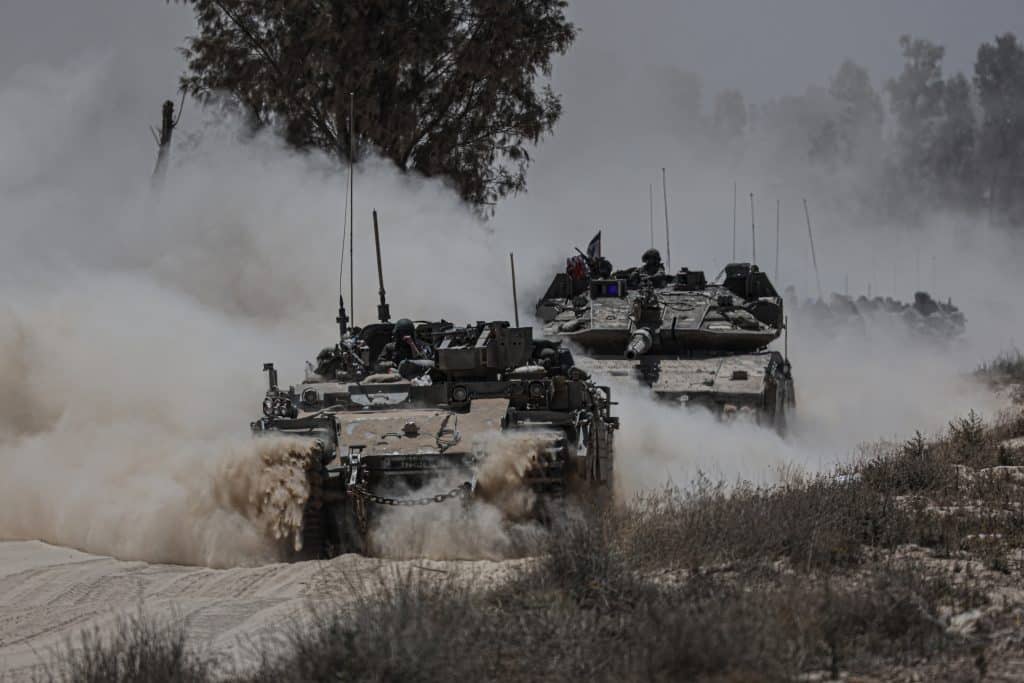
Israeli army tank deploys near the Gaza border, May 20, 2025. (Photo: © Saeed Qaq/ZUMA Press Wire/ZUMA Wire/APA Images)
As Donald Trump proclaimed a “forever peace” in the region last October, Israel proceeded to dramatically escalate its military operations, launching repeated assaults across Palestine, Syria, Lebanon, and beyond. In Gaza, Israel has violated the ceasefire over a thousand times; in Lebanon, it continues to target resistance forces; in Syria, it attempts to destabilize the new regime, launches raids that kills dozens at a time, and tries to exacerbate sectarian divisions in the country; and more recently, it has continued to beat the drums of war with Iran. Its recent recognition of Somaliland also signals an Israel that seeks to regionalize its terror regime, challenge Turkey’s presence in Somalia, and position itself closer to Yemen and Iran for future skirmishes.
Some might consider this a failure of Israeli policy — that Israel is incapable of translating military success into a new political reality, that its war grinds on in a strange suspended animation while the political horizon remains frozen. Without such a political transition, the argument goes, military success remains transient: decisive in appearance, yet incapable of altering the structural conditions that generate and sustain resistance.
Israel views any fixed political agreement as a liability constraining its freedom of action. War is no longer an exceptional condition but a way of life, a normalized instrument of regional order.
There is some truth to this. But it also papers over something more important: Israel views any fixed political agreement as a liability, a diplomatic straitjacket constraining its freedom of action. Israel’s moves in Syria and Lebanon, alongside its broader regional realignments, point to an emerging strategic preference for a model of managed, perpetual conflict, rather than a stable political status quo that cannot be altered. War is no longer an exceptional condition but a way of life, a normalized instrument of regional order.
For now, this model is sustainable for Israel because its consequences are largely externalized: peripheral arenas and adversarial societies bear the brunt of the damage of its operations, while the Israeli home front remains relatively insulated from sustained disruption. The absence of a definitive political settlement is not a liability but a boon.
Perpetual war, so long as it remains geographically displaced and technologically mediated, allows Israel to defer the difficult work of political resolution while maintaining strategic initiative, leaving the door open for unilateral military action in the future.
The strategic logic of this model is reflected in two developments, respectively spatial and geopolitical in nature.
The first development is most immediately felt, with Israel expanding its buffer architectures in Syria, spatially dispersing resistance formations in south Lebanon, and continuously expanding its buffer zone within Gaza by bringing more parts of the Strip under its control.
These aren’t tactical adjustments, but long-term arrangements based on the logic of “security perimeters” and the preemptive management of threat horizons.
The other development is less visible but no less significant, represented in Israel’s entanglement in the byzantine geopolitics of states jockeying for influence across the region. There is the Saudi-Turkish-Qatari scramble to determine Syria’s future — each backing different factions, pursuing incompatible visions, yet united in their determination not to be left out of whatever arrangement eventually emerges from the rubble.
Meanwhile, Israel has been cultivating relationships with Greece and Cyprus, building up a network of eastern Mediterranean partnerships that look suspiciously like an attempt to outflank Turkey, with whom competition is becoming increasingly open.
It’s a messy business, and the alliances don’t follow any neat ideological lines. Yesterday’s enemy can become today’s tacit partner if the circumstances require it, with Israel dealing with the Saudis on some fronts while watching them bankroll projects elsewhere that run counter to their interests. The Israeli-Turkish relationship oscillates between functional cooperation on trade and energy and bitter rivalry on everything from gas exploration rights to influence in post-Assad Syria.
But even though Israeli actions suggest a growing comfort with inhabiting a permanently offensive posture in the region, its imperial entanglements also create new liabilities. Yes, Israel’s room for maneuver has been enlarged, but it has also been constrained — and not always in predictable ways — due, in part, to its relatively new relations with states such as the United Arab Emirates. More partners mean more options, to be sure, but they also entail more obligations and points at which things can unravel once the interests of the various actors inevitably diverge.
So the question isn’t whether Israel wields influence in the region (it plainly does), but whether this dense thicket of diplomatic activity constitutes a coherent strategy or a mere accumulation of tactical expedients whose long-term durability remains uncertain.
And then there’s Israel’s boldest move yet: its attempt to plant the first flag of its would-be empire in Africa.
Somaliland: the Horn of Africa gambit
Israel’s recognition of Somaliland on December 26, 2025, adds yet another layer to this already congested landscape, operating simultaneously across multiple vectors of competition: with Turkey over influence in the Horn of Africa, and against the ability of Yemen’s Ansar Allah (commonly known as “the Houthis”) to disrupt trade routes.
Turkey has maintained its largest overseas military base in Somalia since 2017. Camp TURKSOM in Mogadishu has trained some sixteen thousand troops and secured, in February 2024, the exclusive rights to train, equip, and modernize Somalia’s navy and patrol its exclusive economic zone. This consolidation of Turkish strategic presence transforms Somalia into something approaching a client state, not through direct annexation but through the patient accumulation of security, infrastructural, and economic dependence.
The Israeli move was framed explicitly as being “in the spirit of the Abraham Accords,” yet it functions equally as a counter to Turkish maritime ambitions and as a wedge into a region where Ankara has spent over a decade building institutional depth.
Israel’s recognition of Somaliland is not an isolated diplomatic gesture, but an attempt to secure a foothold in proximity to these competing networks. Somaliland’s coastline sits directly across from Yemen, offering monitoring and intervention capacity over Ansar Allah’s activities while simultaneously complicating Turkish ambitions in the region. What emerges is a field of overlapping projects: Turkish military infrastructure consolidating Somalia as a projection platform into the Red Sea; Iranian weapons flows moving through Somali territory to sustain Ansar Allah operations; and the Israeli recognition of Somaliland in an attempt to disrupt both.
The recognition of Somaliland appears minor but it reverberates across multiple strategic theaters at once — the Horn of Africa, the Red Sea shipping lanes, the Turkish sphere, the Emirati-Israeli alignment, and the broader axis of resistance.
The question is whether these entanglements represent calculated strategic depth or merely additional commitments that generate their own unforeseen vulnerabilities, binding each actor to the volatile fortunes of a region where clarity remains perpetually deferred, and alliances shift faster than the institutional arrangements meant to stabilize them.
What we are witnessing is not chaos but rather the return of classical balance-of-power politics. It is something far more familiar to students of European statecraft: a multipolar regional system where even ostensible allies pursue contradictory objectives, and where every gain by one actor automatically triggers compensatory maneuvers by others.
Consider the balance of forces. Turkey, a NATO member, builds military infrastructure in Somalia while competing with Israel — another American partner — for influence across the Horn and the eastern Mediterranean. The Saudis and Turks back opposing factions in Syria while both maintain channels to Washington. Israel cultivates Greece and Cyprus as counterweights to Turkey, yet all remain within the American security umbrella. This isn’t alliance breakdown — it is alliance complexity. The trouble is that it requires a kind of diplomatic sophistication that the current regional leadership often lacks.
More centrally, however — as with much of Israel’s regional conduct — this move is best understood as part of a broader preparation for future war.
The recognition of Somaliland is instructive precisely because it appears minor. On its own, it registers as a small diplomatic gesture; in practice, it reverberates across multiple strategic theaters at once — the Horn of Africa, the Red Sea shipping lanes, the Turkish sphere, the Emirati-Israeli alignment, and the broader axis of resistance. This is how power increasingly operates in a multipolar environment: not through singular, decisive moves, but through the cumulative positioning of nodes whose strategic value emerges relationally and in anticipation of the other’s actions.
More centrally, however — as with much of Israel’s regional conduct — this move is best understood as part of a broader preparation for future war. Perpetual war, here, isn’t an emergency condition to be avoided, but a governing paradigm to be managed, expanded, and spatially pre-configured long before war erupts again.
Regionalizing Israel’s strategy towards Palestine
Israel’s reorientation toward perpetual war is not unprecedented. States that enjoy overwhelming technological and military superiority often discover that victory is less useful than managed instability. An unresolved conflict preserves freedom of action, allowing borders to remain elastic, threats to be continuously redefined, and exceptional measures to become permanent. Israel’s conduct across Gaza, Lebanon, Syria, and now the Horn of Africa suggests a growing comfort with precisely this condition.
Seen in this light, the apparent failure to translate military dominance into political settlement begins to look less like an inability and more like a choice. Political closure would impose constraints: fixed borders, binding obligations, and reciprocal guarantees. Endless war, by contrast allows Israel to act preemptively, redraw security architectures, and embed its power into the geography of the region without having to negotiate or seek international ratification.
Israel is expanding territories under its control not to govern them, but to shape them for the purpose of absorbing shock. This strategy isn’t new to Israel when it comes to its relationship with the Palestinians, having for decades sustained a managed, perpetual war in the West Bank and Gaza that it has continuously modulated between alternating cycles of escalation and containment. The difference is that Israel is now moving to regionalize this model.
What’s new about this strategy isn’t its logic, but its scale, transplanting a decades-old strategy of managing its colonial frontier within Palestine to geographies far beyond it.
In other words, what’s new about this strategy isn’t its logic, but its scale, transplanting a decades-old strategy of managing its colonial frontier within Palestine to geographies far beyond it. Yet with this increase in scale, things get more complicated, giving the people of the region more reasons to resist.
As for the forces of resistance, it is precisely Israel’s refusal to entertain a political arrangement with them that keeps resistance alive. They have not been defeated because they can’t be so long as Israel’s only acceptable notion of defeat is total collapse or surrender. Certainly resistance won’t be defeated through Israel’s method of targeting the entire social and infrastructural body of what it declares to be “enemy societies.”
And the Israelis actually understand this better than they publicly admit: the buffer zones, the spatial fragmentation, the preemptive configurations — these are all tacit admissions that victory in any meaningful sense is unattainable.
What’s being managed and perhaps even perpetuated is the desire to sustain an intractable situation without any form of resolution. The resistance elements — whether Palestinian, Lebanese, or Yemeni — can certainly be weakened, perhaps even contained, but they can’t be eliminated entirely, because they’re embedded in political contexts that military force alone cannot address.
The regionalization of Israel’s regime of violence is generating an unintended strategic effect: the idea of a unified arena, encouraging coordination, resource-sharing, and political alignment among resistance forces.
At the same time, the regionalization of Israel’s regime of violence is generating an unintended strategic effect: by extending its operations across multiple theaters, it has renewed the salience of the idea of a unified arena, encouraging coordination, resource-sharing, and political alignment among resistance forces, including those that for long stretches viewed one another with suspicion.
It is true that, for now, many of these actors remain preoccupied with survival, political relevance, and the arduous work of rebuilding. Israel is determined to keep it that way, working to further fragment Syria, consolidate partnerships with Greece and Cyprus, deepen military cooperation with the Emirates across the Red Sea, operate in tandem with select Kurdish forces, and continue to bomb targets in Gaza, Syria, Lebanon, Yemen, and Iran.
Yet the longer Israel pursues this strategy of regional entanglement, the more it collapses once-discrete arenas into a single, interconnected field of confrontation.
In doing so, it pushes previously separated actors into closer proximity, lending renewed force to the idea of resistance not as a collection of isolated struggles, but as a set of interlinked campaigns increasingly compelled to operate in tandem.
Israel’s victoryless war is not an aberration, nor a failure of translation. It is the mature expression of a political order that can neither resolve resistance nor survive its resolution — and therefore reorganizes space, diplomacy, and force around the permanent modulation of war.
Abdaljawad Omar
Abdaljawad Omar is a writer and Assistant Professor at Birzeit University, Palestine. Follow him on X @HHamayel2
As Donald Trump proclaimed a “forever peace” in the region last October, Israel proceeded to dramatically escalate its military operations, launching repeated assaults across Palestine, Syria, Lebanon, and beyond. In Gaza, Israel has violated the ceasefire over a thousand times; in Lebanon, it continues to target resistance forces; in Syria, it attempts to destabilize the new regime, launches raids that kills dozens at a time, and tries to exacerbate sectarian divisions in the country; and more recently, it has continued to beat the drums of war with Iran. Its recent recognition of Somaliland also signals an Israel that seeks to regionalize its terror regime, challenge Turkey’s presence in Somalia, and position itself closer to Yemen and Iran for future skirmishes.
Some might consider this a failure of Israeli policy — that Israel is incapable of translating military success into a new political reality, that its war grinds on in a strange suspended animation while the political horizon remains frozen. Without such a political transition, the argument goes, military success remains transient: decisive in appearance, yet incapable of altering the structural conditions that generate and sustain resistance.
Israel views any fixed political agreement as a liability constraining its freedom of action. War is no longer an exceptional condition but a way of life, a normalized instrument of regional order.
There is some truth to this. But it also papers over something more important: Israel views any fixed political agreement as a liability, a diplomatic straitjacket constraining its freedom of action. Israel’s moves in Syria and Lebanon, alongside its broader regional realignments, point to an emerging strategic preference for a model of managed, perpetual conflict, rather than a stable political status quo that cannot be altered. War is no longer an exceptional condition but a way of life, a normalized instrument of regional order.
For now, this model is sustainable for Israel because its consequences are largely externalized: peripheral arenas and adversarial societies bear the brunt of the damage of its operations, while the Israeli home front remains relatively insulated from sustained disruption. The absence of a definitive political settlement is not a liability but a boon.
Perpetual war, so long as it remains geographically displaced and technologically mediated, allows Israel to defer the difficult work of political resolution while maintaining strategic initiative, leaving the door open for unilateral military action in the future.
The strategic logic of this model is reflected in two developments, respectively spatial and geopolitical in nature.
The first development is most immediately felt, with Israel expanding its buffer architectures in Syria, spatially dispersing resistance formations in south Lebanon, and continuously expanding its buffer zone within Gaza by bringing more parts of the Strip under its control.
These aren’t tactical adjustments, but long-term arrangements based on the logic of “security perimeters” and the preemptive management of threat horizons.
The other development is less visible but no less significant, represented in Israel’s entanglement in the byzantine geopolitics of states jockeying for influence across the region. There is the Saudi-Turkish-Qatari scramble to determine Syria’s future — each backing different factions, pursuing incompatible visions, yet united in their determination not to be left out of whatever arrangement eventually emerges from the rubble.
Meanwhile, Israel has been cultivating relationships with Greece and Cyprus, building up a network of eastern Mediterranean partnerships that look suspiciously like an attempt to outflank Turkey, with whom competition is becoming increasingly open.
It’s a messy business, and the alliances don’t follow any neat ideological lines. Yesterday’s enemy can become today’s tacit partner if the circumstances require it, with Israel dealing with the Saudis on some fronts while watching them bankroll projects elsewhere that run counter to their interests. The Israeli-Turkish relationship oscillates between functional cooperation on trade and energy and bitter rivalry on everything from gas exploration rights to influence in post-Assad Syria.
But even though Israeli actions suggest a growing comfort with inhabiting a permanently offensive posture in the region, its imperial entanglements also create new liabilities. Yes, Israel’s room for maneuver has been enlarged, but it has also been constrained — and not always in predictable ways — due, in part, to its relatively new relations with states such as the United Arab Emirates. More partners mean more options, to be sure, but they also entail more obligations and points at which things can unravel once the interests of the various actors inevitably diverge.
So the question isn’t whether Israel wields influence in the region (it plainly does), but whether this dense thicket of diplomatic activity constitutes a coherent strategy or a mere accumulation of tactical expedients whose long-term durability remains uncertain.
And then there’s Israel’s boldest move yet: its attempt to plant the first flag of its would-be empire in Africa.
Somaliland: the Horn of Africa gambit
Israel’s recognition of Somaliland on December 26, 2025, adds yet another layer to this already congested landscape, operating simultaneously across multiple vectors of competition: with Turkey over influence in the Horn of Africa, and against the ability of Yemen’s Ansar Allah (commonly known as “the Houthis”) to disrupt trade routes.
Turkey has maintained its largest overseas military base in Somalia since 2017. Camp TURKSOM in Mogadishu has trained some sixteen thousand troops and secured, in February 2024, the exclusive rights to train, equip, and modernize Somalia’s navy and patrol its exclusive economic zone. This consolidation of Turkish strategic presence transforms Somalia into something approaching a client state, not through direct annexation but through the patient accumulation of security, infrastructural, and economic dependence.
The Israeli move was framed explicitly as being “in the spirit of the Abraham Accords,” yet it functions equally as a counter to Turkish maritime ambitions and as a wedge into a region where Ankara has spent over a decade building institutional depth.
Israel’s recognition of Somaliland is not an isolated diplomatic gesture, but an attempt to secure a foothold in proximity to these competing networks. Somaliland’s coastline sits directly across from Yemen, offering monitoring and intervention capacity over Ansar Allah’s activities while simultaneously complicating Turkish ambitions in the region. What emerges is a field of overlapping projects: Turkish military infrastructure consolidating Somalia as a projection platform into the Red Sea; Iranian weapons flows moving through Somali territory to sustain Ansar Allah operations; and the Israeli recognition of Somaliland in an attempt to disrupt both.
The recognition of Somaliland appears minor but it reverberates across multiple strategic theaters at once — the Horn of Africa, the Red Sea shipping lanes, the Turkish sphere, the Emirati-Israeli alignment, and the broader axis of resistance.
The question is whether these entanglements represent calculated strategic depth or merely additional commitments that generate their own unforeseen vulnerabilities, binding each actor to the volatile fortunes of a region where clarity remains perpetually deferred, and alliances shift faster than the institutional arrangements meant to stabilize them.
What we are witnessing is not chaos but rather the return of classical balance-of-power politics. It is something far more familiar to students of European statecraft: a multipolar regional system where even ostensible allies pursue contradictory objectives, and where every gain by one actor automatically triggers compensatory maneuvers by others.
Consider the balance of forces. Turkey, a NATO member, builds military infrastructure in Somalia while competing with Israel — another American partner — for influence across the Horn and the eastern Mediterranean. The Saudis and Turks back opposing factions in Syria while both maintain channels to Washington. Israel cultivates Greece and Cyprus as counterweights to Turkey, yet all remain within the American security umbrella. This isn’t alliance breakdown — it is alliance complexity. The trouble is that it requires a kind of diplomatic sophistication that the current regional leadership often lacks.
More centrally, however — as with much of Israel’s regional conduct — this move is best understood as part of a broader preparation for future war.
The recognition of Somaliland is instructive precisely because it appears minor. On its own, it registers as a small diplomatic gesture; in practice, it reverberates across multiple strategic theaters at once — the Horn of Africa, the Red Sea shipping lanes, the Turkish sphere, the Emirati-Israeli alignment, and the broader axis of resistance. This is how power increasingly operates in a multipolar environment: not through singular, decisive moves, but through the cumulative positioning of nodes whose strategic value emerges relationally and in anticipation of the other’s actions.
More centrally, however — as with much of Israel’s regional conduct — this move is best understood as part of a broader preparation for future war. Perpetual war, here, isn’t an emergency condition to be avoided, but a governing paradigm to be managed, expanded, and spatially pre-configured long before war erupts again.
Regionalizing Israel’s strategy towards Palestine
Israel’s reorientation toward perpetual war is not unprecedented. States that enjoy overwhelming technological and military superiority often discover that victory is less useful than managed instability. An unresolved conflict preserves freedom of action, allowing borders to remain elastic, threats to be continuously redefined, and exceptional measures to become permanent. Israel’s conduct across Gaza, Lebanon, Syria, and now the Horn of Africa suggests a growing comfort with precisely this condition.
Seen in this light, the apparent failure to translate military dominance into political settlement begins to look less like an inability and more like a choice. Political closure would impose constraints: fixed borders, binding obligations, and reciprocal guarantees. Endless war, by contrast allows Israel to act preemptively, redraw security architectures, and embed its power into the geography of the region without having to negotiate or seek international ratification.
Israel is expanding territories under its control not to govern them, but to shape them for the purpose of absorbing shock. This strategy isn’t new to Israel when it comes to its relationship with the Palestinians, having for decades sustained a managed, perpetual war in the West Bank and Gaza that it has continuously modulated between alternating cycles of escalation and containment. The difference is that Israel is now moving to regionalize this model.
What’s new about this strategy isn’t its logic, but its scale, transplanting a decades-old strategy of managing its colonial frontier within Palestine to geographies far beyond it.
In other words, what’s new about this strategy isn’t its logic, but its scale, transplanting a decades-old strategy of managing its colonial frontier within Palestine to geographies far beyond it. Yet with this increase in scale, things get more complicated, giving the people of the region more reasons to resist.
As for the forces of resistance, it is precisely Israel’s refusal to entertain a political arrangement with them that keeps resistance alive. They have not been defeated because they can’t be so long as Israel’s only acceptable notion of defeat is total collapse or surrender. Certainly resistance won’t be defeated through Israel’s method of targeting the entire social and infrastructural body of what it declares to be “enemy societies.”
And the Israelis actually understand this better than they publicly admit: the buffer zones, the spatial fragmentation, the preemptive configurations — these are all tacit admissions that victory in any meaningful sense is unattainable.
What’s being managed and perhaps even perpetuated is the desire to sustain an intractable situation without any form of resolution. The resistance elements — whether Palestinian, Lebanese, or Yemeni — can certainly be weakened, perhaps even contained, but they can’t be eliminated entirely, because they’re embedded in political contexts that military force alone cannot address.
The regionalization of Israel’s regime of violence is generating an unintended strategic effect: the idea of a unified arena, encouraging coordination, resource-sharing, and political alignment among resistance forces.
At the same time, the regionalization of Israel’s regime of violence is generating an unintended strategic effect: by extending its operations across multiple theaters, it has renewed the salience of the idea of a unified arena, encouraging coordination, resource-sharing, and political alignment among resistance forces, including those that for long stretches viewed one another with suspicion.
It is true that, for now, many of these actors remain preoccupied with survival, political relevance, and the arduous work of rebuilding. Israel is determined to keep it that way, working to further fragment Syria, consolidate partnerships with Greece and Cyprus, deepen military cooperation with the Emirates across the Red Sea, operate in tandem with select Kurdish forces, and continue to bomb targets in Gaza, Syria, Lebanon, Yemen, and Iran.
Yet the longer Israel pursues this strategy of regional entanglement, the more it collapses once-discrete arenas into a single, interconnected field of confrontation.
In doing so, it pushes previously separated actors into closer proximity, lending renewed force to the idea of resistance not as a collection of isolated struggles, but as a set of interlinked campaigns increasingly compelled to operate in tandem.
Israel’s victoryless war is not an aberration, nor a failure of translation. It is the mature expression of a political order that can neither resolve resistance nor survive its resolution — and therefore reorganizes space, diplomacy, and force around the permanent modulation of war.
Abdaljawad Omar
Abdaljawad Omar is a writer and Assistant Professor at Birzeit University, Palestine. Follow him on X @HHamayel2
Analysis
How Israel's Somaliland gambit will reshape Red Sea geopolitics
Israel's recognition of Somaliland could redefine security calculations and redraw sensitive fault lines across the Horn of Africa and the Red Sea

Giorgio Cafiero
06 January, 2026
THE NEW ARAB
Late last year, Israel broke new diplomatic ground by becoming the first country to formally recognise the independence of Somaliland, a self-declared republic existing within Somalia’s internationally recognised territory.
Perched along the southern coast of the Gulf of Aden, extremely close to the strategically vital Bab al-Mandab strait, Somaliland has spent more than three decades seeking international legitimacy after declaring independence in 1991.
Tel Aviv’s decision marked a historic turning point for the breakaway state, conferring unprecedented recognition from a UN member and instantly transforming a long-frozen question of sovereignty into a matter of regional and global consequence.
Somaliland’s president, Abdirahman Mohamed Abdullahi, welcomed the development as a “historic moment.” In a phone call with Abdullahi, Israeli Prime Minister Benjamin Netanyahu said that Tel Aviv was recognising Somaliland’s “right of self-determination,” a step he argued would create “a great opportunity for expanding” Israel’s ties with the breakaway republic.
Israel has pledged to deepen its cooperation with Somaliland across a wide range of sectors, including agriculture, economics, health, and technology.
Nonetheless, officials in Somalia’s government in Mogadishu swiftly and forcefully condemned Israel’s decision. Analysts now warn that Tel Aviv’s recognition of Somaliland could reverberate within Somalia itself, aggravating long-standing political fault lines and inflaming tensions that remain far from resolved.
“Recognition of Somaliland is a highly sensitive issue both within Somaliland and across Somalia, seen by many as a further division of the Somali territories of the Horn of Africa,” Dr Nisar Majid, research director for the PeaceRep (Somalia) programme at the London School of Economics, told The New Arab. He also stressed that “no incumbent national president in Mogadishu wants to be known as having ‘lost’ Somaliland under his watch”.
Dr Majid told TNA that many Somalis see Tel Aviv’s recognition of Somaliland as a “precursor” to more countries making that same decision, which could risk “damaging a spirit of reconciliation that has re-emerged regularly over the past two decades, and which will play into the hands of anti-federalists and centralists who advocate for a centralised state”.
He further cautioned that the move is likely to sharpen internal divisions within Somaliland, particularly in the eastern region of Sanaag and the western region of Awdal.
In response, both Djibouti and the Federal Government of Somalia (FGS) may feel compelled to step up political and material support for unionist areas, while deliberately distancing themselves from the separatist leadership in Hargeisa.
According to Dr Majid, such dynamics carry a serious risk of sparking armed conflict within Somaliland itself. At the same time, he noted, Puntland and Jubbaland are likely to exploit the situation to intensify pressure on the president of FGS.
Beyond Somalia’s borders, Israel’s recognition of the semi-desert territory in the Horn of Africa has sparked widespread controversy. Many governments, particularly across the Arab and Islamic world, fear that a formalised Israel-Somaliland relationship could carry far-reaching repercussions that extend well beyond the realm of diplomacy.

Reshaping fault lines
Ultimately, Israel’s recognition of Somaliland represents far more than a bilateral diplomatic breakthrough between Tel Aviv and Hargeisa. It is a catalyst that risks reshaping political alignments, security calculations, and fault lines across the Horn of Africa and the wider Red Sea arena.
For Somaliland, Israeli recognition offers long-sought validation and the promise of deeper economic and strategic partnerships. Yet, it also exposes the fragility of internal cohesion and heightens the danger of regional proxy competition playing out on its soil.
For the FGS, the move is perceived as a direct challenge to the country’s sovereignty, one that could undermine already delicate reconciliation efforts and intensify rivalries among federal states and neighbouring actors.
Regionally, Israel’s decision intersects with broader contests involving Gulf powers, Turkey, Egypt, and Iran, each seeking to safeguard their interests in one of the world’s most strategically vital maritime corridors.
As concerns mount over militarisation, forced population transfers, and the erosion of established borders, Somaliland’s recognition has become a litmus test for competing visions of order versus fragmentation of states in the neighbourhood.
Exactly how this development will play out in terms of the regional security architecture and geopolitical balance has yet to be realised. Nonetheless, Israel’s recognition of Somaliland has further internationalised a long-frozen dispute, and the consequences may reverberate far beyond Somalia’s UN-recognised borders for many years to come.
Giorgio Cafiero is the CEO of Gulf State Analytics
Follow him on X: @GiorgioCafiero
Edited by Charlie Hoyle
How Israel's Somaliland gambit will reshape Red Sea geopolitics
Israel's recognition of Somaliland could redefine security calculations and redraw sensitive fault lines across the Horn of Africa and the Red Sea
Giorgio Cafiero
06 January, 2026
THE NEW ARAB
Late last year, Israel broke new diplomatic ground by becoming the first country to formally recognise the independence of Somaliland, a self-declared republic existing within Somalia’s internationally recognised territory.
Perched along the southern coast of the Gulf of Aden, extremely close to the strategically vital Bab al-Mandab strait, Somaliland has spent more than three decades seeking international legitimacy after declaring independence in 1991.
Tel Aviv’s decision marked a historic turning point for the breakaway state, conferring unprecedented recognition from a UN member and instantly transforming a long-frozen question of sovereignty into a matter of regional and global consequence.
Somaliland’s president, Abdirahman Mohamed Abdullahi, welcomed the development as a “historic moment.” In a phone call with Abdullahi, Israeli Prime Minister Benjamin Netanyahu said that Tel Aviv was recognising Somaliland’s “right of self-determination,” a step he argued would create “a great opportunity for expanding” Israel’s ties with the breakaway republic.
Israel has pledged to deepen its cooperation with Somaliland across a wide range of sectors, including agriculture, economics, health, and technology.
Nonetheless, officials in Somalia’s government in Mogadishu swiftly and forcefully condemned Israel’s decision. Analysts now warn that Tel Aviv’s recognition of Somaliland could reverberate within Somalia itself, aggravating long-standing political fault lines and inflaming tensions that remain far from resolved.
“Recognition of Somaliland is a highly sensitive issue both within Somaliland and across Somalia, seen by many as a further division of the Somali territories of the Horn of Africa,” Dr Nisar Majid, research director for the PeaceRep (Somalia) programme at the London School of Economics, told The New Arab. He also stressed that “no incumbent national president in Mogadishu wants to be known as having ‘lost’ Somaliland under his watch”.
Dr Majid told TNA that many Somalis see Tel Aviv’s recognition of Somaliland as a “precursor” to more countries making that same decision, which could risk “damaging a spirit of reconciliation that has re-emerged regularly over the past two decades, and which will play into the hands of anti-federalists and centralists who advocate for a centralised state”.
He further cautioned that the move is likely to sharpen internal divisions within Somaliland, particularly in the eastern region of Sanaag and the western region of Awdal.
In response, both Djibouti and the Federal Government of Somalia (FGS) may feel compelled to step up political and material support for unionist areas, while deliberately distancing themselves from the separatist leadership in Hargeisa.
According to Dr Majid, such dynamics carry a serious risk of sparking armed conflict within Somaliland itself. At the same time, he noted, Puntland and Jubbaland are likely to exploit the situation to intensify pressure on the president of FGS.
Beyond Somalia’s borders, Israel’s recognition of the semi-desert territory in the Horn of Africa has sparked widespread controversy. Many governments, particularly across the Arab and Islamic world, fear that a formalised Israel-Somaliland relationship could carry far-reaching repercussions that extend well beyond the realm of diplomacy.
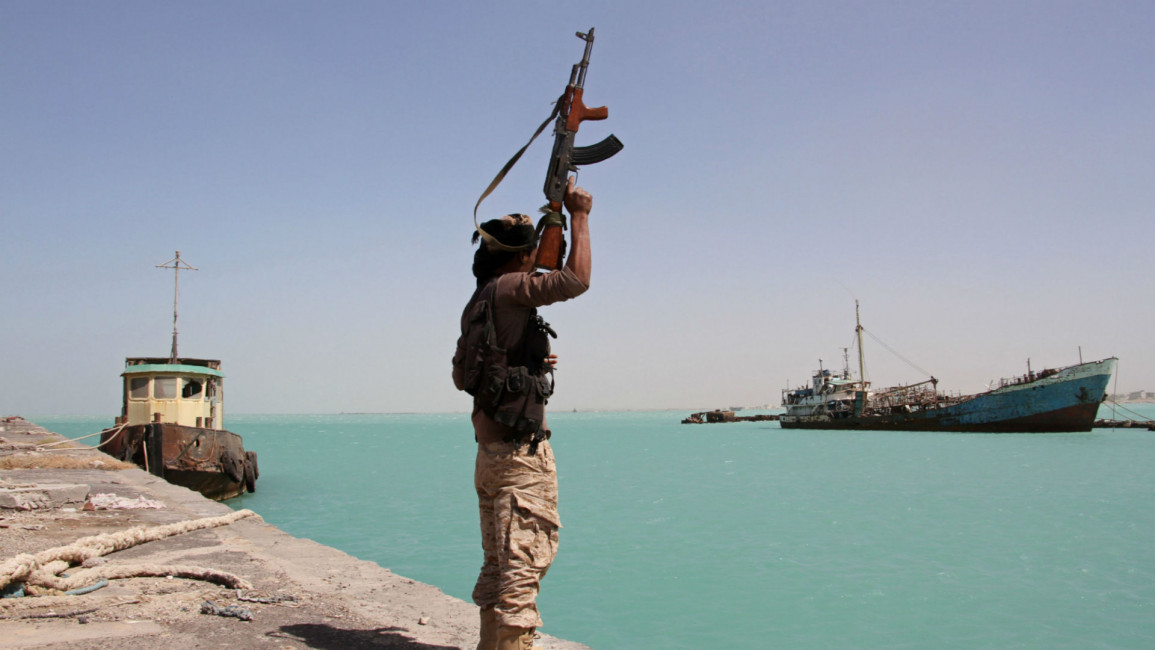
Israel's decision has instantly transformed a long-frozen question of sovereignty into a matter of regional and global consequence. [Getty]
Several months ago, multiple news outlets reported that Israel had approached Somaliland about the potential resettlement of Palestinians forcibly displaced from Gaza. Israel declined to comment on these reports, while Somaliland insisted that any Israeli decision to recognise its independence would be entirely unrelated to the Palestinian issue.
Nevertheless, both Somalia and the Palestinian Authority have suggested that Tel Aviv’s recognition of Somaliland could be linked to a broader plan to displace Palestinians.
Speaking to his parliament, Somalia’s president categorically rejected this possibility, declaring, “Somalia will never accept the people of Palestine to be forcibly evicted from their rightful land to a faraway place”.
Strategic flashpoint: Somaliland and the Horn of Africa
Somaliland’s largest port, located in Berbera, also features an extensive runway, making it a strategically significant hub in the region. For years, officials in the breakaway statelet have leveraged these facilities to cultivate closer ties with foreign powers.
Recent speculation suggests that Israel may seek to establish a military presence in Somaliland, although Hargeisa - the capital and largest city of the self-declared republic - has maintained that no such plans are underway.
States across the broader region swiftly condemned Israel’s recognition of Somaliland, each citing reasons tied to their own national interests.
Highlighting the range of motivations behind this opposition, Dr Michael Woldemariam, associate professor and PhD program director at the University of Maryland School of Public Policy, noted that there are two main strategic inclinations that most of these countries share.
First is a “serious discomfort with growing power and influence of what might be considered a UAE-Israeli axis in the southern Red Sea and Gulf of Aden”, and second is a “general desire to avoid the crack-up of existing state boundaries in the region,” he told TNA.
Turkey's strategic response and regional stakes
On 30 December 2025, Turkish President Recep Tayyip Erdogan used strong language to condemn Israel’s “illegitimate and unacceptable” recognition of Somaliland. That same day, Somali President Hassan Sheikh Mohamud joined Erdogan in Ankara for a joint news conference, where he warned that the Israeli recognition could “add more layers of instability to the Horn of Africa.” Erdogan also announced that Turkey plans to deploy a deep-sea energy drilling vessel to Somalia’s coast next month.
In the past, Ankara has acted as a mediator between Mogadishu and Hargeisa, while also investing in Somalia by developing a range of economic interests and supporting the country’s security forces.
From the perspective of Turkish authorities, Israeli recognition of Somaliland poses a threat to these economic stakes and represents a serious challenge to the national sovereignty of Somalia.
Several months ago, multiple news outlets reported that Israel had approached Somaliland about the potential resettlement of Palestinians forcibly displaced from Gaza. Israel declined to comment on these reports, while Somaliland insisted that any Israeli decision to recognise its independence would be entirely unrelated to the Palestinian issue.
Nevertheless, both Somalia and the Palestinian Authority have suggested that Tel Aviv’s recognition of Somaliland could be linked to a broader plan to displace Palestinians.
Speaking to his parliament, Somalia’s president categorically rejected this possibility, declaring, “Somalia will never accept the people of Palestine to be forcibly evicted from their rightful land to a faraway place”.
Strategic flashpoint: Somaliland and the Horn of Africa
Somaliland’s largest port, located in Berbera, also features an extensive runway, making it a strategically significant hub in the region. For years, officials in the breakaway statelet have leveraged these facilities to cultivate closer ties with foreign powers.
Recent speculation suggests that Israel may seek to establish a military presence in Somaliland, although Hargeisa - the capital and largest city of the self-declared republic - has maintained that no such plans are underway.
States across the broader region swiftly condemned Israel’s recognition of Somaliland, each citing reasons tied to their own national interests.
Highlighting the range of motivations behind this opposition, Dr Michael Woldemariam, associate professor and PhD program director at the University of Maryland School of Public Policy, noted that there are two main strategic inclinations that most of these countries share.
First is a “serious discomfort with growing power and influence of what might be considered a UAE-Israeli axis in the southern Red Sea and Gulf of Aden”, and second is a “general desire to avoid the crack-up of existing state boundaries in the region,” he told TNA.
Turkey's strategic response and regional stakes
On 30 December 2025, Turkish President Recep Tayyip Erdogan used strong language to condemn Israel’s “illegitimate and unacceptable” recognition of Somaliland. That same day, Somali President Hassan Sheikh Mohamud joined Erdogan in Ankara for a joint news conference, where he warned that the Israeli recognition could “add more layers of instability to the Horn of Africa.” Erdogan also announced that Turkey plans to deploy a deep-sea energy drilling vessel to Somalia’s coast next month.
In the past, Ankara has acted as a mediator between Mogadishu and Hargeisa, while also investing in Somalia by developing a range of economic interests and supporting the country’s security forces.
From the perspective of Turkish authorities, Israeli recognition of Somaliland poses a threat to these economic stakes and represents a serious challenge to the national sovereignty of Somalia.
Israel's diplomatic move is a catalyst that risks reshaping political alignments, security calculations, and fault lines across the Horn of Africa and the wider Red Sea arena. [Getty]
Egypt's opposition and Iran's concerns
Having condemned Israel for unilaterally recognising Somaliland in violation of international law and the UN Charter, Egypt described Tel Aviv’s move as a threat to regional and global peace.
In recent years, Cairo has clashed with Ethiopia over the Grand Ethiopian Renaissance Dam (GERD), heightening the strategic importance of its relationship with Somalia. The security pact signed between Cairo and Mogadishu in 2024 underscores this dynamic. Understandably, Egypt views a strong, unified Somalia as crucial to its efforts to counterbalance Addis Ababa.
Iran also quickly voiced its opposition to Israel’s Somaliland recognition. “Recognition of a part of an independent country by an illegitimate regime is aimed at fragmenting Islamic countries, weakening the region, and making it more vulnerable to Israeli ambitions and aggression,” declared Iranian Foreign Ministry Spokesperson Esmaeil Baqaei.
Tehran’s reaction came as little surprise, given the Islamic Republic’s deep concerns over the possibility of an Israeli presence near the Bab al-Mandab, from which it could threaten Yemen’s Houthi rebels - currently Iran’s most powerful ally in the “Axis of Resistance” following the events of 2024, which entailed Lebanon’s Hezbollah suffering major blows in its conflict with Israel.
Simply put, Iran views any Israeli military foothold within Somalia’s UN-recognised borders as a significant challenge to its strategic interests across the Horn of Africa, the Red Sea, and the Gulf of Aden.
Noting that the Houthis’ geographic distance from Israel provided Ansar Allah an advantage during direct hostilities with the country following 7 October 2023, Dr Stig Jarle Hansen, professor at the Norwegian University of Life Sciences, told TNA that an Israeli military base in Somaliland would be a “strategic challenge” and a “nightmare” for the Houthis.
In response, the Houthis threatened that any Israeli presence in the territory would be a “target”.
The Gulf reacts: Unity, solidarity, and strategic calculations
Members of the Gulf Cooperation Council (GCC) voiced strong opposition to Israel’s recognition of Somaliland, primarily viewing the move as destabilising, a violation of Somalia’s sovereignty, and a threat to regional stability.
On 4 January, Saudi Foreign Minister Prince Faisal bin Farhan met with his Somali counterpart, Abdisalam Abdi Ali, in Riyadh, where Saudi Arabia’s chief diplomat “reaffirmed the Kingdom’s full support for the sovereignty of the Federal Republic of Somalia and the unity and territorial integrity of its land, rejecting anything that undermines Somalia’s security and stability”.
Senior officials from other GCC states echoed this stance, expressing solidarity with Mogadishu in similarly firm terms.
The United Arab Emirates (UAE) remains a key actor to watch in this unfolding situation. Abu Dhabi did not officially denounce Israel’s diplomatic recognition of Somaliland; it has a longstanding record of political, economic, and strategic support for the breakaway republic - albeit without formally recognising its independence.
Through extensive commercial and investment activities in Berbera, the UAE has become a major player in Somaliland, a presence that has heightened tensions with Mogadishu, where the FGS views Abu Dhabi’s involvement as a challenge to the country’s sovereignty and territorial integrity.
“We have not yet seen direct evidence of the UAE's involvement in Israel's recognition of Somaliland, but I think there is a clear convergence of interests between the two sides on this issue. Going forward, I would expect Abu Dhabi and the Israelis to coordinate (often covertly) their support for Somaliland,” Dr Woldemariam told TNA.
“For the UAE, the perception of a stronger and recognised Somaliland fits into its Red Sea strategy, as the Southern Transitional Council’s push for a Southern state in Yemen. In the Red Sea and the Gulf of Aden, the UAE and Israel's strategies continue to converge, driven by maritime security and counter-smuggling,” said Eleonora Ardemagni, a senior associate research fellow at the Milan-based Institute for International Political Studies, in a TNA interview.
“These strategies look increasingly opposed to those of Saudi Arabia and Egypt, which instead advocate for the same regional security goals, but pursued through the status quo in both Somalia and Yemen,” she added.
Dr Hansen expects the UAE to act cautiously in order to “keep a low profile,” particularly given existing tensions with Saudi Arabia over Yemen, which could intensify if Abu Dhabi is increasingly perceived as closely aligned with Israel in supporting Somaliland.
As he explained to TNA, the UAE is in a “tough spot,” and officials in Abu Dhabi “don’t want to signal too much support for Somaliland because it’s too costly because of the wider Arab world”.
Egypt's opposition and Iran's concerns
Having condemned Israel for unilaterally recognising Somaliland in violation of international law and the UN Charter, Egypt described Tel Aviv’s move as a threat to regional and global peace.
In recent years, Cairo has clashed with Ethiopia over the Grand Ethiopian Renaissance Dam (GERD), heightening the strategic importance of its relationship with Somalia. The security pact signed between Cairo and Mogadishu in 2024 underscores this dynamic. Understandably, Egypt views a strong, unified Somalia as crucial to its efforts to counterbalance Addis Ababa.
Iran also quickly voiced its opposition to Israel’s Somaliland recognition. “Recognition of a part of an independent country by an illegitimate regime is aimed at fragmenting Islamic countries, weakening the region, and making it more vulnerable to Israeli ambitions and aggression,” declared Iranian Foreign Ministry Spokesperson Esmaeil Baqaei.
Tehran’s reaction came as little surprise, given the Islamic Republic’s deep concerns over the possibility of an Israeli presence near the Bab al-Mandab, from which it could threaten Yemen’s Houthi rebels - currently Iran’s most powerful ally in the “Axis of Resistance” following the events of 2024, which entailed Lebanon’s Hezbollah suffering major blows in its conflict with Israel.
Simply put, Iran views any Israeli military foothold within Somalia’s UN-recognised borders as a significant challenge to its strategic interests across the Horn of Africa, the Red Sea, and the Gulf of Aden.
Noting that the Houthis’ geographic distance from Israel provided Ansar Allah an advantage during direct hostilities with the country following 7 October 2023, Dr Stig Jarle Hansen, professor at the Norwegian University of Life Sciences, told TNA that an Israeli military base in Somaliland would be a “strategic challenge” and a “nightmare” for the Houthis.
In response, the Houthis threatened that any Israeli presence in the territory would be a “target”.
The Gulf reacts: Unity, solidarity, and strategic calculations
Members of the Gulf Cooperation Council (GCC) voiced strong opposition to Israel’s recognition of Somaliland, primarily viewing the move as destabilising, a violation of Somalia’s sovereignty, and a threat to regional stability.
On 4 January, Saudi Foreign Minister Prince Faisal bin Farhan met with his Somali counterpart, Abdisalam Abdi Ali, in Riyadh, where Saudi Arabia’s chief diplomat “reaffirmed the Kingdom’s full support for the sovereignty of the Federal Republic of Somalia and the unity and territorial integrity of its land, rejecting anything that undermines Somalia’s security and stability”.
Senior officials from other GCC states echoed this stance, expressing solidarity with Mogadishu in similarly firm terms.
The United Arab Emirates (UAE) remains a key actor to watch in this unfolding situation. Abu Dhabi did not officially denounce Israel’s diplomatic recognition of Somaliland; it has a longstanding record of political, economic, and strategic support for the breakaway republic - albeit without formally recognising its independence.
Through extensive commercial and investment activities in Berbera, the UAE has become a major player in Somaliland, a presence that has heightened tensions with Mogadishu, where the FGS views Abu Dhabi’s involvement as a challenge to the country’s sovereignty and territorial integrity.
“We have not yet seen direct evidence of the UAE's involvement in Israel's recognition of Somaliland, but I think there is a clear convergence of interests between the two sides on this issue. Going forward, I would expect Abu Dhabi and the Israelis to coordinate (often covertly) their support for Somaliland,” Dr Woldemariam told TNA.
“For the UAE, the perception of a stronger and recognised Somaliland fits into its Red Sea strategy, as the Southern Transitional Council’s push for a Southern state in Yemen. In the Red Sea and the Gulf of Aden, the UAE and Israel's strategies continue to converge, driven by maritime security and counter-smuggling,” said Eleonora Ardemagni, a senior associate research fellow at the Milan-based Institute for International Political Studies, in a TNA interview.
“These strategies look increasingly opposed to those of Saudi Arabia and Egypt, which instead advocate for the same regional security goals, but pursued through the status quo in both Somalia and Yemen,” she added.
Dr Hansen expects the UAE to act cautiously in order to “keep a low profile,” particularly given existing tensions with Saudi Arabia over Yemen, which could intensify if Abu Dhabi is increasingly perceived as closely aligned with Israel in supporting Somaliland.
As he explained to TNA, the UAE is in a “tough spot,” and officials in Abu Dhabi “don’t want to signal too much support for Somaliland because it’s too costly because of the wider Arab world”.
There is growing alarm over the power and influence of what might be considered a UAE-Israeli axis in the southern Red Sea and Gulf of Aden. [Getty]
Reshaping fault lines
Ultimately, Israel’s recognition of Somaliland represents far more than a bilateral diplomatic breakthrough between Tel Aviv and Hargeisa. It is a catalyst that risks reshaping political alignments, security calculations, and fault lines across the Horn of Africa and the wider Red Sea arena.
For Somaliland, Israeli recognition offers long-sought validation and the promise of deeper economic and strategic partnerships. Yet, it also exposes the fragility of internal cohesion and heightens the danger of regional proxy competition playing out on its soil.
For the FGS, the move is perceived as a direct challenge to the country’s sovereignty, one that could undermine already delicate reconciliation efforts and intensify rivalries among federal states and neighbouring actors.
Regionally, Israel’s decision intersects with broader contests involving Gulf powers, Turkey, Egypt, and Iran, each seeking to safeguard their interests in one of the world’s most strategically vital maritime corridors.
As concerns mount over militarisation, forced population transfers, and the erosion of established borders, Somaliland’s recognition has become a litmus test for competing visions of order versus fragmentation of states in the neighbourhood.
Exactly how this development will play out in terms of the regional security architecture and geopolitical balance has yet to be realised. Nonetheless, Israel’s recognition of Somaliland has further internationalised a long-frozen dispute, and the consequences may reverberate far beyond Somalia’s UN-recognised borders for many years to come.
Giorgio Cafiero is the CEO of Gulf State Analytics
Follow him on X: @GiorgioCafiero
Edited by Charlie Hoyle

No comments:
Post a Comment