By Lucy Hall
TRIBUNE
01.03.2026
Zohran Mamdani’s election as New York mayor was built on mass mobilisation. Whether he can govern as a democratic socialist will depend on sustaining that movement beyond the campaign.
Zohran Mamdani’s election as New York mayor was built on mass mobilisation. Whether he can govern as a democratic socialist will depend on sustaining that movement beyond the campaign.
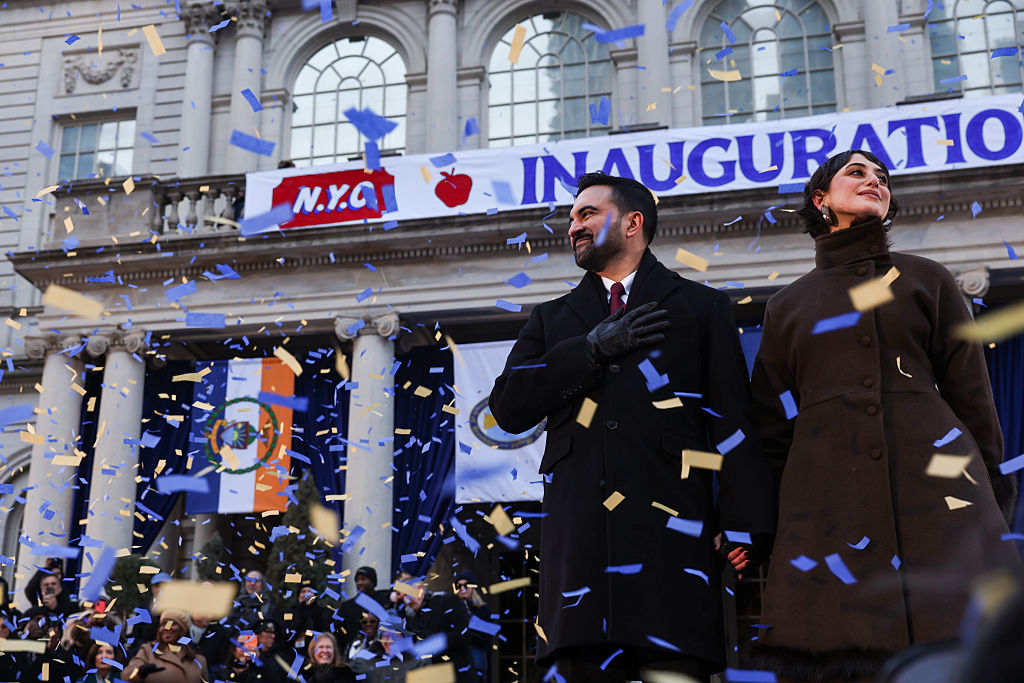
Zohran Mamdani and his wife Rama Duwaji after his inauguration as mayor at City Hall. (Spencer Platt/Getty Images
Zohran Mamdani, the 112th mayor of New York City, concluded his inauguration speech with a call to arms. After reassuring the crowd that he was ‘elected as a democratic socialist and will govern as a democratic socialist,’ he went on to say:
‘Before I end, I want to ask all of you, if you are able — whether you are here today or anywhere watching — to stand with me. I ask for you to stand with us now and every day that follows. City Hall will not be able to deliver on its own.’
Inside the ticketed area of City Hall’s plaza, the official space reserved for campaign staff, the transition team, and core volunteers, this was met with whoops of approval. It was brave for Mamdani to end his address with an overt plea. It was also an honest one. Socialism is a movement and should never be about one person. It was refreshing to hear this stated so plainly by the newly inaugurated mayor.
That appeal was also a recognition of how Mamdani came to power in the first place. His election campaign recruited nearly 100,000 volunteers, and there is broad consensus, among both media commentators and his own team, that his victory would have been impossible without them.
For many of those volunteers, it was the first time they had been involved in politics. I know this because I served as a field lead for the campaign in Brooklyn, leading weekly, and sometimes twice-weekly, canvasses from early August through to election day. The people who showed up were of all kinds. Some identified as socialists; many were simply fed up with the sheer cost of living in New York.
I was struck by how many of these volunteers, who had given up hours of their weekends and evenings to trudge through apartment blocks knocking on doors, did not resemble stereotypical lefties. Some worked corporate jobs, admitting this quietly and with reserve. Some were mothers who wanted to return to work but could not because of unaffordable childcare costs. There was almost no type of person I did not encounter during these canvasses.
This breadth should not have been surprising. Mamdani is not simply a progressive figure defined by abstract principles. His popularity is the direct result of an economic populism rooted in material demands, aimed at tackling the cost of living in one of the most expensive cities on earth. On campaign posters and fliers, there was just one sentence beneath his name: ‘For a New York You Can Afford’. His three central pledges — a rent freeze, universal childcare, and fast and free buses — were without question at the heart of his victory. Whether he is ultimately judged a success will depend on the delivery of those commitments.
Governing as a Democratic Socialist
Winning, however, is not the same as governing. The challenge Mamdani now faces is sustaining and organising the wide, diverse movement that brought him to power. Electoral mobilisation does not automatically translate into durable political participation, particularly once the energy of a campaign dissipates.
There are, however, already fledgling offshoots of the movement. The most notable is Our Time, an organisation building on the campaign’s grassroots momentum, though not formally affiliated. Its self-description is principled but thin on detail, promising to ‘organise to win and defend the agenda that resonated with voters: free child care, fast and free buses, freezing the rent and building affordable homes, and more’, while calling for continued participation through ‘door-knocking, phone-banking, communicating, and organising at neighbourhood, city, and state level’.
For now, the left has more than momentum; it has power. And Mamdani, it seems, is insisting that the two cannot be separated.
That power will come with constraints. Mamdani’s manifesto is economically ambitious, and much of it will depend on the support of state legislators, with the compromises required to secure that support uncertain. These pressures will not come only from institutional forces seeking to frustrate his programme, but also from elements of his own base.
To function as an effective mayor at all, Mamdani will also have to work with the NYPD. This lesson was learned the hard way by Bill de Blasio, elected in 2013, who lost the support of the police early in his tenure, a rupture that caused persistent difficulties throughout his administration. Mamdani’s cooperation with the police has already frustrated some on the left. He has been criticised for retaining NYPD commissioner Jessica Tisch, who is known for her role in repressing pro-Palestine protests.
It has been dispiriting to see accusations of failure and betrayal levelled at Mamdani before he has even taken office. It seems there are pockets of the left so accustomed to powerlessness that they appear unwilling to reckon with what power actually entails.
If Mamdani achieves even half of his mandate, it will be an extraordinary victory for the left and will create an opening for socialists not only in the United States but further afield. We must hold him to account, yes, but now that a socialist holds executive power, activism must replace cynicism.
Inside New York City Hall’s plaza on 1 January, cynicism had been left at the door. The atmosphere was electric. The day began chaotically, with different police officers directing us to different entrances, prompting murmurs in the crowd. The confusion quickly subsided, and a freezing but excited line formed. We shouted and whooped as Bernie Sanders walked past, raising a fist. Upon entry, we laughed in disbelief at finding ourselves seated behind Cynthia Nixon. We sang along and danced to the songs played by the DJ before the ceremony began. Well-meaning volunteers repeatedly asked us to sit down. Eventually, we did.
Halfway through Zohran’s speech, I found myself unexpectedly welling up, and a quick glance around confirmed I was not the only one. But it was the new mayor’s final words that felt the most consequential. They were addressed not only to the 4,000 supporters gathered at City Hall, not only to New Yorkers, but to viewers around the world:
‘The work continues. The work endures. The work, my friends, has only just begun.’
Contributor
Lucy Hall is a British writer and activist living in New York, where she is studying fiction writing.

No comments:
Post a Comment