WORD OF THE DAY
The Scouser’s Guide to Radical Feminism
Tribune
5th January, 2026
At the tail end of the 1960s, the Merseyside Women’s Liberation Movement was founded in a modest flat in the Liverpool 8 area. Its subsequent rich history offers a vital corrective to clichéd, male-dominated accounts of regionalism.
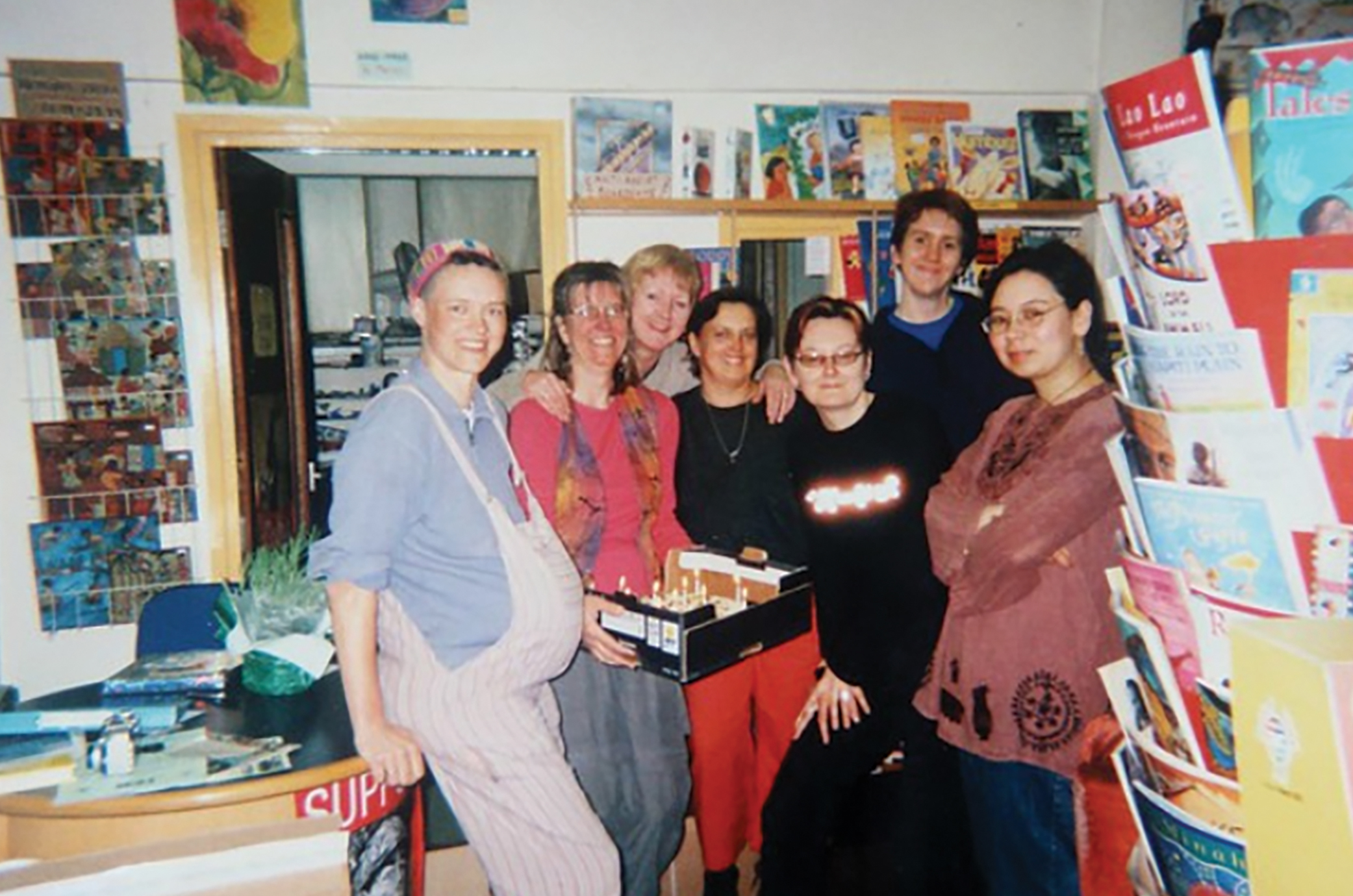
Members inside News from Nowhere, c.1990s (Copyright News from Nowhere)
On my regular commute from Liverpool Central train station to the University of Liverpool, I pass several physical reminders of the Merseyside Women’s Liberation Movement (MWLM). Walking up Bold Street, I see that the News from Nowhere radical bookshop still stands on my right, a flourishing non-profit women’s co-operative and long-standing focal point for non-sectarian socialist politics. A couple of streets across, a nondescript bar and pizza restaurant on Seel Street carries memories of the first Merseyside Women’s Centre and women’s commune. As I arrive on campus, I catch a quick glimpse of the Liverpool Guild of Students, where feminists hurled flour bombs, stormed the stage, and tore down sound equipment to demonstrate against a charity’s ‘slave girls’ auction in 1972.
While these are just a few reminders of women’s activism in the city, they illustrate just how embedded Liverpool’s feminist past is in the urban landscape. Why then, if people pass these spatial echoes every day, has this important history been largely forgotten?
Described by British historian John Belchem as ‘a city on the edge’, Liverpool’s distinct propensity for political radicalism, industrial militancy, and provincial otherness has formed a key component of its identity throughout the twentieth century. Yet, while the Toxteth riots (1981), the Militant council’s rate-capping rebellion (1985), and, later, the Liverpool dockers’ dispute (1995–8) have endured in popular memory, women’s contributions have been consistently overlooked.
Recovering the MWLM can help us piece together a richer picture of Liverpool’s contestable history. At a time when national and regional identities are being diluted, distorted, and weaponised by far-right agitators, restoring a positive narrative of radical provincialism can also help to initiate a reclaiming of progressive local identity and provide hope for future political mobilisation and development.
Feminism out of Socialism
The MWLM’s origin story is not unlike many others, epitomising the decentralised small-group philosophy of women’s liberation. In late 1969, a group of women and men — many of whom were already friends and neighbours — gathered informally at Princes Park Mansions in the multicultural area of Liverpool 8, in a modest flat belonging to town planner and housing activist Catherine Meredith. Others in the group included trainee speech therapist Anne Neville and her partner Charles Wakstein, teacher Marge Ben-Tovim and her husband Gideon, and radical GP Sheila Abdullah.
Many of these activists were not local but had migrated to Liverpool for work or study, drawn by the city’s radical reputation and its flourishing literary and artistic cultures of the late 1960s. Like many early WLM groups, the women were mostly white, university-educated, young professionals in their twenties and thirties, most were married or partnered with young children, and almost all had come to feminism ‘out of socialism’.
In the months that followed, the women began to develop collective interests and priorities for action, and the group held their first formal meeting soon after, on 12 February 1970. Two weeks later, several members attended the first British Women’s Liberation Conference in Oxford, bringing along two children, and two men who worked in the creche. Within a year, the MWLM had grown into an unusually structured umbrella organisation encompassing several local groups and campaigns across the city, with a rapidly growing membership of over ninety women by 1971.
While the MWLM was part of a wider national (and international) movement, early members decided that their first and foremost concern would be ‘direct action in [their] locality’, eager to adapt their feminism to the city’s working-class culture and existing radical networks. They aimed to support and involve local women as a kind of feminist advisory service, and focus on tackling ‘the most pressing injustices’ and ‘local inadequacies’ affecting the whole community. To do so, different campaign groups were established, and the MWLM formulated its own set of demands in 1970, building on the existing four national demands:
From the outset, women’s reproductive healthcare (or lack of it) formed a major site of feminist activism in response to stark local disparities in abortion and contraception provision in Liverpool. Despite legislative advances since the 1960s, Liverpool remained a stronghold of medical and religious opposition, stemming largely from its deeply embedded Irish Catholic culture. Known as a ‘city against abortion’, Liverpool was reported as the most difficult place in the country to get an NHS abortion.
Several key MWLM activists who had medical backgrounds also introduced a feminist focus on women’s healthcare. Although the WLM eschewed formal leaders officially, certain people clearly emerged as local figureheads with strong influence over campaigning priorities. Abdullah was a passionate defender of abortion rights and, alongside other sympathetic local doctors like Socialist Health Association president Cyril Taylor, used her practice as a site of activism to educate and advocate for women’s health.
Her professional expertise garnered trust from people within and outside the women’s movement, giving credibility to the campaign in Liverpool and helping to establish several early feminist initiatives, including free pregnancy testing, family planning services, and pioneering women’s health pamphlets. As activist Nina Houghton later reflected, ‘It was [Sheila’s] priority, and she made it ours too.’
Women’s health remained a key local priority throughout the 1970s and 1980s, championed by Abdullah and other later activists like Dr Katy Gardner, Linda Pepper, and Sylvia Hikins. Feminists were also galvanised by national struggles against the White (1975), Benyon (1977), and Corrie (1979) anti-abortion bills, as well as the ongoing local campaign for a daycare abortion unit, a new support service for Irish women seeking abortions, and action defending Liverpool’s Women’s Hospital.
Scouse Defiance
Curating a distinct feminist identity through local campaigning priorities equipped the MWLM with a strong basis for outreach endeavours, allowing activists to recruit new members, publicise the movement, and spread feminist ideas into multiple spaces. Alongside public marches, protests, and street campaigning, feminists in Liverpool used both the mainstream and alternative media to promote their ideas and establish the movement locally. They also engaged with existing women’s groups and left organisations, seeing their feminism as part of a broader movement.
Linking up with other groups sparked surprising collaborations and networks in the city. One early example was the unlikely solidarity between Merseyside feminists and striking dustmen, who led a campaign for council workers’ wage increases in October 1970. The women suggested a joint march to show unity between all low-paid workers, and the resulting demonstration saw thirty feminists march side by side with over a hundred dustmen and their wives. While the dustmen carried MWLM placards displaying slogans such as ‘Merseyside WLM demands a basic wage for all’, feminist activists carried dustbins, which they emptied on the steps of Liverpool City Hall in protest. Examples like this demonstrate how, at least on a local level, feminist activism often overlapped and connected with a myriad of different groups in the fight for social equality.
A desire to appeal to ordinary Scousers also prompted the development of a distinctly local style of protest, as the dustmen’s demonstration hints at. Adopting a Scouse blend of ‘truculent defiance, collective solidarity. . . and fatalist humour’ in the face of adversity, feminist activism in Liverpool was bold, creative, irreverent, and dramatic.
Feminist street theatre, for example, functioned as a powerful tool of political engagement and consciousness-raising. It enabled activists in Merseyside to make links with women in different communities and communicate their ideas in humorous and experimental ways, often using cross-dressing, music, caricature, and political satire to deconstruct and critique gender identities and inequalities. The group’s first play, performed outside the Liverpool Women’s Hospital in 1976, highlighted the absurdity of the Benyon abortion bill and featured feminists dressed up as William Benyon and other Conservative politicians in a mock boxing ring. Another play in 1980 featured a ‘cuts monster’ to visualise Thatcher’s ‘gobbling up’ of public services, housing, and local employment, and was written in collaboration with community groups like Dingle Tenants Action Group and the Netherley Flat Dwellers.
Fusing the WLM’s deliberately ostentatious style of protesting and a rich history of avant-garde political performance with Liverpool’s distinctive working-class wit, Merseyside feminist street theatre was a novel strategy that allowed activists to establish a feminist presence in the city and gain political agency through the contestation of physical space.
Reclaiming the urban landscape was also an important impetus for creating specific women’s spaces, which proved a growing necessity as the movement expanded. In late 1973, the first Merseyside Women’s Centre opened at 49 Seel Street in Liverpool city centre, in a derelict Georgian terrace building owned by the council. A group of young feminists took on the lease, including Marianne Sawyer, who was involved in housing co-operatives, and Sue Cartledge, who worked alongside Meredith in the council’s planning department. This expertise and experience with housing was crucial in acquiring and refurbishing the space as a women-only commune and women’s centre.
As in other towns and cities, the women’s centre quickly became the focal point for local feminist activism and communication, operating as an information and advice centre, library, meeting space, and an informal refuge for vulnerable women. Similarly to later spatial experiments of the 1980s (like the Merseyside Trade Union, Unemployed, and Community Resource Centre on Hardman Street), the Merseyside Women’s Centre was an important place for both feminists and women outside the movement to socialise, access help and support, and tentatively explore collective politics. Symbolically, it also provided evidence of a powerful and tangible feminist movement existing within the city, representing the transformation of everyday urban spaces for political uses.
Regionalism Reimagined
The Seel Street centre closed in 1977 due to problems with finances, logistics, and difficult internal dynamics. But this did not mark the end of the mwlm. Local feminism continued to flourish in different spaces, including the Sunnyside women’s housing co-operative (where women from the Seel Street commune moved to in 1975), the News from Nowhere bookshop, and a new women’s centre established at the Rialto Community Centre in 1978.
Like the national movement, the MWLM experienced a widening of feminist ideas and action at this time. While some historians have characterised the late 1970s as a time of turmoil, tension, and fragmentation for the WLM, the movement in Liverpool also saw an influx of women from diverse backgrounds and ages, as well as new campaigns and groups such as Reclaim the Night, Women and Ireland, Merseyside Women Oppose the Nuclear Threat, and the Socialist-Feminist and Women’s Action Group.
Yet, like elsewhere, the MWLM struggled to navigate this diversification. A plurality of ideas and experiences provoked numerous tensions and disagreements from the mid-1970s onwards, over issues concerning class, sexuality, and separatism. One particular area of difficulty was the relationship between black and white feminists, reflecting a wider disjuncture between the Left and the black community in Liverpool. Despite organising in historically multicultural areas like Liverpool 8, white feminists in the MWLM failed to make meaningful links with the black community, leading to the establishment of an entirely separate movement of black feminism led by groups like Liverpool Black Sisters.
It is important to remember that the WLM was not the only women’s movement of the period, but was part of a wider ‘second-wave’ that was fought on many fronts. Alongside WLM groups, women organised in trade unions, tenants groups, political parties, and community groups. Sometimes, as with black women’s groups, these networks were isolated and distinct from the MWLM. However, in many cases, they did converge around various campaigns, particularly those focused on women’s healthcare, housing, and community action. Collaboration between feminists and working-class tenants organising in places like Kirkby and Netherley, for example, resulted in reciprocal and long-lasting networks of solidarity.
This was reflected in the shifting focus of the local feminist magazine Merseyside Women’s Paper, which began in 1977 to provide a ‘Liverpool perspective on feminism and a feminist perspective on Liverpool’. While class politics and broader community activism were emphasised as central to the women’s movement from the paper’s beginnings, by the late 1970s, the editorial collective was keen to cater to a wider readership and foster communication with women outside the MWLM. From this point, Merseyside Women’s Paper acted as a more representative forum for a broader struggle, frequently including reports on women’s strikes and community campaigns, as well as interviews and articles by women from various socialist and communist groups.
Co-ordinating these struggles and forging cross-class, intergenerational, and translocal alliances became increasingly salient with the brutal onslaught of Thatcherism after 1979, which exacerbated Liverpool’s economic decline and brought many working-class communities into extreme deprivation. In the face of intense deindustrialisation, mass unemployment, and public sector cuts, a broad socialist-feminist approach was, as I’ve argued elsewhere, ‘not just an ideological preference but an economic and political necessity’ to defend against closures and job losses, and to reimagine new grassroots alternatives.
While the macho class-reductionist politics of Militant somewhat hindered the development of a ‘municipal feminism’ within Liverpool’s radical Labour council, MWLM activists still managed to play an important role in the city’s broader networks of resistance in the 1980s. Many also forged feminist careers and took their experience of women’s liberation into fields such as education, healthcare, trade unions, and the cultural sector, reflecting wider feminist trajectories in Britain. As my commute hints, the legacy of this in the city is demonstrated by the longevity of feminist spaces like News from Nowhere, Blackburne House, and the Women’s Health Information and Support Centre.
Recovering the MWLM redresses an injustice in the historical memory of radical Liverpool, supplanting the almost folkloric anti-heroes of Derek Hatton and Tony Mulhearn with hitherto unknown feminist activists like Neville and Abdullah. Telling these stories also provides important examples of how the Left can embed itself in local communities by being attuned to regional specificities and being open to adapting, experimenting, and forming alliances across the political spectrum. To overcome its fragmentation and build a truly devolved movement, the Left should look to the radical regionalism of the past for real grassroots examples rooted in (and driven by) the needs of local communities. As Sam Wetherell concludes in his recent book on the ‘making and unmaking’ of Liverpool, ‘the future is less certain and more open to possibilities than we can presently imagine’.

Contributors
Rachel Collett is a PhD student at the University of Liverpool researching the Merseyside Women’s Liberation Movement from 1969 to the 1990s.
Rachel Collett is a PhD student at the University of Liverpool researching the Merseyside Women’s Liberation Movement from 1969 to the 1990s.

No comments:
Post a Comment