47 Ways Trump Has ‘Made Life Less Affordable’ in Second Term
“Trump’s actions since taking office a year ago reveal a clear and consistent effort... to serve the interests of his billionaire and corporate backers,” said a co-author of the Economic Policy Institute report.

Federal employees rally in support of their jobs outside of the Kluczynski Federal Building on March 19, 2025 in Chicago, Illinois.
(Photo by Scott Olson/Getty Images)
Jessica Corbett
Jan 13, 2026
COMMON DREAMS
From “stripping collective bargaining rights from more than 1 million federal workers” to “denying 2 million in-home healthcare workers minimum wage and overtime pay,” President Donald Trump “has actively made life less affordable for working people.”
That’s according to a Tuesday report from the Economic Policy Institute (EPI), which cataloged 47 key ways that the 47th president made life worse for working people during the first year of his second term.
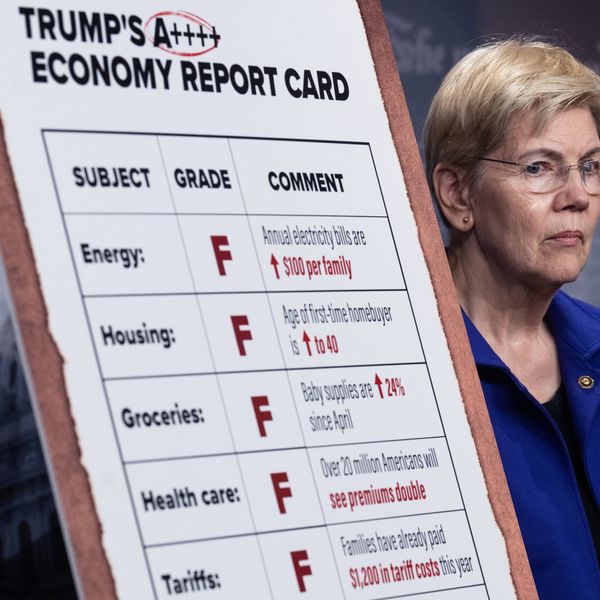
Nearly Half of Americans Say Their Financial Security Is Getting Worse Under Trump
The think tank sorted the actions into five categories: eroding workers’ wages and economic security; undermining job creation; weakening workers’ rights; enabling employer exploitation; and creating an ineffective government.
“Many of the actions outlined here have impacts across categories,” the report notes. “Trump’s attacks on union workers, for example, reduce workers’ wages, weaken workers’ rights, and promote employer exploitation of workers.”
“Every dollar denied to typical workers in wages ends up as higher income for business owners and corporate managers.”
The first section highlights that Trump (1) cut the minimum wage for nearly 400,000 federal contractors, (2) ended enforcement of protections for workers illegally classified as independent contractors, (3) slashed wages of migrant farmworkers in the H-2A program, (4) deprived in-home healthcare workers of minimum wage and overtime pay, and (5) facilitated the inclusion of cryptocurrencies among 401(k) investment options.
On the job creation front, the president (6) paused funding for projects authorized under a bipartisan infrastructure law, (7) signed the Laken Riley Act as part of his mass deportation agenda, (8) revoked an executive order that created a federal interagency working group focused on expanding apprenticeships, (9) is trying to shutter Job Corps centers operated by federal contractors, and (10) disrupted manufacturing supply chains with chaotic trade policy.
In addition to (11) attacking the union rights of over 1 million government employees, Trump (12) delayed enforcement of the silica rule for coal miners, (13) proposed limiting the scope of the Occupational Safety and Health Administration’s general duty clause, (14) fired National Labor Relations Board (NLRB) General Counsel Jennifer Abruzzo, (15) stripped work permits and temporary protections from immigrants lawfully in the country, and (16) deterred worker organizing with immigration enforcement actions.
Trump’s assault on workers’ rights has included (17) nominating Labor Secretary Lori Chavez-DeRemer, who has pursued a deregulatory agenda, (18) illegally firing Gwynne Wilcox from the NLRB, (19) ending funding to fight human trafficking and child and forced labor globally, and (20) terminating International Labor Affairs Bureau grants.
Chavez-DeRemer isn’t Trump’s only controversial pick for a key labor post. He’s also nominated (20) Jonathan Berry as solicitor of labor, (21) Crystal Carey as NLRB general counsel, (22) Scott Mayer as an NLRB board member, and (23) Daniel Aronowitz to lead the Employee Benefits Security Administration.
Trump has also (24) weakened workplace safety penalties for smaller businesses, (25) nominated Andrea Lucas as Equal Employment Opportunity Commission (EEOC) chair, (26) revoked an executive order promoting strong labor standards on projects receiving federal funds, (27) appointed Elisabeth Messenger, the former leader of an anti-union group, to head the Office of Labor-Management Standards, (28) fired EEOC Commissioners Charlotte Burrows and Jocelyn Samuels, and (29) conducted systematic worksite raids that punished workers rather than improving wages and working conditions.
The president’s various “deliberate actions to weaken the federal government” have included (30) politicizing career Senior Executive Service officials, (31) firing most staff at the National Institute for Occupational Safety and Health, (32) nominating Brittany Panuccio as an EEOC commissioner, (33) and picking Project 2025 architect Russell Vought as Office of Management and Budget director.
He has also fired (34) Federal Labor Relations Authority Chair Susan Tsui Grundmann and (35) Merit Systems Protection Board Member Cathy Harris, and (36) tried to fire Federal Reserve Governor Lisa Cook, whose case is set to be argued before the US Supreme Court next week. Trump further (37) fired Bureau of Labor Statistics (BLS) Commissioner Erika McEntarfer over accurate economic data, and is attempting to shut down (38) the Consumer Financial Protection Bureau, and (39) the Federal Mediation and Conciliation Service.
Additionally, the president (40) directed federal agencies to end the use of disparate impact liability, (41) put independent agencies under his supervision, (42) signed the so-called One Big Beautiful Bill Act that transfers wealth from working families to the ultrarich, (43) proposed a rule that would make it easier to fire federal employees for political reasons, and (44) issued an executive order on apprenticeships that does not require the government to consult with labor groups.
Finally, since returning to the White House, the Republican has (45) gutted the federal workforce, (46) directed US Attorney General Pam Bondi to challenge state laws that would regulate artificial intelligence technologies, and (47) fired 17 inspectors general.
“Trump’s actions since taking office a year ago reveal a clear and consistent effort to make life less affordable for working people in order to serve the interests of his billionaire and corporate backers,” said report co-author Celine McNicholas, EPI’s director of policy and general counsel, in a statement.
“Every dollar denied to typical workers in wages ends up as higher income for business owners and corporate managers,” McNicholas added. “This growing inequality is what is making life so unaffordable for workers and their families today.”
EPI released the report as the BLS published its consumer price index data for December, which show a 2.7% year-over-year increase in prices for everyday goods and services.
“Trump’s actions since taking office a year ago reveal a clear and consistent effort... to serve the interests of his billionaire and corporate backers,” said a co-author of the Economic Policy Institute report.
Federal employees rally in support of their jobs outside of the Kluczynski Federal Building on March 19, 2025 in Chicago, Illinois.
(Photo by Scott Olson/Getty Images)
Jessica Corbett
Jan 13, 2026
COMMON DREAMS
From “stripping collective bargaining rights from more than 1 million federal workers” to “denying 2 million in-home healthcare workers minimum wage and overtime pay,” President Donald Trump “has actively made life less affordable for working people.”
That’s according to a Tuesday report from the Economic Policy Institute (EPI), which cataloged 47 key ways that the 47th president made life worse for working people during the first year of his second term.
Nearly Half of Americans Say Their Financial Security Is Getting Worse Under Trump
The think tank sorted the actions into five categories: eroding workers’ wages and economic security; undermining job creation; weakening workers’ rights; enabling employer exploitation; and creating an ineffective government.
“Many of the actions outlined here have impacts across categories,” the report notes. “Trump’s attacks on union workers, for example, reduce workers’ wages, weaken workers’ rights, and promote employer exploitation of workers.”
“Every dollar denied to typical workers in wages ends up as higher income for business owners and corporate managers.”
The first section highlights that Trump (1) cut the minimum wage for nearly 400,000 federal contractors, (2) ended enforcement of protections for workers illegally classified as independent contractors, (3) slashed wages of migrant farmworkers in the H-2A program, (4) deprived in-home healthcare workers of minimum wage and overtime pay, and (5) facilitated the inclusion of cryptocurrencies among 401(k) investment options.
On the job creation front, the president (6) paused funding for projects authorized under a bipartisan infrastructure law, (7) signed the Laken Riley Act as part of his mass deportation agenda, (8) revoked an executive order that created a federal interagency working group focused on expanding apprenticeships, (9) is trying to shutter Job Corps centers operated by federal contractors, and (10) disrupted manufacturing supply chains with chaotic trade policy.
In addition to (11) attacking the union rights of over 1 million government employees, Trump (12) delayed enforcement of the silica rule for coal miners, (13) proposed limiting the scope of the Occupational Safety and Health Administration’s general duty clause, (14) fired National Labor Relations Board (NLRB) General Counsel Jennifer Abruzzo, (15) stripped work permits and temporary protections from immigrants lawfully in the country, and (16) deterred worker organizing with immigration enforcement actions.
Trump’s assault on workers’ rights has included (17) nominating Labor Secretary Lori Chavez-DeRemer, who has pursued a deregulatory agenda, (18) illegally firing Gwynne Wilcox from the NLRB, (19) ending funding to fight human trafficking and child and forced labor globally, and (20) terminating International Labor Affairs Bureau grants.
Chavez-DeRemer isn’t Trump’s only controversial pick for a key labor post. He’s also nominated (20) Jonathan Berry as solicitor of labor, (21) Crystal Carey as NLRB general counsel, (22) Scott Mayer as an NLRB board member, and (23) Daniel Aronowitz to lead the Employee Benefits Security Administration.
Trump has also (24) weakened workplace safety penalties for smaller businesses, (25) nominated Andrea Lucas as Equal Employment Opportunity Commission (EEOC) chair, (26) revoked an executive order promoting strong labor standards on projects receiving federal funds, (27) appointed Elisabeth Messenger, the former leader of an anti-union group, to head the Office of Labor-Management Standards, (28) fired EEOC Commissioners Charlotte Burrows and Jocelyn Samuels, and (29) conducted systematic worksite raids that punished workers rather than improving wages and working conditions.
The president’s various “deliberate actions to weaken the federal government” have included (30) politicizing career Senior Executive Service officials, (31) firing most staff at the National Institute for Occupational Safety and Health, (32) nominating Brittany Panuccio as an EEOC commissioner, (33) and picking Project 2025 architect Russell Vought as Office of Management and Budget director.
He has also fired (34) Federal Labor Relations Authority Chair Susan Tsui Grundmann and (35) Merit Systems Protection Board Member Cathy Harris, and (36) tried to fire Federal Reserve Governor Lisa Cook, whose case is set to be argued before the US Supreme Court next week. Trump further (37) fired Bureau of Labor Statistics (BLS) Commissioner Erika McEntarfer over accurate economic data, and is attempting to shut down (38) the Consumer Financial Protection Bureau, and (39) the Federal Mediation and Conciliation Service.
Additionally, the president (40) directed federal agencies to end the use of disparate impact liability, (41) put independent agencies under his supervision, (42) signed the so-called One Big Beautiful Bill Act that transfers wealth from working families to the ultrarich, (43) proposed a rule that would make it easier to fire federal employees for political reasons, and (44) issued an executive order on apprenticeships that does not require the government to consult with labor groups.
Finally, since returning to the White House, the Republican has (45) gutted the federal workforce, (46) directed US Attorney General Pam Bondi to challenge state laws that would regulate artificial intelligence technologies, and (47) fired 17 inspectors general.
“Trump’s actions since taking office a year ago reveal a clear and consistent effort to make life less affordable for working people in order to serve the interests of his billionaire and corporate backers,” said report co-author Celine McNicholas, EPI’s director of policy and general counsel, in a statement.
“Every dollar denied to typical workers in wages ends up as higher income for business owners and corporate managers,” McNicholas added. “This growing inequality is what is making life so unaffordable for workers and their families today.”
EPI released the report as the BLS published its consumer price index data for December, which show a 2.7% year-over-year increase in prices for everyday goods and services.

Matthew Chapman
January 13, 2026
RAW STORY
The conservative Wall Street Journal editorial board had a dire assessment of Trump's current economy: he's effectively fiddling while it burns, rather than deliver on any of the GOP's more conservative, growth-focused policies.
"Regarding prices, the consumer-price index came in somewhat hotter than expected with an increase of 0.3% in December and 2.7% over the past 12 months. Overall inflation isn’t rising, but it also isn’t coming down. Increases last month were especially notable for categories of goods and services that Americans buy on a regular basis like shelter (0.4%), medical care (0.4%), food (0.7%) and energy bills (1%)."
The sectors that saw the most inflation disproportionately hit lower-income Americans, the board noted. Worse still, earnings aren't getting any better, the board wrote.
"Real average hourly earnings rose 0.7% during the first five months of this year, but income growth has since stalled. For production and nonsupervisory workers, real average hourly earnings have declined 0.2% since May. The reason is a bump in inflation in the summer months that erased the gains from wage increases."
"This goes a long way to explain why so many Americans feel as if they are treading financial water," wrote the board — and it makes Trump's legal bullying of the Federal Reserve to try to lower interest rates look even more counterproductive, since the Fed isn't even at its inflation target yet and doesn't have room to lower rates to what Trump wants.
Instead, the board concluded, Trump is scrambling to try to implement price controls — something that has been tried and failed in previous inflation spells — most recently controls on credit card interest.
"The President has recently been rolling out a flurry of counterproductive policies worthy of Bernie Sanders in the name of reducing prices (see the editorial nearby on credit-card interest rates). But what the President really needs is what he promised in the campaign, which is rising real wages," wrote the board. "That means further reducing inflation and letting deregulation and tax policy drive faster economic growth and productivity. That will make everything more affordable."
"Regarding prices, the consumer-price index came in somewhat hotter than expected with an increase of 0.3% in December and 2.7% over the past 12 months. Overall inflation isn’t rising, but it also isn’t coming down. Increases last month were especially notable for categories of goods and services that Americans buy on a regular basis like shelter (0.4%), medical care (0.4%), food (0.7%) and energy bills (1%)."
The sectors that saw the most inflation disproportionately hit lower-income Americans, the board noted. Worse still, earnings aren't getting any better, the board wrote.
"Real average hourly earnings rose 0.7% during the first five months of this year, but income growth has since stalled. For production and nonsupervisory workers, real average hourly earnings have declined 0.2% since May. The reason is a bump in inflation in the summer months that erased the gains from wage increases."
"This goes a long way to explain why so many Americans feel as if they are treading financial water," wrote the board — and it makes Trump's legal bullying of the Federal Reserve to try to lower interest rates look even more counterproductive, since the Fed isn't even at its inflation target yet and doesn't have room to lower rates to what Trump wants.
Instead, the board concluded, Trump is scrambling to try to implement price controls — something that has been tried and failed in previous inflation spells — most recently controls on credit card interest.
"The President has recently been rolling out a flurry of counterproductive policies worthy of Bernie Sanders in the name of reducing prices (see the editorial nearby on credit-card interest rates). But what the President really needs is what he promised in the campaign, which is rising real wages," wrote the board. "That means further reducing inflation and letting deregulation and tax policy drive faster economic growth and productivity. That will make everything more affordable."
'Worst case scenario': Expert warns economic 'crash' risk grows by the day under Trump
Nicole Charky-Chami
January 12, 2026
Nicole Charky-Chami
January 12, 2026
RAW STORY
An economic expert Monday warned that a looming stock market crash could be on the horizon as the Trump administration shows its penchant for chaos.
Bloomberg economics columnist Clive Crook responded to questions over why the economy has not crashed and how despite policy disruptions and predictions of "doom" from experts and economists, the stock market appears to be still doing well — yet that could change.
Crook argued that given the Trump administration's sweeping policy changes, including tariffs and a rocky political situation unfolding both in and outside the United States, that Trump's policies have not yet been vindicated.
"The fact that the markets have done incredibly well is not really an endorsement of Trump's policies," Crook said.
"Don't misunderstand me: There are aspects of Trump's policies that the financial markets do — as it were, rationally — welcome rationally regard as pro-growth. In particular, lower corporate taxes and efforts at deregulation, those are pluses in the market's mind. But there are also negatives alongside: trade policy fiscal and monetary policy."
The result has been more complicated than it might appear, he added.
"On balance, it's hard to say how those will work out," Crook said. "And the other big thing that needs to be emphasized is the hope or the prospect that AI innovation will transform growth going forward, will transform productivity. So I'm not saying there are aren't reasons to be optimistic. All I'm saying is in this bundle of conflicting information and conflicting narratives, there are negatives which persist regardless of where the markets go. And as it were the disorder and the disruption that this administration really revels in, as that continues, the risk of a crash creating the worst case scenario, then that risk grows — grows over time."
An economic expert Monday warned that a looming stock market crash could be on the horizon as the Trump administration shows its penchant for chaos.
Bloomberg economics columnist Clive Crook responded to questions over why the economy has not crashed and how despite policy disruptions and predictions of "doom" from experts and economists, the stock market appears to be still doing well — yet that could change.
Crook argued that given the Trump administration's sweeping policy changes, including tariffs and a rocky political situation unfolding both in and outside the United States, that Trump's policies have not yet been vindicated.
"The fact that the markets have done incredibly well is not really an endorsement of Trump's policies," Crook said.
"Don't misunderstand me: There are aspects of Trump's policies that the financial markets do — as it were, rationally — welcome rationally regard as pro-growth. In particular, lower corporate taxes and efforts at deregulation, those are pluses in the market's mind. But there are also negatives alongside: trade policy fiscal and monetary policy."
The result has been more complicated than it might appear, he added.
"On balance, it's hard to say how those will work out," Crook said. "And the other big thing that needs to be emphasized is the hope or the prospect that AI innovation will transform growth going forward, will transform productivity. So I'm not saying there are aren't reasons to be optimistic. All I'm saying is in this bundle of conflicting information and conflicting narratives, there are negatives which persist regardless of where the markets go. And as it were the disorder and the disruption that this administration really revels in, as that continues, the risk of a crash creating the worst case scenario, then that risk grows — grows over time."
Trump’s Losing Streak Continues as Jobs Report Shows Weak 2025 Labor Market
WASHINGTON - The latest jobs report shows the United States added 50,000 jobs in December 2025, and prior months revised down by a combined 76,000 jobs. The unemployment rate remains elevated at 4.4% and is near its highest levels of the past four years. The December report caps a year of sluggish job growth, with the fewest number of jobs added outside of a recession since 2003. Hiring slowed sharply over the course of 2025 as Trump’s erratic economic policies froze the labor market.
Groundwork Collaborative’s Chief of Policy and Advocacy Alex Jacquez released the following statement:
“December’s job report confirms that Trump’s reckless trade policies and lifeless economy are costing Americans dearly. Working families face sluggish wage growth, fewer job opportunities, and never-ending price hikes on groceries, household essentials, and utilities. Despite the President’s endless attempts to deflect and distract from the bleak economic reality, workers and job seekers know their budgets feel tighter than ever thanks to Trump’s disastrous economic mismanagement.”
Job growth in 2025 fell far behind last year’s pace. Total job growth in 2025 was just 584,000, compared to 2 million jobs added in 2024 — a 71% slowdown.
Job gains remain narrowly concentrated in a small number of sectors. In December, job gains were concentrated in education and health services. Retail trade lost 25,000 jobs this holiday season, as budgets continue to be squeezed. The U.S. is shedding blue-collar jobs for the first time since the pandemic, with roughly 60,000 job losses in manufacturing, transportation and warehousing, and mining in 2025 while construction jobs stall out.
Long-term unemployment remains elevated. The number of people unemployed for six months or more remains at 1.9 million, increasing by roughly 400,000 compared to the year before. This points to rising financial strain for job seekers and growing unease among workers about job stability.
Official payroll statistics may overstate the number of jobs the economy is creating. Federal Reserve Chair Jerome Powell warned in December that headline job gains may be overstated by as many as 60,000 jobs per month. This is because the Bureau of Labor Statistics has to estimate job gains and losses at new and closing businesses that are difficult to survey directly. The lackluster jobs reports throughout 2025 may paint an overly rosy picture of the labor market.
New hiring has ground to a halt. The latest Job Openings and Labor Turnover Survey data show that job openings fell to about 7.1 million in November from nearly 7.5 million in October, while the hiring rate dropped to 3.2 percent, one of the lowest levels since April 2020, when the pandemic-induced recession was underway. According to data from Challenger, Gray & Christmas, U.S. employers sharply pulled back on hiring plans in 2025. Announced hires fell to about 508,000, down 34 percent from nearly 770,000 in 2024, the lowest annual total since 2010, signaling much weaker employer confidence in expanding their workforce.
WASHINGTON - The latest jobs report shows the United States added 50,000 jobs in December 2025, and prior months revised down by a combined 76,000 jobs. The unemployment rate remains elevated at 4.4% and is near its highest levels of the past four years. The December report caps a year of sluggish job growth, with the fewest number of jobs added outside of a recession since 2003. Hiring slowed sharply over the course of 2025 as Trump’s erratic economic policies froze the labor market.
Groundwork Collaborative’s Chief of Policy and Advocacy Alex Jacquez released the following statement:
“December’s job report confirms that Trump’s reckless trade policies and lifeless economy are costing Americans dearly. Working families face sluggish wage growth, fewer job opportunities, and never-ending price hikes on groceries, household essentials, and utilities. Despite the President’s endless attempts to deflect and distract from the bleak economic reality, workers and job seekers know their budgets feel tighter than ever thanks to Trump’s disastrous economic mismanagement.”
Job growth in 2025 fell far behind last year’s pace. Total job growth in 2025 was just 584,000, compared to 2 million jobs added in 2024 — a 71% slowdown.
Job gains remain narrowly concentrated in a small number of sectors. In December, job gains were concentrated in education and health services. Retail trade lost 25,000 jobs this holiday season, as budgets continue to be squeezed. The U.S. is shedding blue-collar jobs for the first time since the pandemic, with roughly 60,000 job losses in manufacturing, transportation and warehousing, and mining in 2025 while construction jobs stall out.
Long-term unemployment remains elevated. The number of people unemployed for six months or more remains at 1.9 million, increasing by roughly 400,000 compared to the year before. This points to rising financial strain for job seekers and growing unease among workers about job stability.
Official payroll statistics may overstate the number of jobs the economy is creating. Federal Reserve Chair Jerome Powell warned in December that headline job gains may be overstated by as many as 60,000 jobs per month. This is because the Bureau of Labor Statistics has to estimate job gains and losses at new and closing businesses that are difficult to survey directly. The lackluster jobs reports throughout 2025 may paint an overly rosy picture of the labor market.
New hiring has ground to a halt. The latest Job Openings and Labor Turnover Survey data show that job openings fell to about 7.1 million in November from nearly 7.5 million in October, while the hiring rate dropped to 3.2 percent, one of the lowest levels since April 2020, when the pandemic-induced recession was underway. According to data from Challenger, Gray & Christmas, U.S. employers sharply pulled back on hiring plans in 2025. Announced hires fell to about 508,000, down 34 percent from nearly 770,000 in 2024, the lowest annual total since 2010, signaling much weaker employer confidence in expanding their workforce.

No comments:
Post a Comment