
Only the Iranian People Should Determine Their Nation’s Future
It’s virtually impossible to predict what lies ahead for Iran and its people. But if President Donald Trump decides to take military action against Iran’s current regime, nothing good will come out of it.
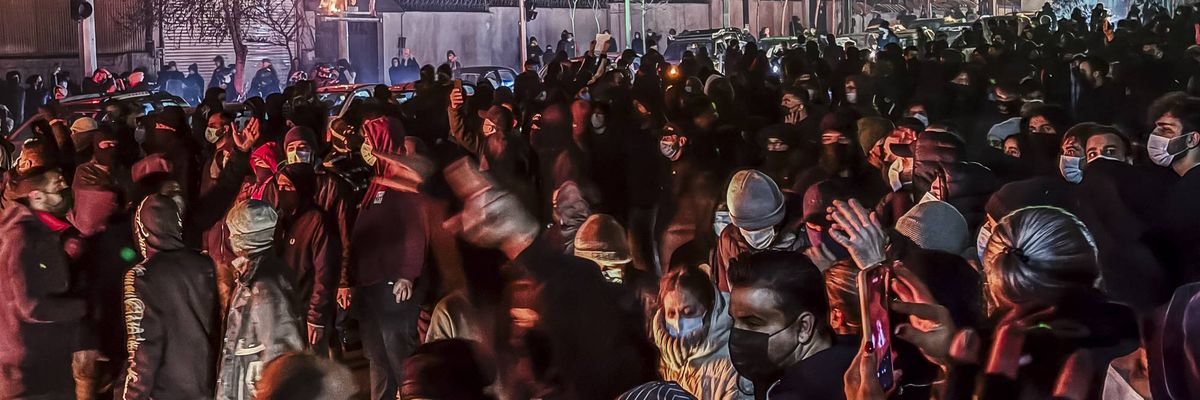
Iranians gather while blocking a street during a protest in Tehran, Iran on January 9, 2026.
(Photo by MAHSA / Middle East Images / AFP via Getty Images)
C.J. Polychroniou
Jan 14, 2026
Iran’s Islamic regime is under incredible pressure as the protests that begun in late December over the collapse of the currency have morphed into a mass popular uprising that has spread across the entire country and shows no sign of slowing despite a brutal crackdown that has resulted so far in the killing of thousands of protesters.
Make no mistake about it. Iran’s current leadership is murdering its own citizens in order to remain in power and thus block the growing support for secularism, freedom, and democracy. It’s as simple as that. This is a regime that has been facing unprecedented hostility by the United States and some of its closest allies since coming to power in 1979 but has been far more interested in exporting the Islamic revolution than looking after the well-being of its own citizens. It is a reactionary regime that has suppressed the fundamental rights of women, banned independent trade unions, and engaged in a systematic crackdown of communists and other leftists, all the while catering to powerful national capitalist interests.
Iranians have a long history of rebellion against authoritarianism and repression. Under the Shah, Iran had one of the world’s most brutal and repressive regimes, strongly supported by the United States. Indeed, while the Shah sought to modernize the country and even gave women the right to vote, and the Family Protection Law of 1968 granted women certain rights in divorce and custody, he and his generals ran the country with an iron first. Tens of thousands of Iranians were killed during the Shah’s reign, and Iran’s dreaded secret police, SAVAK, employed torture and execution to stifle political opposition.
Yet, Ayatollah Khomeini’s 1979 revolution, aided by Marxists, intellectuals, various secular groups, and the middle class, did not represent a transition from monarchy to democracy. Instead, it replaced a brutal, pro-Western monarchy with a theocratic regime that rolled back much of the social progress that had occurred up to that point. Repression came back, this time with an Islamic face, though the regime enjoyed at first considerable support among merchants, students, clerics, and the poor. Khomeini’s regime massacred and exiled all communists and embarked on a campaign of purification of policies. Women’s rights were drastically curtailed, and this included the removal of professional women from the public sector as well as the adoption of various means and methods aimed at discouraging women in general from entering the labor force.
The US is an imperialist power with a long history of undermining democracy throughout the world. The Iranian people will not accept US interference into their own political affairs.
Iranian women took to the streets by the thousands just a few weeks after the revolution to oppose Khomeini’s decree mandating the hijab. This decree was followed by a ban on alcohol, the separation of men and women in schools and beaches, and the criminalization of music. Iran was converted in no time from a Westernized society with a brutal political regime to an Islamic state sustained by an equally brutal political regime. Under the new social order, religion and state mixed as thoroughly as they did in Saudi Arabia. The only difference is that the two countries followed different branches of Islam--Iran’s political system is based on Shiism, while Saudi Arabia’s rests on Wahhabism.
More recently, in 2022, the death of the 22-year-old Kurdish-Iranian woman Jina Mahsa Amini while under morality police custody sparked the nationwide “Woman, Life, Freedom” protests, which people from all walks of life joined to call for an end to the four-decade rule of Iran by the religious fanatics. The Iranian authorities responded by detaining thousands of people while killing more than 560 protesters. It was reported that the average age of those arrested was 15.
The key reasons behind the current anti-government protests are economic hardships and political grievances. Iran’s economy has been under severe strains for a long time due to the international sanctions but also because of mismanagement, corruption, and a host of deep structural problems (chronic inflation, widespread poverty, and high youth unemployment, among others) which the regime has failed to address.
Protests broke out on December 28 after the Iranian currency, the rial, crumbled against the US dollar, leading to soaring food prices and to an even higher inflation rate, which had already risen to nearly 50%. It all started with demonstrations by shopkeepers in Tehran’s Grand Bazaar, but they quickly spread to numerous cities across the country, reflecting deep and widespread discontent among the general citizenry with the current regime. This means that the protests, which have been very large in size and joined by people from across Iranian society, are not simply driven by economic worries. They are political protests against a corrupt and oppressive regime.
According to some sources, more than 2,500 people have been killed by the Iranian authorities since the protests begun, but there are unverified reports, suggesting that the number of protesters killed could be at least 12,000 and possibly as high as 20,000. Leading Iranian officials have labeled protesters as “enemies of God,” a charge that is punishable by death under the laws of the Islamic Republic of Iran. They also insist that the protests are foreign driven.
Israel and the United States would like nothing more than to see regime change in Tehran and turn Iran into a US-Israeli vassal state. But the claim that the Iranian people are protesting against a dictatorship by being a pawn in the hands of foreign powers deserves nothing but scorn. Nonetheless, it speaks volumes of how alienated the regime’s rulers must feel from the nation’s citizenry. I suspect that deep down they are cognizant of the fact that their regime lacks political legitimacy in the eyes of the vast majority of the Iranian people.
The people of Iran have not forgotten the involvement of the CIA in the 1953 coup that ousted the democratically elected Prime Minister Muhammad Mossadegh. Their desire to get rid of Iran’s current regime is not an invitation for foreign interference. Indeed, who is to say that perhaps none of the courageous protesters would be paying with their lives for Iran to be free from an oppressive theocracy if the 1953 coup hadn’t happened?
It’s virtually impossible to predict what lies ahead for Iran and its people. But if President Donald Trump decides to take military action against Iran’s current regime, nothing good will come out of it. The US is an imperialist power with a long history of undermining democracy throughout the world. The Iranian people will not accept US interference into their own political affairs. In fact, such action may cause many Iranians to unite, at least temporarily, behind the regime. In sum, only the Iranian people themselves should be able decide their nation’s future.
Our work is licensed under Creative Commons (CC BY-NC-ND 3.0). Feel free to republish and share widely.
C.J. Polychroniou is a political economist/political scientist who has taught and worked in numerous universities and research centers in Europe and the United States. His latest books are The Precipice: Neoliberalism, the Pandemic and the Urgent Need for Social Change (A collection of interviews with Noam Chomsky; Haymarket Books, 2021), and Economics and the Left: Interviews with Progressive Economists (Verso, 2021).
Full Bio >
Six Poins to Navigate the Turmoil in Iran
Iran is in turmoil. Across the country, there have been protests of different magnitudes, with violence on the increase with both protesters and police finding themselves in the morgue. What began as work stoppages and inflation protests drew together a range of discontent, with women and young people frustrated with a system unable to secure their livelihood. Iran has been under prolonged economic siege and has been attacked directly by Israel and the United States not only within its borders, but across West Asia (including in its diplomatic enclaves in Syria). This economic war waged by the United States has created the situation for this turmoil, but the turmoil itself is not directed at Washington but at the government in Tehran.
There are reports—such as in the mainstream Israeli newspaper Ha’aretz in October 2025 about Israeli “influence operations aiming to install Reza Pahlavi as Shah of Iran”—that Israeli intelligence has a role in the protests, and the United States has openly told the protestors that it would bomb Tehran if the violence by the government increase. Last year, protests took place in twelve South Pars oil refineries, where five thousand contract workers in the Bushehr Gas Refinery Workers Union marched with their families on 9 December in Asaluyeh to demand higher wages and better working-conditions. When the workers took their struggle to the National Parliament in Tehran, where they called for an end to the contract work system, the Israelis and the United States took advantage of these sincere protests to attempt to transform a legitimate struggle into a potential regime change operation.
To understand what is happening, here are six points of historical importance that are offered in the spirit of discussion. Since 1979, Iran has played a very important role in the movement beyond monarchies in the Arab and Muslim world, and it has been an important defender of the Palestinian struggle. Iran is no stranger to foreign interference, going back to the British control of Iran’s oil from 1901, the 1907 Anglo-Russian Convention that divided Iran into spheres of influence, the 1921 coup that put Reza Khan on the throne, the 1953 coup that installed his son, Mohammed Reza Shah Pahlavi to the throne, and then the hybrid war against the Iranian Revolution from 1979 to the present. Here are the six points:
- The Iranian Revolution of 1978-79 overthrew the rule of the Shah of Iran Reza Pahlavi, and due to the strength of the religious clergy and its political formations resulted in the creation of the Islamic Republic in April 1979 with the Constitution of the Islamic Republic coming into effect in December 1979. The other currents in the revolution (from the communist left to the liberals) found themselves largely sidelined and even—in some cases—repressed. The March 1979 protests on International Women’s Day in Tehran followed the restrictions on women’s rights (particularly against the compulsory hijab policy), which forced the government to accept the demands of the protests—but this was a short-term win, since in 1983 a mandatory hijab law was passed.
- The Revolution followed the military coup of Zia ul-Haq in Pakistan in 1977, the Saur Revolution in Afghanistan (August 1978), the establishment of the Yemeni Socialist Party (October 1978) that took the People’s Democratic Republic of Yemen into the Soviet sphere and that led to the North-South war in Yemen (February-March 1979), and the capture of power by Saddam Hussein Iraq in July 1979—the entire region of south-western and central Asia catapulting in political somersaults. Some of these developments (Pakistan, Iraq) offering advantages to the United States, and the others (Afghanistan, Iran, Yemen) being counter to US objectives in the region. Very quickly, the United States attempted to press its advantages by trying to overthrow the Islamic Republic of Iran, the People’s Democratic Republic of Yemen, and the Democratic Republic of Afghanistan.
- The pressure by the United States on these processes led to a war-like situation in all three countries: the US and its Gulf allies urged Iraq to invade Iran unprovoked in September 1980, starting a war that lasted till 1988; the Gulf Arab states urged North Yemen to invade South Yemen after the assassination of Salim Rubaya Ali (a Maoist who was negotiating the merger of the two Yemens); finally, in Afghanistan, the US began to fun the mujahideen to start an assassination campaign against cadre of the People’s Democratic Party of Afghanistan. Iran, Afghanistan, and Yemen saw their social projects narrowed by the attacks they faced from outside. Afghanistan crashed into over forty years of terrible violence and war, even though the Democratic Republic of Afghanistan remained in place for eighteen years; the Marxist government in South Yemen remained until 1990, but it was a pale shadow of its own expectations; Iran, meanwhile, saw its Islamic Republic survive a harsh sanctions policy that followed the end of the war by Iraq (in 1988).
- The Islamic Republic faced several important, consecutive challenges:
The most important came from US imperialism, which not only fully spurred Iraq’s war, but supported initiatives by the former Iranian elites to restore their rule and supported Israeli attempts to undermine the Islamic Republic (including direct attacks on Iran, sabotage operations, and assassinations of key figures from the science professions and military). It is the United States and Israel that have been systematically trying to erode Iran’s power in the region with the assassination of General Qassem Soleimani in 2020, the harsh attack on Hezbollah during the Israeli genocide and the assassination of Syed Hassan Nasrallah in 2024, and the overthrow of the government in Syria in December 2024 with the installation of the former al-Qaeda chief as President in Damascus.
The old Iranian elites, led by the Shah at first till his death in 1980 and then his son, so-called Crown Prince Reza Pahlavi, joined with the Europeans and the US to restore their rule. It is important to know that while the Shah had sat on the Peacock Throne from 1941, he was forced to accept a democratic government from 1951 to 1953 – which was overthrown by Western intelligence services and then the Shah was encouraged to exercise absolute rule from 1953 to the revolution of 1978-79. The Shah’s bloc has consistently wanted to return to power in Iran. While the Green Movement of 2009 had a very small monarchical element, it represented the dominant classes who wanted political reforms against the more plebeian presidency of Mahmoud Ahmadinejad. It is telling that the United States has ‘chosen’ the Shah’s son, who lives in Los Angeles, as the figure of this uprising.
Limitations to the republic’s transformative social agenda were present as it tolerated sections of the old elite, allowing them to hold their property, and therefore allowing the formation of a stratified class system that benefited sections of these property owners and an emergent middle class. After the death of Ayatollah Ruhollah Khomeini in June 1989 and the end of the Iran-Iraq War, the government adopted large parts of the International Monetary Fund’s structural adjustment policies, which —one way or the other—remained in place for decades (the policy was driven by Mohsen Nourbaksh, who was the Minister of Economic Affairs from 1989 to 1994 and then head of the Central Bank from 1994 to 2003). The economy was not organised along socialist lines in 1979, but it had built a strong role for the state and for public planning due to the needs of the war economy and due to the commitment to Islamic social welfare. Nourbaksh could not totally dismantle the state, but he conducted currency and banking reform as well as he did cautiously integrate Iran into the global economy. The class divergence and the difficulties of life for the majority of Iranians increased due to the combined impact of the US-European sanctions regime, the military threats by the US-Israelis (that has led to high military spending in Iran—still at around 2.5 percent of GDP it is much lower than the 12 percent of GDP during the reign of the Shah), and to the neoliberal policies pursued by the increasingly neoliberal finance ministers of the government (such as Ali Tayebnia from 2013 to 2017 and Ali Madanizadeh from 2025). It was this limitation of the Islamic Republic that has led to cycles of economic protest: 2017-2018 (around inflation and subsidy cuts), 2019 (around fuel price hike), 2025 (by bakers), and 2025-26 (soaring inflation and the collapse of the Iranian rial). - While the current protests are largely driven by a record-high Rial to USD exchange and a 60 percent food inflation rate, the transition from labor strikes in South Pars to coordinated urban violence points towards a deeper level of intervention. The administration has favoured sections of the import-export sector, which has worked in the context of the sanctions, to assist the commodity-exporters at the expense of the importers – a situation that is not easy to correct. Yet the abrupt 30-40 percent currency drop is a classic hallmark of external financial manipulation. Therefore, what began as business owners protesting the Central Bank without interference, soon morphed into a violent, top-down assault on the state fabric. The “protests” shifted overnight from peaceful assemblies to high-intensity urban sabotage resulting in the deaths of roughly 100 law enforcement officers, with claims that some officers were burned alive, a security member was beheaded, and a medical clinic was torched, claiming the life of a nurse, for instance. The use of close-range small arms fire against civilians further suggests an attempt to maximize domestic tension and provide a pretext for foreign intervention. The geopolitical orchestration behind the chaos became undeniable as the US State Department and Mossad openly cheered the violence in real-time. Once authorities disabled Internet access, the protests significantly lost strength, which places into question the spontaneity of the movement and lends truth to the thesis that there is a destabilization strategy at play, seeking to benefit from the current international conjuncture.
- The opposition has taken to the streets but recognises that it does not have the strength to seize power. There are reports of US and Israeli interference, and it does not help the opposition that the Shah’s son has been both claiming credit for the protests and seeing himself as its beneficiary. With Trump at the helm of hyper-imperialism, and with Israel amid a period of what it feels are endless victories, it is impossible to know what these dangerous cliques will do. As the mobilisations lose steam, which will take place, the US-Israel might take advantage of the situation to strike Tehran and other cities with more force than it did in June 2025. This should be a worry not only for the people in Iran, the vast mass of whom do not wish an attack on their country, but also the people of the Global South—who will find themselves as the next target after Venezuela and Iran.
Real problems bedevil the population, but these problems are not going to be solved through a hyper-imperialist aerial bombardment by the United States and Israel. The Iranians will need to sort out their own problems. The sanctions regime and the threats of violence do nothing to allow that to happen. It is easy to say “solidarity to the Iranians” in the West, where protesters are being beaten and even killed for their support of the Palestinians and their anger at the anti-immigration policies; seems to be much harder to say “end the sanctions,” and therefore allow the Iranian people to breathe into their own future.
This article was produced by Globetrotter.
Vijay Prashad is an Indian historian, editor, and journalist. He is a writing fellow and chief correspondent at Globetrotter. He is an editor of LeftWord Books and the director of Tricontinental: Institute for Social Research. He has written more than 20 books, including The Darker Nations and The Poorer Nations. His latest books are On Cuba: Reflections on 70 Years of Revolution and Struggle (with Noam Chomsky), Struggle Makes Us Human: Learning from Movements for Socialism, and (also with Noam Chomsky) The Withdrawal: Iraq, Libya, Afghanistan, and the Fragility of US Power. Chelwa and Prashad will publish How the International Monetary Fund is Suffocating Africa later this year with Inkani Books.
Conversation with Historian Ervand Abrahamian about Protests in Iran, Israel, and the US Imperialism
DV coeditor Faramarz Farbod interviewed Ervand Abrahamian on January 11, 2026, about protests in Iran. Discussions also touched on the US invasion of Venezuela, US imperialism, late-stage capitalism, and the European, Russian, and Chinese positions on a possible second round of US/Israeli military attack on Iran. Abrahamian is an emeritus distinguished Professor of Iranian and Middle Eastern history and politics at the City University of New York and the author of many books, including A History of Modern Iran, The Coup: 1953, the CIA, and the Roots of Modern U.S.-Iranian Relations, and the forthcoming The Inevitable Revolution.
January 14, 2026
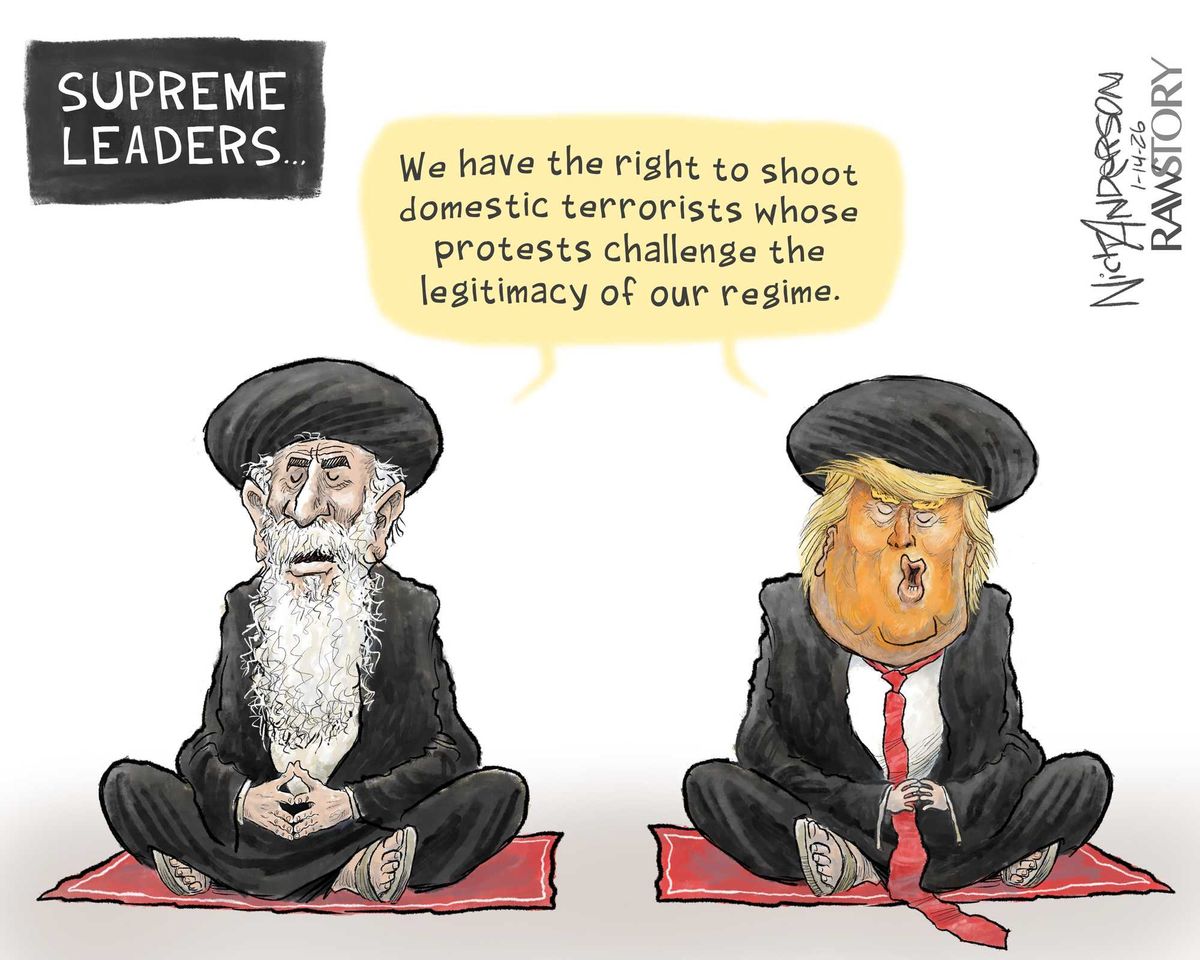
Nick Anderson/Raw Story
Nick Anderson is a Pulitzer Prize-winning editorial cartoonist.
The popular protests in Iran are just, but rolling back the regime through US intervention, rather than through the actions of the Iranian people themselves, cannot plausibly be described as support for democracy.
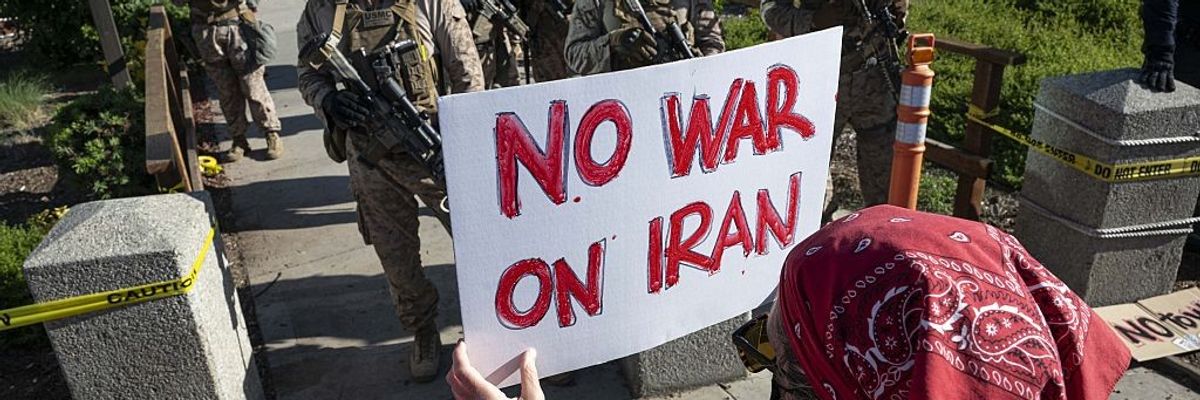
A Protester holds a sign in front of United States Marine Corps soldiers outside of the Federal Building in downtown Los Angeles during the “No War On Iran” protest after conflicts arise with Iran and Israel on June 19, 2025 in Los Angeles, United States.
(Photo by Jon Putman/Anadolu via Getty Images)
Eric Ross
Jan 13, 2026
Multiple things can be true at once. The Iranian people are engaged in a legitimate popular struggle against an entrenched political elite that has failed to meet their material needs and has answered demands for freedom and dignity with unconscionable violence and repression. At the same time, the US has no political, legal, or moral basis to intervene in Iran. The dire state of the country, as is true of Venezuela and Cuba, the two other nations targeted by the latest neo-neoconservative regime change enthusiasts blinded by imperial hubris and a fetishization of military power, is in significant part the result of Washington’s own policies.
Since 1979, the US has pursued policies aimed at ensuring the failure of the Iranian Revolution. In the decades that followed, and with particular acceleration under the Trump administration, this effort crystallized into a sanctions regime designed not to promote democracy or human rights but to drive ordinary Iranians into a state of immiseration. This strategy, deployed against governments that Washington unilaterally deems problematic, occasionally for defensible reasons but far more often for refusing to subordinate themselves to US imperial and corporate power, has been linked to an estimated 38 million deaths worldwide since 1971.
In Iran, as elsewhere, this policy has rested on the cynical belief that mass suffering will produce political unrest advantageous to the interests of the United States and, in this case, of Israel as well. The quiet part was said out loud by Sen. John Fetterman (D-Pa.), who mocked the government’s recent inability to quell economic discontent through modest financial inducements and celebrated this as “a testament to how our nation and Israel broke Iran.”
The disregard for international law, democratic principles, and human life that underpins this slow violence (see for example Madeleine Albright’s 1996 insistence that sanctions killing as many as half a million Iraqi children was “worth it”) is more evident today than ever. The hypocrisy of an administration that has enabled a genocide in Gaza, decapitated a government in pursuit of oil, threatens to militarily seize the territory of a sovereign country, and condemns repression in Iran while defending public execution of Renee Good by Immigration and Customs Enforcement is not lost on anyone.
US intervention would both co-opt the movement and almost certainly foreclose any real possibility of justice or democracy.
Beyond sanctions, the template for deeper US involvement in Iran appears poised to follow a familiar, troubling playbook. If Washington moves toward directing regime change under the guise of “supporting” Iranian freedom, the most likely beneficiary would be the exiled son of the former Shah, who has not lived in the country for decades. Such an intervention would amount to a second US-backed ouster of an Iranian government to reinstall a member of the Pahlavi dynasty.
The Shah’s son, who has cultivated warm ties with Donald Trump and Benjamin Netanyahu, and has been rebuffed by Iranian human rights activists, does not represent a pathway toward Iran’s democratization. The pursuit of US intervention today then might well produce consequences as calamitous and as unpredictable as those unleashed in 1953. This broader history must therefore remain central to any serious assessment of the current crisis in Iran.
The Oil Curse in Iran
Before Venezuela possessed the largest proven oil reserves in the world, that distinction belonged to Iran. More than a century ago, a weak, illegitimate, and cash-strapped Qajar Dynasty sold the rights to petroleum prospecting to British mining magnate William Knox D’Arcy, a speculative venture in a country with no existing oil industry and no guarantee of viable deposits. At the time, petroleum had not yet come to grease the wheels of the West or serve as the engine of its industrial and military power.
As a result, the 1901 oil concession was not met with the same resistance that had greeted earlier attempts by the Qajars to treat the country as their personal fiefdom, outsourcing development and selling national resources to the highest foreign bidder. The Iranian people had long resisted such Western encroachment, repeatedly forcing their government to retreat from foreign contracts. Yet popular pressure failed to materialize for what would become the most consequential concession of all, one that laid the foundation for decades of imperial intervention in Iran.
The discovery of a vast sea of oil in 1908 prompted the creation of the Anglo-Persian Oil Company (rebranded the Anglo-Iranian Oil Company in 1935 and again as British Petroleum in 1954). By 1914, citing financial uncertainty for the company and a desire to modernize the British naval fleet from domestic coal to more efficient foreign oil, the British government moved to acquire a majority stake in APOC. The timing proved decisive. The world war that followed fueled a global oil boom, and Iranian production expanded rapidly, with APOC supplying a substantial share of Britain’s wartime needs.
After the war, in 1925, a coup ended Qajar rule, and Minister of War Reza Khan crowned himself Shah, inaugurating the Pahlavi Dynasty. He renegotiated the oil concession on marginally better terms, but the increased revenues enriched the Pahlavi elite far more than ordinary Iranians. The result was a growing inequality that fed a revived anti-imperial consciousness.
British control, combined with a failure to defend national sovereignty, radicalized Iranians across social classes. Nowhere was this discontent more acute than among exploited oil workers, who lived and labored in squalid, dangerous conditions, excluded from advancement and constrained by a rigid colonial hierarchy that starkly contrasted with the privileged lives of foreign staff.
The Rise and Fall of Mohammad Mossadegh
That the Shah served at the pleasure of British commercial interests became evident in 1941, when London, and Moscow, deposed him, citing his perceived closeness to Germany, and installed his son, Mohammad Reza Pahlavi, to secure oil for the war effort and keep it from falling into German hands. For good measure, British and Soviet forces occupied the country for the next five years.
After the war and occupation, Iranians renewed their demands for sovereignty, beginning with reclaiming what they saw as their inalienable birthright: control of the natural wealth beneath their soil. Mohammad Mossadegh embodied this struggle. A European-trained lawyer and leader of the National Front coalition, he became the first fully democratically elected prime minister in 1951, sidelining the authority of the Shah and riding a wave of widespread popular support. His ascent was so significant to both Iran and to broader geopolitics that it prompted Time Magazine to name him “Man of the Year” and hail him as the “Iranian George Washington” by 1952.
The events of 1979, shaped by the blowback from 1953, also set the US on a trajectory of deeper imperial entanglement.
Yet he committed what, in the early Cold War, was an unforgivable offense: He nationalized Iran’s own natural resources. This move was wildly popular. The depth of exploitation was evident in that the Anglo-Iranian Oil Company made more in profits in 1950 than it had paid Iran in royalties over nearly the entire previous half century. Mossadegh insisted he was willing to compensate the company, a practice consistent with recent nationalizations, not only in places like Mexico but in Britain itself, which had nationalized its coal industry under the Labour government in 1947. The British nonetheless refused any negotiated settlement.
London instead responded with economic warfare, imposing a de facto embargo designed to starve Mossadegh’s government, obstruct his reform agenda, and grind the population into submission, not unlike more recent sanctions regimes. The campaign only intensified nationalist fervor; some of Mossadegh’s allies declared it preferable for Iran’s oil to be destroyed “by an atom bomb” than to remain under British control. When economic coercion failed, London turned to overthrowing the government, a plot Mossadegh uncovered, leading to the expulsion of British personnel from the country.
In Washington, Downing Street found willing accomplices. The pretext for intervention was that the economic turmoil, engineered by British policies, might in turn create a political vacuum that the Soviets or domestic communists would exploit. In reality, CIA documents acknowledged that Mossadegh was not a communist but a committed nationalist, and that Iran’s communist party was marginal, among the population and within the military. Despite this intelligence, the United States turned toward regime change, establishing the first ever model for covert coups that would follow around the world.
In 1953, after the CIA fomented an artificial uprising and Mossadegh was arrested by a US-backed military loyalist, the Shah, who had fled the country in anticipation of a failed plan, was restored to power. For their trouble, American oil companies were granted a 40% share in the new consortium that controlled Iranian oil, while another 40% went to British Petroleum.
The Last Shah of Iran?
Lacking popular legitimacy, the Shah depended heavily on US backing to maintain control. His rule was enforced through the expansion of the secret police, SAVAK, which functioned as an instrument of state terror rooted in surveillance, repression, and torture. US arms transfers helped sustain this coercive order. By the end of the Shah’s reign, US weapons sales to Iran were in the billions annually, with cumulative purchases over the decade perhaps as high as $20 billion.
As the regime poured staggering resources into armaments, it failed to adequately provide for the well-being of its population. The economic shocks of the 1970s drove millions into the slum-like peripheries of cities like Tehran. These dispossessed joined a broad coalition of women, religious clerics, merchants, laborers, students, and activists who mobilized against the monarchy. Political ferment deepened as President Jimmy Carter, in a display of strategic myopia, publicly toasted the Shah, praising Iran as an “island of stability,” and crediting his “great leadership,” asserting that he had the “respect and the admiration and love” of his people.
That the revolution which soon followed would assume an Islamic character, or culminate in the creation of a theocratic state, was not predetermined. It drew on the influence of the exiled religious figure, soon to be Supreme Leader, Ayatollah Khomeini, as well as an Islamic political vocabulary shaped by Ali Shariati, whose synthesis of Marxism, Iranian history, and Shi’a Islam resonated widely. Yet it was driven above all by a general popular discontent. As in revolutions everywhere, ideology supplied meaning, but material conditions set the stage. Iranian scholar Hamid Dabashi captures this reality in his observation that “Khomeini may not have led a revolution for the price of melon, but many of his followers thought they did.”
If there was a shared ideological thread running through the protests then, it was anti-imperialism. Demonstrators rejected the forced Westernization and authoritarian secularism of the Pahlavi state and rallied behind the slogan “Neither East nor West,” an expression of Third World nationalism and assertion of self-determination. So too did the memory of Mohammad Mossadegh animate the uprising. His figure, representing a crushed experiment in democracy and an anti-imperialist past, remained deeply embedded in Iranian political consciousness.
The Pahlavi government met this movement with escalating violence. This repression, historian Ervand Abrahamian writes, “placed a sea of blood between the Shah and the people,” ensuring the monarchy could not survive and hastening the defection of the military. The revolution soon set in motion events that culminated in the student seizure of the US Embassy in Tehran over fears that Washington intended to rehabilitate, and reinstate, the Shah after admitting him for cancer treatment. The result was a prolonged 444-day standoff that institutionalized mutual hostility and cast a long shadow over both countries and the region.
This animus deepened as the US backed Iraq in its invasion of Iran soon after the revolution. The eight-year war killed roughly 1 million people and revealed Washington’s willingness to bleed regional powers to maintain its geopolitical influence. Continued US support for Israel and the Islamic Republic’s resistance further solidified the adversarial relationship.
The events of 1979, shaped by the blowback from 1953, also set the US on a trajectory of deeper imperial entanglement. These moves included a tightening partnership with Saudi Arabia, a more direct response to the Soviet invasion of Afghanistan, and laid the foundations for the Gulf War. Taken together, they created the conditions for the catastrophic, mass murderous “War on Terror” that was to come, revealing a direct line from US policy toward Iran to the wider architecture of American empire across the Greater Middle East.
“We’re Looking at Very Strong Options”
The popular protests in Iran are just, and the exceedingly violent response is an affront to the most basic principles of human rights and dignity. But rolling back the regime through US intervention, rather than through the actions of the Iranian people themselves, cannot plausibly be described as support for democracy. It represents the opposite. It is an attempt to reimpose a former client state and reclaim a strategic foothold lost in 1979, in service of a broader ideological project aimed at reasserting US hegemony in the region and beyond.
The Iranian people deserve freedom, and have the right to determine their own political destiny. The horrific slaughter of protesters and imprisonment of dissidents must end. Yet US intervention would both co-opt the movement and almost certainly foreclose any real possibility of justice or democracy.
The precedent here is unmistakable. There was once what was presented as a compelling case for removing Saddam Hussein, given his record of atrocities. But regime change in Iraq, pursued under the ulterior aims of an imperial America; carried out through lies, deceit, and illegality; and urged on by an exile elite with no local legitimacy, became one of the defining crimes of the century. To follow a similar course in Iran today would not only risk replicating those failures. It would reopen wounds that remain painfully fresh, even as they are all too easily forgotten.
Our work is licensed under Creative Commons (CC BY-NC-ND 3.0). Feel free to republish and share widely.
Right Message, Wrong Messengers: A Brief History of Oil and U.S. Empire in Iran
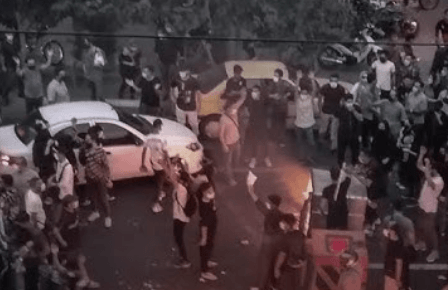
YouTube screenshot.
Multiple things can be true at once. The Iranian people are engaged in a legitimate popular struggle against an entrenched political elite that has failed to meet their material needs and has answered demands for freedom and dignity with unconscionable violence and repression. At the same time, the U.S. has no political, legal, or moral basis to intervene in Iran. The dire state of the country, as is true of Venezuela and Cuba, the two other nations targeted by the latest neo-neoconservative regime change enthusiasts blinded by imperial hubris and a fetishization of military power, is in significant part the result of Washington’s own policies.
Since 1979, the U.S. has pursued policies aimed at ensuring the failure of the Iranian Revolution. In the decades that followed, and with particular acceleration under the Trump administration, this effort crystallized into a sanctions regime designed not to promote democracy or human rights but to drive ordinary Iranians into a state of immiseration. This strategy, deployed against governments that Washington unilaterally deems problematic, occasionally for defensible reasons but far more often for refusing to subordinate themselves to U.S. imperial and corporate power, has been linked to an estimated 38 million deaths worldwide since 1971.
In Iran, as elsewhere, this policy has rested on the cynical belief that mass suffering will produce political unrest advantageous to the interests of the United States and, in this case, of Israel as well. The quiet part was said out loud by Senator John Fetterman, who mocked the government’s recent inability to quell economic discontent through modest financial inducements and celebrated this as “a testament to how our nation and Israel broke Iran.”
The disregard for international law, democratic principles, and human life that underpins this slow violence (see for example Madeleine Albright’s 1996 insistence that sanctions killing as many as half a million Iraqi children was “worth it”) is more evident today than ever. The hypocrisy of an administration that has enabled a genocide in Gaza, decapitated a government in pursuit of oil, threatens to militarily seize the territory of a sovereign country, and condemns repression in Iran while defending public execution of Renee Good by ICE is not lost on anyone.
Beyond sanctions, the template for deeper U.S. involvement in Iran appears poised to follow a familiar, troubling playbook. If Washington moves toward directing regime change under the guise of “supporting” Iranian freedom, the most likely beneficiary would be the exiled son of the former Shah, who has not lived in the country for decades. Such an intervention would amount to a second U.S.-backed ouster of an Iranian government to reinstall a member of the Pahlavi dynasty.
The Shah’s son, who has cultivated warm ties with Donald Trump and Benjamin Netanyahu, and has been rebuffed by Iranian human rights activists, does not represent a pathway toward Iran’s democratization. The pursuit of U.S. intervention today then might well produce consequences as calamitous and as unpredictable as those unleashed in 1953. This broader history must therefore remain central to any serious assessment of the current crisis in Iran.
The Oil Curse in Iran
Before Venezuela possessed the largest proven oil reserves in the world, that distinction belonged to Iran. More than a century ago, a weak, illegitimate, and cash-strapped Qajar Dynasty sold the rights to petroleum prospecting to British mining magnate William Knox D’Arcy, a speculative venture in a country with no existing oil industry and no guarantee of viable deposits. At the time, petroleum had not yet come to grease the wheels of the West or serve as the engine of its industrial and military power.
As a result, the 1901 oil concession was not met with the same resistance that had greeted earlier attempts by the Qajars to treat the country as their personal fiefdom, outsourcing development and selling national resources to the highest foreign bidder. The Iranian people had long resisted such Western encroachment, repeatedly forcing their government to retreat from foreign contracts. Yet popular pressure failed to materialize for what would become the most consequential concession of all, one that laid the foundation for decades of imperial intervention in Iran.
The discovery of a vast sea of oil in 1908 prompted the creation of the Anglo-Persian Oil Company (rebranded the Anglo-Iranian Oil Company in 1935 and again as British Petroleum in 1954). By 1914, citing financial uncertainty for the company and a desire to modernize the British naval fleet from domestic coal to more efficient foreign oil, the British government moved to acquire a majority stake in APOC. The timing proved decisive. The world war that followed fueled a global oil boom, and Iranian production expanded rapidly, with APOC supplying a substantial share of Britain’s wartime needs.
After the war, in 1925, a coup ended Qajar rule, and Minister of War Reza Khan crowned himself Shah, inaugurating the Pahlavi Dynasty. He renegotiated the oil concession on marginally better terms, but the increased revenues enriched the Pahlavi elite far more than ordinary Iranians. The result was a growing inequality that fed a revived anti-imperial consciousness.
British control, combined with a failure to defend national sovereignty, radicalized Iranians across social classes. Nowhere was this discontent more acute than among exploited oil workers, who lived and labored in squalid, dangerous conditions, excluded from advancement and constrained by a rigid colonial hierarchy that starkly contrasted with the privileged lives of foreign staff.
The Rise and Fall of Mohammad Mossadegh
That the Shah served at the pleasure of British commercial interests became evident in 1941, when London, and Moscow, deposed him, citing his perceived closeness to Germany, and installed his son, Mohammad Reza Pahlavi, to secure oil for the war effort and keep it from falling into German hands. For good measure, British and Soviet forces occupied the country for the next five years.
After the war and occupation, Iranians renewed their demands for sovereignty, beginning with reclaiming what they saw as their inalienable birthright: control of the natural wealth beneath their soil. Mohammad Mossadegh embodied this struggle. A European-trained lawyer and leader of the National Front coalition, he became the first fully democratically elected prime minister in 1951, sidelining the authority of the Shah and riding a wave of widespread popular support. His ascent was so significant to both Iran and to broader geopolitics that it prompted Time Magazine to name him “Man of the Year” and hailed him as the “Iranian George Washington” by 1952.
Yet he committed what, in the early Cold War, was an unforgivable offense: he nationalized Iran’s own natural resources. This move was wildly popular. The depth of exploitation was evident in that the Anglo-Iranian Oil Company made more in profits in 1950 than it had paid Iran in royalties over nearly the entire previous half century. Mossadegh insisted he was willing to compensate the company, a practice consistent with recent nationalizations, not only in places like Mexico but in Britain itself, which had nationalized its coal industry under the Labour government in 1947. The British nonetheless refused any negotiated settlement.
London instead responded with economic warfare, imposing a de facto embargo designed to starve Mossadegh’s government, obstruct his reform agenda, and grind the population into submission, not unlike more recent sanctions regimes. The campaign only intensified nationalist fervor; some Mossadegh’s allies declared it preferable for Iran’s oil to be destroyed “by an atom bomb” than to remain under British control. When economic coercion failed, London turned to overthrowing the government, a plot Mossadegh uncovered, leading to the expulsion of British personnel from the country.
In Washington, Downing Street found willing accomplices. The pretext for intervention was that the economic turmoil, engineered by British policies, might in turn create a political vacuum that the Soviets or domestic communists would exploit. In reality, CIA documents acknowledged that Mossadegh was not a communist but a committed nationalist, and that Iran’s communist party was marginal, among the population and within the military. Despite this intelligence, the United States turned toward regime change, establishing the first ever model for covert coups that would follow around the world.
In 1953, after the CIA fomented an artificial uprising and Mossadegh was arrested by a U.S-backed military loyalist, the Shah, who had fled the country in anticipation of a failed plan, was restored to power. For their trouble, American oil companies were granted a 40 percent share in the new consortium that controlled Iranian oil, while another 40 percent went to British Petroleum.
The Last Shah of Iran?
Lacking popular legitimacy, the Shah depended heavily on U.S. backing to maintain control. His rule was enforced through the expansion of the secret police, SAVAK, which functioned as an instrument of state terror rooted in surveillance, repression, and torture. U.S. arms transfers helped sustain this coercive order. By the end of the Shah’s reign, U.S. weapons sales to Iran were in the billions annually, with cumulative purchases over the decade perhaps as high as $20 billion.
As the regime poured staggering resources into armaments, it failed to adequately provide for the well-being of its population. The economic shocks of the 1970s drove millions into the slum-like peripheries of cities like Tehran. These dispossessed joined a broad coalition of women, religious clerics, merchants, laborers, students, and activists who mobilized against the monarchy. Political ferment deepened as President Carter, in a display of strategic myopia, publicly toasted the Shah, praising Iran as an “island of stability,” and crediting his “great leadership,” asserting that he had the “respect and the admiration and love” of his people.
That the revolution which soon followed would assume an Islamic character, or culminate in the creation of a theocratic state, was not predetermined. It drew on the influence of the exiled religious figure, soon to be Supreme Leader, Ayatollah Khomeini, as well as an Islamic political vocabulary shaped by Ali Shariati, whose synthesis of Marxism, Iranian history, and Shi’a Islam resonated widely. Yet it was driven above all by a general popular discontent. As in revolutions everywhere, ideology supplied meaning, but material conditions set the stage. Iranian scholar Hamid Dabashi captures this reality in his observation that “Khomeini may not have led a revolution for the price of melon, but many of his followers thought they did.”
If there was a shared ideological thread running through the protests then, it was anti-imperialism. Demonstrators rejected the forced Westernization and authoritarian secularism of the Pahlavi state and rallied behind the slogan “Neither East nor West,” an expression of Third World nationalism and assertion of self-determination. So too did the memory of Mohammad Mossadegh animate the uprising. His figure, representing a crushed experiment in democracy and an anti-imperialist past, remained deeply embedded in Iranian political consciousness.
The Pahlavi government met this movement with escalating violence. This repression, historian Ervand Abrahamian writes, “placed a sea of blood between the shah and the people,” ensuring the monarchy could not survive and hastening the defection of the military. The revolution soon set in motion events that culminated in the student seizure of the U.S. Embassy in Tehran who feared that Washington intended to rehabilitate, and reinstate, the Shah after admitting him for cancer treatment. The result was a prolonged 444-day standoff that institutionalized mutual hostility and cast a long shadow over both countries and the region.
This animus deepened as the U.S. backed Iraq in its invasion of Iran soon after the revolution. The eight-year war killed roughly one million people and revealed Washington’s willingness to bleed regional powers to maintain its geopolitical influence. Continued U.S. support for Israel and the Islamic Republic’s resistance further solidified the adversarial relationship.
The events of 1979, shaped by the blowback from 1953, also set the U.S. on a trajectory of deeper imperial entanglement. These moves included a tightening partnership with Saudi Arabia, a more direct response to the Soviet invasion of Afghanistan, and laid the foundations for the Gulf War. Taken together, they created the conditions for the catastrophic, mass murderous “War on Terror” that was to come, revealing a direct line from U.S. policy toward Iran to the wider architecture of American empire across the Greater Middle East.
“We’re Looking at Very Strong Options”
The popular protests in Iran are just, and the exceedingly violent response is an affront to the most basic principles of human rights and dignity. But rolling back the regime through U.S. intervention, rather than through the actions of the Iranian people themselves, cannot plausibly be described as support for democracy. It represents the opposite. It is an attempt to reimpose a former client state and reclaim a strategic foothold lost in 1979, in service of a broader ideological project aimed at reasserting U.S. hegemony in the region and beyond.
The Iranian people deserve freedom, and have the right to determine their own political destiny. The horrific slaughter of protesters and imprisonment of dissidents must end. Yet U.S. intervention would both co-opt the movement and almost certainly foreclose any real possibility of justice or democracy.
The precedent here is unmistakable. There was once what was presented as a compelling case for removing Saddam Hussein, given his record of atrocities. But regime change in Iraq, pursued under the ulterior aims of an imperial America, carried out through lies, deceit, and illegality, and urged on by an exile elite with no local legitimacy, became one of the defining crimes of the century. To follow a similar course in Iran today would not only risk replicating those failures. It would reopen wounds that remain painfully fresh, even as they are all too easily forgotten.
Protest, Pressure, and the Risk of Misreading Iran
January 14, 2026
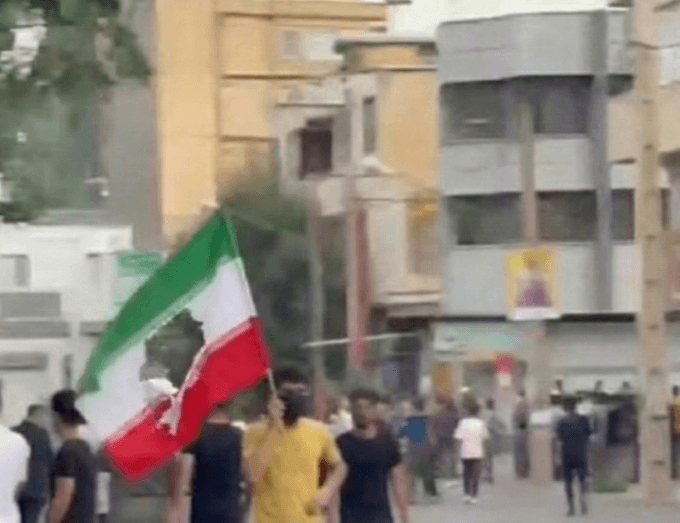
Photograph Source: راننده از تهران – CC0
Reza Pahlavi, the crown prince of Iran, released a video in Farsi last week calling on Iranians to go outside on Thursday and Friday evenings at 8pm. He urged them to chant from wherever they were, be it streets, rooftops, windows, inside homes, as a collective act of protest against the Islamic Republic’s leadership. Was this part of a plan?
For what it was worth, I had already begun thinking about Iran a few days into the new year, as my time in the English countryside was coming to an end. Bizarrely enough, I heard what I took to be the washing machine. A steady, menacing hum. Then I realised it was coming from outside, then from the sky, and was likely connected to the nearby military airbase shared with the Americans. I realised I now knew that sound from elsewhere—from Bagram, Kandahar, Camp Bastion, Lashkar Gah—not the sound of fury exactly, but of military activity stepping up.
I scanned the press that day. Reports indeed suggested the United States was building up its military presence in the UK following its unilateral mission to capture Venezuela’s Nicolás Maduro and his wife. According to several accounts in the press, both local and national, at least ten C-17 Globemasters and a pair of heavily armed AC-130Js had already landed at two bases, including the one nearby. The Ministry of Defence declined to comment, but the rural Wilts and Gloucestershire Standard noted a US spy plane among the movements, probably a Lockheed U-2 Dragon Lady.
Understandably, these developments would be linked to Greenland as well as the seizure of a sanctioned oil tanker, later three, though another two were to slip through the Channel unchallenged. My instinct at the time was to wonder whether any of this was not also connected to Iran, where demonstrations were still under-reported. Nor was the Iranian situation entirely disconnected from Venezuela. It was well understood how the operation there undermined Iran’s strategic energy partnership with Caracas, cutting off another source of oil exports and leverage against US sanctions.
The protests in Iran had begun over the collapsing economy and the plunge of the rial, spreading through Tehran’s Grand Bazaar and into other cities. This was despite heavy security, including the familiar, malevolent swarms of state motorbikes. Officials quickly blamed “foreign enemies,” notably the US and Israel.
By the second week, protests had hardened into broader anti-government dissent. At least 36 people had been killed and more than 2,000 arrested. Iran’s chief judiciary promised “no leniency.” In Kurdish regions, security forces reportedly used teargas, pellet guns, and live ammunition. Footage posted via Starlink showed shopkeepers, students, and opposition figures calling for sustained protest.
That week back in London I happened to meet two seasoned ex-diplomats. The first said a great deal in the Middle East—and beyond—now hinged on Iran, which was acutely sensitive to any international take on things after the US raids in Venezuela, with fears something similar might be about to be attempted in Tehran. “Geopolitical spillover” was the phrase. The collapse of the rial, combined with inflation and sanctions, was fuelling unrest but now human-rights groups were reporting children killed and dozens of minors detained.
Some demonstrators had begun renaming streets, including one in Tehran after Trump. Opposition figures in exile spoke of a historic opportunity, though they had all been down this road before. Iran’s army chief warned of pre-emptive military action in response to the hostile rhetoric coming out of Washington. Trump, meanwhile, issued fresh threats. “Death to the dictator” became a common chant in the streets of Iran.
After meeting the second ex-diplomat, I wondered why this country gripped me so. Was it because I’d seen what regime collapse had looked like elsewhere? Was it because I distrusted Western interventionist optimism? Or was it because Iran sat at the crossroads of so many mistakes many have watched unfold in the past?
Press coverage turned to the details of possible Western military intervention. This was expected to mean precision air strikes to degrade Iran’s capacity to suppress the protests. There was even talk of a no-fly zone to “protect” civilians. While Trump’s statements amounted more to threat than plan, not perhaps for the first time, US officials insisted strike options remained “on the table.” The relevance now of UK airbases seemed indirect, meaning Cyprus rather than Gloucestershire.
If Iran responded by targeting US or allied bases, it was expected Washington might authorise retaliatory strikes on missile or drone sites. As these possibilities were weighed, I thought back to a traditional Iranian family feast in Italy in my late teens, celebrating Nowruz. I remembered sprouts, apples, garlic, baklava, poetry. Two of the Iranians were gifted painters. This was shortly before the Revolution. I believed, in my innocence, that Iran was, above all else, a culture of warrior-poets and beautiful people. I wondered now whether that memory complicated, or sharpened, my response to today’s calls for regime change.
Meanwhile, protests demanding an end to clerical rule continued to escalate. Security forces responded with live ammunition, internet blackouts, and mass arrests. Rights groups reported dozens more killed and thousands detained. Famously harassed staff at BBC Persian reported at least 70 bodies in one hospital one night. While the ageing Iranian leader tried to explain the world to a young population, the Norwegian human-rights group Hengaw reported that some security personnel had been arrested for refusing orders to fire.
However, and this may be crucial to know, many Iranian protesters remain wary of the West even as they oppose their government. There seems little enthusiasm for foreign intervention. Especially with reports of UK diplomats believing Trump may be motivated in part by distracting US voters from the economy in the run-up to the mid-terms. On the subject of Iran at the weekend, former UK Iranian ambassador Sir Richard Dalton also said, “I don’t trust the Americans.” He cited previous records with regime change. Surveys suggested a significant minority in Iran preferred Western powers not intervene at all, seeing the movement as an internal struggle. Some also noted the irony of American authorities shooting their own citizens while condemning Iran for doing likewise.
What worries some now is not indifference, but misalignment, between Western signalling and the harsh realities faced by protesters. Many do seem to favour Western diplomatic pressure, which is something very different. Polls during earlier protest waves showed strong support for defending protesters’ rights, even as direct military involvement remained unwelcome.
This is why Trump’s public warnings risk being counter-productive. Strong US rhetoric allows Tehran to portray the movement as Western-backed, justifying even worse crackdowns and reawakening nationalist sentiment. Threatening military action, even rhetorically, raises the stakes, emboldens hardliners, and makes protests more dangerous. The effect is often the opposite of what is claimed. In other words, not protection, but exposure.
We keep hearing that it may be preferable, then, that the protesters hear it from a crown prince. Pahlavi is the eldest son of the late Shah, himself reinstalled by the US, but he has no governing experience, which is why some regard him as a pawn. Unlike Western leaders, however, he occupies a space outside the regime that is nonetheless still within Iran’s historical imagination. His association with the Shah is said to have softened among younger protesters. In Iran today, though, or so it appears, credibility is earned not through exile or inheritance, but through risk-sharing, which is something no one outside the country like Pahlavi can fully do.
We are also told the Supreme Leader is preparing to leave. He had not left at the time of writing. Maybe he has since. What is certain is that others are positioning themselves abroad and at home. The danger, as ever, is that those with the least to lose will shout loudest, while those with the most to lose will be left to absorb the consequences.
Protests have continued amid intensified repression, with no rupture inside the regime and no external intervention beyond talk and sanctions, though Trump has just taken a more direct stance again in the past day by urging Iranians “keep protesting,” saying that “help is on its way,” cancelling talks with Tehran and intensifying pressure with more tariff talk and the warning that military options remain open. Recent reports suggest that overall fatalities have climbed into the low thousands—with one Iranian official acknowledging about 2,000 deaths—making the past week one of the deadliest of unrest. However, the central problem remains unchanged. Pressure from below persists, but the danger of outsiders misreading, and thereby worsening, the moment has only grown.
I sit with the reality that I have no idea what Iranians really want. I don’t know what they go through day to day. I haven’t been on the ground. I haven’t spoken to them.
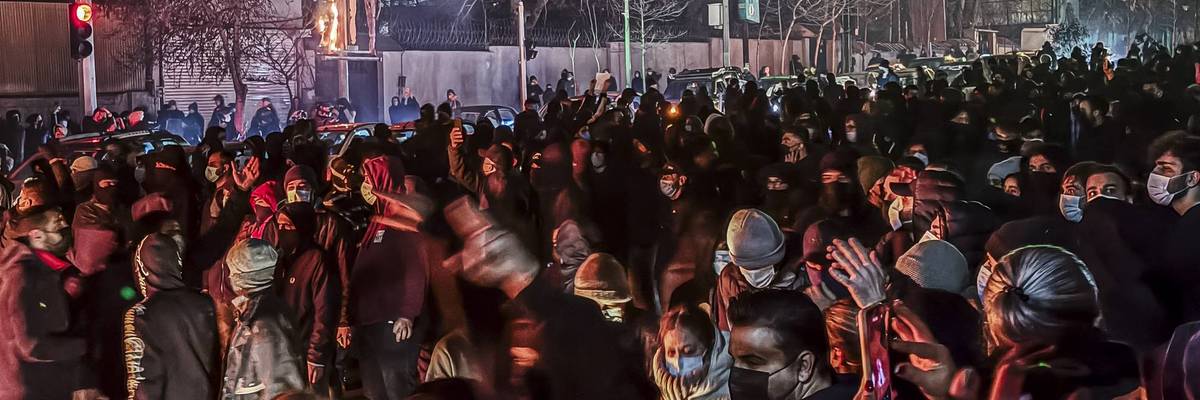
Iranians gather while blocking a street during a protest in Tehran, Iran on January 9, 2026.
(Photo by MAHSA / Middle East Images / AFP via Getty Images)
Elaheh Farmand
Jan 13, 2026
My Mamanbozorg, or maternal grandmother, died on Monday, January 5, 2026 in Iran.
My family and I hadn’t seen her in roughly four years. We didn’t get to care for her or help with her adjusting to life in a nursing home. We didn’t witness her dementia in person. We said our goodbyes from afar. We watched her burial over video footage and photos. We grieved as a family together on FaceTime.
This is not unusual for Iranian families outside of Iran, to not feel safe to return to their birth country, not even during times of grief. The Iranian government is unpredictable. They may hold passports under false accusations of espionage.
This is a layer of grief of being an immigrant that no one really talks about. To be an immigrant, especially one in exile, is to grieve not just the loss of homeland, but the loss of loved ones. Some believe that seeing the body after death helps the living with the grief process. What about the immigrant mother who doesn’t get to hold her dying mother’s hand on her death bed?
Iranians, like any other nation, deserve full human rights. They deserve dignity and freedom, and the right to choose their government. What they don’t need is a Western savior.
As I write this, Iran is once again in the headlines. Mainstream headlines are calling out the number of protester deaths. A hypocrite media is the perfect match for a hypocrite government. They assume the position of caring for the Iranian people and their human rights. When it comes to Iran, democracy and freedom matter to American media and politicians. Meanwhile, they have no problem with the slaughter of Palestinians. Palestinians’ freedom and democracy are never considered.
Everyone on the internet has an opinion on Iran. Leftists, conservatives, monarchists, liberals, Zionists: a collision of beliefs on what’s right for the future of Iranians and Iran.
I was born and raised in Iran and lived there for 11 years. I moved to the US in 1999. My family has suffered and endured unimaginable grief and cruelty under both governments: the Pahlavi Kingdom and the current Islamic Republic. No version of the Iranian flag resonates with me. I can sit here on my comfortable couch in suburban America and write about my dreams and visions for the Iranian people.
Instead, I sit with the reality that I have no idea what Iranians really want. I don’t know what they go through day to day. I haven’t been on the ground. I haven’t spoken to them. I have a general sense from reports from friends and family and the diaspora, but I don’t know. I don’t have the right to pretend that I do. I don’t have the right to dictate to my Western audience that I am writing on behalf of all Iranian people.
I write from the position of being an Iranian immigrant woman in my late 30s, grieving the loss of my beloved Mamanbozorg, calling my mother daily to hold her grief and to fill the gaping hole in her heart with love. I am heartbroken to see Iranians dying on the streets, their voices yet again repressed. I am angry at Western politicians who pretend to care about Iranian life for their own interests and agendas in the region. I am angry at the Iranian government who continues to kill, repress, and quash dissent. It feels isolating to want to speak on this grief, but knowing that I must do so carefully or my words will be taken out of context.
Iranians, like any other nation, deserve full human rights. They deserve dignity and freedom, and the right to choose their government. What they don’t need is a Western savior.
Our work is licensed under Creative Commons (CC BY-NC-ND 3.0). Feel free to republish and share widely.
Elaheh Farmand
Elaheh Farmand immigrated to the U.S. when she was 11 years-old, leaving her birth country of Iran. In 2016, she founded Immigrants & Exile, a performance series that invites people from all disciplines and backgrounds to share their stories of immigration, nostalgia, longing, and exile. Elaheh's poetry and prose have appeared in Left Turn and Recenter Press. She can be reached at immigrantsandexile@gmail.com.
Full Bio >
“This government has shown that it is not capable of reform,” said one Iranian demonstrator. “On the other side, there are Trump and Netanyahu, both of whom are war criminals.”
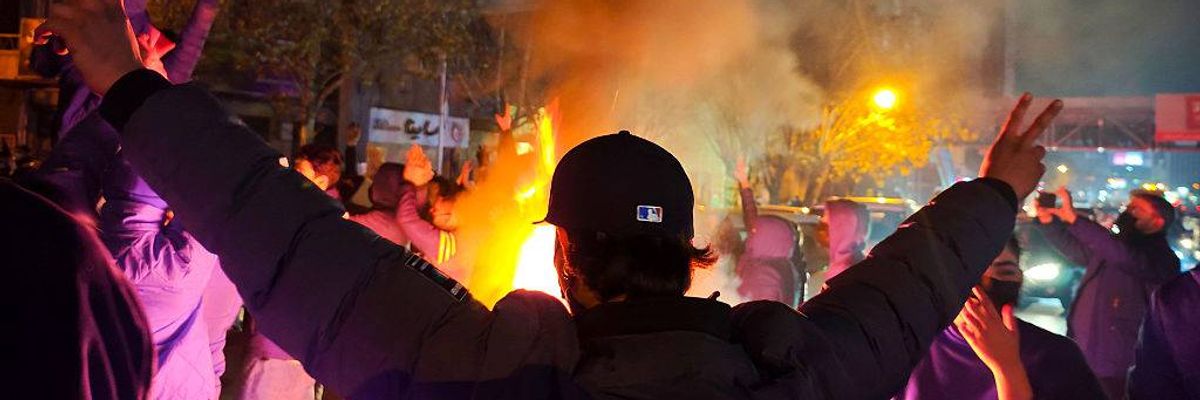
Fires are lit as protesters rally on January 8, 2026 in Tehran, Iran.
(Photo by Anonymous/Getty Images)
Brad Reed
Jan 13, 2026
COMMON DREAMS
President Donald Trump has threatened to launch military strikes against Iran, purportedly to help anti-government protesters who are demanding change amid an economic crisis.
However, Middle East Eye spoke with some of the Iranian demonstrators and found they had little appetite for interference from either the US or Israel.
A 39-year-old protester from Tehran, who identified only as Sara, said that Israel’s record of bombing countries in the region made her suspicious of any offer that its government would make to help the Iranian protest movement.
“Over the past one or two years, Israel has attacked almost every country in the region,” she said. “They want the entire region to be in chaos while they remain safe.”
Sara also emphasized that “we want regime change, but we do not want our country to be destroyed.”
A 28-year-old demonstrator named Reza also expressed skepticism of Israel and US offers to help even while stating his fierce opposition to the Iranian government.
“On one side, this government has shown that it is not capable of reform and knows nothing but repression,” he said. “On the other side, there are Trump and Netanyahu, both of whom are war criminals.”
The Middle East Eye report noted that Trump, unlike past presidents, has not even offered a pretense of wanting to bring democracy to Iran to justify military action and has instead stated his desire to seize foreign nations’ resources, such as when he declared that the US would take control of petroleum production in Venezuela after the US military abducted President Nicolás Maduro.
Jamal Abdi, president of the National Iranian American Council, earlier this month expressed solidarity with the Iranian protesters while also warning Trump and Israeli Prime Minister Benjamin Netanyahu to butt out.
“The outbreak of protests in Iran over the past week has been led by Iranians suffering under tremendous economic pressure and repression,” said Abdi. “It is the Iranian people’s movement and they deserve to be heard, not President Trump or Israeli Prime Minister Netanyahu, who cannot and should not try to speak for them. President Trump’s decision to insert himself and threaten military intervention at this moment is profoundly reckless. It distracts from the legitimate grievances of Iranians and risks being exploited to justify a more violent government crackdown.”
The Iranian government has responded to the protests with violence and mass arrests of demonstrators, and the government has blacked out internet access for its citizens.
The exact death toll resulting from the Iranian government’s crackdown is not known, although the US-based Human Rights Activists News Agency estimated as of Monday night that more than 500 people had been killed, while an unnamed Iranian official told Reuters on Tuesday that 2,000 people had been killed so far, including Iranian security forces.
Expert reveals why Trump uses 'state violence' on US protests while backing Iranians
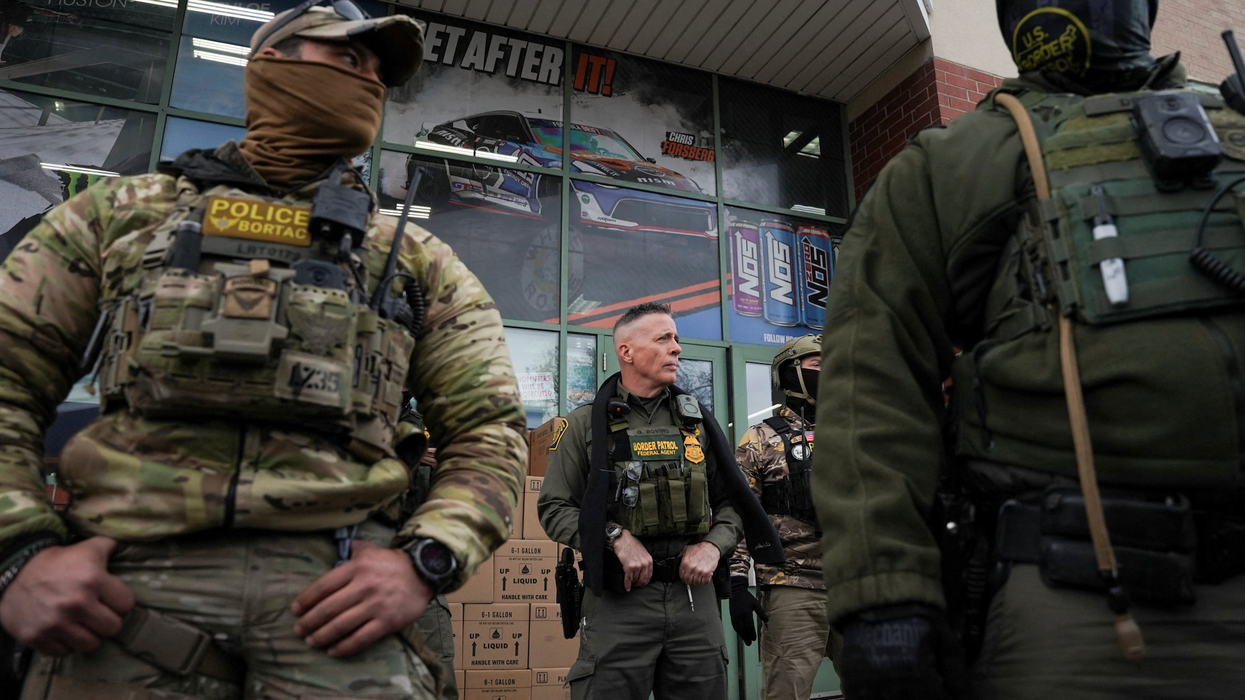
Border Patrol commander Greg Bovino stands accompanied by federal agents at a gas station in Minneapolis, Minnesota, U.S. January 13, 2026. REUTERS/Seth Herald
President Donald Trump has been vocal in his support of pro-democracy protesters in Iran — but has endorsed heavy-handed tactics for American protesters. One expert is offering a theory as to why that dichotomy exists.
The New York Times' Peter Baker wrote Tuesday that Trump has become increasingly more involved in backing Iranian demonstrators, posting to his Truth Social platform that the "killers and abusers" of more than 2,400 protesters in the Islamic Republic "will pay a big price." He has also urged protesters to remain in the streets, and pledged: "Help is on its way."
Meanwhile, the president has used demeaning language toward Americans protesting U.S. Immigration and Customs Enforcement (ICE) in Minneapolis, Minnesota following ICE agent Jonathan Ross' fatal shooting of 37 year-old U.S. citizen Renee Good. In a lengthy Truth Social post written just an hour prior to his post about Iran, Trump called Minneapolis demonstrators "anarchists and professional agitators" who were deliberately causing "unrest" to distract from daycare fraud that took place in 2022 and was widely investigated.
Baker posited that the opposite approaches Trump has taken to demonstrations in the Middle East vs. in the United States signal that the president is happy to support movements aimed at ousting an unpopular leader — unless that unpopular leader is himself.
"The situations in Iran and Minnesota, of course, are different and complicated, but the president’s rule of thumb seems simple enough: Those who take to the streets supporting a cause he favors are laudable heroes," he wrote. "Those who take to the streets to oppose him are illegitimate radicals."
Former State Department official Amy Hawthorne, who Baker described as a "longtime scholar of democracy issues in the Middle East," agreed, and added that Trump simply "frames each protest movement in terms of himself."
"He justifies state violence against protesters who challenge him or his policies, and promises protection when he thinks demonstrators can hurt his adversaries," she said.
Baker noted that Trump's cheering of pro-democracy protesters has not extended to Venezuela. After ousting President Nicolás Maduro, Trump allowed Maduro's vice president Delcy Rodroguez to become acting president, and has so far not entertained calls to support Venezuelan opposition leader María Corina Machado's bid to lead the South American petrostate. He notably did not rule out a potential one-eighty if Machado was willing to hand over her Nobel Peace Prize, which she won in 2025 for her efforts to oppose the Maduro government.
Click here to read Baker's full analysis in the New York Times (subscription required).
(Statements): Solidarity with Iranian protesters!

Statements in solidarity with Iranian protesters from Socialist Alliance (Australia), Partido Lakas ng Masa (The Philippines) and Communist Party of India (Marxist-Leninist) Liberation.
Australia: Solidarity with the Iranian protest movement
Socialist Alliance, January 9.
As protests sweep across Iran, Socialist Alliance expresses its solidarity with the students, workers, shopkeepers, young people, women and all Iranians resisting a brutal and authoritarian regime.
We stand with Iranians who seek to live free from a 45-year long autocratic and repressive religious regime and who demand safety, dignity and the right to determine their own futures.
We recognise that women and queer people, as well as Kurdish, Afghan, Baluch and other marginalised communities, are among those most violently oppressed by the regime, as they are at the forefront of resistance.
We strongly oppose the opportunistic weaponisation of the Iranian people’s struggle by Israel, the United States and their allies.
Attempts to channel legitimate resistance into renewed US dominance, a Zionist-aligned regional order or a restoration of the monarchy, would simply replace one oppressive regime with another.
Iranians are caught between an autocratic and repressive religious regime, US imperialism, Zionism and monarchist restoration. Through their uprising, Iranians are making more than a choice between rival systems of domination.
We express our unwavering solidarity with them.
We firmly reject the appropriation of women’s rights by the fascist and imperialist right wing, which seeks to weaponise women’s rights to justify war, imperialism, racism and the demonisation of Muslim people.
Socialist Alliance stands in solidarity with the 92 million Iranians, and the 5 million who live outside of Iran, who all have the right to self-determination, safety, universal dignity and freedom of political, sexual, cultural and artistic expression.
Women’s liberation cannot be achieved through racism, Islamophobia or imperial violence.
The freedom of Iranians is intertwined with the freedom of Palestinians and all other oppressed peoples. True liberation is collective, anti-imperialist and rooted in international solidarity.
The Philippines: Solidarity with the workers, students, women, and all the people of Iran — No to US Intervention!
Partido Lakas ng Masa, January 13
Iran is witnessing a renewed wave of mass protests rooted in genuine grievances—economic collapse, repression, corruption, and the denial of democratic rights.
What began as anger over soaring prices and a collapsing currency has spread nationwide, with workers striking, students mobilising, and people demanding bread, work, dignity, and freedom. The Iranian regime has responded with brutal repression, killing protesters and arresting thousands.
PLM stands in solidarity with workers, students, young people, women, LGBTQI communities, shopkeepers, and all Iranians rising up against an authoritarian and repressive regime.
At the same time, we unequivocally reject attempts by the United States, Israel, their allies, and forces linked to the deposed Shahist monarchy to cynically exploit this uprising to advance imperial domination, impose a Zionist-aligned regional order, or restore the monarchy.
U.S. President Donald Trump has repeatedly threatened military action against Iran under the pretext of “supporting” protesters. Such imperialist grandstanding is not solidarity. It endangers protesters, strengthens the regime’s justification for repression, and seeks to turn a genuine popular uprising into a tool of foreign power.
Numerous civil and political activists inside Iran have warned that foreign intervention only escalates repression and places those resisting the regime at even greater risk.
This crisis cannot be separated from U.S. and Western sanctions, which amount to economic warfare and collective punishment, devastating ordinary people while strengthening authoritarian rule.
At the same time, wealth and power remain concentrated in the hands of a narrow elite, forcing the working class and poor to bear the burden of poverty, unemployment, discrimination, and repression.
As Iranians fight for liberty, U.S. imperialism, the Israeli Zionist state, and Shahist forces are once again attempting to hijack the struggle for regime-change agendas.
Their interventions are not acts of solidarity—they fuel repression and undermine the people’s struggle. Iran’s history shows that foreign intervention brings domination, not freedom.
We stand in solidarity with the people’s struggle against the regime of the Islamic Republic and against all forms of oppression.
We demand an immediate end to the bloody repression of protesters; the immediate and unconditional release of all detainees, political prisoners, and prisoners of conscience; and the identification and prosecution of those responsible for ordering and carrying out the killing of protesters.
The struggle in Iran is inseparable from the wider struggle against imperialism—for a free Palestine, opposition to U.S. attacks and sanctions against Venezuela, to the blockade against Cuba.
We firmly reject imperialist intervention, sanctions, war, and any attempt to restore monarchy. The future of Iran must be decided by its people alone.
Solidarity with the people of Iran.
No to U.S. and Israeli intervention.
India: As people fight for bread and liberty, Iran also has to remain alert against imperialist intervention and Shahist and Zionist conspiracies
Communist Party of India (Marxist-Leninist) Liberation, January 12
Amid a deepening economic crisis in Iran, protests that began as a movement of workers and traders in December last year in Tehran’s bazaar have now spread across the country, developing into a mass uprising for livelihood, dignity, and democratic rights. Protests are unfolding across Iran as workers organise strikes and pickets in several sectors, and students rise up in resistance despite repression unleashed by the forces of the theocratic regime. According to reports, several people have been killed, with widespread violence reported from across the country, including the capital city of Tehran.
At the same time, as the Iranian people fight for bread and liberty, we are witnessing cynical attempts by US imperialism, the Israeli Zionist state and forces linked to the deposed brutal Shahist monarchy to infiltrate and hijack the movement and further their own Islamophobic narrative and clamour for regime change. The Trump regime, emboldened by its recent aggression against Venezuela and the bombing in Iran in 2025 and driven by imperial hubris, uses the pretext of “standing with the people of Iran” to recolonise the country politically and economically and subjugate its people, just as the United States did in 1953 through the CIA‑orchestrated coup (Operation Ajax) against the democratically elected government of Mohammad Mosaddegh.
The economic crisis in Iran is inseparable from the criminal sanctions imposed by the United States and Western powers, which amount to collective punishment of an entire population. They have devastated livelihoods, weakened public services and deepened inequality. This crisis is further aggravated by a monopolistic economic model within Iran that concentrates wealth and power in the hands of a few individuals and foundations, while working class and toiling masses are made to bear the burden.
Like many historic struggles in Iran, including the 2022 Zan, Zendegi, Azadi (Woman, Life, Freedom) movement, the ongoing protests reflect the anger of the people against a tyrannical economic and political system that has for decades crushed democratic rights, suppressed trade unions and popular struggles, and denied freedom of association.
We stand in solidarity with the democratic and working-class movements of Iran that have called for strengthening the struggle for livelihood and liberty against the repressive regime and for firmly rejecting any attempts to push the country back into the tyranny of monarchy or to exploit the protests as a pretext for imperialist intervention. The people of Iran alone have the right to determine the future of their country.

No comments:
Post a Comment