In Commemoration of Trump’s Inaugural Address:
A Brief, Historical Definition of Fascism

Sue Coe, Fight Fascism, 2024. Courtesy the artist..
The word fascism derives from the Italian fascio, the name for the bundle of sticks carried by ancient Roman officials to beat into submission anybody who challenged their authority. A country gripped by fascism beats down its population until it acquiesces to dictatorial authority. Its ruler governs like a king, subject to few if any laws. (Not a king like the current King Charles of England; more like Atilla the Hun.) Citizens in fascist counties are encouraged to imagine a distant past when the country was great, while believing that the current, anti-democratic system will endure forever. In a fascist nation, the life of an individual is unimportant compared to the mass. The “mass” however, isn’t the community or the collective – it’s a population disciplined by fear and nationalist myth. Equally important for fascism is protecting “racial purity.” It doesn’t matter that there is no such thing as racial purity; fascist rulers lie with abandon. Violence is freely used to prevent resistance and ensure compliance; political dissidents and racial, ethnic, or gender outliers may be sent to prisons or concentration camps or even killed.
Below is an abbreviated list of the distinguishing features of fascism. But remember that every fascist regime is a little different; if it comes to prevail in the U.S., it will have its own, American characteristics. For one thing, people will wave the U.S. flag, not the Nazi swastika. In general however, fascist governments:
1) Aim to bring all parts of their political system to heel – no checks and balances.
2) Use violence and plots to cripple opposition parties and control elections.
3) Intimidate the press and take control of the media.
4) Sponsor rallies and parades to celebrate the unity of a supposed, racially pure nation.
5) Uphold the “leadership principle.” The nation’s head is adored and called “The Leader”.
6) Mock the rule of law and support the idea that might makes right.
7) Rescind or limit women’s rights: political, reproductive, and economic.
8) Deny free sexual expression – sex is only for making babies and the pleasure of men.
9) Denigrate science and promote lies and crazy conspiracy theories.
10) Endorse the idea of white racial supremacy and make it the basis of policy.
In 1921, the Italian dictator Benito Mussolini formed the National Fascist Party to unify and strengthen a nation badly diminished by World War I and economic recession. The Fascist Party celebrated discipline and violence and endorsed Imperialism – the bullying of weak states by strong ones to steal their wealth or control their markets and territory. Mussolini called himself Il Duce (“the leader”) and insisted everybody else also call him that. Fascist leaders are insecure because the same arrogance and violence that brought them to power, could topple them.
A version of fascism, called National Socialism or Nazism arose at almost the same time in Germany. There, Adolf Hitler managed by 1933, to gain power and begin a program of gleichshaltung – “coordination” or Nazification. The goal was to bring all organs of state and civil society into conformity with Hitler’s will. Control of the press, regimentation of everyday life, elimination of expressive freedoms, destruction of constitutional safeguards, control of trade unions, establishment of a dictatorial (one party) state and an end to the civil rights of minorities (especially Jews) were all key aspects of Gleichshaltung. Hitler called himself Der Führer (the leader) and insisted everybody solute him by raising their right arm above their shoulder and saying “Sieg heil, mein Führer!” or Hail victory, my leader.” Hitler started World War II and was responsible for the Holocaust and the murder of six million Jews.
Both Italian fascist and German Nazi leaders were ruthless. At first, they employed thugs, often former soldiers, to intimidate and even murder the leaders of unions and opposition organizations. Later, they maintained their own, national corps of “shock troops” to undertake larger scale bullying and violence. Their stated goals sounded lofty: to purify the social body, restore a stolen national glory, and establish an empire that would last millennia; but their theories were crackpot: that humanity was composed of biologically distinct races, with some innately superior to others; that violence and war were purifying; and that other nations, lacking racial purity, were certain to surrender to the superior fascist state. But fascists could also be level-headed when they had to be. Their economic proposals generally brought support from the lower middle class, without alienating wealthy industrialists. Soon after gaining power, Mussolini and Hitler passed laws that boosted employment (though with low, hourly wages) and subsidized big business. To succeed politically, they needed money and other assistance from industries, corporations, and the wealthy, as well as the masses; for the most part, they got it.
The fascist and Nazi quest for national and racial glory was thus also linked to the pursuit of profit. Fascism is completely compatible with capitalism (the generalized search for profit), so long as businesspeople don’t get involved in politics, except when invited. The huge growth of weapons manufactures in Italy and Germany during the 1930s was good for the economy, and the fascists and Nazis gained public support because of it. Lots of people in both countries were willing to surrender democratic rights (including free speech and assembly) in exchange for economic stability. In remarkably short order, people accepted – sometimes even welcomed — the harassment, arrest, imprisonment and killing of Communists, Jews, Queers, Roma, the disabled, and others. Eventually, it all came crashing down; Hitler and Mussolini were like the biblical Samson who brought the temple down upon himself.
I’m Very Worried About a Second Trump Administration
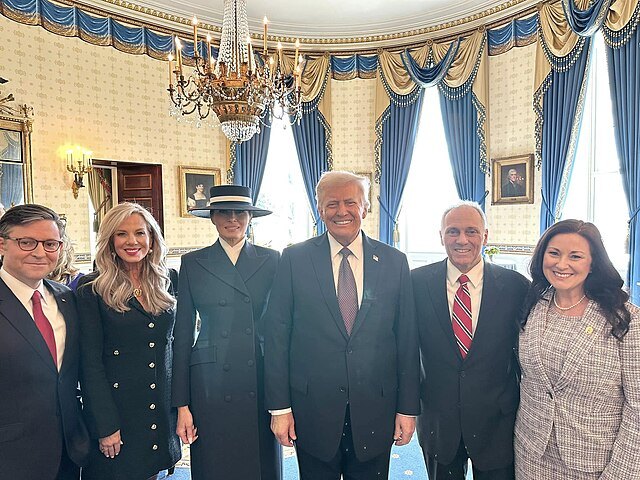
Photograph Source: Office of Speaker Mike Johnson – Public Domain
Although some on the left have minimized the potential for mayhem in a second Trump administration, I’m not sanguine at all. Many like to point to his less than vehement pursuit of war compared to Biden during Trump’s first term as president. Perhaps, but if I was a betting person, and I am not, I would put a lot of money on that number, the number being Trump’s readiness to wage war. Trump is the consummate bully, and war in some ways is the ultimate and perhaps the last stand of a bully in a nuclear age. Conventional war also draws bullies. Iran stands out like the proverbial sore thumb in US war planning. Trump’s slavish support for Israel’s aggression in the Middle East could easily allow the US to be drawn into an open military action with Iran at Israel’s behest. Israel could easily lure Trump into a military action against Iran’s nuclear program. This could lead to a larger war with outcomes not possible to predict. War is unpredictable. Iran and its allies are not predictable in terms of kowtowing to Trump and Israel. War among nuclear powers is especially unpredictable. For those who think that nuclear war is off the table of military strategies, look to the symbolic clock of the Bulletin of the Atomic Scientists. These are people who have carefully reasoned out the chances of nuclear war. “As of January 23, 2024, the Doomsday Clock stands at 90 seconds to midnight.”
The ceasefire between Israel and those fighting Israel’s genocide in the Gaza Strip is a welcome change, but unless Trump is willing to confront the US masters of war and the humongous war industry, then the ceasefire is subject to all kinds of subterfuge. I would like to be completely wrong about the latter, but the US does not have much industry to fall back on besides weapons manufacturers. Professor Norman Finkelstein is perhaps the most knowledgeable expert on the subject of past ceasefires (January 18, 2025) between Israel and those in power in the Gaza Strip. That history is not promising, and Donald Trump may simply not want his inauguration cluttered by war in the Middle East.
Some may argue that conventional war has become normalized. I cannot attend a sporting event because every event in the US is laced with symbols of militarism and war. In These Times (August 20, 2018) carried a good discussion of how sports events have been militarized since September 11, 2001. As a fan of major league baseball, the last image I ever wished to see was a parachutist with full combat gear landing on a baseball field. As a kid, the Pledge of Allegiance opened our Little League games, but this was before the world became engulfed in endless wars in which the US was often a prime mover. A ballplayer or spectators didn’t have to pledge fealty to militarism and endless wars at sporting events.
This is from Normal Mailer just prior to the Iraq War in 2003 from the In These Times article cited above:
“The dire prospect that opens, therefore, is that America is going to become a mega-banana republic where the army will have more and more importance in Americans’ lives… [D]emocracy is the special condition – a condition we will be called upon to defend in the coming years. That will be enormously difficult because the combination of the corporation, the military, and the complete investiture of the flag with mass spectator sports has set up a pre-fascistic atmosphere in America already.”
Mailer was prescient because the idea of fascism here, or some form of inverted totalitarianism as theorized by Sheldon Wolin, have been steadily growing in the US for decades.
Kirsten Gillibrand said during Pete Hegseth’s nomination hearings as Secretary of Defense: “We have hundreds – HUNDREDS – of women who serve in the infantry, lethal members of our military … But you degrade them,” (Reuters, January 15, 2025).
“Hegseth’s opening remarks, praising Trump, were repeatedly interrupted by protesters. He vowed to restore a “warrior culture” to the U.S. military and said accountability was coming for those who fall short” (Reuters, January 15, 2025).
In regard to writing on the left, the censors have already done their damage. Freedom of speech on college and university campuses has become a joke vis-à-vis Israel/Palestine and the expanded wars in the Middle East. I reread “The Long Silence” (CounterPunch, August 23, 2008), and I cannot believe that the Middle East has degenerated into such a hellhole of war.
What worries me most are some of the people I come in contact with in the area in which I live. Many people I’ve met are multilingual people. Many who work in the surrounding towns and cities are also multilingual. I naively thought that all of these people were immigrants who had nothing to worry about in regard to the federal government. I met people locally as a census enumerator during the census in 2010, and I assumed they and their families had some kind of valid visas. Many of the people I meet may have come here to work and may have had or have valid work visas to fill jobs in the kitchens of local restaurants, or worked at different trades in the community. I have no idea what the status of peoples’ visas may be, but there must be a kind of mass anxiety among people who came here to escape all manner of mayhem in the nations from which they came that often were put into subservience and immiseration by the global economy and militarism that is driven by the US and its allies. Many people are often here as a result of the race to the bottom of the global working class.
“The Senate on Wednesday adopted the first amendment to the Laken Riley Act, as Republicans push for a legislative win to open the new Congress” (The Hill, January 15, 2025).
“The legislation in its current form would mandate federal detention of immigrants without legal status accused of theft, burglary and other related crimes” (The Hill, January 15, 2025).
Trump has hardly left the gate and according to this Guardian article (January 17, 2025) he has an immigration raid scheduled for Chicago the day after his inauguration. Some of his supporters, rattled by the economy and life’s challenges over decades, may rally to his side. These raids will be a kind of right-wing militarism brought to the domestic front. It’s another shiny object with which to distract many from Trump’s larger agenda. Trump did not emerge in a political, economic, or social vacuum. He is a symptom of what the duopoly, militarism, empire, greed, meanness, and predatory capitalism have coughed up.
The Trump/Hegseth Military Versus Protesters in the US
January 22, 2025

Photograph Source: Gage Skidmore – CC BY-SA 2.0
It might be a dangerous time to be a protester in the US, with Defense Secretary Pete Hegseth serving under President Trump. Trump is eager to use the military against civilian protests, which was stymied during his first term by two things: its illegality under the Posse Comitatus Act, which traditionally bars federal troops from civilian law enforcement; and the repeated objections of military leadership.
When massive demonstrations erupted around the country, protesting the May 25, 2020, murder of George Floyd, then-President Trump succeeded in illegally deploying thousands of National Guard troops to Washington. To use them against the protest, Trump told his Secretary of Defense Mark T. Esper and Chairman of the Joint Chiefs of Staff Gen. Mark A. Milley that he wanted to invoke the Insurrection Act, a loophole in the Posse Comitatus Act that allows the president to identify a dangerous protest as an “insurrection.”
This would permit the president (ironically, later the indicted Insurrectionist in Chief) to use the military for civilian law enforcement. But Esper and Milley refused to allow this, and Esper later recounted his refusal when Trump had asked him if the military could “just shoot [protesters]…in the legs or something” in response to a demonstration. A similar refusal was issued in a June 5, 2020, statement by 89 former defense officials, which called on Trump to desist in any plans to use active-duty military personnel to control civilians.
So Trump, in his first term, was prevented from rushing the military to quell protesters due to the guardrails in place by his own lawful military and defense leadership. Trump later expressed his regret about this, insisting at a rally, “The next time, I’m not waiting.”
Enter Pete Hegseth, Donald Trump’s Defense Secretary nominee, offering Trump a second chance at carnage. He has said, “When President Trump chose me for this position, the primary charge he gave me was to bring the warrior culture back to the Department of Defense.” Not surprisingly, Hegseth declined during his Senate confirmation hearing to say whether he’d follow a Trump order to shoot at demonstrators. His refusal was taken by Senators to mean he would indeed follow such an order to shoot.This means the guardrails are now down, and Trump’s intent to use military force against protesters is no longer contained.
Even more frightening still is that Hegseth will not only fail to contain the use of the military against civilian protests. In his writings he makes clear that he, as defense secretary, intends to proactively swivel the US military’s target away from foreign enemies to the “enemy within,” by which he makes clear is the left in all its forms. I have been reading recently about the horrific military violence used on peaceful protesters by the Argentine junta and Chile’s Pinochet, rounding them up into stadiums to shoot them en masse or throwing them into the ocean from so-called “death planes.” If we’re not paying close attention and pushing back, US protesters could be next.
As Donald Trump assumes the presidency, the world is bracing for shifts in international relations and policy. From Israel’s genocide in Gaza to the war in Ukraine, the US’ strategic rivalry with China, and the challenges facing Europe, Trump’s administration is poised to leave a significant mark. What should we expect in the coming months on these critical issues? How might Trump’s foreign policy reshape Europe and its role in the world? Join Yanis Varoufakis and special guest Katie Halper—American journalist, political commentator, and host of The Katie Halper Show—for a live discussion hosted by Mehran Khalili. Join us and share your questions and comments in real-time!

No comments:
Post a Comment