It’s possible that I shall make an ass of myself. But in that case one can always get out of it with a little dialectic. I have, of course, so worded my proposition as to be right either way (K.Marx, Letter to F.Engels on the Indian Mutiny)
Monday, January 20, 2025
Yemen's Houthi Rebels Agree to Lift Red Sea Blockade
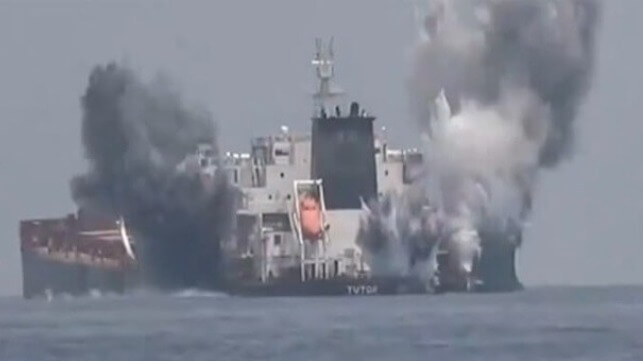
Houthi fighters sabotage the disabled bulker Tutor, sending it to the bottom, 2024 (Houthi Military Media)
On Sunday, Yemen's Houthi rebels announced plans to phase down their campaign against shipping in the Red Sea, beginning with a cessation of hostilities against "non-Israeli" vessels.
The group's "Humanitarian Operations Coordination Center" issued a statement on Sunday reporting that the group is lifting its yearlong blockade on shipping in the Red Sea, following implementation of the ceasefire between Israel and Hamas in Gaza last week. The first phase was a prisoner exchange between Israeli forces and Hamas; this took place successfully on Sunday with a trade of 90 Palestinian suspects for three Israeli hostages.
The center said that going forward, it would not attack most categories of ships, including ships bound for Israel; American or British ships; vessels partly owned by Israeli interests; or vessels operated by Israeli interests but owned by other nationalities. The Houthis still plan to attack vessels that are wholly Israeli-owned or are Israeli-flagged, at least until all phases of the ceasefire agreement are implemented. These fully-Israeli vessels are "prohibited from transiting the Red Sea, Bab-el-Mandeb, the Gulf of Aden, the Arabian Sea and the Indian Ocean at present," the HOCC said.
In a warning, the group said that it could resume hostilities against commercial shipping if U.S. and UK forces strike Yemen again. If that occurs, the group warned, it could resume its attacks on specifically American and British shipping.
On Friday, Houthi leader Malik Al-Houthi suggested that the group's "naval operations have reached a decisive result and a real victory" in the announcement of the ceasefire, but warned that the group's activities could resume if fighting returns to Gaza. "At any stage in which the Israeli enemy returns to aggression and escalation, we will be ready to support [Hezbollah]," said Al-Houthi.
The group's decision to back away from further anti-ship missile and drone strikes had been anticipated by many in the shipping industry. Dimitris Maniatis, CEO of Marisks, told Reuters that the Houthis' capabilities have been significantly reduced by Israeli and American airstrikes over the past month, leaving the group eager for "a pretext to announce a ceasefire" and end their campaign. Multiple other sources told Reuters that shipping interests are already eyeing a return to the Red Sea route, though blue-chip carriers have emphasized that they still plan to wait and see how the situation stabilizes.
Whether or not their assurances for Western shipping stay in place, Houthi forces have appeared to select vessel targets that do not align with their criteria in the past, and have occasionally attacked ships tied to their own foreign sponsors.
The fate of the hijacked car carrier Galaxy Leader and her stranded crew remain uncertain. The ro/ro has been detained at anchor off northwestern Yemen for more than a year.
On the same day as the HOCC's announcement, Houthi leaders claimed an eighth attempt to target the carrier USS Harry S. Truman in the Red Sea. As with previous claims of Houthi attacks on aircraft carriers, U.S. Central Command has not commented.
Gaza Ceasefire Raises Hopes of Renewed Security in the Red Sea
Houthi missiles on display at a parade, 2024 (Houthi Military Media)
On Thursday, Israeli Prime Minister Benjamin Netanyahu announced that an agreement for a ceasefire and hostage exchange had been reached with terrorist group Hamas, setting conditions for the end of hostilities in Gaza - though an unspecified last-minute issue has delayed an Israeli cabinet vote to finalize the deal. If approved, it appears to satisfy most of the demands of Yemen's Houthi rebels, who have attacked shipping in the Red Sea for more than a year in protest of Israeli operations in Gaza.
In a response to Netanyahu's announcement early Friday, Houthi leader Malik Al-Houthi cast the ceasefire as a loss for Israel and America. He suggested that the group's "naval operations have reached a decisive result and a real victory," and contributed to a "failure" for Israel in the Gaza Strip. He cautioned that the group would monitor the situation for the next three days as the deal takes effect; notably, Al-Houthi did not pledge a halt to attacks on shipping, and he left open the possibility of renewed strikes. "At any stage in which the Israeli enemy returns to aggression and escalation, we will be ready to support [Hezbollah]," said Al-Houthi.
Shipping and security analysts have given mixed predictions about the group's intentions going forward. Dimitris Maniatis, CEO of Marisks, told Reuters that the Houthis' capabilities have been significantly reduced by Israeli and American airstrikes over the past month, leaving the group eager for "a pretext to announce a ceasefire" and end their campaign. Multiple other sources told Reuters that shipping interests are already eyeing a return to the Red Sea route after a year of disruption, so long as sky-high war risk insurance rates come down.
Others are less sure, especially since Houthi fighters have reportedly developed a revenue stream from their campaign. A UN panel on Yemen investigated their operations and spoke with regional shipbrokers and service providers; the panel heard multiple accounts that the group was extorting shipowners out of hundreds of thousands of dollars for each safe transit past Yemen, and estimated that the Houthis are earning about $2 billion per year from "security" fees. While the exact amount of the fee is debated, "there's clearly some deal-cutting," U.S. special envoy for Yemen Tim Lenderking told The Economist - and those deals may create a business incentive for Houthi fighters to continue launching attacks.
Blue-chip carriers have signaled that they do not plan a quick return to the route. Maersk has predicted that the Red Sea will stay shut down for global container liners "well into 2025," and a spokesperson told Reuters on Thursday that it is "still too early to speculate about timing." Hapag-Lloyd concurred, saying that the "agreement has only just been reached."
Others will be unaffected. The Russia-linked "shadow fleet" tankers that ferry Russian oil to buyers in India and China have consistently used the Suez-Red Sea route, without interruption, and will likely continue to do so after an eventual cessation of Houthi hostilities. Chinese shipping interests have also benefitted from a public nonaggression pact, and many continue to use the route.
The Houthis have announced a limited halt to attacks on ships in the Red Sea, but major shipping companies remain cautious.
Shipping giants are concerned about the long-term security situation in the region and are closely monitoring developments.
The prolonged conflict and attacks had forced many ships to reroute, disrupting supply chains and increasing shipping costs.
Following the Israel-Gaza ceasefire, the Iran-aligned Houthis will limit attacks in the Red Sea to vessels linked with Israel, the Humanitarian Operations Coordination Center, through which the Houthis communicate with merchant shipping, has said.
“We affirm that, in the event of any aggression against the Republic of Yemen by the United States of America, the United Kingdom, or the usurping Israeli entity, the sanctions will be reinstated against the aggressor,” the center said in an email sent to shipping industry officials dated on January 19 and quoted by Reuters on Monday.
The Houthis will only target ships that are wholly or partially owned by Israeli individuals or entities, as well as Israel-flagged ships, the Houthis said, announcing a partial halt to the attacks in the Red Sea that have disrupted commercial shipping in the past year.
However, global shipping giants do not expect a quick return to Red Sea traffic.
“We will continue monitoring the situation in the Middle East closely and will return to the Red Sea and sailing through Bab el Mandeb when it is safe to do so,” A.P. Moller-Maersk A/S told Bloomberg in an emailed statement on Friday.
Last week, Israel and Hamas reached a Gaza ceasefire and hostage release deal following 15 months of war. During most of these months, the Houthis attacked commercial vessels passing through the Bab el Mandeb Strait and the Red Sea.
These attacks forced the global container and tanker shippers to re-route their journeys between Europe and Asia via the longer route around the southern tip of Africa.
The longer voyages via Africa have increased travel times, delayed goods delivery, disrupted supply chains, and raised shipping costs.
Apart from Maersk, another shipping giant, Hapag-Lloyd, also expects no imminent return to the Red Sea shipping lane.
“The agreement has only just been reached. We will closely analyze the latest developments and their impact on the security situation in the Red Sea,” a spokesperson for Hapag-Lloyd told Reuters on Thursday.


No comments:
Post a Comment