NO FUCKING WAY!!

Jean-Francois Belanger, assistant professor at the Royal Danish Defense College, explains why he says Canada should take advantage of its resources that are already enough to develop nuclear weapons.
Amid a changing global security landscape and ongoing sovereignty taunts from U.S. President Donald Trump, one military expert says Canada may need to reconsider its position on nuclear weapons.
In the current geopolitical environment, Canadians need to start thinking about “difficult questions” around national security, Jean-François Bélanger, assistant professor of Military Operations at the Royal Danish Defence College, said in a Tuesday interview with BNN Bloomberg.
“What does it mean when our Number 1 ally in the first place decouples from European security and also mentions that they’re tired of paying for Canadian security collaboration, and on the other hand threatens annexation?” he said.Trade War coverage on BNNBloomberg.ca
Bélanger argued that there may come a time when Canada can no longer rely on more powerful military allies for protection, and that creating a nuclear weapons program of its own may be a necessary deterrent against the threat of foreign aggression.
He said developing nuclear capability does not necessarily need to happen now, but Canada should be thinking about “shoring up” its nuclear latency “to the point where if we are in need and if we decide (to) as a nation… we’ll be ready to go.”
‘Bordering on the absurd’
Canada pursuing nuclearization in any way would be “bordering on the absurd as an undertaking,” Paul Meyer, adjunct professor of international studies at Simon Fraser University and a former Canadian diplomat, told BNNBloomberg.ca.
“There’s a whole series of obstacles that would be in the way of any government that wanted to go down that road, not to mention that I think no government would want to do it,” he said in an interview on Thursday.
“We have a long-standing legal obligation as a state party to the nuclear Non-Proliferation Treaty (NPT) never to develop or acquire nuclear so it would mean a withdrawal from that treaty if we were going to pursue a nuclear program.”
Meyer, former chair and current director of the Canadian Pugwash Group, noted that to date, the only country that has ever withdrawn from the NPT is North Korea, “so I don’t think you’d want to be in that company,” he said.
Bélanger acknowledged that Canada would be in violation of the NPT, which it signed in 1968, were it to pursue nuclearization, however he argued that other nations with nuclear ambitions seem to be taking advantage of an opening “window of opportunity.”
“And when I say window of opportunity, I don’t necessarily mean something positive. There’s a drive for the acquisition of nuclear weapons in the world at the moment,” he said, noting that the global consensus around non-proliferation may be fading.
Bélanger pointed to nations such as Poland and Germany, where nuclear deterrence has become a talking point recently as the U.S. distances itself from its European allies, while South Korea “is talking about outright nuclearization.”
NPT under ‘increased stress’
Meyer said the viability of the NPT has indeed come under “increased stress” in the last decade or so, particularly because of Russia’s ongoing territorial ambitions in Ukraine.
“Russian aggression against Ukraine has caused second thoughts in some capitals about possessing nuclear weapons as a deterrent, and obviously, if they’ve gone in that direction, that weakens this norm of non-proliferation,” he said.
“(U.S. President) Donald Trump’s decision to pull out of the Iran nuclear deal was also a case of irresponsible action that sets back the non-proliferation ideal, so that is unfortunate to say the least.”
Bélanger argued that these developments may eventually change the nature of the NPT, as well as defence partnerships like the North Atlantic Treaty Organization (NATO).
“Is NATO as an alliance going to rethink things or at least are our European allies going to be rethinking their stance on non-proliferation? If that happens, how does Canada position itself in that discussion?” he said.
“Because we don’t have the options that the Europeans have. I don’t think it’s credible to ask the U.K. and France for extended deterrence or the nuclear umbrella… Canada in this case would be left to its own design.”
Bélanger said that if Canada was subjected to, for example, Russian aggression in the Arctic, or if the trade war with the U.S. escalated to the point of armed conflict, Canada’s European allies would likely be too “bogged down” with their own security concerns to provide meaningful aid.
“Am I saying that the probability is that (these scenarios) are going to happen? No. Is it going to happen tomorrow morning? No,” he said.
“But we’re in a world now where we actually need to look at the chance that something like this could happen.”
Meyer said any movement away from the long-established global norm of non-proliferation would have “profound repercussions.”
“It’s a troubled picture for those that believe in the overall wisdom of maintaining an international security regime with a strong norm of nuclear non-proliferation and an impetus to, at some point, achieve a world without nuclear weapons,” he said.

Jordan Fleguel
Journalist, BNNBloomberg.ca
THIS IS THE PEACEFUL USE OF NUCLEAR
Podcast: Canada's leading role in life-saving medical isotopes
Bruce Power's Chief Operating Officer James Scongack is also Chairman of the Canadian Nuclear Isotope Council and, as he explains, the country is aiming to grow its leadership role in nuclear medicine.
He outlines the life-saving diagnostics and treatments that now exist thanks to isotopes produced in Canada's Candu reactors, research reactors and cyclotrons, and talks about the new trials and treatments which are emerging.
The Canadian Nuclear Isotope Council has recently signed an agreement with the International Atomic Energy Agency's Rays for Hope campaign and aims to help provide nuclear medicine's diagnostics and treatments to those parts of the world where people do not currently have access. This is one of the drivers he sees for huge demand growth in the years ahead.
For those who may say that producing isotopes is the equivalent of a 'side hustle' for a nuclear power plant, Scongack says it might be "1% of the cashflow, but it's 50% of our contribution" in terms of tackling some of the greatest challenges that communities and society are facing.
Scongack also talks about progress at Bruce Power, where the modernisation programme is adding extra capacity equivalent to that which would be provided by building three small modular reactors. There's also an update on Bruce C.
Scongack, who sees a bright future for nuclear energy in general, says that communicating positive stories is key. He presents the Canadian Nuclear Isotopes Council's own podcast - called Isotopes for Hope - helping to spread the news about what he calls a "real hidden gem of what our industry around the world does". For instance, Canada supplies about half of the world's cobalt-60 which is used to sterilise about 40% of the world's single-use medical devices.
_66488.jpg)
Co-60 is made by irradiating rods of cobalt-59 inside a Candu pressurised heavy water reactor for up to three years (Image: Bruce Power)
With other Candu reactor countries also producing, or planning to do their bit to help meet global demand, he says that the challenge for the future is to ensure that, as with producing energy "the world is counting on us ... when someone turns their light switch on at home, they expect the light to turn on, and when an oncologist is ready to give a patient cancer treatment, we need to make sure they have the isotopes that they need to provide that patient with the best chance of success".
Listen and subscribe on all major podcast platforms:
World Nuclear News podcast homepage
Apple
Spotify
Amazon Music
Youtube Music
Episode credit: Presenter Alex Hunt. Co-produced and mixed by Pixelkisser Production
Minister announces funds for new reactor as Safari-1 turns 60
As South Africa's Safari-1 research reactor marks its 60th anniversary, Minister of Electricity and Energy Kgosientso Ramokgopa has announced a budget allocation of ZAR1.2 billion (USD66 million) towards a new multipurpose reactor at Pelindaba.
_61498.jpg)
Addressing the celebrations held by the Nuclear Energy Corporation of South Africa (NECSA) on 25 March, Ramokgopa said the ZAR1.2 billion is included in the government's 2025 budget, which is currently awaiting final parliamentary approval.
Safari-1 is a tank-in-pool research reactor which reached first criticality in 1965 with a capacity of 6.67 MWt. Over its 60 years of operation it has undergone various power uprates and been converted to use low-enriched uranium fuel and low-enriched uranium targets for isotope production. Today, it has a licensed operating power of 20 MWt and is one of the world's major commercial producers of medical and industrial radioisotopes. It is also used for activation analyses, material modification (such as the neutron transmutation doping of silicon for the semi-conductor industry) and provides support services such as neutron radiography and neutron diffraction for both industry and research.
Safari-1 is currently licensed to operate until 2030, and could be a sustainable operational irradiation facility beyond that date, pending an engineering assessment supported by ageing management programme, according to Necsa.
The South African cabinet approved the construction of the Multipurpose Reactor to succeed the Safari-1 research reactor, in 2021. Necsa released a Request for Information for the new reactor the following year, to allow a good lead-time for procurement and construction so that the radioisotope production and the other functions currently fulfilled by Safari-1 can continue without interruption.
Ramokgopa acknowledged that the allocation in this year's budget will not be sufficient, on its own, to fund the project, adding that Necsa must also find support from other quarters. ZAR1.2 billion "is not going to get us to where we want to be" but national financing is constrained, he said, "so we must find bespoke financing, we must find partners, who will not just bring money, but technological know-how, and when we bring it together with ours, the sum is greater than the whole of its parts".
And a national contest will be held to choose a name for the new reactor. "We will not call it the MPR … we must give it a name," he said. "Because South Africans must own Necsa. South Africans must know what nuclear is. South Africans must know what these possibilities are. So we will run this contest [to choose a name for the reactor] so that South Africans can embrace it, and know that it is their's."
Safari-1's contribution over its 60 years of operations has been "profound", saving up to 10 million lives in more than 60 countries, World Nuclear Association Director General Sama Bilbao y León said in an address to the Necsa celebration. The know-how and experience from the reactor's exemplary operations have also been a driving force that will continue to support South Africa's nuclear sector, she said. "Energy demand at a global level continues to increase, because it is an essential enabler for prosperity, growth and quality of life, and this is particularly important in Africa, where we still have 600 million people with zero access to energy. Nuclear energy can be a game-changer in Africa, providing abundant, affordable, 24/7 carbon-free energy that will be able to propel the entire industry forward," she said.
German nuclear association calls for restart of reactors
German nuclear technology association Kerntechnik Deutschland e.V. says that restarting the country's nuclear power plants "offers a safe, economically viable and climate-friendly alternative to the current energy policy". It says that up to six shut down reactors could technically resume operation.
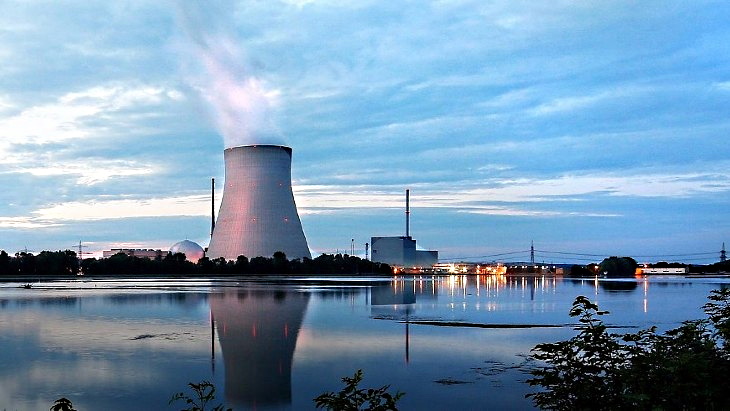
In August 2011, the 13th amendment of the Nuclear Power Act came into effect, which underlined the political will to phase out fission nuclear power in Germany. As a result, eight units were closed down immediately: Biblis A and B, Brunsbüttel, Isar 1, Krümmel, Neckarwestheim 1, Phillipsburg 1 and Unterweser. The Brokdorf, Grohnde and Gundremmingen C plants were permanently shut down at the end of December 2021. The country's final three units - Emsland, Isar 2 and Neckarwestheim 2 - shut down in April 2023. All the units are now at various stages of decommissioning.
The expansion of renewable energy, which was to compensate for the closure of the reactors, has varied greatly between individual federal states, with the expansion of wind energy particularly progressing very slowly in Bavaria. The expansion of power line capacities and the transmission grid in southern Germany has also not progressed as quickly as planned. Meeting German electricity demand has therefore required fossil energy sources or imports (of mainly French nuclear power).
"Our electricity costs are no longer competitive in an international comparison and are threatening the existence of our economy," according to Kerntechnik Deutschland e.V. (KernD). "It is no longer economically viable to finance and implement an infrastructure (grid, storage and backup) that is largely based on renewable energies."
It adds: "If the proportion of volatile energy sources in the German energy mix continues to increase, the need for electricity imports or self-generated fossil electricity will intensify. This is a vicious circle that will lead to disastrous dependencies."
KernD notes that the continued operation of coal-fired power plants has led to significantly higher CO2 emissions than planned, and the timetable for phasing out coal is unrealistic under the current framework conditions.
"The recommissioning of nuclear power plants in Germany is this pragmatic, economical and socially sensible solution," it says. "Up to six shut-down nuclear power plants could be brought back online in just a few years - without compromising on nuclear safety."
It noted: "Depending on the dismantling status, individual nuclear power plants can be put back into operation in the near future." Earlier this month, KernD said that between EUR1 and EUR3 billion (USD1.1-3.3 billion) in investments would be needed per nuclear power plant restart, depending on the dismantling status.
The recommissioning of those plants is based on the existing power plant structures, the association said. This enables rapid availability - within 3-5 years - of large installed baseload capacity. The continued operation of nuclear power plants enables the rapid phase-out of coal-fired power generation without jeopardising security of supply, it adds. "In fact, nuclear power plants are the ideal complement to renewable energies to compensate for their volatility. Nuclear energy therefore also supports the further expansion of wind and solar energy in the long term."
"It is high time to make the right decision now for a stable and sustainable energy policy. Because deindustrialisation, excessively high electricity prices, dependence on electricity imports and the uncertain supply situation must end now," KernD said. "KernD is offering the new federal government the opportunity to take the future into its own hands and stop the deindustrialisation of Germany. KernD's member companies are on hand with expertise and energy to help."
KernD's members include organisations from all sectors and fields of application of nuclear technology: manufacturers, suppliers, service providers, universities and research institutes and trade associations. Its members include Framatome, GNS, Nukem Technologies, Orano, Urenco and Westinghouse.
Carsten Haferkamp, managing director of Framatome GmbH and deputy chairman of KernD, said: "The decision on restarting nuclear power plants rests with the federal government, which must create the necessary framework. One thing is certain: electricity from nuclear power plants is an important pillar for reducing CO2 emissions in the short term and strengthening the competitiveness of the economy through low electricity costs."
President signs bill on funding for Polish nuclear power plant
President Andrzej Duda has signed a bill that designates funds from the national budget for the construction of Poland's first nuclear power plant. Under the bill, Polskie Elektrownie Jądrowe is set to receive PLN60.2 billion (USD15.5 billion) in public funding between 2025 and 2030.
_43506.jpg)
In November 2022, the then Polish government selected Westinghouse AP1000 reactor technology for construction at the Lubiatowo-Kopalino site in the Choczewo municipality in Pomerania in northern Poland. An agreement setting a plan for the delivery of the plant was signed in May last year by Westinghouse, Bechtel and Polskie Elektrownie Jądrowe (PEJ) - a special-purpose vehicle 100% owned by Poland's State Treasury. The Ministry of Climate and Environment in July issued a decision-in-principle for PEJ to construct the three-unit plant. The aim is for Poland's first AP1000 reactor to enter commercial operation in 2033.
The total investment costs of the project are estimated to be about PLN192 billion (USD49 billion).
In September last year, the Polish government announced its intention to support this investment through: an equity injection of about PLN60.2 billion covering 30% of the project's costs; state guarantees covering 100% of debt taken by PEJ to finance the investment project; and a two-way contract for difference (CfD) providing revenue stability over the entire lifetime of the power plant of 60 years.
President Duda has now signed a bill that "provides for the provision of investment financing in the amount of PLN60.2 billion as part of the recapitalisation of the PEJ company by the State Treasury in the years 2025-2030. The remaining amount will be obtained from financial institutions, primarily foreign institutions supporting exports originating from equipment suppliers' countries, including export credit agencies, in particular the American export credit agency Export-Import Bank of the United States.
"The investment in the scope of [the first plant] is to be financed by 30% from equity capital and 70% from foreign capital. It was assumed that external financing will be incurred after the owner's own contribution has been made in full, in accordance with the equity first principle," a presidential statement said.
The act introduces reporting obligations regarding the use of public support in a given year. An appropriate report will be submitted by PEJ to the Plenipotentiary, and the Plenipotentiary will submit information in this regard to the Council of Ministers.
In December 2024, the European Commission launched an investigation into whether the planned public support for Poland's first nuclear power plant complies with EU rules on state aid. It has yet to give its approval.
Framatome awarded I&C upgrade work at Swiss plant
Framatome has been selected by Kernkraftwerk Leibstadt AG to modernise instrumentation and control systems at the Leibstadt nuclear power plant in Switzerland. The value of the contract was not disclosed.
_16745.jpg)
Instrumentation and control systems - or I&C - coordinate the operation of all the components that make up a nuclear power plant, such as motors, pumps or valves, allowing plant personnel to monitor the status of the plant effectively and supporting safe and reliable power generation through controlling the plant processes.
The modernisation project at Leibstadt is part of Kernkraftwerk Leibstadt AG's (KKL's) ongoing investments at the plant. This investment includes the complete replacement of the safety I&C for the engineered safety functions that will also achieve significant improvements in plant operation and availability, in addition to an ease of maintenance in the future.
Framatome said it will implement the I&C modernisation at Leibstadt based on the latest generation of its digital TELEPERM XS technology, which has been installed or is currently being installed in 92 reactors in 17 countries worldwide.
"Framatome is honoured to once again partner with KKL on this significant I&C modernisation project," said Frédéric Lelièvre, senior executive vice president of Framatome's Sales, Regional Platforms and Instrumentation and Control Business Unit. "This modernisation will not only help improve the safety and efficiency of Switzerland's most powerful nuclear plant, but also reinforce our shared commitment with KKL for their extended safe operations at Leibstadt."
Leibstadt features a single BWR built in the early 1980s. The plant produces 1165 MWe for six utilities with various stakes and provides electricity for two million households. Since 1984, KKL has invested a total of around EUR1.5 billion (USD1.6 billion) in the modernisation and maintenance of the plant. A further EUR1 billion is planned for renovations in the coming years to ensure safe, reliable and economical electricity generation until at least 2045.
Japan, Korea develop prototype nuclear batteries
The Japan Atomic Energy Agency has developed what it says is the world's first "uranium rechargeable battery" and that tests have verified its performance in charging and discharging. Meanwhile, South Korean researchers have developed a prototype betavoltaic battery powered by the carbon-14 isotope.
_11126.jpg)
The uranium storage battery utilises depleted uranium (DU) as the negative electrode active material and iron as the positive one, the Japan Atomic Energy Agency (JAEA) said. The single-cell voltage of the prototype uranium rechargeable battery is 1.3 volts, which is close to that of a common alkaline battery (1.5 volts).
The battery was charged and discharged 10 times, and the performance of the battery was almost unchanged, indicating relatively stable cycling characteristics.
"To utilise DU as a new resource, the concept of rechargeable batteries using uranium as an active material was proposed in the early 2000s," JAEA noted. "However, no studies were reporting the specific performance of the assembled uranium rechargeable batteries."
It added: "If uranium rechargeable batteries are increased in capacity and put to practical use, the large amount of DU stored in Japan will become a new resource for output controls in the electricity supply grid derived from renewable energy, thereby contributing to the realisation of a decarbonised society."
According to JAEA, there is currently about 16,000 tonnes of depleted uranium stored in Japan and some 1.6 million tonnes stored worldwide.
JAEA said it is now aiming to increase the capacity of uranium storage batteries (the amount of electricity they can store) by circulating the electrolyte.
"Specifically, we will be examining whether it is possible to increase capacity by increasing the amount of circulating electrolyte and the concentration of uranium and iron, and what the optimal materials are for the electrodes and membranes that make up the storage battery," JAEA said. "If we are successful in increasing the capacity of uranium storage batteries and put them to practical use and implemented in society using depleted uranium stored in Japan, we can expect them to play new roles such as adjusting supply and demand for mega solar power plants."
It says the need for rechargeable batteries has been increasing in recent years with an increase in the introduction of renewable energy sources. Power generation from solar, wind, and other sources is affected by weather conditions and has the instability of fluctuating power generation. To stabilise the power supply in this situation, output controls via energy storage devices such as rechargeable batteries are necessary, and the development of new energy storage technologies is attracting attention.
Batteries to last a lifetime
South Korean researchers are considering radiocarbon as a source for safe, small and affordable nuclear batteries that could last decades or longer without charging.
Su-Il In, a professor at Daegu Gyeongbuk Institute of Science & Technology, will present his results at the spring meeting of the American Chemical Society, being held 23-27 March. The research was funded by the National Research Foundation of Korea, as well as the Daegu Gyeongbuk Institute of Science & Technology Research & Development Programme of the Ministry of Science and Information and Communication Technology of Korea.
With the increasing number of connected devices, data centres and other computing technologies, the demand for long-lasting batteries is increasing. However, In says that the performance of lithium-ion (Li-ion) batteries is "almost saturated". His team is therefore developing nuclear batteries as an alternative to lithium.
The researchers have produced a prototype betavoltaic battery with carbon-14, an unstable and radioactive form of carbon, called radiocarbon. "I decided to use a radioactive isotope of carbon because it generates only beta rays," said In. Moreover, a by-product from nuclear power plants, radiocarbon is inexpensive, readily available and easy to recycle. And because radiocarbon degrades very slowly, a radiocarbon-powered battery could theoretically last for millennia.
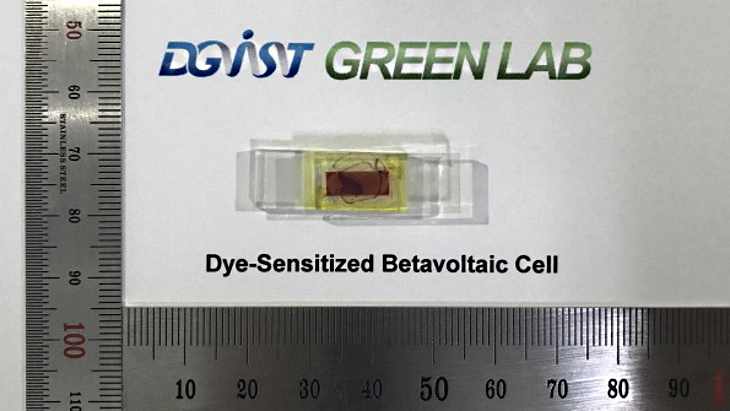
(Image: Daegu Gyeongbuk Institute of Science & Technology)
To significantly improve the energy conversion efficiency of their new design, the team used a titanium dioxide-based semiconductor, a material commonly used in solar cells, sensitised with a ruthenium-based dye. They strengthened the bond between the titanium dioxide and the dye with a citric acid treatment. When beta rays from radiocarbon collide with the treated ruthenium-based dye, a cascade of electron transfer reactions, called an electron avalanche, occurs. Then the avalanche travels through the dye and the titanium dioxide effectively collects the generated electrons.
The new battery also has radiocarbon in the dye-sensitised anode and a cathode. By treating both electrodes with the radioactive isotope, the researchers increased the amount of beta rays generated and reduced distance-related beta-radiation energy loss between the two structures.
During demonstrations of the prototype battery, the researchers found that beta rays released from radiocarbon on both electrodes triggered the ruthenium-based dye on the anode to generate an electron avalanche that was collected by the titanium dioxide layer and passed through an external circuit resulting in usable electricity.
These long-lasting nuclear batteries could enable many applications, says In. These include powering implants, remote applications, and satellites. For example, a pacemaker would last a person's lifetime, eliminating the need for surgical replacements.
However, this betavoltaic design converted only a tiny fraction of radioactive decay into electric energy, leading to lower performance compared to conventional Li-ion batteries. In suggests that further efforts to optimise the shape of the beta-ray emitter and develop more efficient beta-ray absorbers could enhance the battery's performance and increase power generation.
Proposed reactor designs 'seem suitable', Dutch regulator concludes
A review of the feasibility studies submitted by EDF, Westinghouse and Korea Hydro & Nuclear Power for two new reactors in the Netherlands suggests that all three designs would meet necessary safety requirements, the country's nuclear regulator announced. Last week, KHNP indicated it is withdrawing from the technology selection process.
_60627.jpg)
In December 2021, the Netherlands' new coalition government placed nuclear power at the heart of its climate and energy policy. Based on preliminary plans, two new reactors will be completed around 2035 and each will have a capacity of 1000-1650 MWe. The two reactors would provide 9-13% of the country's electricity production in 2035. The cabinet announced in December 2022 that it currently sees Borssele as the most suitable location for the construction of the new reactors.
EDF of France, KHNP of South Korea and Westinghouse of the USA were contracted by the Ministry of Climate and Green Growth (KGG) to conduct feasibility studies into the construction of their respective reactors - the EPR, APR-1400 and AP1000 - in the Netherlands.
The studies were to consider whether their designs comply with Dutch legislation and regulations, whether they can be fitted into the preferred location at Borssele, and to develop a more detailed estimate of the costs and time required to build the two new units. The possible impact on the environment was also highlighted in the studies. In November, Amentum of the USA was selected to review and advise on the studies submitted by the three potential reactor vendors.
The country's Authority for Nuclear Safety and Radiation Protection (ANVS) has now released its conclusions of the review of the studies. It notes that it reviewed the APR-1400 design before KHNP said it would withdraw. ANVS said that, "when it comes to safety", it is feasible any of the three designs could be built in the Netherlands.
"These companies have tested their designs against our guidelines for Safe Design and Safe Operation of Nuclear Power Plants (VOBK)," ANVS said. "In doing so, they have identified a number of points where their design deviates from the literal text of the VOBK and have provided substantiation that the underlying safety objectives are being achieved."
The ANVS uses the VOBK as a reference framework for the design assessment in the run-up to the licensing procedure. "Following recommendations from the International Atomic Energy Agency, the recent evaluation of the Nuclear Energy Act and the results of this self-evaluation, the ANVS has decided to revise the VOBK to better align it with the international state-of-the-art, to harmonise it more internationally and to make it less technology-dependent," it said.
Findings on each design
ANVS notes that Westinghouse's AP1000 relies heavily on the use of passive systems for safety management. "In a possible licensing procedure, it must still be proven in detail that the passive systems and principles are also sufficiently reliable in practice to guarantee safety in all accident scenarios," it said. "This will be an extensive point of attention for the ANVS during the design assessment." In addition, it says the safety file of the AP1000 is largely based on compliance with prescriptive US standards, while in the Netherlands, targeted legal standards apply. "This system requires the applicant to demonstrate in detail that these objectives are achieved with the design. This entails a risk of a longer lead time because the applicant will have to rewrite the safety documentation extensively. In addition, there are risks for the licensing because in the American frameworks, different choices are sometimes made than in the IAEA framework or EU context."
Regarding EDF's EPR, ANVS notes that the design has been based on Western European norms and standards from the start of the design phase. "The many (safety) systems make the design robust but also complex," it said. "This poses challenges for both the permitting and (supervision of) the construction in terms of the amount of work and maintaining a good overview." However, it said that as the reactor is already in operation or under construction in Finland, France and the UK, it "has the advantage that the ANVS will be able to rely as much as possible on European colleague authorities when assessing the design". It notes that EDF is now focused on developing the EPR2 design, so EDF "must ensure that this does not detract from the quality of the design that is offered to the Netherlands".
Although KHNP has now withdrawn its APR-1400 design, ANVS said the design "appears to meet the expectations that (Western) European countries, including the Netherlands, have for nuclear power plants". It added that KHNP's intention to rely heavily on the supply of components from South Korea "entails challenges with regard to the on-site quality assurance assessment and supervision by the ANVS during manufacturing".
ANVS concludes: "Based on the self-evaluations as carried out by the designers, the ANVS sees no reason to assume that one of these designs could not be licensed in the Netherlands. As far as safety is concerned, there is therefore no reason to exclude a design from participation in the tender or to require adjustments to the standard design in the context of this process."
The regulator said the Ministry of Climate and Green Growth "can use this information for the tender to ultimately come to the choice of a company that can start building in the Netherlands.
"Naturally, before a permit is granted, ANVS will very carefully assess whether the design complies with Dutch legislation and regulations, whereby the applicant will have to provide much more information about the design and the safety analyses than is currently available in the self-assessments," ANVS said. "Only once the location is known will it be possible to consider the location-specific safety aspects that play a role at that location."
Eighth NuScale SMR simulator opened
NuScale Power Corporation has announced the opening of an Energy Exploration Centre at Rensselaer Polytechnic Institute in Troy, New York. The centre will augment undergraduate courses through the integration of hands-on experiences that complement theoretical concepts.
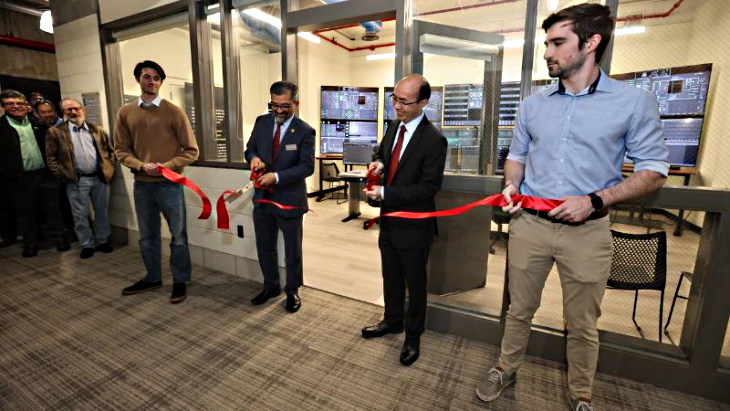
Installed in February, the Energy Exploration (E2) Centre at the Jonsson Engineering Center - a hub of Rensselaer Polytechnic Institute's School of Engineering on its Troy campus - offers users a hands-on opportunity to apply nuclear science and engineering principles through simulated, real-world nuclear power plant operation scenarios. The E2 Centre employs state-of-the-art computer modeling to simulate a NuScale VOYGR-12, 924 MWe, small modular reactor (SMR) plant powered by 12 NuScale Power Modules.
The E2 Centre at Rensselaer Polytechnic Institute (RPI) was co-funded by a grant from the US Department of Energy's Nuclear Energy University Programs.
"We are proud to join with the faculty and students at RPI to open this NuScale E2 Centre aimed at showcasing the importance of nuclear energy," said NuScale President and CEO John Hopkins. "We hope that this learning facility will foster collaborative problem-solving and creative solutions that inspire future energy pioneers and equip a nuclear-ready workforce."
"Having a high-quality simulator on campus will provide our students with exciting learning opportunities in the design, operation, and control of modern, small modular reactors," said Shekhar Garde, dean of the RPI School of Engineering. "This capability adds to the growing strength of RPI's School of Engineering in augmented, virtual, and digital technologies for education, where students can learn about everything from atoms to galaxies, and work on designing new drugs, airplanes, and, now, nuclear reactors."
"These new learning opportunities will provide students with a comprehensive education, bridging theory with practice and preparing them to understand, implement, and comply with reactor operation safety regulations in line with nuclear industry standards," added Shanbin Shi, assistant professor of mechanical, aerospace, and nuclear engineering.
Since November 2020, NuScale has unveiled eight E2 Centres with university partners, including RPI; Oregon State University; Texas A&M University; Idaho State University; University Politechnica in Bucharest, Romania; Seoul National University in South Korea; the Ohio State University; and Ghana Atomic Energy Commission in Accra, Ghana.
The NuScale Power Module on which the VOYGR nuclear power plants are based is a pressurised water reactor with all the components for steam generation and heat exchange incorporated into a single 77 MWe unit. The company offers a 12-module VOYGR-12 power plant is capable of generating 924 MWe as well as the four-module VOYGR-4 (308 MWe) and six-module VOYGR-6 (462 MWe) plants and other configurations based on customer needs.

No comments:
Post a Comment