Story by Jenna Benchetrit
• CBC
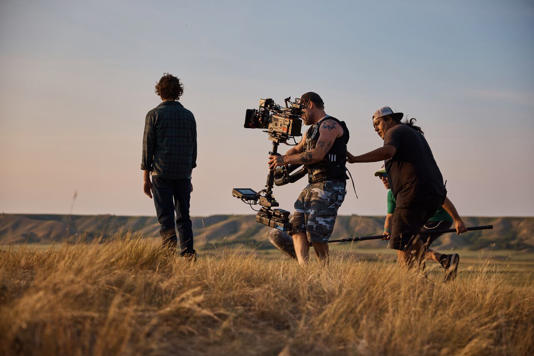
Cast and crew film a scene for the movie Die Alone in Saskatchewan's Qu'appelle Valley in summer 2023. Many provinces offer tax incentives to lure film and TV productions. (Die Alone Productions)

U.S. President Donald Trump says he wants to impose a 100 per cent tariff on movies produced outside the country, a move that could devastate the Canadian film landscape — but experts are scratching their heads over how such a tax would work, given how intertwined the global film industry is.
Trump, in a Truth Social post on Sunday night, said he directed the Department of Commerce and the U.S. Trade Representative to "immediately begin the process" of imposing the tariff. He hasn't signed an executive order, and the White House said on Monday that no final decisions had been made.
Other countries "are offering all sorts of incentives to draw out filmmakers and studios away from the United States," Trump wrote.
"Hollywood, and many other areas within the U.S.A., are being devastated," he went on, framing it as a matter of national security.
Asked if he'd float the issue during his meeting with Prime Minister Mark Carney on Tuesday, Trump responded that Canada is "only one of many countries" that uses tax incentives to lure U.S. film productions.
He offered few details on what this latest plank in his tariff regime would entail, or how it would be executed — including whether it would impact co-productions, or films made entirely abroad and exhibited in the U.S., not to mention those that appear on streaming services and at film festivals.
 Related video: Hollywood North preparing to be latest victim in U.S. trade war (Global News) Duration 2:11
Greg Denny, a Canadian film producer whose most recent credits include The Apprentice, a biopic about Trump that was partially shot in Toronto, says movies are rarely the product of a single country.
"We're not creating a good here. We're creating a movie. How do you put a tariff on top of that?" he asked. "This is many countries working together at all times, creating footage and content... It's not really something I see you can put a tariff on."
The announcement also drew swift rebukes from the Canadian Media Producers Association (CMPA) and the Alliance of Canadian Cinema, Television and Radio Artists (ACTRA), the actors' union.
B.C. Premier David Eby called the proposal "incredibly hard to understand," while Ontario's Doug Ford lamented that it's "something new with [Trump]" every day.
Why Hollywood goes north
Like other parts of its economy, Canada's film industry is deeply intertwined with that of its southern neighbour. Oscar-winners like Titanic, The Revenant and Juno were all filmed at least partly on Canadian soil; and Hollywood filmmakers from Guillermo Del Toro to Christopher Nolan have shot multiple movies here.
That means Canada is also vulnerable to crises that originate in Hollywood, like the 2023 Writers Guild of America and SAG-AFTRA strikes, which further wounded an industry still recovering from pandemic-related shutdowns.

Leonardo DiCaprio, right, and Kate Winslet appear in a scene from 1997's Titanic, which was partly shot in Canada. (Paramount Pictures/Associated Press)
Canada is highly appealing to U.S. film producers, according to experts. The filmmaking workforce is highly skilled, but costs less to pay, and Toronto, Montreal, Vancouver, Calgary and Halifax are frequently used as stand-ins for other cities in the U.S., Europe and Asia. U.S. film production creates 30,000 jobs and has a $2.6 billion economic impact in Toronto alone, according to Mayor Olivia Chow.
Most importantly, the federal government offers a 16 per cent refundable tax credit, which is used to attract foreign productions from Hollywood and elsewhere to Canada.
Provinces also have their own tax incentives, some of which — like Ontario's — can be harmonized with the federal credit. B.C., meanwhile, announced just a few months ago that it would up its production tax incentives, and give a 2 per cent bonus to productions that spend big in the province.
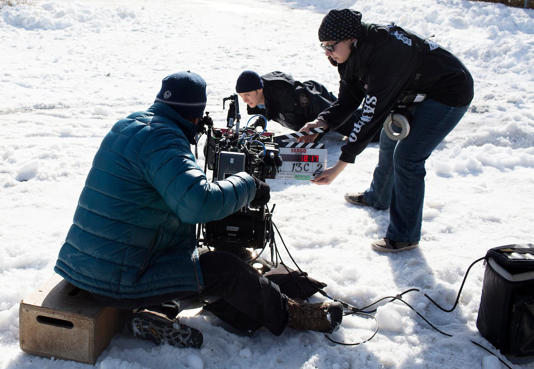
Crew members prepare to film actor Colin Hanks on the set of the TV series Fargo in Calgary on March 11, 2014. U.S. President Donald Trump says he wants to put a 100 per cent tariff on movies produced in other countries, though the details remain murky. (Todd Korol/Reuters)
CBC News reached out to several major U.S. studios for their reaction, but none have responded. Trump said on Monday that he'd meet with the industry to discuss the proposal.
"I'm not looking to hurt the industry. I want to help," he said. "I want to make sure they're happy with it because we're all about jobs."
'The consumer still wants to consume'
Charlie Keil, professor at the University of Toronto's Cinema Studies Institute, says a U.S. film industry exodus from Canada would have a "devastating impact" on the domestic sector.
But it's hard to know how a tariff like the one Trump is proposing would be imposed, and to which movies it would apply.
"There's a whole spectrum here, between films that are primarily made in the U.S. but might have some post-production work done in another country, to films that are entirely made by another country," he said.

Noah Segal, the co-founder of Toronto-based film distributor Elevation Pictures, said major streamers are unlikely to get on board with Trump's proposal. (Aizick Grimman/CBC)
There's also the question of who would absorb the cost of the tariff. After years of price hikes and hidden junk fees, a more expensive movie ticket likely wouldn't fly with audiences, says Keil.
That would mean theatre owners would eat the cost themselves or split it with a distributor, which would make production itself more expensive. Retaliatory tariffs would further complicate things, given that the global box office is deeply important to the success of a blockbuster, Keil notes.
And what about U.S. streaming services? Netflix, for example, has seen success with foreign-made content — being the primary distributor for Oscar fare like Spain's Society of the Snow and South Korea's Okja.
Noah Segal, the co-president of the Toronto-based film distributor Elevation Pictures, says major streamers are unlikely to get on board with Trump's proposal.
"I think that they want to get localized content going because they know there's certain [niches] that they can't get through American content," he said.
However, if a U.S. tariff is imposed globally on other filmmaking countries, Segal argues that it could be a boon for Canada's domestic industry.
"If there's less content, the consumer still wants to consume as much as the consumer wants to consume. So therefore, it may be a great opportunity for Canadian content, Canadian culture and Canadian industry," he said.
‘Aussiewood’ courts Hollywood as Trump film tariffs loom
By AFP
May 6, 2025

'Crocodile Dundee' helped put Australia's fledgling film industry on the map in America - Copyright AFP Patrick T. Fallon
Australia still wants to make “great films” with the United States, Foreign Minister Penny Wong said Tuesday, as new tariffs threaten the home of Hollywood hits like The Matrix, Elvis and Crocodile Dundee.
US President Donald Trump on Sunday announced 100 percent tariffs for all films produced in “foreign lands”, saying struggling Tinsel Town would be better served by “movies made in America”.
So-called “Aussiewood” has for years used generous tax breaks and other cash incentives to lure foreign filmmakers Down Under, producing a string of hits for major Hollywood studios.
Although little is known about how the tariffs might work, Australia’s top diplomat Wong said they risk ultimately proving a flop with filmgoers.
“Our message is we make great films together,” she told national broadcaster ABC.
“We have films, American films, which are filmed here in Australia. The collaboration is a good thing. So, let’s not get in the way of that.”
“Crocodile Dundee”, a 1986 comedy about an Australian bushman transplanted to New York City, helped put Australia’s fledgling film industry on the map in America.
Since then, some of Hollywood’s hottest directors have used Australia to film Marvel blockbusters, Mission Impossible instalments, and box office winners like Elvis.
The tariffs could also trouble neighbouring New Zealand, which famously lent its spectacular scenery to the beloved Lord of the Rings trilogy.
New Zealand Film Commission boss Annie Murray said they were still trying to untangle how the tariffs might work.
“We’re mindful, however, this is an evolving situation and it’s too early to speculate on what this could mean,” she told AFP.
The tariffs appear to target a business model favoured by American studios who obtain tax breaks to film in countries such as Britain, Canada, Ireland and Australia.
A recent survey of studio executives found that their top five favoured production locations were all outside the United States.
At the start of this year, Trump appointed veteran stars Sylvester Stallone, Mel Gibson and Jon Voight to bring Hollywood back “bigger, better and stronger than ever before”.
‘Makes no sense’: Hollywood shocked by Trump’s film tariffs announcement
By AFP
May 6, 2025

Most movie studios and other industry organizations had yet to officially react Monday but Trump's announcement triggered crisis meetings - Copyright AFP DAVID SWANSON
Romain FONSEGRIVES
Hollywood reacted Monday with skepticism to US President Donald Trump’s announcement of 100 percent tariffs on foreign films, with movie insiders calling it a policy made up on the fly by a president who fails to understand how the industry works.
“It makes no sense,” entertainment lawyer Jonathan Handel said of Trump’s idea.
Handel explained to AFP that many US productions, from James Bond flicks to the “Mission Impossible” franchise, are filmed abroad for obvious creative reasons.
“If the stunt is Tom Cruise climbing up the Eiffel Tower, what are we supposed to do, shoot at the replica Eiffel Tower in Las Vegas?” Handel said. “I mean, it’s just nonsensical.”
Writing Sunday on his platform Truth Social, Trump said: “I am authorizing the Department of Commerce, and the United States Trade Representative, to immediately begin the process of instituting a 100% Tariff on any and all Movies coming into our Country that are produced in Foreign Lands.”
Trump added: “WE WANT MOVIES MADE IN AMERICA, AGAIN!”
His words plunged the movie industry into uncertainty, as entertainment companies saw their stock prices fall, unions struggled to understand if the bombshell also applies to TV series and everyone wondered if the policy could even be enforced.
Handel noted that movies involve intellectual property.
“You can buy a movie ticket, but you don’t buy a movie the way you buy a piece of clothing or an automobile,” which can be taxed as they cross a border into the United States, he said.
Even if a system could be devised to impose tariffs on movies filmed outside the United States, these levies would do more harm than good to the US industry, the lawyer added.
“The result of that would be to reduce production, to increase the cost of movies, to reduce the number of movies available for movie theaters and streamers to show, which would damage the distribution side of the business,” Handel argued.
– ‘Confusion’ –
Unions for actors and other media and entertainment workers said they awaited more details of Trump’s plan but supported the goal of increasing production of movies, TV and streaming in the United States.
“We will continue to advocate for policies that strengthen our competitive position, accelerate economic growth and create good middle-class jobs for American workers,” said one such guild, SAG-AFTRA.
Many movie studios and other industry organizations had yet to officially react Monday but Trump’s announcement triggered crisis meetings, Hollywood press outlets reported, publishing skeptical comments from insiders speaking on condition of anonymity.
“I can’t see his target here other than confusion and distraction,” the showbiz news outlet Deadline quoted a top distribution executive as saying.
“Let’s hope this only encourages desperately needed increases in US state tax incentives being implemented ASAP,” that person added.
Such incentives offered by other countries — like Britain, Canada and Ireland, among others — are a lure for US movie studios to film outside the country.
While Trump’s idea is divisive, there is widespread agreement that the US movie industry is in dire straits.
Since the historic strikes by actors and writers that shut it down in 2023, Hollywood has struggled to get back on its feet.
In Los Angeles, the number of filming days hit a record low in 2024, if one excludes the total shutdown in 2020 because of the Covid pandemic.
This is in part because many movies are now filmed in a growing number of countries that offer incentives such as tax rebates.
Deadline quoted a Hollywood movie financier as saying he actually agrees with Trump’s goal of having more movies filmed in the United States.
“But obviously the need is for rebates, not tariffs. Tariffs will just choke the remaining life out of the business,” they were quoted as saying.
As Hollywood fretted over Trump’s announcement, the White House said no decision on foreign film tariffs has been made.
“The Administration is exploring all options to deliver on President Trump’s directive to safeguard our country’s national and economic security while Making Hollywood Great Again,” the White House said in a statement.
Trump told reporters Monday, “I’m not looking to hurt the industry. I want to help the industry. But they’re given financing by other countries.”
That seemingly conciliatory remark stopped short of walking back the film tariff announcement, as Trump criticized California Governor Gavin Newsom, who is pushing for his state to double the tax credits it grants to the movie industry.
“Our film industry has been decimated by other countries taking them out, and also by incompetence,” Trump said, attacking Newsom.
“He’s just allowed it to be taken away from, you know, Hollywood.”
By AFP
May 6, 2025
Most movie studios and other industry organizations had yet to officially react Monday but Trump's announcement triggered crisis meetings - Copyright AFP DAVID SWANSON
Romain FONSEGRIVES
Hollywood reacted Monday with skepticism to US President Donald Trump’s announcement of 100 percent tariffs on foreign films, with movie insiders calling it a policy made up on the fly by a president who fails to understand how the industry works.
“It makes no sense,” entertainment lawyer Jonathan Handel said of Trump’s idea.
Handel explained to AFP that many US productions, from James Bond flicks to the “Mission Impossible” franchise, are filmed abroad for obvious creative reasons.
“If the stunt is Tom Cruise climbing up the Eiffel Tower, what are we supposed to do, shoot at the replica Eiffel Tower in Las Vegas?” Handel said. “I mean, it’s just nonsensical.”
Writing Sunday on his platform Truth Social, Trump said: “I am authorizing the Department of Commerce, and the United States Trade Representative, to immediately begin the process of instituting a 100% Tariff on any and all Movies coming into our Country that are produced in Foreign Lands.”
Trump added: “WE WANT MOVIES MADE IN AMERICA, AGAIN!”
His words plunged the movie industry into uncertainty, as entertainment companies saw their stock prices fall, unions struggled to understand if the bombshell also applies to TV series and everyone wondered if the policy could even be enforced.
Handel noted that movies involve intellectual property.
“You can buy a movie ticket, but you don’t buy a movie the way you buy a piece of clothing or an automobile,” which can be taxed as they cross a border into the United States, he said.
Even if a system could be devised to impose tariffs on movies filmed outside the United States, these levies would do more harm than good to the US industry, the lawyer added.
“The result of that would be to reduce production, to increase the cost of movies, to reduce the number of movies available for movie theaters and streamers to show, which would damage the distribution side of the business,” Handel argued.
– ‘Confusion’ –
Unions for actors and other media and entertainment workers said they awaited more details of Trump’s plan but supported the goal of increasing production of movies, TV and streaming in the United States.
“We will continue to advocate for policies that strengthen our competitive position, accelerate economic growth and create good middle-class jobs for American workers,” said one such guild, SAG-AFTRA.
Many movie studios and other industry organizations had yet to officially react Monday but Trump’s announcement triggered crisis meetings, Hollywood press outlets reported, publishing skeptical comments from insiders speaking on condition of anonymity.
“I can’t see his target here other than confusion and distraction,” the showbiz news outlet Deadline quoted a top distribution executive as saying.
“Let’s hope this only encourages desperately needed increases in US state tax incentives being implemented ASAP,” that person added.
Such incentives offered by other countries — like Britain, Canada and Ireland, among others — are a lure for US movie studios to film outside the country.
While Trump’s idea is divisive, there is widespread agreement that the US movie industry is in dire straits.
Since the historic strikes by actors and writers that shut it down in 2023, Hollywood has struggled to get back on its feet.
In Los Angeles, the number of filming days hit a record low in 2024, if one excludes the total shutdown in 2020 because of the Covid pandemic.
This is in part because many movies are now filmed in a growing number of countries that offer incentives such as tax rebates.
Deadline quoted a Hollywood movie financier as saying he actually agrees with Trump’s goal of having more movies filmed in the United States.
“But obviously the need is for rebates, not tariffs. Tariffs will just choke the remaining life out of the business,” they were quoted as saying.
As Hollywood fretted over Trump’s announcement, the White House said no decision on foreign film tariffs has been made.
“The Administration is exploring all options to deliver on President Trump’s directive to safeguard our country’s national and economic security while Making Hollywood Great Again,” the White House said in a statement.
Trump told reporters Monday, “I’m not looking to hurt the industry. I want to help the industry. But they’re given financing by other countries.”
That seemingly conciliatory remark stopped short of walking back the film tariff announcement, as Trump criticized California Governor Gavin Newsom, who is pushing for his state to double the tax credits it grants to the movie industry.
“Our film industry has been decimated by other countries taking them out, and also by incompetence,” Trump said, attacking Newsom.
“He’s just allowed it to be taken away from, you know, Hollywood.”

No comments:
Post a Comment