Venice exhibition includes model of Newcleo reactor
A full-scale model of innovative reactor developer Newcleo's TL-40 lead-cooled fast reactor for maritime applications is being displayed at the 19th International Architecture Exhibition of the Venice Biennale. Newcleo said the exhibit is aimed at "redefining the image of nuclear energy".
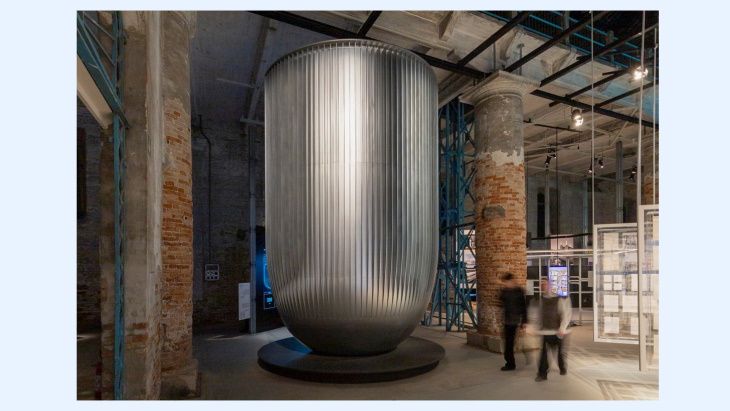
The interactive exhibit is a joint project by Paris-headquartered Newcleo, leading Italian design company Pininfarina, and Italian shipbuilder Fincantieri.
"Combining technological vision, industrial expertise, and cutting-edge design, the three companies have collaborated to redefine the image of nuclear energy," Newcleo said. "Visitors are invited to reimagine their preconceptions of nuclear power as they embark on a highly interactive journey exploring the extraordinary potential of atomic fission in combating climate change and decarbonising human activities."
At the heart of the collaborative project, housed within Venice's historic Corderie dell'Arsenale, stands a full-scale reproduction of the TL-40 liquid lead-cooled reactor designed by Newcleo for powering large maritime vessels.
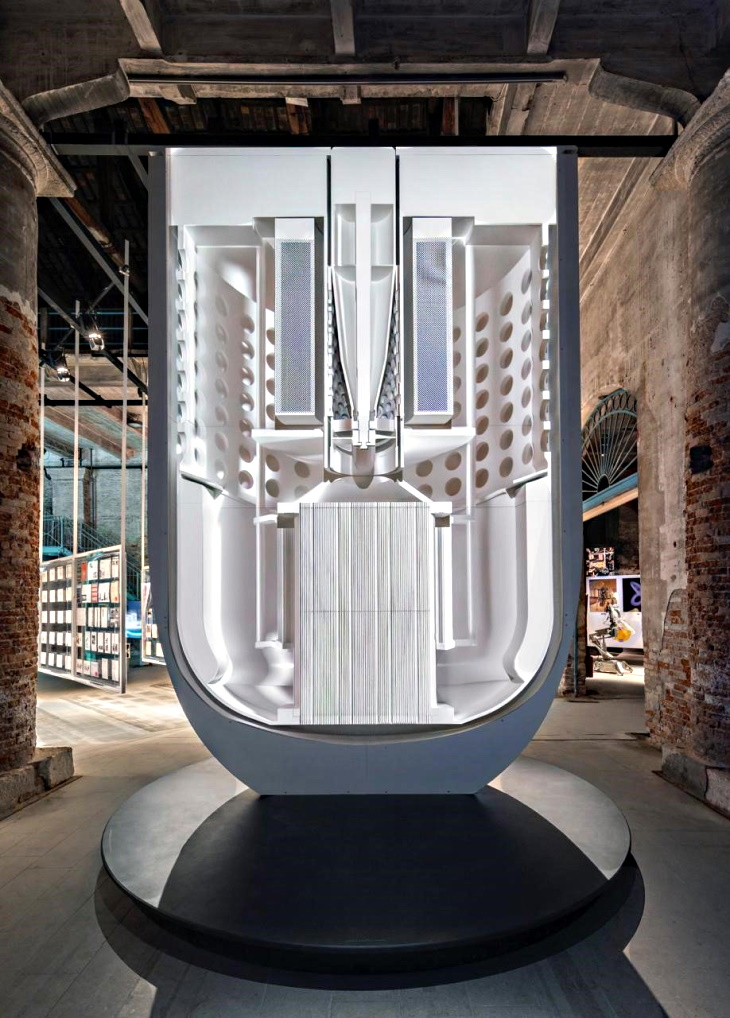
(Image: Newcleo)
"Guided through an immersive experience, visitors will discover the functioning of the reactor, its ability to burn waste produced by traditional nuclear power plants, and its passive safety features that make it the ideal solution for powering energy-intensive human activities in a sustainable and decarbonised manner," Newcleo said.
A system has also been set up for interactive visualisation of data and information on nuclear energy and its role within the process of decarbonising energy systems.
Pininfarina has curated the project's creative vision by "infusing" Newcleo's technological solutions with design, "bringing for the first time to the nuclear industry a creative vision that mixes technical and aesthetic elements to facilitate its integration in urban and peri-urban environments".
Fincantieri has contributed to the project its extensive experience in shipbuilding, studying a possible industrial application for Newcleo's innovative solution.
Fincantieri and Newcleo have been collaborating since 2023 to study applications of Newcleo's technology for naval propulsion. Similarly, Pininfarina is collaborating with Newcleo to design a nuclear fuel research and development centre that will be built in Chusclan in the Gard region of France.
"Through this installation, we're introducing the world to a new paradigm of clean, sustainable nuclear energy designed to serve people and communities," said Newcleo founder and CEO Stefano Buono. "Moving beyond the large reactors of the past, we've developed small, inherently safe reactors that solve the nuclear waste problem while delivering abundant decarbonised energy. Together with Pininfarina and Fincantieri, we're unveiling a new vision for nuclear power engineered for forward-thinking societies that are committed to both progress and caring for the environment."
The exhibition opened on 8 May and runs until 28 November.
Foundation in place for new Dutch research reactor
The construction pit and foundation have been completed for the reactor building of the Pallas research reactor in Petten, the Netherlands. Preparations are now under way for the start of construction of the reactor building itself.
_88766.jpg)
NRG-Pallas applied in June 2022 to the Dutch regulator, the Authority for Nuclear Safety and Radiation Protection, for a permit to construct and operate the Pallas reactor. ANVS granted a construction licence in mid-February 2023. Preparatory work on the foundation began in May 2023. This work was carried out by Belgian construction firm Besix, which was awarded a contract in November 2022.
The building of the construction pit - a hole of about 50 metres by 50 metres and 17.5 metres deep - and the foundation has now been completed. This has involved digging 30 trenches measuring one-and-a-half metres wide, into which concrete was poured to create the so-called "diaphragm walls". The diaphragm walls are anchored with 380 bored piles placed within them. An underwater concrete floor 1.5 metres thick has also been constructed, and on top of this, a reinforced foundation slab measuring 50 metres by 50 metres and also 1.5 metres thick.
"This unique construction project has brought together all of our expertise and innovative capabilities. Both in terms of technical aspects and the stringent security requirements of a nuclear site, as well as the construction site surrounded by the dune area," said Nic De Roeck, managing director of Besix Nederland. "All of this introduced additional considerations for how we had to execute the work. I look back with satisfaction on how we carried out this challenging work together with NRG-Pallas and our partners; this was work at a Champions League level."
Peter Dijk, programme director and member of the Executive Board at NRG-Pallas said completion of the pit and foundation was "a significant step forward on the path to realising the Pallas reactor". He added: "This has laid the foundation for the next phase of construction. The arrival of the Pallas reactor is crucial for the production of medical isotopes."
Currently, NRG-Pallas, together with main contractor Spanish construction firm FCC Construcción and designer ICHOS, is preparing the next phase of the project.
Last month, FCC Construcción signed an agreement with NRG-Pallas to move the project forward through its successive phases. To this end, an agreement was formalised on the scope, schedule, budget and technical solutions for the construction of the first part of the Pallas reactor building.
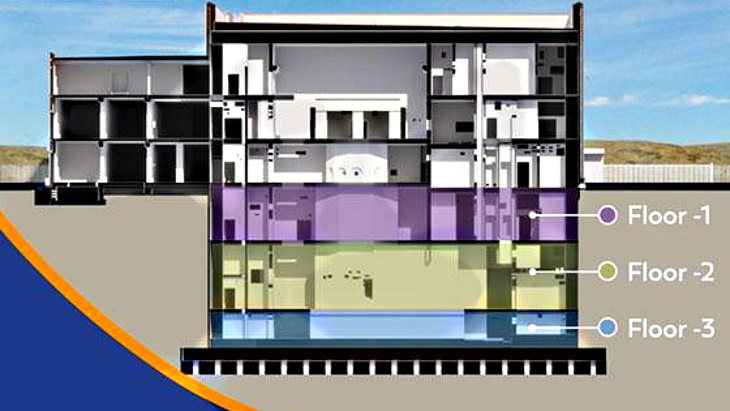
A cross-section of the Pallas reactor building (Image: FCC Construcción)
The construction site is now being restructured so that work on the lower section of the reactor can begin later this year. Additionally, preparations are underway for the installation of the cooling water pipeline. The pipeline will extract water from the North Holland Canal and discharge it into the sea.
Although funding has been allocated in the coming years for the construction of the Pallas reactor, the Dutch government has yet to make a final decision on its construction. The European Commission has already approved, under EU state aid rules, the Dutch government's plan to invest EUR2 billion (USD2.2 billion) in the construction of Pallas.
Former Minister of Health, Welfare and Sport Ernst Kuipers instructed the NRG-Pallas not to take any irreversible steps, but to continue with the preparations for the project in the meantime to avoid unnecessary delays.
The Pallas research reactor is to be built at Petten to replace the existing High Flux Reactor (HFR). The 45 MW HFR started operating in September 1960, since when its use has largely been shifted from nuclear materials testing to fundamental research and the production of medical radioisotopes. The reactor - operated by NRG on behalf of the European Union's Joint Research Centre - has for a long time supplied about 60% of Europe's and 30% of the world's medical radioactive sources.
Pallas will be of the "tank-in-pool" type, with a thermal power of around 55 MW, and able to deploy its neutron flux more efficiently and effectively than the HFR.
Article researched and written by WNN's Warwick Pipe
ForoNuclear highlights role of nuclear in Spanish energy mix
Spain's nuclear power plants generated almost 20% of its total net electricity production in 2024 and became its second largest source of electricity production, according to the country's nuclear industry forum ForoNuclear. The recent blackout that struck the Iberian peninsula highlights nuclear's role in providing inertia and stability to the electricity system, it says.
_97597.jpg)
In the latest edition of its annual report - titled Nuclear Results for 2024 and Future Perspectives - ForoNuclear says Spain's nuclear power reactors generated almost 52.4 TWh net in 2024, slightly down from the 54.4 TWh generated in 2023. As of 31 December, the total installed net capacity of the electricity generation fleet in Spain was 128,987 MWe, of which nuclear accounted for 7117 MWe (net), corresponding to 5.52% of the total installed net capacity.
According to figures from Spain's transmission system operator, Red Eléctrica, renewables - which accounted for 66% of the country's total installed capacity - accounted for 56.8% of Spain's electricity generation in 2024 (wind 23.2%, solar 18.6% and hydro 13.3% and others, including biogas and biomass, 1.7%), up 10.3% compared with 2023.
"The seven operating reactors continued to guarantee supply and energy independence, as they produce baseload power constantly and reliably," said ForoNuclear President Ignacio Araluce. "These aspects are essential in the current geopolitical context, in which Europe is striving to achieve energy sovereignty.
"I would like to highlight that Spanish nuclear power plants are essential in providing strength and stability to the electricity system. For yet another year, they contributed around 20% of the electricity consumed, even though their installed capacity remained unchanged while that of other technologies continues to increase. The plants have operated with the highest quality and safety standards, thanks to the commitment and dedication of the sector's companies, their workers and owners, who invest millions to keep the sites in optimal conditions and prepared for long-term operation."
Blackout response
On 28 April, two consecutive generation loss events occurred in southwestern Spain. The remaining generation was insufficient to meet demand, thereby triggering a cascading failure across the entire grid. The fault disrupted electricity supply not only in Spain but also in Portugal, Andorra and parts of the south of France. Red Eléctrica restored most of the electricity supply by early the following day. Investigations into the root cause of the blackout are still ongoing, but a lack of rotating inertia - a term for how resistant a grid is to changes in frequency - is thought to be the likely cause.
Four reactors (Almaraz II, Ascó I and II, and Vandellós II) were operational just before the blackout occurred. Three units were already offline - Trillo was in a scheduled outage, while Almaraz I and Cofrentes were not generating as Red Electrica had requested them not to generate power due to the high contribution from renewable energy in the system.
As a result of the loss of external power supply caused by the blackout, the operating reactors shut down automatically, and safety systems were activated to maintain a safe shutdown, ForoNuclear noted.
"The nuclear power plants acted according to their design and always remained stable and safe," it said. "During the incident, the Nuclear Safety Council activated its Emergency Response Organization [due to the lack of offsite power] and remained continuously informed while monitoring the status of the plants. The reactors are now resuming production after completing all corresponding safety checks, reconnecting to the grid as instructed by the System Operator or when matched in the electricity market."
It added: "It is worth noting that the large turbines and generators in nuclear power plants provide rotating power and inertia to the grid, as they are heavy synchronous machines that help stabilise voltage and frequency."
Phase-out policy
There were strong suggestions that renewables were the cause of the blackout, and that there was therefore a need to maintain the nuclear fleet. However, Prime Minister Pedro Sánchez dismissed suggestions that the blackout was the result of his administration's decision to expand the use of renewables while phasing out nuclear power. Under the country's nuclear phase-out plans, agreed in 2019, four reactors are scheduled to close by the end of 2030, while the remaining three reactors will shut by 2035.
"It does not seem logical to cling to a nuclear phase-out plan established 2019 without opening our eyes to reality, especially as the current energy, environmental, and geopolitical context is radically different from what it was then," Araluce said. "The most reasonable course of action would be to revise the closure schedule, considering the crucial role nuclear power plants play in ensuring supply, avoiding CO2 emissions, and helping to contain electricity prices. In fact, recent studies show that without nuclear, electricity in our country would be 23% more expensive for citizens and small businesses, and 35% higher for industrial consumers.
"That said, ensuring the continuity of nuclear energy requires a review of the suffocating tax burden it currently bears. This taxation - which has been increased by more than 70% in the past five years - includes overlapping taxes, regional eco-taxes, and the Enresa fee, which the Government unilaterally raised by 30%. This excessive tax burden, far above the European average, is making Spanish nuclear plants artificially unviable, despite the willingness of their owners to continue operating them and the fact that they are in excellent technical and safety conditions."
Earlier this year, the Plenary Session of the Spanish Congress approved a non-binding proposal calling for the government to implement a series of measures that would reverse the country's decision to phase out nuclear power. The proposal, presented by the right-wing People's Party, was passed on 12 February, with 171 votes in favour, 164 against and 14 abstentions. On 4 April, the Popular Party presented a bill to extend the useful life of nuclear power plants, arguing that it is "necessary" to keep them operational for the long-term.
World Nuclear Association Director General Sama Bilbao y León said: "The economic future of Spain depends on having access to abundant, affordable, 24/365, clean and definitely stable electricity. Thus, maintaining the current nuclear fleet is essential for the economic future of Spain."
Article researched and written by WNN's Warwick Pipe
EU seeks to end all energy imports from Russia
The European Commission has published a roadmap for the European Union to end its dependency on Russian energy by stopping the import of Russian gas and oil and phasing out Russian nuclear energy. The commission said it will make legislative proposals next month.
_41039.jpg)
In May 2022, in response to Russia's invasion of Ukraine three months earlier, the European Commission (EC) formally adopted the REPowerEU Plan, which aimed to rapidly reduce EU dependence on Russian fossil fuels. The plan recognised that nuclear will have a role to play in ensuring security of EU energy supplies, and highlighted the importance of coordinated action to reduce dependence on Russian nuclear materials and fuel cycle services.
"Despite the significant progress achieved under the REPowerEU Plan and via sanctions since Russia's invasion of Ukraine, in 2024 the EU saw a rebound in Russian gas imports," the EC said. "More coordinated actions are therefore needed, as the EU's overdependency on Russian energy imports is a security threat."
Measures taken so far have reduced the volumes of imported Russian gas from 150 billion cubic metres (bcm) in 2021 to 52 bcm in 2024 – with the share of Russian gas imports dropping from 45% to 19%, it noted. All imports of Russian coal have been banned by sanctions; oil imports have shrunk from 27% at the beginning of 2022 to 3% now.
In nuclear, more than 14% of uranium was sourced in the EU from Russia in 2024, while around 23% of the whole EU demand for uranium conversion services was satisfied from Russia and in uranium enrichment services Russia covered almost 24% of EU needs. Member States that are still using Russian-designed VVER reactors have made progress in replacing Russian nuclear fuel with fuel from other producers.
The EC has now published the REPowerEU Roadmap, which it says "paves the way to ensure the EU's full energy independence from Russia". The roadmap sets out a gradual removal of Russian oil, gas and nuclear energy from the EU markets "which will take place in a coordinated and secure manner as we advance our energy transition".
"The European Commission will seek to make Russian imports of enriched uranium economically less viable by presenting, next month, trade measures on the import of enriched uranium," the roadmap says. "This will level the playing field and encourage political and business decisions in the relevant Member States to accelerate investment and capacity-building, develop an EU value chain and diversify away from Russia in a gradual manner, while allowing for supplies from other international partners. Next month the Commission intends also to restrict new supply contracts co-signed by the Euratom Supply Agency for uranium, enriched uranium and other nuclear materials with Russian suppliers as of a certain date."
The EC also said the development of alternative nuclear fuels for Russian-designed VVER reactors operating in Member States and their licensing needed to be accelerated. It said contracting with alternative suppliers should progress quickly towards a complete replacement of Russian supplies.
The Commission is proposing to stop all remaining imports of Russian gas by the end of 2027.
EU Member States will be asked to prepare national plans by the end of this year setting out how they will contribute to phasing out imports of Russian gas, nuclear energy and oil.
Hungarian Foreign Minister Peter Szijjarto said that Hungary opposes the EC's proposal. He said that cutting Russian gas and nuclear fuel imports threatens Hungary's energy security.
Slovak Prime Minister Robert Fico said he respected attempts to reduce energy dependence on third countries but the Commission's proposals would harm the EU, raising prices in the bloc and damaging its competitiveness. "This is simply economic suicide to go to the point where neither gas, nor nuclear, nor oil, everything, must end just because some new Iron Curtain is being built between the Western world and perhaps Russia and other countries," he was quoted as saying by Reuters.
Article researched and written by WNN's Warwick Pipe

No comments:
Post a Comment