‘HTS rejects Syria’s social mosaic, thus obstructing any path toward a democratic, pluralistic future’

In light of the recent developments in Syria particularly following Hay’at Tahrir al-Sham’s (HTS) seizure of power and the overthrow of the Ba’athist Syrian regime we observe that the conflict in Syria has deepened, descending further into widespread chaos. This jihadist regime and its extremist ideology have perpetrated massacres and acts of genocide against our people in the Syrian coastal regions. Today, we witness this same oppressive force launching brutal assaults against our Druze community with equal ferocity.
Yet, our Druze people represent an ancient and honorable community, just like all the other components of Syrian society, and they have long struggled for their freedom and independence. HTS, with its authoritarian and oppressive mentality, seeks to subjugate the deeply rooted peoples of this land, such as the Alawites and Druze, deliberately sowing sectarian conflict and fueling tensions among the diverse communities of the region. By doing so, they aim to exploit these divisions in pursuit of their notorious strategy of “divide and rule.”
Recent events have further exposed the grave danger posed by this jihadist ideology not only to the peoples of Syria but to women in particular. A regime that rejects the rich diversity of peoples and faiths can never be a model for governance in Syria. Historically, Syria has been a homeland where diverse communities have coexisted on the same land. This diversity must never be a pretext for genocide or persecution; rather, it should be a wellspring for freedom of thought, expression, and coexistence.
In truth, Syria has endured the unspeakable horrors of a prolonged and bloody war. The peoples of this region are exhausted by this destruction and yearn to live freely and with dignity on their own land. However, the jihadist mentality categorically rejects Syria’s social mosaic, thus obstructing any path toward rebuilding a democratic, pluralistic Syria. Moreover, democracy cannot take root in a system dominated by patriarchal and authoritarian rule.
The model capable of leading Syria into a just and peaceful future is the Democratic Nation model whose achievements can already be witnessed in the reality of North and East Syria (Rojava), where all communities have been able to express their identities and live freely in harmony and mutual respect.
As the Women’s Protection Units (YPJ), we categorically condemn these terrorist crimes committed against our Druze and Alawite peoples, who are an integral part of Syria’s social fabric. We stand firmly against all forms of systematic terrorist aggression that target human values and threaten the unity of Syrian society. We believe that self-defense is the primary and indispensable guarantee for building a free and democratic society.
We affirm that only women possess the vision and strength to lead Syria through this critical juncture, steering the region toward stability and security. At the same time, we can construct a future Syria that is democratic and secure, guided by the ethical and aesthetic consciousness of womena consciousness that stands in direct opposition to the dominant, violent, patriarchal mentality.
On this basis, we call upon all peoples especially women to embrace the principle of self-defense as a means to protect their rights and the rights of all communities, for self-defense is a natural and legitimate right for every people. Women across the region and around the world must shoulder their historic responsibility to their peoples, and together, we must escalate our struggle to strengthen unity and organization.
Once again, we reaffirm our commitment to building a free and dignified life through collective struggle and shared consciousness. We declare that the only viable solution for Syria lies in establishing a participatory society shaped by the organized will and leadership of women. In response to the massacres committed against our Syrian people, our greatest act of resistance will be to embrace the mission of legitimate self-defense with conscious, organized resolve and to realize a democratic Syria that welcomes all peoples and women in peace, dignity, and freedom.
Syria: Building an anticapitalist economy in Rojava
First published at Academy of Democratic Modernity.
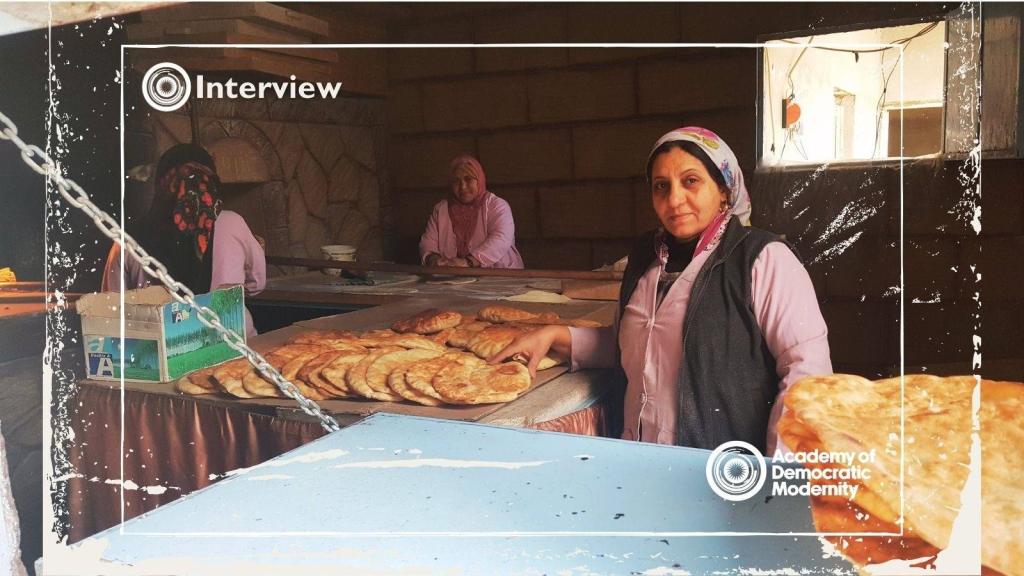
Since 2012, there has been a democratic self-government in northeastern Syria organized according to the principles of democratic confederalism. The social system of the Democratic Autonomous Administration of North and East Syria (DAANES) constitutes a real alternative to the capitalist system, especially for people and movements fighting for a more just world. The economy is vital in this context. What kind of economic order is there in Rojava/North and East Syria? What economic spheres exist, and who controls them? How are the market, production, and consumption organized? How is the issue of property dealt with? What are the class relations in Rojava, and what role does the class struggle play in the revolution?
The Academy of Democratic Modernity (ADM) has posed these and other questions to Dr. Azize Aslan, an expert on the region and its economic aspects. Her published book Anticapitalist Economy in Rojava elaborates on these questions and is published in English and Spanish. The German version will be published in 2025.
Azize Aslan is from Kurdistan and lives in Mexico. She studied economics and did her master’s degree in development economics in Istanbul, where she supported the organisation of women’s cooperatives. Since then she has been working on issues related to women’s economy and co-operatives in Kurdistan. She holds a PhD in Sociology from the Institute of Social Sciences and Humanities of the Benemérita Universidad Autónoma de Puebla, Mexico. She received the Jorge Alonso Chair Award for her work in 2021. This interview with ADM was conducted in November 2024.

No comments:
Post a Comment