Canada begins public engagement on siting of second repository
Canada's Nuclear Waste Management Organization is seeking public input to "confirm and refine" its proposed approach ahead of the planned 2028 launch of the site selection process for a second radioactive waste repository.
_92470.jpg)
In 2023, the Nuclear Waste Management Organization (NWMO) took on the responsibility to manage intermediate- and non-fuel high-level radioactive waste in a deep geological repository, after the Minister of Natural Resources endorsed the recommendations within Canada's Integrated Strategy for Radioactive Waste. This work is separate and distinct from the work NWMO has led since 2002 to plan for the safe, long-term management of Canada's used nuclear fuel, also in a deep geological repository.
NWMO has now released a discussion document on its proposed approach for siting a deep geological repository to be used for the disposal of intermediate and non-fuel high-level radioactive waste. It could potentially also hold used nuclear fuel from future nuclear reactors built in Canada.
"For the new project, we will continue our longstanding focus on technical safety and community willingness as primary site selection criteria," NWMO said. "For the next two years, we want to hear from a wide range of rightsholders, communities, industry and other groups with an interest in the project. Based on our experience so far, we are prioritising engagement with Indigenous communities."
"We are committed to seeking input from Indigenous Peoples from the very beginning of our site selection process for the next deep geological repository, and to forge relationships built upon trust and transparency," said Joanne Jacyk, the NWMO's Director of Site Selection for the second repository project.
NWMO President and CEO Laurie Swami added: "Like many countries with commercial nuclear power programmes, Canada is planning for the future. There is international scientific consensus that a deep geological repository is the safest way to manage intermediate and high-level waste over the long-term."
A deep geological repository comprises a network of highly-engineered underground vaults and tunnels built to permanently dispose of higher activity radioactive waste so that no harmful levels of radiation ever reach the surface environment. Countries such as Finland, Sweden, France, the UK and the USA are also pursuing this option.
Last year, the NWMO announced the selection of Wabigoon Lake Ojibway Nation and the Township of Ignace in northwestern Ontario as the host communities for the proposed deep geological repository for used nuclear fuel, following a consent-based siting process that had begun some 14 years earlier.
Construction of the facility will only begin once the repository has successfully completed the federal government's multi-year regulatory process and the Indigenous-led Regulatory Assessment and Approval Process, a sovereign regulatory process that will be developed and implemented by Wabigoon Lake Ojibway Nation.
Economic impacts of EU nuclear energy expansion assessed
A nuclear power generating capacity of 200 GWe would reap widespread economic benefits throughout the EU, sustaining almost two million jobs and hundreds of billions in additional economic output, tax revenues and household income, according to a report commissioned by Brussels-based nuclear trade body Nucleareurope.
_54866.jpg)
Nucleareurope commissioned Deloitte to analyse the contribution of the nuclear power sector to the overall economy of the European Union. It assessed current economic and social benefits generated directly through the nuclear industry and effects resulting from the nuclear sector's economic activities throughout the EU. The analysis was conducted to show both the current impact of the industry and provide a measurable outlook on its future benefits up to 2050.
Currently, with a generating capacity of around 106 GWe, the EU's nuclear sector contributes EUR251.2 billion (USD286.8 billion) per year to the bloc's economy and generates yearly public revenues of about EUR47.6 billion, the study says. In addition, more than 883,000 jobs are sustained in the EU each year through the nuclear sector.
The Economic and Social Impact Report focuses on the three installed nuclear capacity scenarios for 2050 included in the 2024 report developed on behalf of Nucleareurope by Compass Lexecon: 100 GWe, 150 GWe and 200 GWe.
If installed nuclear capacity in the EU was increased to 150 GWe by 2050, it would generate over EUR 330 billion in annual economic output and support nearly 1.5 million jobs across the EU, the study found. Increasing capacity to 200 GWe would generate over EUR383 billion in annual economic output and support nearly 1.6 million jobs across the EU.
"The decision-makers now have access to a reliable forecast of the benefits that would be derived from the deployment of a 200 GW nuclear power capacity throughout the Europe Union, while the results are dependent on the construction plan of the new nuclear reactors," Nucleareurope said.
"Nuclear is one of the few net-zero value chains that is anchored in Europe, and this is clearly reflected in the figures put forward by this report," said Nucleareurope Director General Emmanuel Brutin. "It shows how, by investing in nuclear, Europe can reap the benefits in terms of stimulating economic growth and job creation, alongside ensuring security of supply and meeting the decarbonisation targets. As such, it is important that the European Commission provides the right policy framework to stimulate long-term investment in nuclear through, for example, the Nuclear Illustrative Programme (PINC) and the next Multi-annual Financial Framework."
In April, the European Commission launched a four-week call for evidence related to the investment needs of the nuclear power sector in the EU. Seen as an important part of the consultative process and an opportunity for input from stakeholders and the public, the feedback received through this exercise will feed into the Commission's work in preparing the update of the PINC, which is expected to be published before the end of 2025.
Thorizon enlists French expertise for corrosion tests
Thorizon has announced a new research collaboration with Curium and INSA Lyon to support the development of its Thorizon One advanced small modular molten salt reactor. The collaboration includes corrosion testing of metals in contact with molten salt.
_36783.jpg)
To support this effort, Curium brings its expertise in characterisation and experimentations with chemicals and radioactive materials, while MATEIS - a laboratory affiliated with INSA Lyon, CNRS and Claude Bernard Lyon 1 University - benefits from international recognition in surface engineering and corrosion.
A major focus of the partnership is the development of corrosion tests for metals in contact with molten salt. Thorizon said these tests are essential for understanding how different materials interact with molten salts, an area of research that is critical for ensuring the safety and durability of reactor components.
As the project evolves, the collaboration will scale from material samples to testing of full sub-systems. These system-level trials will help confirm the performance and reliability of the Thorizon One reactor's most critical parts, laying the groundwork for commercialisation and broader deployment.
Thorizon said this collaboration gives it access to dedicated research spaces in the Auvergne-Rhône-Alpes region of France, allowing the company to expand its R&D efforts.
"Collaborating with Curium and MATEIS allows us to benefit from their unrivalled expertise in materials and corrosion testing," said Thorizon CEO Kiki Lauwers. "It gives us access to specialised testing capabilities and will be a key step in closing the gap between concept and commercial readiness. This is just the latest in our transformative journey in France, where we are committed to growing our footprint, deepening local partnerships, and strengthening our roots in Europe's energy future."
Thorizon - a spin-off from NRG, which operates the High Flux Reactor in Petten in the Netherlands - is developing a 250 MWt/100 MWe molten salt reactor, targeted at large industrial customers and utilities. The molten salt fuel adopted by Thorizon uses a combination of long-lived elements from reprocessed used nuclear fuel and thorium. The reactor will be able to recycle long-lived waste from existing nuclear facilities. The Thorizon One concept is unique in that the core is composed of a set of cartridges that is replaced every five to ten years. This, the company says, overcomes two molten salt design obstacles: material corrosion and handling of used fuel volumes.
The company says it is conducting pre-feasibility studies at three nuclear-designated sites in France, Belgium and the Netherlands, targeting construction by 2030.
Thorizon was selected in March 2024 by the French government to receive EUR10 million (USD11.4 million) in funding through the France 2030 national investment plan. Launched by President Emmanuel Macron in October 2021, the France 2030 re-industrialisation plan is endowed with EUR54 billion in funding schemes to be deployed over five years.
Akkuyu to have real-time discharge water monitoring system
The Akkuyu nuclear power plant in Turkey will have an automated system installed to remotely monitor the cooling water discharged into the sea, to meet the requirements of Turkish environmental regulations.
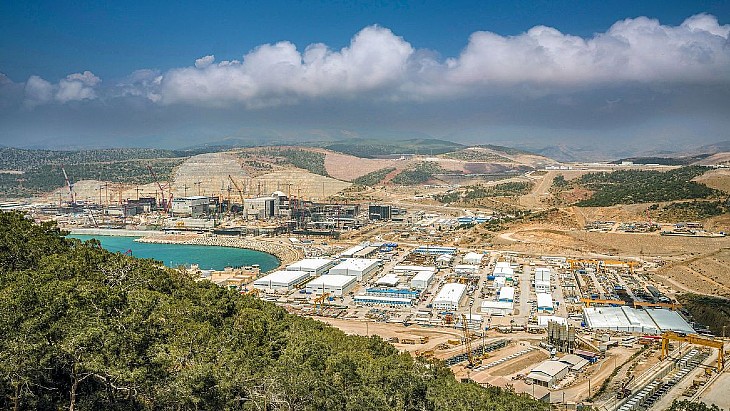
The four-unit Akkuyu plant will be cooled by water from the Mediterranean Sea. There will be one pumping station for each power unit, a drainage channel, siphon wells, a distribution chamber, a water intake and spillway structure and desalination processes. Rosatom says the total capacity in the normal operation of the power unit will be 260,000 cubic metres per hour and that the design "will reliably protect the pumping station equipment from any external factors including floods and tsunamis".
The start-up and testing phase of the on-shore pumping station for unit 1 began in February.
Work to integrate the water monitoring system into the existing design started about three years ago, Rosatom said, after Turkey's amended regulation was adopted, and the decision to include it has been confirmed.
The monitoring system, which will operate for the entire life of the plant, will "remotely monitor the purity and flow rate of the discharged water, suspended solids, dissolved oxygen, acid-base properties, chemical oxygen demand, temperature, conductivity, and other key indicators".
Sergei Butckikh, Akkuyu Nuclear JSC CEO, said: "The Akkuyu NPP project is being implemented in accordance with high environmental standards and principles of sustainable development. All environmental parameters are systematically monitored at the site and in the construction region of the nuclear power plant: conditions of the soil, air, flora, fauna and, of course, sea water. For us, this is not just a duty to comply with legal requirements but a part of the project's philosophy. All employees of the NPP will live with their families in this region, and each of them is aware of their personal responsibility for the environment."
Background
Akkuyu, in the southern Mersin province, is Turkey's first nuclear power plant. Rosatom is building four VVER-1200 reactors, under a so-called BOO (build-own-operate) model. According to the terms of the 2010 Intergovernmental Agreement between the Russian Federation and the Republic of Turkey, the commissioning of the first power unit of the nuclear power plant must take place within seven years from receipt of all permits for the construction of the unit.
The licence for the construction of the first unit was issued in 2018, with construction work beginning that year. Nuclear fuel was delivered to the site in April 2023. Turkey's Nuclear Regulatory Agency issued permission for the first unit to be commissioned in December, and in February it was announced that the reactor compartment had been prepared for controlled assembly of the reactor - and the generator stator had also been installed in its pre-design position.
The aim is for unit 1 to begin supplying Turkey's energy system in 2025. When the 4800 MWe plant is completed, it is expected to meet about 10% of Turkey's electricity needs, with the aim that all four units will be operational by the end of 2028.
Argentina aiming for SMR and uranium developments
Plans for the deployment of four ACR-300 small modular reactors and restarting uranium mining and enrichment were among the priorities outlined as Argentina's National Atomic Energy Commission celebrated its 75th anniversary.
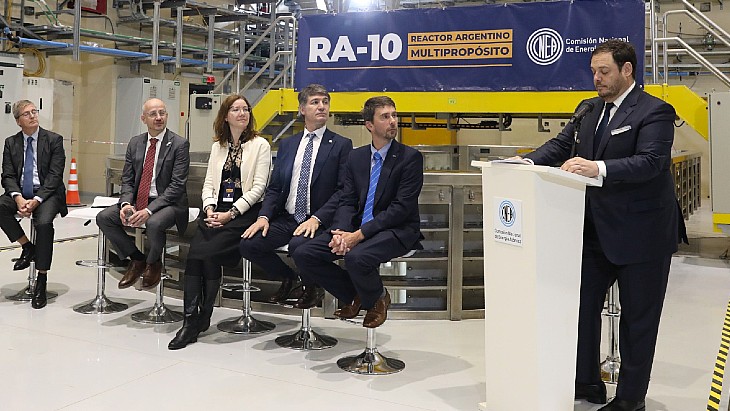
Demian Reidel, President of the Argentine Nuclear Council, told the event held at the site of the RA-10 multipurpose reactor: "With the development of the ACR-300, we will offer the world a clean, stable, and scalable source of energy. The ACR-300, a 300 MW technological marvel designed by Argentine engineers, is a centrepiece of the Nuclear Power Plan, which will position our country at the forefront of the new energy revolution.
"We are going to begin construction of four modules at the Atucha site, which will allow us to nearly double the country's installed nuclear capacity. This is only the first stage. Then, we will license this technology to the rest of the world. This will not only transform our energy mix, it will also change Argentina's export mix."
Germán Guido Lavalle, President of the National Atomic Energy Commission (CNEA), outlined the organisation's five key targets for the coming year: reaching criticality at the RA-10 plant; beginning the refurbishment of the Heavy Water Industrial Plant (PIAP); restarting uranium mining; launching the Argentine Proton Therapy Center; and resuming uranium enrichment to complete the nuclear fuel cycle.
He said: "We have a National Atomic Energy Commission that, through technological development and human resource training, has provided the platform for the emergence of nuclear sector companies that today compete globally, export, create jobs, and offer services in Argentina. This is a true success of state policy."
Reidel, a chief adviser to Argentina's President Javier Milei, told La Nacion last week that the aim was for Argentina to be the first country, or among the first, to be commercially selling small modular reactors (SMRs). He said that the National Nuclear Plan aimed to accelerate the development of the ACR-300, developed by INVAP with private capital, and "aims to have the four modules operational within five years".
He has also suggested that the SMRs could be sold with a commitment to purchase Argentine uranium, saying in a March interview with Infobae that it was "crazy" for the country to be importing uranium for its existing reactors despite having substantial reserves.
The anniversary ceremony was broadcast across all CNEA's centres. The commission, created in 1950, says its mission "is to consolidate Argentina's position as a leading nation in the peaceful and safe use of nuclear energy, having been committed to scientific and technological development since its inception".
The background
Argentina currently has three operable nuclear power units - Atucha 1, connected in 1974, Atucha 2, which was connected in 2014 and Embalse which was connected to the grid in 1983. Between them they generate about 5% of the country's electricity. There had been plans for a fourth unit, as Atucha III, but it appears that has been superceded by the SMR plans.
Argentina has already had an SMR in development: the CAREM SMR - the name comes from Central Argentina de Elementos Modulares - is a 32 MWe prototype and is Argentina's first domestically designed and developed nuclear power unit. First concrete was poured in 2014, but construction has since been suspended a number of times. It is currently estimated to be about two-thirds complete. With reports of funding uncertainty, a Critical Design Review was ordered for it in May last year.
Allseas aims for rapid SMR deployment
Dutch offshore construction engineering contractor Allseas has launched a five-year plan to design, develop and deploy a small modular reactor tailored for integration into offshore vessels and for onshore use.
_25577.jpg)
The company has selected high-temperature gas-cooled reactors (HTGRs), using tri-structural isotropic - or TRISO - particle fuel, with a power output of about 25 MWe. It said it selected this small modular reactor (SMR) technology "due to their inherently safe characteristics".
In the first year, Allseas aims to finalise initial design studies for offshore and onshore use. This will be followed by prototype development and pre-licensing discussions in consultation with key stakeholders, including regulators (such as the Dutch Authority for Nuclear Safety and Radiation Protection, the International Maritime Organization and the International Atomic Energy Agency (IAEA)) as well as safety and classification bodies (including Lloyd's Register), and in close collaboration with its research and innovation partners, including TNO, NRG-Pallas, Delft University of Technology (TU Delft), and the Royal Association of Netherlands Shipowners (KVNR).
"Our goal is to start production at a dedicated facility by 2030," said Stephanie Heerema, Project Manager Nuclear Developments at Allseas. "Initial deployment will likely begin on land while offshore regulations are finalised, followed by application on our own vessels and broader industry adoption. This aligns with our own sustainability targets – 30% emissions reduction by 2030, and net-zero operations by 2050."
Allseas said that responsible waste management was central to its long-term plan, so the company is exploring circular approaches, such as the reuse of graphite and reprocessing of used TRISO fuel, to "further reduce environmental impact, ensuring waste management remains a key consideration throughout the SMR lifecycle".
Jan Leen Kloosterman, Professor of Nuclear Reactor Physics and Department Head Radiation Science and Technology at TU Delft, said: "Delft University of Technology has been working on an inherently safe microreactor based on HTR technology for more than 10 years. We are therefore delighted to contribute to a practical application of this technology."
The shipping industry consumes some 350 million tonnes of fossil fuel annually and accounts for about 3% of total worldwide carbon emissions. In July 2023, the shipping industry, via the International Maritime Organization, approved new targets for greenhouse gas emission reductions, aiming to reach net-zero emissions by, or around, 2050.
According to Allseas, nuclear offers "unmatched energy density, combining zero emissions with stable, scalable power supply". For onshore industrial clusters, it says "SMRs can ease grid pressure while providing consistent, carbon-free power and heat – accelerating decarbonisation and boosting industrial resilience and long-term competitiveness."
"Nuclear is the next frontier, and Allseas is leading the way to deliver safe, clean and reliable offshore and onshore energy," Heerema said. "As pioneers of offshore innovation with a can‑do mentality, from single‑lift platform removal to dynamically positioned pipelay, we have a proven track record of turning groundbreaking concepts into reality."
Newcleo and JAVYS establish joint venture company
Innovative reactor developer Newcleo and Slovak state-owned radioactive waste management company JAVYS have signed a joint venture shareholder agreement, paving the way toward the construction of up to four Newcleo lead-cooled fast reactors at the Bohunice site.
_14079.jpg)
The agreement to establish the Centre for Development of Spent Nuclear Fuel Utilisation (CVP) as a joint venture company was signed in Rome on 3 June by Newcleo CEO Stefano Buono and JAVYS Chairman Peter Gerhart. The signing was witnessed by Slovak Prime Minister Róbert Fico, Deputy Prime Minister and Minister of Economy of Slovakia, Denisa Saková, and Italy's Minister of Environment and Energy Security, Gilberto Pichetto Fratino.
The signing of the agreement follows Paris-headquartered Newcleo's signing of framework cooperation agreements with JAVYS and Slovak engineering company VUJE in January this year.
The newly established joint venture - of which JAVYS will own 51% and Newcleo 49% - will focus on developing a project to build up to four LFR-AS-200 reactors with a total output of 800 MWe on the site of the decommissioned Bohunice nuclear power plant in Slovakia. The units are to be powered with mixed uranium/plutonium oxide (MOX) fuel fabricated from existing Slovakian used nuclear fuel extracted from the country's current reactor fleet.
The aim is to reprocess the used fuel in France and assemble new fuel rods at Newcleo's planned French MOX facility which would then be used to power the LFR-AS-200 units creating a closed nuclear fuel cycle for the operation.
"This new operating model aims at shaping the future of the nuclear industry by establishing a complementary industrial synergy between thermal and fast reactors, by leveraging the latter's potential to utilise spent nuclear fuel and closing the fuel cycle," Newcleo said. "Newcleo intends to use this model as a blueprint for operations in other countries who have an existing nuclear fleet or legacy spent fuel as a way of managing what might otherwise be considered a waste product in a sustainable manner."
The first phase of the project is a feasibility study, which will be prepared over the next 12 months. After its completion, a feasibility decision will be made based on expert arguments, confirming or not the overall technical and economic feasibility of the project, including its financing, conceptual design, timetable and total costs. The following phases include site preparation, construction of the non-nuclear and subsequently the nuclear part, system tests and the actual operation of the reactors.
In parallel, Newcleo and JAVYS will continue cooperating with the French government and nuclear fuel supply chain to develop and deploy used nuclear fuel transportation and reprocessing solutions, as well as continuing to advance Newcleo's fuel manufacturing facility in France.
"Today we are at the dawn of a new model for the nuclear energy industry, where public and private firms collaborate to close the fuel cycle," Buono said. "This project demonstrates that the future of nuclear energy lies in the intelligent utilisation of existing resources. Spent nuclear fuel ceases to be a problem and instead becomes a solution for improving Europe's energy security and independence. Slovakia is thus becoming a pioneer in the field of closed nuclear fuel cycle."
Gerhart added: "Our goal is to create a solution that will not only strengthen Slovakia energetically but will also be a model for the entire European region in the field of safe and efficient use of spent nuclear fuel."
According to Newcleo's delivery roadmap, the first non-nuclear pre-cursor prototype of its lead-cooled fast reactor (LFR) is expected to be ready by 2026 in Italy, the first reactor operational in France by the end of 2031, while the final investment decision for the first commercial power plant is expected around 2029.

No comments:
Post a Comment