Explainer
French unions will hold a nationwide strike on Thursday against the government’s 2026 budget plan. Authorities expect up to 800,000 protesters, with schools and tourist sites affected and disruptions expected on Paris and regional transport networks.
Issued on: 17/09/2025 -
FRANCE24
By: Anaelle JONAH

A person uses a megaphone during a demonstration at the Place de la Republique square, in Paris, on September 10, 2025. © Julien de Rosa, AFP
French trade unions have called for a nationwide strike and protests on Thursday to oppose "brutal" budget measures unveiled over the summer – measures that new Prime Minister Sébastien Lecornu has so far refused to rule out.
After meeting with Lecornu on Monday, the hardline CGT union said they were more determined than ever, despite the government’s announcement that it would drop a controversial plan to cut two public holidays. "He didn’t commit to anything. None of the disastrous policies from [former Prime Minister] François Bayrou’s tenure have been scrapped," said union leader Sophie Binet.
Lecornu, who promised "substantive changes" on taking office, held talks with most unions over the last week. But union chiefs are standing firm on their call to mobilise on September 18, hoping to shape the future budget.
Up to 800,000 demonstrators
Nine unions will march together for the first time since June 2023, when they fought against pension reform. The CGT said Monday that more than 220 rallies were already planned across France, with the tally still rising.
Union leaders aim to surpass the “Block Everything” movement, a grassroots protest that started on social media and drew nearly 200,000 participants on September 10, according to the interior ministry, but fell short of closing down the country as hoped. Whether those protesters – many of them wary of unions – will join Thursday’s strike remains uncertain.
French trade unions have called for a nationwide strike and protests on Thursday to oppose "brutal" budget measures unveiled over the summer – measures that new Prime Minister Sébastien Lecornu has so far refused to rule out.
After meeting with Lecornu on Monday, the hardline CGT union said they were more determined than ever, despite the government’s announcement that it would drop a controversial plan to cut two public holidays. "He didn’t commit to anything. None of the disastrous policies from [former Prime Minister] François Bayrou’s tenure have been scrapped," said union leader Sophie Binet.
Lecornu, who promised "substantive changes" on taking office, held talks with most unions over the last week. But union chiefs are standing firm on their call to mobilise on September 18, hoping to shape the future budget.
Up to 800,000 demonstrators
Nine unions will march together for the first time since June 2023, when they fought against pension reform. The CGT said Monday that more than 220 rallies were already planned across France, with the tally still rising.
Union leaders aim to surpass the “Block Everything” movement, a grassroots protest that started on social media and drew nearly 200,000 participants on September 10, according to the interior ministry, but fell short of closing down the country as hoped. Whether those protesters – many of them wary of unions – will join Thursday’s strike remains uncertain.
Protesters clash with police in France as new PM starts job

© France 24
04:59
“We want a million people with us,” CFTC union leader Cyril Chabanier told RTL television. Authorities estimate turnout could surpass 800,000, four times as many as on September 10, and fear several hundred radical protesters may join the marches.
In a joint statement released in late August, unions denounced the government’s budget measures as "unprecedented brutality", accusing it of once again making "workers, the unemployed, retirees and the sick" pay the price.
They point to sweeping cuts in public services, another overhaul of unemployment insurance, a freeze on benefits and public sector pay, lower pensions, doubled medical fees and even threats to France’s fifth week of paid leave.
The scrapping of plans to cut two public holidays – widely condemned by unions – was hailed by CGT’s Binet as "a first victory" and proof that "we are in a position of strength".
Even the CFDT union, usually cautious about joining street protests, confirmed it would march. "The budget as it stands is not compatible with social, fiscal and environmental justice," CFDT leader Marylise Léon told France Inter.
04:59
“We want a million people with us,” CFTC union leader Cyril Chabanier told RTL television. Authorities estimate turnout could surpass 800,000, four times as many as on September 10, and fear several hundred radical protesters may join the marches.
In a joint statement released in late August, unions denounced the government’s budget measures as "unprecedented brutality", accusing it of once again making "workers, the unemployed, retirees and the sick" pay the price.
They point to sweeping cuts in public services, another overhaul of unemployment insurance, a freeze on benefits and public sector pay, lower pensions, doubled medical fees and even threats to France’s fifth week of paid leave.
The scrapping of plans to cut two public holidays – widely condemned by unions – was hailed by CGT’s Binet as "a first victory" and proof that "we are in a position of strength".
Even the CFDT union, usually cautious about joining street protests, confirmed it would march. "The budget as it stands is not compatible with social, fiscal and environmental justice," CFDT leader Marylise Léon told France Inter.
Major disruption in Paris transport
Paris transport operator RATP faces major disruption, with its four biggest unions all calling for a strike. On its website Tuesday night, the RATP advised passengers to work from home or postpone travel if possible.
The company’s second-largest union said it expects "a black day" with some metro lines completely closed and others only partially running. It estimated strike participation at "90% among metro drivers and 80% among RER drivers".
Only fully automated metro lines (Lines 1, 4 and 14) will run normally; others will operate only at peak hours.
Some bus lines will be cancelled and tram service on the T5, T7 and T8 lines will be disrupted.
The RER will also be affected, with heavy disruption expected on lines D and E.
RATP recommends using its online planner or the Bonjour RATP app to check real-time updates, track alternative routes and monitor onboard crowding.To plan a metro or RER journey with updated information, use the Paris transport system's online planner, available in English here.
To ease travel, RATP is partnering with Lime to offer access to 3,000 free bikes worth €1 each for rentals made directly through the app. “It’s first come, first served,” the website says.
Regional trains also affected
Regional train services will also be disrupted, varying by area. The SNCF is bracing for walkouts after unions called on all railway workers to strike.
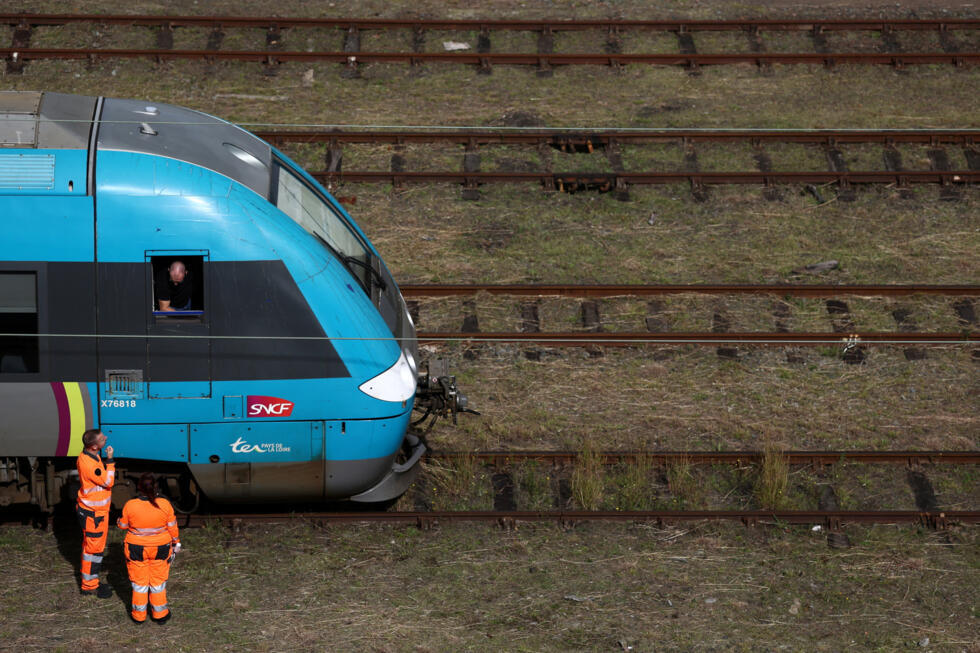
Workers stand next to a SNCF regional train at the railway station in Nantes two days before a strike by French state-owned railway SNCF workers, in France, on September 16, 2025. © Stephane Mahe, Reuters
Outgoing Transport Minister Philippe Tabarot said nine out of 10 high-speed TGV trains will be running while SNCF's regular network, Intercités, would see "significant disruption", with just one train in two operating. Around three out of five regional trains (TER) are expected to run.
Air France faces strike notices from at least three unions, although air-traffic controllers have delayed their walkout.To check flights in real time, visit the Aéroports de Paris website in English
Outgoing Transport Minister Philippe Tabarot said nine out of 10 high-speed TGV trains will be running while SNCF's regular network, Intercités, would see "significant disruption", with just one train in two operating. Around three out of five regional trains (TER) are expected to run.
Air France faces strike notices from at least three unions, although air-traffic controllers have delayed their walkout.To check flights in real time, visit the Aéroports de Paris website in English
Museums and monuments impacted
Museums and landmarks across the country could see limited access or closures. The Arc de Triomphe is already closed a day ahead of the strike. “Due to a social movement (strike), the monument is exceptionally closed today,” the website states.
The Louvre warned that opening could be delayed and some galleries may remain closed. Versailles also said it could not guarantee access to the château and grounds due to the strike.
Visitors are advised to check official websites and plan ahead. Regular opening hours remain in force unless otherwise announced, and any updates will likely be provided if the strike continues.
One-third of primary teachers expected to strike
The largest primary school union expects one-third of nursery and primary teachers to strike. “Public schools urgently need adequate resources and a real budget,” it said in a statement on Tuesday.
According to its back-to-school survey, almost 3,000 classes across more than 6,000 schools had no assigned teacher this year. Over 80% of schools reported having at least one class with more than 22 pupils, and 57% had at least one pupil without a support assistant for children with disabilities.
Last week, the education ministry estimated that 6% of teachers joined the September 10 “Block Everything” protests, mostly in secondary schools. This time the strike is expected to be more widely followed.
Disruption is also expected in school canteens and after-school services in some cities.
90% of pharmacies to stay closed
French pharmacies are also joining Thursday’s nationwide strike, with around nine out of 10 expected to close. Participation is forecast at 85-90%, though some will stay open to provide essential services.
Unlike most sectors, the pharmacists’ protest is not over the 2026 budget but related to government cuts to the rebate for generics, which account for roughly a third of pharmacy margins. The government cap has already fallen from 40% to 30% and is set to drop further, to 20% by 2027. Unions warn the measure could force thousands of closures and job losses, and affect access to essential medicines such as antibiotics, antidiabetic drugs and anti-epileptics.
French strikes delay Bayeux Tapestry transfer ahead of British Museum loan
Nationwide strikes planned for Thursday in France have forced a delay in the transfer to another location of the Bayeux Tapestry ahead of its historic planned loan to the British Museum in London next year, an official said.
Issued on: 17/09/2025 -
By: FRANCE 24

Iconic Bayeux Tapestry goes to UK for first time in 900 years

The location of the place where the tapestry is due to be kept safely ahead of the loan has not been revealed.
This transfer operation will take place "in the coming days", the envoy told AFP.
Critics have said the transfer to the UK risks causing damage to the priceless artefact. A petition posted online on change.org has called on Macron to stop a "true heritage crime".
Bélaval has previously defended the transfer, insisting that there is is no suggestion that the loan to the UK will damage the tapestry.
The tapestry's loan will mark the first time in its almost 1,000-year lifetime that the 68-metre-long piece, which dates from around 1077, will be on British soil.
Read moreFast facts on the Bayeux Tapestry
It will be loaned to the British Museum for 10 months from September 2026. French museums will in exchange be loaned ancient treasures mainly from the Anglo-Saxon Sutton Hoo site, one of England's most important archaeological hoards.
France was on Thursday bracing for a day of nationwide disruption in a show of anger over Macron's budget policies.
Unions have vowed mass protests, public transport is set to be paralysed in places due to strikes while officials have warned of the possibility of extremists causing disturbances.
(FRANCE 24 with AFP)
Nationwide strikes planned for Thursday in France have forced a delay in the transfer to another location of the Bayeux Tapestry ahead of its historic planned loan to the British Museum in London next year, an official said.
Issued on: 17/09/2025 -
By: FRANCE 24
The Bayeux Tapestry dates from around 1077. © Loic Venance, AFP
Protests and strikes planned for Thursday in France have forced a delay in the transfer to a secret location of the Bayeux Tapestry ahead of its historic planned loan to the UK next year, an official said.
French President Emmanuel Macron agreed to loan the medieval tapestry – which records the 1066 Norman conquest of Anglo-Saxon England – to the British Museum in 2026 to celebrate Franco-British relations.
After the museum where the tapestry is held in the town of Bayeux in Normandy closed for renovations, the tapestry was due to be removed Thursday to a secret location in France ahead of the loan.
"Due to the expected mobilisation tomorrow (Thursday)", the local authorities do not consider they are "able to ensure the security of such a high-profile transfer and ... of such an expensive work", said Philippe Bélaval, the French presidency's envoy for the British Museum loan.
Protests and strikes planned for Thursday in France have forced a delay in the transfer to a secret location of the Bayeux Tapestry ahead of its historic planned loan to the UK next year, an official said.
French President Emmanuel Macron agreed to loan the medieval tapestry – which records the 1066 Norman conquest of Anglo-Saxon England – to the British Museum in 2026 to celebrate Franco-British relations.
After the museum where the tapestry is held in the town of Bayeux in Normandy closed for renovations, the tapestry was due to be removed Thursday to a secret location in France ahead of the loan.
"Due to the expected mobilisation tomorrow (Thursday)", the local authorities do not consider they are "able to ensure the security of such a high-profile transfer and ... of such an expensive work", said Philippe Bélaval, the French presidency's envoy for the British Museum loan.
Iconic Bayeux Tapestry goes to UK for first time in 900 years
France to loan iconic Bayeux Tapestry to UK for first time in 900 years © France 24
01:54
01:54
The location of the place where the tapestry is due to be kept safely ahead of the loan has not been revealed.
This transfer operation will take place "in the coming days", the envoy told AFP.
Critics have said the transfer to the UK risks causing damage to the priceless artefact. A petition posted online on change.org has called on Macron to stop a "true heritage crime".
Bélaval has previously defended the transfer, insisting that there is is no suggestion that the loan to the UK will damage the tapestry.
The tapestry's loan will mark the first time in its almost 1,000-year lifetime that the 68-metre-long piece, which dates from around 1077, will be on British soil.
Read moreFast facts on the Bayeux Tapestry
It will be loaned to the British Museum for 10 months from September 2026. French museums will in exchange be loaned ancient treasures mainly from the Anglo-Saxon Sutton Hoo site, one of England's most important archaeological hoards.
France was on Thursday bracing for a day of nationwide disruption in a show of anger over Macron's budget policies.
Unions have vowed mass protests, public transport is set to be paralysed in places due to strikes while officials have warned of the possibility of extremists causing disturbances.
(FRANCE 24 with AFP)

No comments:
Post a Comment