What recognizing “one planet” really means is showing a wide-open reverence for everything and everybody on it, including everything we don’t understand.

A protester is seen during a climate change demonstration holding a placard that says,” There is no planet B.”
(Photo by Ronen Tivony/SOPA Images/LightRocket via Getty Images)
Robert C. Koehler
Jan 23, 2026
Common Dreams
Let’s put Immigration and Customs Enforcement and, indeed, war itself—the smugly violent certainty of militarism—into the largest perspective possible. I suggest this as the only way to maintain my sanity: to believe that we, that our children, actually have a future.
This is one planet. Every living being, every pulse of life, every molecule of existence, is intertwined. I’m not in any way suggesting I understand what this means. I simply see it as our starting point, as we acknowledge and embrace the Anthropocene: the current global era, basically as old as I am, in which natural and human forces are intertwined. The fate of one determines the fate of the other.
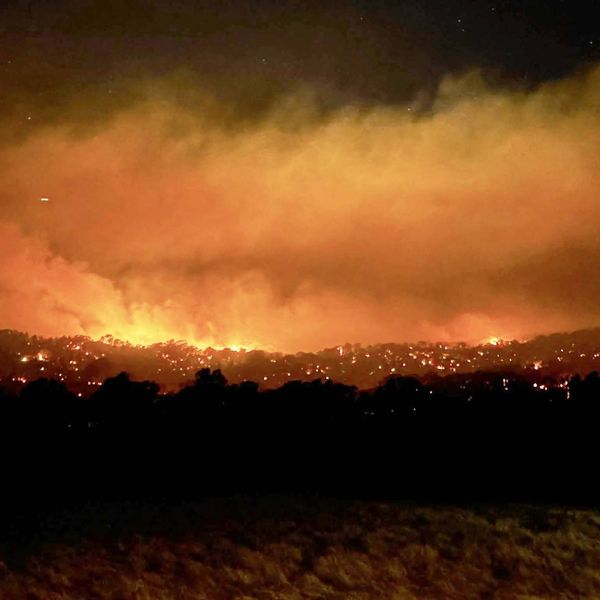
‘We Are Running Out of Time’: 2025 Keeps Hot Streak Alive for Global Temperatures
If that’s really true, we have to start thinking beyond the mindset that brought us here. We are truly creating the future by what we do. Our lives are no longer about simply exploiting the present for our limited self-interests or perpetrating us-vs.-them violence on what amounts to ourselves.
I began by mentioning ICE because it’s so blatantly in the news these days, exemplifying the minimalist thinking of US (and global) leaders, as they claim exclusive ownership of bits and pieces of the planet.
The Trump administration is in a weird way proclaiming its belief in “one planet,” but this planet includes only them: basically white, politically obedient Americans.
As Julia Norman writes, for instance, the Department of Homeland Security is in the process of accumulating industrial warehouses around the country “...in an effort to expand the administration’s capacity to execute its mass deportation agenda—a system Secretary Noem recently aptly described as ‘one of the most consequential periods of action and reform in American history.’”
“After the ‘Big Beautiful Bill’ allocated an additional $45 billion specifically to ICE for building new immigration detention centers through 2029—a budget 62% larger than the entire federal prison system—DHS gained unprecedented financial capacity to expand its system of terror on a massive scale.”
She adds: “Private contractors such as GEO Group continue to operate facilities housing the vast majority of ICE detainees, positioning themselves to make substantial profit as the administration moves to double detention capacity to 100,000 beds with tens of billions in federal spending. GEO Group and CoreCivic have already reported soaring revenues under Trump’s second term, with executives describing the expansion as ‘pivotal’ and ‘an unprecedented growth opportunity.’ In this system, human confinement has been transformed into an investment strategy.”
There’s an enormous irony here. The Trump administration is in a weird way proclaiming its belief in “one planet,” but this planet includes only them: basically white, politically obedient Americans. What recognizing “one planet” really means is showing a wide-open reverence for everything and everybody on it, including everything we don’t understand.
As I wrote in a column nearly a decade ago, the Anthropocene has come about by a combination of extraordinary technological breakthroughs and cold indifference to their consequences: human evolution, you might say, outside the circle of life. But here we are nonetheless.
The primary causes of the geological shift, according to the Guardian, are the radioactive elements dispersed across the planet by nuclear bomb tests, along with such things as plastic pollution, soot from power stations, concrete, and even the bones left by the global proliferation of the domestic chickens.
“None of this is good news,” I wrote. “Short-sighted human behavior, from nuclear insanity to agribusiness to the proliferation of plastic trash, has produced utterly unforeseen consequences, including disruption of the stable climate that has nurtured our growth and becoming over the last dozen millennia. This is called recklessness. And mostly the Anthropocene is described with dystopian bleakness: a time of mass extinctions. A time of dying.”
But dystopian bleakness is not the spiritual endpoint here. As Our Planet tells us: “The habitats that make up our planet are connected and reliant upon each other. The astonishing diversity of life on earth depends on these global connections.”
“This is a critical moment for our planet. We have changed it so much we have brought on a new geological age—the Anthropocene. The age of humans. For the first time in our history, the global connections that all living things rely upon are breaking. But if we act quickly, we have the knowledge and the solutions to make our planet thrive again.”
There is, in the collective human soul, a deep love for the planet. I understand how naïve it will sound if I just cry: “C’mon, world! No more war!”So I’ll hold off on that and simply address, well, the media, the antiwar protesters, whoever might be reading this. Yes, we should abolish ICE, defund and think beyond militarism, question the sanctity of the imaginary lines (aka, borders) all across our planet. But we should not do so merely out of fear. Let’s do so, rather, in the deep (dare I say religious?) awareness that humanity and Planet Earth are evolving together. And we’re hovering at a moment of extraordinary change.
Let me know what you think: What should we do next? What are we already doing right?
Let’s put Immigration and Customs Enforcement and, indeed, war itself—the smugly violent certainty of militarism—into the largest perspective possible. I suggest this as the only way to maintain my sanity: to believe that we, that our children, actually have a future.
This is one planet. Every living being, every pulse of life, every molecule of existence, is intertwined. I’m not in any way suggesting I understand what this means. I simply see it as our starting point, as we acknowledge and embrace the Anthropocene: the current global era, basically as old as I am, in which natural and human forces are intertwined. The fate of one determines the fate of the other.
‘We Are Running Out of Time’: 2025 Keeps Hot Streak Alive for Global Temperatures
If that’s really true, we have to start thinking beyond the mindset that brought us here. We are truly creating the future by what we do. Our lives are no longer about simply exploiting the present for our limited self-interests or perpetrating us-vs.-them violence on what amounts to ourselves.
I began by mentioning ICE because it’s so blatantly in the news these days, exemplifying the minimalist thinking of US (and global) leaders, as they claim exclusive ownership of bits and pieces of the planet.
The Trump administration is in a weird way proclaiming its belief in “one planet,” but this planet includes only them: basically white, politically obedient Americans.
As Julia Norman writes, for instance, the Department of Homeland Security is in the process of accumulating industrial warehouses around the country “...in an effort to expand the administration’s capacity to execute its mass deportation agenda—a system Secretary Noem recently aptly described as ‘one of the most consequential periods of action and reform in American history.’”
“After the ‘Big Beautiful Bill’ allocated an additional $45 billion specifically to ICE for building new immigration detention centers through 2029—a budget 62% larger than the entire federal prison system—DHS gained unprecedented financial capacity to expand its system of terror on a massive scale.”
She adds: “Private contractors such as GEO Group continue to operate facilities housing the vast majority of ICE detainees, positioning themselves to make substantial profit as the administration moves to double detention capacity to 100,000 beds with tens of billions in federal spending. GEO Group and CoreCivic have already reported soaring revenues under Trump’s second term, with executives describing the expansion as ‘pivotal’ and ‘an unprecedented growth opportunity.’ In this system, human confinement has been transformed into an investment strategy.”
There’s an enormous irony here. The Trump administration is in a weird way proclaiming its belief in “one planet,” but this planet includes only them: basically white, politically obedient Americans. What recognizing “one planet” really means is showing a wide-open reverence for everything and everybody on it, including everything we don’t understand.
As I wrote in a column nearly a decade ago, the Anthropocene has come about by a combination of extraordinary technological breakthroughs and cold indifference to their consequences: human evolution, you might say, outside the circle of life. But here we are nonetheless.
The primary causes of the geological shift, according to the Guardian, are the radioactive elements dispersed across the planet by nuclear bomb tests, along with such things as plastic pollution, soot from power stations, concrete, and even the bones left by the global proliferation of the domestic chickens.
“None of this is good news,” I wrote. “Short-sighted human behavior, from nuclear insanity to agribusiness to the proliferation of plastic trash, has produced utterly unforeseen consequences, including disruption of the stable climate that has nurtured our growth and becoming over the last dozen millennia. This is called recklessness. And mostly the Anthropocene is described with dystopian bleakness: a time of mass extinctions. A time of dying.”
But dystopian bleakness is not the spiritual endpoint here. As Our Planet tells us: “The habitats that make up our planet are connected and reliant upon each other. The astonishing diversity of life on earth depends on these global connections.”
“This is a critical moment for our planet. We have changed it so much we have brought on a new geological age—the Anthropocene. The age of humans. For the first time in our history, the global connections that all living things rely upon are breaking. But if we act quickly, we have the knowledge and the solutions to make our planet thrive again.”
There is, in the collective human soul, a deep love for the planet. I understand how naïve it will sound if I just cry: “C’mon, world! No more war!”So I’ll hold off on that and simply address, well, the media, the antiwar protesters, whoever might be reading this. Yes, we should abolish ICE, defund and think beyond militarism, question the sanctity of the imaginary lines (aka, borders) all across our planet. But we should not do so merely out of fear. Let’s do so, rather, in the deep (dare I say religious?) awareness that humanity and Planet Earth are evolving together. And we’re hovering at a moment of extraordinary change.
Let me know what you think: What should we do next? What are we already doing right?

No comments:
Post a Comment