Thursday, November 20, 2025

TRUMP'S DOJ Sides with Cruise Industry Seeking to Block Hawaii’s “Green Fee”

cruise ship off Hawaii coast
One cruise ship, Pride of America, sails year-round in Hawaii (NCL)

Published Nov 19, 2025 3:49 PM by The Maritime Executive


In an unusual move, the Department of Justice filed a motion in federal court seeking to intervene in the pending legal action by the cruise industry against the State of Hawaii. The action is in keeping with the Trump administration’s position that denies climate change and seeks to block individual state efforts, which it sees as damaging to federal policy and commerce.

The motion was filed in the U.S. District Court in Hawaii, arguing that the federal Department of Justice should be permitted to intervene in defending federal law.  It takes the position that the private plaintiffs, in this case, the cruise industry, cannot fully represent or protect federal law and that the issue is to ensure the uniformity of the taxation of vessels as established in the U.S. Constitution.

The trade group Cruise Lines International Association (CLIA) filed the suit at the end of August, supported by vendors to the cruise industry and tour operators in Hawaii. It is seeking an injunction to stop Hawaii’s new “Green Fee” from going into effect in January on the basis that they argue the cruise industry is being discriminated against.

At issue is a May 2025 law enacted in Hawaii that imposes additional fees on tourists in hotels and on cruise ships to address climate impact on the state. Hawaii Governor Joshua Green called it “a groundbreaking move for climate action,” saying it could generate as much as $100 million annually, which would be used to fund projects for environmental stewardship.

CLIA is arguing that the fees do not treat the cruise industry and other segments of tourism equally and are not for services being provided to the ships and their passengers. It points to the small increases in hotel costs and the lack of fees on airplanes. At the same time, it argues that under the U.S. Constitution, fees imposed on ships must be approved by the U.S. Congress. 

DOJ seeks to intervene, citing this later point under the so-called “Tonnage Clause” in the Constitution, saying that states need Congressional approval for tonnage fees. The motion argues the “United States has a strong interest in ensuring the primacy of Federal law.”

They are also arguing that the “Hawaii unabashedly boasts that this revenue is not for the purpose of paying for services actually provided to incoming cruise ships or their passengers, but for funding climate change initiatives.”

"This scheme to extort American citizens and businesses solely to benefit Hawaii flies in the face of federal law,” asserts the DOJ.

Hawaii has also sought to have the federal court dismissed, arguing that it is a state matter and, as such, should be resolved in state, not federal court.

Falling under the cabotage provisions of the Passenger Services Act, cruising is a small part of Hawaii’s overall tourism industry, as foreign-flag cruise ships cannot transport passengers around the islands or between the mainland and the islands without going to a foreign port. One large, U.S.-flagged cruise ship sails year-round from Honolulu, while foreign-flag cruise ships make port calls during Pacific crossings or operate Hawaii cruises with Mexican port calls to bypass the cabotage restrictions.

Cruises reportedly bring about 3000,000 tourists annually to Hawaii, based on 2023 data. Hawaiian government data shows that there were more than 9.6 million visitors to the state in 2023. During a court hearing at the end of October, however, it was argued that the one cruise ship sailing year-round in Hawaii, Pride of America, is experiencing a 30 percent decline in bookings for 2026 versus 2025 due to the increased cost of the cruises from the “Green Fee.”

Hawaiian officials have said they will vigorously defend the law due to the impact of climate on the state. They said the focus would be on the shoreline and other areas being most impacted by the changes in climate.

ECOCIDE: DRILL, BABY,  DRILL

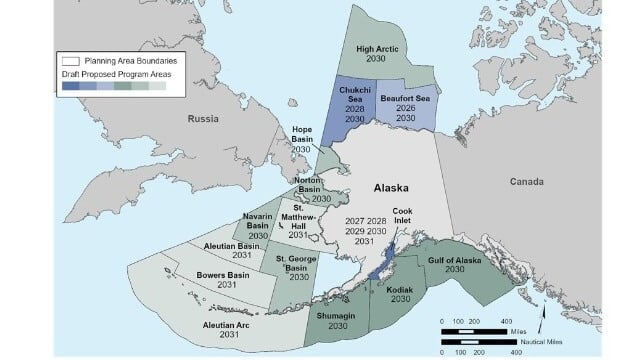
New U.S. Offshore Oil and Gas Plan Opens High Arctic Waters for Drilling

Trump lease areas
Courtesy Department of the Interior

Published Nov 20, 2025 4:10 PM by The Maritime Executive


The U.S. Department of the Interior has announced that it is withdrawing the Biden-era offshore leasing plan for 2024-29 and instituting a new plan. 

The proposal puts forward a schedule for as many as 34 lease sales covering 1.27 billion acres. The proposed areas cover waters off the coast of Alaska, the U.S. Gulf and California. The map includes some novel new additions that depart from recent policy. The first is a new "High Arctic" lease area in the icy Arctic Ocean, extending out to roughly 80 degrees north latitude - a frigid and inaccessible region visited only by icebreakers. Moving south, the plan proposes leasing in every possible block off mainland Alaska and the Aleutian Chain, from border to border (with the exception of Bristol Bay).

On the U.S. West Coast, it proposes three lease areas off the coast of California, two of which would begin auctions in 2027. Political commentators have noted that offshore leasing would be an effective retaliatory measure against California's governor, a vocal opponent of the administration.

In the Gulf, the lease areas cover the western and central regions from Texas to Alabama, which are routinely on offer at auction. For the first time in years, Interior also plans to offer lease areas off Florida, an idea which has been consistently opposed by the state's Republican governor and its congressional delegation. Atlantic waters off the U.S. Southeast - where oil and gas exploration is heavily opposed by Republican-led state governments - were excluded. 

The lease plan received positive reviews from the offshore industry, which stands to benefit from a faster tempo of auctions and a broader geographic reach. 

"After years of delay in federal leasing, this is a historic step toward unleashing our nation’s vast offshore resources," said Mike Sommers, president and CEO of the American Petroleum Institute. "We applaud Secretary Burgum for laying the groundwork for a new and more expansive five-year program that unlocks opportunities for long-term investment offshore and supports energy affordability at a time of rising demand at home and abroad."

"While the Central and Western Gulf . . . remain core areas for investment and energy production, a forward-looking approach that evaluates new areas ensures the U.S. remains competitive and secure in meeting future energy needs," said Erik Milito, head of the National Ocean Industries Association (NOIA). "Energy demand is on the rise and America’s offshore basins are a shining opportunity for U.S. competitiveness and leadership."

Environmental groups have given the lease plan critical reviews. 

"Trump’s plan would risk the health and well-being of millions of people who live along our coasts. It would also devastate countless ocean ecosystems that both humans and wildlife rely on. This administration continues to put the oil industry above people, our shared environment, and the law," said Earthjustice senior attorney Brettny Hardy.

Tanzania: When bullets replace ballots

Wednesday 19 November 2025, by Paul Martial


The East African country of Tanzania has been going through the most serious political crisis in its history since gaining independence in 1961, following the disputed re-election of Samia Suluhu Hassan as president. There is now talk of thousands of deaths, an estimate corroborated by diplomatic sources.

Politics of terror

As in many other countries on the continent, the two main oppositionists were excluded from the electoral process. Tundu Lissu, leader of the Chadema party, was prevented from running for legal reasons, while Luhaga Mpina, leader of the ACT-Wazalendo party, is awaiting trial in prison on charges of treason — an offence that does not allow for bail.

In all the major cities of the country, massive demonstrations took place to denounce this sham election. The police have repeatedly fired live ammunition. The first videos released after the internet reopened show streets littered with corpses. The police are trying to erase this evidence by sending text messages threatening anyone who broadcasts testimonies about this bloodbath.

After the elections, the abuses continued. Security teams went at night to the homes of citizens suspected of having taken sides against the president in order to execute them. Even some important figures of the ruling party, the CCM, such as Humphrey Polepole, disappeared after issuing criticisms of the current political line.
An isolated regime

Samia Suluhu Hassan, initially vice president, came to power after the sudden death of president John Magufuli. The early days of her mandate were marked by a relative openness of the public space. But very quickly, authoritarian and then openly dictatorial practices took over, at a time when opposition parties, notably Chadema, were gaining popularity.

The ferocity of the repression illustrates the fragility of the Hassan regime, whose only real support remains, so far, the army and the police forces. Her predecessor, although also undemocratic, had never reached such a level of coercion. Magufuli also retained a certain social base, because of his anti-imperialist rhetoric and sovereignist economic policy in the face of British and Canadian multinationals in the mining sector. His measures against corruption and budget waste also won him some popular sympathy.

Samia Suluhu Hassan, on the other hand, is pursuing a neoliberal economic policy aimed at improving the “business climate” and attracting foreign investors by favouring the private sector. Her brutal authoritarianism earned her the nickname “Idi Amin Mama” on the street, in reference to Idi Amin Dada, the bloodthirsty Ugandan dictator of the 1970s. This shows the popularity of this president, officially elected with... 98% of the votes.

13 November 2025

Translated by International Viewpoint from l’Anticapitaliste.

Attached documentstanzania-when-bullets-replace-ballots_a9273.pdf (PDF - 904.7 KiB)
Extraction PDF [->article9273]

Tanzania
Tanzania: Masai evicted from their land on the altar of profit
Thousands of Maasai driven from their land in Tanzania


Paul Martial is a correspondent for International Viewpoint. He is editor of Afriques en Lutte and a member of the Fourth International in France.


International Viewpoint is published under the responsibility of the Bureau of the Fourth International. Signed articles do not necessarily reflect editorial policy. Articles can be reprinted with acknowledgement, and a live link if possible.
The bromance between André Ventura and Luis Montenegro in Portugal

Thursday 20 November 2025, by Françisco Louçã


The media hype in Portugal about the “survival” of the Bloco de Esquerda (Left Bloc) has the same function as the anti-gypsy posters of André Ventura (president of the far-right Chega party), namely, to distract through a gesture with one hand, while the other takes care of more lucrative tasks.


I am therefore led to fight two misconceptions: the one according to which the problem of the left is delineated and the one that ensures that the country is condemned to the new normality of the close relationship (bromance) between André Ventura and Luis Montenegro. [Montenegro was prime minister of Portugal from April 2024, at the head of a centre-right government led by the PSD-Social Democratic Party.]]
The malaise

With 2% for the Bloco de Esquerda, 2.9% for the Communist Party (PCP) and 4.1% for the Livre (Green Party), and the Socialist Party (PS) overtaken in number of deputies by Chega (because the latter has monopolized the votes of the Portuguese abroad), the recent parliamentary elections have shown the state of distress of the left and the centre. Together, they now account for less than a third of the vote, which means less than 20% of the electorate. None of these parties has the capacity to reconstitute a majority. They lost the parliamentary and municipal elections. And some do not want to understand this, because sectarianism, the most toxic characteristic of the Portuguese left, leads those who look in the mirror to ignore the world or, worse still, to pretend that the difficulties lie in their neighbour.

On the other hand, the right-wing and far-right majority has been consolidated, and has gained the power to revise the constitution. It can change the composition of the Constitutional Court and other bodies and will strengthen its positions because it has the wind in its sails. Their alliance was a historic gamble, which aimed to convince public opinion that there was a holy war between the ethnic Portuguese and the horde of dangerous invaders who were already in the citadel, according to the Passos Coelho-Ventura-Montenegro version. [1] The advance of this crusade constitutes the greatest transformation of Portuguese politics since 25 April 1974: the terrain has changed and so have the protagonists.

This shift of the political regime through the new balance of forces is the result of the convergence of two crises. The first was the collapse of the absolute majority of the PS (which governed until a year and a half ago – until 2 April 2024, and since November 2015 – remember?), which caused a fracture in Portuguese society, and which tends to be overshadowed by the daily feverishness. Its effect has been to pave the way for the installation of the right as a political space, excluding from the field of possibility any reference to protection measures at work or for housing (the rise in housing prices, under the effect of Airbnb tourism and the purchase of housing by Europe’s “retirees”, is unbearable for wage earners). The second crisis, from which we must not turn away, is caused by the naturalization of inequalities and the glorification of an insatiable and despotic neoliberalism: life thus becomes an ordeal for the majority of the population, precisely those who are led to believe that the fault lies with the colour of the immigrants’ skin. This double crisis explains the surprising fact that the cultural affirmation of the new balance of forces no longer hesitates to erect a monument to Trump, Netanyahu and Milei. The “jesters” and the “criminals” are the heroes of revenge.
The power of caste

To deal with this, the theory of the three bodies (interrelations between three actors) has been brandished, which leads to the recommendation of a compromise: the centre (and the left) should offer their support to the right to save it from the unstable proximity of the far right. It is obvious that this leads to a failure that arouses shame and disarray, reducing the PS to an ambiguous policy that renounces presenting alternatives, as in the case of its support for a “bad” and “uncredible” budget, and thus follows the drift. In view of the presidential election in January 2026, this strategy is being interpreted in a theatrical way by António José Seguro (who was secretary general of the PS from 2011 to 2014), which is not new. Indeed, a dozen years ago, the current candidate for the presidency of the PS – alongside various declared candidates, among them André Ventura, Luis Marques Mendes linked to the PSD and Catarina Martins of the Bloco – tried to conclude a “national salvation” agreement that would have led the PS to align itself with the government of Passos Coelho. It was Mário Soares (president of Portugal from 1986 to 1996, who died in 2017) who prevented him from doing so, threatening to leave the PS if the affair succeeded.

Can we therefore be surprised by a presidential campaign whose main concern seems to be to deny the relevance of left-wing values? This headlong rush has become the candidate’s refrain, which reveals an unprecedented electoral manoeuvre, because it is the first time that I have heard an emphatic call for a vote that declares itself useless. Moreover, the imbroglio is deepening, because, if we are to believe the latest poll, this theory of the three bodies would advise a vote for Admiral Henrique Gouveia e Melo in order to guarantee him a presence in the second round and thus avoid Ventura. The world is certainly round.

The “pacification”" of the PS therefore has a history, which began with Seguro and continues today. However, this is a profound process because it corresponds to the “pacification” of politics. Former prime minister Antonio Costa himself set the tone by lamenting that “people feel like strangers in their own country,” which led Leitão Amaro to raise the level to a conspiracy of “demographic reengineering” aimed at filling the country with immigrants. As Público pointed out, the fact that the deputy who kisses everyone (Filipe Melo de Chega, in September, mimed a “hug” from the socialist Isabel Moreira during a parliamentary debate) calls for the expulsion of a black deputy “to her country” is already a mainstream policy. The Montenegro-Ventura bromance is the consecration of this hard and xenophobic right-wing current.

What I mean here is that we can defeat this current by knowing its weak points. Its first fragility is the arrogance of the caste. Notice how tycoons mount presidential candidacies, how arms or public procurement contractors pour funds into the Chega party, or how they finance the Observador-Iniciativa Liberal (a right-wing party that calls the regime set up after the Carnation Revolution a “left-wing dictatorship”). In fact, as in all the authoritarian reversals of the ruling class in the past, there is a boundless greed here. Formed by the state and fuelled by the state, the caste accumulated its wealth through the plundering of taxes, the threat of the sword, and colonial ideology. That’s what it’s back to today, with laws that protect the accumulation of real estate and tax cuts for the coffers of the biggest corporations, and it’s also why racism against the colonized from within (including the Roma, long-time residents) is so natural to it. They repeat the language of their origin.

Hence its second and main weakness: this policy of “pacification” does not respond to anything. For the people, this only means that life in our cities is becoming an ordeal, that pensions and salaries are literally plundered by rents and that the supermarket charges exorbitant prices. We are driven from our land by the caste. It is in the revolt against this unbearable life that there lies the strength to constitute a new majority, a new response from the left and a new project for Portugal. The slogan is “to live.” The caste forbids the hope of a normal life to people who work and want to breathe. It must be overcome in order to live.

3 November 2025

Article first published in Público. Translated by International Viewpoint from A l’Encontre.


Attached documentsthe-bromance-between-andre-ventura-and-luis-montenegro-in_a9274.pdf (PDF - 913.7 KiB)
Extraction PDF [->article9274]

Footnotes


[1] Pedro Passos Coelho, Prime Minister from June 2011 to November 2015, at the head of a centre-right government (PPD/PSD, CDS/PP) which applied severe austerity measures.

Portugal
“There is a strategic impasse on the left on the issue of race”
Building an anti-liberal left in Portugal is difficult but necessary
The crossroads of the Portuguese left
Victory for right, neo-fascists in second place in Portuguese elections
Hard questions for Left Bloc after a terrible parliamentary election


Françisco Louçã is an economist and a Left Bloc member of the Portuguese parliament. He was the candidate of the Left Bloc in the presidential election of January 2005 (where he won 5.3% of the votes).

International Viewpoint is published under the responsibility of the Bureau of the Fourth International. Signed articles do not necessarily reflect editorial policy. Articles can be reprinted with acknowledgement, and a live link if possible.

Sotsialnyi Rukh (Social Movement): Workers, you are important for the future of Ukraine


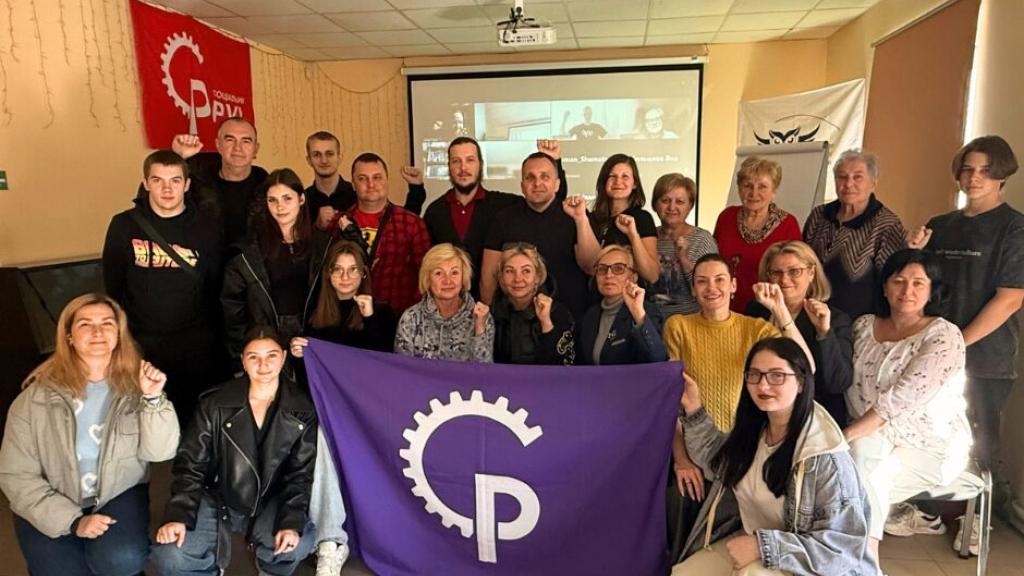
Social Movement meeting

First published in Ukrainian at Sotsialnyi Rukh. Translation republished from European Network for Solidarity with Ukraine.

Ukraine is stuck in a dead end of corrupt neoliberalism, which delays the end of the war and forces the population to suffer from poverty. The work of all state institutions is permeated by priorities of personal gain, lack of planning, and being closed off to the masses. Such a system cannot win.

The working people of Ukraine are massively and sacrificially holding back the enemy, which contrasts with the model of a state that depends on a narrow circle of individuals and is unable to care for the common good. The country's resources are being depleted not only by the occupiers, but also by greedy big businessmen who profit from the key needs of society — in the energy and defense industries. Society's response to such abuses was protests in July 2025 under anti-corruption slogans.

The so-called “reset” of the government only accelerated the risk of passing laws desired by the oligarchs. The appointment to key positions of Yulia Svyrydenko, Oleksiy Sobolev, Taras Kachka, and other adherents of unbridled capitalism from the Kyiv School of Economics clearly demonstrates this. The greatest threat comes from the ministry headed by Mr Sobolev, which seeks to deprive the working population of their rights by drafting a Labor Code and, at the same time, has taken over powers in the field of ecology, simplifying the exploitation of natural resources by business. Our country is becoming unfit for life, and hopes for a just reconstruction are fading with each passing day.

This situation is a reflection of global trends. The pressure of reactionary forces in the world and the treacherous behavior of the US administration have made all Ukrainians feel insecure. Interruptions in the supply of weapons to repel the Russian aggressor are shifting the global balance of power in favor of the oppressors. But security is not just a matter of weapons. It is also about social security — the stable functioning of critical infrastructure, fair remuneration for conscientious work, and far-reaching protection for those who find themselves in difficult life circumstances. All of this forms the foundation on which effective defense can be built.

Both defense and welfare are key functions of the state. Private capital is not interested in this due to its focus on profit and desire to contribute as little as possible to the budget. Despite the Ukrainian people's hopes that the state would begin to care more about solving people's problems, the opposite has happened. One after another, scandals are erupting about businessmen making money on anything, including the production of weapons. All this is a consequence of the centralisation of power, the concealment of information behind the “fog of war,” and the erosion of democratic principles. Unfortunately, the state acts not as a social shield for the people, but as a corrupt superstructure. The lack of support is keenly felt by everyone, especially military personnel, people who are forced to leave their homes, and those who are raising new generations of Ukrainians in these uncertain times.

The working class, whose political potential remains untapped, has been and remains a mass force that can change history at a critical moment. The working masses have been pushed away from politics, becoming pawns in the games of the ruling classes. If working people unite, they can change the rules of politics and, in the long run, take power away from the current elites. This is because the social influence of railway workers, doctors, energy workers, and educators has grown exponentially thanks to their enormous contribution to welfare. Everyday life depends on their unwavering performance of their duties, so it will be difficult for the authorities to argue with their opinion.

Conversely, capital plays no role in keeping society afloat. The state budget is not filled by income taxes: these have always been hidden in offshore accounts, and since the beginning of the invasion, they have fallen due to the collapse of exports. The budget is largely supported by payroll taxes (13.11% of revenue), which finance defense, as well as international aid, which finances the social sector.

The role of critical infrastructure sectors, which operate outside market logic but are vital to sustainability on the battlefield and in the rear, has grown. Employees in these sectors are often victims of Russian attacks, but the Ukrainian Pension Fund does not pay them the promised compensation due to bureaucratic problems with obtaining the status of critical infrastructure facilities. The existence of this problem negates all claims of people-oriented policy.

The level of support for pensioners and persons with disabilities, given the huge amounts of international financial support, is unacceptable. To justify the poor social standards, false ideological clichés about the threat of growing “paternalistic sentiments” (both among the authorities and in the opposition camp) are spreading.

The lack of positive developments in the field of social support, combined with low wages, is leading to mass emigration, primarily among young people under the age of 22.

For decades, the state has been catering to investors and business people, because they supposedly generate profits.

But it is becoming clear that generating profits is now impossible, given the war-torn economy. It is time for the broad masses of the population to demand that their needs be prioritised, because everything depends on them. The level of well-being will be determined not by economic efficiency, but by the extent to which the population demands to be treated humanely. The disproportionate influence that the oligarchy retains over the government must disappear so as not to hinder Ukraine's development.

Believing that only by overcoming the capitalist course can the interests of the working people be fully secured, Social Movement emphasises the priority of the following demands:

1. A shared economy for a shared victory. Nationalisation under workers' control of infrastructure, defense industry, and mineral resource exploitation enterprises. A 50% quota for representatives of labor collectives on the supervisory boards of such enterprises will serve as a safeguard against corruption and the usurpation of power by servants of capital. This will allow for the accounting of resources that can be used for defense. The socialisation of energy companies, among other things, will prevent an environmental crisis, which is manifested in the deterioration of water, soil, and air quality. It is particularly necessary to nationalise the defense-industrial complex 100% in order to prevent private individuals from profiting from orders and to ensure stable working conditions for personnel. During the period of martial law, there can be no market for renting housing, medicines, or military technology — all processes must be regulated by independent state bodies that are not guided by the pursuit of profit. Funding for medical institutions should not be based on efficiency criteria, as this leads to the transformation of medical care from a guaranteed right into a commodity. Expanding the public sector in the economy will be a bridge to full employment, provided that employment services and trade unions cooperate. The tax system should perform a social function, counteracting excessive wealth differentiation through taxation.

2. Rebooting the welfare state. Prolonged war should be seen as a social risk factor for the entire population, and social protection should be recognised as a duty of the state. Social protection agencies should be proactive and offer assistance to the families of military personnel, affected workers, and vulnerable groups even before they ask for it. Empty newly built housing should be used to house internally displaced persons (IDPs) and military personnel while the housing crisis continues. During wartime, the state cannot burden the population with debt collection for utilities and tariff increases. The period of residence in front-line territories, as well as the status of IDPs after February 24, 2022, should be counted as insurance experience for citizens, regardless of official employment. In order to prevent the risk of intellectual backwardness among the population, work in education should be encouraged by providing all educators with salaries not less than the national average and access to safe and comfortable shelters. Independent monitoring of educational losses should be introduced, especially in front-line regions.

3. Revival of mass democracy. The authorities must listen to citizens when implementing policies at all levels — by creating new institutions of public representation and electing representatives of the workforce to manage enterprises. Workers must be guaranteed the right to 14 days of paid annual leave for volunteer work so that they can support the army and address social issues. A parliament whose term of office has expired does not have the right to consider bills about which members of the public have expressed concerns regarding the restriction of citizens' rights and freedoms. Guaranteeing the legal binding nature of petitions addressed to state authorities. Hold elections as soon as possible after the lifting of martial law. In order to prevent politicians who have discredited themselves through ties to oligarchs from coming to power, property qualifications should be abolished, the threshold for political parties to enter parliament should be lowered to 1%, and freedom of self-nomination should be guaranteed. Solving everyday social problems should become both a political goal and an incentive for broader involvement of the masses in political life. The contradictions that have accumulated in society must be resolved through the strengthening of real political competition, subject to the affirmation of human rights and ideological pluralism.

It is the working people — workers, educators, doctors, railway workers, energy workers — who must become the driving force behind Ukraine's renewal. You create all the wealth of the country, you defend it, you have every right to decide how to run it.

Social Movement calls on all working people to unite. Create trade unions in your enterprises. Demand participation in decisions that affect you. Organise councils in your communities. Do not wait for permission from above — take this right for yourselves.

Only through mass organisation and solidarity is victory in the war and fair reconstruction afterwards possible. History shows that all significant social transformations were achieved through struggle from below, not granted from above.

Approved as a basis for Social Movement’s work on September 28, 2025, at the annual Social Movement Conference (participants pictured above).


The Nestor Makhno Archive - index


Sri Lanka: One year on, reading the National People’s Power government ‘from below and to the left’


NPP

First published at Polity.

The National People’s Power (NPP) in Sri Lanka achieved a significant two-thirds parliamentary majority in the November 2024 elections, the largest single-party majority since 1977. Driven by the Janatha Vimukthi Peramuna (JVP), the NPP is an alliance of political parties, trade unions, women’s organisations, and other civil society organisations. Rather than a Marxist or a ‘radical party’, the NPP is a progressive social coalition.

The NPP’s meteoric rise from a marginal ‘third force’ to the party of government emerged from a division among the elites that was triggered by the 2022 popular uprising, the Aragalaya. This convergence of activists, groups, social movements, and the general public, illustrated a historic moment, “from below and to the left”.

With the Aragalaya disrupting alliances within the hegemonic bloc of the Rajapaksa regime, the NPP was able to construct a new set of alliances on a different basis, which drew on many of the same actors. This bloc includes business, political, military, religious, media, trade union, and civil society actors. The new hegemonic bloc is based on a narrow anti-corruption agenda, linked with an efficient economic governance discourse, legitimised through a more inclusive Sinhala Buddhist hegemony under a militarised state.

It is important to recognise that as ever, there is a hidden class war in operation, in which dominant groups and their allies — political parties, media, intellectuals, social media activists, civil society actors — are engaged in misinformation and disinformation campaigns, portraying the NPP as radical, inexperienced, or incompetent. For example, a recent editorial in The Morning newspaper, owned by TV Derana owner and now opposition politician Dilith Jayaweera, is titled “Inexperience is Costly” (The Morning 2025). Its main aim was to undermine the NPP’s perceived legitimacy and potential for success.

This article aims to evaluate the past year of the NPP, by contextualising the emergence of the NPP, its tactical and strategic orientation within representative politics, and thinking through what this might mean for strengthening democratic social movements. This is a reading of the NPP “from below and to the left”, with my assessment of how the NPP is attempting, with mixed success, to expand the politics of the possible within this conjuncture of forces and movements. 

“From below and to the left” is a slogan associated with the Zapatistas in Mexico that signifies a political philosophy based on grassroots organising and a left-wing, anti-capitalist vision. The “below” in our context refers to oppressed and marginalised groups, such as: the struggling farmers, fisherfolk, working classes, Tamil and Muslim communities in the North and East, Malaiyaha (hill country) plantation community, women, people with disabilities, ageing people, LGBTQI+ community, and others. The “left” refers to anti-capitalism, positioning people before profit, and proposing alternative futures grounded in freedom from exploitation, oppression, domination and alienation. By the “left” I also mean the political project to extend democracy into the realm of production (workplaces) and social reproduction (families and communities), as well as into organisational cultures and social movements.

The political economic conjuncture

In Sri Lanka, the 1977 launch of the neo-liberal market driven economy shaped party politics. The agenda of deregulation of the economy and the retraction of the state through the privatisation of state-owned enterprises favoured party allies. Meanwhile, the withdrawal of the welfare state through “targeted” welfare enabled party influence over the welfare distribution system. The NPP emerged in a context where the realm of representative party politics was dominated by bourgeois parties and family dynasties entrenched in reproducing patrimonial capitalism. It was legitimised through a national-popular project, which consisted of a hetero-patriarchal Sinhala-Buddhist notion of “nationhood”.

Patrimonial capitalism is based on systems of patronage, where patron-client relations enable the political elites to use their control over resources to exchange private benefits for political support. While colonial feudal clientelism (1505-1948) in Ceylon/Sri Lanka was based on reciprocal, customary ties, more current (post-1977) capitalist clientelism is often a transactional, contingent exchange in the context of a market economy. This fragility of loyalties is a site of oppression as well as resistance. The orientation of the elites is to integrate an export-oriented economy reproducing a rentier economy, where profits are generated through owning and controlling assets, rather than through a production-based economy. The opportunity cost of this system is a neglect of profits generated through productive labour or socially and ecologically sound investments that encourage decent work opportunities and strengthen capacities of cultural flourishing.

The national-popular project is about articulating a national political and cultural identity that unites the interests of the dominant class with those of the “popular” or subaltern classes (workers, peasants, marginalised groups) to achieve social hegemony and state power. Since the 1977 launch of the neo-liberal market-driven economy, this national-popular project further polarised ethnic and class divisions, while reinforcing a militarised authoritarian state.

A key aspect was the introduction of the executive presidency in the 1978 Constitution that centralised and concentrated state power with the holder of that office who was at one and the same time the head of state, head of government, and commander-in-chief of the military. A key legal mechanism strengthening the coercive strategies of the state was the Prevention of Terrorism Act (PTA) in 1979, which enhanced state capacities for violent repression of resistance. The ruling party also engaged in co-option as well as coercion of an emerging human rights discourse in the public sphere.

The authoritarian state also integrated the ruling party with criminal networks, among other activities, engaged in the drugs, arms trade and human trafficking. This is also the period that expanded the casualisation of labour, which created a reserve army of underemployed workers engaged in precarious work.

Locating representative and movement politics “from below and to the left”

The logic of representative politics is about creating consent to ‘reforming’ the existing economic system through a national-popular project. The NPP’s national-popular project is a continuation of market-driven “development” narrowed to “economic growth”, but with a more active role of the state in promoting investments as well as reducing economic inequality.

The NPP, unlike other political parties of the elites, is mostly made of subaltern groups, or urban and rural lower middle-class groups. Their elected MPs, rather than from business backgrounds as under the Rajapaksa regime, are mostly professionals, such as teachers, engineers, doctors, and other middle-class occupations. While the NPP MPs also reflect class mobility, there are enduring alliances with marginalised groups and those ‘below’.

In Sri Lanka in 2022, the richest 10% of the population commanded 40% of the share of national income while the bottom 50% of the population subsisted on only 17% share of national income (cited in Skanthakumar 2025: 91). However, the NPP’s politics of redistribution and efforts to reduce economic inequality, is faced with institutional challenges within the party as well as the state.

The NPP has encouraged the use of the term Malaiyaha/m (‘hill country’) to identify hill country plantation communities, ending the colonial-era term of ‘Indian Tamils’. Despite the promises, the government still fumbles with the question of increasing the wages of hill country plantation workers, and the weak implementation of estate housing and infrastructure development illustrate the contradictions of some of the key players within the hegemonic bloc.

More than any previous government, the NPP has taken a stance on recognising the rights of individuals with diverse sexual orientations, gender identities, and expressions. This challenges the idealised heteronuclear family model, the cornerstone of patriarchal ethno-nationalist projects that evade questions of sexual labour, social reproduction within the family, the commodification of sex, and militarism. However, the NPP tactically retracted affirming rights of LGBTQ+ communities, when faced with the opposition from the senior Buddhist clergy and Colombo’s Archbishop Malcom Cardinal Ranjith (The Sunday Times 2025). For those engaged in counter-hegemonic struggles, it is important to recognise the contradictory role of these active allies within the NPP’s hegemonic bloc, as well as their complicity with authoritarian elite politics of the class war from above. Recognising these contradictions is about identifying the weak points of these alliances, and disrupting them, as well as developing new alliances that are “from below and to the left”

The realm of representative politics overlaps cultures and structures of political parties and the state bureaucracy, including the security forces. The NPP as a political party is entrenched in patriarchal hierarchies with a ‘pragmatic’ orientation that falls into TINA (There Is No Alternative) compromises.

As a ruling political party, the NPP is also integrated with the “national security and rule of law” discourse linked with the coercive state apparatus encompassing the military, police, legal as well as carceral system. Designed to maintain social order and state control through the legitimate (as well as illegitimate) use of force and the threat of violence, these institutions directly impact movements “from below and to the left”. This highlights why social movements from below have multiple challenges when confronting the NPP that now represents a progressive neo-developmental state, which is coercive as well as consensual.

Democratic social movements (movement politics) from below are integral to transforming the NPP as well as the realm of representative politics by encouraging the active participation of the public. The internal dynamics of social movements, their relationships with political parties and collective learning, shapes the strategic orientation of social movements. There are authoritarian social movements (patriarchal, fascist, ethno-nationalist) and democratic (counter-hegemonic) ones based on a range of social and ecological justice concerns.

Both representative and movement politics involve transnational dimensions of global networks, consisting of diaspora communities, party networks, civil society, and movement networks. For example, some local trade unions are linked with global union federations and networks, and local political parties are linked with global networks of political parties and diaspora supporters with varying degrees of activism.

New culture of governance

Democratic social movements from below in Sri Lanka are faced with an authoritarian patriarchal Sinhala-Buddhist militarised state, which is currently led by an NPP regime with a progressive agenda. Therefore, the NPP’s reform discourse is embedded in tactical and strategic manoeuvrings. A key achievement of the NPP is the fostering of a new culture of governance and of representative politics. The absence of major electoral violence was important given the history of political party integration with criminal networks and a heavily militarised state, with former soldiers and deserters often forced into criminal activities in a context of scarce access to meaningful employment with a living wage.

The NPP has also transformed the expensive and elaborate state rituals, which were mostly about maintaining and reproducing the authority of the state and fostering a sense of order and obligation. But within patrimonial capitalism, this was also about reproducing patron-client systems of representative politics. Interventions such as the scaled-down parliamentary inauguration rituals and the Independence Day celebration, abolishing pensions for former parliamentarians, and reduced security spending for ministers are both about fiscal responsibility as well as creating a less elitist culture of governance.

Economic dimension: to the left?

In terms of the economic dimension, the NPP government has maintained a path of macro-economic recovery assisted by improved tourism revenues and remittances. Inflation has declined since 2024, giving some relief to the majority low-income consumers. Despite a campaign promise to reduce electricity tariffs, under pressure to meet IMF demands, the government increased the cost of electricity by 15% in June 2025. Meanwhile, the merchandise trade deficit has widened (with increase in imports of vehicles and general consumer goods) and debt servicing has risen (World Bank 2025). Overall, the IMF has been pleased, announcing in October 2025 that the NPP’s “ambitious reform agenda continues to deliver commendable outcomes” (IMF 2025).

However, the NPP government has expanded the social welfare program (Aswesuma), increased public and private sector minimum wages, raised pensions and allowances for the elderly and disabled, and boosted student scholarships and allowances. Measures have been introduced to address the issue of predatory microfinance loans (such as the Microfinance and Credit Regulatory Authority Act, approved by the Cabinet in August 2025), which have disproportionately impacted women. Subsidised loans were provided to small rice mill owners, and the fuel subsidy for fishermen was increased. The Paddy Marketing Board was reactivated and reorganised, and the fertiliser subsidy for paddy was increased.

Despite the success in raising minimum wages in some sectors, the NPP remains strategically engaged in labour market reforms, which is mainly about giving business more capacity to casualise and exploit labour. Its approach is marked by the lack of negotiations on labour market reforms with sections of the labour movement opposed to the JVP trade unions. In school education, it is promoting wide-ranging modernisation of curriculum, methods, and infrastructure; while backtracking from the abolition of corporal punishment and disappointing teachers who await long-standing salary revision.

Internationally, the government secured stronger ties with regional powers, particularly China and India, attracting foreign direct investment while balancing security arrangements. Following the visit of an EU delegation in May 2025, the current GSP scheme, providing duty-free access to the EU market for eligible exports like textiles, garments, and seafood, was extended until the end of 2027. The announced increase in US tariffs to 44% in April 2025 was reduced to 30% in July 2025, indicating the NPP’s capacity to negotiate a relatively favourable agreement. However, the termination of USAID programmes has impacted government as well as civil society programmes (Gamage and Dadlan 2025).

Tactical and strategic elements of anti-corruption and the hegemonic bloc

The “from below and to the left” approach positions the NPP’s anti-corruption agenda, involving tactical and strategic dimensions, as integral to a broader struggle for a multi-layered democratic transition, while transforming structures of patronage capitalism.

The NPP’s achievements on the anti-corruption agenda is tactical in order to maintain public trust by delivering some convictions. It is also strategic because there are different bureaucracies (including the legal, administrative, and policing system), which are important for the day-to-day governance of the system. Reforming the system is a complex governance process of negotiating diverse interests while overcoming non-compliance, in order to sustain the long-term strategic goal of institutional reforms.

The NPP’s crackdown on corruption has included: the imprisonment of two former chief ministers of provincial councils, the former sports minister sentenced to 20 years, and former Sathosa corporation chairman and former trade minister jailed for 25 years. Former president Ranil Wickremesinghe was arrested and then released on bail, for the misuse of public funds. Former president Mahinda Rajapaksa and his predecessor and successors were removed from their official residences in Colombo after passing the Presidential Entitlements (Repeal) Bill. Meanwhile, there are on-going investigations, including into a former navy commander, arrested for the alleged abduction, detention in a secret facility, and murder of a civilian.

The strategic goal of remaining in power relies on maintaining a coalition of alliances within the hegemonic bloc. The competition and contradictions among these actors illustrate a hegemonic bloc that is changing as well as emerging.

It is this dynamic within the hegemonic bloc that is often implicated in the discussions around the NPP’s rigidity (not doing enough, unwilling to compromise) and flexibility (doing enough, and willing to compromise). For some on the left, the NPP illustrates too many compromises (compliance with the IMF, maintaining the presidential system, lack of effort towards ethnic reconciliation, maintaining patriarchal cultures, undermining trade unions, ignoring climate mitigation interventions, etc.).

Leaning left

The NPP emerged from the disruption of the hegemonic bloc by the Aragalaya, a popular uprising “from below and to the left”. The Aragalaya leaned left, in terms of promoting a solidarity economy (mutual help, communal activities and a notion of the commons), along with ecological sensibilities of a new generation.

The protest was against authoritarian elitist politics, encouraging solidarity with the marginalised and participatory democratic practices committed to non-violence. This was despite the violence of the ruling regime, including misinformation and disinformation campaigns to delegitimise the collective memory of the Aragalaya, which is on-going.

The NPP’s first year in government has illustrated its strategic commitment to an anti-corruption agenda, grounded in a neo-liberal capitalist project with social democratic tendencies. The NPP has strategically avoided a left discourse of class struggle, that critically engages with patriarchal ethno-nationalism by highlighting common economic interests (in transforming the exploitation of labour) across gender and ethnic divisions. Similarly, the NPP’s “green capitalism” orientation misrecognises and mystifies how the capitalist pursuit of profits and unlimited accumulation (and consumption) is the driving force of ecological harm that mostly impacts the marginalised classes. The exploitation of the environment is inextricably linked to the exploitation of labour.

In terms of ethnic reconciliation, the NPP remains entrenched in a Sinhala-Buddhist nationalist project, depicted by the demand for a domestic rather than an international or a hybrid mechanism in addressing the issue of war crimes. The strategic delay in addressing war crimes (Perera 2025), which the hegemonic bloc under the previous government denied, illustrates the persistent vested interests of the Buddhist clergy, the military as well as the media (Tamil Guardian 2025).

Social movements from below are faced with historically aggregated “movements from above”, with privileged access to state structures, economic and cultural resources (Cox 2024). This is why any evaluation of the strategic orientation of the NPP, demands articulating an alternative to authoritarian, militarised, patriarchal Sinhala-Buddhist (ethno-nationalist) capitalism (to avoid TINA compromises), by strengthening local and global networks of counter-hegemonic social movements.

The NPP illustrates multiplicities, ambiguities, opportunities, and contradictions. Multiplicities reveal how identity is not singular but a collection of many fluid, sometimes contradictory, experiences, narratives, and perspectives. Fostering new effective alliances within the hegemonic bloc sustained by the NPP, demands tactical and strategic interventions. In this historic phase of a democratic transition, the practices as well as critical analysis within and outside the NPP remain significant for nurturing the spirit of the Aragalaya, “from below and to the left”.

Author’s note: Thanks to my friend Ethan Blue for his thoughtful comments.

Janaka Biyanwila (PhD., University of Western Australia) is the author most recently of Debt Crisis and Popular Social Protest in Sri Lanka: Citizenship, Development and Democracy Within Global North-South Dynamics (2023, Leeds: Emerald Publishing Limited).

References

Cox, Laurence. (2024). “Social movements and hegemonic struggle”. In William K. Carroll (ed). The Elgar Companion to Antonio Gramsci (370–387). UK: Edward Elgar Publishing.

Gamage, Rajni, and Tanujja Dadlani. (2025). “Impact of the US’ Reciprocal Tariffs on Sri Lanka: Between Protectionism and RegionalismISAS Briefs (27 June). Available at https://www.isas.nus.edu.sg/papers/impact-of-the-us-reciprocal-tariffs-on-sri-lanka-between-protectionism-and-regionalism/

International Monetary Fund (IMF). (2025). “IMF Staff Reaches Staff-Level Agreement on the Fifth Review Under Sri Lanka’s Extended Fund Facility Arrangement”. (9 October). Available at https://www.imf.org/en/News/Articles/2025/10/09/pr25335-sri-lanka-imf-staff-reaches-sla-on-fifth-review-under-eff-arrangement

Perera, Jehan. (2025). “First steps in wartime accountability”. The Morning (3 October): https://www.themorning.lk/articles/8H84HhyfR43cJ8CLh8Yg

Skanthakumar, B. (2025). “Budget 2025: Playing A Bad Hand” (25 March). Polity, 13 (1): 91-100. https://polity.lk/b-skanthakumar-budget-2025-playing-a-bad-hand/

The Sunday Times. (2025). “Amid uproar over corporal punishment and pay, Govt. retreats on education reforms” (19 October): https://www.sundaytimes.lk/251019/columns/amid-uproar-over-corporal-punishment-and-pay-govt-retreats-on-education-reforms-616552.html

Tamil Guardian. (2025). “Former Sri Lankan Navy Commander arrested over abduction and murder allegations” (31 July): https://www.tamilguardian.com/content/former-sri-lankan-navy-commander-arrested-over-abduction-and-murder-allegations

The Morning. (2025). “Editorial: Inexperience is Costly”. (30 October): https://www.themorning.lk/articles/HAjr5xNSkjV2zAQqjIQE

World Bank (2025). Sri Lanka Development Update, October 2025: Better Spending for All. Available at https://openknowledge.worldbank.org/entities/publication/04f4b71d-d0df-493f-ab22-8b74c3664afc

A Hidden, Deep Syrian Wound

Palestine, the Motherland, and the Legacy of Colonial Cartography


“Zionism as a reactionary ideology fitted exactly the ambitions of the British colonialism at that period and later on the American imperialism plans to the areas.”

“The Palestinian resistance movement is not a movement to liberate a geographical 26,000 square km; it is a historical movement which aims to liberate the Jews from zionism and the Arabs from reactionaries, and to establish the Socialist Democratic Palestine. The question of Palestine is the question of a clashing contradiction between the National Liberation movement of the Arabs, headed by the Palestinian national Liberation movement, and imperialism in this part of the world, headed by the zionist movement. And this is how it is a mistake to understand that Israel is just a home of Jews, because Israel is a base of imperialism.”

— Ghassan Kanafani

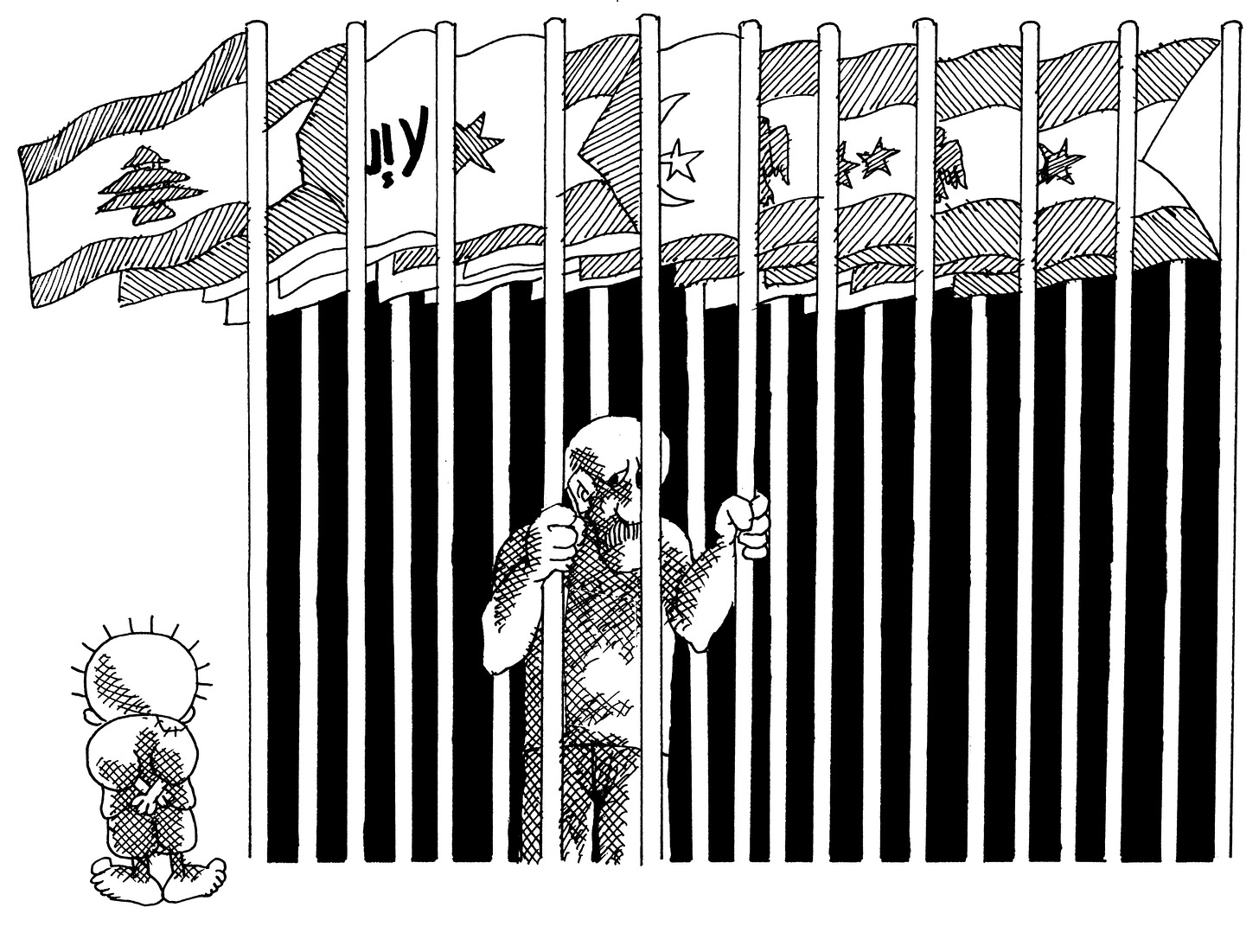
The common narrative of the “Palestinian-Israeli conflict,” while rich in detail and moral urgency, is built upon a fundamental geographical and historical misapprehension. The events of 1948, known to the Arabs as Al-Nakba (the Catastrophe), are almost universally presented as the tragedy of a distinct Palestinian people. This framing, however, obscures a deeper, more profound truth. A critical examination of history, geography, and imperial design reveals that Al-Nakba is not merely a Palestinian wound, but a Syrian one—the violent culmination of a century-long project to prevent the emergence of a unified Arab country in Bilad al-Sham. The struggle of the Arab natives of Palestine against settler-colonial zionism and its imperialist backers is not, in its essence, the “Question of Palestine,” but rather the enduring “Question of Syria.”

I. The Organic Motherland: Syria Before Colonial Dissection

To understand this is to recognize that the political consciousness of the region’s people preceded its colonial dissection by millennia. The modern assertion that there was no Palestinian state is a deliberate anachronism that erases a prior, more organic reality. For millennia, the territory known as Palestine was not a separate political entity but an integral part of Bilad al-Sham, or Greater Syria. This region, encompassing modern-day Syria, Lebanon, Jordan, and historical Palestine, shared a common culture, economy, and social fabric.

This unity is not a modern nationalist fantasy but a historical fact attested to by the ancient world’s first historian. Herodotus, writing in the 5th century BCE, consistently refers to the entire coastline of the Levant as “Syria.” He makes a clear geographical distinction, noting that the people of the coast “are Syrians who dwell in the parts of Arabia lying along the sea.” This establishes that the inhabitants of this coast were identified as Syrians regardless of sub-regional names, anchoring them within the broader cultural and ethnic fabric of the region. Furthermore, he explicitly names the specific part of this Syrian coast that we call Palestine, not as a separate country, but as a region within it: “Thence they [the Persians] went on to invade Egypt; and when they were in Syria which is called Palestine.”

The cultural unity of the Syrian coast is clearly attested by Herodotus, who records shared practices that bound its peoples together. He observes that the Persians learned to sacrifice to the heavenly goddess from “the Assyrians and the Arabians,”and describes many shared practices, like circumcision, which “the Phenicians and the Syrians who dwell in Palestine confess themselves that they have learnt it from the Egyptians.” Here, he explicitly groups the Phoenicians with the “Syrians of Palestine,” presenting them as a collective entity. This confirms that the entire littoral was understood as a Syrian space, in Arabia, whose peoples shared a common cultural identity.

My own family history is a testament to the endurance of this organic reality into the modern era. My grandfather represented the city of Safad not at a “Palestinian” congress, but in the First Syrian National Congress in 1920. This body, which declared the independence of a united Syria with its capital in Damascus and explicitly included Palestine within its borders, represented the true will of the land. For men like my grandfather, to speak for Safad was to speak for Syria, continuing an unbroken historical consciousness that viewed Palestine and Syria as one and the same—a reality so ancient that it was already a long-established truth when Herodotus recorded it as history two and a half thousand years ago.


Tripoli’s Blood Unites Us.

II. Deconstructing the Fallacy: The Sicily Analogy

A common zionist talking point asserts that there was no sovereign Palestinian state prior to 1948, a statement deliberately used to bolster the lie of “a land without a people.” This argument commits a fundamental logical category error: it conflates the modern political concept of a nation-state with the ancient social reality of a people and their homeland. The absence of a centralized government in a Westphalian model does not mean the land was empty, any more than the absence of a “Sicilian state” meant Sicily was uninhabited. This argument is not just ahistorical; it is a logical absurdity that collapses under the slightest scrutiny. To expose its sophistry, one need only apply the same logic to a different context.

Imagine if the United States, in its 19th-century expansion, had not just conquered the West but specifically targeted the island of Sicily. To secure this strategic foothold in the Mediterranean, it encourages and facilitates the migration of a distinct religious group, say the Mormons, who were once persecuted within the U.S. but now act as a settler vanguard. They establish thriving settlements, citing a two-thousand-year-old religious text that they believe grants them a divine right to the island. The world would rightly view the resistance of the Sicilian people not as an isolated “Sicilian Question,” but as a struggle for Italian territorial integrity—an attack on Italy itself.

Now, imagine these American-backed settlers arguing, “There is no sovereign Sicilian state; therefore, Sicily is a land without a people, ripe for our taking.” This would be immediately recognized as nonsense. Sicily, while not an independent nation-state, is undeniably a foundational part of the Italian nation, with its people being an inseparable part of its social and cultural fabric. To frame the conflict as solely between the “Mormons and the Sicilians” would be to accept the colonial premise and erase both Italy and the role of American power from the map. The absurdity would be compounded if the conflict was then mislabeled a “clash between Mormons and Catholics,” thereby masking the core issues of land, sovereignty, and a state-sponsored colonial conquest.

This refined analogy precisely mirrors the deception at the heart of the colonial narrative on Palestine. It captures the dynamic of a great power using a settler project to achieve its strategic aims. To claim there was no Palestinian state is as irrelevant as claiming there was no Sicilian state. Palestine was not an island in the Mediterranean—it was an integral part of Syria. Its people were Syrians. The attempt to retroactively justify conquest by applying a modern political standard to an ancient land is not a historical argument; it is the propaganda of dispossession.

III. The Imperial Genesis: From Napoleon to Sykes-Picot

The “Syria Question” for the British Empire truly began not with the Balfour Declaration, but with Napoleon’s invasion of Egypt and Palestine in 1798. This was a direct strategic thrust aimed at severing Britain’s route to its most prized possession: India. Although Napoleon was defeated, the shockwave he sent through the British Admiralty never faded. From that moment, controlling the land bridge of Bilad al-Sham—particularly the corridor of Palestine—became a paramount imperial imperative for London. Any potential threat to that route, whether from a resurgent France, a weakening Ottoman Empire, or later, a unified Arab state, had to be preemptively neutralized.

This long-standing strategic anxiety culminated in the ultimate act of colonial cartography: the Sykes-Picot Agreement of 1916. This secret pact between Britain and France did not simply redraw borders; it surgically dismembered the body of Bilad al-Sham, deliberately fracturing a unified cultural and economic sphere into the artificial, competing mandates of Syria, Lebanon, and Palestine. The creation of “Palestine” as a separate British Mandate was not an accident of history; it was a deliberate strategy to isolate and control the most geostrategically sensitive portion of the Syrian homeland.

IV. The First Arab Threat and the Zionist “Solution”

The first major test of this new colonial order came from Muhammad Ali Pasha of Egypt and his son Ibrahim Pasha, who in the 1830s swept through Bilad al-Sham, threatening to create a powerful, modernizing Arab state that could challenge both the Ottomans and European influence. British policy reacted with alarm. As the historian George Antonius noted, Britain’s resistance to this nascent Arab state was fundamental. This is chillingly confirmed by British Foreign Minister Lord Palmerston, who wrote in 1833:

“The real goal of Muhammad Ali is to establish an Arab kingdom that includes all the countries that speak Arabic… Moreover, we see no reason that justifies replacing Turkey with an Arab king in control of the route to India.”

It was in this context—the need to secure the route to India by ensuring a fragmented and controlled Syria—that British colonial strategists began to see a “zionist” solution decades before the Austrian Theodor Herzl. In September 1840, the Earl of Shaftesbury, a key influencer of British policy, explicitly proposed the establishment of a British colony in Syria and argued for the settlement of Jews in Palestine. He wrote that the region needed capital and labor, and that the “Hebrews were anticipating a return to Syria.” He concluded that employing the Jews was the “cheapest and most guaranteed method” to develop and control this sparsely populated, strategic land bridge.

A quarter-century later, in 1856, Shaftesbury was even more explicit, asking: Does Britain not have an interest in this? He answered:

“It would be a blow to England if any of its rivals were to seize Syria. Its empire… would be cut in two. England must preserve Syria for itself… [and] should foster the nationalism of the Jews.”

As Nahum Sokolow, one of the founders of zionism, later noted, the British strategic mind had already, by the mid-19th century, linked the “future of Palestine” directly to the security of the Empire. British colonialism had become functionally zionist before the European political zionist movement itself was formally born.

V. The Strategy of Perpetual Fragmentation: From Pipelines to Proxy Wars

The colonial dismemberment of Bilad al-Sham did not conclude with the Sykes-Picot Agreement or even the Nakba of 1948; it evolved into a perpetual strategy to ensure the region’s permanent weakness and subservience. This policy of intentional fragmentation, which relies on and inflames sectarian, ethnic, and regional divisions, has been a consistent weapon in the imperial arsenal to preempt the re-emergence of a unified, independent Arab power. The motivation for this is twofold: a long-standing geopolitical imperative and a more recent, critical struggle over energy dominance.

The visionary Palestinian writer and revolutionary Ghassan Kanafani, in his study The Arab Cause During the Era of the United Arab Republic, identified the internal dimension of this strategy with chilling precision. He argued that colonialism and its zionist spearhead found natural allies in the region’s internal divisions:

“There is no doubt that the reactionary, the opportunist, the regionalist, and the sectarian… meet in their goals with the goals of Israel and colonialism, whether they intended that or not… In fact, the reliance of colonialism and Israel on this trio is almost complete.”

As definitive proof, Kanafani cited a declassified Israeli plan from 1957, which laid out a blueprint for the systematic destruction of Arab unity. The plan called for rapid measures to establish a Druze state, a Shiite state in Lebanon, a Maronite state, an Alawite state in Syria, a Kurdish state in Iraq, and a region for the Copts. This document was not merely speculative; it was a reflection of a core strategic understanding that the survival of the colonial implant depended on ensuring the motherland remained divided. As Kanafani noted, this plan “resulted from a feeling that there are tendencies in the indicated regions for secession,” and its purpose was to exploit those tendencies to “establish any defeatist ability in the Arab homeland.”

This century-old strategy of balkanization was violently re-energized in the 21st century, driven by a new and critical geopolitical prize: control over energy corridors. As analyses have revealed, the struggle in Syria is the latest episode in a “pipeline war” whose roots stretch back to the mid-20th century. This conflict reached a critical juncture in 2009, when Qatar proposed a massive pipeline project that would run from its North Field, through Saudi Arabia, Jordan, and Syria, to Turkey, with the aim of supplying European markets. This Qatari pipeline, backed by the United States, was in direct competition with a rival Iranian proposal that would run from Iran through Iraq and Syria. Syria’s refusal in 2011 to agree to the Qatari pipeline, in part to protect the strategic interests of its ally Russia, the dominant gas supplier to Europe, was the decisive geopolitical event that ignited the modern phase of this conflict.

This economic rejection coincided with the U.S. policy, revealed by WikiLeaks, of aggressively pursuing “regime change” in Syria. The subsequent war, fueled by foreign powers, cannot be disconnected from this struggle over which global powers would control the energy future of Europe and isolate Iran. The pipeline competition provided a powerful economic and strategic motive for certain external actors to actively pursue the fragmentation of Syria, using the very sectarian and regionalist playbook outlined in the 1957 Israeli document. The goal was to either install a compliant government in Damascus or, failing that, to balkanize the country into weaker, controllable statelets, thereby securing the transit route and dealing a blow to their rivals.

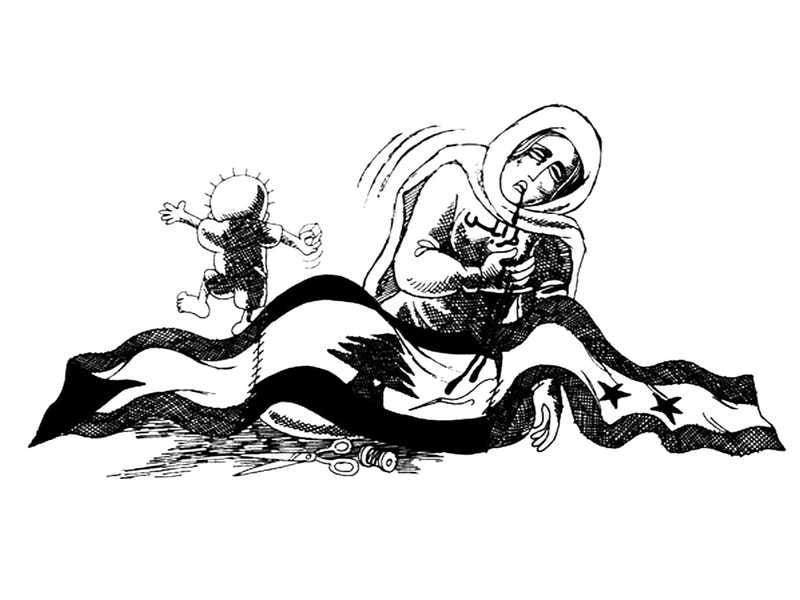
Thus, the ongoing tragedy in Syria is not a separate “conflict,” nor did it spring from internal strife. It is the continuation of the same war declared on Bilad al-Sham over a century and a half ago. The support for separatist militias, the manipulation of opposition groups by imperialist and foreign intelligence agencies, the fueling of sectarian strife, and the economic siege are all modern tools to achieve an ancient European colonial goal, now supercharged by the geopolitics of energy: to ensure that the Syrian wound never heals, that the motherland never reunifies, and that the Question of Syria remains unanswered, leaving its land and resources open to external domination.

The Unanswered Question of Syria

To understand Al-Nakba as a Syrian wound is to restore the struggle to its proper scale and historical genesis. It moves the discussion beyond the cramped confines of the failed paradigm of the “two-state solution,” revealing the struggle as what it has always been: the central battle in the long war against the imperial division of the Eastern Mediterranean—a division initiated to secure the route to India; cemented by Sykes-Picot; and consummated by the shameful Balfour Declaration. The “Question of Syria” is the question of a land struggling for reunification and liberation from this imperial legacy. The struggle in Palestine is not a local border dispute; it is the fight for the integrity of the motherland. Until this foundational reality is acknowledged, any analysis of the struggle will remain incomplete, treating the symptoms while ignoring the amputation that afflicts the entire body of Bilad al-Sham.

  • This essay relies significantly on historical documents, quotes and analysis compiled by Emile Touma in his seminal Arabic-language work, The Roots of the Palestinian Cause.
Amel-Ba’al, a symbolic name in keeping with a Palestinian tradition, is a Palestinian refugee located on the unceded land known as British Columbia. Read other articles by Amel-Ba’al, or visit Amel-Ba’al's website.