Pakistani institutions, such as ECP, have benefitted from Washington’s support in the past.

• Pakistani institutions, such as ECP, have benefited from Washington’s support in the past
• Waiver granted for oversight of F-16 programme
THE Trump administration has halted nearly all US government funding for programmes that promote democracy and human rights in many countries, a move that experts warn will have significant repercussions for Pakistan’s democratic institutions.
Pakistan has been one of the largest recipients of US development assistance in South Asia. Under these programmes, Washington provided between $13 million and $15 million to the Election Commission of Pakistan (ECP) to support free and fair elections.
The funds were allocated for the ‘Strengthening Electoral and Legislative Processes’ project, which ran from 2016 to 2023, under the supervision of the United Nations Development Programme (UNDP).
The Trump administration’s broader foreign aid freeze has also impacted humanitarian and development assistance, halting $845m in funding for Pakistani projects and disrupting 11 governance programmes.
In a recent interview with a Fox News affiliate in Detroit, Michigan, former Pakistani president Arif Alvi claimed that the US Agency for International Development (USAID) had given up to $17m to the ECP.
Supporting the Trump administration’s decision to suspend such funding, Dr Alvi asserted that the ECP was responsible for overseeing the 2024 general elections, which he alleged were marred by widespread rigging.
However, according to data from the US government website ForeignAssistance.gov, Pakistan received between $13m and $15m for the seven-year programme, and not specifically for the 2024 elections.
Waivers
However, a number of waivers have been issued as well. Pakistan is receiving two types of waivers under the Trump administration’s new aid policy: emergency humanitarian assistance and security-related funds.
Under a national security waiver, $397 million has been allocated to a US-backed programme monitoring Islamabad’s use of F-16 fighter jets. A congressional aide emphasised that such oversight serves US national security interests, given Pakistan’s nuclear capabilities.
Additionally, the US Bureau of International Security and Nonproliferation has secured 17 exemptions aimed at curbing the spread of weapons of mass destruction.
Pakistan also qualifies for emergency humanitarian aid, including food and medical assistance for flood-affected areas, though the total amount remains undisclosed.
Consequences for Pakistani institutions
The sudden loss of US funding raises concerns about Pakistan’s ability to maintain electoral transparency and civil society engagement. The cut in democracy assistance means that the ECP will have fewer resources for election monitoring and capacity-building programmes.
Civil society organisations that rely on US support for voter education and legal reform will also struggle to continue operations. Media and watchdog groups that play a crucial role in ensuring fair elections may lose funding, limiting their ability to hold institutions accountable.
A senior official at a leading Pakistani think tank, speaking on condition of anonymity, described the situation as “a major setback for democracy advocates in Pakistan. The US was a key partner in ensuring transparency, and this decision leaves a vacuum that authoritarian forces could exploit”.
Global impact
Pakistan is not the only country affected. The National Endowment for Democracy (NED), which funds civil society groups worldwide, reported that it could no longer access its accounts at the Treasury Department.
The shutdown came after staff from Elon Musk’s newly created Department of Government Efficiency (DOGE) took control of financial operations.
Mr Musk has publicly criticised NED, calling it “a scam” and “an evil organisation”, a sentiment echoed by conservative think tanks such as the Centre for Renewing America, which argues that the entity interferes in other countries’ internal affairs.
The cuts are extensive: $486m slashed for global electoral and political process strengthening programmes; $39m removed from fiscal federalism projects in Nepal; and $47 million cut from educational programmes across Asia.
In India, President Trump questioned why the US was funding election-related initiatives in a “wealthy nation”, leading to the cancellation of a $21m grant.
Indian ruling party leader Amit Malviya labelled the now-cancelled funding as “external interference in India’s electoral process”.
Expert warnings
Michael Kugelman, director of the Wilson Centre’s South Asia Institute, emphasised the long-term damage these cuts could inflict: “Pakistan is one of the largest recipients of US development assistance in South Asia. These cuts will not only impact electoral support but will also affect civil society organisations that promote democratic governance.”
Congressman Steve Cohen, a Democrat from Memphis, called the aid reductions “a serious blow to the US government’s role in international development, halting critical humanitarian aid, disaster relief and global health initiatives”.
The International Council of Voluntary Agencies (ICVA), a network of groups in about 160 countries, warned that US cuts had taken a devastating toll on crisis-hit populations. In a recent report, ICVA noted that aid groups across the world have been forced to close operations, lay off staff and halt life-saving work.
While the Trump administration argues that these cuts align with an “America First” policy, critics contend that reducing US engagement in democratic development will embolden authoritarian regimes and weaken global governance.
As debates continue in Washington, affected countries must reassess how to sustain democratic initiatives without US support.
Published in Dawn, February 24th, 2025
Should We Celebrate the Demise of USAID and NED?
The opening month of the second Donald Trump Presidency has produced a number of consensus-shattering executive actions that have upended the normal functioning in Washington. One of the most surprising is Trump’s attempt to eliminate the United States Agency for International Development (USAID) and defund the National Endowment for Democracy (NED).
For decades, USAID and NED have presented themselves as wearing a white hat, helping other countries become more democratic and enlightened. However, much of the real work of the agencies was to foment dissent and at times, overthrow governments that do not comply with Washington’s dictates.
 USAID and NED fund media outlets that repeat Washington’s propaganda, support political opposition factions that want to align more with the White House, and bolster NGOs that facilitate regime changes.
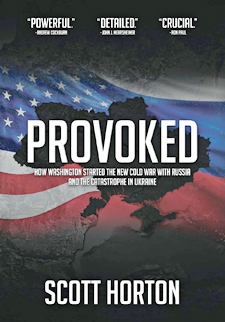
In the following excerpt from Provoked: How Washington Started the New Cold War with Russia and the Catastrophe in Ukraine, Scott Horton discusses some of the many nefarious operations of USAID and NED in Europe. As Washington completed a series of political revolutions, regime change operations, and coups, it changed the balance of power in the region.
In 2014, the US pulled off its second coup in Ukraine in ten years, putting Washington, Kiev, and Moscow on the path to war.
The excerpt below is just a portion of Horton’s comprehensive coverage of USAID and NED’s regime change operations that created a New Cold War with Russia. Donate to the Libertarian Institute’s fund drive, and you can get a signed copy of Provoked.
~ Kyle Anzalone
NED
The color-coded revolutions were essentially U.S. coups d’état dressed up as local “uprisings,” primarily against Russian-leaning states in their near abroad. Backed by the CIA, the United States Agency for International Development (USAID), National Endowment for Democracy (NED), National Democratic Institute (NDI), International Republican Institute (IRI) and friendly, supposedly private non-governmental organizations (NGOs) like Serbian Otpor, the Soros Foundation, Open Society Foundation, International Renaissance Foundation and the Atlantic Council, they have had quite a few successes.
Allen Weinstein, a co-founder of the NED, told the Washington Post’s David Ignatius in 1991, “A lot of what we do today was done covertly twenty-five years ago by the CIA.” Ignatius added, “When [Cold War-era] covert activities surfaced (as they inevitably did), the fallout was devastating. The CIA connection, intended to protect people and organizations from public embarrassment, had precisely the opposite effect.” However, “The biggest difference is that when such activities are done overtly, the flap potential is close to zero. Openness is its own protection.”
Electoral Revolution
Though the U.S. and allied oil companies British Petroleum and Amoco helped overthrow President Abulfaz Elchibey of Azerbaijan in 1993, that was more of a straight-up coup than any pretended “revolution.” But those started with mixed success in Albania and Bulgaria in 1996, Montenegro and Romania in 1997, Armenia in 1998, Slovakia and Croatia in 1999 and Serbia in 2000.
Slovakia
The NED’s Rodger Potocki explained that “NDI … and IRI, in the early 90s, working in Bulgaria and Romania, came up with two key ideas on how you build momentum for democratic change: citizen advocacy and monitoring groups.” In 1997, after the success of their intervention in the Bulgarian elections, the NED targeted Slovak President Vladimír Mečiar. The NED and associated NGOs spent more than $850,000 in direct financial support to Mečiar’s opponent, Paval Demeš, and his OK’98 campaign. Contributors to Demeš’s “electoral revolution” included the United States Information Service, the IRI and NDI, Soros’s Open Society Foundation, the German Marshall Fund, as well as the governments of Britain and the Netherlands.
This money paid for a tour of 13 rock concerts, two films and a television ad buy, encouraging the young to vote. It was a massive success. The NGOs also did extensive exit polling so they could claim their results before the votes could be counted. Though the incumbent’s party received the most votes, the minority parties were able to form a coalition and oust him for a Western-compliant MP named Mikuláš Dzurinda. The NED and associated groups only claimed to be supporting the process, but that was an obvious lie. Their propaganda was entirely designed to push people to vote for the right guy — or at least against the wrong one.
Croatia
In Croatia, Clinton turned on his ally Franjo Tudjman. The NED and its allies created a new group called Citizens Organized to Monitor Elections (known by its Croatian acronym GONG). Again they bought a massive advertising campaign in support of pro-Western parties. The Slovak politician and NGO leader Demeš traveled to Croatia to help show GONG how it was done. Tudjman died just before the election and the pro-Western parties won. Demeš later became a leader at the German Marshall Fund. At least he was honest about what they were doing, saying that “[e]xternal funding for these civic campaigns is critical. Without external support, they wouldn’t happen.”
The Same Old NGO Scam
The NED’s Carl Gershman himself later referred to this revolution as a successful “overthrow” of Yanukovych. Apologists for this intervention like to cry that accusers are “denying the agency” of the Ukrainians who did the coup. But that is ridiculous. Every CIA- or NED-backed coup plot in history has relied on local forces to agitate and then ultimately take over the country. Domestic opponents who accepted U.S. help to replace Shukri al-Quwatli, Mohammad Mosaddeq, Jacobo Árbenz, Ngo Dinh Diem, Sukarno, João Goulart, Cheddi Jagan, Patrice Lumumba, Rafael Trujillo, Gough Whitlam, Salvador Allende, Jean-Bertrand Aristide, Vladimír Mečiar, Franjo Tudjman, Slobodan Milošević, Eduard Shevardnadze, Askar Akayev, Manuel Zelaya, Muammar Gaddafi, Mohamed Morsi, Evo Morales, Viktor Yanukovych, etc. all had “agency,” alright: they were the sock puppets of “the Agency” — the American CIA and their junior partners at USAID, the NED and the rest of the regime change industry.
The question is regarding the motives behind and extent of U.S. government intervention and whether it helped to make a difference in the success of the regime change. As former CIA Director of Operations Ray S. Cline put it, in reference to the successful 1953 Iran coup, what counted was “supplying just the right bit of marginal assistance in the right way at the right time. Such is the nature of effective political action.” The Ukrainians and their factions are the pieces, while major powers America and Russia are the players in this game of chess.
For example, Center UA was a “civil society” group run by Oleh Rybachuk, the former chief of staff of ex-President Yushchenko, who had been central to the CIA-MI6 scheme to work with the Ukrainian SBU against Yanukovych during the Orange Revolution of 2004, and bankrolled by American oligarchs Pierre Omidyar — who donated $335,000 in 2011 alone — and, though he later denied it, George Soros. The Open Society Foundation was happy to take credit where it was due. “The International Renaissance Foundation played an important role supporting civil society during the Euromaidan protests,” they boasted, adding that they had paid for legal aid for “activists, protesters and journalists,” as well as medical care and assistance to Hromadske TV and other pro-Maidan media. The Kyiv Post reported in 2014 that USAID gave Center UA more than $500,000 in 2012 through an NGO called Pact Inc., adding, “Nearly 36 percent came from Omidyar Network, a foundation established by eBay founder Pierre Omidyar and his wife.” And, of course, Soros’s International Renaissance Foundation and NED picked up the rest. With the help of USAID-backed Pact Inc., Rybachuk’s Center UA organized approximately 60 different NGOs and provided grants to at least 80 more. Rybachuk also headed up the Civic Expert Council, advocating for Ukraine to sign the new association agreement with the EU.
As soon as Amb. Pyatt got to Kiev, he approved a $50,000 USAID grant to Hromadske TV. Their editor-in-chief Roman Skrypin worked for the U.S. government’s Radio Liberty and the also-U.S.-funded Ukrainska Pravda. He got another $30,000 from Soros’s International Renaissance Foundation. Skrypin also helped to set up the Channel 5 TV network with money from the IRF in time for the Orange Revolution in 2004. USAID gave Pact Inc. $7 million in 2013. “Euromaidan Press,” official mouthpiece of the Maidan movement, admitted two years later that they got the vast majority of their funding from Soros’s Renaissance Foundation. Their website still reads, “Euromaidan Press is grateful for the longtime support of the International Renaissance Foundation,” and for “the past support of GPD Charitable Trust, British Embassy Kyiv, and National Democratic Institute.”
IRF beneficiary Viktoria Siumar from Hromadske Radio thanked Soros for all his generosity, saying that “without those efforts the revolution might not have succeeded… Partners of the IRF were the main driving force and the foundation of the Maidan movement.”
This is how it works. As the Financial Times reported, “Kiev-based New Citizen, headed by Rybachuk … played a big role in getting the protest up and running weeks ago when Yanukovych backed out of signing far-reaching association and free trade agreements with the EU.” The plan had been in the works for years. As Rybachuk told the Financial Post back in 2012, “We now have 150 NGOs in all the major cities in our ‘clean up Parliament campaign.’ … Facebook had 300,000 members a year ago and now has two million. The Orange Revolution was a miracle. … We want to do that again and we think we will.”
Mustafa Nayyem, co-founder of Hromadske TV, explained in an article for Soros’s Open Societies Foundation that he had kicked the protests off on November 21 with a Facebook post asking people to meet at the Maidan. But as journalist Kit Klarenberg explained, “Nayyem was no ordinary ‘online journalist.’ In October 2012, he was one of six Ukrainians whisked to Washington, D.C., by Meridian International, a State Department-connected organization that identifies and grooms future overseas leaders, to ‘observe and experience’ that year’s Presidential election.” The group met with Senator John McCain among others while they were in town.
Also interestingly, Klarenberg found that “[i]n the hours following Russia’s invasion of Ukraine, NED hurried to remove any and all trace of its funding for organizations in Ukraine from its website.” He noted that while the NED grants database for Ukraine returned no results, “a snapshot of the page captured February 25th [2022] reveals that since 2014, a total of 334 projects in the country have been awarded a staggering $22.4 million,” adding that “by NED President Duane Wilson’s reckoning, Kiev is the organization’s fourth-largest funding recipient worldwide.” Journalist Will Porter found scrubbed NED records showing they had spent $4.5 million on 70 separate projects in 2013–2014 alone. Is the NED leadership not proud of the assistance they have given? Evidently they find it preferable to keep their name out of the prehistory of this terrible conflict.
Forbes magazine dug even deeper into Hromadske TV’s funding and found contributions from the U.S., Swiss and German embassies, various Canadian and Swiss government agencies and assorted NGOs, as well as the European Commission’s Ukrainian delegation office. “[D]onations from the European Commission are a particularly interesting reveal,” Forbes noted, “given the anti-Russian government news … coming out of Hromadske.” Rather than a grassroots effort of “the Ukrainian people,” as Nuland claimed, USAID’s annual report from 2013 makes it clear that Ukraine’s entire “civil society” was nothing but American and Western European astroturf. Their NGOs spent at least tens of millions of dollars picking and choosing winners across many different fields.
Soros’s Freedom House even sent out a fundraising appeal based on their intervention in this case. “More support, including yours, is urgently needed to ensure that Ukrainian citizens struggling for their freedom are protected and supported.” No point in their being modest. The group’s David J. Kramer had issued an official statement demanding Yanukovych resign on December 9.
Ukrainian oligarch Igor Kolomoysky, who controlled vast oil, gas and banking interests in the country, had an old grudge against Yanukovych from previous fights over the semi-private oil company Ukrtatnafta. He quickly employed his TV channel 1+1 in service of the protest movement.

No comments:
Post a Comment