Canada Conservative leader warns Trump could break future trade deal
By AFP
April 2, 2025

Canadian Conservative Party leader Pierre Poilievre speaks in Ottawa on March 4, 2025 - Copyright AFP Sai Aung MAIN
Canada’s Conservative Party leader Pierre Poilievre on Wednesday escalated his criticism of Donald Trump, outlining plans to confront a US president he said cannot be trusted to honor agreements.
Hours before Trump was set to unveil sweeping tariffs that could punish the Canadian economy, Poilievre addressed an audience of business leaders in downtown Toronto, the epicenter of Canada’s financial industry.
Polling ahead of Canada’s April 28 election indicates Poilievre has struggled to establish himself as a forceful counter to Trump, whose trade war and repeated threats to annex Canada have shattered bilateral relations.
Poilievre said if elected to replace Liberal Party leader Mark Carney as prime minister he would immediately ask Trump to launch negotiations on a new trade agreement.
“I will propose that both countries pause tariffs while we hammer out that deal,” Poilievre said.
But, he added, Canada cannot assume Trump will keep his word.
“How can we trust that he’ll honor any new agreement when, let’s be honest, he violated the last one, the one he negotiated.”
Trump has previously called the current North American free trade agreement, which was renegotiated during his first term, “the best agreement we’ve ever made.” He now accuses Canada of taking advantage of the United States in trade.
Poilievre said Canada should be able to “withdraw” from defence, border security and trade commitments in response to Trump “breaking his word.”
“If and when he decides to break the deal and tariff us again, we will hold up our end of the bargain only as long as he holds up his.”
At the start of the year, Poilievre appeared on track to be Canada’s next prime minister, as polls gave him a commanding lead over then-prime minister Justin Trudeau.
But Trudeau’s resignation and Trump’s threats have upended the race.
Carney, a wealthy former investment banker who led both the Bank of Canada and the Bank of England, has argued his experience prepared him to lead Canada through the economic crisis.
The public broadcaster CBC’s poll aggregator on Wednesday gave the Liberals a 90 percent chance of forming a majority, a stunning turnaround.
But Poilievre blames Trudeau’s economic policies for making Canada vulnerable to Trump and says Carney is not the solution.
“A resume is not a plan,” he said, seeking to undermine Carney’s economic experience.
Prominent Canadian investor and Poilievre supporter Mark McQueen argued that, regardless of Carney’s background, the Liberal attachment to big government would hinder economic progress.
Carney’s “resume does not make up for intestinal fortitude,” he told AFP after Poilievre’s speech.
There are “bureaucrats across this country who gum things up… Governments are not in the business of progress, they’re in the business of managing ministers.”
Canada Plots Energy Escape Route from Trump’s America
- Canadian energy CEOs demand reforms to simplify regulations and accelerate projects.
- Both Liberal leader Mark Carney and Conservative leader Pierre Poilievre promise to expand and modernize Canada’s energy infrastructure.
- Both leaders are looking to reduce reliance on U.S. exports amid Trump’s tariff threats.

The leaders of Canada’s two biggest political parties are promising expansion and modernization of energy infrastructure to reduce dependence on the United States for energy exports amid U.S. President Donald Trump's tariff and sovereignty threats.
Mark Carney, the Prime Minister who replaced Justin Trudeau and is leading the Liberal Party ahead of the April 28 federal election, says that Canada’s principal investment imperatives include “expanding and modernizing our energy infrastructure so that we are less dependent both on foreign suppliers and the United States as our main customer.”
The leader of the main opposition Conservative Party, Pierre Poilievre, vowed this week that if the Conservatives came to power after a 10-year Liberal rule, he would create a ‘Canada First’ National Energy Corridor to rapidly approve and build the infrastructure Canada needs to end its energy dependence on America, “so we can stand up to Trump from a position of strength.”
The Liberals, who were trailing Conservatives for years under former PM Trudeau, are now ahead in the opinion polls and widening the lead over Conservatives as the new Liberal leader Carney is seen as more capable than Poilievre of standing up to President Trump’s threats. If the six-point lead of the Liberals holds until Election Day, Carney could be able to form Canada’s first majority government in a decade.
Conservative leader Poilievre, however, is more vocal than Carney in Canada’s need to cut its overall trade and energy export dependence on the United States.
Poilievre announced on Monday that he would create a ‘Canada First’ National Energy Corridor to fast-track approvals for transmission lines, railways, pipelines, and other critical infrastructure across Canada in a pre-approved transport corridor entirely within Canada, transporting Canadian resources within Canada and to the world while bypassing the United States.
The corridor “will bring billions of dollars of new investment into Canada’s economy, create powerful paycheques for Canadian workers, and restore our economic independence,” the Conservative Party said.
Poilievre’s plan is that all levels of government “will provide legally binding commitments to approve projects,” which would end the “endless regulatory limbo” for investors.
“In 2024, Canada exported 98% of its crude oil to the United States. This leaves us too dependent on the Americans,” said Poilievre.
“Our Canada First National Energy Corridor will get us out from under America’s thumb and enable us to build the infrastructure we need to sell our natural resources to new markets, bring home jobs and dollars, and make us sovereign and self-reliant to stand up to Trump from a position of strength.”
The U.S. tariff threat was a wake-up call for Canadian policymakers that the federal and provincial governments may have too hastily scrapped over the past decade Alberta-to-coast pipeline projects that could have diversified Canada’s oil and gas exports.
Last month, the chief executives of some of the largest Canadian energy companies called on Canada’s main political parties to declare a Canadian energy crisis and key projects in the “national interest,” which would speed up reforms, planning, and construction of new oil and gas pipelines and LNG terminals.
The open letter from 14 CEOs representing the four largest pipeline companies and 10 largest oil and natural gas companies recommends five key steps to build new energy infrastructure—simplify regulation, commit to firm deadlines for project approvals, grow production, attract investments, and encourage Indigenous co-investment opportunities.
On Tuesday, Poilievre committed to meeting all of the policy recommendations from Canada’s energy sector to end dependence on the U.S. market and unleash Canada’s economy. Poilievre challenged Carney to do the same and to repudiate his commitment to “keep it in the ground”
“Canada’s energy sector, the experts on energy growth, have told us what we need to do. Today, I am committing to meeting all of their urgent recommendations,” Poilievre said.
Carney, for his part, announced last week a plan to diversify Canadian trade by improving Canada’s trade-enabling infrastructure. A Mark Carney-led Liberal government will inject US$3.5 billion (C$5 billion) into a new Trade Diversification Corridor Fund to accelerate projects at ports, railroads, inland terminals, airports, and highways.
By Tsvetana Paraskova for Oilprice.com
LNG Canada Moves Closer to Launch

LNG Canada has received its first import cargo of liquefied gas that it will use for equipment testing as the facility nears completion, which is scheduled to take place later this year.
The Greece-flagged Maran Gas Roxana tanker arrived safely in Kitimat, LNG Canada said in a news release without specifying the size of the LNG cargo. “This activity is critical to our safe start-up and commissioning process in advance of our operations, and to achieving our first LNG export cargoes by the middle of 2025,” the company said.
LNG Canada is a joint venture between Shell, with 40%, Malaysia’s Petronas with 25%, Mitsubishi Corp. with 15%, Korea Gas Corp. with 5%, and PetroChina with 15%. The facility, will process 1.9 billion cubic feet of natural gas per day—a significant chunk of Canada’s output. Once operational, the project is expected to boost Canadian natural gas prices, as supply that previously flowed south to the U.S. gets redirected to Asian markets.
LNG Canada is the country’s first project for the export of superchilled fuel, with a focus on Asian markets as the biggest demand driver. Eventually, however, Canada could potentially supply 36.2 million tons of LNG per year by 2040, according to estimates by Wood Mackenzie. That’s despite statements by the previous Canadian government that there was no business case for liquefied natural gas in the country. The statements were made in response to a request by the former German chancellor, Olaf Scholz, for potential LNG supply deals with Canada.
Right now, the business case for Canadian LNG just got a massive boost from President Trump’s tariffs, which hit allies and adversaries alike, prompting warnings of retaliation. Energy is one obvious target for such retaliation as already demonstrated by China, which retaliated against an earlier tariff slap by slapping back with its own tariffs on U.S. energy imports. Canadian LNG is an obvious alternative to U.S. LNG, should such an alternative become necessary.
By Irina Slav for Oilprice.com
Trade war saps Canadian share sale market despite metals deals
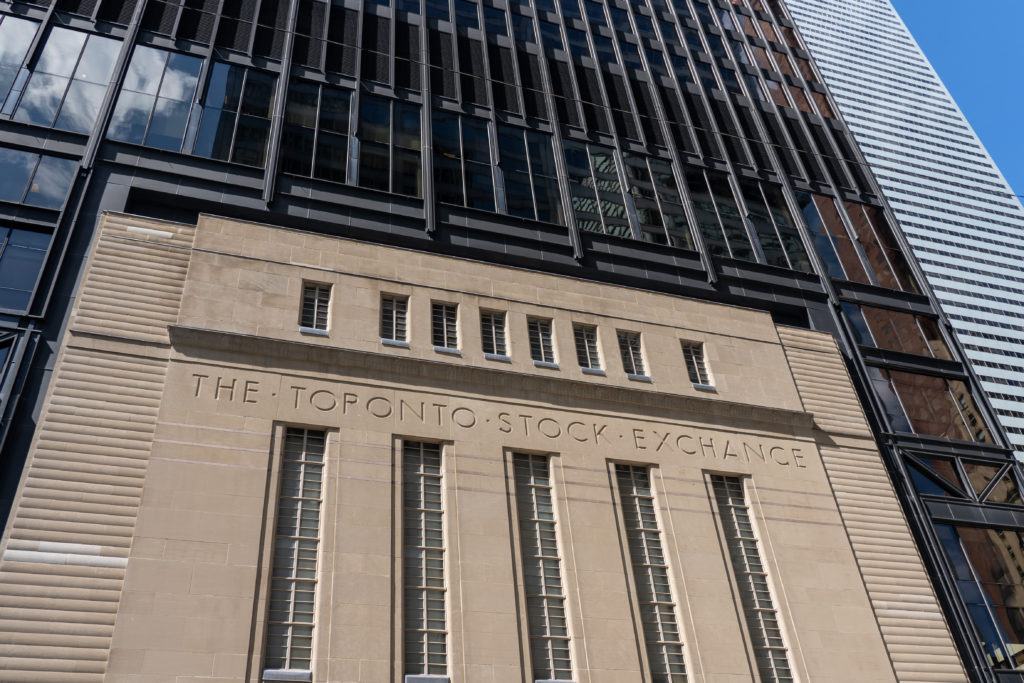
Volatility from trade tensions with the US kept a lid on Canada’s market for equity deals in the first quarter, even as activity in precious metals perked up.

Canada-listed firms raised just $2 billion in the first quarter, compared to the $2.9 billion raised during the same period a year ago, data compiled by Bloomberg show. Investment bankers say market gyrations wrought by the US-Canada trade war have made dealmaking difficult.
“Whatever thesis you have for making your investment today could be very different from a month, an hour, a year from now,” said Grant Kernaghan, chief executive officer and chairman of Citigroup Global Markets Canada Inc. “This is not, for the most part, a positive backdrop just because there’s too much volatility.”
The cooling market dashed the hopes of some dealmakers who saw green shoots in 2024, including an initial public offering that ended an 18-month dry spell and a steady flow of deals for existing shares.
Companies weighing a share sale today believe the price they’ll get might fluctuate wildly with every conflicting headline, and that uncertainty also dampens buyer sentiment, Kernaghan said. That’s why investment bankers have been very picky about when they bring deals to the market, and it’s also why deals that take longer to market — like IPOs — could be delayed, leading potentially to a further slowdown in activity.
“There have been some very good days,” said Daniel Nowlan, managing director of equity capital markets, corporate and investment banking at National Bank Financial Markets. He pointed to Swiss Re’s C$655 million ($455 million) sale of its 10% stake in Definity Financial Corp., a Canadian insurer, announced March 18.
“For a company that’s not very liquid, it went very well with great names in the book,” Nowlan said. “But it’s one of those things where we had to pick exactly the right day to be able to do it.”
One bright spot in the market has been miners of precious metals. Precious metals companies raised $1.1 billion in Canadian markets in the first quarter, more than four times the amount in the same period last year, according to data compiled by Bloomberg. Discovery Silver Corp.’s C$247.5 million deal is Canada’s biggest equity raise so far this year.
“It hasn’t been a surprise given gold’s strength recently,” said Mike Wang, portfolio manager, ECM and options with Periscope Capital Inc. in Toronto. The increase in activity in materials has prompted the firm and its Periscope Capital Multi-Strategy Fund to focus on it, he said.
“There are certainly sectors within mining that would have no problem coming to market right now and raising equity, but outside of that, I think it’s certainly very challenging,” Citigroup’s Kernaghan said.
(By Geoffrey Morgan)
.jpg)


No comments:
Post a Comment