Ukraine: Not a Proxy War

The Ukrainian people are currently fighting against Russia’s brutal invasion and the occupation of about twenty percent of its territory. The war remains today what is has been from the beginning: A war of national self-defense and self-determination against Russian imperialism as Vladimir Putin attempts to reduce Ukraine to its former colonial status under both the Tsarist and Soviet empires. From the start of the war Ukraine, like any nation in such a position, has had the right to obtain arms wherever it can get them, despite the fact that the U.S. provision of arms and intelligence could influence and pressure Ukraine. And the right to self-defense remains despite the fact that the Ukrainian people are simultaneously challenging the neoliberal policies of the Zelensky government.
Now, thanks to a New York Times analysis by Adam Entous, “The Partnership: The Secret History of the War in Ukraine,” published on March 29, we have new information about the extent of U.S. military assistance. The Russian press and pro-Putin media have been crowing about the article, claiming it somehow invalidates Ukraine’s war of self-defense.
But while the article provides us with the story of the U.S.-Ukrainian military relationship in the Biden years in remarkable detail, significantly it provides no evidence of U.S. political control of the war, let alone that Washington pressed Ukraine to fight on when Kyiv preferred to throw in the towel. The article recounts the continual disagreements and tensions between U.S. and Ukrainian generals, as well as among Ukrainian political and military leaders. Most of those tensions arose from Ukraine’s legitimate and understandable desire to drive the Russian invader from its territory and, importantly, to free Ukrainians in the occupied territories from the oppression they have been enduring, on the one hand, and the U.S. concern about the dangers of a wider, even a nuclear, war, on the other.
At the center of the article is a long discussion of the attempted Ukrainian counteroffensive of 2023 that ended in “stillborn failure.” Entous shows that Zelensky chose to follow the advice of his ground forces commander to deploy forces to the unsuccessful effort to defend Bakhmut, rather than concentrate forces for a push to the south as urged by both his own supreme commander and the Americans, effectively scuttling the counter-offensive.
There followed more tensions and rifts among the Ukrainians. Never in the course of reading this article does one have the sense that the Americans were dictating to the Ukrainians. And that, of course, is the key issue.
Early on in the article, Entous writes, “In some ways, Ukraine was, on a wider canvas, a rematch in a long history of U.S.-Russia proxy wars — Vietnam in the 1960s, Afghanistan in the 1980s, Syria three decades later.” But his article does not substantiate that claim.
What is a proxy war? One in which the parties doing the fighting are not the ones calling the shots. So the Soviet Union and China provided arms to North Vietnam – as they should have – but the decision to resist the American aggression was made in Hanoi and among the South Vietnamese, not Moscow or Beijing. Likewise, Ukrainians are fighting not because any foreign power compelled them to do so, but because they value their own national survival. In the Biden years, the United States supported Ukraine for its own motives—to weaken and prevent the expansion of Russia and to strengthen its relationship with its NATO allies and with the European Union and its economy. Washington and its generals proved incapable of forcing the Ukrainians to do what they thought was best strategically for American goals and never was able to take control of the war politically.
Today, the situation is quite different. At the moment, Pres. Donald Trump is attempting precisely to take control, forcing a solution that essentially splits the spoils of Ukraine between the United States and Russia, with Washington getting mineral rights of the sort that great powers have often demanded of their colonies and Russia getting big chunks of Ukrainian territory, including its population and resources. Putin would also strip Ukraine of its autonomy, denying it the right to join NATO or the European Union. It is Trump’s support for Putin’s position that forms the basis for a broader U.S.-Russian partnership that would threaten other European nations. So Ukraine’s fight for its sovereignty is as important as ever.
But as important as Ukraine’s struggle is for the long-term security of other European countries, the latter could not induce Kyiv to soldier on if Ukrainians themselves didn’t see the value of resisting Russian subjugation. Unfortunately, given the military imbalance between Russia and Ukraine, Ukraine cannot carry on their war of self-defense if other nations don’t contribute arms. We will have to organize to insist that the arms keep flowing until Ukraine can attain the just piece that the majority of the Ukrainian people so desperately desire.
New York Times Throws Ukraine Under the
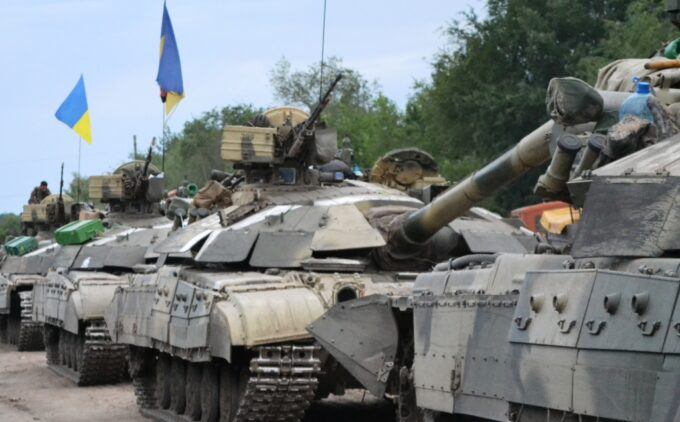
Photograph Source: Ministry of Defense of Ukraine – CC BY-SA 2.0
In a practice that might seem quaint if it weren’t so murderous, the American uniparty is currently assigning party colors to its ‘boutique’ wars in Ukraine and West Asia. While these wars were arguably started by, and are being prosecuted by, the United States, the powers that be in the US have apparently determined that branding them by team color (Red v Blue) would effectively preclude the development of a national anti-war response.
In this light, the (New York) Times recently shat out the second installment of its ex-post recitation of CIA talking points crafted with a method that I call ‘cat-litter journalism.’ The focus of the new Times’ piece is the American war in Ukraine. Should this read as a misstatement to you, that maybe it is a war between Ukraine and Russia, tell it to the New York Times. The gist of the Times piece is that the Americans would have won the war if it hadn’t been for the Ukrainians.
The phrase ‘cat-litter journalism’ refers to the near-random assemblage of earlier reporting by the Times that has been reassembled to convey the illusion that its ‘reporting’ ties to any determinable facts. Deference to authority is another way to describe the piece. Without footnotes and / or links, the assertions made in the piece are a compilation of the least plausible state propaganda of recent years crafted for the post-election political dynamic.
‘In some ways, Ukraine was, on a wider canvas, a rematch in a long history of U.S.-Russia proxy wars — Vietnam in the 1960s, Afghanistan in the 1980s, Syria three decades later.’ nytimes.com’ 3/29/25.
For readers upset by the prospect of their favorite war losing its luster, fear not. The political logic of Donald Trump’s rapid policy dump upon entering office is the ethereal nature of Presidential power. For good and not-good reasons, Mr. Trump is about to hit a wall of institutional pushback. Further, his ‘peace through strength’ schtick (borrowed from Richard Nixon) is a serious misreading of the current political environment.
The reason why New York Times reporters are acting like rats fleeing a sinking ship with respect to the CIA’s war in Ukraine is that the Ukraine ship is sinking. Don’t take my word for it. The new US Intelligence Assessment for 2025 states 1) that Ukraine (the CIA) has substantially lost the conflict, and 2) nothing that the West has at its disposal will turn the situation around. Having a chair to sit in when the music stops is the political needle being threaded.
Russia in the past year has seized the upper hand in its full-scale invasion of Ukraine and is on a path to accrue greater leverage to press Kyiv and its Western backers to negotiate an end to the war that grants Moscow concessions it seeks. dni.gov.
The political logic of parsing the war in Ukraine from the genocide in West Asia goes like this, 1) by US calculations, there is no way for the West to prevail in Ukraine, and 2) attending to the denouement in Ukraine when a promise of genocide has been sold to a foreign adversary (Israel) requires operational consolidation. Once the US moves outside of Gaza (it already has), Greater Israel begins to resemble Poland on August 31, 1939.
For those who may have forgotten, here is the leader of the Blue Team telling us that ‘Putin has already lost the war’ in mid-2023. Two years later, the New York Times is belatedly informing us that it was the Ukrainians who lost the war; that the US is blameless, if not heroic, for its ‘support’ of Ukraine; and that maybe the US should have gotten one-million citizens of a more deserving nation killed for the privilege.
That British ‘intelligence,’ MI6, was active in both the Russiagate fraud and in maintaining friendly relations with Ukrainian fascists from 1944 to the present so that they were available for service in Ukraine 2013 – present, argues for ending the Five-Eyes Alliance and criminally charging the Brits for interfering in American elections. The problem is that the Western ruling class has demonstrated itself to be immune from public sanction.
That the leader of the Blue Team was the largest recipient of legal bribes from supporters of Israel in Congress unites him in a deep moral commitment to genocide with Donald J. However, in the American terms of discourse in 2025, Donald Trump ‘got the better deal.’ Miriam Adelson contributed $150 million to Mr. Trump’s 2024 campaign, with $100 million of it reportedly dedicated to improving the lives of Western arms dealers. Joe Biden only got four million dollars for his genocide.
This ‘genocide for hire’ posture of America 2.0, where US foreign policy does the bidding of foreign adversaries in exchange for specific payments to specific politicians, might seem irredeemably corrupt. In fact, it is irredeemably corrupt. However, there is a political term— ‘imperialism,’ that rehabilitates corrupt acts under the nuevo-scriptural precept of ‘kick their ass and steal their gas’ that is emerging from the gold toilet crowd.
Were it not for the earlier ‘coming-clean’ piece from the Times that began in the aftermath of the US – British coup in Ukraine in 2014, the US timeline found in the recent Times article would be inexplicable. How could the timelines match US state propaganda so perfectly given that between the two articles, pretty much everything that the Americans and Brits said about the conflict was later restated in materially different terms?
Further, as the vile, offensive, and yes, fascistic, efforts by the Trump administration to quell domestic rebellion against corrupt acts by politicians taking money from adversarial foreign governments to commit genocide, the ship of state is struggling. Threatening Americans with deportation, imprisonment, and being disappeared for expressing their constitutionally protected right to object to these policies is profoundly anti-American under the existing terms of discourse.
Ominously for we, the people, Donald Trump was able to extract far more money than Joe Biden was for a roughly equivalent genocide (thus far). Yes, under US law, American politicians can take money from adversarial foreign governments which personally benefits them, and not the United States, in exchange for the promise that the US will commit genocide against foreign nationals for the benefit of other foreign nationals. Question: where is MAGA on this?
If any of this suggests a path out of the current mess through electoral politics, the evidence doesn’t support that conclusion. Here is one of the several pieces that I wrote in and around early 2019 where I correctly argued that were Joe Biden to be elected, he would fail to govern and that Donald Trump, or someone worse, would follow Biden. That is what happened. I was right, and the DNC just reelected Donald Trump.
For those who don’t see it yet, Donald Trump is in the process of imploding politically. His economic policies, which share quite a bit with Bill Clinton, Barack Obama, and Ronald Reagan, are ideological— based on a group of like-minded people sitting around making shit up with no one to challenge them. He doesn’t understand basic economics well enough to avoid the catastrophe-in-the-making that his policies will produce.
Firing tens of thousands of Federal workers without a coherent plan to reemploy them both raises the unemployment rate and lowers wages. As I’ve previously written, adding former Federal employees to the unemployment line increases the number of workers vying for a limited number of jobs, thereby leading the most desperate to accept lower wages. Rising unemployment and falling wages is a recipe for electoral defeat.
With respect to liberal fears of a Fourth Reich, ex-CIA Larry Johnson and others familiar with military production argue that the lead time from cold start to having weapons in hand is a decade. When existing facilities can be used, this lead time can be reduced to three years. In its wisdom, the US began firing its skilled manufacturing workforce in the 1970s. Skilled work in 2025 is ‘influencing’ teenagers to buy Viagra for their pet gerbils on YouTube.
When Mr. Trump references ‘peace through strength,’ he asserts that while his aim (‘peace’) is virtuous, his method will be the threatened or actual use of violence to achieve it. The social logic is that the party being threatened has a choice to surrender or be killed. This framing has been used by repressive power for millennia to claim that political repression maintained through violence is ‘peace.’ In so doing, the term is emptied of content. The definition of peace is reduced to ‘not death.’
The political benefit of this approach for empires is that it frames repressive political power as a defense of peace, and its opponents as the instigators of violence. In history, the US is only two generations from the ‘Indian Wars,’ where innocent settlers ‘were overwhelmed and slaughtered by ignorant savages,’ for those who buy Hollywood’s version of the history. Howard Zinn’s A People’s History of the United States and Robert Hughes’ The Fatal Shore illustrate the genocidal versions of this view-from-power of ‘peace.’
How the phrase (peace through strength) was heard on the campaign trail by Mr. Trump’s constituents was likely through the anti-historical fantasy that the US has won the wars that it has engaged in since WWII. As actual history has it, it was the Russians who won WWII. Richard Nixon used the term, combined with his claim that he had a ‘secret plan’ to end the US war in Vietnam. He didn’t. Nixon ended up expanding the war to Laos and Cambodia before the ignominious ‘fall of Saigon’ in 1975.
With respect to the US proxy war in Ukraine, the precise social logic of Mr. Trump implying that the Biden administration was ‘weak’ in threatening imminent nuclear annihilation in the latter days of the administration begs the question of what the word means? Is ending the world a sign of strength? To whom? Who would be alive to judge the matter, and what would be the consequence of any such judgment?
One might have imagined that Times readers previously burned by its fraudulent reporting regarding Iraq’s WMDs and Russiagate would have felt ‘twice bitten, thrice shy’ with respect to its Ukraine reporting. Implied in the steadfastness of its readership is that getting true information about the world isn’t— is not, why its readers read the Times. Or perhaps, Times readers like their news several years after the fact, when it can be found in the ‘corrections’ section.
The residual purpose of the New York Times is to demonstrate that Pravda in the waning days of the Soviet Union is the model to which the American press aspires. But this is only a ‘press’ story to the extent that the volunteer state media in the US doesn’t require threats to carry water for power. They want to do so. It gives them purpose, and the occasional invitation to the right dinner party.
I wrote early on in the US war in Ukraine that the Ukrainians ‘would rue the day that they ever heard of the United States.’ With the New York Times now blaming the Ukrainians for the American loss against Russia, they join the Palestinians in being tossed onto the garbage heap of empire. So are the Russians. The difference is that the Russians can take care of themselves. That is why American imperialists hate Russia so much. They don’t control it.
The Ghost of Russia’s Hybrid Warfare in Europe
Sabotage, espionage, propaganda: Russia is supposedly already at war with Europe. How European elites and Western media keep pushing a dangerous but false narrative.
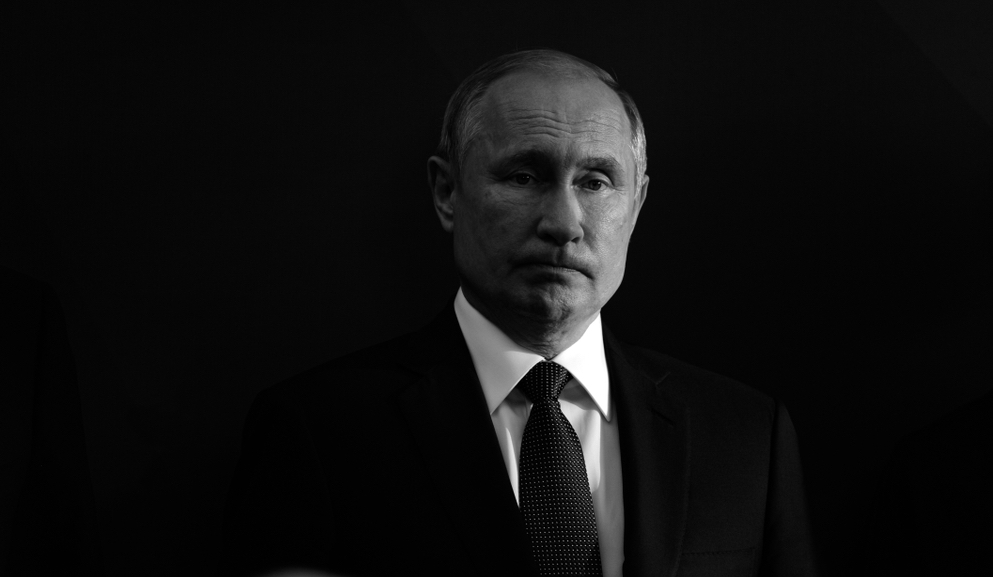
YEREVAN, ARMENIA - 1 OCTOBER 2019: Russian President Vladimir Putin attends a meeting of the Supreme Eurasian Economic Council in Yerevan, Armenia.
On March 19, 2025, the Inspector General of the German Bundeswehr, Carsten Breuer, and the professor of international politics and military expert Carlo Masala were guests on the prominent TV talk show Maischberger of the public broadcasting network ARD with millions of viewers. They explained to the German audience that Russia is preparing for a major war.
Masala described a scenario in which Russia could start with a small attack, for example on the city of Narva in Estonia, which is right on the Russian border, a mixture of “hybrid activities, very limited military actions, sometimes with ‘little green men’ [soldiers without marked uniforms, as during the annexation of Crimea in 2014], in this sense hybrid, where in the end a city of 50,000 inhabitants was taken, with the argument of protecting the Russian minority.”
Against this background, the question arises, Masala continued, of whether NATO and in particular the USA under president Donald Trump would start a full-scale war against Russia for the sake of a small city.
Inspector General Carsten Breuer added that Russian units were already being strengthened on the Western border – in preparation for a major attack. It is the intention of Russian President Vladimir Putin not to stop at Ukraine.
Russia is Already Attacking Europe
For the Bundeswehr general, it is clear that Russia has long been attacking Europe. He points to drones over army barracks and chemical parks, as well as increasing acts of sabotage and espionage.
“This is part of the hybrid warfare. The idea is to gain access for a possible larger war. So they want to know how to attack. And on the other hand, they want to create insecurity among the population. (…) We see the threat and have to counter it with something.”
In view of the hybrid warfare and the danger of a major war, Breuer and Masala are calling for a massive and urgent rearmament of Germany and the EU. It is now imperative to have the Bundeswehr comprehensively expanded and modernized in just four years, because Putin will be capable of a large-scale war by 2029.
Farewell to the Proxy
The view that Russia is already at war with Europe, albeit in a hybrid or small-scale way, is not new. As early as September 2022, Susan Glasser, a political columnist for The New Yorker magazine, and Fiona Hill, who served on president Trump’s first term National Security Council, stated that “we are already fighting World War III with Russia,” even if it is not admitted.
It is certainly true that a proxy war is taking place in Ukraine between the US-led West and Russia. This was already the case during the Cold War with the Soviet Union, albeit in different ways. But blurring the line between a shadow war and a direct military confrontation, a distinction both sides have strictly adhered to since the Cold War, is dangerous and irresponsible, as Anatol Lieven, Eurasia expert at the Quincy Institute, notes.
“It suggests a universal threat, and the need for, and the possibility of, absolute victory over absolute evil, as in World War II. But the war in Ukraine is nothing like that.”
The Rise of “Hybrid Warfare”
The term “hybrid warfare” has gained remarkable prominence with the Ukraine conflict since 2014 and especially since Russia’s invasion of Ukraine over three years ago, bringing into focus Russia as an imminent threat of war to Europe and NATO.
On March 20, Foreign Affairs published an article titled: “Arsonist, Killer, Saboteur, Spy. While Trump Courts Him, Putin Is Escalating Russia’s Hybrid War Against the West”. Peace talks in Ukraine seem therefore misguided as it is alleged that Moscow has already brought the war in Ukraine to Europe. While the insinuation of hybrid warfare makes Russia appear as an aggressor confronting the entire continent, there are calls to finally prepare for war.
War without War
But the assertion of Russia’s “hybrid war” against Europe encounters several problems. Whatever one thinks of the term itself (more on this later), there is no war Russia is fighting against EU or NATO states. Hence, there is no hybrid war either, a concept that is based on a mixture of regular and irregular, military and non-military means of conflict. So, unless one implies that Russian forces already fight British, German, French or NATO troops the essential ingredient for warfare is missing.
What is really happening is that political leaders, pundits and media focus on the alleged non-military means of Russia in Europe, i.e. “actions in gray areas” that affect the civilian sector (politics, economics, public opinion) – whereby the causer is often obscured like with espionage, sabotage, covert propaganda or cyberwarfare – in order to fabricate a war or an impending one even though there is none. In this sense every suspicion, every photo of an army barrack by a Russian, every damaged internet cable in the Baltic Sea is presented as part of a grand military strategy of the Russian president to wage war against Europe – first covertly, then openly.
Panorama of Horror
The media especially in European countries have not grown tired in recent years of unfolding a panorama of espionage and sabotage acts by Russia against European societies. The secret services are repeatedly referred to, who explain that Russian hybrid destabilization attempts are on the increase. Western experts on hybrid warfare are being interviewed, who speak of a “huge number of stiches” by Russia in Europe, with the Kremlin planning to be able to “finalize” them militarily as well.
On December 23 last year, the German weekly Die Zeit published a detailed chronology of the most important cases of hybrid warfare in Europe since 2022. It describes over 70 incidents in countries such as Germany, France and Poland, ranging from minor incidents to sabotage. The dossier states:
“Russia has long been at war with Europe – and not only with Ukraine. Any state that supports the Ukrainian government is an enemy for the rulers in Moscow that must be fought. The aims of this hybrid war, which is being waged against the people of the West with many means and in many places, are to sow uncertainty, instill fear, create divisions and undermine. It began with espionage and graffiti, with disinformation and lies. Then, with increasing attacks on critical infrastructure.”
When Suspicions Are Not Confirmed
Looking at the cases listed, it is often unclear who is specifically behind the actions. Most of them are suspicions, with no evidence that the Russian leadership is behind them.
But that doesn’t stop the media from categorizing the incidents as “Russian hybrid warfare” Ultimately, the narrative of a hybrid war in Europe consists of a widely accepted and practiced reporting based on suspicion, fed by secret services, ministries and investigators who make unverifiable accusations.
Just to take one example: when unknown persons cut two important DB German Railways communication cables in October 2022, there was immediate talk of a Russian attack. But the fact that the Russian government was behind it was pure speculation.
Later, in June 2024, it turned out that two criminals suspected of wanting to steal the cables were behind the attacks. The cases are considered to have been solved: no foreign state is responsible, according to the public prosecutor’s office in charge.
However, in its list of Russian hybrid actions, published at the end of 2024 and updated on March 3, 2025, Die Zeit continues to claim – counterfactually – that there is suspicion of sabotage in the case of the railway cable damage, implying that Russia remains the focus of the investigation. Not a word about the crime being solved.
Every Russian Acts on Behalf of the Kremlin
In other cases, there is at least circumstantial evidence that implicates a connection to Russia (though not the Russian state). During the German election campaign, the exhaust pipes of 270 vehicles were sprayed with foam, rendering them inoperable. Initially, it was assumed that the act had been committed by climate activists.
According to the police one of four suspects stated, that he had received instructions from a cell phone in Russia. The Spiegel speaks of “junk agents” who were recruited with money from Russia.
Foreign Minister Annalena Baerbock was immediately certain that Russia was behind the alleged sabotage. Meanwhile, the Federal Ministry of the Interior stated that so far there is no concrete evidence of Russian clients.
Even if some kind of connection to Russia can be proven, it is a long way to claiming that the Russian government is waging hybrid warfare with these acts. Unless one assumes that every Russian acts in the name of the Kremlin and that every action of the Russian government or secret service agents is embedded in a war strategy against Europe.
The Baltic Sea Cable Affair
In other cases, the accusations against Russia petered out. At the end of 2024, communication, energy and electricity cables in the Baltic Sea that connect European countries were damaged by cargo ships. This triggered a wave of political outrage.
While Moscow has repeatedly rejected the accusation of sabotage against Western infrastructure, in Europe Russian acts of sabotage are again assumed, albeit without evidence.
NATO Secretary General Mark Rutte spoke of “hybrid warfare” and “sabotage” that must be deterred. German Defense Minister Boris Pistorius agreed. In a joint statement, the foreign ministers of Germany, Poland, France, Italy, Spain and the United Kingdom accused Russia of “systematically attacking European security architecture.”
“Moscow’s escalating hybrid activities against NATO and EU countries are also unprecedented in their variety and scale, creating significant security risks.”
Futile Search for Saboteurs
As early as January, however, a consensus was emerging between the security services of the United States and Europe that the damage on the seabed was the result of accidents and not Russian sabotage, as reported in the Washington Post. Finland released the oil tanker that had been accused of damaging the power cables.
On March 8 of this year, the Wall Street Journal finally reported that NATO was looking in vain for undersea cable saboteurs, but found no evidence. However, most of German and European major media outlets are not interested in such news, which questions NATO’s narrative of Russia’s hybrid war of sabotage in the Baltic Sea, while continue to talk about sabotage.
The list of vague suspicions against Russia could be continued for a long time. When a DHL airplane crashed in Lithuania on November 25 last year, it was again wildly speculated that it was a Russian terrorist attack. The German Foreign Ministry and many others spoke again of a possible hybrid attack. Evidence, even proof?
On March 26 the investigating prosecutors in Lithuania declared that the crash was likely caused by an error of the Spanish pilot who is now the suspect in the case. “Other versions of the accident were refuted by the data obtained during the investigation,” the statement of the prosecutors reads.
The War Front: Graffities and Suspicious Russians
The alleged hybrid warfare of the Russian government, which has been defined as the security threat in Europe, ultimately consists of a hodgepodge of suspicions, some of which quickly dissolve into nothing. Let us recall the blowing up of the Nord Stream pipelines in 2022, which was initially blamed on Russia, while it soon became clear that the investigative leads point to Ukraine and even to the United States.
In addition to the high-profile cases of sabotage orchestrated by the media, which target the Russian government as the aggressor, a flood of smaller incidents is simultaneously being woven into a web of hybrid Russian attacks against the Europeans, in which it is also often unclear who the perpetrators are, not to mention the lack of a Kremlin connection.
The chronology of Die Zeit on Russian hybrid actions contains a whole series of mostly insignificant incidents, including “suspicious vehicles” that were registered in front of army barracks, or drones circling over bases, graffiti on Berlin walls calling for an end to the war in Ukraine, or social media campaigns.
The Media Battlefield
If you ask yourself: What has the Kremlin verifiably done in the last three years since the outbreak of the war in Ukraine in terms of sabotage and so called “hybrid actions” in Europe that pose a threat to the stability of EU states, then you likely come up empty-handed.
One would think that if Russia has been waging a hybrid war against Europe for over ten years, at least according to the prevailing narrative, then something of this unprecedent security threat should be noticeable. But beyond the media battlefield, there are no signs of destabilization.
No Peace Allowed
As for the term itself: it is nothing new that states not only act militarily in war, but also use non-military means – from propaganda and covert actions to sabotage – to achieve their war aims. Therefore, a number of researchers reject the notion that hybrid warfare is a new form of warfare. At the same time, the term, which emerged in the course of the US anti-terrorism wars, is criticized for its ideological orientation.
The argument is that the concept attempts to extend the right to military force to non-belligerent conflict situations. A whole range of terms such as “borderless war,” “asymmetric war,” “operations other than warfare,” “new kinds of battlefields,” and “irregular war” have been introduced with the aim of blurring the boundaries between peace and war.
According to this definition, war does not only take place when two states fight each other militarily with a certain intensity, but rather it starts with espionage activities, PR activities and acts of sabotage. However, according to critics, this is not compatible with international law and entails a dangerous expansion of war.
The Myth of Hybrid War
According to Mary Ellen O’Connell, a professor of law at the University of Notre Dame in the US and an expert on the topic, the crux of the matter is not how the war is waged (and in the past, wars have always been waged in a “hybrid” fashion), but whether it is a war at all, which is linked to clear conditions (and thus also to corresponding rules and counter-measures). She speaks of the “myth of hybrid war”, while clarifying to what extent it makes sense to speak of a “hybrid war” in relation to Russia:
“Russia’s varied conduct in Ukraine can be termed as ‘hybrid warfare’ when it is integral to the actual organized armed fighting that is occurring in Ukraine.”
Germany is not Crimea
The important thing here is “in Ukraine” and integral to “fighting … in Ukraine”. Under these conditions, non-military methods can become part of warfare in Ukraine, according to O’Connell, such as the “little green men” in Crimea, propaganda campaigns in Ukraine, espionage, the use of irregular forces, corruption and various coercive measures beyond military action.
But Germany, France or Poland are not Eastern Ukraine or Crimea and have not been at war with Russia. As Russia experts repeatedly have pointed out, there are no intentions and strategies in Moscow to invade EU or NATO states, not to mention the lack of means to wage war beyond eastern Ukraine. But it is precisely this suggestion that is spread through the narrative of a hybrid war against Europe.
Cold War Conspiracy 2.0
Murat Caliskan, a senior researcher at Beyond the Horizon International Strategic Studies, a Belgium-based organization, believes the discourse around hybrid warfare is misleading. He criticizes that every Russian action is interpreted as part of a well-coordinated “hybrid warfare” campaign – similar to US President John F. Kennedy’s warnings of a grand conspiracy in Moscow during the Cold War of the 1960s.
At the time, Kennedy spoke of the enormous capacity of the Soviet Union to attack the West using “covert means”, “intimidation” or “infiltration”. “It is a system which has conscripted vast human and material resources into the building of a tightly knit, highly efficient machine that combines military, diplomatic, intelligence, economic, scientific and political operations,” Kennedy alerted the West.
Today, Moscow once again appears to be omnipotent, with its alleged monopoly on covert, indirect methods that Europe has no way of countering. For Caliskan, the talk of a hybrid war is a false label that the West is imposing on Russia.
The West’s Hybrid War
Furthermore the label is selective, while the focus on Moscow distorts the balance of power and the fact that it is not Russia, but the United States that is actually the master of hybrid warfare.
One only has to look at the indirect and covert methods used by Washington and its allies in recent decades, ranging from drone and dirty wars, private armies, cooperation with militias, financial blackmail of states, massive espionage (see the NSA scandal or the German BND program, which has been used to spy also on friendly states, the White House, the Vatican, international organizations and foreign journalists), to economic sanctions, propaganda, political influence on elections and support for uprisings and revolutions in former Soviet states.
Furthermore, the public debate in the West only focuses on Russia’s alleged hybrid warfare against Europe. Similar methods used by the West against Russia to put pressure on Moscow are not included in this category.
But the US and NATO countries also engage in espionage, PR and political influence against Russia. Adopting conventional standards, the NATO expansion to the east, the support of the Maidan uprising, the manifold sanctions against Russia, the military support of Ukraine since 2014 and the deployment of special forces and CIA employees should also be seen as hybrid tactics directed against Moscow.
The Kremlin’s Actual Doctrine
Russia itself does not describe its actions in Ukraine as hybrid warfare. Nor is Russia’s military doctrine geared towards such actions, as Michael Kofman and Matthew Rojansky of the Kennan Institute at the Wilson Center in the United States emphasize.
The frequently quoted words of the Chief of the General Staff of the Russian Armed Forces, Valery Gerasimov, from 2013, to pay more attention to non-military means, merely expressed a reminder to the Russian leadership to keep pace with Western warfare methods since its Global War on Terror. They are by no means proof that Russia has focused on a hybrid strategy, according to Kofman and Rojansky.
The term hybrid warfare is “as amorphous as the phenomenon it describes,” explained Florian Schaurer, then a strategy development officer at the German Ministry of Defense, as early as 2015. A study shows that in 66 examined media articles in which the term “hybrid warfare” was used, it was only applied correctly in 18 cases. Schaurer concludes that the term has lost some of its “analytical depth” in media use in connection with the Ukraine conflict and is now used primarily as a “political slogan”.
The Legend of the Superior Enemy
This applies all the more today, since the term has been extended beyond the borders of Ukraine to the whole of Europe, but only selectively for Moscow. By this, the narrative that Russia is already waging war on the European continent – albeit covertly and indirectly, or in preparation for an all-out war – is pushed forward.
Of course, we can fairly assume that Russia is interfering in Europe, engaging in espionage and trying to influence public opinion. That should come as no surprise. But Moscow’s room for maneuver is very limited and its actions are usually quite ineffective, as studies show. The US and NATO countries have a much more extensive arsenal of coercive and intervention measures at their disposal worldwide – and also a much greater reach of power.
It should become clear: Russian actions have nothing to do with a war against Europe. We are only talking about hybrid warfare in Europe because politics, the military, the secret services and the media want us to. Following this line of thought makes no sense and ultimately promotes solutions that could actually destabilize the continent.
ZNetwork is funded solely through the generosity of its readers. Donate
David Goeßmann is a journalist and author based in Berlin, Germany. He has worked for several media outlets including Spiegel Online, ARD, and ZDF. His articles have appeared on Truthout, Common Dreams, The Progressive, Progressive International, among others. In his books, he analyzes climate policies, global justice, and media bias.

No comments:
Post a Comment