
Erik De La Garza
May 10, 2025
RAW STORY
A new op-ed published Friday suggested that the election of Pope Leo XIV – the first American pope – could pose challenges for U.S. politicians like Vice President JD Vance, who have aligned themselves with Catholic ideology.
That’s according to Commonweal editor-at-large Mollie Wilson O’Reilly, who argued Friday that Pope Leo’s American roots and fluency in English remove longtime language barriers between the Vatican and American elected officials. Unlike his predecessors, she told readers, the new pope is expected to speak directly to American Catholics.
“There will be no opportunity for anyone to soften his remarks with ‘What the Holy Father meant to say…’” Wilson O’Reilly wrote in an MSNBC op-ed. “This is certainly bad news for Catholics like Vice President J.D. Vance, who want to use church teaching to serve authoritarian ends.”
She added: “Perhaps the cardinals liked the idea of an American pope who can condemn human rights abuses and call for restitution and repentance in words that will not need translating.”
The columnist went on to tell readers Friday that the new, native English-speaking pope, “surely recognizes the need to be shrewd in dealing with American politics.”
“If and when he speaks directly to America, it will be because he has something important to say,” she concluded.
The only question left, according to O’Reilly, will be: “ Are we prepared to listen?”
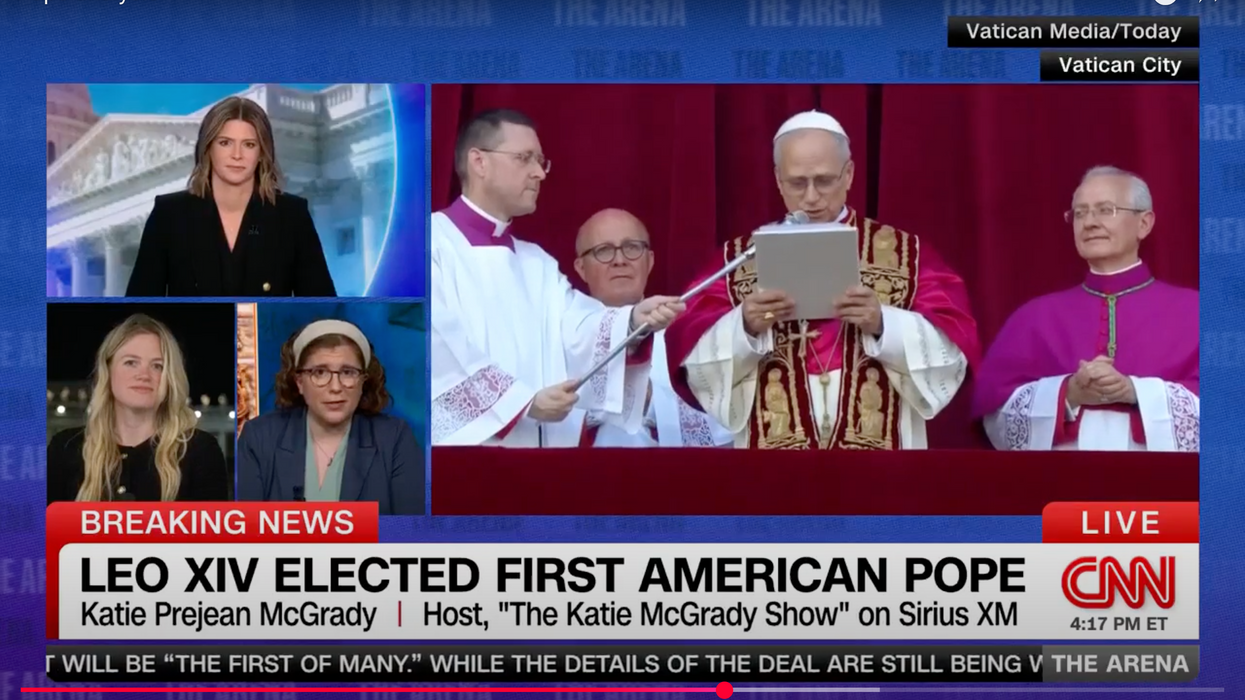
Vatican analyst Katie McGrady on CNN on May 8, 2025. (screengrab)
Vatican analyst Katie McGrady has said Cardinal Dr. Robert Prevost, who was elected to be the new pope Thursday, "has the training to put all of the loud American Catholics in their place."
She added that Prevost's training is as a canonist. "He's a canon lawyer. He knows the teachings of the church and the laws of the church very intimately. He has his doctorate," McGrady noted during an appearance on CNN Thursday.
She continued, "He was on mission to Peru while he was writing his doctoral dissertation, so he's a man who can clearly multitask."
"If anybody is going to be able to speak with clarity, it's a canonist missionary who has his bachelors of science degree," McGrady said.
New York Times reporter Elizabeth Dias noted earlier during the segment that there have been mixed reactions from Americans on different sides of the political spectrum regarding the new pope. "People are trying to sort out what they make of who he might be. Both camps—conservative and liberal—are hoping that the signal from the name he chose, Pope Leo the 14th, might indicate that he will be a champion of their priorities," she said.
"I've heard from both sides. On the conservative side, some say that the name suggests he will emphasize moral clarity. On the liberal side, others think he might represent the social justice aspect of the Church," Dias added.
Earlier on Thursday, Cardinal Prevost was chosen as pope on the second day of the conclave, becoming the head of 1.4 billion Roman Catholics. He made history by becoming the first American pope.
Upon assuming his role, he welcomed his congregation with the words, “Peace be with you.”
Watch the vide below or at this link.
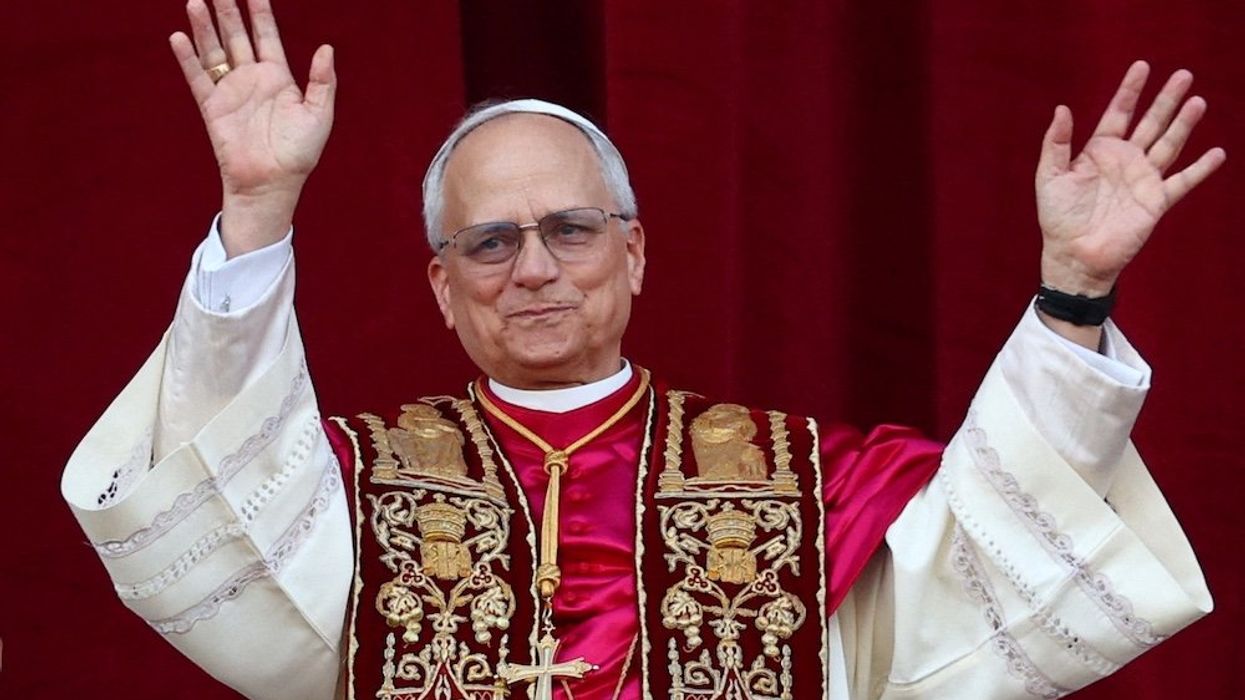
Newly elected Pope Leo XIV, Cardinal Robert Prevost of the United States appears on the balcony of St. Peter's Basilica, at the Vatican, May 8, 2025. REUTERS/Guglielmo Mangiapane
ALTERNET
Cardinal Dr. Robert Prevost has officially taken the name Pope Leo XIV, becoming the first American head of the Catholic Church in history. And a tweet Prevost wrote earlier this year about Vice President JD Vance is going viral.
In February, Prevost amplified an op-ed published in the National Catholic Reporter in which author Kat Armas criticized the vice president (who converted to Catholicism in 2019) over his remarks suggesting there was a hierarchy of Christian priorities. Vance told Fox News in late January: "There is a Christian concept that you love your family and then you love your neighbor, and then you love your community, and then you love your fellow citizens, and then after that, prioritize the rest of the world. A lot of the far left has completely inverted that."
Prevost's tweet repeated the headline of the op-ed: "JD Vance is wrong: Jesus doesn't ask us to rank our love for others."
"[The Apostle] Paul reminds them: love starts close. It moves first toward those in front of us, ensuring widows were not abandoned while preserving the church's resources for those truly without support," Armas wrote in the op-ed. "But make no mistake — this isn't about love confined to bloodlines or geographic boundaries. It's about love rooted in responsibility, expanding outward. And it was subversive even then."
Prevost/Leo XIV's tweet lit up social media, with various journalists and commentators like Democratic strategist Matt McDermott celebrating "our new woke pope."
"Well this will be fun," Independent D.C. bureau chief Eric Michael Garcia tweeted.
"Get in loser we're combing through the new pope's old tweets," Business Insider senior politics reporter Bryan Metzger tweeted.
Dan Cluchey, who was a speechwriter for former President Joe Biden, also celebrated the tweet by observing that the "new pope already upholding the only tradition that matters: s----ing on JD Vance."
"STOP STOP IF I START LIKING THE CHICAGO POPE ANY MORE I'LL FORGET THE REFORMATION," tweeted theologian Dr. Laura Robinson.
Tahra Hoops, who is the director of economic analysis at the Progress Chamber, combed into the op-ed Leo XIV tweeted and opined that he was "abundance-pilled," referring to the political theory that public policy should be oriented around making sure all members of society have a high standard of living.
President Donald Trump has not yet commented on Leo XIV's tweet, but delivered a statement on his Truth Social account writing: "Congratulations to Cardinal Robert Francis Prevost, who was just named Pope. It is such an honor to realize that he is the first American Pope. What excitement, and what a Great Honor for our Country. I look forward to meeting Pope Leo XIV. It will be a very meaningful moment!"
Pope Leo XIV has been described as a potential bridge-builder for a divided Catholic Church, likely to pursue parts of his predecessor’s progressive agenda while reaching out to disgruntled conservatives. From his stance on women’s roles in the Church to his criticism of the Trump administration’s anti-immigrant policies, his past statements offer clues as to which way his papacy might lean.
Issued on: 09/05/2025

Vatican-watchers say the new pope’s choice of name, a tribute to Leo III’s 19th-century pursuit of social justice and reform, points to continuity with many of the causes also championed by the late Pope Francis.
Others have pointed at the traditional red cape and papal trappings Leo XIV sported on his first appearance as pope – garments his predecessor eschewed upon his election in 2013 – as suggesting a return to some degree of tradition after Francis's unorthodox pontificate.
Read morePope Leo XIV: Robert Prevost, from Peru missionary to first American pontiff
Here’s a look at where the Chicago-born former missionary and Peru-based archbishop has stood on some of the key issues roiling the 1.4 billion-member Catholic Church.
Same-sex couples and LGBT+ rights
The new pontiff, born Robert Francis Prevost, is expected to adopt a more cautious stance on the subject of same-sex couples after his predecessor authorised priests to offer informal blessings of couples in “irregular” unions in a landmark 2023 document that angered conservatives within the Church.
In October 2024, Prevost expressed the need for dialogue between each bishops’ conference to discuss blessings on a case-by-case basis, taking into account cultural differences around the world, according to a report by the College of Cardinals.
He noted that some bishops in Africa described how local culture made the church's new policy difficult to implement. "[I]t wasn’t rejecting the teaching authority of Rome, it was saying that our cultural situation is such that the application of this document is just not going to work,” then Cardinal Prevost said.
Following his election to the papacy, LGBT+ faith groups expressed hope that the first American pontiff had “moved on” from opinions he voiced in a 2012 address to the world Synod of Bishops, when he criticised the media's "sympathy" for the “homosexual lifestyle”.
“Western mass media is extraordinarily effective in fostering within the general public enormous sympathy for beliefs and practices that are at odds with the Gospel – for example abortion, homosexual lifestyle, euthanasia,” Prevost said at the time.
“We trust he will be open to listen to the lived experience of LGBT+ Catholics, their parents and families,” the UK-based LGBT+ Catholics Westminster Pastoral Council said in a statement on Thursday.
“Opinions and ideas can change,” the group added, noting that Prevost had “expressed openness to marginalised groups”.

Pope Francis’s efforts to open the Church to the modern world helped foster debate on the role of women in the church, although Pope Leo XIV, like his predecessor, remains opposed to the ordination of women as priests.
At a gathering of bishops in October 2023, Prevost argued that the ordination of women would not solve the Church's problems and could even create new ones, according to the report by the College of Cardinals.
The 69-year-old pope does, however, support greater inclusion of women in non-ordained leadership roles within the Church.

Significantly, Prevost presided over one of the most notable reforms of Francis’s pontificate, when he added three women to the voting bloc that decides which bishop nominations to forward to the pope.
As Leo XIV prepared to celebrate his first Mass as pontiff in the Sistine Chapel on Friday, two women delivered the traditional Scripture readings, perhaps an indication of the new pope's intention to follow in his predecessor's footsteps on expanding the role of women.
Climate change
The former archbishop of Chiclayo is known in Peru as a saintly missionary who waded through mud to bring help to the needy after torrential rains flooded the region. He is widely expected to pursue his predecessor’s advocacy in the fight against climate change.
Prevost declared in November 2024 that “humanity's dominion over nature should not be tyrannical” but rather “a relationship of reciprocity”.
He has voiced support for the use of climate-friendly technology, such as solar panels and electric vehicles, and has urged followers on social media to sign petitions calling for climate action.
Social justice
Pope Leo XIV’s choice of name signals a commitment to social justice that is in line with his predecessor’s global ministry and harks back to a late 19th-century pope regarded as the founder of Catholic social thought.
Vatican spokesman Matteo Bruni confirmed that the choice of the name Leo was a reference to Leo XIII, whose “Rerum Novarum” encyclical addressed workers’ rights and capitalism at the dawn of the industrial age.
The new pontiff, a member of the mendicant Augustinian Order known for its charity work, is expected to continue Francis’s critique of unbridled capitalism and his social outreach in favour of the poor and marginalised.
He has also spoken out against racism.
At the height of the 2020 racial justice movement that swept the globe after the police killing of George Floyd, Prevost retweeted a series of posts on his then Twitter account, urging the eradication of prejudice and hatred.
“We need to hear more from leaders in the Church, to reject racism and seek justice,” he wrote in a post from May 30, 2020.
Immigration
Like his predecessor, who spoke out against the current US administration’s mass deportation of immigrants, the first US pontiff is starkly at odds with the White House on the subject of immigration.
Then Cardinal Prevost's X account indicates a history of criticising the policies of US President Donald Trump and Vice President JD Vance, a Catholic convert who has argued that Christians should prioritise their families over the rest of the world.
Read morePrior to election, Pope Leo reposted articles criticising Trump and Vance
He reposted an article in February that was bluntly headlined, “JD Vance is wrong: Jesus doesn’t ask us to rank our love for others."
When Trump had a meeting last month with El Salvador's President Nayib Bukele to discuss jailing suspected gang members deported from the US at a prison notorious for human rights abuses, Prevost reposted a comment that asked: “Do you not see the suffering? Is your conscience not disturbed?”
Church sex abuse
In a 2023 interview with the Vatican News website, Prevost said the Church must be transparent and honest in dealing with the abuse allegations that have shattered its standing across the world.
His own record on sexual abuse cases, however, has not been thoroughly examined in public.
The Survivors Network of those Abused by Priests, a US-based advocacy group, expressed “grave concern” about his election, accusing him of failing to take action against suspected predatory priests when he served in both Chicago and in Peru.
"You can end the abuse crisis – the only question is, will you?" it said in a statement addressed to the new pope.
Bishop Accountability, a group that tracks clergy sexual abuse, was more cautious in its response, suggesting the former archbishop had a mixed record on the issue. The group praised his efforts to help one abuse victim in Peru but raised questions about his handling of other allegations levelled against two priests.
‘Synodality’ and inclusivity
“Synodality”, which refers to efforts to make the Church more inclusive, attentive to lay people and respectful of diversity, was a key mantra of Francis’s pontificate. His successor is widely expected to stick to that approach.
The future pope said in a 2023 interview with Vatican News that polarisation in the Church was a wound that needed to be healed.
“Divisions and polemics in the Church do not help anything. We bishops especially must accelerate this movement towards unity, towards communion in the Church,” he said.

Thanking his predecessor in his first address from the balcony of St. Peter’s Basilica on Thursday, the newly elected pope made clear his intention to carry forward the vision of a Church that walks together, builds bridges and remains close to those suffering.
“To all of you, brothers and sisters of Rome, of Italy, of the whole world, we want to be a synodal Church, a Church that walks, a Church that always seeks peace, that always seeks charity, that always seeks to be close, especially to those who suffer,” he said.
Natalia Imperatori-Lee, the chair of religious studies at Manhattan University in the Bronx, told AP that Prevost’s election could send a strong message to the US Catholic Church, which has been deeply divided between conservatives and progressives and which has fuelled much of the right-wing opposition to Francis.
“I think it is going to be exciting to see a different kind of American Catholicism in Rome,’’ she said.
This article was translated from the original in French by Benjamin Dodman.
The Election of Pope Leo XIV
White Smoke and Speculation
The occasion of electing another Pope was a spectacle in time and, in many ways, outside it. It was the one rare occasion in the twenty-first century where ancient ceremony, the old boy network – many presumptive virgins – along with festive dressing up, were seen with admiration rather than suspicion. Feminists were nowhere to be heard. Women knew their place; the phallocrats were in charge. Secret processes and factions, unscrutinised by media or any temporal body, could take place in secure, deliberative seclusion. Reverential followers of unquestioning loyalty turned up to the square of St. Peter’s Basilica in Rome awaiting the news of the election. Then, the white smoke rises from the Sistine Chapel’s chimney, with gasps of excitement and elation.
Taking a punt on who the new leader of the Catholic Church will be once the conclave of Cardinals concludes is a failing bet. A mischievous remark was once made by an Australian commentator on Church matters that you would have better chances picking a winner at the Melbourne Cup horse race than the next pontiff.
The choice of Leo XIV, formerly Cardinal Robert Francis Prevost, Prefect of the Dicastery of Bishops, was suitably surprising. Few had their cards on a pick from the United States, let alone a pick from Chicago, Illinois. But ever politic, the church narrative was quick to point out his naturalised status as a Peruvian and his elevation to the position of Bishop of Chiclayo in September 2015. He had been an Augustinian missionary. Not only was he a Western hemispheric representative, but one who doubled up as truly American, comprising North and South. This was an identitarian jackpot, a treat for the advertising wing of the Vatican.
Clues on what Leo’s reign will look like are few in number. “We must seek together,” he urges, “how to be a missionary Church, a Church that builds bridges, dialogue, always open to receive like this square with its open arms, all, all who need our charity, our presence, dialogue and love.” His choice of name suggests a lineage of diplomatic and doctrinal-minded figures.
Much Fourth Estate commentary has been vague, laden with cryptic references and snatches of speculation. In the absence of detail, obsession over minutiae becomes paramount. He turned up in the garb of Benedict XVI, suggested one observer on the BBC World Service, but spoke like his immediate predecessor, Pope Francis I. “We saw a balance of the aesthetics of the traditional church,” opined Charlie Gillespie of Sacred Heart University, “along with language that sounded like Pope Francis.”
Any use of the term “moderate” is also bound to be meaningless, though Leo’s brother, John Prevost, has aired his own prediction: “I don’t think we’ll see any extremes either way.” Such a figure is straitjacketed by doctrine and buttoned up by process. One who is bound to follow ancient texts drafted by the superstitious, however modernised in interpretation, will be caged by them. In 2012, for instance, Prevost was revealing on that very issue when commenting on church attitudes to homosexuality. Certain Western values, he thought, proved sympathetic to views “at odds with the gospel”, one of them being the “homosexual lifestyle.”
The same cannot be said about Leo’s attitudes to migrants and the poor. A social media account bearing Prevost’s name did not shy away from attacking the immigration policy of the Trump administration via a number of reposted articles. In February, for instance, an article from the National Catholic Reporter titled “JD Vance is wrong: Jesus doesn’t ask us to rank our love for others” featured. Suffice to say that his selection did not impress certain figures in the MAGA movement, most notably Steve Bannon. Calling Leo the “worst pick for MAGA Catholics,” Bannon sniffed a conspiracy. “This is an anti-Trump vote by the globalists that run the Curia – this is the pope Bergoglio [Francis I] and his clique wanted.”
The orbit of other problems will also be impossible for the new pontiff to escape. The stain of clerical sex abuse remains an immovable reminder of organisational defect and depravity. Terrier like activists continue their sorties against the Church, demanding redress and publishing their findings on such outlets as ConclaveWatch.org. Earlier this year, the Survivors Network of those Abused by Priests (SNAP), along with Nates Mission, another survivors’ organisation, named the then Cardinal Prevost as one of six figures seminal in covering up sexual abuse in the church. These formed a dossier of complaints submitted to Cardinal Pietro Parolin, the Vatican’s secretary of state. According to the campaigners, the dossier documenting claims of mismanagement and cover-ups marked “the first time multiple high-ranking cardinals have been targeted … by co-ordinated, survivor-led action.”
An open letter published on May 8 by SNAP also proved sharp on the election. “The sex offender in the collar commits two crimes: one against the body, and one against the voice. The grand pageantry around your election reminds us: survivors do not carry the same weight in this world as you do.” The organisation further stated that Prevost, when provincial of the Augustinians, permitted Father James Ray, a priest accused of child abuse with restricted ministry since 1991, to reside at the Augustinians’ St. John Stone Friary in 2000. From the outset, the Pope’s ledger is already a heavy one.

No comments:
Post a Comment