Trump Trade 'Deal' With UK Ripped as Another 'Con on American Workers'
"At this point the goal of policy seems to be to goose the market for the next few days, with no long-term plan."
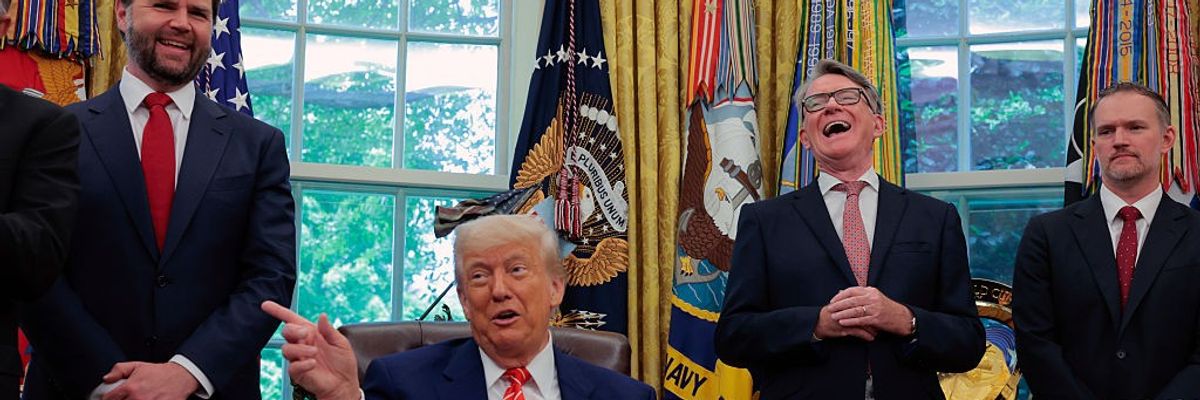
U.S. President Donald Trump, Vice President JD Vance, British Ambassador to the U.S. Peter Mandelson, and U.S. Trade Representative Jamieson Greer laugh in the Oval Office on May 8, 2025.
(Photo: Anna Moneymaker/Getty Images)
Jake Johnson
May 08, 2025
COMMON DREAMS
U.S. President Donald Trump on Thursday unveiled the framework of a trade deal with the United Kingdom that was extremely light on details despite being billed as a "full and comprehensive agreement," leading critics to describe the fanfare surrounding the announcement as a cynical photo op for both sides.
In a statement, U.K. Prime Minister Keir Starmer touted the deal as "historic" while acknowledging that it is incomplete. Trump insisted the deal is "maxed out," though he told reporters in the Oval Office that "the final details are being written up in the coming weeks."
U.S. Agriculture Secretary Brooke Rollins, meanwhile, described the agreement as one "in concept," drawing comparisons to Trump's widely derided statement on the campaign trail that he had a "concept of a plan" on healthcare.
Melinda St. Louis, Global Trade Watch director at Public Citizen, said Thursday that "Trump may have enjoyed having his ego stroked by Starmer and [U.S. Commerce Secretary Howard] Lutnick fawning over him for 'closing' a deal—one that is obviously not actually done—but his con on American workers continues."
"The American and British people need to see whatever text there is or is developed in ongoing talks—and no deal should be approved or go into effect without going through proper on-the-record public comment processes and congressional oversight," said St. Louis. "We need to know, for instance, when they claim to address 'non-tariff barriers,' just what giveaways for Big Tech may be inserted on behalf of Elon Musk and Trump's other tech-bro billionaire buddies, given that he waved around Big Tech's wish list when he announced the tariffs."
"With claims of dozens more 'deals' in progress," St. Louis added, "Congress must act swiftly to demand transparency and accountability in any trade deal before Trump and his team sell off our country for parts behind closed doors."
According to summaries released by the Trump White House and U.K. government, the bilateral trade framework would leave in place the 10% tariff rate that Trump has applied to all imports to the U.S. while providing targeted tariff relief for the British auto, steel, and aluminum industries.
The White House also said, without providing specific details, that the deal would "significantly expand U.S. market access in the U.K., creating a $5 billion opportunity for new exports for U.S. farmers, ranchers, and producers."
The U.K. is the first country to announce an agreement in principle with Trump since he unilaterally imposed tariffs on imports to the U.S. last month, invoking emergency authority. The U.S. ran a trade surplus with the U.K. last year, and experts questioned the extent to which the terms of the agreement broadly outlined Thursday would change the trade dynamic between the two countries.
"At this point the goal of policy seems to be to goose the market for the next few days, with no long-term plan," suggested economist Paul Krugman.
Around the world, stocks rose in response to the U.S.-U.K. announcement.
Nick Dearden, director of the U.K.-based advocacy group Global Justice Now, said that Thursday's events were primarily "about appeasing Trump"—but cautioned that worse could be coming in the near future.
"While there are limited tariff reductions, we remain in a much worse position than we were six months ago," Dearden argued. "What's more, Trump could impose new tariffs at any time because Starmer has proven to him that his threats work: caving in to a bully is not something to be celebrated. Today's press conference also fires the starting gun on a genuinely scary, fuller trade deal, and there are strong indications our rights, standards, and protections will be up for grabs in that larger agreement."
"Unless we stand up to this deal, the British public will pay a very high price for Starmer's friendship with Donald Trump," Dearden added.
In a blog post published ahead of Thursday's announcement, Dearden warned that the new framework could set the stage for a deal that locks the U.K. "into policies that favor the unchecked growth of tech monopolies: deregulated AI, increased corporate access to NHS data, and restrictions on our ability to rein in Silicon Valley giants."
"Worse may be coming unless we stop treating trade negotiations as a matter of royal prerogative," wrote Dearden. "We need a modern, democratic process for international agreements—transparent, accountable, and inclusive. But Starmer has shown that such reform won't be gifted by those in power. It must be demanded."
U.S. President Donald Trump on Thursday unveiled the framework of a trade deal with the United Kingdom that was extremely light on details despite being billed as a "full and comprehensive agreement," leading critics to describe the fanfare surrounding the announcement as a cynical photo op for both sides.
In a statement, U.K. Prime Minister Keir Starmer touted the deal as "historic" while acknowledging that it is incomplete. Trump insisted the deal is "maxed out," though he told reporters in the Oval Office that "the final details are being written up in the coming weeks."
U.S. Agriculture Secretary Brooke Rollins, meanwhile, described the agreement as one "in concept," drawing comparisons to Trump's widely derided statement on the campaign trail that he had a "concept of a plan" on healthcare.
Melinda St. Louis, Global Trade Watch director at Public Citizen, said Thursday that "Trump may have enjoyed having his ego stroked by Starmer and [U.S. Commerce Secretary Howard] Lutnick fawning over him for 'closing' a deal—one that is obviously not actually done—but his con on American workers continues."
"The American and British people need to see whatever text there is or is developed in ongoing talks—and no deal should be approved or go into effect without going through proper on-the-record public comment processes and congressional oversight," said St. Louis. "We need to know, for instance, when they claim to address 'non-tariff barriers,' just what giveaways for Big Tech may be inserted on behalf of Elon Musk and Trump's other tech-bro billionaire buddies, given that he waved around Big Tech's wish list when he announced the tariffs."
"With claims of dozens more 'deals' in progress," St. Louis added, "Congress must act swiftly to demand transparency and accountability in any trade deal before Trump and his team sell off our country for parts behind closed doors."
According to summaries released by the Trump White House and U.K. government, the bilateral trade framework would leave in place the 10% tariff rate that Trump has applied to all imports to the U.S. while providing targeted tariff relief for the British auto, steel, and aluminum industries.
The White House also said, without providing specific details, that the deal would "significantly expand U.S. market access in the U.K., creating a $5 billion opportunity for new exports for U.S. farmers, ranchers, and producers."
The U.K. is the first country to announce an agreement in principle with Trump since he unilaterally imposed tariffs on imports to the U.S. last month, invoking emergency authority. The U.S. ran a trade surplus with the U.K. last year, and experts questioned the extent to which the terms of the agreement broadly outlined Thursday would change the trade dynamic between the two countries.
"At this point the goal of policy seems to be to goose the market for the next few days, with no long-term plan," suggested economist Paul Krugman.
Around the world, stocks rose in response to the U.S.-U.K. announcement.
Nick Dearden, director of the U.K.-based advocacy group Global Justice Now, said that Thursday's events were primarily "about appeasing Trump"—but cautioned that worse could be coming in the near future.
"While there are limited tariff reductions, we remain in a much worse position than we were six months ago," Dearden argued. "What's more, Trump could impose new tariffs at any time because Starmer has proven to him that his threats work: caving in to a bully is not something to be celebrated. Today's press conference also fires the starting gun on a genuinely scary, fuller trade deal, and there are strong indications our rights, standards, and protections will be up for grabs in that larger agreement."
"Unless we stand up to this deal, the British public will pay a very high price for Starmer's friendship with Donald Trump," Dearden added.
In a blog post published ahead of Thursday's announcement, Dearden warned that the new framework could set the stage for a deal that locks the U.K. "into policies that favor the unchecked growth of tech monopolies: deregulated AI, increased corporate access to NHS data, and restrictions on our ability to rein in Silicon Valley giants."
"Worse may be coming unless we stop treating trade negotiations as a matter of royal prerogative," wrote Dearden. "We need a modern, democratic process for international agreements—transparent, accountable, and inclusive. But Starmer has shown that such reform won't be gifted by those in power. It must be demanded."
'Incoherence': Trump slammed after reporter accuses him to his face of 'overstating' UK trade deal
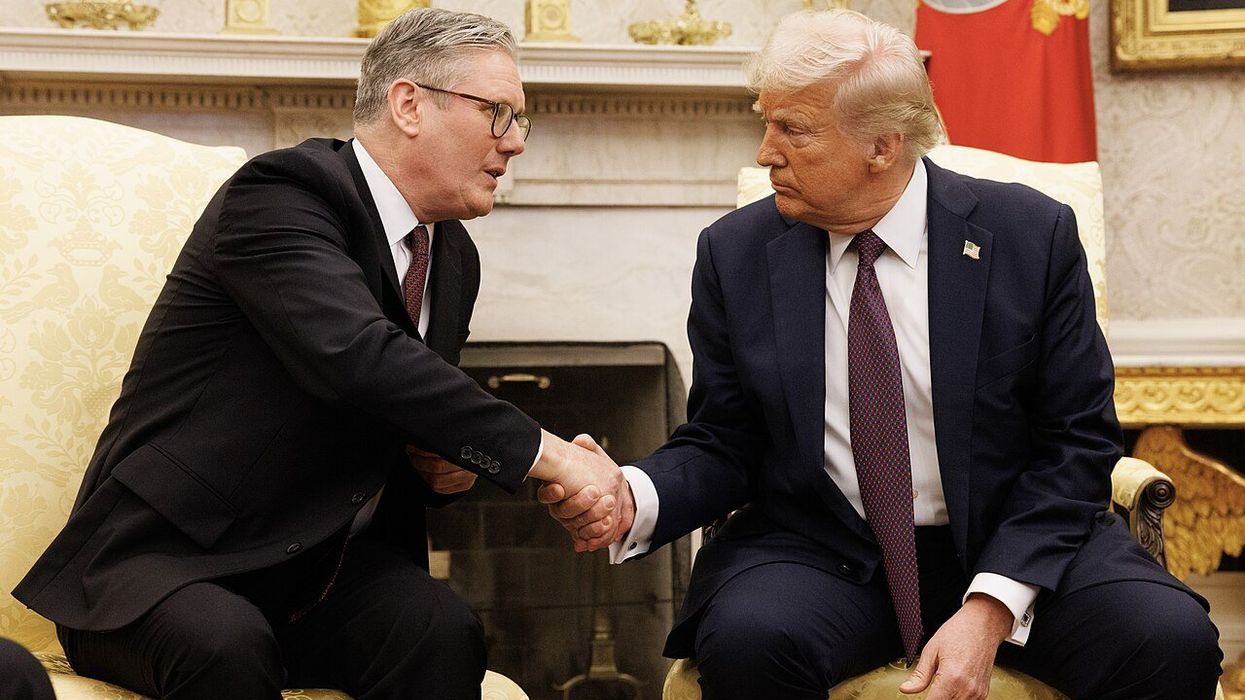
U.S. President Donald Trump meeting with UK Prime Minister Keir Starmer meets in the White House on February 27, 2025 (Simon Dawson/No 10 Downing Street/Flickr)
U.S. President Donald Trump meeting with UK Prime Minister Keir Starmer meets in the White House on February 27, 2025 (Simon Dawson/No 10 Downing Street/Flickr)
May 08, 2025
ALTERNET
During a White House press conference late Thursday morning, May 8, U.S. President Donald Trump announced a new trade deal with the U.K. Trump was joined by visiting U.K. Prime Minister Keir Starmer — leader of the Labour Party since 2020 — as well as Commerce Secretary Howard Lutnick and Vice President JD Vance as he bragged that the arrangement will be a source of great prosperity for both the United States and Great Britain.
The arrangement, Trump told reporters, will bring increased market access to the U.K. for U.S. exports ranging from beef to ethanol. But Trump critics are describing the deal as big on hype but painfully short on specifics.
uring the presser, Sky News' James Matthews was highly skeptical about the deal — telling Trump, "I'd like to ask, why Britain, and why now?.... Clearly, there's much more work still to do. With respect, are you overstating the reach and significance of this deal because you're a president who needs a result at a difficult time?"
Trump responded, "I think that it's a great deal for both parties. It’s for us. We’re opened up. I didn't know how closed it was. Quite closed, the market, as you know, the U.K. And it opens up a tremendous market for us, and it works out very well, very well…. And a lot of assets, you see the chart, and those are tremendous assets. But we've been trying, and when you say why us, meaning your country — we've been trying for years, and they’ve been trying for years to make a deal, including when I was in the, you know, first term. It would always be people talking, but they weren’t getting it done. But for 25 years before that, they were trying always to make a deal. A very significant deal."
After the press conference came at a time, MSNBC got a reaction from Democratic attorney Gene Sperling — who served as director of the National Economic Council (NEC) under Democratic Presidents Bill Clinton and Barack Obama and was White House coordinator for the American Rescue Plan under President Joe Biden.
Sperling slammed the U.K. deal as a "very marginal trade agreement" that underscores the "incoherence of the Trump trade policy," telling MSNBC's Ana Cabrera, "You had an economy that was a consensus soft landing….. Now, you have consensus fears of a recession and stagflation."
Trump's exchange with Matthews is drawing a lot of responses on X, formerly Twitter.
CPCG founder Karen Hinks tweeted, "We need to see this 'deal' for the performative theatre for what it is. Which is nothing. Trump needed a win. He needed a way out for the destruction his fool-hardy tariffs are causing this country. Pathetic."
Raven Capital investment manager Nelson Rangel argued, "UK temporary deal is all a show to get people to prop up the market for presidential approval ratings, to give (Treasury Secretary Scott) Bessent a bigger cushion ahead to China meeting on Saturday and for insiders to sell stocks at a better prices... *TRUMP: BETTER GO OUT AND BUY STOCKS NOW."
Canada-based X user David Blakely posted, "Sounds like a win for the UK and that Trump has caved in favour of UK workers. Trump needed a distraction today and there was no trade imbalance with the UK. No surprise the way Trump and the fawning Lutnick are positioning this. Trade still moving away from US, and quickly."
Paris-based professor Matthew Fraser, a former journalist, commented, "Sounds half-baked. They are still negotiating but Trump wanted a big 'win' to announce, so they staged this press conference."
Attorney Joe Gallina's Call to Activism tweeted, "MASSIVE LET DOWN: Donald Trump admits his 'huge trade deal' with the UK is NOT finalized yet and instead is only a concept of a plan. This is extremely embarassing in light of the press hype. Art of the deal."
Trader Ben Calusinski @BCalusinski wrote, "Trump is really trying to push how 'Big' this deal with the UK is. The market does not care When the market has to price in a 'Big Deal' with a gap-up and then he doesn't follow through, we will see it sell I don't make the rules."
ALTERNET
During a White House press conference late Thursday morning, May 8, U.S. President Donald Trump announced a new trade deal with the U.K. Trump was joined by visiting U.K. Prime Minister Keir Starmer — leader of the Labour Party since 2020 — as well as Commerce Secretary Howard Lutnick and Vice President JD Vance as he bragged that the arrangement will be a source of great prosperity for both the United States and Great Britain.
The arrangement, Trump told reporters, will bring increased market access to the U.K. for U.S. exports ranging from beef to ethanol. But Trump critics are describing the deal as big on hype but painfully short on specifics.
uring the presser, Sky News' James Matthews was highly skeptical about the deal — telling Trump, "I'd like to ask, why Britain, and why now?.... Clearly, there's much more work still to do. With respect, are you overstating the reach and significance of this deal because you're a president who needs a result at a difficult time?"
Trump responded, "I think that it's a great deal for both parties. It’s for us. We’re opened up. I didn't know how closed it was. Quite closed, the market, as you know, the U.K. And it opens up a tremendous market for us, and it works out very well, very well…. And a lot of assets, you see the chart, and those are tremendous assets. But we've been trying, and when you say why us, meaning your country — we've been trying for years, and they’ve been trying for years to make a deal, including when I was in the, you know, first term. It would always be people talking, but they weren’t getting it done. But for 25 years before that, they were trying always to make a deal. A very significant deal."
After the press conference came at a time, MSNBC got a reaction from Democratic attorney Gene Sperling — who served as director of the National Economic Council (NEC) under Democratic Presidents Bill Clinton and Barack Obama and was White House coordinator for the American Rescue Plan under President Joe Biden.
Sperling slammed the U.K. deal as a "very marginal trade agreement" that underscores the "incoherence of the Trump trade policy," telling MSNBC's Ana Cabrera, "You had an economy that was a consensus soft landing….. Now, you have consensus fears of a recession and stagflation."
Trump's exchange with Matthews is drawing a lot of responses on X, formerly Twitter.
CPCG founder Karen Hinks tweeted, "We need to see this 'deal' for the performative theatre for what it is. Which is nothing. Trump needed a win. He needed a way out for the destruction his fool-hardy tariffs are causing this country. Pathetic."
Raven Capital investment manager Nelson Rangel argued, "UK temporary deal is all a show to get people to prop up the market for presidential approval ratings, to give (Treasury Secretary Scott) Bessent a bigger cushion ahead to China meeting on Saturday and for insiders to sell stocks at a better prices... *TRUMP: BETTER GO OUT AND BUY STOCKS NOW."
Canada-based X user David Blakely posted, "Sounds like a win for the UK and that Trump has caved in favour of UK workers. Trump needed a distraction today and there was no trade imbalance with the UK. No surprise the way Trump and the fawning Lutnick are positioning this. Trade still moving away from US, and quickly."
Paris-based professor Matthew Fraser, a former journalist, commented, "Sounds half-baked. They are still negotiating but Trump wanted a big 'win' to announce, so they staged this press conference."
Attorney Joe Gallina's Call to Activism tweeted, "MASSIVE LET DOWN: Donald Trump admits his 'huge trade deal' with the UK is NOT finalized yet and instead is only a concept of a plan. This is extremely embarassing in light of the press hype. Art of the deal."
Trader Ben Calusinski @BCalusinski wrote, "Trump is really trying to push how 'Big' this deal with the UK is. The market does not care When the market has to price in a 'Big Deal' with a gap-up and then he doesn't follow through, we will see it sell I don't make the rules."

No comments:
Post a Comment