It’s possible that I shall make an ass of myself. But in that case one can always get out of it with a little dialectic. I have, of course, so worded my proposition as to be right either way (K.Marx, Letter to F.Engels on the Indian Mutiny)
Saturday, May 17, 2025
PHYTOLOGY
Europe’s forest plants thrive best in light-rich, semi-open woodlands – kept open by large herbivores
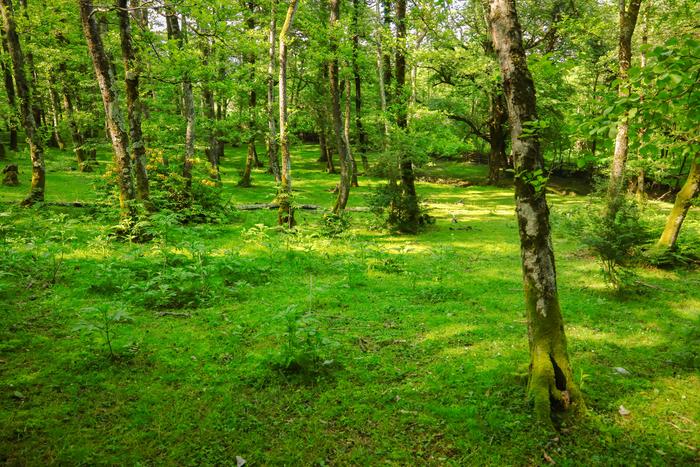
Where traditional livestock grazing in forests hasn't been abandoned, like on this woodpasture in Georgia, forests likely still resemble their pre-human state shaped by large herbivores. In such forests high diversity of forest plants still can be found.
Before Homo sapiens arrived, Europe’s forests were not dense and dark but shaped by open and light-rich woodland landscapes. A new study from Aarhus University shows that most native forest plants are adapted to semi-open, light-filled woodlands – formed over millions of years by the influence of large, free-ranging herbivores such as bison, elk, and wild horses.
The study adds another chapter to a growing body of research challenging the traditional idea of Europe’s forests as closed-canopy wilderness.
The researchers analyzed 917 native forest plant species in Central and Western Europe and found that more than 80 percent prefer high-light conditions – environments traditionally created by large herbivores. This suggests that dense forests only became widespread after humans eliminated the large herbivores.
“Our results provide strong evidence that the closed-forest model commonly used in restoration does not match the evolutionary history or ecological preferences of most temperate forest plants,” says lead author Szymon Czyżewski, a PhD student at the Center for Ecological Dynamics in a Novel Biosphere (ECONOVO) at Aarhus University.
He conducted the study together with the center’s director, Professor Jens-Christian Svenning, and their findings are published in Nature Plants.
The evidence is mounting
The new study builds on a series of earlier ECONOVO results that, based on different data, point in the same direction. Together, the research paints a picture of a Europe where large herbivores, for millions of years, created light-rich woodland landscapes that have now largely disappeared.
The researchers also uncovered a worrying link between herbivore decline and the extinction risk of plants. Forest plants that are most strongly adapted to heavy grazing pressure are significantly more threatened today.
According to Jens-Christian Svenning, this development has had serious consequences for biodiversity:
“Our study shows that the plants most dependent on grazing are also the ones most at risk today. When large herbivores disappear, the forest closes in, and many light-demanding plants struggle to survive.”
Implications for forest management
The study has far-reaching implications for conservation, forest management, and reforestation across Europe. It challenges the prevailing “closed forest paradigm” and supports a shift toward restoring or maintaining heterogeneous, semi-open woodlands through trophic rewilding and low-intensity grazing.
The researchers thus call for a new approach to ecological restoration that actively includes large herbivores – either through rewilding or extensive woodland grazing – to recreate the varied, light-rich woodland landscapes.
“We should be cautious about simply planting trees everywhere and thinking that will promote biodiversity. It can actually be harmful if we don’t also preserve and restore the natural dynamics that large herbivores have maintained for millions of years,” says Szymon Czyżewski.
Temperate forest plants are associated with heterogeneous semi-open canopy conditions shaped by large herbivores
Should we protect non-native species? A new study says maybe
What happens when plants thrive outside their native range but struggle in their original habitat? A new study puts numbers to a growing conservation dilemma.
German Centre for Integrative Biodiversity Research (iDiv) Halle-Jena-Leipzig
When a plant species spreads beyond its habitat, it is usually seen as a threat to native flora and fauna. But what happens when that same species is struggling to survive in its original range? A new study published in New Phytologist and led by researchers at the German Centre for Integrative Biodiversity Research (iDiv), Leipzig University and the Helmholtz Centre for Environmental Research - UFZ found that over a quarter of the world’s naturalised plant species are threatened in parts of their native range — raising questions about the role non-native populations may play in global conservation efforts.
“I initially assumed that plant species expanding into non-native ranges were global winners, benefiting from range gains. However, our results show that many species with range gains also experience range contractions, complicating how we assess non-native populations”, explains lead author Dr Ingmar Staude of iDiv and Leipzig University.
The finding that 27% of all naturalised species worldwide are considered threatened somewhere in their native range is the result of a global synthesis that links sub-global Red Lists of vascular plants from 103 countries with the Global Naturalized Alien Flora (GloNAF) database.
An extreme example of this conservation dilemma is the species Agave vera-cruz, which is globally classified by the International Union for the Conservation of Nature (IUCN) as extinct in the wild (referring to its native range), but survives in multiple self-sustaining, non-native populations. However, most plant species that have expanded beyond their non-native range and face native-range threats are not globally threatened, highlighting the dynamic nature of species ranges.
While non-native species are often evaluated in terms of their ecological impact or eradication, the study advocates for a more nuanced approach. The findings suggest that some species colonising new regions may provide conservation value, though each case requires careful evaluation.
The researchers underscore the importance of reassessing a too rigid distinction between “native” and “non-native” species in the context of global biodiversity change. As species distributions increasingly shift due to climate change and land use, ever more such conservation dilemmas will emerge. The researchers call for a balanced perspective that acknowledges both risks and potential conservation opportunities.
They are the transition zones between forest and open landscape and serve as habitats and retreats for various animal species. This refers to scrub fringes, the proportion of which is very low in Central Europe due to forestry and agriculture. This is detrimental to animals and plants that depend on these shrubby landscape elements.
A research team led by Professor Jochen Krauss, Chair of Animal Ecology and Tropical Biology at the Julius-Maximilians-Universität Würzburg, has examined the affected animal and plant species in the first comprehensive study of its kind. The researchers have shown that a mosaic of open and semi-open shrub fringes is needed to maximize biodiversity. These fringe types can be distinguished by how densely the shrubbery is overgrown.
To generate positive effects for biodiversity, active and well-thought-out fringe management is required: "We recommend that landowners, foresters, landscape conservation associations and nature conservation authorities give shrub fringes sufficient space. These habitats provide rare and endangered animal and plant species with habitats that are otherwise rarely found in our intensively used cultivated landscape," says Krauss.
The results were produced in cooperation with the Ebern Institute for Biodiversity Information. They have been published in the Journal of Applied Ecology.
Determining Diversity in the Shrub Fringes
The researchers examined a total of 45 shrub edges in Bavaria - including habitats near the Lower Franconian towns of Höchberg, Retzstadt and Güntersleben. They were particularly interested in herbaceous plants, grasshoppers, bugs, ground beetles and spiders. Ground traps and other trapping methods were used to count and identify the animals.
The zoologists differentiated between open and semi-open shrub fringes. Within these two categories, the researchers tested the influence of three other parameters on biodiversity: the size of the area, the proportion of near-natural habitats in the surrounding landscape and the habitat quality. The latter is made up of, among other things, the number of species of shrubs and their structural richness.
Fringe Management Necessary at Landscape Level
The most important influences on diversity are the quality of the habitat and the degree of shrub cover. "We realized that across all groups, the open edges with high quality were the most species-rich: They had the highest species richness of herbaceous plants, grasshoppers and bugs. We also found many different spider species in these habitats, while the species richness of ground beetles was highest in semi-open fringes of lower habitat quality," says Fabian Klimm, first author of the study.
The appeal is clear: "We need a fringe management at landscape level. Both open and semi-open fringes should be promoted to maximize diversity," says the doctoral student. Biodiversity ensures essential ecosystem services for humans, such as the pollination of crops or ecological pest control.
Life at the (h)edge – Multidiversity in shrub ecotones is driven by habitat and shrub foliage cover
Article Publication Date
13-May-2025
COI Statement
The authors declare that they have no competing interests and there was no financial support for this work that could have influenced the outcome of this paper. Fabian A. Boetzl is an Associate Editor of the Journal of Applied Ecology, but took no part in the peer review and decision-making processes for this paper.

No comments:
Post a Comment