No closer to the truth about antisemitism
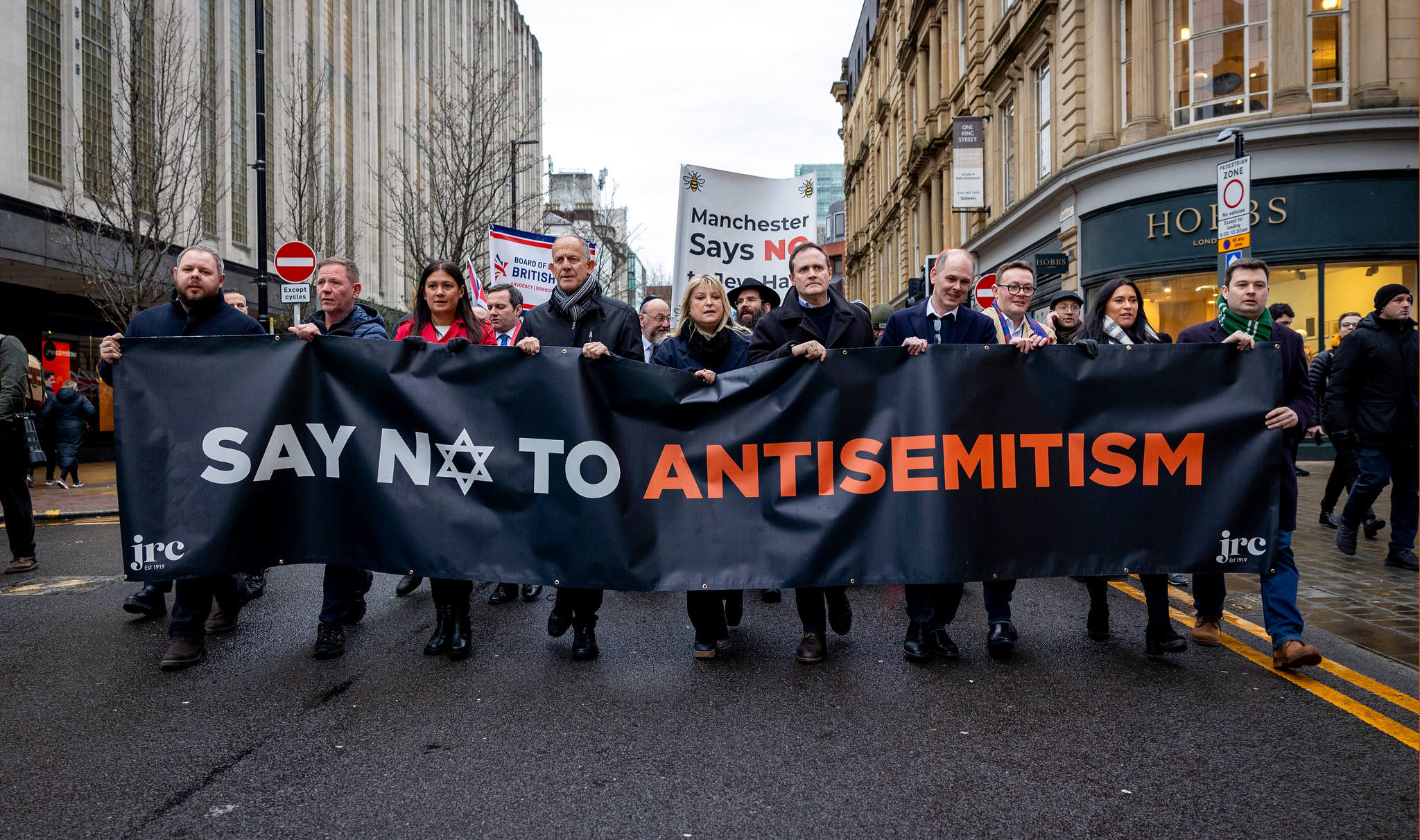
A protest in Manchester against antisemitism. (Photo: Home Office / Flickr)
Brave? Or foolhardy? Calling your book ‘The Truth about Antisemitism’ sets the bar very high, given that the field is a crowded one, characterized by bitterly opposing views. Almost all of these opinions are expressed by writers ranging from impressively qualified academics to stand-up comedians who claim, in one form or another, to be telling us the truth about Jew-hatred. Shabi presumably knows this and believes that she will bring us new insights, fresh enlightenment to which we have yet to be exposed.
In many respects she is well placed to do this. Shabi is an experienced journalist who was a prominent observer and commentator on the antisemitism furore that engulfed the Labour Party during Jeremy Corbyn’s tenure as its leader. She acknowledges that she has ‘skin in the game’. Her parents are Iraqi Jews, forced to leave their country and emigrate to Israel, where she was born in 1973. She was brought up in Britain but has reported extensively from the Middle East.
Her encounter with antisemitism is by no means just second-hand. As a self-declared leftist, she is troubled that the left has not “taken up the fight against [antisemitism] as a left-wing cause”. While she states that “in different ways and to varying degrees we are all bad at talking about antisemitism” she singles out the “protesting against the clear weaponisation of antisemitism” particularly as a means of getting rid of Corbyn, as “[bleeding] into a posture of indifference about antisemitism at best, and outright denials of it at worst”.
The central contention and project of the book is that “the left has forgotten to apply to antisemitism the frames of analysis already available within our movements….A true understanding of what has gone wrong with this discussion—and how to put it right—will not just fortify the left, consolidate our antiracist endeavours and yield inclusiveness, moral clarity and cohesion. It will help us make sense of the alarming, divisive and destructive rightwards shift of the world we are all in—because only then do we stand a chance of changing it.”
Really? This is breathtakingly ambitious. Especially in light of the fact that the appalling state of discourse about antisemitism was being flagged by leading scholars of antisemitism long before Shabi faces it in her book. Take, for example Professor David Feldman (Director of the Birkbeck Institute for the Study of Antisemitism): “when it comes to antisemitism many of us literally don’t know what we’re talking about and are happy to admit it. And as for the rest of us who think we know what antisemitism is, we are congenitally unable to agree among ourselves”. That was in 2017. In 2018, Professor Jonathan Judaken (Rhodes College) described the study and discussion of antisemitism as “a dialogue of the deaf waged as a battle to the death”.
RELATED
Shabi doesn’t attempt to disentangle the mess they identified. She just ignores it. She contends that “post-war Western societies welcomed Jewish people into whiteness, ushered us in to help maintain it as a social construct.” It is the phenomenon of what she calls “Jewish not-whiteness” and it’s the supposed lack of attention to it that she emphasises.
This is where Shabi takes us to the less considered ground encapsulated in the title of the book: Off-White. Its importance for Shabi is clear from the fact that Off-White is the title. Her concern is that “amid European Jewish communities, there is a lingering ambivalence over whiteness. The sense of this being a category error. White Jews aren’t not white. But we aren’t really white either. We are off-white.”
Shabi believes that “post-war Western societies welcomed Jewish people into whiteness, ushered us in to help maintain it as a social construct.” She suggests that the history of it “could open up more meaningful understanding of whiteness itself”. The absence of this history, she seems to be saying, is what has led to “British antisemitism get[ting] weirdly sanitised treatment.”
Shabi clearly wants us to understand this analysis as profound and original, but she brings woefully little evidence to support it. The argument is no more than a series of assertions. Who are the historians, the sociologists, the researchers of contemporary antisemitism, the public intellectuals backing the allegations that British Jews are in any significant way exercised by whiteness/non-whiteness? Historians of British antisemitism will surely not thank her for implying that their work treats antisemitism in a “sanitised” fashion.
Crucially, what does this tell us about the actual state of antisemitism today and how Jews are experiencing it in the UK (which is her main geographical focus)? Does discussion about whiteness really relate in any meaningful way to revealing the truth about antisemitism? It is hard to believe that Shabi is offering any more than a sense of resignation and platitudes: “we’re going to have to make peace with that state of ambiguity about Jewishness and whiteness. Get beyond the boxes. Embrace the complexity. Because apart from anything else, cleaving to a categorisation system imposed by racism itself is simply absurd.” This is all very well, but what are we to do with it? Put both Jews and antisemites on the psychologist’s couch?
Media storm
When she shifts gear and places this approach in the wider historical context, she follows a familiar and well-trodden path: seeing antisemitism as the defining feature of Jewish existence. So we should not be surprised by the current Jewish predicament. The picture has always looked dire. “In Europe more broadly Jews were being racialised, scapegoated by Christians, subject to pogroms, and then ultimately subjected to ‘mass [genocide]’. The Holocaust wasn’t a blip, but a grotesque culmination in a landscape saturated with antisemitism.”
What Shabi seems to be saying in this exposition of the eternalist understanding of antisemitism is that for Jews, the promise of the Enlightenment brought no lasting benefit. Antisemitism was so deeply embedded in European societies, integration and absorption was always fragmentary, contingent, no matter how far Jews came to be seen as ‘white’.
Whether you are convinced or not about the significance of the notion of ‘Jewish not-whiteness’, it would be very hard to sustain the idea that the vast quantity of news and comment about real or alleged antisemitism prompts Jews to ask themselves first and foremost how white they are. And it is equally hard to give credence to her claim that “As antisemitism hit the UK headlines, Jews across the country felt this issue crash into their lives unexpectedly: at work, down the pub or within political organising spaces”—a bizarre choice of real world contexts to choose without any polling evidence to back it up.
Given that the left is supposed to be at the heart of this book, if anything crashed into the lives of Jewish people it was surely the media storm about Labour and antisemitism, and its confected nature that we must highlight. But how does Shabi characterise this? “Broadly, much of the Corbyn-supporting left minimised the problem, while the right hyperbolised it”.
Frankly, this is a stunning piece of oversimplification, and loaded to boot. It is not insignificant that Jewish Voice for Labour (JVL) is not referred to anywhere in the book. In the forefront of pushing back against antisemitism accusations against Corbyn personally and the party in general was JVL, a new grouping set up specifically to support the Corbyn leadership.
Their contributions to discussions on antisemitism were often nuanced, a corrective to the lies and character assassination to which Corbyn-supporting Jews were subjected. And also forthright in arguing that the exaggerated attention paid to Jews was “taking up space and jostling out more pressing or deserving issues, not least those concerning structural racism in the party.” I quote Shabi’s words here, but she does not endorse the “taking up space” argument. While you might not have agreed with all the JVL members’ interventions published on the JVL website, where free speech and independence of thought prevailed, no serious study of the truth about antisemitism during this period can ignore JVL’s role and presence.
Erasure
One of the factors leading to this erasure is Shabi’s problematic emphasis on and understanding of the role of Jewish leftists. For example, she writes: “By the early 2000s Jewish leftists within racial justice spaces”—whatever they are—“would be no more inclined to discuss antisemitism than they would, say, the idea of Britain leaving the EU. It wasn’t on anyone’s radar.”
She is wrong. In 1994 the left-leaning think tank, the Runnymede Trust published the results of a commission it set up, of which I was a member, investigating antisemitism. The report was titled: A Very Light Sleeper. The Jewish Socialist Group (JSG) in the mid-1990s had manipulation of antisemitism in its sights. Rising antisemitism in former communist countries was an issue attracting increasing attention. At the same time, the relationship between antisemitism and criticism of Israel and Zionism was subject to growing discussion, with many left-thinking Jews expressing increasing scepticism about any equivalence.
Moreover, a new generation of British scholars of antisemitism, including the late Professor David Cesarani, Professor Tony Kushner and Professor David Feldman, were making their mark with incisive research on antisemitism within the wider context of racism in general, and that of a broader focus locating antisemitism within the wider area of Jewish/non-Jewish relations.
Why does Shabi not factor this into her narrative? In part I believe it’s because ambivalence over whiteness had no significant role in these narratives. And further, it disrupts the eternalist understanding of antisemitism that guides her thinking. We saw this already in her flawed summation of the Holocaust as effectively inevitable.
This sense of being predetermined, which goes hand in hand with the understanding of antisemitism as an eternal phenomenon—that it was bound to happen, and that it can happen again— emerges in her view that “deep down we know that [a civilised, cultured society] can go in a blink…. So often in European Jewish history, everything was just fine right up until the moment it suddenly was not. Antisemitic violence operates in cycles by its very nature, with some Jewish people elevated in status precisely so that the entire community can be used to deflect attention from the powerful when necessary. That is why the history of antisemitism in Europe cycles between periods of calm and episodic persecution”.
Shabi emphasises this highly contentious idea: “As we have seen throughout European history, Jewish people had to be first elevated to be then reviled, so they could act as a buffer community between the ruling powers and the masses”. Imagining Jews as a “buffer class” is not something Shabi says is confined to the past. Together with some other Jewish leftists (especially in the USA), she sees Jews fulfilling this function today. And she uses this contention in part to explain why Jews post-7/10 have become a “trauma nation”, and why apparently “Jewish people are freaking out”.
If this is cyclical, as she argues, it seems to imply that we Jews, because of our unique historical experience, are psychologically predisposed to see ourselves as victims and continue to fulfil the role of being a “buffer class”. She regrets the manipulation of Holocaust memory to explain Jewish reaction to 7/10, and yet seems to blame the left for not acknowledging “Jewish anguish”.
This anguish is inextricably linked to the “Israel-Palestine conflict steeped in suffering built into its genesis, with the horrors of the Holocaust leading to the creation of a state that would bring catastrophe on another people.” It is unfortunate to say the least that this sounds like Shabi is blaming the Nazis for the fate of the Palestinians. It’s playing fast and loose with both Holocaust and Zionist history. The Israeli state was in an advanced stage of coming into being before the Holocaust made its impact on the timing of statehood.
RELATED

Historical assumptions
The author of a book that boldly claims to tell us “the truth” about antisemitism, but shows little willingness to check her historical facts and be clear about her historical assumptions, is skating on thin ice. The idea of “eternal antisemitism” as an unbroken continuity of persecution of Jews beginning at the end of the Roman Empire and continuing into the twentieth century is a dangerous and discredited fallacy.
Whether intentionally or not, Shabi is basing her “truth about antisemitism” on a deeply troubling Jewish exceptionalism. And this emerges in the wider context of her central contention that failure to understand and deal with the problem of antisemitism is somehow exclusively the fault of “the left”, an entity she never clearly identifies. “The left has ceded the space on antisemitism—responding to accusations of it, sure, but not taking up the fight against it as a left-wing cause.”
For Shabi then, a tremendous amount rests not only on the left making a screeching handbrake turn by taking up and winning the fight against antisemitism as a left-wing cause using tools (unspecified) already at its disposal. But by clearing up the antisemitism mess, the door will also open to bringing about revolutionary change in achieving the widest of anti-racist goals and a change of “the world we are all in”.
Shabi does not set out to marginalise the fate of the Palestinians. She acknowledges that Zionism is settler colonialism, and quotes from the writings of the early Zionist leaders to support the point but then is far too quick to repeat the argument that Zionism has its “roots in the Jewish experience of centuries of exclusion and persecution”. So where does this leave the Palestinians? Shabi then fails to clarify that Palestinians are not responsible for the fate of the Jews.
Nor does she allow for it being a Jewish imperative to work tirelessly setting right the injustice Palestinians have faced – a central task essential not only on its own terms but also because it would have a major impact on the hostility and antisemitism facing Jews today. Instead, it’s back to the argument she has already made that “[we] must build a universal anti-racist movement—fusing together our currently siloed understandings of oppression, Islamophobia, racism and antisemitism …. get past a sides-based narrative not of our making [and] build a collective narrative more rooted in historical and geographic reality of all the people who live in the region”.
Regrettably, this sentiment, however well-meaning, takes us no closer to the truth about antisemitism or to any practical way in which the left can take-up and win the fight against it—if indeed one accepts the logic of her claim that responsibility for this must be shouldered by the left.
It is all very well speaking of building a collective narrative rooted in historical reality, but if your own narrative is singularly deficient in understanding historical reality when it comes to current antisemitism, the collective narrative will lack credibility.
Debates over definitions
Shabi knows well-enough that in seeking the truth about antisemitism today one must account for the central significance of the so-called ‘new antisemitism’ and its codification in the International Holocaust Remembrance Alliance (IHRA) working definition of antisemitism. But her grasp of the significance of the notion of ‘new antisemitism’ and its deliberate creation as a weapon to undermine the struggle for justice for Palestinians and to brand them as the new Nazis is seriously flawed.
She shows no awareness of the role the Israeli government formally took upon itself in 1988 to head-up the global Jewish fight against antisemitism (although she appears to be drawing here on sources that clearly set this out). Israel’s subsequent interventions in the two decades after 9/11, which contributed to the drive to produce a new definition of antisemitism—in other words a codification of ‘new antisemitism’ (such as Natan Sharansky’s ‘3 Ds’)— are regularly linked to her uncritical acceptance of reports of spikes in antisemitism for which little hard evidence is provided.
For example, she writes of “this terrible degradation of the term antisemitism [coming] at exactly the moment when awareness of it is most needed… when antisemitism is globally surging”—validating this claim by quoting only UK Community Security Trust (CST) statistics, the reliability of which has been subject to authoritative critique. (CST is the independent body monitoring antisemitism for the official representative bodies of British Jewry.)
This inadequate treatment of ‘new antisemitism’ is followed by a very unsatisfactory account of the origins of the IHRA working definition, a proper understanding of which is crucial to any serious attempt to tell the truth about antisemitism. For IHRA was a political project designed to codify ‘new antisemitism’ in the form of a new definition that would become internationally accepted, clamping down on criticism of Israel and Zionism and turning Palestinians and advocates of Palestinian human rights into the main disseminators of the eternal hatred of Jews.
But Shabi does not seem to understand the consequences of crying out to the left to deal with the problem of the antisemitism ‘mess’. It is right to locate this fight within the realm of politics, yet she offers no practical political pathway to achieving this. On the contrary, it seems clear to me that the more psychology-based ‘truths’ about antisemitism, which she gleans from many unnamed individuals, as well as a very few named ones, provide the ‘practice’ which Shabi feels the left must adopt—thereby sidestepping the complexity and intractability of the problem about which she claims she is telling us the truth.
I am not seeking to devalue her journalistic propensity to rely on recording peoples’ experiences and testimonies. But a book that purports to be telling us the truth about antisemitism must surely be assessed against a higher standard than you might require if it were an extended article for a magazine.
And I think it is only reasonable to expect a substantive summing up, especially because Shabi seeks to cover many bases in the quest for this truth, which is why this reader found it deeply disappointing to reach the final chapter titled ‘Conclusion’ only to discover it consisted of less than five pages. Even in this short space, problematic assertions are made, for example: “When we get right down to it, very little of our conversation is actually about Jewish people or their lived experiences, so much as it is about ‘The Jews’, as the antisemitic conspiracy and as the victims of it”. But we are told earlier in the book of the necessity to understand why Jews are “freaking out”. Isn’t that lived experience?
Shabi also reminds us of the truth about “leftist movements of all kinds [needing] to stop ceding the fight against [antisemitism] and start reclaiming it as an antiracist cause, [and that] the next truth is that this is one hell of a task”. Such a comment does nothing to add to the seriousness of her ‘truths’. Then she asserts “we should be confident in the necessity of understanding and overcoming antisemitism right now”. Really? Does such a statement actually bring you nearer to your objective?
And one further deeply troubling assertion: “the vital need for thoughtful definitions of antisemitism that provide clarity without trampling over Palestinian rights”. I found nothing in this book supporting the conclusion indicating that this contributes to identifying truths about antisemitism. Academic debates about definitions are a lost cause. They will never result in the replacement of IHRA, the formulation process for which was a political act. And they will certainly do nothing to bring an end to the trampling over Palestinian rights. The fates of Palestinians and Jews today have never been more fully intertwined. Such that the path to the truth about antisemitism runs through the absolute necessity of relentlessly fighting for and securing Palestinian rights.
ABOUT THE AUTHOR


No comments:
Post a Comment