Source: Xinhua
Editor: huaxia
2025-05-13 13:20:45
by Xinhua writers Zhao Kai, Meng Yifei
MEXICO CITY, May 12 (Xinhua) -- Amid the accelerating changes in the global landscape, the 4th ministerial meeting of the China-Community of Latin American and Caribbean States (CELAC) Forum opened Tuesday in Beijing.
The return to Beijing 10 years after the forum's debut ministerial meeting marks a significant milestone. It is expected to further advance the vision of a China-Latin America community with a shared future and enhance cooperation among the developing countries of the Global South.
United by a commitment to multilateralism and self-improvement as Global South nations, China and Latin America have achieved plenty over the past decade. Against this backdrop, the forum has grown into a vital platform that enhances mutual political trust, aligns development strategies, and strengthens people-to-people bonds.
Over the past years, close high-level contacts and strategic communication have guided China-LAC relations through a shifting international landscape, paving the way for a new stage of equality, mutual benefit, innovation, and openness, with tangible benefits for both peoples.
Deepened political trust was evident when Panama, El Salvador, the Dominican Republic, Nicaragua, and Honduras established or restored diplomatic ties with China, and when Venezuela, Uruguay, Colombia, and Nicaragua upgraded or established a strategic partnership with China.
Notably, relations between Brazil and China have been elevated to foster a community with a shared future for a more just world and a sustainable planet. The China-proposed Belt and Road Initiative (BRI) is contributing to development in more than 20 economies in the LAC region, highlighted by multiple landmark cooperation projects currently underway.
China is now Latin America's second-largest trading partner, and the region has become the second-largest destination for overseas Chinese investment, with 600.8 billion U.S. dollars in stock by the end of 2023. Currently, China has five free trade partners in the region. The country has been the largest market for Chilean cherries for years, and Chinese companies account for 37 percent of automobiles sold in Ecuador.
The China-LAC cooperation is also expanding into new sectors, such as renewable energy, digital technology, and transnational e-commerce, with dynamics driven by successful bilateral forums on science and technology innovation, digital technology cooperation, and space cooperation, all under the framework of the China-CELAC Forum. China's cloud computing, big data and AI technologies have widely empowered local industries to facilitate digital transformation.
High-level BRI construction is also helping advance the region's industrial upgrade, such as fully equipping Trinidad and Tobago's Phoenix Park Industrial Estate with a state-of-the-art 5G network.
The deepening of China-LAC relations has boosted employment, including the creation of higher-income jobs through BRI projects. Among recent examples is the April reopening of the Mexico City Metro's key Line 1, a project assisted by Chinese expertise aimed at improving residents' transit experience.
Meanwhile, a wide range of programs have strengthened cultural exchanges and the people-to-people bonds. These include Chinese government scholarships and vocational training programs for CELAC member countries, the China-LAC Youth Development Forum, the China-LAC Cultural Exchange Year, and China's foreign aid projects aimed at improving livelihoods.
Standing at a new historical starting point, China-LAC relations and cooperation are expected to build on the previous accomplishments and enter a new era replete with opportunities and broader prospects.
The China-CELAC Forum meeting in Beijing is sending a strong message of unity from the Global South, particularly in response to the increasing uncertainty and unpredictability stemming from rising unilateralism, protectionism, and bullying actions.
Undoubtedly, enhancing China-LAC relations and collaboration will contribute to stability and foster positive momentum in a tumultuous world. ■
China’s Xi slams ‘bullying’ in veiled swipe at US as Beijing hosts Latin America leaders
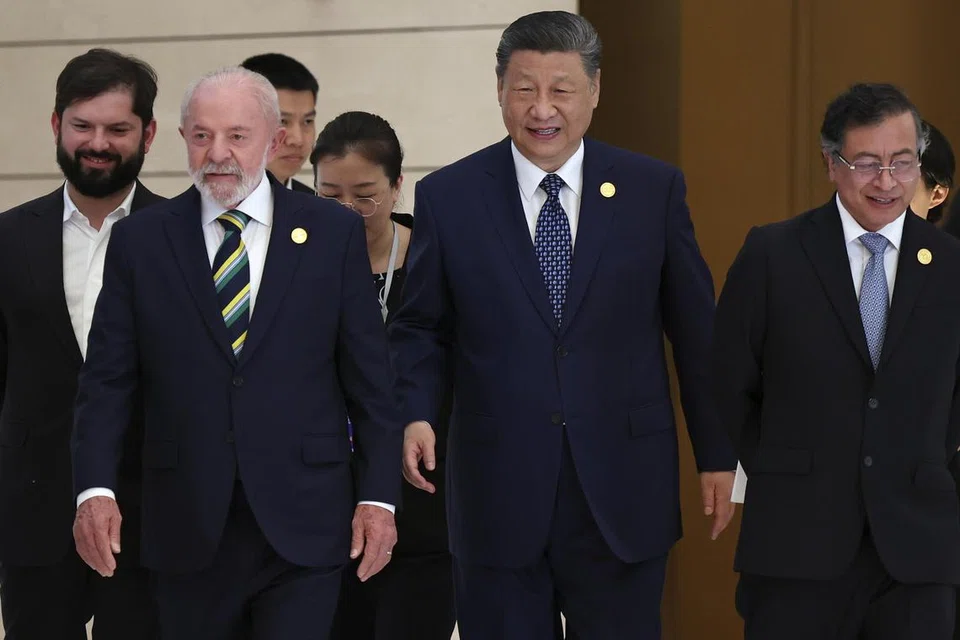
Leaders and officials from Latin America and the Caribbean have descended on the Chinese capital for the China-CELAC Forum.PHOTO: EPA-EFE
UPDATED May 13, 2025
Beijing - Chinese President Xi Jinping vowed on May 13 to deepen ties with Latin America and condemned “bullying” in a thinly veiled swipe at the United States, as he addressed regional leaders in Beijing.
Leaders and officials from Latin America and the Caribbean have descended on the Chinese capital for the China-CELAC (Community of Latin American and Caribbean States) Forum.
Beijing has stepped up economic and political cooperation with Latin American nations in recent years and has urged a united front against US President Donald Trump’s recent maelstrom of tariffs.
Addressing leaders on May 13, Mr Xi hailed China’s burgeoning ties with the region.
“Although China lies far from the Latin American and Caribbean region, the two sides have a time-honoured history of friendly exchanges,” he said at the opening ceremony, likening the summit to a “great, sturdy tree”.
“Only through unity and cooperation can countries safeguard global peace and stability and promote worldwide development and prosperity,” Mr Xi said, pledging US$9.2 billion (S$12 billion) in credit towards “development” for the region. He also warned of “bloc confrontation”.
Mr Xi’s remarks come a day after the United States and China announced a deal to drastically reduce tit-for-tat tariffs for 90 days, an outcome Mr Trump dubbed a “total reset”.
Under that agreement, the United States agreed to lower its tariffs on Chinese goods to 30 per cent while China will reduce its own to 10 per cent.
The deal marked a major de-escalation of a gruelling trade war between the world’s two largest economies which threw global markets into turmoil.
Mr Xi told delegates on May 13: “There are no winners in tariff wars or trade wars.”
“Bullying and hegemony will only lead to self-isolation,” the Chinese leader warned.
“The world today is undergoing accelerated transformations unseen in a century, with multiple risks intertwined and overlapping,” Mr Xi said.
Among notable attendees at the forum is Brazilian President Luiz Inacio Lula da Silva, who arrived in Beijing on May 10 for a five-day state visit.
Also present is Colombian President Gustavo Petro, who last week said he intends to sign an accord to join Beijing’s Belt and Road Initiative during his visit.
Two-thirds of Latin American countries have joined Beijing’s trillion-dollar BRI infrastructure programme, and China has surpassed the US as the biggest trading partner of Brazil, Peru and Chile, among others. AFP
More on this Topic
Leaders and officials from Latin America and the Caribbean have descended on the Chinese capital for the China-CELAC Forum.PHOTO: EPA-EFE
UPDATED May 13, 2025
Beijing - Chinese President Xi Jinping vowed on May 13 to deepen ties with Latin America and condemned “bullying” in a thinly veiled swipe at the United States, as he addressed regional leaders in Beijing.
Leaders and officials from Latin America and the Caribbean have descended on the Chinese capital for the China-CELAC (Community of Latin American and Caribbean States) Forum.
Beijing has stepped up economic and political cooperation with Latin American nations in recent years and has urged a united front against US President Donald Trump’s recent maelstrom of tariffs.
Addressing leaders on May 13, Mr Xi hailed China’s burgeoning ties with the region.
“Although China lies far from the Latin American and Caribbean region, the two sides have a time-honoured history of friendly exchanges,” he said at the opening ceremony, likening the summit to a “great, sturdy tree”.
“Only through unity and cooperation can countries safeguard global peace and stability and promote worldwide development and prosperity,” Mr Xi said, pledging US$9.2 billion (S$12 billion) in credit towards “development” for the region. He also warned of “bloc confrontation”.
Mr Xi’s remarks come a day after the United States and China announced a deal to drastically reduce tit-for-tat tariffs for 90 days, an outcome Mr Trump dubbed a “total reset”.
Under that agreement, the United States agreed to lower its tariffs on Chinese goods to 30 per cent while China will reduce its own to 10 per cent.
The deal marked a major de-escalation of a gruelling trade war between the world’s two largest economies which threw global markets into turmoil.
Mr Xi told delegates on May 13: “There are no winners in tariff wars or trade wars.”
“Bullying and hegemony will only lead to self-isolation,” the Chinese leader warned.
“The world today is undergoing accelerated transformations unseen in a century, with multiple risks intertwined and overlapping,” Mr Xi said.
Among notable attendees at the forum is Brazilian President Luiz Inacio Lula da Silva, who arrived in Beijing on May 10 for a five-day state visit.
Also present is Colombian President Gustavo Petro, who last week said he intends to sign an accord to join Beijing’s Belt and Road Initiative during his visit.
Two-thirds of Latin American countries have joined Beijing’s trillion-dollar BRI infrastructure programme, and China has surpassed the US as the biggest trading partner of Brazil, Peru and Chile, among others. AFP

No comments:
Post a Comment