Poland Checks Baltic for Explosives as Tensions Continue Over Shadow Fleet
The governments of Poland and Estonia continue to highlight the dangers in the Baltic coming from the shadow fleet and asserting their rights to inspect vessels. This comes as Russian officials have stepped up their verbal attacks on the EU’s efforts to reign in the activity of the so-called shadow fleet of tankers supporting Russia’s oil and gas trade.
After revealing that it had used its military to chase away a tanker acting suspiciously in the Baltic, Poland’s Prime Minister Donald Tusk told reporters on Thursday, May 22, “Not everyone realizes how often critical infrastructure facilities lying on the bottom of the Baltic Sea are the target of sabotage or even terrorist activities.” He was speaking during a follow-up meeting to Tuesday’s incident taking place at the Maritime Operations Center in Gdynia.
Tusk said that the shadow tanker acting suspiciously near the power cable connecting Poland and Sweden was “not the first such situation that we have encountered.” He said he was very satisfied that in a very effective, discreet manner, it was possible to discourage the ship from any actions that could have caused damage to the power cable.
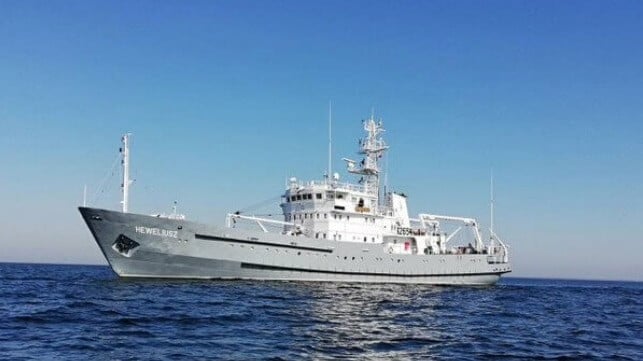
However, he also told reporters, “We are still investigating whether any explosives were planted.” Poland reported that the Navy’s survey vessel ORP Heweliusz had been sent to the area after the incident. Tusk said there were currently no alarming signals but the process was proceeding. He also reported that during the meeting they decided to purchase surveillance drones for the Polish Navy.
At the same time, Estonia’s Prime Minister was questioned by the country’s parliament (Riigikogu) about the incident last week when Estonia attempted to inspect another shadow tanker that it suspected was operating without a valid registration. Prime Minister Kristen Michal cited the mandate given to the Estonian Defense Forces, the Police, and the Border Guard, asserting that “Estonia had legal grounds to inspect the vessel.”
He said the Navy and the other sections of the government would take steps to protect Estonia’s maritime space, including critical infrastructure. ERR news reports he told parliament that “the inspections will continue.”
The Prime Minister said Estonia was ready to board the tanker if it had entered Estonian waters. Instead, the decision had been made to escort the vessel away from Estonian waters. A Russian fighter jet had briefly entered Estonia’s airspace and NATO planes were also observing. Russia however contended at a UN meeting of the Security Council that Estonia was trying to seize the tanker, attempted to board the ship, and tried to ram the tanker when it failed to gain control of the tanker.
Russia’s Permanent Representative to the United Nations Vassily Nebenzia told the Security Council, “This habit of using NATO naval forces and assets for such illegal actions will do nothing but pave the way to military escalation and creation of serious challenges to maritime security.” He called the efforts “pirates of the Baltic Sea.” He also asserted that NATO and West was blocking the investigation to find the terrorists that damaged the Nord 2 pipeline.
Speaking to the media in Moscow on Wednesday, presidential spokesperson Dmitry Peskov said according to Interfax that Russia would use all means available within the framework of international law to defend its ships in the Baltic Sea.
"As the latest events related to the attempted pirate attack on one of the tankers have shown, Russia has shown that it is capable of responding quite harshly," Interfax reports Peskov said.
Fueling the tensions are moves by the European Union and the UK expanding the sanctions against shadow fleet tankers. The EU highlighted that it more than doubled the number of sanctioned vessels this week after previously authorizing inspections of documentation and insurance for all ships passing through EU waters even if they were not making a port stop in the EU.
Panama Registry Cracks Down on STS Actions to Stop Shadow Fleet
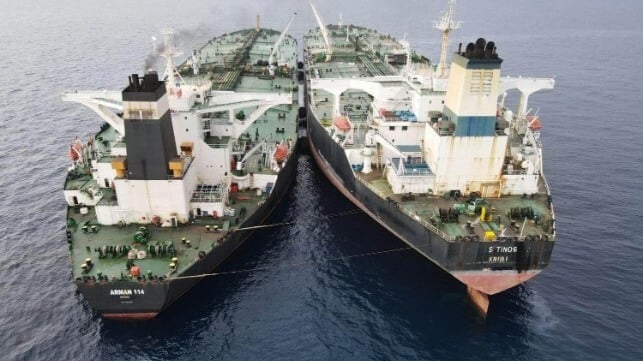
The Panama Maritime Authority (PMA) is taking further actions to crack down on suspicious tankers by establishing new rules for ship-to-ship oil transfers for vessels in its registry. It is the latest in a series of steps responding to international pressure to stop the notorious technique used by vessels trying to hide transactions of Russian and Iranian oil.
“This new regulation reinforces Panama’s role as a flag state committed to maritime safety, operational transparency, and the prevention of fraudulent use of its registry, in full alignment with IMO regulations and the MARPOL Convention,” explained DGMM Acting Director, Engineer Rina Berrocal. “This is not just about safeguarding the reputation of the Panamanian registry,” she warned, “but about ensuring that our vessels are not used as platforms for illicit activities that undermine global trade and harm the environment.”
Under a resolution published this month, the PMA introduced rules it says are designed to create stricter controls and mandatory traceability for offshore STS transfers of hydrocarbons. Effective immediately, all Panama-flagged vessels with a gross tonnage of 150 or more must notify the flag state at least 48 hours in advance of any planned STS operation, providing detailed technical, logistical, and operational information.
“This initiative addresses the growing use of opaque vessels to circumvent international sanctions, transport undeclared crude, or evade environmental safety regulations—practices commonly associated with what is known as the shadow or dark fleet,” said Berrocal.
Ships are required to provide details on the other ship involved in the transfer including its IMO number and flag. They must also declare where and how the transfer will be performed and confirm that it has a plan in accordance with the MARPOL convention.
Last year, the PMA took steps to clean its registry and make the process of removing violators simpler. As the largest registry by the number of ships, Panama also had the greatest number of ships identified by watchdog groups as involved in the oil trade for Iran and Russia. Registry officials said they were making an effort to purge their ranks of suspect vessels and also have worked with other leading registries to identify vessels attempting to flag hop to avoid detection
Western Sanctions Take Big Bite Out of Sovcomflot’s Results
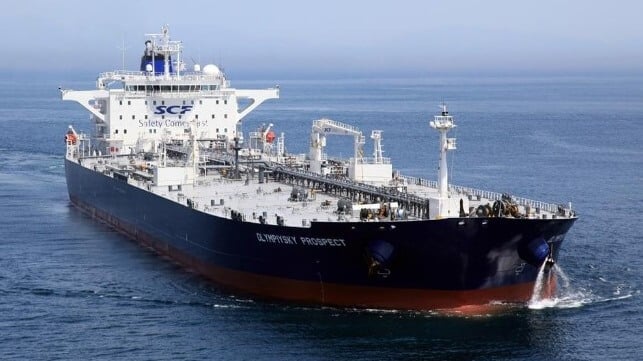
Russia’s tanker operator PAO Sovcomflot is citing the impact of the Western sanctions on the company’s results. It reported a significant drop in revenues and a loss for the first quarter of 2025 along with recording a non-cash impairment related to the fleet.
The U.S., UK, and EU have all stepped up their efforts targeting the shadow tanker fleet and Russia’s income from the oil and gas sectors. In announcing its financial results the company cited the impact and warned investors that the board of directors would be taking into account “significant changes in the external business conditions that have a direct impact on the current financial performance of the company” as it considers dividends. They said future decisions would be guided by the principle of capital adequacy.
Sovcomflot has previously acknowledged the sanctions, which it calls illegal, and early on after the start of the sanctions regime took steps selling ships and moving management to Dubai and elsewhere. It was also moving ships to registries such as Gabon but later flag hopping. Some returned to the Russian registry.
In today’s financial announcement, the company acknowledged that some vessels are now idled by the sanction. During the first quarter, it took a non-cash impairment charge of $322 million against the value of the fleet.
“During the reporting period, unprecedented sanctions were imposed on the company and its vessels, which created additional commercial and operational difficulties in the operation of the fleet,” the company writes in its results announcement. “The company continues to work systematically to minimize the negative impact of sanctions restrictions on its activities, consistently adhering to high standards of maritime safety and the quality of maritime operations.”
Despite the efforts, the company reported first quarter revenues were down by nearly a third (30 percent) to $278 million versus the previous quarter, or nearly by half versus the first quarter of 2024. Earnings were down 45 percent (EBITDA) versus last quarter driving the company’s bottom line to a loss of $104 million in the first quarter of 2025.
“Despite these events, the company's business model demonstrates high stability due to the portfolio of existing long-term contracts and a diversified fleet structure,” Sovcomflot states in its report. It says the company has sufficient cash liquidity and a balanced capital structure that also allows it to maintain a stable financial position.
Both the UK and EU vowed this month to further increase the pressure on the Russian oil sector in an effort to reduce revenues and support to the Russian economy. The EU noted it doubled the number of tankers it had sanctioned to over 300 vessels while the UK added another 100 to its listing. The UK also said it was in discussion with Western allies about lowering the price cap the G7 imposed on the sale of Russian oil. The EU has pledged to make an effort to end its imports of Russian gas giving countries the tools to break long-standing contracts and dramatically reduce imports by 2027. The EU has pledged to break free of its Russian imports.

No comments:
Post a Comment