Reuters | May 22, 2025 |
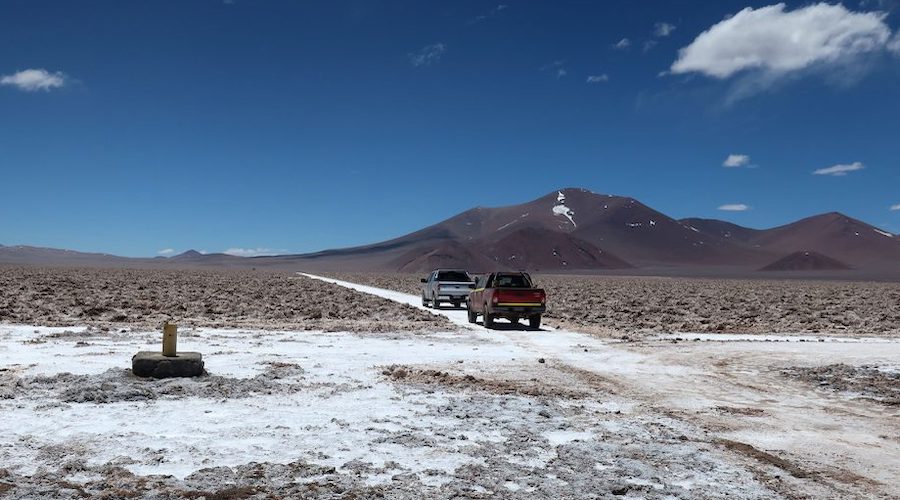
The Maricunga lithium project sits on its namesake salt flat, Chile’s second-largest in terms of reserves. (Image courtesy of Lithium Power International.)
Global miner Rio Tinto will tackle one of the biggest technological challenges in the lithium industry as it takes the lead in Chile’s first major projects involving the battery metal in years, alongside state-run mining companies Codelco and ENAMI.

Codelco’s Maricunga project and ENAMI’s Altoandinos project represent a new pivot in Rio’s lithium ambitions and a turning point for Chile, which for many years had only two companies – Chile’s SQM and US-based Albemarle – extracting the metal that powers electric vehicles.
Rio will spearhead the operational side of both projects, with nearly 50% ownership at Maricunga and 51% at Altoandinos.
The plans came the same week that Rio announced on Thursday the surprise departure of its CEO Jakob Stausholm, who led the miner’s big bets on lithium, later this year.
As Rio raises its profile in lithium, a major challenge will be deploying new technology, called direct lithium extraction, or DLE, to separate the ultralight metal from salty brine liquid. It is meant to be more environmentally friendly and efficient than conventional methods, industry experts say, but has yet to be proven widely in the industry and has never been used in Chile at commercial scale.
The technical challenge comes against a backdrop of uncertainty for lithium prices, which have fallen nearly 90% since late 2022 due to oversupply and weak demand for EVs.
“Scaling it in line with global demand timelines remains uncertain,” said Nicole Porcile, a partner at mining consulting firm Anagea. “The ability to deliver at scale, efficiently and reliably will be a decisive factor in the project’s competitiveness and investor confidence.”
Rio has a DLE pilot plant at its Rincon project in Argentina, and recently acquired US-based Arcadium, which employs a mix of DLE and traditional extraction methods.
That DLE know-how gave Rio an edge over three final competitors to partner with copper giant Codelco, said a person familiar with the Maricunga deal. Still, Rio and Codelco must now hammer out which kind of DLE will work sustainably and effectively at Maricunga, one of the world’s most lithium-rich salt flats.
“That’s certainly the goal: to develop and operate this in the most environmentally friendly manner possible because Codelco is well aware that they’ll be under the microscope,” the person said.
Codelco’s search for a Maricunga investor attracted Middle Eastern, Chinese and Western companies, the person added, speaking on condition of anonymity because the talks were private. Construction is expected to start in three to five years, once environmental permits are updated.
Codelco has proposed a gradual transition to DLE, but Rio Tinto is aiming to use DLE from the start, with lower costs relative to other DLE projects, said a second person familiar with the matter.
Argentina experience
Rio told Reuters its Argentina experience provided strong footing for future projects.
“We are therefore confident in the application of our technology to Maricunga and potentially to other lithium salt flats in Chile,” a spokesperson said.
Rio will spend up to $900 million at Maricunga, and lead design, construction, operation and sales. At Altoandinos, it plans to initially contribute $425 million to the project to fund studies required before a final investment decision.
Rio is the only major mining company to bet heavily on lithium, accelerating its push with a second deal in six months at a time of low market prices.
“We have not heard from investors that they want to see further investment in lithium,” RBC Capital Markets said in a note.
Codelco hired investment bank Rothschild to scout for candidates for the Maricunga project. And at the same time, it is set to soon close a deal to partner with Chile’s SQM at the Atacama salt flat.
Benchmark Minerals analyst Federico Gay noted that Rio and Codelco will have to carefully prioritize. “Too many fronts (are) open for both companies, in a moment when justifying large investments for lithium is challenging.”
Rio, which could be granted an intellectual property permit if its DLE technology is used for the project, will hold a majority of seats on a technical committee with Codelco, and will move to a 50-50 split once production begins, according to a filing with Chile’s financial regulator.
ENAMI ran its own selection process separately, attracting bids from Chinese electric vehicle maker BYD, French miner Eramet, and South Korean steel group Posco, as well as financing proposals from China’s CNGR Advanced Material Co Ltd and South Korea’s LG Energy Solution.
(By Daina Beth Solomon and Clara Denina; Editing by Rod Nickel and Jamie Freed)
Chile’s ENAMI says lithium venture with Rio Tinto to start production in 2032
Reuters | May 23, 2025 |

Chile’s Atacama region. (Image by LMspencer | Stock Photo.)
Chile’s state-run mining firm ENAMI aims for its new Rio Tinto lithium partnership at Altoandinos to begin production in 2032 with 35,000 metric tons of the battery metal per year, and ramp up over three years to 75,000 tons, ENAMI company chief Ivan Mlynarz said on Friday.
The Altoandinos project, as well as the Maricunga project that Rio Tinto was tapped this week to spearhead alongside state-run copper producer Codelco, will give the global miner a critical role in Chile’s lithium industry alongside long-established players SQM and Albemarle.
Rio Tinto will initially put forward $425 million to the project, which ENAMI said will require a total investment of $3 billion.
ENAMI previously estimated the Altoandinos project capacity to be 60,000 tons a year, before new studies showed more resources than expected, particularly at the La Isla salt flat.
Mlynarz said ENAMI plans for the project to start with direct lithium extraction (DLE), an innovative method that has yet to be used in Chile, and that Rio Tinto is testing at its Rincon project in Argentina.
ENAMI has begun testing DLE options from various companies, and Mlynarz said early results from Rio Tinto’s technology look promising, paving the way for its potential use on the project.
“The results have been encouraging with Rio Tinto, and it has the advantage of having the operator use their own technology,” Mlynarz said.
He added that the partnership needed approval from international regulatory agencies, but that ENAMI in the meantime would continue exploration studies, with the hope that Rio Tinto will take the lead in 2026.
“We need to keep working in the salt flat because both ENAMI and Rio Tinto know that timing is key,” Mlynarz said.
(By Daina Beth Solomon; Editing by Alexander Villegas)
Rio Tinto board looks for new CEO who knows mining better
Bloomberg News | May 23, 2025 |
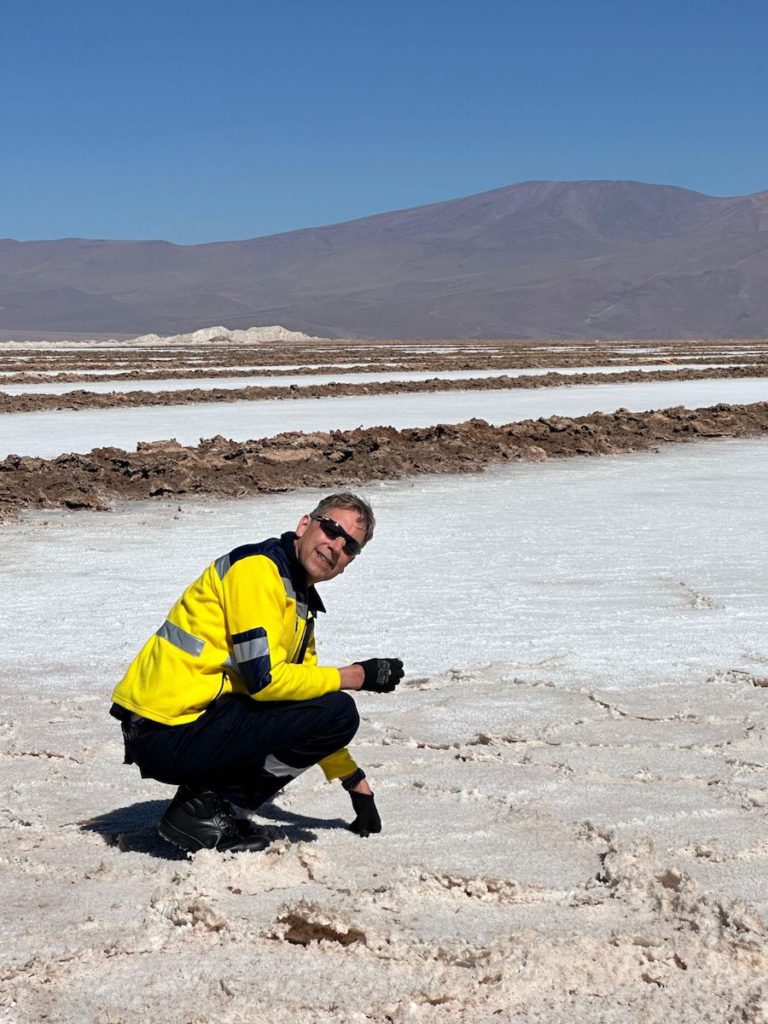
Jakob Stausholm visits the Rincon project. (Image: Jakob Stausholm | LinkedIn.)
When Jakob Stausholm took the top job at Rio Tinto Group, his task was to repair the reputation of a company that had just blasted through a 46,000-year-old sacred Aboriginal site and bungled its response. Now the world’s second-largest miner has decided it needs a boss that can lead it into the future.
Then, Stausholm, a sober Dane who came to Rio as chief financial officer after time at AP Moller-Maersk A/S and Shell Plc, stepped into the least desirable job in mining. He has repaired relationships and edged the company toward new investments, including lithium — a battery material most of his rivals have shunned.
But the company, whose board asked Stausholm to stand down, is now looking for a boss that can make the most of Rio’s crucial growth assets, including the Oyu Tolgoi copper and gold mine in Mongolia and the vast Simandou iron ore deposit in Guinea. To set a path for the coming decades will mean prioritizing operational expertise and a track record, according to people familiar with the company.
That could put Simon Trott, head of Rio’s iron ore business, in the running alongside aluminum executive Jérôme Pécresse to replace Stausholm when he leaves later this year, according to the people. They asked not to be named as the conversations are not public.
“It’s not something that you are candidate for, it’s something that you’re eligible” for, Pécresse said Friday in an interview on BNN Bloomberg Television. “It’s for the board to decide who is eligible and who is not.”
Chief commercial officer Bold Baatar, a former investment banker who has been instrumental in bringing Simandou to production after years of delays, is also being considered but is not thought to be a front-runner, the people said.
“Stausholm came on board at a time of crisis and he’s resolved many of the strategic issues that the company was hampered by at the time,” said Rob Stein, a Macquarie Group Ltd. research analyst. “Now the strategic priority appears to be growth, and the new CEO may be a growth-oriented leader — as opposed to Jakob who was a cultural change agent.”
Rio’s ability to run its mines and aluminum smelters significantly improved under Stausholm, but right from the start of his tenure there were tensions with some investors around his lack of technical expertise. By comparison, Stausholm’s peers at BHP Group, Anglo American Plc and Glencore Plc have spent decades in the industry.
As the mining company prepares for its next major push, board members increasingly felt more operational experience was required at the top of Rio. Stausholm’s departure caught the market by surprise, but the people familiar with the firm said the exit was expected.
Trott, who helped repair relationships in Australia after the social responsibility disaster of Juukan Gorge five years ago, is widely seen as having strong relationships and diplomatic skills, the people said.
Pécresse only joined Rio in October 2023, but is credited with turning around the aluminum unit, long a headache for the company.
The miner’s “next five years appear very operation driven,” said Matthew Haupt, portfolio manager at Wilson Asset Management, which holds the company’s stock. “It’s probably a good time for Jakob to find a new challenge.”
As the mining sector begins to shift its focus to expansion and deals, Stausholm took the first step toward bringing Rio back to the fray, with the acquisition of Arcadium Lithium Ltd. last year, and has invested in projects including Rincon in Argentina. It’s a major bet on a commodity, which rivals like BHP Group consider to be too small and geologically abundant, at a time of dismal prices thanks to a persistent global glut.
It was still a first step toward easing the company’s heavy dependence on iron ore, the steelmaking ingredient which accounts for more than 80% of underlying earnings. The commodity has generated billions in cash flow, but its future is less certain as China’s growth plateaus.
Still, Stausholm’s successor will also have to face big questions on Rio’s deal strategy and what role the company will play in any major consolidation.
Stausholm was directly involved in talks about a potential deal with Glencore Plc last year that went on for months, which could have created the world’s biggest miner.
While Rio has never publicly discusses the talks, its willingness to engage with Glencore jolted many in the industry. The deal ultimately fell down with the two sides far apart on valuation, the people said, rather than any strong divisions with Rio on the combination.
In an internal message to Rio Tinto employees, Stausholm said the company expected to announce a successor before third-quarter production results, typically published in October.
(By Paul-Alain Hunt and Thomas Biesheuvel)

No comments:
Post a Comment