09-05-2025
Rudaw
Opinions
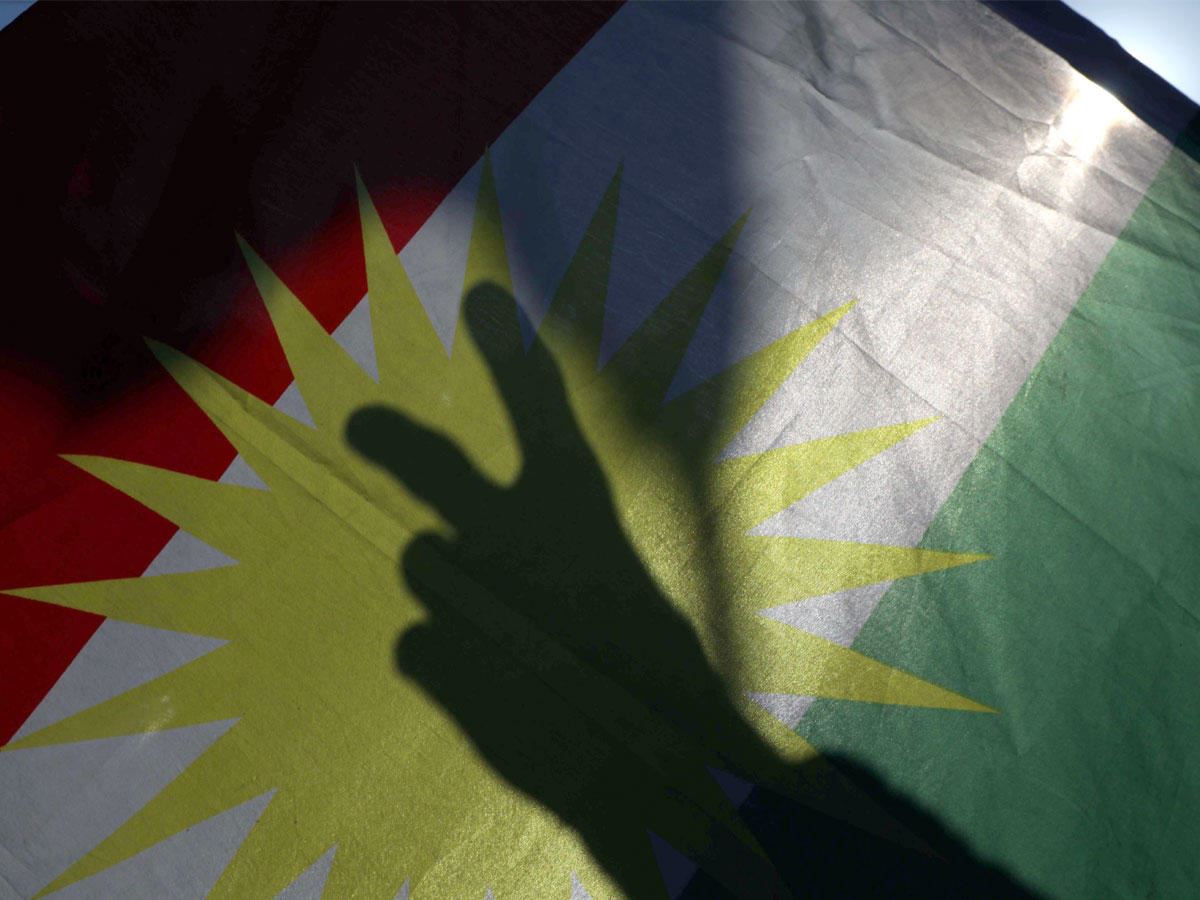
Kurdistan flag. Photo: file/AFP
Following the change of the Baath regime in Syria, Ahmed al-Sharaa and Hay’at Tahrir al-Sham (HTS) wanted to convey the message that they would establish a political system different from the previous one. Not only would that, but the behavior of HTS would also change. Sharaa dropped his nom de guerre Abu Mohammed al-Jolani and promised to dissolve his organization as well. The majority of people were pleased with the end of family and dictatorial rule that had lasted for decades under the Baath government and Bashar al-Assad's regime. The new situation created hope that this change would end the 13-year-long internal conflict, monopoly, and civil war. Minority groups, considering the reformist rhetoric and promises of the new leadership under Sharaa, did not think the potential for diversity and political stability was far-fetched.
Many countries around the world, particularly Western nations, despite their caution, welcomed the possibility of change in Syria. Initial developments, such as efforts to rebuild infrastructure, reopen schools, and negotiations between parties strengthened hopes of a different Syria. But this optimism quickly faded as a severe inconsistency emerged between Sharaa's public statements and the actual practices of his governance. The events in Syria's coastal regions and the clashes between the government and the Druze drew international attention, and despite promises for reform, respect for the rights of minorities and various components of Syria, and the implementation of principles of governance, the announcement of the new constitution - which was drafted under Sharaa's supervision - showed a contrary image by consolidating extensive powers for the president, including control over the judiciary and security forces.
Instead of strengthening local administrations or guaranteeing minority rights, the constitutional framework has established a highly centralized state that appears to be, in some places, a copy of certain sections of the Turkish constitution, which has been utilized regarding territorial integrity and state centralization. In the sections concerning presidential powers, it resembles parts of the Iranian constitution, and even goes beyond it. In general, this has raised concerns about a return to dictatorial rule. This contradiction between reformist rhetoric and the monopolistic design of institutions has worried ethnic minorities and different religious sects in Syria and has rekindled fears of political stagnation under a different guise.
Opening Sharaa's path to Damascus
There is a debate about whether the rapid changes and events that occurred in Syria last year, resulting in the quick domino-like collapse of cities under the authority of the previous Syrian government, happened due to an international agreement or because of the internal dynamics of that country's politics, but in reality, it may be a mixture of both factors. The reason for the diminishing role of Syria's previous allies and partner states, particularly countries like Russia and Iran and other actors like Lebanon's Hezbollah, to a level that paved the way for Assad's fall, is still shrouded in mystery.
Some believe that the regime's collapse and the establishment of the HTS with Sharaa as Syria's new ruler, their quick and easy arrival in Damascus, and the sudden disappearance of Russia and Iran, was due to an agreement among the world's major powers. Others believe that other factors played a key role in this rapid collapse of Syria, such as the poor living conditions and the financial situation of army soldiers whose monthly salary was not enough to cover even a quarter of the month. Constant war and destruction for more than 13 years had created a deep sense of weariness and exhaustion among Syrian soldiers that made them unable to fight. Therefore, when cities easily fell one by one under the control of an Islamic-military force, their first reaction was to lay down their weapons, flee, and surrender.
Announcement of a transitional constitution
Now, countries around the world are dealing with Sharaa as a legitimate president and some are hopeful that Syria under his era will be a democratic and freedom-loving country that embraces diverse components and religions. However, there are also many doubts and concerns about whether it will turn out this way. The recently announced interim constitution, written for a five-year transitional period, drew considerable criticism.
Some believe that announcing a constitution after the fall of the previous regime was a necessity, but this constitution, in its form, shape, wording, and structure, is not similar to other constitutional declarations around the world. Rather, it resembles more of a statement aimed at conveying the message to the outside world that "we are drafting a constitution." Besides that, it is not known whether it is a temporary constitution or will remain in effect for a long period in practice.
The expectations before the writing of the constitution were that it should protect the rights of all components, ethnic minorities, and religions, and respect Syria's diverse demographic structure, but contrary to this, a monochromatic and single-ideology constitution was announced under the hegemony of the leaders of the HTS. It has concentrated all powers in the hands of the HTS, just as the key ministers of the current government belong to that organization. Another issue is that this constitution does not resemble in any way the interim constitutions of countries that have gone through war and had regime changes.
In reality, the ideological beliefs of Damascus's current authorities are such that they fundamentally view the constitution as something superficial, because they regard the Quran as the main constitution - whatever is in the book serves their interests, and they work with it as a constitution. This government and state is a jihadist state, not a state based on law that would work according to a constitution, so they don't need a constitution. What they have called a constitution is only so they can say they have one. From the very beginning, the committee announcing the constitution, who were responsible for writing and drafting it, were not constitution experts.
Disappointment of Kurds
The Kurds, who are the second largest national and ethnic component in Syria, quickly raised their voices against this constitution and harshly criticized its text and its drafters from several aspects.
The first point of Kurdish criticism is the framing of Syria as an Arab state. Syria's composition is multi-colored (diverse), so from their perspective, it was necessary to remove the word "Arab" from the phrase "Syrian Arab Republic" rather than keeping it as before. But in this new constitution, the Syrian state is referred to as the "Syrian Arab Republic." This is the same expression and repetition of the same one-sided ideology of Syria's previous government.
If we look at the style wording and semantics of the constitution, we see that in places where it discusses the state, it uses strong words, such as "commits to," but when it comes to discussing rights and freedoms, it uses very weak words and phrases - it "ensures" freedoms. This kind of wordsmithing is not randomly done but has purpose and intent behind it. Only in one article, Article 7, and in a secondary manner, does it discuss the diversity and rights of other components of Syria that the state "ensures."
It is also stated that the official language of the state is Arabic, which is a threat to Kurdish cultural freedom. In Syria's history, five constitutions have been written and in none of these constitutions has there been any mention of Kurds. And in this constitution, it is the same. In one article, which is Article 7, there is mention of the diversity and variety of Syria's composition, but it is unclear and is referenced in a very secondary manner.
Another important issue is the question of centralization and the devolution of power to government agencies, regions, and institutions. What was expected was that, unlike the previous government, power would not be concentrated in the hands of one person, but rather, powers would be devolved to government institutions. However, the powers that Sharaa currently has can be said to be much greater than those of Bashar al-Assad. In this way, as before, all decisions are made from Damascus, particularly by Sharaa himself, which again feeds into central authority and opposes decentralization.
The constitution has granted absolute power to the president. For example, the president can make decisions in place of parliament, and also has all military authority as the head of the army, which demonstrates that he wants to fully consolidate his power and remain in power for a long time.
The third point concerns the issue of religious freedom. There is a contradiction between the articles of the constitution itself and Sharaa’s promises and behaviors. In this constitution, Islam has been made the basis for drafting legislative laws. Restrictions on religious freedom are increasing to the extent that they now go to Christians and tell them they must become Muslims, which has resulted in the dissatisfaction of other denominations because they believe their religious rights and freedoms are not embodied in the constitution.
It is important to note that a constitution is like a chain where all texts and points are connected to each other, but in this constitution, this kind of connection doesn't exist, there are contradictions between its articles. For example, at one point it emphasizes protecting the rights of minorities and respecting different thoughts, religions, and components, but at another point it mentions that the religion of the person who becomes president must be a Muslim. This point is very important. Religious freedom is the mother of all other freedoms, but according to this constitution, a person belonging to another religion cannot become president and nominate themselves for such a position.
Regarding the issue of contradiction between words and actions, when HTS came to power, Sharaa announced in several interviews that they had not come to rule with a revolutionary mentality, but rather they would follow civil governance in which the principles of statehood and civility would be established. However, soon after these statements, when the Alawites demanded some normal rights and demands, the events in the coastal areas occurred, and later tensions with the Druze emerged. Also, when Sharaa and Mazloum Abdi, chief of the Kurdish-led Syrian Democratic Forces (SDF), reached an agreement, it was emphasized that Kurds are a main component of Syria and their rights are protected, but in the announcement of this constitution, the rights of Kurds and other components have not been explicitly recognized. When the Kurdish National Conference was held in Qamishli and several decisions were made, all the results and decisions were rejected by Sharaa’s government and declared illegitimate.
Another point concerns the issue of democracy, technocratic governance, and statehood. According to this constitution, women do not have the right to political participation, but only the right to education. If we look more closely at the points of the constitution, we see that democracy is not mentioned in any way, and women's rights are not protected in any way because they are viewed from an ideological perspective. The same applies to the rights of children and other components.
Regarding the participation of Kurds and other components in the government, the government that was formed did not include representatives of all components. Rather, all those who received power and participated in forming the government, even if they were from different components, were from their own circle. If a Kurd has participated, they only represented themselves and did not represent any Kurdish political side or component. Also, in all government meetings and conferences, no Kurd has participated as a representative of political parties. In the national conference about Syria's future, which was organized by the government some time ago, in which about 800 people participated, the majority had the same ideology as Sharaa and the future of Syria was only discussed for two hours.
In Article 52, five years have been designated as a "transitional period." In reality, this period is long, and it is still unknown what Sharaa’s purpose and goal are and what he wants to do during those five years. During that period, a committee will be formed, and that committee will form a commission to elect the members of parliament. That commission will be affiliated with Sharaa and it is clear that those close to Sharaa will be elected, and in this way, parliament will be formed. Also, amending and changing this constitution is very difficult, which is mentioned in Article 50, and it will require the approval of the president and parliament.
Next political steps for Syrian Kurds
Syria's main problem has two parts: the first part is the loss of constitutional and legal culture. Three years after the Syrian state was first established, there was a military coup. Also, ten years after the coup, the Baath party or before them Jamal Abdel Nasser, who made Syria part of the United Arab Republic, did not allow the constitution to have a role and become a culture, but they always carried out coups. Therefore, Syria's constitutional struggle must be to build a culture of constitution and law. So it is important for Kurds to participate in parliament at any opportunity despite all the above-mentioned points and disagreements. They need to participate in negotiations and not distance themselves from legislative power, and continue to obtain their rights in a democratic way.
For Kurds, this is a difficult situation, but at the same time, there are some opportunities for negotiation that should not be missed. The Kurdish National Conference was late, but it was very important that it was held. It is very important to quickly form a joint Kurdish delegation. It is not necessary to go directly to Damascus, but before going to Damascus, it should request meetings with the European Union, America, and also Turkey. They should visit Egypt, Qatar, Jordan, Saudi Arabia, and the UAE. These steps are important for protecting their rights in the constitution.
Authors:
- Kamran Hajo, head of the Kurdish National Council's (ENKS) foreign relations
- Azad Ali, writer and former head of Rudaw Research Center
- Sardar Abdullah, former member of Iraqi parliament
- Farouk Haji Mustafa, writer and the head of Barchaw organization for democracy and media development
- Kawa Azizi, ENKS member.
The views expressed in this article are those of the authors and do not necessarily reflect the position of Rudaw.

No comments:
Post a Comment