Funniest internet reactions to first US-born pontiff, Pope Leo XIV
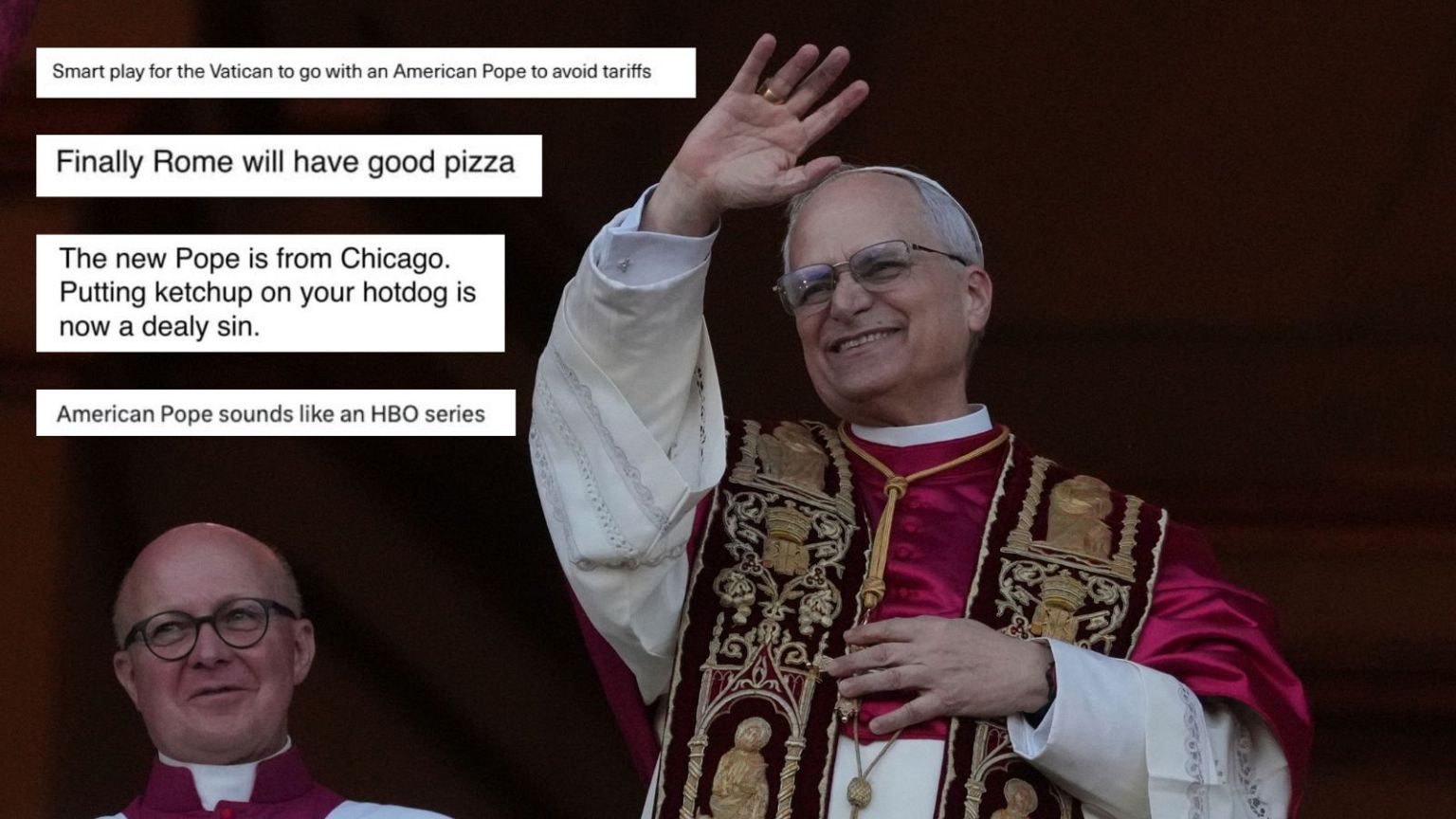
From deep dish pizza to 'The Bear', with also mentions of Trump's tariffs, the internet wasted no time in welcoming the new pope with a solid dose of tomfoolery.
The papal conclave is over and a new pontiff has officially been announced: Cardinal Robert Francis Prevost, now known as Pope Leo XIV.
The 69-year-old is the first-ever pope hailing from the US, having been born in Chicago, Illinois. And as you can imagine, the internet wasted no time in commenting on the moment, with reactions that verged from humorous to plain dumb – especially when it came to the MAGA crowd, who weren’t best pleased that the new pope didn’t speak in English for his first speech.
For the sake of sanity, we won’t focus on the terminally stupid takes and opt for the sanity-restoring tomfoolery, with a great deal of social media users taking the late Pope Francis at his word when he said “There is faith in humour” and letting their Chicago pride shine.
The Chicago mayor, Brandon Johnson, posted: “Everything dope, including the Pope, comes from Chicago! Congratulations to the first American Pope Leo XIV! We hope to welcome you back home soon.”
Others referenced Chicago’s famous deep dish pizza, joking about whether Rome would be able to accept that particular kind of culinary heresy, while some referenced the celebrated Chicago-based TV show The Bear.
Here are some of our favourite reactions to the new pope: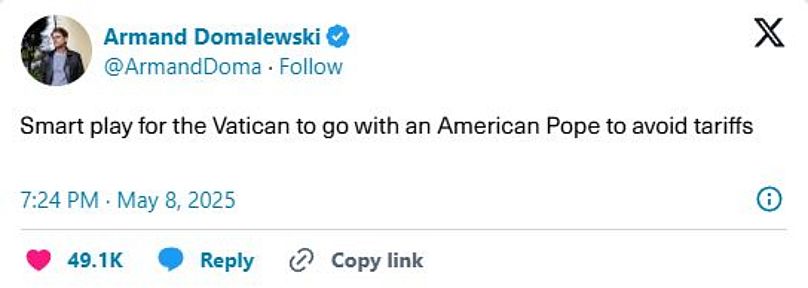
TariffsX
"Smart play for the Vatican to go with an American Pope to avoid tariffs"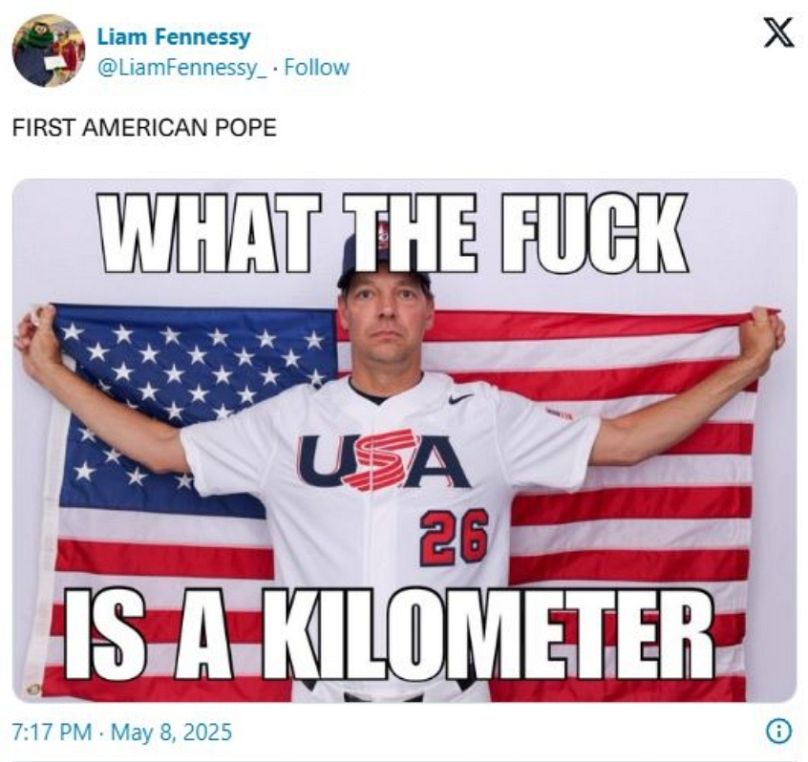
Kilo-what?X
Some homework will be required...
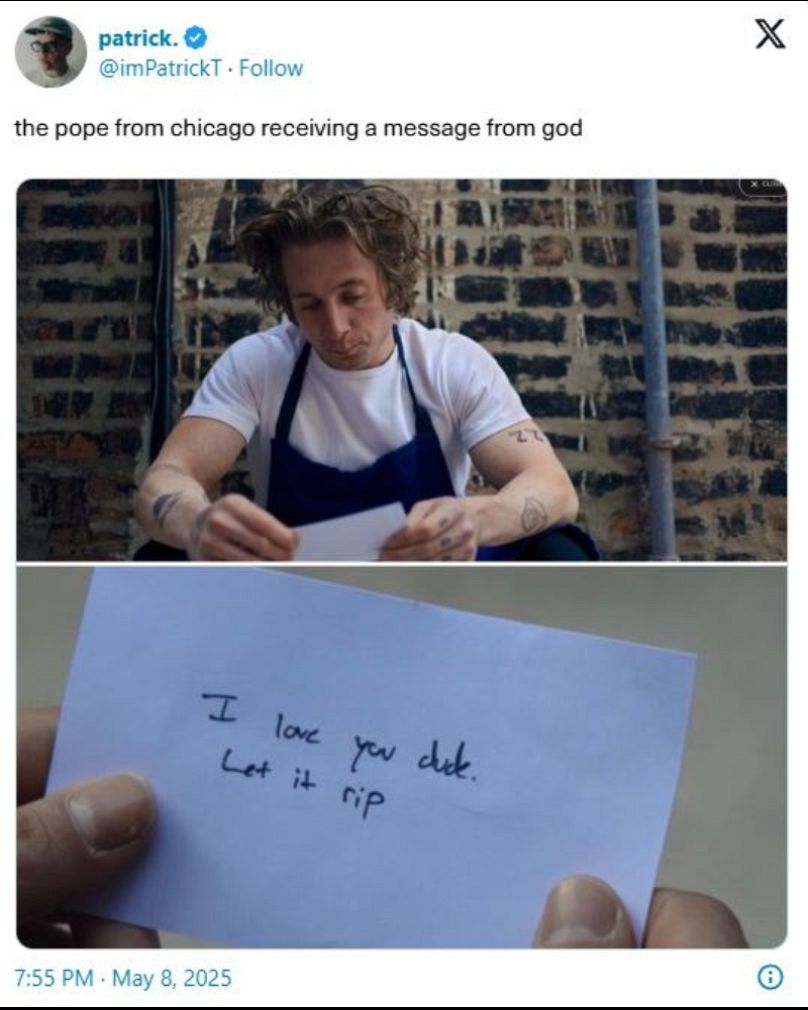
The BearX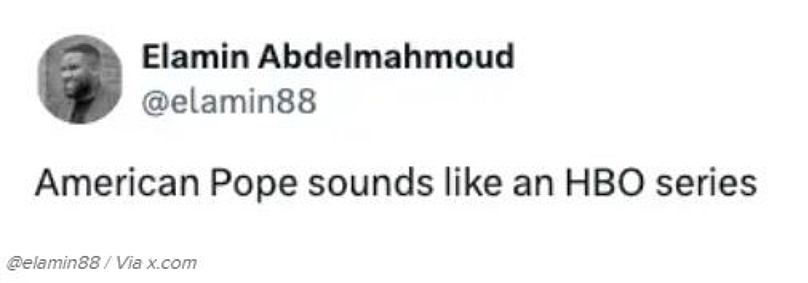
HBOX
No truer word has been spoken.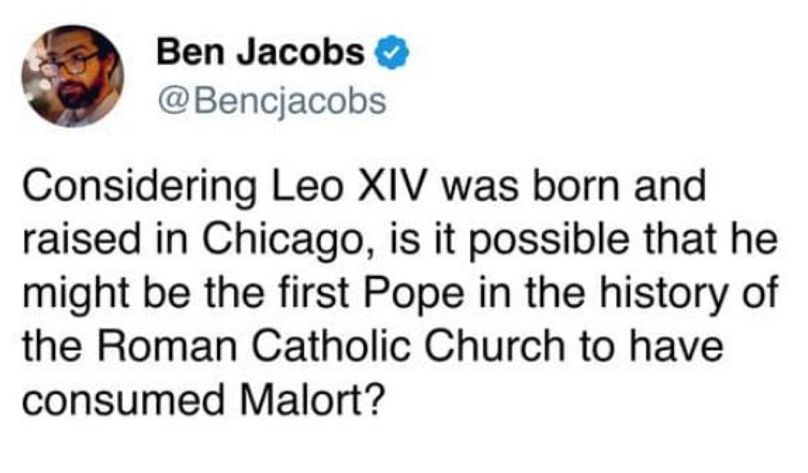
MalortX
For those not familiar, Malört is a US brand of bäsk liqueur, a type of brännvin flavoured with anise that was introduced in Chicago in the 1930s. Spoiler: it's disgusting.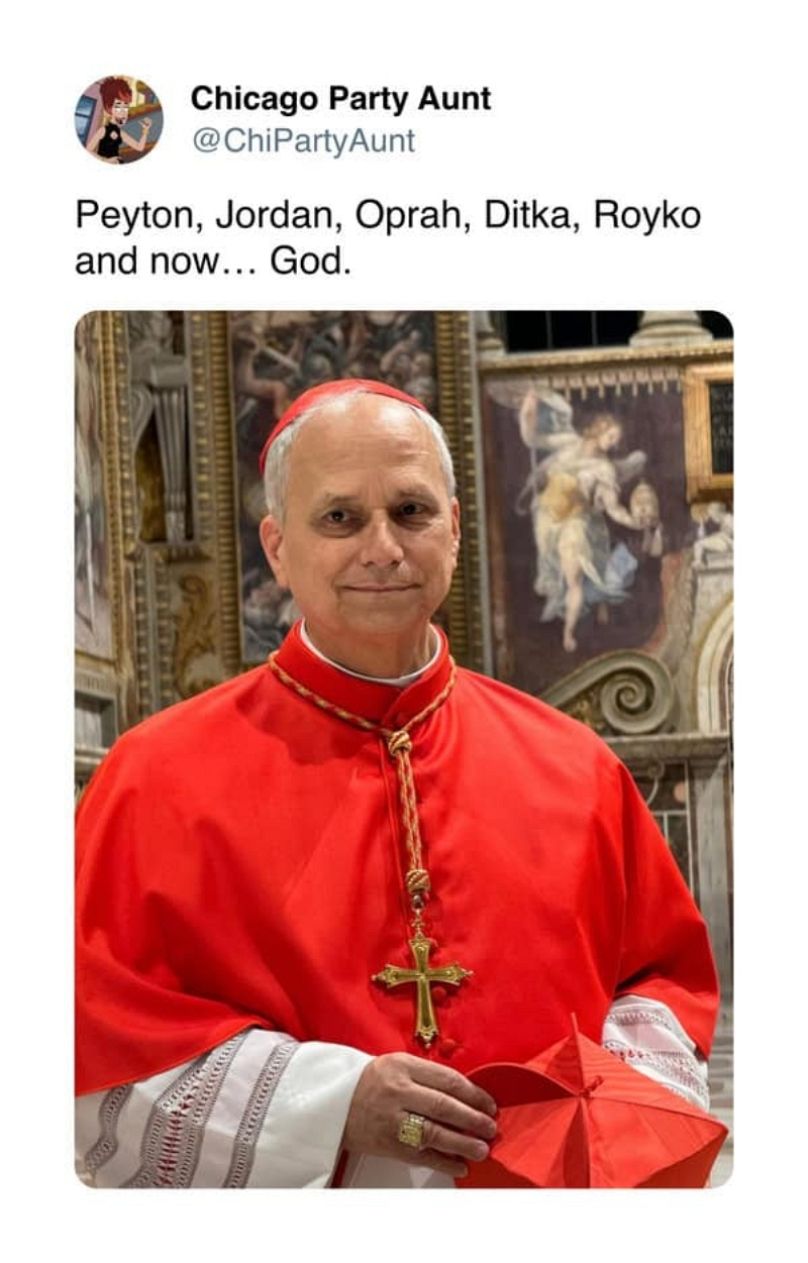
The lineageX
Impressive run, it has to be said.
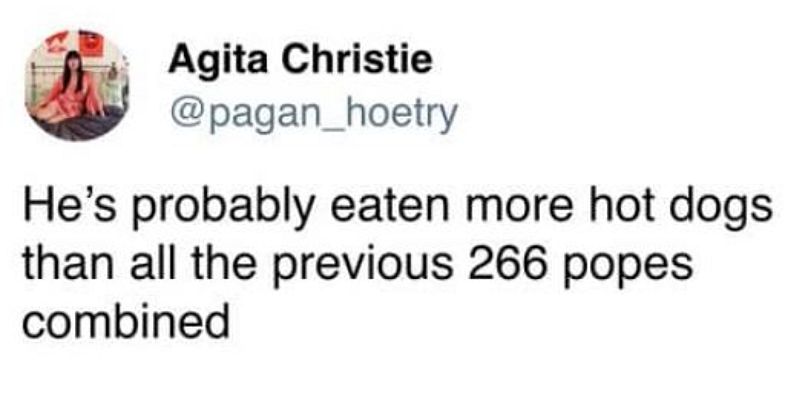
Hot dogsX
The odds look good.
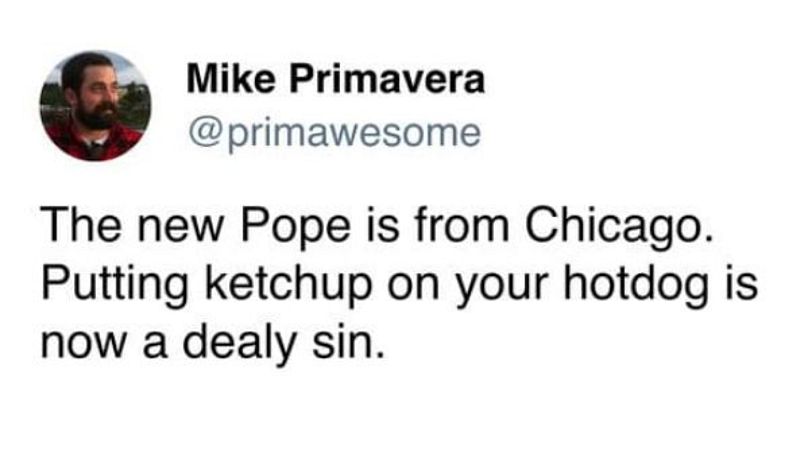
New sinX
It's mustard and pickles all the way now. Which is no bad thing.
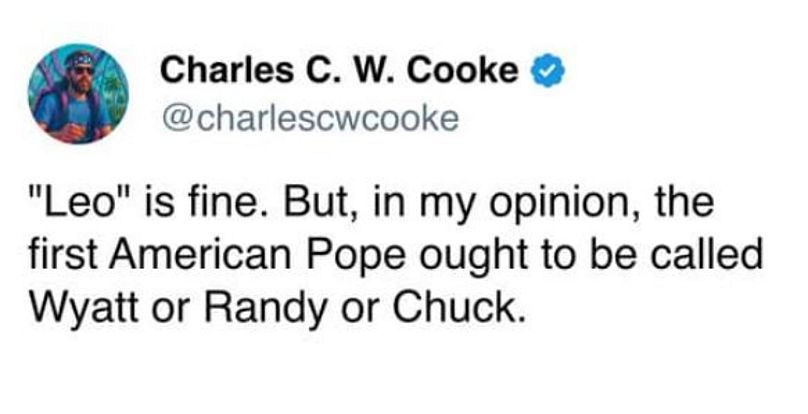
Wyatt, Randy or ChuckX
Pope Chuck does have a certain ring to it... Is it too late to make a change?
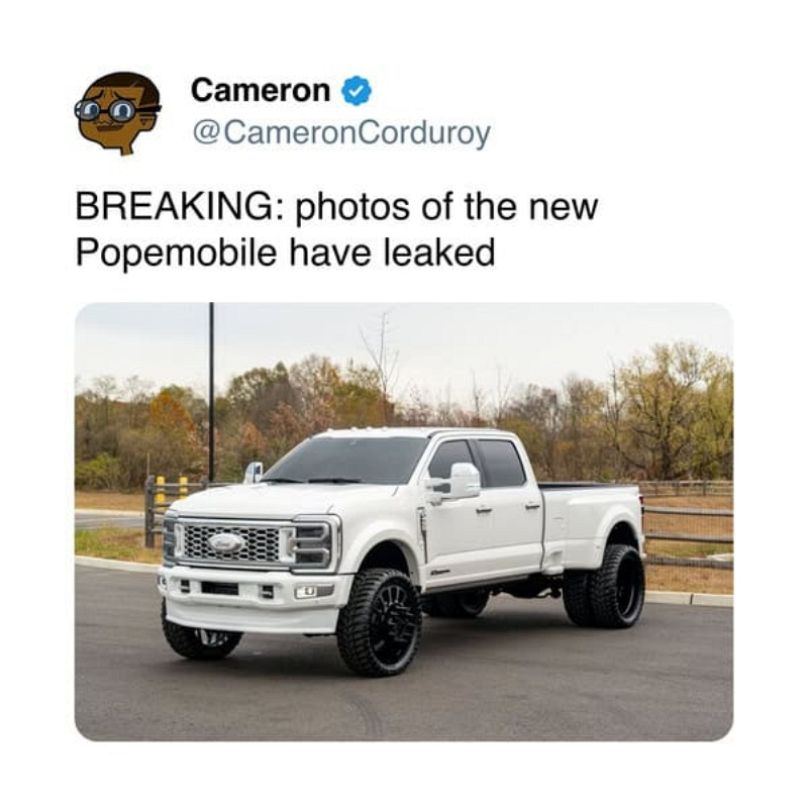
PopemobileX
Looks... sturdy.
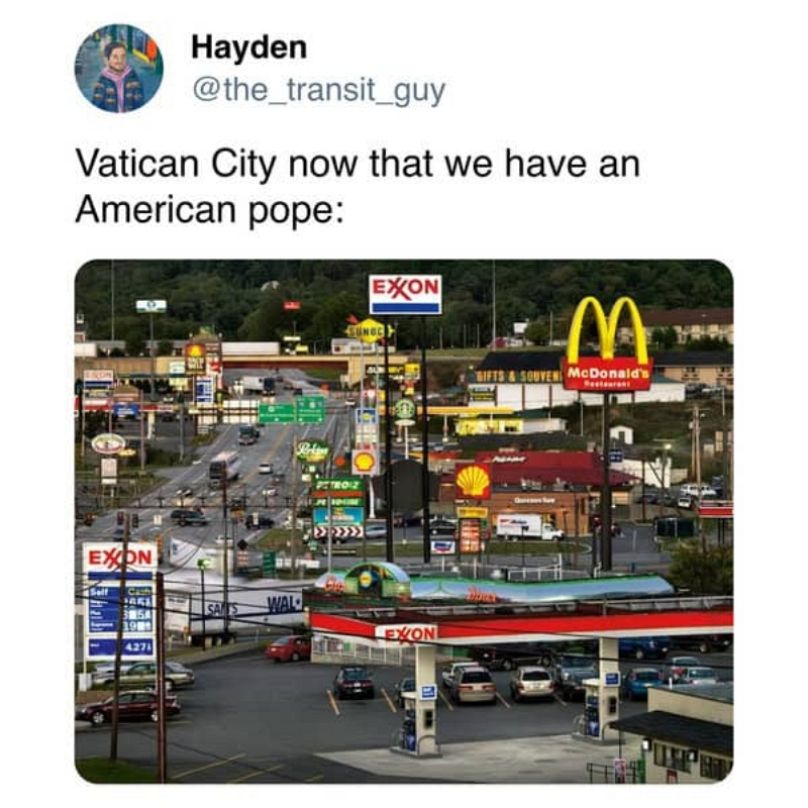
Upgrade?X
The horror... The horror...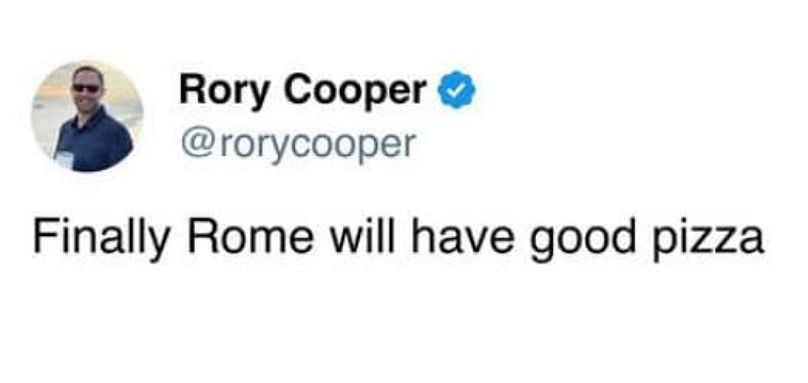
PizzaX
This take will not fly. And deep dish pizza is not pizza. To quote Jon Stewart, in one of his finest rants:
It’s a casserole.”
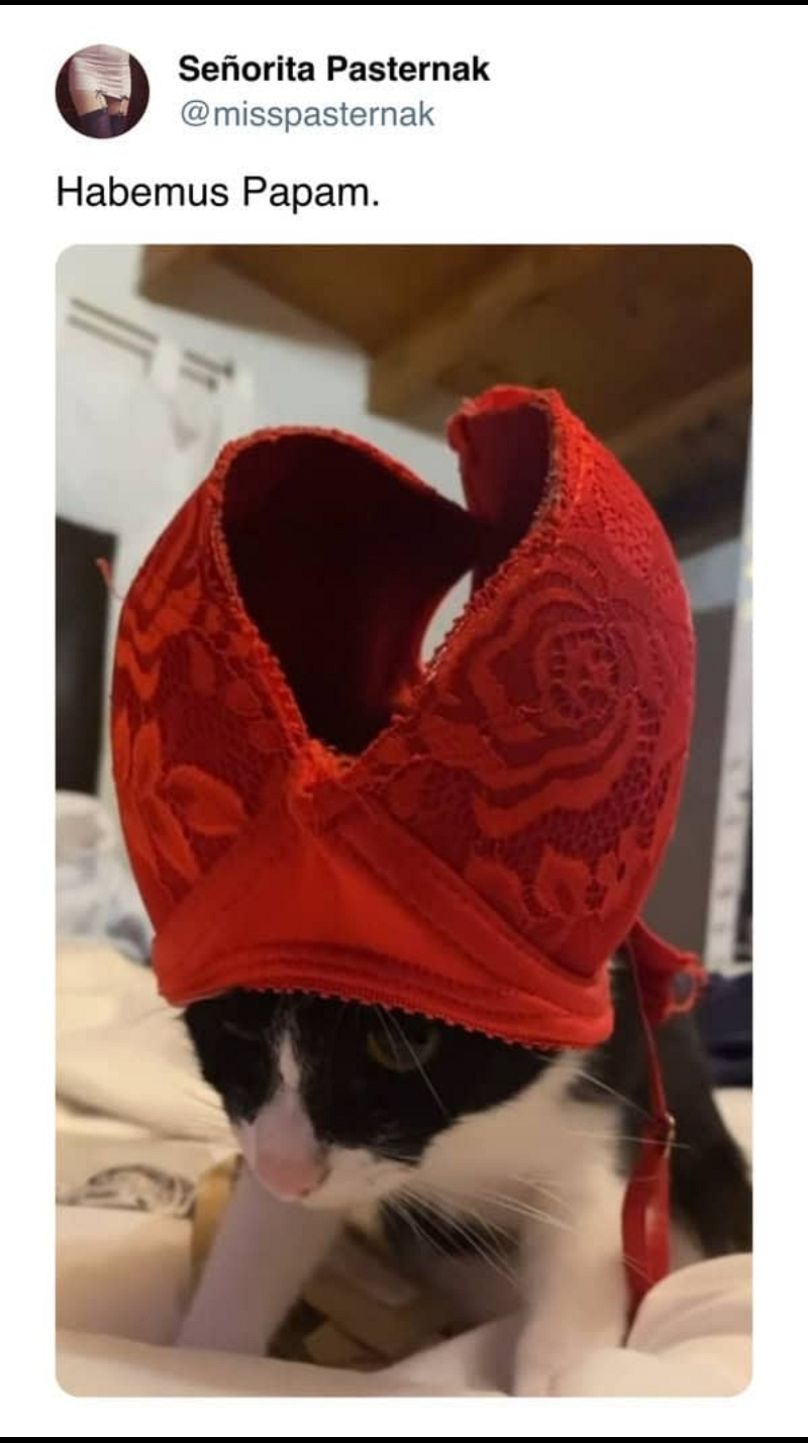
We do... We really doX
Pope Mush the Dainty.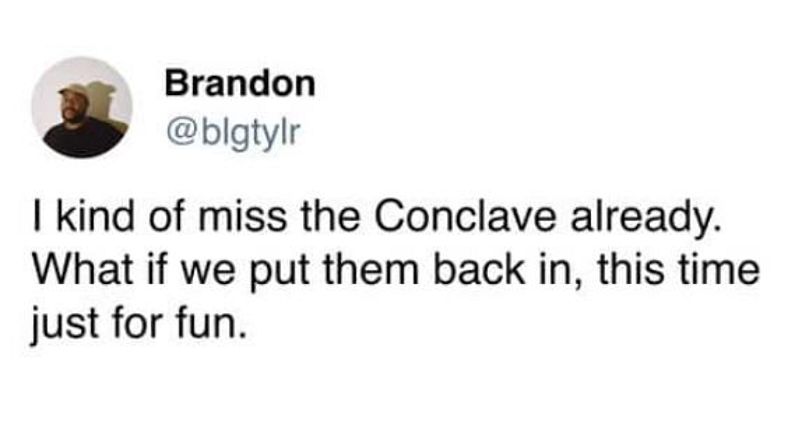
ConclaveX
It did go by awfully quickly, didn't it?

By AFP
May 8, 2025

Adept in social media, newly elected Pope Leo will have more ways to address crowds than oratory from a balcony of the St Peter's Basilica - Copyright AFP
From pillorying the US vice president to denouncing the death penalty, Pope Leo has proven unafraid to tackle prickly political issues on social media — making him the first “extremely online” pontiff.
When JD Vance suggested that Christians should love their family, neighbors, community and fellow citizens — in that order — one very notable Christian took umbrage.
Robert Prevost, now better known to the world as Pope Leo, quickly took to X to take a theological swipe at the vice president.
“JD Vance is wrong: Jesus doesn’t ask us to rank our love for others,” he wrote, reposting a columnist’s searing opinion piece and prompting tens of thousands of likes and a slew of barbed comments.
Pope Benedict may have been the first to tweet under the handle @Pontifex in 2012, but Pope Leo is undoubtedly the first to take the Chair of Saint Peter with the baggage of a long social media history.
In 14 years since his X account was created, he has posted more than 400 times, opining on a range of hot-button issues: racism, sexual abuse by the clergy, Covid-19, the police murder of George Floyd and Russia’s invasion of Ukraine.
Perhaps unsurprisingly for an American who spent decades in Peru and took up its citizenship, immigration is a topic close to his heart.
The new pope has notably amplified criticism of US President Donald Trump’s immigration policies, reposting a 2017 article which called refugee bans “a dark hour of US history” and an abandonment of “American values.”
He has repeatedly taken Vance to task, challenging a vice president whose religious views show all the zeal of a recent convert to Catholicism.
It is clear from his ample online commentary, interviews and video blogs that retweets are almost always endorsements.
In 2020, days after African American Floyd was suffocated to death under a police officer’s knee, he implored fellow members of the clergy to speak up.
“We need to hear more from leaders in the Church, to reject racism and seek justice,” he posted.
He has also demanded more action of the church in ousting members of the clergy who sexually abused children.
“If you are a victim of sexual abuse by a priest, report it,” he told Peruvian paper La Republica this month.
“We reject cover-ups and secrecy; that causes a lot of harm. We have to help people who have suffered due to wrongdoing.”
Embracing another contentious issue, in 2014 he wrote that it was “time to end the death penalty” and has repeated that point over the years in interviews, masses and in public remarks.
“We have to be pro-life at all times” he once told assembled Peruvian journalists in his fluent and modestly accented Spanish.
Still, he is also unafraid to post a joke, including a suggestion that while many people are intelligent, most are asymptomatic.
Like many of us, the tempo of his social media posts appeared to increase during pandemic lockdowns.
It is unclear if he will extend that social media chattiness from inside the Apostolic Palace.
By AFP
May 8, 2025

US President Donald Trump and Vice President JD Vance made no reference to the new pope's prior critical comments as they congratulated him on his election - Copyright AFP
Pope Leo XIV shared articles criticizing US President Donald Trump and Vice President JD Vance on social media months before his election as America’s first pontiff, particularly on issues of migration.
In February, the then-Cardinal Robert Francis Prevost reposted on X a headline and a link to an essay saying Vance was “wrong” to quote Catholic doctrine to support Washington’s cancellation of foreign aid.
The Vatican confirmed Thursday the account was genuine and belonged to the Chicago-born Prevost.
The article took issue with Vance, who converted to Catholicism in 2019 and argued that Christians should love their family first before prioritizing the rest of the world.
“JD Vance is wrong: Jesus doesn’t ask us to rank our love for others,” said the headline reposted on Prevost’s account, along with a link to the story by the National Catholic Reporter.
After becoming vice president, Vance justified the cancellation of nearly all US foreign assistance by quoting 12th-century theologian Thomas Aquinas’s concept of “ordo amoris,” or “order of love.”
The late pope Francis, in a letter soon afterward to US bishops, said that “true ordo amoris” involved building “a fraternity open to all, without exception.”
A few days later Prevost posted the headline and link of another article about Vance’s doctrinal arguments, which referred to Francis’s criticisms of Trump’s mass deportations of migrants.
The future pope’s last activity on X before his election on Thursday was to repost a comment by another user criticizing the Trump administration’s mistaken deportation of a migrant to El Salvador.
The post talked about “suffering” and asked, “Is your conscience not disturbed?”
The US president and vice president made no reference to the new pope’s prior comments as they congratulated him on his election.
Vance, who met Francis briefly on Easter Sunday hours before the pontiff died, said: “May God bless him!”
“I’m sure millions of American Catholics and other Christians will pray for his successful work leading the Church,” he said on X.
Trump, who had posted an AI-generated image of himself in papal clothes a few days earlier, said the election of the first pope from the United States was a “great honor for our country.”

Published on 09/05/2025 -
Robert Prevost, a 69-year-old from Chicago, became the first ever US pontiff when he was chosen by his fellow cardinals on Thursday, less than three weeks after the death of his predecessor, Pope Francis.
Trump was quick to celebrate Prevost's appointment, sending his congratulations and expressing a desire to meet the pontiff, who is now known by the name Leo XIV.
"What excitement, and what a great honour for our country. I look forward to meeting Pope Leo XIV. It will be a very meaningful moment!" Trump said in a post on his Truth Social platform.
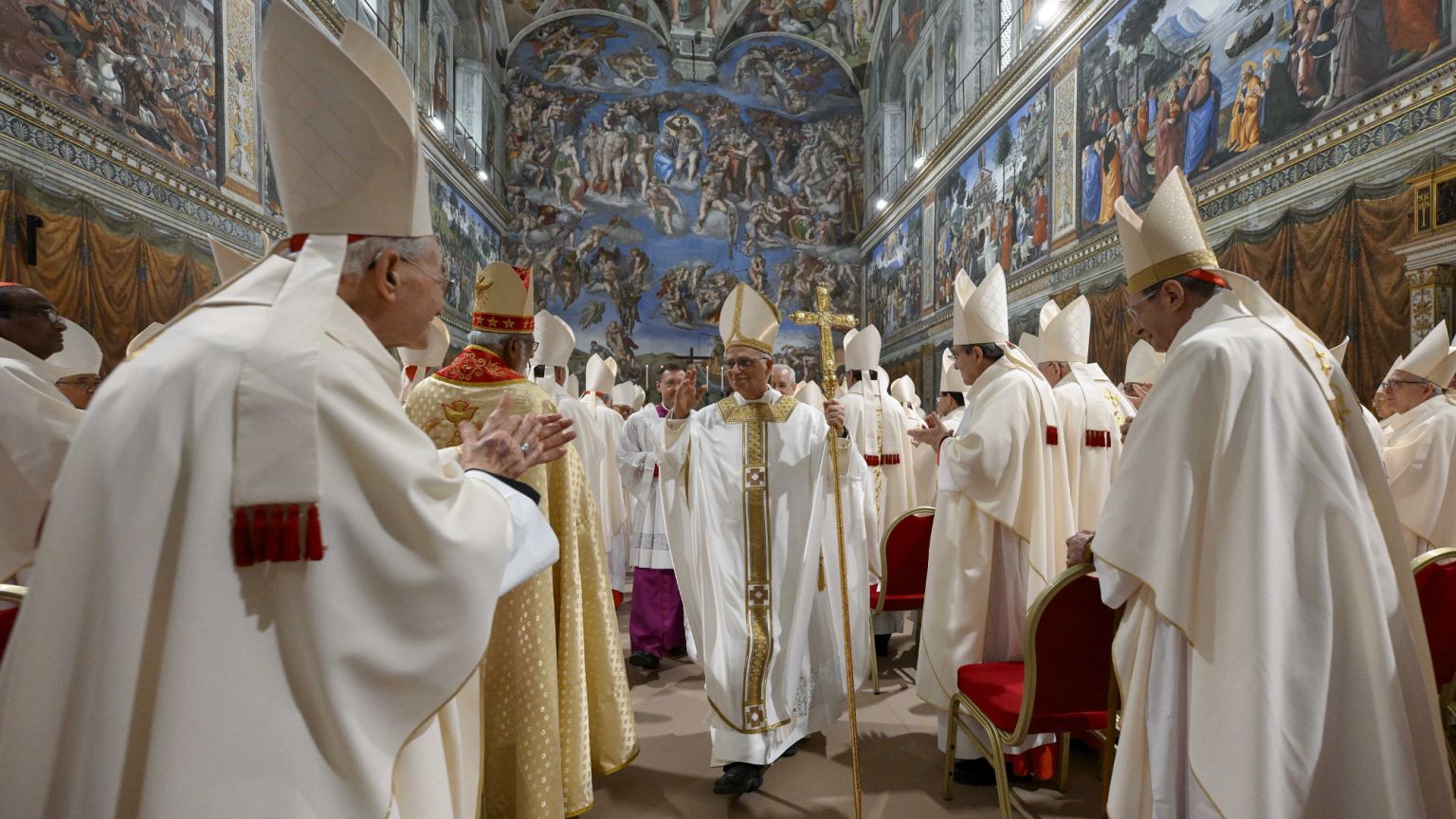
Copyright AP Photo
Laura Loomer, a far-right activist who was invited by Trump to the Oval Office in early April, called the new pope "anti-Trump, anti-MAGA, pro-open borders and a total marxist like Pope Francis."
Her criticism came in response to an article allegedly reposted by Prevost on X.
A verified account under his name shared a Washington Post opinion piece written by Cardinal Timothy Dolan in 2015.
The article was titled "Why Donald Trump's anti-immigrant rhetoric is so problematic."
In February, the same account reposted an article — written by the National Catholic Reporter (NCR) — that criticised the US Vice President JD Vance over his comments on the Christian concept of "ordo amoris."
Related
Who is Cardinal Robert Francis Prevost, elected Pope Leo XIV?
"There's this old school – and I think it's a very Christian concept by the way – that you love your family and then you love your neighbour, and then you love your community, and then you love your fellow citizens in your own country, and then after that, you can focus and prioritise the rest of the world," Vance said earlier this year.
His interpretation of the doctrine was widely condemned by leading religious figures, with the NCR article shared by Prevost's account concluding "JD Vance is wrong: Jesus doesn't ask us to rank our love for others."
But unlike Loomer, some Trump allies tried to reserve judgement.
"Is it too much to hope that some 20-year-old ran the new pope's X account and he never looked at it?" asked former Fox News host Megyn Kelly.
Story by Jabed Ahmed
 The Independent
Maga melt down over 'woke marxist pope'
Key figures from Donald Trump’s MAGA movement have decried the appointment of the first American Pope.
Not much is known about Pope Leo’s political alliances, though he has been openly critical of the Trump government’s anti-immigration stance.
In the run-up to his election on Thursday as the 267th pope, the then-cardinal Robert Prevost criticised US vice president JD Vance on his social media platform on X, formerly Twitter.
Leo shared an article from a Catholic publication with the headline, “JD Vance is wrong: Jesus doesn’t ask us to rank our love for others.”
Mr Trump has so far only said that Leo's election was a "great honour" for the US. However, some of the president’s most vocal supporters have been critical towards the new pontiff and quick to attack him.

Pope Leo replaced the late Pope Francis after a Conclave vote on Thursday (Copyright 2025 The Associated Press. All rights reserved)
Speaking to the BBC on Friday, Mr Trump’s former chief strategist Steve Bannon said Leo’s election was “jaw-dropping”.
"It is shocking to me that a guy could be selected to be the Pope that had had the Twitter feed and the statements he's had against American senior politicians," Mr Bannon said.
The practising Catholic predicted there's "definitely going to be friction" between the new pontiff and the US president.
Laura Loomer, a far-right conspiracy theorist who reportedly has the US president’s ear, described the new Pope as "anti-Trump, anti-Maga, pro-open Borders, and a total Marxist like Pope Francis".
However, New York Cardinal Timothy Dolan said on Friday he thought Leo would seek to build bridges with all world leaders, including Mr Trump.

Steve Bannon predicted there's ‘definitely going to be friction’ between Leo and Trump (Getty)
The new pope shares some policy similarities with the Mr Trump team. He opposes abortion, as does Trump and Vance.
But he supports work to combat climate change, according to a post urging followers to sign a Catholic climate petition. Mr Trump removed the US from the Paris climate accord that fights global warming.
(RNS) – 'As an Augustinian Catholic institution, we celebrate this significant day for our university community and the global church,' said the Rev. Peter M. Donohue, president of Villanova University, the alma mater of the new pope.
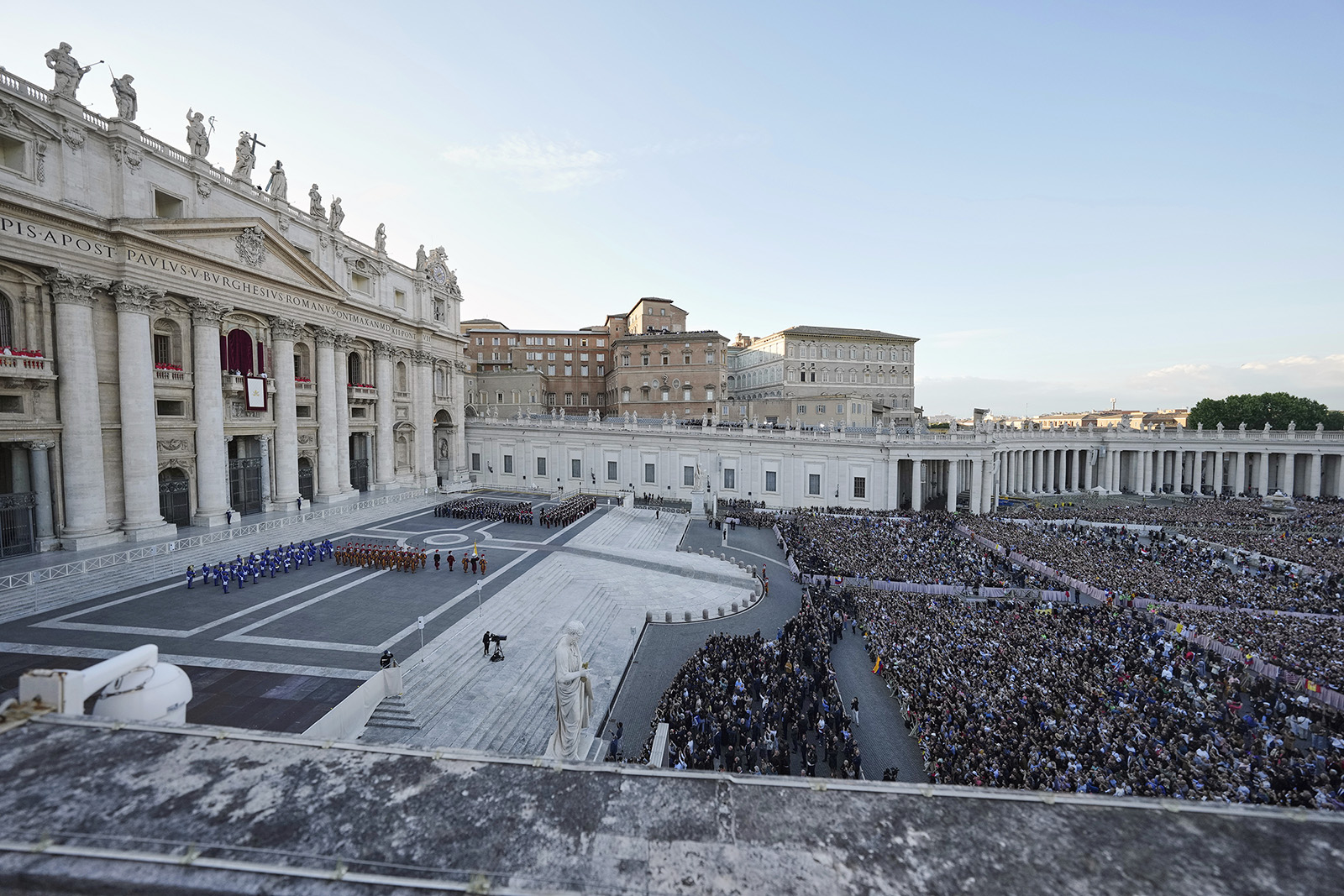
Newly elected Pope Leo XIV appears at the balcony of St. Peter's Basilica at the Vatican, Thursday, May 8, 2025. (AP Photo/Markus Schreiber)
Fiona André and Adelle M. Banks
May 8, 2025
(RNS) – Religious and political leaders around the world are commenting on the election of American Cardinal Robert Prevost as the 267th pope. He will take the name of Pope Leo XIV.
Here’s what they said:
U.S. President Donald Trump
“Congratulations to Cardinal Robert Francis Prevost, who was just named Pope. It is such an honor to realize that he is the first American Pope. What excitement, and what a Great Honor for our Country. I look forward to meeting Pope Leo XIV. It will be a very meaningful moment!”
Former U.S. President Joe Biden
“Habemus papam – May God bless Pope Leo XIV of Illinois. Jill and I congratulate him and wish him success.”
U.S. Vice President JD Vance
“Congratulations to Leo XIV, the first American Pope, on his election! I’m sure millions of American Catholics and other Christians will pray for his successful work leading the Church. May God bless him!”
Archbishop Timothy P. Broglio, U.S. Conference of Catholic Bishops’ president
“In communion with Catholics around the world, the bishops of the United States offer prayers of thanksgiving for the election of His Holiness Pope Leo XIV. … Certainly, we rejoice that a son of this Nation has been chosen by the cardinals, but we recognize that he now belongs to all Catholics and to all people of good will. His words advocating peace, unity, and missionary activity already indicate a path forward.”
The Rev. James Martin, Jesuit priest and America Magazine editor
“I know Pope Leo XIV to be a kind, open, humble, modest, decisive, hard-working, straightforward, trustworthy, and down-to-earth man. A brilliant choice. May God bless him.”
Ronald S. Lauder, president of the World Jewish Congress
“The World Jewish Congress (WJC) congratulates Pope Leo XIV on his election as the next leader of the Catholic Church. The WJC’s relationship with the Holy See spans decades and is grounded in a deep, ongoing commitment to interfaith dialogue. The WJC looks forward to continuing and deepening this essential dialogue under the leadership of Pope Leo XIV. At a time of global crisis, the importance of this relationship is only heightened.”
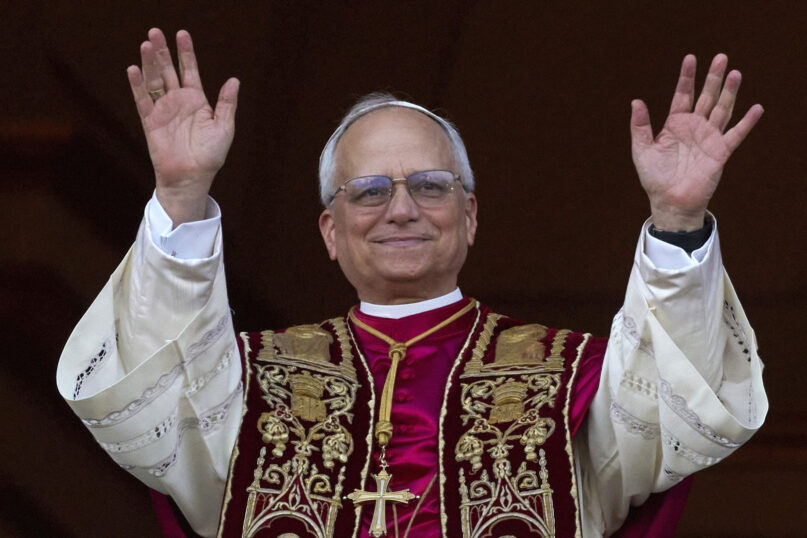
Newly elected Pope Leo XIV appears at the balcony of St. Peter’s Basilica at the Vatican, Thursday, May 8, 2025. (AP Photo/Andrew Medichini)
U.S. Speaker of the House Mike Johnson
“Congratulations to Pope Leo XIV. May God bless the first American papacy in these historic days.”
U.S. Rep. Nancy Pelosi, D-Calif.
“Joyfully, people around the world have learned of a new Pope elected by one of the largest and most diverse conclaves ever — and the first American pope in history. For many of us, the name Leo XIV happily brings to mind Leo XIII’s Rerum novarum which was a blessing for working people. And it is heartening that His Holiness continued the blessing that Pope Francis gave on Easter Sunday: ‘God loves everyone. Evil will not prevail.'”
Sen. Raphael Warnock, D-Ga.
“I would like to extend my heartfelt congratulations to Pope Leo XIV. I’m praying for him as he assumes this position of spiritual leadership. May God grant him the compassion and courage needed to lead during these difficult times.”
Mike Huckabee, U.S. ambassador to Israel
“Praying for my Catholic friends & extending high hopes for their new leader. God’s blessing on Pope Leo XIV!”
Isaac Herzog, president of Israel
“I congratulate Cardinal Robert Prevost, the newly elected Pope Leo XIV, on assuming this sacred and momentous responsibility – the first American Pope. I send you my warmest wishes from the Holy City of Jerusalem. We look forward to enhancing the relationship between Israel and the Holy See, and strengthening the friendship between Jews and Christians in the Holy Land and around the world. May your papacy be one of building bridges and understanding between all faiths and peoples. May we see the immediate and safe return of the hostages still held in Gaza, and a new era of peace in our region and around the world.”
Sheikh Mohammed bin Rashid Al Maktoum, ruler of Dubai, United Arab Emirates
“We extend our congratulations to His Holiness Pope Leo XIV on his election. We in the UAE deeply appreciate the Vatican’s role in promoting dialogue and peace among nations and faiths, and we look forward to working together with His Holiness to advance a global message of coexistence, tolerance and shared humanity.”
Bishop Robert Barron of Diocese of Winona-Rochester (Minnesota)
“Friends, our new Holy Father is Pope Leo XIV!… The first-ever American pope, Prevost served most recently as the head of the Church’s Dicastery for Bishops and president of the Pontifical Commission for Latin America. Please join me in praying for Pope Leo!”
Rabbi Noam Marans, director of interreligious affairs, American Jewish Committee
“We look forward to a close relationship with Pope Leo XIV as we continue to advance positive Catholic-Jewish relations for the benefit of Catholics, Jews, and all of humanity. In this sixtieth anniversary year of Nostra Aetate, when we celebrate and reflect upon the positive transformation of Catholic-Jewish relations, we stand ready to work with Pope Leo XIV to assure that past successes are affirmed and furthered and new challenges are met with confident collaboration.”
Bishop Lawrence Sullivan, vicar general for the Archdiocese of Chicago
“This is for all of us, having Pope Leo, the 14th elected as the Holy Father. It’s a day of great excitement for the church. Additionally, it’s a day of great excitement for Chicago, for the United States to have one of our own be elected as the Pope, to serve as the Holy Father, really is a cause of great joy, great excitement. I do believe that Pope Leo, the 14th, is going to serve with great, obviously great faith. He’s a very humble, a very kind person, and someone who really does look to the Lord for guidance in all that he does. He’s a very prayerful and spiritual man, and he’s going to take that sense of God’s love and do all that he can to care for all of God’s children to care for, for all of us.”
The Rev. Robert A. Dowd, president of the University of Notre Dame
“The Notre Dame community joins with the Church worldwide in giving thanks and rejoicing in the election of Pope Leo XIV, the first American pope. We celebrate his work as a tireless missionary who has never hesitated to cross borders to announce the Gospel. A leader of vision, humility and energy, he has inspired us with his compassion, generosity and love for the people of God. As he begins his pontificate, we pray that Pope Leo will always be blessed with the wisdom, courage and fortitude he will need.”
Chris Wimbush, interim president, Catholics for Choice
“It is not lost on us that the first U.S. pope comes now, in 2025. Whether intentional or not, Pope Leo will immediately be cast as a foil to President Trump and Catholic Vice President Vance and their anti-immigrant, anti-peacemaking, anti-economic justice policies. It is our most fervent hope that Pope Leo will rise to this challenge and show the world what true, humble, global leadership looks like. … Catholics for Choice’s work is more important than ever. That’s why we collected stories from the faithful Pope Leo now serves, who disagree with church teaching (on abortion). We will be sending them to Pope Leo in the hope he will open his heart to listen. The future of our church depends on greater inclusion and nuance on reproductive health decisions like abortion, contraception, and IVF.”
The Rev. Peter M. Donohue, Villanova University president
“As an Augustinian Catholic institution, we celebrate this significant day for our University community and the global Church. … With today’s election of His Holiness, Pope Leo XIV, I cannot help but reflect on what his Augustinian papacy will mean to our University community and our world. Known for his humility, gentle spirit, prudence, and warmth, Pope Leo XIV’s leadership offers an opportunity to reaffirm our commitment to our educational mission.”
Catholic Charities USA President and CEO Kerry Alys Robinson
“Today we join with the global Catholic Church and people of good will throughout the United States and around the world in congratulating and praying for Pope Leo XIV as he begins his papacy. In the weeks, months, and years to come, we look forward to drawing inspiration in a special way from the first American pope as the 168 Catholic Charities agencies across the United States fulfill their vital mission to come to the aid of our most vulnerable sisters and brothers in every corner of this country.”
Survivors Network of those Abused by Priests
“As white smoke rises, the Survivors Network of those Abused by Priests (SNAP) extends its acknowledgment to Pope Leo XIV on the gravity of the role he now assumes. With the title comes a grave reckoning.”
Francis DeBernardo, executive director, New Ways Ministry
“We pray that as our church transitions from 12 years of an historic papacy, Pope Leo XIV will continue the welcome and outreach to LGBTQ+ people which Pope Francis inaugurated. The healing that began with ‘Who am I to judge?’ needs to continue and grow to ‘Who am I, if not a friend to LGBTQ+ people?’ … For more than five decades LGBTQ+ Catholics have been pleading for the church to listen. With Pope Francis, their request was fulfilled. To revert to old ways of turning deaf ears to people who long to be full members of the Church is not the way of Jesus
Dignity USA
“DignityUSA joins many around the world in offering our prayers and best wishes to Cardinal Robert Prevost, now Pope Leo XIV, as he begins his service to our church and the world in this new role. This election appears to signal a willingness to continue building on Pope Francis’ commitment to synodality and social justice. … We express concern with the former Cardinal’s statements — as reported in the New York Times — in a 2012 address to bishops, where he stated that Western news media and popular culture fostered ‘sympathy for beliefs and practices that are at odds with the gospel’ including the ‘homosexual lifestyle’ and ‘alternative families comprised of same-sex partners and their adopted children.’”
RELATED: Pope Leo XIV Election in Photos
David J. Michaels, director of United Nations and intercommunal affairs, B’nai B’rith
“The Catholic-Jewish friendship is indispensable – and its flourishing over the past 60 years in particular can serve as a model for reconciliation and vital interreligious engagement. We affirm our commitment to this bond and hope to engage with Pope Leo XIV, as we have his predecessors.”
The Rev. Samuel Rodriguez, president of the National Hispanic Christian Leadership Conference
“The election of Pope Leo XIV – the first American pope – marks a watershed moment in the history of the Catholic Church. It is a reminder that faith is for all people in all places and that the gospel is an invitation to all. … My prayers are with the Catholic Church during this historic transition.”
Sheikh Ahmed El-Tayeb, grand imam of al-Azhar University, Cairo, Egypt
“My sincere congratulations to Pope Leo XIV on his election as Pope of the Catholic Church. We look forward to continuing our collaboration with His Holiness in strengthening interfaith dialogue and promoting the values of human fraternity, in pursuit of global peace, coexistence, and a better future for all humanity.”
Amanda Tyler, executive director, Baptist Joint Committee for Religious Liberty
“With his election, Cardinal Robert Francis Prevost, now Pope Leo XIV, assumes religious leadership of Catholics spanning continents, cultures, and political systems. As political leaders in our country celebrate this moment as a national triumph, we must be clear: Christianity is a global religion, grounded in humility, compassion, and universal dignity – beliefs that stand in direct contrast to nationalism, which seeks to elevate one nation or identity above others. Faith should never be used as a tool of nationalism.”
Monsignor Fernando Ocáriz, prelate of Opus Dei
“From the moment his name was announced from the balcony of St Peter’s Basilica, we have been offering our prayers for him and for the immense mission that lies ahead of him. … Let us accompany the new Roman Pontiff with our affection and prayer, following our Founder’s example.”
Robert Prevost, first US pope, will reign as Leo XIV
VATICAN CITY (RNS) — In a shocking vote that caught the Catholic world by surprise, Robert Francis Prevost has been elected the 267th pope, and the first United States citizen to become the bishop of Rome.
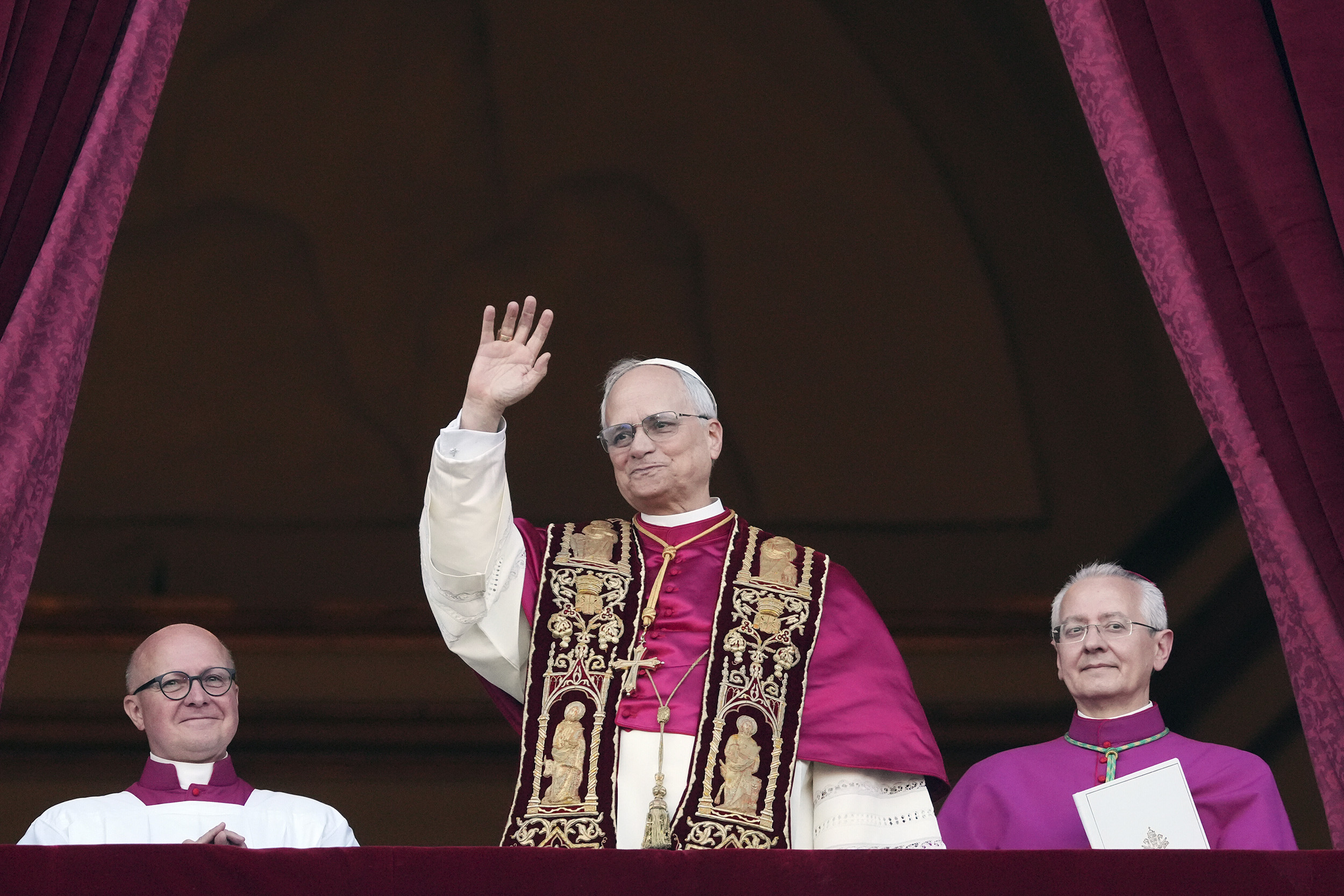
Cardinal Robert Prevost appears on the central loggia of St. Peter’s Basilica after being chosen the 267th pontiff of the Roman Catholic Church, choosing the name of Pope Leo XIV, at the Vatican, Thursday, May 8, 2025. (AP Photo/Alessandra Tarantino)
Claire Giangravé and Aleja Hertzler-McCain
May 8, 2025
VATICAN CITY (RNS) — In a shocking vote that caught the Catholic world by surprise, the College of Cardinals elected Robert Francis Prevost, 69, the 267th pope on Thursday (May 8). He is the first United States citizen to become the bishop of Rome.
The Chicago-born Prevost has chosen to take the name Pope Leo XIV, signaling a kinship with the 19th-century Pope Leo XIII, who was known for opening the doors of the church to the world and made Catholic social teaching a central issue during his pontificate.
As he walked out of the loggia onto the balcony of St. Peter’s Basilica to greet the cheering crowd in the square below, the new pope said, “Peace be with you all!” Remembering the Easter season being celebrated in the church, he added, “I would like this greeting of peace to reach all people, in the entire world.”
At his mention of his predecessor, Pope Francis, who died April 21, the crowd roared, and the new pope reminded them: “We are all in the hands of God. Hence, without fear, united hand in hand with God and with each other, we go forward. We are disciples of Christ. Christ precedes us!”
Corinne Bernhard, a Chicagoan who was in the crowd, said “it feels surreal” to have a pope who was born in Chicago.
Miles Redwine, a Catholic visiting from the small Texas town of Chester, said, “I would’ve never thought in a million years that it would’ve been an American.” Marie Clack, who was traveling with him, said, “I almost started crying, full body chills.”
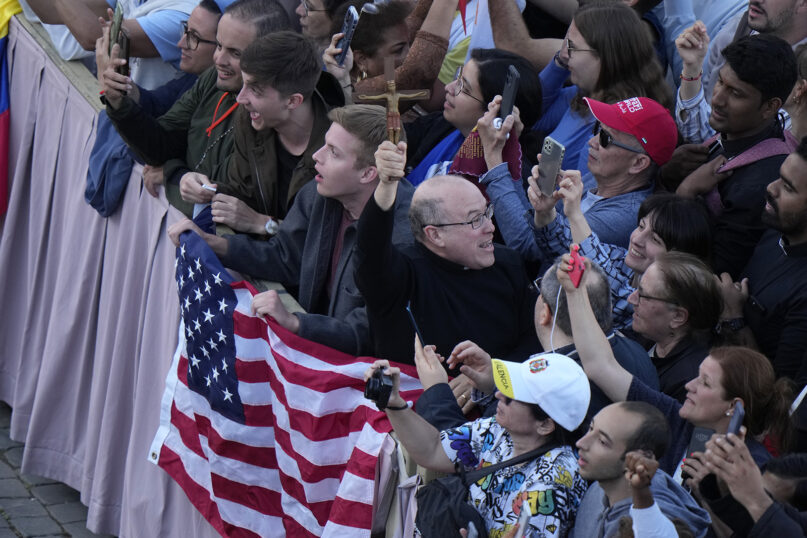
People react after Cardinal Dominique Mamberti announced the election of Cardinal Robert F. Prevost as the 267th pope, choosing the name of Pope Leo XIV, at the Vatican, Thursday, May 8, 2025. (AP Photo/Luca Bruno)
Prevost is a former head of the Order of St. Augustine and was the only member of the ancient order in the conclave. In his role as prior general from 2001 and 2013, Prevost traveled widely, gaining hands-on experience about the demands and priorities of the many countries where the Augustinians serve.
He graduated from Villanova University and Catholic Theological Union but has spent much of his career outside the U.S., having served from 2015-2023 as the archbishop of Chiclayo in Peru, where he also holds citizenship.
Jaisy Joseph, assistant professor of systematic and constructive theology at Villanova University, said on Thursday: “Bells are ringing. People are in shock or in various stages of excitement. Tears have been shed.”
When she met him with Villanova students last October, Joseph said, she could see his Augustinian spirit. “It’s about friendship. It’s about community,” she explained. “We felt that warmth. We felt that he was really present to the individuals that were in front of him, and so I think that’s part of his formation.”
He couples his pastoral experience working in parishes and heading a diocese with a keen understanding of church law. He holds a degree in canon law from the Pontifical College of St. Thomas Aquinas in Rome, a positive for a pope who will face many legal and procedural issues as pope.
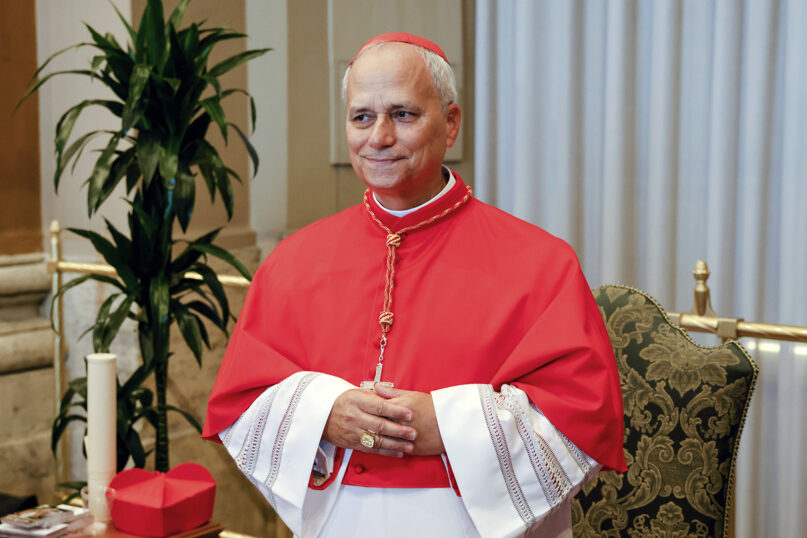
FILE – Cardinal Robert Francis Prevost, prefect of the Dicastery for Bishops, stands for a portrait at the end of the consistory where Pope Francis elevated 21 new cardinals in St. Peter’s Square at the Vatican, Sept. 30, 2023. (AP Photo/Riccardo De Luca, File)
Francis brought him to Rome to serve as president of the Pontifical Commission for Latin America, as well as the head of the Dicastery for Bishops — a powerful Vatican office that vets bishops around the world. Francis elevated him to cardinal in September 2023. Two years later, Francis made him a cardinal-bishop, the highest rank among cardinals.
As the head of the Dicastery for Bishops, taking over the role from the more conservative Canadian Cardinal Marc Ouellet, he assisted Francis in appointing bishops who shared the late pontiff’s priorities. Prevost was also the first to appoint women to assist him in the task of selecting bishops
He has kept a low profile in Rome, making his views on hot-button issues something of a mystery. But in a rare interview with Vatican News, he painted the picture of a church leader that “must not hide behind an idea of authority that no longer makes sense today. The authority we have is to serve, to accompany priests, to be pastors and teachers.”
In that same interview, he said that prelates are often “preoccupied with teaching doctrine,” at the risk of forgetting the message of the Gospels.
The quickness of his election demonstrates a unity among the cardinals, who have been portrayed as a polarized group as they headed into the conclave, and in recent decades as Francis’ style produced strong reactions, especially from conservative churchmen. But in a College of Cardinals of which 80% had been elevated by Francis and inspired by his message of welcoming and inclusion, the choice of a progressive such as Prevost may have been anticipated.
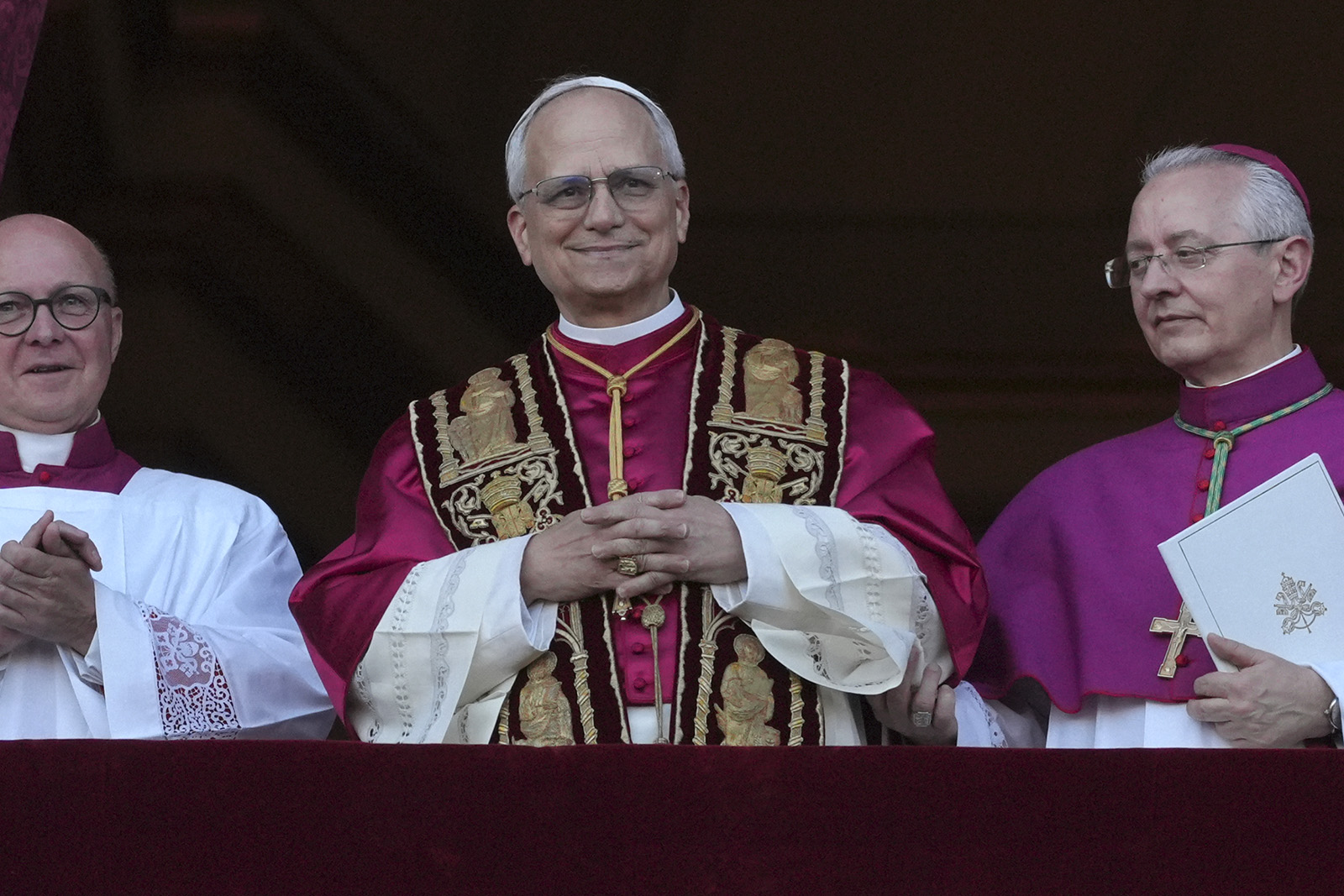
Pope Leo XIV
By Claire Giangravé · May 8, 2025
Prevost himself spoke of the divisions in the church in his Vatican News interview, saying, “We bishops especially must accelerate this movement towards unity, towards communion in the church.”
Prevost may have played a role in the sidelining of U.S. Bishop Joseph Strickland, who had become notorious for his resistance to COVID-19 vaccines and sharp criticism of Pope Francis. In 2023, Prevost met with Francis and Archbishop Christophe Pierre, the papal nuncio, or ambassador, to the United States, and speculation was that the conversation centered on the process of asking for the resignation of the bishop.
Strickland, who has garnered a following among some right-wing Catholics in the U.S., told Religion News Service he would not retire voluntarily, but he was removed from his post roughly two months later.
RNS national reporter Jack Jenkins contributed to this report.
Five things to know about Pope Leo XIV
VATICAN CITY (RNS) — Who is Robert Francis Prevost, now Pope Leo XIV, and what might we expect from his papacy?
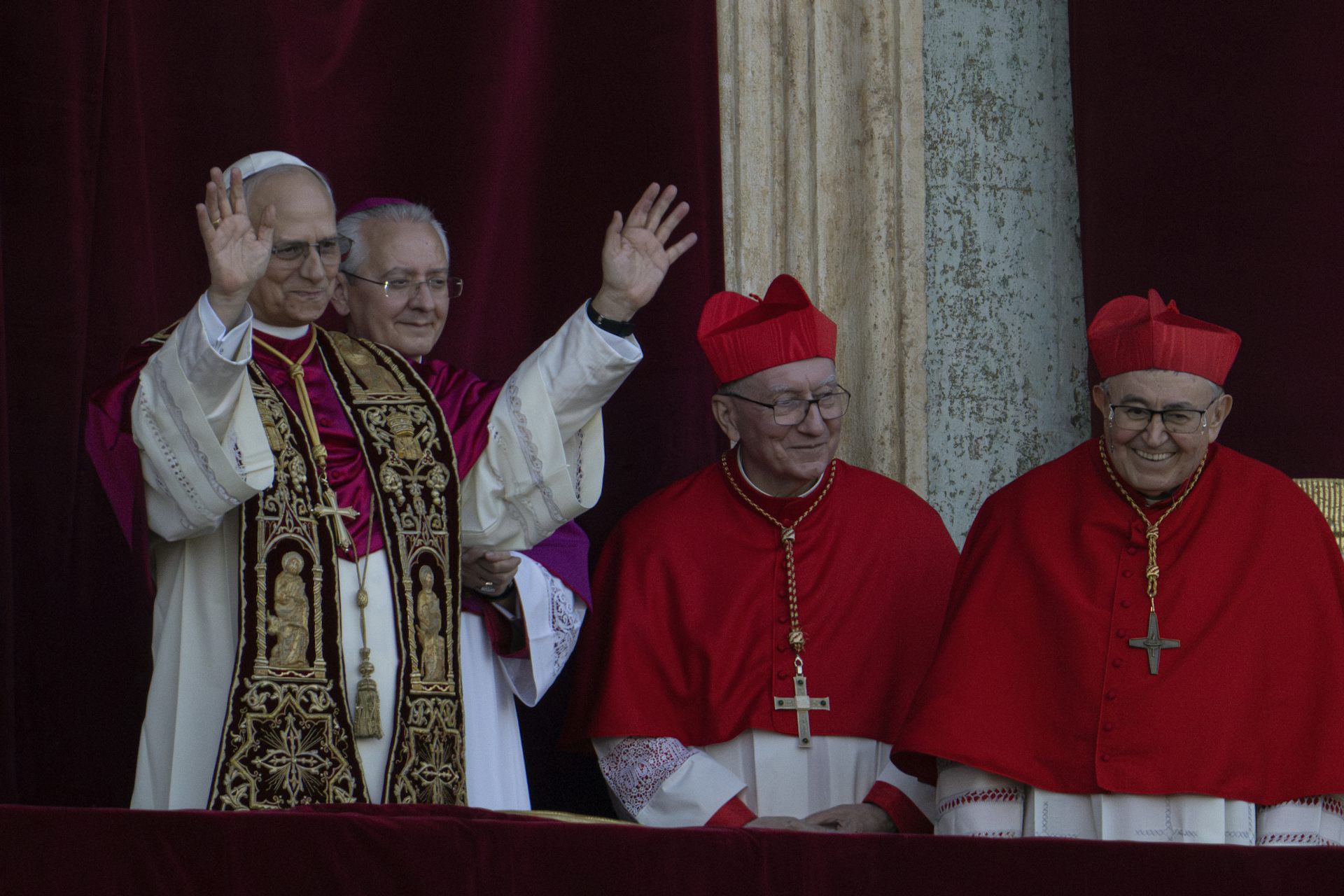
Newly elected Pope Leo XIV appears on the central loggia of St. Peter's Basilica at the Vatican shortly after his election as pontiff on May 8, 2025. (AP Photo/Domenico Stinellis)
Claire Giangravé and Roxanne Stone
May 8, 2025
VATICAN CITY (RNS) — For the second conclave in a row, the College of Cardinals shocked the watching world with its choice for the next pope. U.S. Cardinal Robert Francis Prevost was a long-shot favorite, precisely because he was American — conventional wisdom being that a pope should not be drawn from a global superpower. But on Thursday (May 8), the smiling man who emerged from behind the red curtains in St. Peter’s loggia was a Chicago-born, Peruvian missionary — and the youngest man to don the white zucchetto in nearly 50 years.
But who is obert Francis Prevost, now Pope Leo XIV, and what might we expect from his papacy?
Robert Francis Prevost, 69, was born and raised in Chicago’s south suburbs, attending the (now closed) Church of St. Mary of the Assumption. His father, Louis Marius Prevost, of French and Italian descent, was a World War II veteran and school administrator. His mother, Mildred Martínez, of Spanish descent, was a librarian. After his election, reports emerged that his maternal grandparents were Black and had Creole roots. He has two brothers, Louis Martín and John Joseph. After studying math and philosophy at Villanova, he returned to Chicago to attend the Catholic Theological Union in Hyde Park, on Chicago’s South Side, from 1978 to 1982, according to CBS Chicago.
But Prevost is also arguably the least American of the American cardinals. He left the U.S to serve as a missionary in Chulucanas, Peru, shortly after his ordination until 1986. In 1988, he led the Augustinian seminary in Trujillo, Peru, where he held several important posts and taught canon law. He became a Peruvian citizen in 2015, after Francis appointed him to lead the Diocese of Chiclayo. He is a fluent Spanish speaker and issued a greeting to his diocese in Spanish after becoming pope.
In addition to Spanish and English, Prevost also speaks Italian, French and Portuguese and can read Latin and German.
2. Prevost is a member of the Order of St. Augustine, having served twice as its head.
Leo is a member of the Order of St. Augustine, the only Augustinian in this conclave. The order, founded in 1244 under Pope Innocent IV, follows a rule of life that emphasizes communal living, prayer, fasting and modest living. Augustinians are also known for evangelizing the New World and the Philippines.
Prevost joined the order in 1977 and became the leader of the Augustinian of Our Mother of Good Council in Chicago, overseeing the order in the Midwest. In 2001, he was chosen to become the head of the global Augustinian order, a position he held for two consecutive terms until 2013, traveling to the 47 countries where the Augustinians are present. Throughout his leadership in the order, he placed a special emphasis on missionary work, especially in Latin America. He later continued to have an important role in the order, proving his leadership and management abilities.
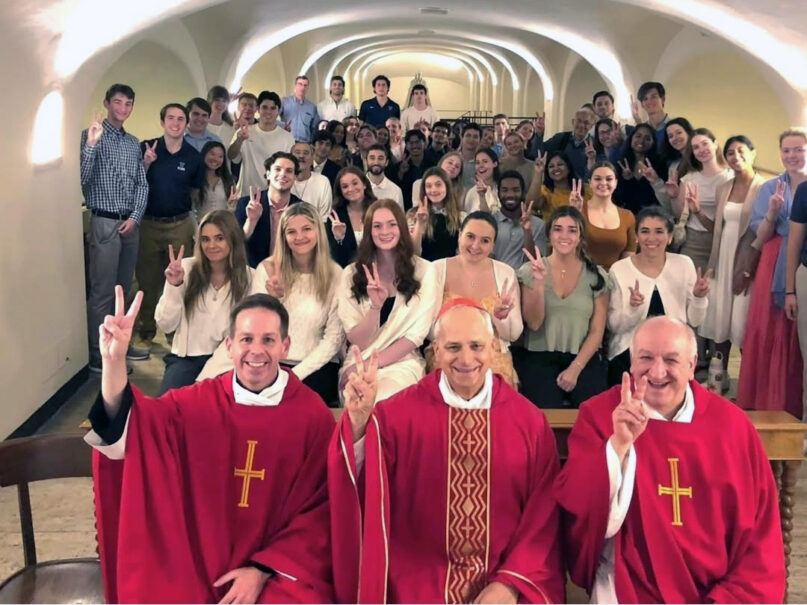
Cardinal Robert Prevost, center, holds up the Villanova V with others after a Mass at St. Peter’s crypt for Villanova students visiting Rome in October 2024. (Photo courtesy of Jaisy Joseph)
3. As head of the Dicastery for Bishops, Prevost may have played a role in sidelining a prominent right-wing American bishop.
Francis tapped then-Cardinal Prevost to take over the Vatican’s oversight of the appointment of bishops in January 2023. In this influential position, he assisted in selecting the bishops to be placed around the world. He also aided Francis in dealing with rogue or misbehaving bishops, including Bishop Joseph Strickland, who was removed from his Diocese of Tyler, Texas, after Strickland’s sharp criticism of Francis’ pontificate. Prevost brought on three women in 2022 to aid him in the selection of bishops, a first in the department’s history.
Prevost was relatively mum on the very issues about which many Vatican watchers are keen to know his stance. He gave a few nods in his greeting Thursday that signaled his papacy may be a continuation of his predecessor’s. He named synodality, dialogue and bridge-building as priorities, in addition to peace, but broke with Francis by reviving the tradition of wearing a mix of red and white, in addition to a burgundy stole — Francis, who emerged in only white, was known for his turn toward a more modest papacy.
Speculation abounds as to how the first American pope will interact with President Donald Trump and his administration, including the Catholic Vice President JD Vance. There are X posts attributed to Prevost circling the internet, in which the then-cardinal was critical of both.
5. With the name Leo XIV, Prevost inherits a legacy of reform and social justice.
Leo has been a relatively popular name for popes — the fourth most, in fact. Prevost’s most recent predecessor, Pope Leo XIII, who reigned from 1878 to 1903, is sometimes referred to as the first modern pope, overseeing a church that was responding to a time of rapid industrialization and globalization. Leo XIII published the encyclical “Rerum Novarum” (On New Things) in 1891, which promoted the rights of workers and the need to fight injustice and help the poor.
Pope Francis was a passionate climate advocate. Will Pope Leo XIV continue his legacy?
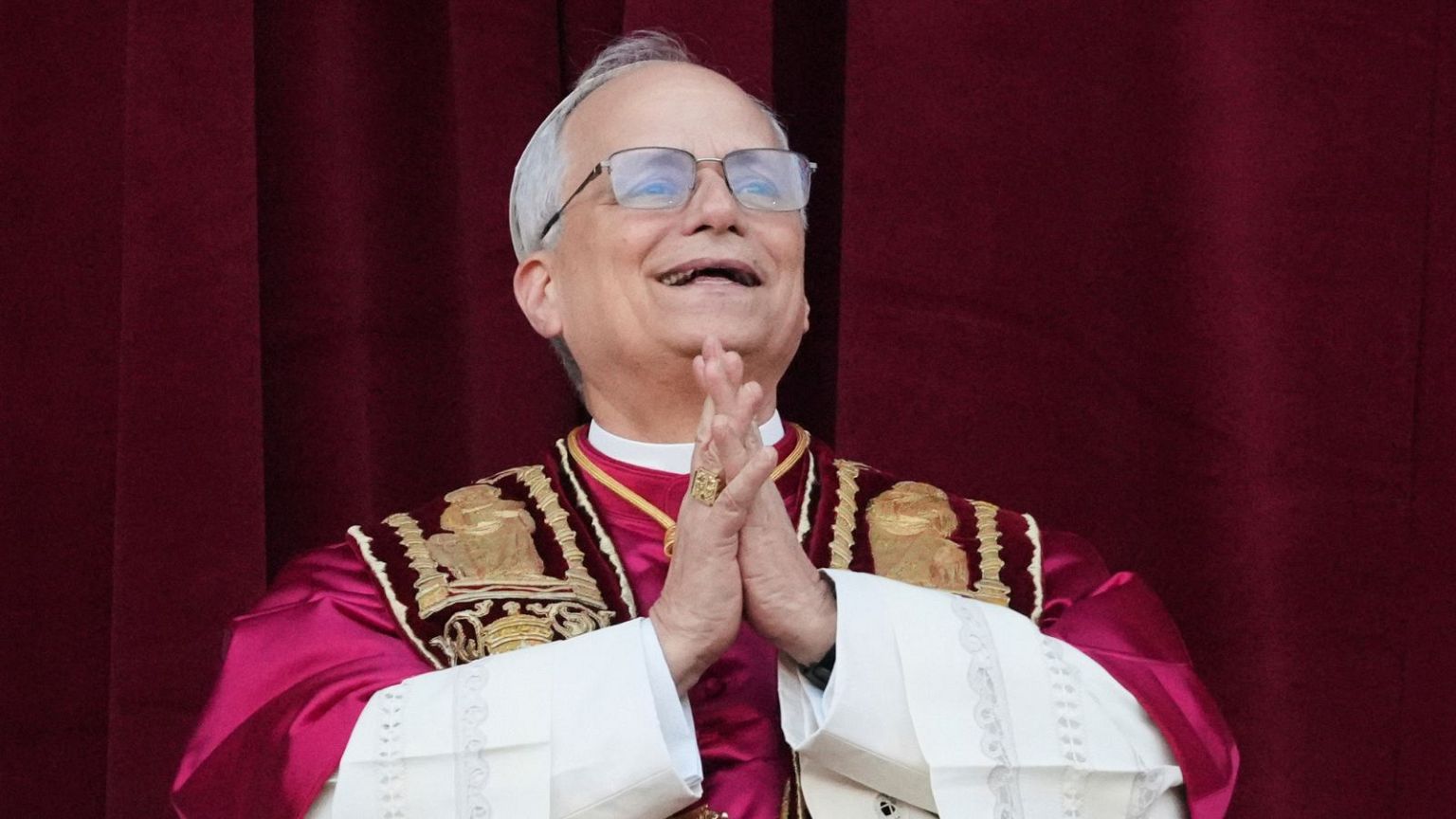
Copyright AP Photo/Alessandra Tarantino
By Lottie Limb
Published on 09/05/2025
Experts say that Robert Francis Prevost aligns closely with Pope Francis’ environmental priorities. Here’s what we know so far.
A puff of white smoke, a procession of Swiss Guards, and Habemus Papus: we have Pope Leo XIV.
Most people knew little about Cardinal Robert Francis Prevost before he became head of the Catholic Church yesterday, but his views are now the subject of intense speculation and analysis.
What does the first US-born Pope’s appointment mean for climate change and environmental issues? Will he be a strong successor to Pope Francis, who was credited with being an “unflinching global champion of climate action”?
Time will tell, but there are reasons to be hopeful that the 69-year-old Pontiff will take up his predecessor’s mantle on this vital global front.
What has Pope Leo said about climate change?
New Pope Leo "is outspoken about the need for urgent action on climate change", according to the College of Cardinals Report, an initiative from an international team of Catholic journalists and researchers which profiles would-be Popes to help the cardinals make an informed choice.
Last November, during a seminar in Rome dedicated to discussing climate change, then-Cardinal Prevost stressed it is time to move “from words to action.” He said the answer to this challenge must be based on the Social Doctrine of the Church.
“Dominion over nature” - the task which God gave humanity - should not become “tyrannical,” he said. It must be a “relationship of reciprocity” with the environment.
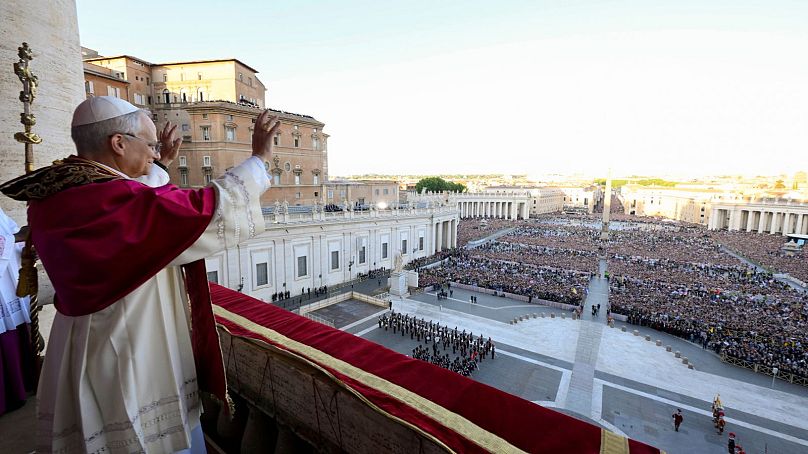
Prevost - who was president of the Pontifical Commission for Latin America and Prefect of the Dicastery for Bishops - cautioned against the “harmful” consequences of technological development.
He reiterated the Holy See’s commitment to protecting the environment, pointing to a simpler embrace of existing green technology, such as the Vatican installing solar panels and shifting to electric vehicles.
According to the College of Cardinals Report, "He aligns closely with Pope Francis’ environmental priorities."
Prevost spent many years working as a missionary in Peru, where he also holds citizenship. Christine Allen, director and chief executive of Catholic aid agency CAFOD, says this means he “brings with him the vital perspective of the Global South, elevating voices from the margins to centre stage.”
Pope Leo takes the top job at a critical moment in human history.
Atmospheric concentrations of CO2 are now 50 per cent higher than during pre-industrial times - largely due to burning fossil fuels. This has raised global temperatures by 1.3°c, unleashing a slew of increasing climate disasters - from heatwaves to droughts, floods and wildfires.
These are realities that US President Donald Trump’s administration is seeking to suppress and avoid. As just the latest example in a litany of climate action cutbacks, the US National Oceanic and Atmospheric Administration will no longer track the cost of climate change-fueled weather disasters.
The Cardinals will no doubt have considered Trump’s outsized geopolitical influence when deciding to elect a Pope from the US.
And Leo has already shown that he is not afraid to stand up to the self-styled US strongman, and call out the perceived moral failings of his administration.
In February, his X account shared a post which was critical of the administration's deportation of a US resident to El Salvador, and then a critical comment piece written about a TV interview given by Vice-President JD Vance to Fox News.
"JD Vance is wrong: Jesus doesn't ask us to rank our love for others," read the first post, repeating the headline from the commentary on the National Catholic Reporter website.
As spiritual leader of the world’s 1.4 billion Catholics, the Pope has a significant potential role to play in getting people to prioritise climate action and rallying the conscience of other world leaders.
During his pontificate, Pope Francis wrote two encyclicals - pastoral letters addressed to the whole world - on climate change.
Published ahead of the UN climate conference in 2015, his first, Laudato si’: On Care For Our Common Home “provided a clear moral imperative for taking climate action, supporting the Paris Climate Change Agreement,” according to Christiana Figueres, an architect for that landmark deal to limit global heating to 1.5C.
Pope Francis continually used his position to highlight issues of inequality in the consequences of climate change.
“Now more than ever, the world needs a strong and steadfast moral voice,” CAFOD chief Christine Allen wrote in a statement yesterday.
“Saint Pope John Paul II, and Popes Benedict and Francis, all spoke powerfully on climate change and the debt crisis as two of the most pressing issues of their time, and we look forward to working with the Vatican and Pope Leo XIV, to continue and strengthen this work in response to today’s challenges.”
The Pope, she adds, “is an important player on the global stage. He is one of the few people who can bridge political divides and bring world leaders together for the common good.”
(RNS) — As Catholics, our arms will be wide open to the world. We will accompany the world. We will live in the world.
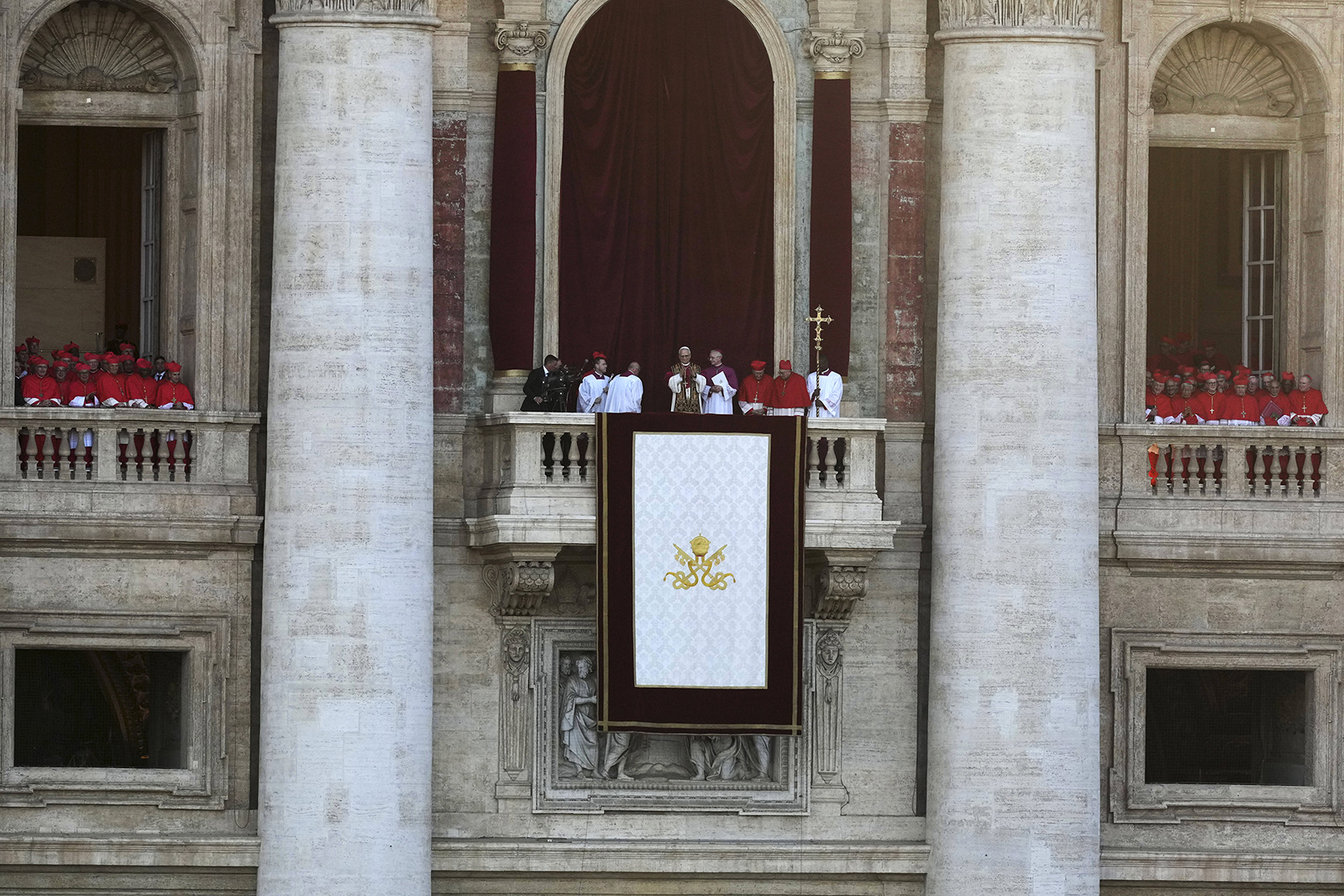
Pope Leo XIV appears on the balcony of St. Peter's Basilica after his election, at the Vatican, Thursday, May 8, 2025. (AP Photo/Antonio Calanni)
Steven P. Millies
May 8, 2025
(RNS) — “Let me tell you something. I’m from Chicago. I don’t break.” — Barack Obama
Let me tell you something. I was born in Chicago’s suburbs and grew up just blocks from the city line, only a few south suburbs away from where Pope Leo XIV grew up. I attended high school and college in Chicago. I moved away for 25 years, but came back to work (by God’s own grace) on Chicago’s South Side in 2017 at the same institution where the new pope trained to be a priest. I am a Chicagoan and a Chicago Catholic down to my bones.
So, really, let me tell you something. We’re tough people. We endure frozen winters and soupy, humid summers. We endure all the “flyover country” jokes our good friends in the coastal cities tell. We endure the baseball teams and football teams and basketball teams and hockey teams that seem never (well, not since Air Jordan) to be on top. And yet, “Come show me another city with lifted head singing so proud to be alive and coarse and strong and cunning,” as Carl Sandburg wrote, around the time the pope was last named Leo. We don’t break.
But the election of Pope Leo XIV nearly broke me.
For as long as I’ve been alive (and longer), conventional wisdom said what Chicago’s Cardinal Blase Cupich said just days ago: It would be “a stretch” for the next pope to come from the United States. There was no way. There was just no way.
But here we are. Not only is the new pope an American, but he knows the streets I know, the neighborhoods I know, the restaurants I know, the city I know. Reports are that, as a fellow Southsider, he shares my allegiance to the White Sox, who have won 51 games since 2023. When Barack Obama (a Southsider and Sox fan) was elected president, I thought we had reached the peak.
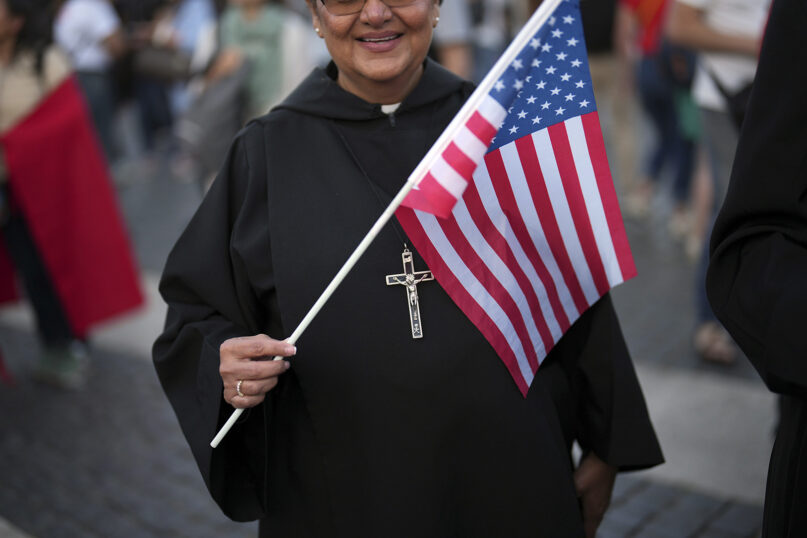
A nun holds a US flag during the speech of the newly elected Pope Leo XIV at the Vatican, Thursday, May 8, 2025. (AP Photo/Francisco Seco)
But wow.
What happened at this all-but-historically short conclave was nothing short of remarkable. It may define the rest of my professional life. But no matter what it means for me, it’s also going to mean something for the whole Catholic Church and the whole world.
I write these words barely two hours after Leo appeared on the balcony of St. Peter’s, and there is a lot we do not know yet. But for now, at least, a few things are plainly obvious.
First, this brisk conclave signals how strong the desire among the cardinal electors was to maintain continuity with the Francis papacy. Many cardinal electors gathered at the Synod on Synodality’s monthlong meetings in October 2023 and October 2024 and had time to get to know each other and to reckon who they wanted to be the next pope. It seems clear that they decided that they want someone who will not look backward, and that they found him today in Leo, who named synodality, dialogue and building bridges.
The Catholic Church is not going back. At 69 years old, the youngest pope elected since John Paul II, Leo may be pope well into the middle of the 21st century ,or past it. The cardinals have sent a strong signal that they mean to cement Francis’ legacy.
Then there is the name. Pope John XXIII convoked Vatican II. Pope Paul VI continued and finished it. Pope John Paul I took both names to signal his intention to continue the reforms of Vatican II, and a month later John Paul II felt obligated to make the same gesture. Pope Benedict XVI seemed to signal a reversal, a pre-Vatican II name that indicated a papacy that would be more cautious.
Francis was something else altogether, a name no other pope had taken. By taking the name Leo, this new pope sends a very clever signal. The name last belonged to Leo XIII, who long preceded the fights over Vatican II and the culture war divisions that have plagued the Catholic Church since. But Leo XIII was also the first modern pope. He wrote about the problems of people living in the Industrial Age and defended the rights of workers against the greed of owners.
Leo XIII gave us the first glimpses of how the Catholic Church faces the modern world. All that has followed was built on his work. This new Leo seems to say, “The arguments of the 20th century are over. Let’s move forward, let’s keep going, let’s believe in the gospel well enough to build a just and peaceful world.”
FILE – Cardinal Robert Francis Prevost, prefect of the Dicastery for Bishops, stands for a portrait at the end of the consistory where Pope Francis elevated 21 new cardinals in St. Peter’s Square at the Vatican, Sept. 30, 2023. (AP Photo/Riccardo De Luca, File)
Lastly, there is the fact that Leo was born in the United States. He spent most of his ministry in Peru, but he is an American (and a Chicagoan) as much as I am. We should ask what was at work in this papal election that once seemed so unthinkable.
The cardinal electors always bring world events with them into the conclave. The diplomats Benedict XV and Pius XII were elected to navigate two closely linked world wars. Paul VI was elected to bring peace after the Cuban missile crisis. John Paul II was the pope the cardinals aimed at the Cold War.
What does it mean for the cardinals to have elected a U.S.-born pope during the second Trump administration as the global order, once guaranteed by U.S. economic and military power, crumbles and authoritarianism creeps ever more toward being the political default? The Catholic Church has taken a side, it seems, to oppose this threat.
My thoughts here are quick impressions, written before the wisps of white smoke have fully dispersed from the Roman air. The coming days, weeks, months and years will fill in the picture. But today we have to say that something remarkable has happened. The Roman Catholic Church has waded fully now into the 21st century as a church committed in a new way to what Vatican II promised and what Francis modeled.
In this new era, there can’t be any credible arguments anymore about taking the church back to before Vatican II. The Catholic Church stands poised to defend the sacred rights of every human person, Catholic or Christian or neither. It will do so in a way that bears witness to how inevitably “We are all united in the hands of God. … [U]nited, hand in hand with God and among ourselves.”
As Catholics, our arms will be wide open to the world. We will accompany the world. We will live in the world.
(Steven P. Millies is professor of public theology and director of the Bernardin Center at Catholic Theological Union. The views expressed in this commentary do not necessarily reflect those of Religion News Service.)
By electing Pope Leo XIV, some see Vatican making very American political play
(RNS) — ‘The election of an American Pope, the first American Pope … there’s a signal here that the church is taking a side in what’s happening around the globe,' said Steven Millies, a professor at Catholic Theological Union.
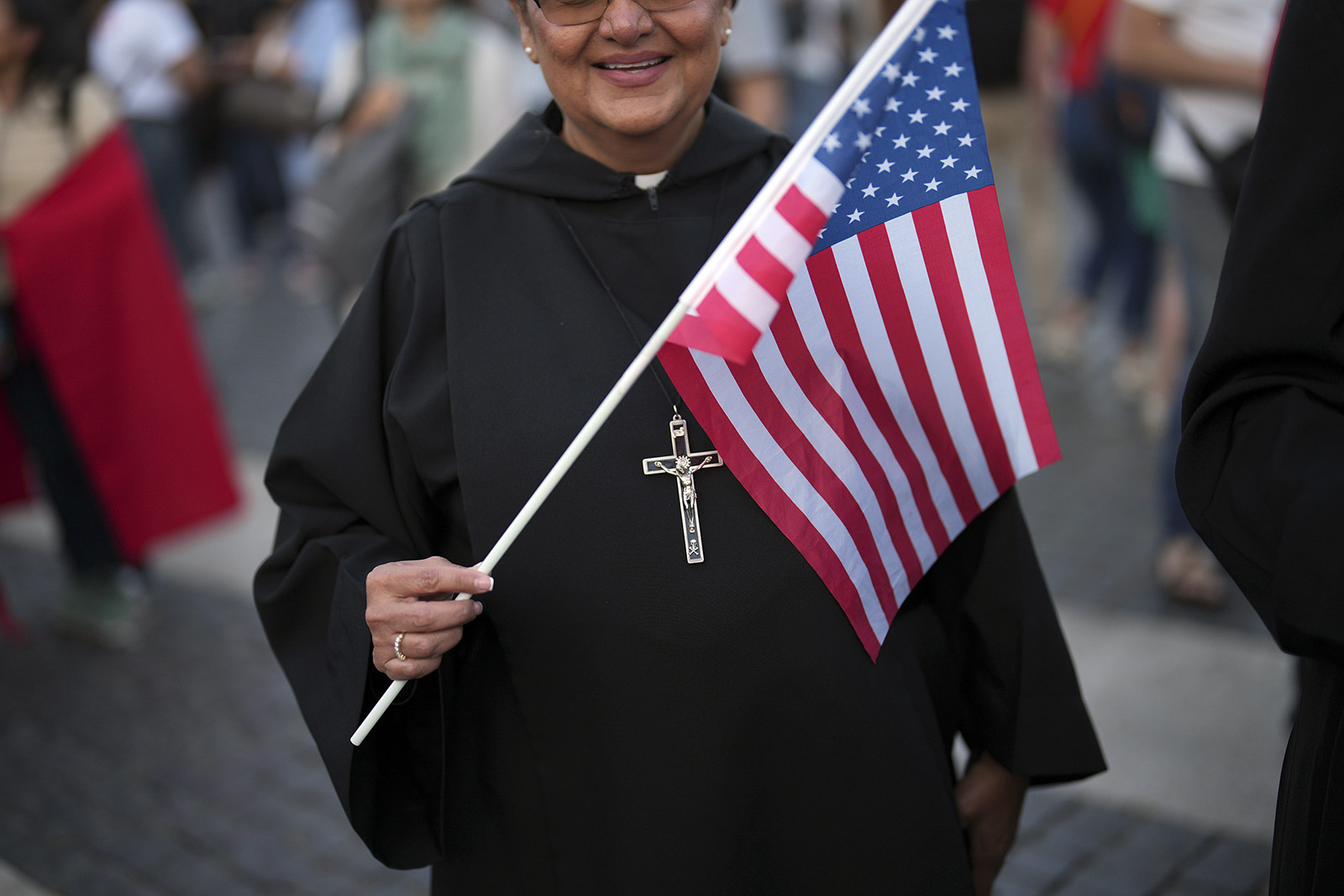
A nun holds a U.S. flag during the speech of the newly elected Pope Leo XIV at the Vatican, Thursday, May 8, 2025. (AP Photo/Francisco Seco)
Jack Jenkins
May 8, 2025
(RNS) — As Cardinal Robert Francis Prevost walked out on the central loggia of St. Peter’s Basilica on Thursday (May 8) and took the name Pope Leo XIV, Steven P. Millies’ initial reaction was a mixture of elation and disbelief. A professor at Catholic Theological Union — a seminary Prevost, a Chicago native, attended — Millies was overjoyed at the idea of a pontiff from so close to home.
“It’s incredible to me that we have a Southsider who’s the pope,” Millies said of the first U.S.-born bishop of Rome.
But Millies also had another thought: By electing Leo, the College of Cardinals was, as Millies put it, “taking a side” in global politics — including U.S. politics.
He was reminded of when Pope John Paul II was elected “from behind the Iron Curtain” in 1978, a move that signaled the church was choosing to challenge the Soviet bloc.
“We are watching authoritarianism swell in all parts of the globe, but is fueled most visibly by the Trump administration in Washington, D.C.,” Millies said. “The election of an American pope, the first American pope … there’s a signal here that the church is taking a side in what’s happening around the globe.”
Leo is already seen as a continuation of the legacy of his predecessor, Pope Francis, who sometimes criticized the Trump administration, particularly over immigration. Some in the church are already arguing the new pope may be more strident on certain issues than his predecessor, and a blatant pushback against President Donald Trump and authoritarianism.
Newly elected Pope Leo XIV appears at the balcony of St. Peter’s Basilica at the Vatican, Thursday, May 8, 2025. (AP Photo/Andrew Medichini)
Leo’s election goes against a long-held unwritten Vatican policy of not selecting pontiffs from a global power, a practice dating back to the early 1300s, when Philip IV of France, Holy Roman Emperor, feuded with Pope Boniface VIII over who wielded more power. Philip engineered the removal of the papacy from Rome to Avignon, where it stayed for the next 67 years. The papacy never fully recovered as a secular power.
In more recent years, however, the motivation for keeping pope and superpower separate is thought to help balance economic and military might with the papacy’s power of moral persuasion.
Massimo Faggioli, a professor at Villanova University, where Leo was an undergraduate, shared Millies’ view that the election of Leo sent a signal. Faggioli believes Trump’s reelection made a U.S.-born pope possible, as it offered cardinals a potential pathway to counter the rightward political shift Trump helped set in motion.
“The Vatican has made its move,” Faggioli said, noting Leo’s elevation doubles as an implicit rebuke of right-wing Catholicism in the U.S.
Trump, for his part, reacted warmly to Leo’s election.
“Congratulations to Cardinal Robert Francis Prevost, who was just named Pope,” Trump posted on Truth Social. “It is such an honor to realize that he is the first American Pope. What excitement, and what a Great Honor for our Country. I look forward to meeting Pope Leo XIV. It will be a very meaningful moment!”
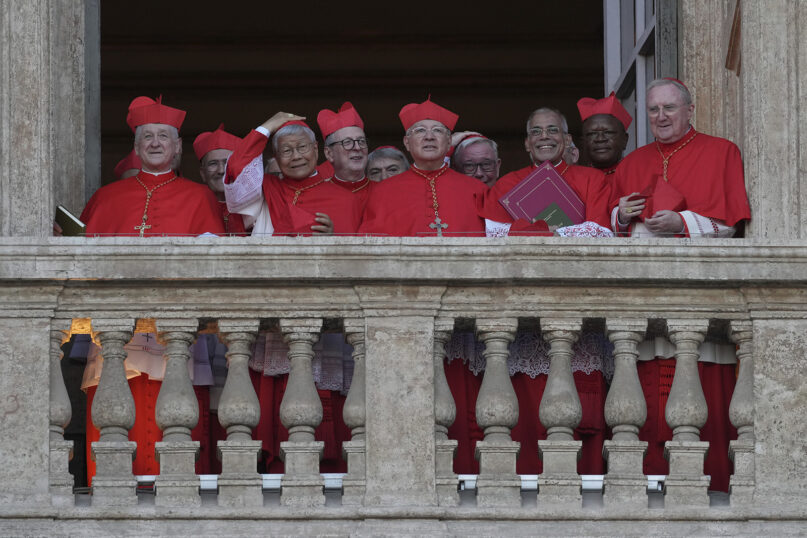
Cardinals following the election of Cardinal Robert F. Prevost as the 267th pope, choosing the name of Pope Leo XIV, at the Vatican, Thursday, May 8, 2025. (AP Photo/Andrew Medichini)
But while Leo reportedly voted in Republican primaries in the past, many U.S. conservatives were more skeptical. In an appearance on the right-wing Newsmax network, former U.S. Sen. Rick Santorum of Pennsylvania, a Catholic, said he had “very little optimism” about the new pontiff. Santorum, who once challenged Francis’ support for taking action on climate change, accused Leo of using “buzzwords of the left” in his first speech as pope, and took issue with his celebration of Francis in his remarks from the balcony at St. Peter’s. “This too shall pass,” Santorum said.
An account on Twitter, now X, purportedly belonging to Leo provoked outrage in conservative activist Laura Loomer, who pointed to articles reposted from the feed showing prominent Catholics criticizing Trump.
“He is anti-Trump, anti-MAGA, pro-open Borders, and a total Marxist like Pope Francis,” Loomer wrote. “Catholics don’t have anything good to look forward to. Just another Marxist puppet in the Vatican.”
Another Trump ally, onetime presidential adviser Steve Bannon, singled out Prevost — now Pope Leo — as someone he hoped cardinals would steer clear of ahead of the conclave vote.
“I do think one of the dark horses, and I think, unfortunately, one of the most progressive, is Cardinal Prevost,” Bannon said during an appearance on the Piers Morgan show. Bannon added that he saw the Chicago native as “one of the ones closest to Francis ideologically.”
U.S. Rep. Nancy Pelosi of California, a Catholic Democrat, praised Leo’s election. The former House speaker noted that a previous Pope Leo — Leo XIII — was the author of “Rerum novarum” — an encyclical that, among other things, outlined rights of workers to form unions and railed against unrestricted capitalism.
“For many of us, the name Leo XIV happily brings to mind Leo XIII’s Rerum novarum which was a blessing for working people,” Pelosi said in a statement. “And it is heartening that His Holiness continued the blessing that Pope Francis gave on Easter Sunday: ‘God loves everyone. Evil will not prevail.’”
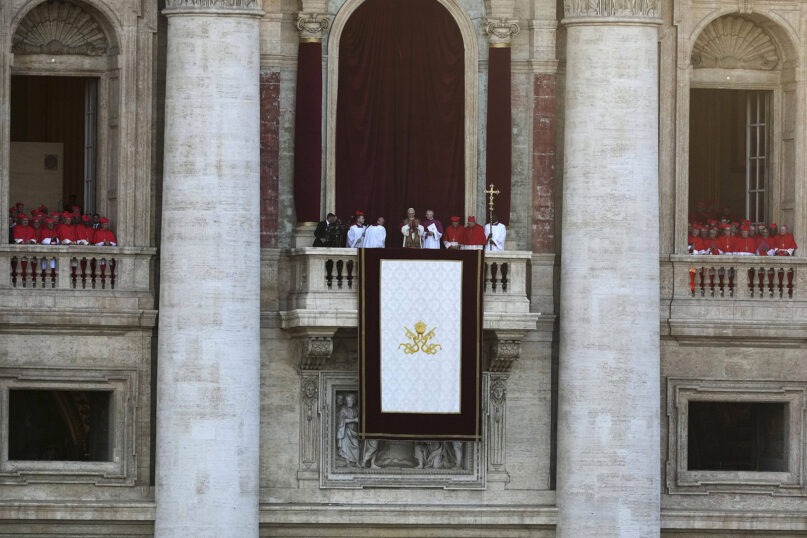
Pope Leo XIV appears on the balcony of St. Peter’s Basilica after his election, at the Vatican, Thursday, May 8, 2025. (AP Photo/Antonio Calanni)
She added: “In his own words, Pope Leo XIV said, ‘We can be a missionary church, a church that builds bridges, that is always open to receive everyone.'”
Natalia Imperatori-Lee, a theologian and professor of religious studies at Manhattan University, said in an email, “the name is everything!”
“There’s a lot that is very good about him signaling an affinity with (Leo XIII), who confronted the industrial revolution with a robust defense of worker’s rights and labor organizing,” she wrote, adding that the prior Leo launched Catholic Social Teaching, a movement that engages the church with the world’s problems. “All of that points to being in the same vein as Francis, but without being Francis II.”
Joaquin Castro, whose mother once sat on the board of the liberal-leaning Catholic social-justice organization Network, congratulated Leo on being the first American pope: “and a Pope reflective of the late Pope Francis’ creed to choose light over darkness, to be kind to our neighbor, and to work to uplift and unify all people in a divided world. Congratulazioni!” he posted on X.
Leo is unlikely to match perfectly the positions of either American political party and will disappoint many as he runs a church that operates far outside of any local political faction. But he knows the U.S. political culture more intimately than any other pope in history — knowledge that may prove useful, as he is unlikely to escape politics altogether.
Pope Leo XIV’s Missionary Work In Peru
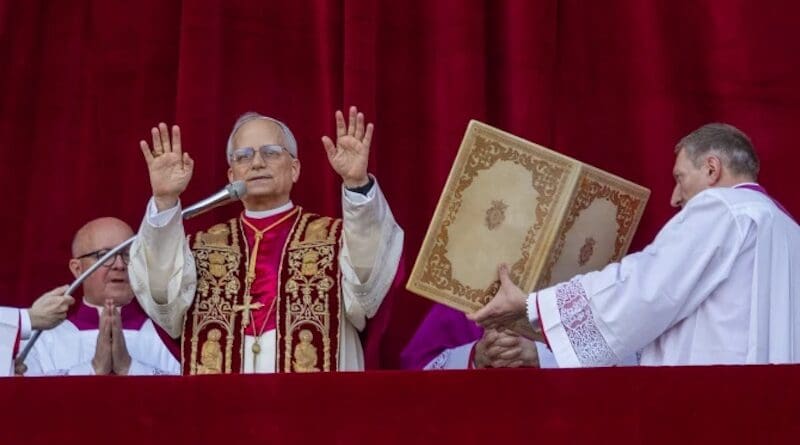
Pope Leo XIV greets the faithful in St. Peter's Square shortly after his election to the papacy, Thursday, May 8, 2025. | Credit: Daniel Ibáñez/CNA
By CNA
By Walter Sánchez Silva
In some of his first words to the world on May 8, newly-elected Pope Leo XIV recalled the land where he worked as a missionary from 1985 to 1998.
“And if you will allow me a word, a greeting to all those… in a particular way to my beloved Diocese of Chiclayo, in Peru,” he said.
Known as the “city of friendship,” Chiclayo is located in northern Peru, about 500 miles from the capital, Lima. Pope Francis appointed him apostolic administrator and then bishop of the Diocese of Chiclayo in 2014 and 2015 respectively. As bishop of Chiclayo and later as apostolic administrator of Callao, he also served as vice president of the Peruvian Bishops’ Conference (CEP by its Spanish acronym).
Father Guillermo Inca Pereda, deputy secretary of the CEP who worked closely with Pope Leo, shared with ACI Prensa, CNA’s Spanish-language news partner, that “the excitement of hearing Cardinal Robert Prevost’s name called as pope, pastor of the universal Church, was truly indescribable, an unforgettable moment.”
“We worked with him, we shared many moments of decision-making in my role at the general secretariat. We have had many opportunities to converse, and I have been able to discover his prudence, his perseverance, his tenacity, and that simplicity that characterizes him, but always with great depth to resolve any issue, any situation, no matter how sensitive,” he added.
“He particularly helped me make decisions that were necessary in my daily work,” the Peruvian priest emphasized.
Pope Leo in Peru
The Augustinians in Peru serve in the vicariates of Iquitos in the Amazon region, San Agustín de Apurímac in the Andes, and San Juan de Sahagún de Chulucanas in northern Peru. The new pope came as a priest to San Juan in 1985, four decades ago.
He remained there until 1986, when he returned to Chicago. In 1988, he returned to Peru, this time to Trujillo — also in the north — where he worked as director of the common formation center for Augustinian aspirants from all of the three aforementioned vicariates.
For 11 years, he worked in various parishes and in various positions with the Augustinians, until he returned to the United States in 1999 to assume the position of prior provincial of the Augustinians in Chicago. He then served as prior general of the Augustinians from 2001 to 2013.
After returning from Rome to Chicago in 2013, Pope Francis appointed him apostolic administrator of Chiclayo, marking his return to Peru.
“I believe that his experience in Peru will give him the nuanced understanding that every pope can have in his heart, because he knows our people, he knows our country, he has experienced the people’s public expressions of faith, which is such a great asset we have among us, he has also seen situations where people are living in poverty, but even in the midst of these difficulties, he saw that hope was never lost,” Inca told ACI Prensa.
In January 2023, when then-Bishop Provost was chosen by Pope Francis to be prefect of the Dicastery for Bishops in the Vatican, he thanked the Peruvian prelates.
“We have walked together for more than eight years. I have felt welcomed, a very fraternal spirit with everyone, and the fraternity we share, the unity, and the witness from here to the entire Church in Peru and to all Peruvians have been a blessing.”
“I came as a missionary to Chulucanas almost 40 years ago, then 11 years in Trujillo and eight years in Chiclayo. I thank God for so many things the Peruvian people have shared with me. We have walked together and shared our faith,” he added.
The deputy secretary of the CEP told ACI Prensa that he is “sure that the heart of Pope Leo XIV, our beloved Cardinal Robert Prevost, will greatly help the world grow and improve.”
This story was first published by ACI Prensa, CNA’s Spanish-language news partner. It has been translated and adapted by CNA.
CNA
The Catholic News Agency (CNA) has been, since 2004, one of the fastest growing Catholic news providers to the English speaking world. The Catholic News Agency takes much of its mission from its sister agency, ACI Prensa, which was founded in Lima, Peru, in 1980 by Fr. Adalbert Marie Mohm (†1986).

No comments:
Post a Comment