It’s possible that I shall make an ass of myself. But in that case one can always get out of it with a little dialectic. I have, of course, so worded my proposition as to be right either way (K.Marx, Letter to F.Engels on the Indian Mutiny)
Wednesday, May 07, 2025
Houthis' Fight With Israel Could Mean Continued Risks for Shipping
Houthi attack drone over the Red Sea (Marine Nationale file image)
Yemen's Houthi rebels have begun to clarify their version of the Red Sea truce agreement announced by the White House, and it appears that international shipping may still face risks on the waterway.
On Tuesday, President Donald Trump announced that the Houthis had "capitulated" after an extended U.S.-Israeli bombing campaign. The group agreed to stop attacking U.S. shipping, Trump said, and U.S. forces would immediately stop bombing sites in Yemen.
After Trump's statement, official Houthi media channels announced that the group would continue to attack Israel in retaliation for the ongoing military operations in Gaza. On Wednesday, Houthi spokesman Mohammed Abdulsalam emphasized that the new agreement with the White House did not affect the group's hostilities with Israel in "any way, shape or form."
If the Houthis' plans to attack Israel also extend to Israeli shipping, the new ceasefire may not reduce risk for foreign-flag commercial traffic. The Houthis have previously attacked vessels with documented links to Israel, but they have used the same justification to attack vessels with no clear Israeli ties - and even vessels that have clear ties to Houthi allies. If this targeting pattern continues, neutral vessels could be targeted as "Israeli ships," whether by accident or by intent.
Given the uncertainty, leading ocean carriers have suggested that they will wait some months after hostilities end before returning their ships to the Red Sea at scale, in part because of the cost and disruption of adjusting global networks to a different route. It would be expensive to change from the Cape of Good Hope route to Suez, then change back to the Cape route again if the Houthis began targeting foreign-flag merchant ships once more.
Analysts agree that when container shipping does return to the shorter Red Sea route, the global ocean freight market will return to a familiar pattern - overcapacity and thin margins.
"The one element of the container shipping market that affects freight rates the most . . . may be nearing an end. But, let's see if this is really happening," said Xeneta lead analyst Peter Sand in a social media post. "If transiting the Red Sea to its full extent is once again safe . . . the balance of the market will once again shift. From its current tightness to one where overcapacity will depress freight rates."
U.S. Suspends Bombing After New "Ceasefire" With Houthis
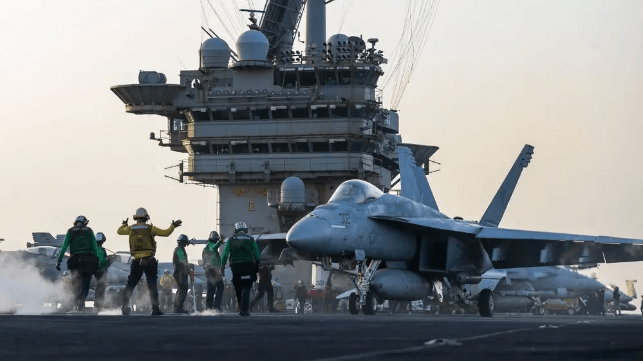
Flight crew on the deck of USS Harry S. Truman in the Red Sea, 2025 (USN)
The Trump administration has decided to implement a mutual ceasefire with Yemen's Houthi rebels, President Donald Trump announced in a press conference Tuesday. He said that U.S. bombing runs over Yemen would cease "effective immediately," and that he would take the Houthis "at their word" that they would cease attacking American shipping.
According to the Sultanate of Oman, which brokered the reported agreement, "neither side will target the other, including American vessels, in the Red Sea and Bab al-Mandab Strait, ensuring freedom of navigation and the smooth flow of international commercial shipping."
This appears to return relations between the Houthis and the U.S. to the state that existed in January, when a U.S.-brokered ceasefire in Gaza prompted the Houthi leadership to halt attacks on most shipping.
The Israeli government was not informed of the U.S.-Houthi detente ahead of Trump's announcement, according to The Jerusalem Post's Amichai Stein.
After Trump's statement, official Houthi outlets pledged to continue missile attacks on Israeli territory.
It remains unclear whether the new ceasefire also ensures the safety of non-American shipping in the Red Sea, including Israeli-linked shipping. A State Department spokesperson declined to clarify, and referred reporters back to the president's remarks.
Mohammed Ali al Houthi, one member of the Houthi leadership council, has cast doubt on whether the arrangement is final. In a statement on X, he said that the group would evaluate an American proposal "on the ground" before making any formal agreements. Trump described the arrangement not as a deal, but a "capitulation" - a Houthi proposal to give up attacks on shipping in exchange for an end to U.S. bombing.
The effects of combined U.S. and Israeli airstrikes would have given the Houthi leadership a powerful incentive to reach a compromise agreement. American forces have hit Houthi command posts and weapons sites "around the clock" since March 15, and two carriers have been deployed in the Red Sea to ensure a high tempo of bombing runs. Since last weekend, Israeli forces have launched mass attacks on dual-use targets in Houthi areas, destroying the airport in the group's capital of Sana'a, the seaport at Hodeidah and several cement factories. The ceasefire announcement followed just hours after the latest Israeli raid.
Possible guidance improvements in the Houthis' Iranian-supplied missile inventory may also have made the group more dangerous to U.S. military assets in recent weeks. Satellite imagery suggests that at least one U.S. Navy carrier off Yemen was forced to make unusual high-speed evasive maneuvers in late April, and the Navy has confirmed the loss of an F/A-18 strike fighter over the side of USS Harry S. Truman during a hard turn; the crew got out of the way before it went over, but one crewmember was injured.
After the ceasefire announcement, analysts' attention has quickly turned to the Houthis' Iranian sponsors - and the question of whether the truce would be durable.
"If this sticks, the Houthis and Iran will use the quiet to rebuild Houthi capabilities in Yemen and try to create the illusion that Tehran is de-escalating amid U.S.-Iran talks when it's a tactical pause to survive," said United Against a Nuclear Iran's Jason Brodsky. "Recall after Israel struck Iranian soil last year, the regime pushed Hezbollah into a ceasefire to not only buy quiet to rearm, but to avoid further damage to Iranian interests."
Upgraded Houthi Missiles Pose a Problem for Shipping
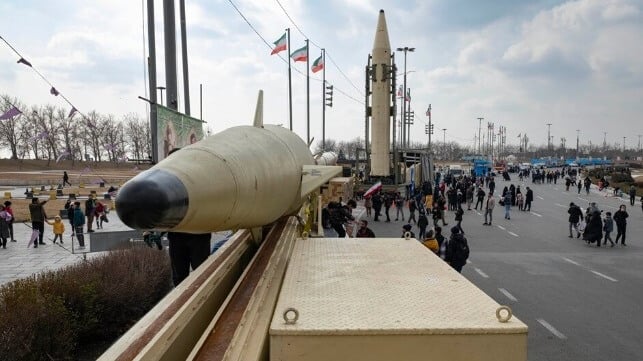
Iranian ballistic missiles on display, Tehran, February 2025 (Photo by Morteza Nikoubazl / NurPhoto via AP)
The successful penetration of Israeli air defenses, as occurred when a Houthi missile hit an empty space within the grounds of Tel Aviv airport, would not normally merit a mention in the annals of the Maritime Executive. In this instance, however, it is emerging from the May 4 attack that the Houthis have a capability which could threaten both ports and ships at sea.
This may explain why the carrier USS Harry S. Truman (CVN-75) has been seen performing vigorous evasive maneuvers in the Red Sea, one of which is likely on April 28 to have caused the loss overboard of an F/A-18 being deck-handled.
Update: CSG 8
The image below is from 23 April, not 28 April
Could be an issue on the Sentinel side given their delays in sharing Red Sea imagery or it was my error (more likely)
What the Houthis described as a Palestine-2 missile impacted on waste ground within Ben Gurion International Airport, landing within 500 yards of the Terminal 3 building and injuring a number of people in the adjacent car park. Attempts to shoot down the incoming missile using both US THAAD batteries and Israel’s Arrow-2/3 systems both failed, although Israel claimed the missile type was not new, had been shot down before, and that technical faults had affected both interceptor systems.
In reality, the likelihood of simultaneous faults occurring on two separate interceptor systems is low. This apparent heightened threat, plus the proximity of the impact point to a busy airport terminal building, provoked an unusually angry Israeli government response.
On the evening of May 5, after a pause of many months, Israel launched the first wave of an attack using 20 aircraft, firing 50 missiles at military and infrastructure targets in Yemen, including what was left of the port at Hodeida and Yemen’s largest cement factory at Bajil.
At least 10 airstrikes targeted Yemen's ???????? Hodeidah port, the Houthi-affiliated Al Masirah TV reported on Monday, blaming the strikes on Israel ???????? and the United States ????????, a day after the Iran-aligned group launched a missile that struck near Israel's main airport… pic.twitter.com/MhLCUk07Eh
On May 6, attacks at the same scale continued, with Sana’a International Airport comprehensively targeted. Israel’s Arabic language spokesman tweeted out a warning to civilians to clear the airport area an hour before impact. Several power stations in Sana’a were also struck, as was a second cement factory in Amran.
The apparently improved performance of the Houthi missile may potentially be connected to the unveiling by Iranian Defense Minister Brigadier General Aziz Nasirzadeh of an improved warhead to their Haj Qasem medium-range solid fuel missile. The separating warhead appears to be independently maneuverable, and its rounded nose, apparent in imagery of a test flight, supports claims by the Brigadier that it has a non-emitting homing system immune to jamming, probably using an electro-optical sensor to compare the image gathered passively with pre-loaded satellite imagery of the target.
Iran unveils an electro-optically guided version of its Haj Qasem missile, dubbed Qasem-e Basir.
- Claimed to feature improved reentry vehicle maneuverability - Resistant to GNSS jamming in the terminal phase - Range reportedly around 1,200 km pic.twitter.com/jYKWY0KBNp
The Iranians are claiming to be back-fitting this new warhead to their existing silo-based Haj Qasem fleet, calling the upgraded missile the Qasem Basir. But the warhead is small enough to have been shipped into Yemen as an assembly, for the Houthis to integrate onto their own versions of the Haji Qasem.
In recent days, US Defense Secretary Pete Hegseth has said that Iran has indeed been spotted shipping weaponry to the Houthis. The Houthis could do so for example by using Iranian cargo ships equipped with deck davit cranes to offload cargoes at remote ports on the Hodeida coastline; such a ship, the MV Elyana (IMO: 9165827), made a northerly passage up the Red Sea at the end of April, and is currently en route to Benghazi.
The electro-optic target acquisition system in the Iranian missile warhead is best suited to static targets with distinctive layouts such as airports. Hence the Houthi threats in the wake of the Ben Gurion attack to target airports in the future as part of an ‘air blockade’ of Israel, and also Iranian threats to hit airfields in GCC states which support American operations.
Ports also make distinctive targets for this relatively unsophisticated homing system. A harder task for such an acquisition system would be to target an aircraft carrier - but the Houthis appear in recent days to have been attempting to use their new capability for just this very purpose.
If precedent is followed, the Houthis will attempt another missile attack shortly, to demonstrate that they retain offensive intent, despite the Israeli air attacks. Senior Houthi figures continued to issue threats after the second wave of airstrikes.


No comments:
Post a Comment