Nor-Shipping: Wind-Assisted Propulsion is Finally Taking Off
Wind-assisted propulsion is having a moment in commercial shipping. On average, most systems on the market can reduce fuel consumption by about 10 percent for a tanker or bulker - or more, if the conditions on the route are right. Design maturity is increasing, along with economies of scale for manufacturing, bringing down capex and shortening payback times for the shipowner. It's not just a matter of whether it's the right thing to do; it is getting to the point where it makes economic sense, especially when factoring in carbon-pricing mechanisms like FuelEU Maritime and the IMO MEPC 83 fee structure.
The latest example is the Brands Hatch, a new Aframax built by CSSC Shanghai Waigaoqiao, one of China's premier state-owned shipyards. Brands Hatch - built for UK-based Union Maritime - has three 40-meter fiberglass sails from BAR Technologies on deck. These giant "WindWings" are capable of generating enough propulsive force to save about 14 tonnes of fuel per day, naval architecture researcher Huang Yiming of Shanghai Waigaoqiao told CGTN.
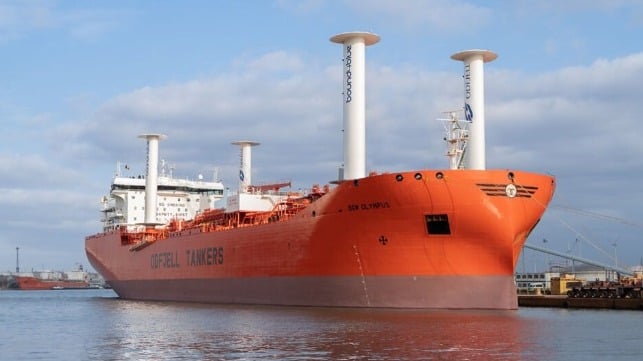
Union Maritime is far from the only owner experimenting with wind power. Odfjell recently installed four self-tending suction sails from Bound4Blue on the tanker Bow Olympus. The installation was easy, Odfjell board member Jan Kjaervik told TME at Nor-Shipping. The pedestal supports for the system were welding on at a yard in China during a shipyard period, and the sails themselves were mounted up in a matter of days at EDR Antwerp Shipyard. No physical changes were required to meet stability requirements after adding the additional mass and lateral force at deck level.
So far, the Bow Olympus' operating experience shows that the system captures some amount of wind energy about 70 percent of the time.
Bound4Blue CTO and co-founder David Ferrer emphasizes that suction sails are compact and comparatively simple, retaining the performance of a Flettner rotor in a less complex package. "Small size means that it can be built out of steel, without having an enormous cost, weight increase. It has greater simplicity, because there are no big moving parts, so maintenance should be reduced," he told TME.
Crew feedback has been positive, in part because a vessel with sails experiences less rolling under most wind conditions. "It's more comfortable to be on board the vessel now. It has a stabilizing effect," said Kjaervik. "The vessel is rolling less than it used to do."
For owners who are looking to follow this path, certification and data are essential, and that falls neatly into the role of class societies. In a recent study for rotor sail builder Anemoi, Lloyds Register - which has been evaluating sail-powered vessels since 1760 - validated the company's performance measurement process, providing assurance that owners can determine how well the system works in practice.
"Owners understand that this is actually a viable option for them to reduce emissions and reduce costs and reduce penalties. So I think that higher fuel prices and the [carbon] taxes really start to bring us closer to the point where owners accept it on a broader basis," says Claes Horndahl, Commercial Director at Anemoi.
Tankers are an easy use case for sail equipment because they have minimal cargo operations over the main deck level. Large bulkers on long-haul routes perform well on a return-on-investment basis, and for these vessels, sail system OEMs have developed a variety of methods for folding down or moving aside the equipment to enable cargo operations with cranes or grab buckets. In the industrial environment of a bulker in port, the sail equipment has to withstand the usual knocks and dings, like any other deck machinery. That moment of practical maturity has arrived, Horndahl says. "We have performed drop tests, and the GRP we are using is very resilient to falling pieces, if that were to occur," he says.
At Nor-Shipping, U.S. Commercial Ties Outweigh U.S. Tariffs

At Nor-Shipping 2025, delegates from Scandinavia and Europe were quick to mention the uncertainty created by the Trump administration's on-again, off-again trade war - and many were just as quick to express an interest in keeping their heads down as Washington and Beijing exchange rhetorical fire. Very few direct criticisms were heard in public, and most players - OEMs, shipowners, service providers - said that they have come to treat U.S. trade policy as a manageable disruption, no different than COVID or the Red Sea crisis. After all, this is shipping: business partnerships and commercial opportunities matter more than politics, and the United States is a big market.
"The history of shipping for 300, 400 years [has been] about dealing with change. And I think the industry has been extraordinarily resilient in managing these shifts. So I think even though we struggle now, we've always been struggling," NYK Europe chief Carl-Johan Hagman said in a panel interview, echoing a common sentiment. "Yes, we are concerned. On the other hand, shipping does not stop."
Some executives predicted that the White House will likely soften its most dramatic tariff and fee proposals. "The regulatory changes that we have seen so far on import tariffs and on the USTR port fees show that the U.S. doesn't want to do self-harm," said the CEO of one prominent Scandinavian shipowner, speaking on the conference's sidelines. "It doesn't seem that it will substantially change the trade flows in either the tanker or the dry bulk markets. Maybe more for container ships and car carriers."
The only sharp objection to U.S. trade policy heard publicly last week came from a Chinese shipowner, Hing Chao, executive chairman of Wah Kwong Maritime Transport and chairman of the Hong Kong Chamber of Shipping.
"From a Hong Kong and Chinese perspective, first of all, the [USTR port fees] are discriminatory. There is no reason why Chinese shipping and Chinese shipowners in particular should be targeted in that manner," said Hing at the Capital Link shipowners' panel. "We feel very much victimized by this U.S. policy. It is targeted, it is discriminatory, it is unfair and it is against the spirit of free trade."
While European owners and service providers were far quieter than Hing on the subject of U.S. trade policy, at least half a dozen voiced skepticism about America's hopes for a domestic shipbuilding revival. Many pointed to the challenge of building a heavy industry in an advanced economy with a skilled labor shortage - a challenge seen in the U.S. defense shipbuilding sector, but also in Korea and Japan. While this skeptical view would not be welcomed with open arms in American shipping circles, it was common in Oslo.
"If you throw enough money at [U.S. shipbuilding], you can make it happen, but I think the U.S. will be very careful how it spends its tax dollars. I think there will be some financing schemes, but outright heavy subsidies - which I think would be required to make it a big thrust - I don't think that's happening," one European energy shipping executive said. "India is next [as a shipbuilding powerhouse], they have the people to join the workforce."
The opinions expressed herein are the author's and not necessarily those of The Maritime Executive.

No comments:
Post a Comment