SPACE/COSMOS
Dark Dwarfs lurking at the center of our Galaxy might hint at the nature of dark matter
New JCAP study suggests ‘dark dwarfs’ may reveal the true nature of dark matter
Sissa Medialab
image:
Artistic representation of a dark dwarf
view moreCredit: Image created by Sissa Medialab staff with Adobe Illustrator
The Anglo-USA team behind the study named them dark dwarfs. Not because they are dark bodies—on the contrary—but because of their special link with dark matter, one of the most central topics in current cosmology and astrophysics research. “We think that 25% of the universe is composed of a type of matter that doesn’t emit light, making it invisible to our eyes and telescopes. We only detect it through its gravitational effects. That’s why we call it dark matter,” explains Jeremy Sakstein, Professor of Physics at the University of Hawai‘i and one of the study’s authors.
What we know today about dark matter is that it exists and how it behaves—but not yet what it actually is. Over the past fifty years, several hypotheses have been proposed, but none have yet gathered enough experimental evidence to prevail. Studies like the one by Sakstein and colleagues are important because they offer concrete tools to break this deadlock.
Among the most well-known dark matter candidates are the Weakly Interacting Massive Particles (WIMPs)—very massive particles that interact very weakly with ordinary matter: they pass through things unnoticed, don’t emit light and don’t respond to electromagnetic forces (so they don’t reflect light and remain invisible), and reveal themselves only through their gravitational effects. This type of dark matter would be necessary for dark dwarfs to exist. “Dark matter interacts gravitationally, so it could be captured by stars and accumulate inside them. If that happens, it might also interact with itself and annihilate, releasing energy that heats the star,” Sakstein explains.
Ordinary stars—like our Sun—shine because nuclear fusion processes occur in their cores, generating large amounts of heat and energy. Fusion happens when a star’s mass is large enough that gravitational forces compress matter toward the centre with such intensity that they trigger reactions between atomic nuclei. This process releases a huge amount of energy, which we see as light. Dark dwarfs also emit light—but not because of nuclear fusion. “Dark dwarfs are very low mass objects, about 8% of the Sun’s mass,” Sakstein explains. Such a small mass is not sufficient to trigger fusion reactions. For this reason, such objects—although very common in the universe—usually only emit a faint light (due to the energy produced by their relatively small gravitational contraction) and are known to scientists as brown dwarfs.
However, if brown dwarfs are located in regions where dark matter is particularly abundant—such as the centre of our galaxy—they can transform into something else. “These objects collect the dark matter that helps them become a dark dwarf. The more dark matter you have around, the more you can capture,” Sakstein explains. “And, the more dark matter ends up inside the star, the more energy will be produced through its annihilation.”
But all of this relies on a specific type of dark matter. “For dark dwarfs to exist, dark matter has to be made of WIMPs, or any heavy particle that interacts with itself so strongly to produce visible matter,” Sakstein says. Other candidates proposed to explain dark matter—such as axions, fuzzy ultralight particles, or sterile neutrinos—are all too light to produce the expected effect in these objects. Only massive particles, capable of interacting with each other and annihilating into visible energy, could power a dark dwarf.
This entire hypothesis, however, would have little value if there weren’t a concrete way to identify a dark dwarf. For this reason, Sakstein and colleagues propose a distinctive marker: “There were a few markers, but we suggested the Lithium-7 because it would really be a unique effect” the scientist explains. Lithium-7 burns very easily and is quickly consumed in ordinary stars. “So if you were able to find an object which looked like a dark dwarf, you could look for the presence of this lithium because it wouldn’t be there if it was a brown dwarf or a similar object.”
Tools like the James Webb Space Telescope might already be able to detect extremely cold celestial objects like dark dwarfs. But, according to Sakstein, there’s another possibility: “The other thing you could do is to look at a whole population of objects and ask, in a statistical manner, if it is better described by having a sub-population of dark dwarfs or not.”
If in the coming years we manage to identify one or more dark dwarfs, how strong would that clue be in support of the hypothesis that dark matter is made of WIMPs? “Reasonably strong. With light dark matter candidates, something like an axion, I don’t think you’d be able to get something like a dark dwarf. They don’t accumulate inside stars. If we manage to find a dark dwarf, it would provide compelling evidence that dark matter is heavy, interacts strongly with itself, but only weakly with the Standard Model. This includes classes of WIMPs, but it would include some other more exotic models as well,” concludes Sakstein. Observing a dark dwarf wouldn’t conclusively tell us that dark matter is a WIMP, but it would mean that it is either a WIMP or something that, for all intents and purposes, behaves like a WIMP.”
The paper “Dark Dwarfs: Dark Matter-Powered Sub-Stellar Objects Awaiting Discovery at the Galactic Center”, authored by Djuna Croon, Jeremy Sakstein, Juri Smirnov, and Jack Streeter, was published in the Journal of Cosmology and Astroparticle Physics (JCAP).
Journal
Journal of Cosmology and Astroparticle Physics
Method of Research
Computational simulation/modeling
Article Title
Dark Dwarfs: Dark Matter-Powered Sub-Stellar Objects Awaiting Discovery at the Galactic Center
Extraterrestrial Habitats: Bioplastics For Life Beyond Earth
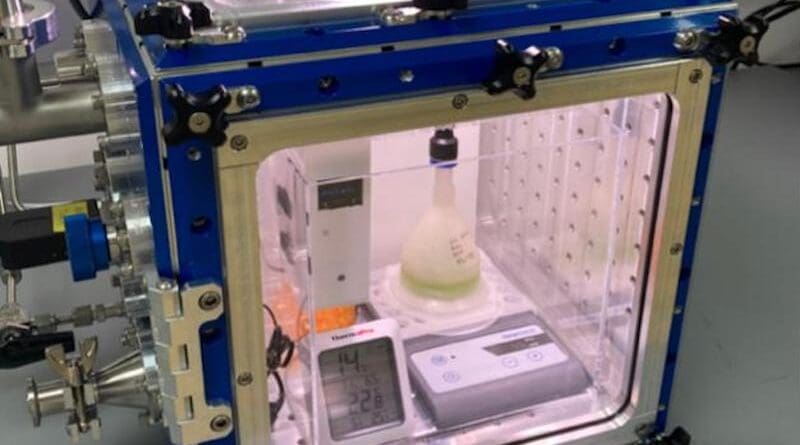
Bioplastic habitat inside the planetary environment chamber. CREDIT: Wordsworth Group / Harvard SEAS
If humans are ever going to live beyond Earth, they’ll need to construct habitats. But transporting enough industrial material to create livable spaces would be incredibly challenging and expensive. Researchers at the Harvard John A. Paulson School of Engineering and Applied Sciences (SEAS) think there’s a better way, through biology.
An international team of researchers led by Robin Wordsworth, the Gordon McKay Professor of Environmental Science and Engineering and Professor of Earth and Planetary Sciences, have demonstrated that they can grow green algae inside shelters made out of bioplastics in Mars-like conditions. The experiments are a first step toward designing sustainable habitats in space that won’t require bringing materials from Earth.
“If you have a habitat that is composed of bioplastic, and it grows algae within it, that algae could produce more bioplastic,” explained Wordsworth. “So you start to have a closed-loop system that can sustain itself and even grow through time.”
The research is published in Science Advances.
Growing algae in Mars-like conditions
In lab experiments that recreated the thin atmosphere of Mars, Wordsworth’s team grew a common type of green algae called Dunaliella tertiolecta. The algae thrived inside a 3D-printed growth chamber made from a bioplastic called polylactic acid, which was able to block UV radiation while transmitting enough light to allow the algae to photosynthesize.
The algae was kept under a Mars-like 600 Pascals of atmospheric pressure – over 100 times lower than Earth’s — and in a carbon dioxide-rich environment, as opposed to mostly nitrogen and oxygen like on Earth. Liquid water cannot exist at such low pressures, but the bioplastic chamber created a pressure gradient that stabilized water within it. The experiments point to bioplastics as potentially key to creating renewable systems for maintaining life in a lifeless environment.
The concept the researchers demonstrated is closer to how organisms grow naturally on Earth, and it contrasts with an industrial approach using materials that are costly to manufacture and recycle.
Humans living in space
Wordsworth’s team previously demonstrated a type of local Martian terraforming using sheets of silica aerogels that mimic the Earth’s greenhouse warming effect to allow for biological growth. A combination of the algae experiments with the aerogels would solve both temperature and pressure issues for supporting plant and algae growth, Wordsworth said, and could open a clearer path toward extraterrestrial existence.
Next, Wordsworth said the researchers want to demonstrate that their habitats also work in vacuum conditions, which would be relevant for lunar or deep-space applications. His team also has plans to design a working closed-loop system for habitat production.
“The concept of biomaterial habitats is fundamentally interesting and can support humans living in space,” Wordsworth said. “As this type of technology develops, it’s going to have spinoff benefits for sustainability technology here on Earth as well.”

No comments:
Post a Comment