Floating Nuclear Power Plants To Be Evaluated For Mediterranean
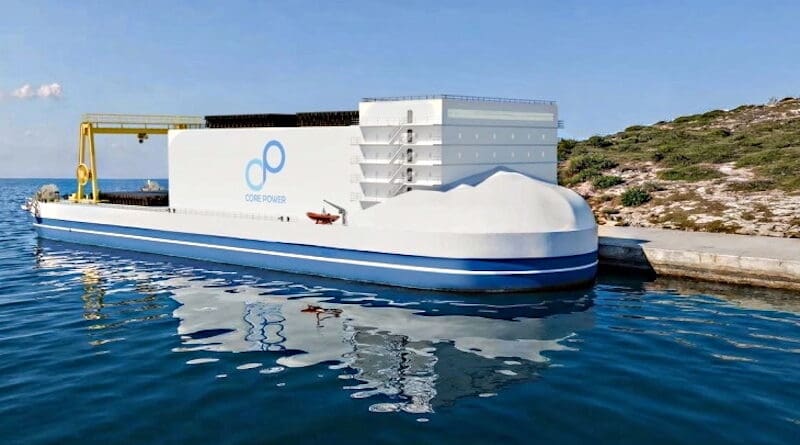
Model of a floating nuclear power plant (FNPP). Image Credit: Core Power
The American Bureau of Shipping, Core Power and Athlos Energy are to collaborate on the evaluation of the potential of deploying floating nuclear power plants to meet the energy demands of islands, ports and coastal communities in the Mediterranean Sea.
The partners will research how floating nuclear power plants (FNPPs) can unlock a wide range of applications, including the provision of grid-scale electricity to remote locations, decarbonising ports by providing emission-free energy and providing reliable clean energy to desalination plants that will provide potable water to drought-affected coastal communities.
“Nuclear energy is ideally suited to support energy demands across the electric, industrial, shipping and transportation sectors to optimise energy generation, utilise and maintain grid reliability, as well as contribute to decarbonisation,” Core Power said.
In October 2024, the American Bureau of Shipping (ABS) unveiled the industry’s first comprehensive requirements for floating nuclear power plants. This consortium will develop original FNPP concepts of operations and publish a visual display of their prospective locations.
The ABS Global Ship Systems Centre will lead a PESTLE (political, economic, social, technological, legal, and environmental) study alongside key stakeholders with the aim of assessing the feasibility of adapting FNPP concepts to supply power and other benefits in the Aegean Sea. The main deliverable of this collaboration will be an open-access white paper for use by industry, policymakers and government.
“FNPPs can revolutionise the way we deliver reliable and affordable nuclear energy to provide vital carbon free energy security to islands and coastal infrastructure in the Mediterranean,” said Mikal Bøe, founder and CEO of UK-based technology company Core Power. “By constructing and mass-assembling a fleet of FNPPs in shipyards, we can deliver clean nuclear energy on time and budget, solving many of the largest energy challenges we face. Core Power is delighted to partner with industry leaders, ABS and Athlos, on this project.”
“As global efforts accelerate to reduce emissions, improve energy efficiencies and strengthen energy security, the use of small modular reactors on floating platforms could offer a viable alternative,” added ABS Chairman and CEO Christopher Wiernicki. “Floating nuclear power facilities show promise in supporting power grids, microgrids, industrial and port operations and data centres, among others.”
Dionysios Chionis, co-founder of Athlos Energy – established in 2024 to promote the use of nuclear energy in Greece – added: “As Greece reconsiders its energy future, the role of nuclear power is increasingly back on the agenda. This study marks an important first step in accessing the feasibility of deploying floating nuclear reactors in the Aegean Sea.”
In February, Core Power announced it would develop a “US-anchored” maritime civil nuclear programme that will “bring floating nuclear power to market by the mid-2030s”. The Liberty programme “will lay the foundation for the use of nuclear power in the civil maritime sector”, the company said. The first part of the programme will see the mass production of floating nuclear power plants. The expertise gained in rolling out FNPPs on a large scale will pave the way for the second part of the programme, which involves developing nuclear propulsion for civil ships. The Liberty programme will employ advanced nuclear technologies, such as molten salt reactors.
In November last year, Westinghouse and Core Power announced they had signed a cooperative agreement under which they will advance the design of a floating nuclear power plant using Westinghouse’s eVinci microreactor and its heat pipe technology. They will also collaborate to develop a regulatory approach to licensing floating nuclear power plant systems.
French regulator says 1300 MW units can operate beyond 40 years
_41821.jpg)
EDF operates four pressurised water reactor designs, known as the 900 MWe, the 1300 MWe, the 1450 MWe N4 and the 1620 MWe EPR. Its 32 operating 900 MWe reactors came into commercial operation between 1977 and 1988, while its 20 1300 MWe units started up between 1985 and 1993. The four N4 reactors were connected to the grid between 1984 and 1991. The Flamanville 3 EPR was connected to the grid in December last year.
In France, the authorisation to create a nuclear facility is issued by the government, after consulting the Nuclear Safety and Radiation Protection Authority (ASNR). This authorisation is issued without time limit and a thorough review of the facility, called a 'periodic review', is carried out every ten years to assess the conditions for the continued operation of the facility for the following ten years.
The ASNR has now determined that the 1300 MW units can continue operating beyond their fourth periodic review, conducted after 40 years of operation.
ASNR noted the fourth periodic safety review of the 1300 MWe reactors is "of particular importance since, when certain reactor equipment was designed, an assumption of 40 years of operation was adopted. Continuation beyond this period requires an update of the design studies or replacement of equipment".
It said: "The ASNR considers that all the provisions provided for by EDF and those it prescribes open up the prospect of continued operation of these reactors for the ten years following their fourth periodic review."
The provisions planned by EDF as part of the generic phase of the fourth periodic review of the 1300 MWe reactors were the subject of a national consultation from 18 January to 30 September 2024. The ASNR also consulted the public, via its website, on its draft decision between 16 May and 15 June 2025
In its decision, the ASNR prescribes the implementation of the major safety improvements planned by EDF, as well as the additional provisions it considers necessary to achieve the objectives of the review.
"This decision closes the so-called generic phase of the review, which concerns the studies and modifications of the facilities common to all 1300 MWe reactors, which are designed on a similar model," ASNR noted. "It is accompanied by a letter formulating additional requests on subjects presenting lesser stakes."
The regulator said the improvements and measures will be applied to each reactor individually during their fourth periodic safety reviews, scheduled to run until 2040. These reviews will take the particularities of each facility into account, it said. The measures planned by EDF for each reactor will be subject to a public inquiry.
ASNR requires EDF to report annually on the actions implemented to meet the requirements and their deadlines, and also on the industrial capacity of both EDF and its outside contractors to complete the modifications of the facilities within the set timeframes. The regulator requires that this information be made public.
According to a Reuters report, EDF expects to spend EUR6 billion (USD7 billion) on extending the life of the 1300 MWe reactors.
In February 2021, France's nuclear safety regulator set the conditions for the continued operation of EDF's 900 MWe reactors beyond 40 years. In August 2023, unit 1 of the Tricastin nuclear power plant in southern France became the first French power reactor licensed to operate beyond 40 years.
Lithuania to look into nuclear energy options
_17154_92147.jpg)
The working group, within the Ministry of Energy, will involve experts from the shut-down Ignalina nuclear power plant, with the State Nuclear Energy Safety Inspectorate due to submit safety regulation proposals.
Lithuania's National Energy Independence Strategy last year predicted that demand for electricity was set to increase from 24 TWh in 2030 to 74 TWh in 2050. The Ministry of Energy says "taking into account the challenges of climate change management, energy security goals and studies carried out, one of the possible solutions is the installation of nuclear reactors with a capacity of up to 1.5 GW in Lithuania".
The national strategy said a decision on the installation of small modular reactors (SMRs) should be made by 2028 with the first operating by 2038.
Two large RBMK reactors at the Ignalina nuclear power plant provided 70% of Lithuania's electricity until their closure in 2004 and 2009 as a condition of the country joining the European Union. The power plant is being decommissioned by Ignalina NPP, which has removed fuel from the reactors and placed it into dry casks for interim storage at the site. The decommissioning process is due to last until 2038.
Linas Baužys, Ignalina NPP Director General, said: "The return of nuclear energy to the agenda of issues of strategic importance shows that Lithuania is thinking ahead - striving for long-term stability, energy independence and progress. Considering the growing demand for electricity in Lithuania, which is predicted to increase more than threefold by 2050, it is necessary to realistically assess the possibilities of various generation sources to ensure clean, reliable and competitive energy in the country and the region. Small modular reactors are one of the potential directions that is worth considering seriously and professionally.
"Our company has accumulated nuclear energy competencies not only in the operation, but also in the closure of a nuclear facility, and this experience is invaluable when planning new nuclear capacities."
The energy ministry said the working group's task is to "conduct a detailed analysis, involve the public, cooperate with international experts and, based on the assessments and small nuclear reactor projects, prepare a report. It will present strategic directions and an action plan for the development of nuclear energy in Lithuania. The expert assistance functions have been assigned to the Ignalina Nuclear Power Plant. It will conduct the necessary studies, prepare reports and other documents necessary for making informed decisions".
South Tortkuduk uranium project fully operational
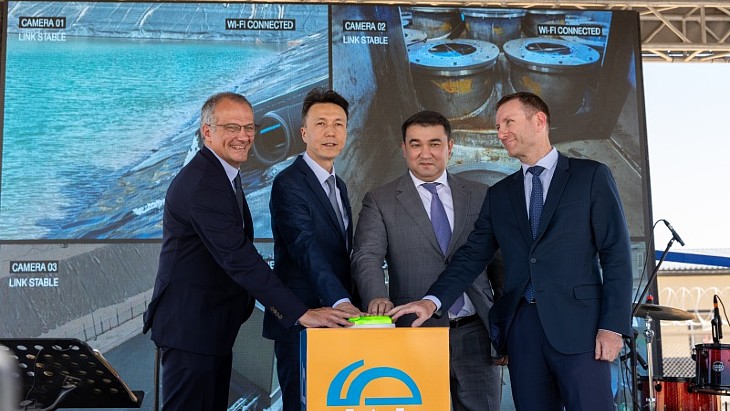
Those attending a ceremony to inaugurate the new uranium processing plant, completing the USD190 million three-year South Tortkuduk project, included Orano's Xavier Saint Martin Tillet, Kazatomprom's Meirzhan Yussupov, Nuralkhan Kusherov, governor of the Turkestan region and Pascal Bastien, Katco director general (all pictured above).
Katco, a joint venture of Orano Mining (51%) and NAC Kazatomprom (49%), produces uranium by in-situ recovery (also known as in-situ leaching) technology at the Muyunkum deposit located in Turkestan region of Kazakhstan, about 300 kilometres north of Shymkent. The South Tortkuduk uranium parcel, with estimated uranium reserves of 46,000 tU, is located between the Tortkuduk and Muyunkum mine sites which Katco has been operating for more than 20 years and which have together produced over 40,000 tU since production began. Like those mines, the new project will use in-situ recovery methods.
Production from South Tortkuduk is intended to gradually replace the currently exploited territories. Katco’s return to the full production level of 4,000 tonnes per year is expected in 2026.
Xavier Saint Martin Tillet, senior executive vice president of the Orano Mining Business Unit, said the project's completion underlined the joint venture's position as one of the largest in-situ recovery (ISR) uranium mining operations in the world "producing 7% of the world’s uranium, indispensable for powering nuclear electricity production and fighting climate change".
He added: "This project showcases the successful partnership between Orano and Kazatomprom, with its development supported by the technical and environmental initiatives outlined in the cooperation memorandum signed between our two companies in November 2022."
Kazatomprom CEO Meirzhan Yussupov said: "The launch of the processing plant at the South Tortkuduk site marks a significant milestone not only for Katco, but also for the entire nuclear industry of Kazakhstan. This milestone bolsters Kazatomprom's position as a world leader in uranium mining and confirms our country's growing role in ensuring global energy security and the transition to a carbon-free future. I would like to especially highlight the professionalism of Kazakh specialists directly involved in the construction of this plant and congratulate our French colleagues on the successful implementation of the project. This is the result of a long-term strategic partnership between Kazatomprom and Orano, built on mutual trust, knowledge sharing, and shared commitment to safety and environmental responsibility."
Depending on the type of mineralisation and the geological setting, uranium can be mined by open pit or underground mining methods, or by dissolving and recovering it via wells. This method is what is known as in-situ recovery, and is now the most widely used method: Kazakhstan produces more uranium than any other country, and all by in-situ methods. Read more: A guide: Uranium and the nuclear fuel cycle
Partnership formed for US deployment of SOLO microreactor
_13696.jpg)
Through a memorandum of understanding signed between the two companies, TechSource will accelerate the introduction of Terra Innovatum's SOLO micro-modular reactor through supply chain and regulatory advisory support, while expanding access to potential strategic investors, customers and US agency funding programmes, including deployment pathways at the US Department of Energy (DOE) and Department of Defense (DOD).
Under the terms of the agreement, Terra Innovatum and TechSource will work collaboratively on identifying and securing optimal sites for reactor assembly and deployment, optimise supply chain management, support Nuclear Regulatory Commission (NRC) compliance, and engage with key stakeholders - including the DOE, DOD, international laboratories, industry leaders, and institutional end users. The collaboration also paves the way for potential co-investments in operational hubs, advanced manufacturing infrastructure, and strategic R&D partnerships.
"This collaboration represents a pivotal milestone in advancing our SOLO MMR technology toward full-scale commercialisation," said Terra Innovatum co-founder and CEO Alessandro Petruzzi. "TechSource's deep network across US governmental agencies, expertise in nuclear material management and US regulatory knowledge will support our regulatory and commercial progress, while bolstering our federal funding and customer acquisition opportunities.
"Together, we plan to strengthen our connection with industry leaders and national laboratories in the US to build a foundation for the widespread deployment of safe, modular nuclear power. Together, we are fast-tracking SOLO's impact on a cleaner, more resilient global energy future."
TechSource Chairman and CEO Brian D'Andrea added: "With decades of experience supporting the Department of Energy, the Department of Defense, national laboratories, and public-sector institutions, we are uniquely positioned to help accelerate the commercialisation and deployment of the SOLO micro-modular reactor."
Terra Innovatum is developing its SOLO micro modular reactor design, intended to form the basis for a scalable modular energy platform from MWe to GWe-class. A SOLO unit is designed to deliver approximately 1 MWe. The design features a solid heterogeneous composite moderator and is intended to accommodate both traditional zircaloy-clad low-enriched uranium (LEU) fuel or, when available, LEU+ and high-assay low-enriched uranium (HALEU) fuels. Heat removal is accomplished by helium gas which eliminates the need for water from the reactor coolant system. The reactor is intended to feature autonomous operation, on-line safeguards-by-design, and a defence-in-depth structure of radiological barriers with the intent to minimise or eliminate emergency planning zone requirements beyond the operational boundary.
The NRC is currently engaged in pre-application activities with Terra Innovatum.
Terra Innovatum says it anticipates that SOLO will be available globally within the next three years and will offer "a wide range of versatile applications, providing CO2-free, behind-the-meter, and off-grid power solutions for data centres, mini-grids serving remote towns and villages, and large-scale industrial operations in hard-to-abate sectors". It also has the ability to supply heat for industrial applications and other specialised processes, including water treatment, desalination and co-generation.

World Nuclear News
World Nuclear News is an online service dedicated to covering developments related to nuclear power. Established in 2007, WNN has grown rapidly to welcome over 40,000 individual readers to the website each month, while its free daily and weekly emails both reach more than 16,000 people. These figures represent a broad audience that includes not only nuclear professionals but also journalists, researchers, opinion leaders, policy-makers, and the general public.

No comments:
Post a Comment