ALT. TECH
HGK Launches First Inland Cargo Vessel Capable of Sailing With Solar Power
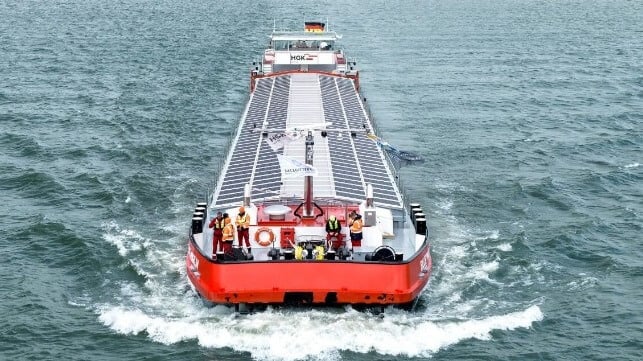
A newly built inland dry goods vessel, Blue Marlin, was named last week in Hamburg, Germany, and became the world’s first hybrid solar-power inland shipping vessel, as well as receiving a designation for remote-controlled operations. The solar system aboard the ship advances on prior low-voltage systems that are supplying power for onboard systems and provides the first capability to contribute solar power to propulsion.
The vessel has several unique capabilities, starting with its 192 solar panels, which are expected to generate up to 37,500 kilowatt hours annually. The system developed by the Netherlands’ Wattlab is more advanced than a system deployed just a year ago and is fully integrated, giving it the capability of contributing power directly to the ship’s high-voltage electric propulsion.
Delivering up to 35 kilowatts under optimal conditions, Wattlab says the Blue Marlin’s solar power system will operate in conjunction with four diesel generators powering the electric propulsion system. This fully integrated setup enables “peak shaving,” where the combination of solar energy and batteries will prevent the need for activating an additional generator during high-demand periods. The system’s automated energy management will distribute electrical energy where and when it is required, increasing efficiency and reducing fuel consumption.
“Furthermore, in situations where the ship is lightly loaded and travelling downstream, we anticipate that it may even sail using only solar power for limited periods—an unprecedented achievement in the inland shipping sector,” said Wattlab co-founder and COO David Kester.
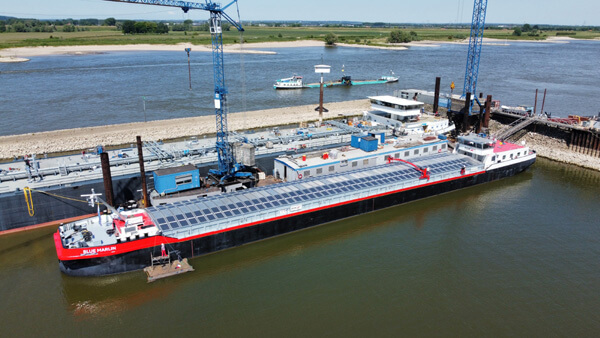
Blue Marlin has 192 solar panels (Wattlab)
The hull of the vessel was built in Romania at the Orsova Shipyard and outfitted in the Netherlands at De Gerlien van Tiemm. It is homeported at Cologne, Germany, and will run for HGK Shipping, a Germany-based European inland shipping company with a fleet of 350 vessels. It will be employed for the German steel company Salzgitter, mainly transporting steel and bulk materials along the network of canals in north-west Germany.
SEAFAR developed technology for the vessel to be operated remotely. After several trial voyages, the German General Directorate of Watersways and Shipping (GDWS) issued a permit for remotely controlled navigation on the canal between Salzgitter and Friedrichsfeld.
In addition to its advanced solar power capabilities, the vessel features a powerful diesel-electric, future-fuel-ready drive concept. Its dimensions (86 meters in length, 9.5 meters wide, and navigation capability with 1.1 meters of draft) were optimized for the canals. It employs two Veth rudder propellers and has a bow thruster. It can also be coupled with a push barge to transport weights up to 3,110 tonnes.
“The Blue Marlin is a strong symbol of what industry and logistics can achieve when they work in tandem,” said Florian Bleikamp, the Managing Director of HGK Dry Shipping. “As we work together, we’re able to put innovative ideas into practice: ranging from emission-free solar technology to remote-controlled navigation for the vessels and even resource-saving drive systems in our fleet.”
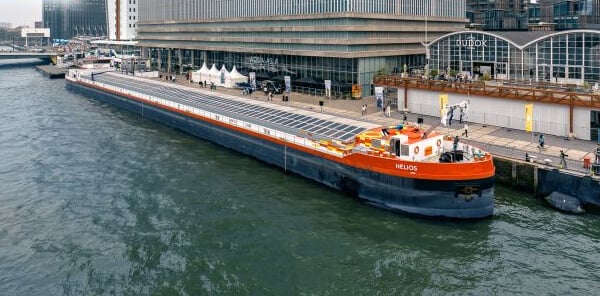
Helios launched in 2024 hold the record with 312 solar panels supplying low voltage onboard systems (HGK)
The companies highlight that the solar system is an advancement on the record-setting 312 solar panels installed last year aboard another HGK dry goods inland vessel, the Helios. The vessel is 135 meters in length and has a capacity for 5,570 cubic meters, and its 27 hatch covers are equipped with solar panels. They generate as much as 90 megawatt hours of electricity per year, with the power being fed to the low-voltage onboard systems. It was recognized as the largest system of its kind by the Guinness Book of Records.
Wattlab, which was founded in 2017 as a maritime solar energy specialist, highlights it has completed installations on than 30 ships. Its goal is to reduce fuel consumption, cut carbon dioxide emissions, and improve operational efficiency as part of the efforts to accelerate the maritime sector’s transition to clean, more sustainable energy.
Anemoi Unveils State-of-the-Art Rotor Sail Production Facility in China
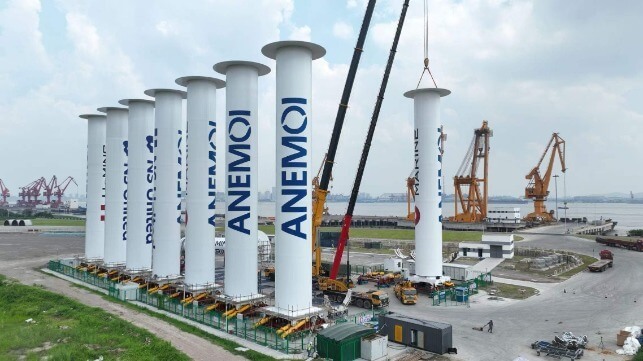
[By: Anemoi Marine Technologies]
Anemoi Marine Technologies, a global leader in wind propulsion solutions, is proud to announce the official opening of its new Rotor Sail production facility in China. This landmark development significantly enhances Anemoi’s manufacturing capabilities and underscores its commitment to accelerating the maritime industry’s transition to zero emissions.
Strategically located on the banks of the Yangtze River, Anemoi’s facility is located in Jingjiang City, Jiangsu Province, within Daming Heavy Industry’s manufacturing base. The facility provides direct access to port infrastructure, enabling seamless logistics for import, export, and delivery. With barge transport available on-site, Rotor Sails can be transported efficiently and installed directly at nearby major shipyards, streamlining operations and minimising environmental impact.
"This is more than just a new site," said Clare Urmston, CEO of Anemoi. "It’s a fully integrated, end-to-end production hub where every stage, from steel fabrication and precision assembly to rigorous testing and quality assurance, is handled under one roof. That means faster turnaround, uncompromised quality, and complete oversight by our expert team, on site, from start to finish. Anemoi’s strategy is quality first and this site enables exactly that.”
Anemoi has been working in China since its pilot installation in 2018, and subsequently established its Chinese entity, ANEMOI Marine Technologies (Changzhou) Co., Ltd., ???????????????, in 2021. The company has built strong strategic partnerships over time. For example, Anemoi has maintained close cooperation and formed a strategic partnership with CRRC Qishuyan Institute Co., Ltd., a first-tier subsidiary of CRRC, the world's largest rail transit equipment manufacturer. With a strong foundation in materials science, key manufacturing processes, key components, and intelligent manufacturing of high-end equipment, the two parties have forged a deep cooperative relationship across the entire value chain, from key component production and system assembly to testing and technical services. Together, they have jointly established this state-of-the-art facility which serves as an advanced manufacturing platform, integrating both production and verification capabilities. The site has been co-designed to enable full speed testing, commissioning and balancing of our Rotor Sails prior to delivery to the Customer to minimise the risk during vessel installation and operation. The site can accommodate Anemoi's full suite of Deployment Systems including Fixed, Folding and Rail types.
This collaboration not only enhances Anemoi’s industrial footprint but also brings the quality assurance associated with China’s high-speed rail to Anemoi’s Rotor Sails. Importantly, Rotor Sails align seamlessly with the CRRC Qishuyan Institute’s development strategy of “High-end Transportation Equipment + Clean Energy Equipment” in the clean energy sector. Moving forward, both parties are committed to advancing global efforts in maritime energy conservation and emissions reduction.
“We are proud to support this milestone project, which reflects the power of international cooperation. By combining British innovation in wind propulsion with China’s advanced manufacturing expertise, we are delivering impactful solutions on a global scale,” Shared by Mr Fang Jun, Vice General Manager of CRRC Changzhou Tech-Mark Industrial Co.,Ltd.
Anemoi has also built a long-term, successful collaboration with Lianyungang Zhongfu Lianzhong Composite Material Group Co., Ltd. (Zhongfu) to produce its composite rotor skins using Anemoi’s patented filament winding manufacturing process. This method, which is unique to Anemoi, ensures additional strength, durability, and uniformity across every product, which is vital for high-performance and withstanding cargo operations. Composite skins are thoroughly tested, painted, and inspected before being transported to Anemoi’s facility in Jingjiang for Rotor Sail assembly.
Ms. Xu Xiuming, Marketing Director of Zhongfu, a leading manufacturer of wind turbine blades, said “We are proud to be contributing to the shipping industry’s decarbonisation journey through our close partnership with Anemoi since 2020, producing high-quality composite Rotors at scale.”
Now, Anemoi has partnered exclusively with Daming Heavy Industries, a global leader in high-end precision manufacturing services for steel fabrication and port services. The collaboration strengthens Anemoi’s position, drives consistent quality in delivery and provides flexibility to scale as global demand for wind-assisted propulsion grows.
Mr. Ren Lei, Marketing Director of Daming said: “Our partnership with Anemoi reflects a shared commitment to quality, efficiency, safety, and timely delivery. With our one-stop, fully integrated facility, we are confident in our ability to support Anemoi’s vision and contribute to a more sustainable maritime future.”
With an annual production capacity of 250 Rotor Sails, and the option to expand further and store units for fast turnaround, the new site positions Anemoi to meet surging global demand and support its customers in achieving critical decarbonisation goals. The scale and capabilities of this facility make it the first of its kind for wind propulsion, cementing Anemoi’s leadership in this transformative sector.
“Our presence in one of China’s key shipping hubs not only strengthens existing strategic relationships but also paves the way for new collaborations,” added Nick Contopoulos, Chief Commercial Officer of Anemoi “Getting to zero emissions requires forward-thinking action and partnerships like these. Together, we are shaping the future of sustainable shipping.”
The products and services herein described in this press release are not endorsed by The Maritime Executive.
RINA Secures World Bank Project to Advance Green Hydrogen at Port of Pecém

[By: RINA]
RINA, the global engineering consulting, inspection and certification company, has secured a high-profile World Bank-funded assignment to help accelerate Brazil’s transition to a low-carbon industrial economy. RINA will deliver a comprehensive water assessment study for securing industrial water for green hydrogen production at the Complexo Industrial e Portuário do Pecém (CIPP), a flagship low-carbon development hub in Brazil. The project will not only support industrial innovation but also contribute to social and environmental equity, improving water access for nearby communities in the state of Ceará.
A Strategic Step Toward Green Hydrogen at Scale
To support large-scale green hydrogen production, the study explores two key water sourcing strategies: reuse of treated effluent from sewage treatment plants in Fortaleza’s western region and seawater desalination. Both options will be assessed for their technical feasibility, economic viability, environmental impact, and compatibility with local infrastructure and regulation.
The water assessment study, to be delivered by RINA in partnership with local firm Krypton, will provide:
- A comparative feasibility study of reclaimed water reuse vs. seawater desalination.
- A detailed environmental impact analysis Assessment of water demand at the CIPP over the next 5–10 years, aligned with anticipated industrial growth.
- A regulatory and infrastructure evaluation, ensuring compliance with Brazilian standards and effective use of existing water systems.
Crucially, the study will also evaluate how the proposed infrastructure could enhance water access for surrounding communities, ensuring that industrial progress contributes to broader regional sustainability.
This award follows RINA’s successful delivery of the first consultancy at World Bank Group, focused on industrial decarbonisation. That assignment encompassed developing a comprehensive GHG inventory, energy balance, and decarbonisation roadmap for the region’s energy-intensive industrial cluster. The continuity between both projects positions RINA as a key contributor to the development of the project in the Port of Pecem, as one of Brazil’s premier clean energy and green export hub.
“This project reflects the power of RINA’s global knowledge base and our ability to apply it in support of sustainable industrial development,” said Andrea Pestarino, IFI and Organizations Engineering Commercial Management Director at RINA. “As a knowledge-led organisation, we bring together experience across sectors and geographies to deliver tailored, high-impact solutions. This World Bank contract reinforces our long-term commitment to the region and to Brazil’s clean energy future.”
The products and services herein described in this press release are not endorsed by The Maritime Executive.

No comments:
Post a Comment