After decades of insurgency against Turkey, PKK begins disarming in step toward peace
Read the Full Transcript
Notice: Transcripts are machine and human generated and lightly edited for accuracy. They may contain errors.
Amna Nawaz:
Today, for the first time in four decades, the Kurdistan Workers Party, known as the PKK, is laying down its arms and says it will end its insurgency against Turkey. The separatist group's disbandment comes after its imprisoned leader, Abdullah Ocalan, announced an end to its 41-year armed struggle and a transition to democratic politics.
Today marks the PKK's first concrete steps toward peace.
Here's Nick Schifrin with more.
Nick Schifrin:
Today, they came down from the mountains. So rifles that for four decades have been drenched in blood can now be destroyed by fire.
Kurdish separatists hope their armed struggle for independence can now become peaceful, said 47-year-old Kurdish separatist leader Bese Hozat.
Bese Hozat, Co-Chair, Kurdistan Communities Union (through interpreter):
To wage our freedom, democracy and socialist struggle with methods of legal and democratic politics, we voluntarily destroy our weapons before your presence as a step of goodwill and determination.
Nick Schifrin:
For years, these fighters, often no older than 20, and their weapons targeted Turkish forces, as seen in their propaganda videos. Some 30 million Kurds live across Turkey, Syria, Iraq and Iran. And in Southeast Turkey and across the border in Iraq, the Kurdistan Worker's Party has been waging an insurgency, demanding greater rights and an independent state.
Their methods have been bloody and include terrorist attacks on civilian targets. Turkey says the 41-year conflict has killed more than 40,000 people.
Zubeyir Aydar, Executive Council Member, Kurdistan Communities Union (through interpreter):
The Kurds and the Kurdish movement took these steps for a peaceful solution and an honest solution. The Kurds took a risk, but this risk has been taken for a peaceful democratic solution.
Nick Schifrin:
Zubeyir Aydar heads the Kurdish separatist movement's political wing. Turkey put out a warrant for his arrest in 2009. He lives in exile. We spoke to him from Brussels.
A Turkish official today said this was a — quote — "irreversible turning point toward peace." Do you believe this is a pause in fighting or this is an irreversible step toward peace?
Zubeyir Aydar (through interpreter):
We don't want to be cheated or lied to and we don't want to cheat anyone. We deeply hope that the opposite side, the Turkish side, is honest as well in the peaceful negotiations.
Nick Schifrin:
For years, Kurdish protesters have accused the Turkish state of cracking down on Kurdish rights and culture. And, for years, the Turkish military has attacked the Kurdistan Worker's Party and its allies in Turkey and beyond with airstrikes that international humanitarian organizations say have violated human rights.
Turkey has set up military bases and outposts in Northern Syria, where Kurds backed by the United States have fought ISIS. Turkey's also created bases in Northern Iraq, where the Kurdistan region is semiautonomous. But, earlier this year, longtime Kurdistan Worker's Party leader Abdullah Ocalan called for peace.
And in a rare video this week, he said his group would disarm and expected Turkey to provide greater rights.
Zubeyir Aydar (through interpreter):
First of all, the Kurdish community should be constitutionally recognized in Turkey. The Kurds have been ignored for a very long time. The Kurds need to be able to live with their own identity and their own culture. Political prisoners must be released and the fighters need to have rights to live and do politics in Turkey.
Nick Schifrin:
And have you seen today Turkey take any of those steps?
Zubeyir Aydar (through interpreter):
Turkey says with words they will take these steps, but these steps haven't been taken. We hope that Turkey will not miss this opportunity, this peace opportunity.
Nick Schifrin:
Turkish President Recep Tayyip Erdogan has long advocated for harsh crackdowns on the Kurds, but this week he predicted peace.
Recep Tayyip Erdogan, Turkish President (through interpreter):
The winners of this will be the whole of Turkey, Turks, Kurds and Arabs. Then it will be our entire region and all our brethren in the region.
Nick Schifrin:
And I'm now joined by Jim Jeffrey, the former U.S. ambassador to Turkey, as well as to Iraq, who was most recently the special representative for Syria under the first Trump administration.
Ambassador Jeffrey, thanks very much. Welcome back to the "News Hour."
Bottom line, how significant is this event that we saw today? The Kurdistan Worker's Party burning their rifles, calling for their armed struggle to be now waged peaceful?
James Jeffrey, Former U.S. Ambassador to Turkey: This is a huge step forward of a process that began about six months ago. It signifies the end of a 40-year terrorist insurgent campaign in Turkey, Iraq and Syria against the Turkish state and at times against various other elements.
It is a dramatic move forward for the whole region and is something that will really stabilize the Northern Levant in very many important ways.
Nick Schifrin:
You heard President Erdogan say in the story that ran just before you and I started speaking, say that the winners of this will be the whole of Turkey.
Of course, he was not the one who really pushed this. It was actually a member of his coalition. Nonetheless, why has he come out and supported this, and why now?
James Jeffrey:
Well, why now is partially domestic politics in Turkey. Erdogan wants to move forward with changes in the Constitution.
And the PKK, besides a terrorist movement, has also an associated political party that has the third largest number of seats in Parliament. So, there is somewhat opportunistic political reason for this as well.
But, nonetheless, Erdogan, back more than a decade ago when I was in Turkey as ambassador, was working hard to try to get cease-fires and some kind of understanding with the PKK and other Kurdish groups.
Nick Schifrin:
In the story that we ran right before, you heard Zubeyir Aydar, the Kurdish separatist political leader, say a few things.
He said — quote — "The Kurds took a risk" and — quote — "We deeply hope that the opposite side, the Turkish side, is honest."
Do you believe that Turkey will proceed honestly going forward?
James Jeffrey:
I believe that the Turkish government, particularly the president, Erdogan, and the leader of the other coalition party, Bahceli, are very serious.
Now, what the Kurds are talking about is continued democratic processes that would give Kurds their rights, language rights, other equality within Turkey. And that is still something that we have to see how it develops on the ground.
Nick Schifrin:
Not only that. Zubeyir Aydar listed a few things that he expected Turkey to do. He said that the Kurdish community should be constitutionally recognized in Turkey, Kurds need to be able to live with their own identity, their own culture, political prisoners need to be released, and fighters need to have rights to live and do politics in Turkey.
Can all that really happen?
James Jeffrey:
That's a good starting list. I can see the Turks granting some of it because some of it's already been granted, Turkish identity, particularly in areas where they're the majority.
And the Turks are talking about reconciliation, but they're also talking about accountability. And some of these PKK fighters have verifiable charges of terrorism against them, and that's going to have to be worked out as well.
Nick Schifrin:
As you know better than anyone, these divisions here are deep. How can this peace really hold, given those divisions?
James Jeffrey:
Well, for two reasons.
First of all, the armed struggle hasn't worked. The PKK has been decisively defeated militarily. But, secondly, over the past 20-plus years, particularly since President Erdogan came to power, the Turkish state has been somewhat more open to Kurdish identity, Kurdish culture, Kurdish language, and other things.
It's not what many Kurds want, but it is a huge step forward from the Turkey that I knew in the 1980s and 1990s.
Nick Schifrin:
And, finally, Jim Jeffrey, the U.S, of course, has had a complex relationship with Kurds across the region, but have allied with Kurds, especially in Syria, against the Islamic State. How does a deal like this today affect the U.S. relationship with Kurds in the other countries, but especially Syria?
James Jeffrey:
It's huge.
Kurds, including the PKK Kurds and the many Kurds in Iraq and Turkey and elsewhere who are not part of the PKK, know that we were an honest broker. They know that we were pushing for both peace and, at the same time, helping Ankara fight terrorism. We also had people on the ground, Foreign Service offices, so important to our diplomacy, working with all sides, often in dangerous conditions, to try to move this forward.
Again, the credit goes to the Turkish people, the government, the PKK and their supporters, but the U.S. played a big role here also.
Nick Schifrin:
Ambassador James Jeffrey, thank you very much.
James Jeffrey:
Thank you.
Jul 11, 2025
PBS NEWSHOUR
By — Nick Schifrin
By —Zeba Warsi
By — Sonia Kopelev
By — Dan Sagalyn
For the first time in four decades, the Kurdistan Workers Party, known as the PKK, is laying down its arms and says it will end its insurgency against Turkey. The separatist group’s disbandment comes after its imprisoned leader announced an end to its 41-year armed struggle and a transition to democratic politics. Nick Schifrin reports.
PBS NEWSHOUR
By — Nick Schifrin
By —Zeba Warsi
By — Sonia Kopelev
By — Dan Sagalyn
For the first time in four decades, the Kurdistan Workers Party, known as the PKK, is laying down its arms and says it will end its insurgency against Turkey. The separatist group’s disbandment comes after its imprisoned leader announced an end to its 41-year armed struggle and a transition to democratic politics. Nick Schifrin reports.
Read the Full Transcript
Notice: Transcripts are machine and human generated and lightly edited for accuracy. They may contain errors.
Amna Nawaz:
Today, for the first time in four decades, the Kurdistan Workers Party, known as the PKK, is laying down its arms and says it will end its insurgency against Turkey. The separatist group's disbandment comes after its imprisoned leader, Abdullah Ocalan, announced an end to its 41-year armed struggle and a transition to democratic politics.
Today marks the PKK's first concrete steps toward peace.
Here's Nick Schifrin with more.
Nick Schifrin:
Today, they came down from the mountains. So rifles that for four decades have been drenched in blood can now be destroyed by fire.
Kurdish separatists hope their armed struggle for independence can now become peaceful, said 47-year-old Kurdish separatist leader Bese Hozat.
Bese Hozat, Co-Chair, Kurdistan Communities Union (through interpreter):
To wage our freedom, democracy and socialist struggle with methods of legal and democratic politics, we voluntarily destroy our weapons before your presence as a step of goodwill and determination.
Nick Schifrin:
For years, these fighters, often no older than 20, and their weapons targeted Turkish forces, as seen in their propaganda videos. Some 30 million Kurds live across Turkey, Syria, Iraq and Iran. And in Southeast Turkey and across the border in Iraq, the Kurdistan Worker's Party has been waging an insurgency, demanding greater rights and an independent state.
Their methods have been bloody and include terrorist attacks on civilian targets. Turkey says the 41-year conflict has killed more than 40,000 people.
Zubeyir Aydar, Executive Council Member, Kurdistan Communities Union (through interpreter):
The Kurds and the Kurdish movement took these steps for a peaceful solution and an honest solution. The Kurds took a risk, but this risk has been taken for a peaceful democratic solution.
Nick Schifrin:
Zubeyir Aydar heads the Kurdish separatist movement's political wing. Turkey put out a warrant for his arrest in 2009. He lives in exile. We spoke to him from Brussels.
A Turkish official today said this was a — quote — "irreversible turning point toward peace." Do you believe this is a pause in fighting or this is an irreversible step toward peace?
Zubeyir Aydar (through interpreter):
We don't want to be cheated or lied to and we don't want to cheat anyone. We deeply hope that the opposite side, the Turkish side, is honest as well in the peaceful negotiations.
Nick Schifrin:
For years, Kurdish protesters have accused the Turkish state of cracking down on Kurdish rights and culture. And, for years, the Turkish military has attacked the Kurdistan Worker's Party and its allies in Turkey and beyond with airstrikes that international humanitarian organizations say have violated human rights.
Turkey has set up military bases and outposts in Northern Syria, where Kurds backed by the United States have fought ISIS. Turkey's also created bases in Northern Iraq, where the Kurdistan region is semiautonomous. But, earlier this year, longtime Kurdistan Worker's Party leader Abdullah Ocalan called for peace.
And in a rare video this week, he said his group would disarm and expected Turkey to provide greater rights.
Zubeyir Aydar (through interpreter):
First of all, the Kurdish community should be constitutionally recognized in Turkey. The Kurds have been ignored for a very long time. The Kurds need to be able to live with their own identity and their own culture. Political prisoners must be released and the fighters need to have rights to live and do politics in Turkey.
Nick Schifrin:
And have you seen today Turkey take any of those steps?
Zubeyir Aydar (through interpreter):
Turkey says with words they will take these steps, but these steps haven't been taken. We hope that Turkey will not miss this opportunity, this peace opportunity.
Nick Schifrin:
Turkish President Recep Tayyip Erdogan has long advocated for harsh crackdowns on the Kurds, but this week he predicted peace.
Recep Tayyip Erdogan, Turkish President (through interpreter):
The winners of this will be the whole of Turkey, Turks, Kurds and Arabs. Then it will be our entire region and all our brethren in the region.
Nick Schifrin:
And I'm now joined by Jim Jeffrey, the former U.S. ambassador to Turkey, as well as to Iraq, who was most recently the special representative for Syria under the first Trump administration.
Ambassador Jeffrey, thanks very much. Welcome back to the "News Hour."
Bottom line, how significant is this event that we saw today? The Kurdistan Worker's Party burning their rifles, calling for their armed struggle to be now waged peaceful?
James Jeffrey, Former U.S. Ambassador to Turkey: This is a huge step forward of a process that began about six months ago. It signifies the end of a 40-year terrorist insurgent campaign in Turkey, Iraq and Syria against the Turkish state and at times against various other elements.
It is a dramatic move forward for the whole region and is something that will really stabilize the Northern Levant in very many important ways.
Nick Schifrin:
You heard President Erdogan say in the story that ran just before you and I started speaking, say that the winners of this will be the whole of Turkey.
Of course, he was not the one who really pushed this. It was actually a member of his coalition. Nonetheless, why has he come out and supported this, and why now?
James Jeffrey:
Well, why now is partially domestic politics in Turkey. Erdogan wants to move forward with changes in the Constitution.
And the PKK, besides a terrorist movement, has also an associated political party that has the third largest number of seats in Parliament. So, there is somewhat opportunistic political reason for this as well.
But, nonetheless, Erdogan, back more than a decade ago when I was in Turkey as ambassador, was working hard to try to get cease-fires and some kind of understanding with the PKK and other Kurdish groups.
Nick Schifrin:
In the story that we ran right before, you heard Zubeyir Aydar, the Kurdish separatist political leader, say a few things.
He said — quote — "The Kurds took a risk" and — quote — "We deeply hope that the opposite side, the Turkish side, is honest."
Do you believe that Turkey will proceed honestly going forward?
James Jeffrey:
I believe that the Turkish government, particularly the president, Erdogan, and the leader of the other coalition party, Bahceli, are very serious.
Now, what the Kurds are talking about is continued democratic processes that would give Kurds their rights, language rights, other equality within Turkey. And that is still something that we have to see how it develops on the ground.
Nick Schifrin:
Not only that. Zubeyir Aydar listed a few things that he expected Turkey to do. He said that the Kurdish community should be constitutionally recognized in Turkey, Kurds need to be able to live with their own identity, their own culture, political prisoners need to be released, and fighters need to have rights to live and do politics in Turkey.
Can all that really happen?
James Jeffrey:
That's a good starting list. I can see the Turks granting some of it because some of it's already been granted, Turkish identity, particularly in areas where they're the majority.
And the Turks are talking about reconciliation, but they're also talking about accountability. And some of these PKK fighters have verifiable charges of terrorism against them, and that's going to have to be worked out as well.
Nick Schifrin:
As you know better than anyone, these divisions here are deep. How can this peace really hold, given those divisions?
James Jeffrey:
Well, for two reasons.
First of all, the armed struggle hasn't worked. The PKK has been decisively defeated militarily. But, secondly, over the past 20-plus years, particularly since President Erdogan came to power, the Turkish state has been somewhat more open to Kurdish identity, Kurdish culture, Kurdish language, and other things.
It's not what many Kurds want, but it is a huge step forward from the Turkey that I knew in the 1980s and 1990s.
Nick Schifrin:
And, finally, Jim Jeffrey, the U.S, of course, has had a complex relationship with Kurds across the region, but have allied with Kurds, especially in Syria, against the Islamic State. How does a deal like this today affect the U.S. relationship with Kurds in the other countries, but especially Syria?
James Jeffrey:
It's huge.
Kurds, including the PKK Kurds and the many Kurds in Iraq and Turkey and elsewhere who are not part of the PKK, know that we were an honest broker. They know that we were pushing for both peace and, at the same time, helping Ankara fight terrorism. We also had people on the ground, Foreign Service offices, so important to our diplomacy, working with all sides, often in dangerous conditions, to try to move this forward.
Again, the credit goes to the Turkish people, the government, the PKK and their supporters, but the U.S. played a big role here also.
Nick Schifrin:
Ambassador James Jeffrey, thank you very much.
James Jeffrey:
Thank you.
ENDING THE ARMED STRUGGLE WITH TURKIYE
Last updated: July 11, 2025
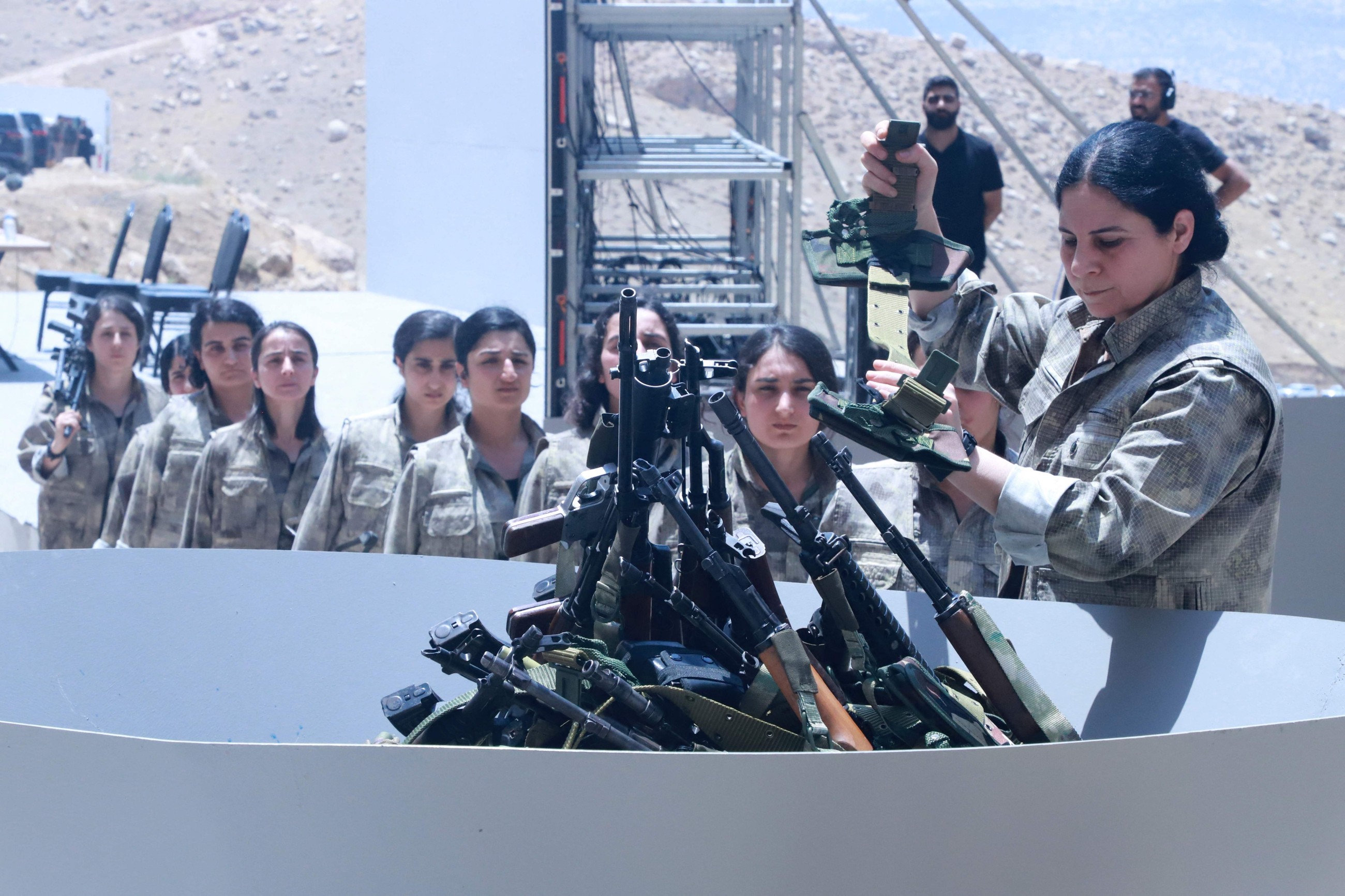
Fighters with the Kurdistan Workers' Party line up to put their weapons into a pit during a ceremony in Sulaimaniyah, Iraq, on Friday. AFP
Thirty PKK fighters destroyed their weapons at a symbolic ceremony in Iraqi Kurdistan on Friday, two months after the Kurdish rebels ended their decades-long armed struggle against the Turkish state.
The ceremony marked a major step in the transition of the Kurdistan Workers' Party (PKK) from armed insurgency to democratic politics, as part of a broader effort to bring an end to one of the region's longest-running conflicts.
Analysts say that with the PKK weakened and the Kurdish public exhausted by decades of violence, Turkey's peace offer handed its jailed founder Abdullah Ocalan a chance to make the long-desired switch away from armed struggle.
The PKK's disarmament also grants President Recep Tayyip Erdogan the distinction of being the Turkish leader who managed to draw a line under a bloody conflict that cost more than 40,000 lives and wrought havoc in Turkey and beyond.
Outside the ancient cave of Casene, a group of 30 PKK fighters, men and women, gathered on a stage in khaki fatigues, their faces uncovered, in front of an audience of around 300 people, an AFP correspondent at the scene said.
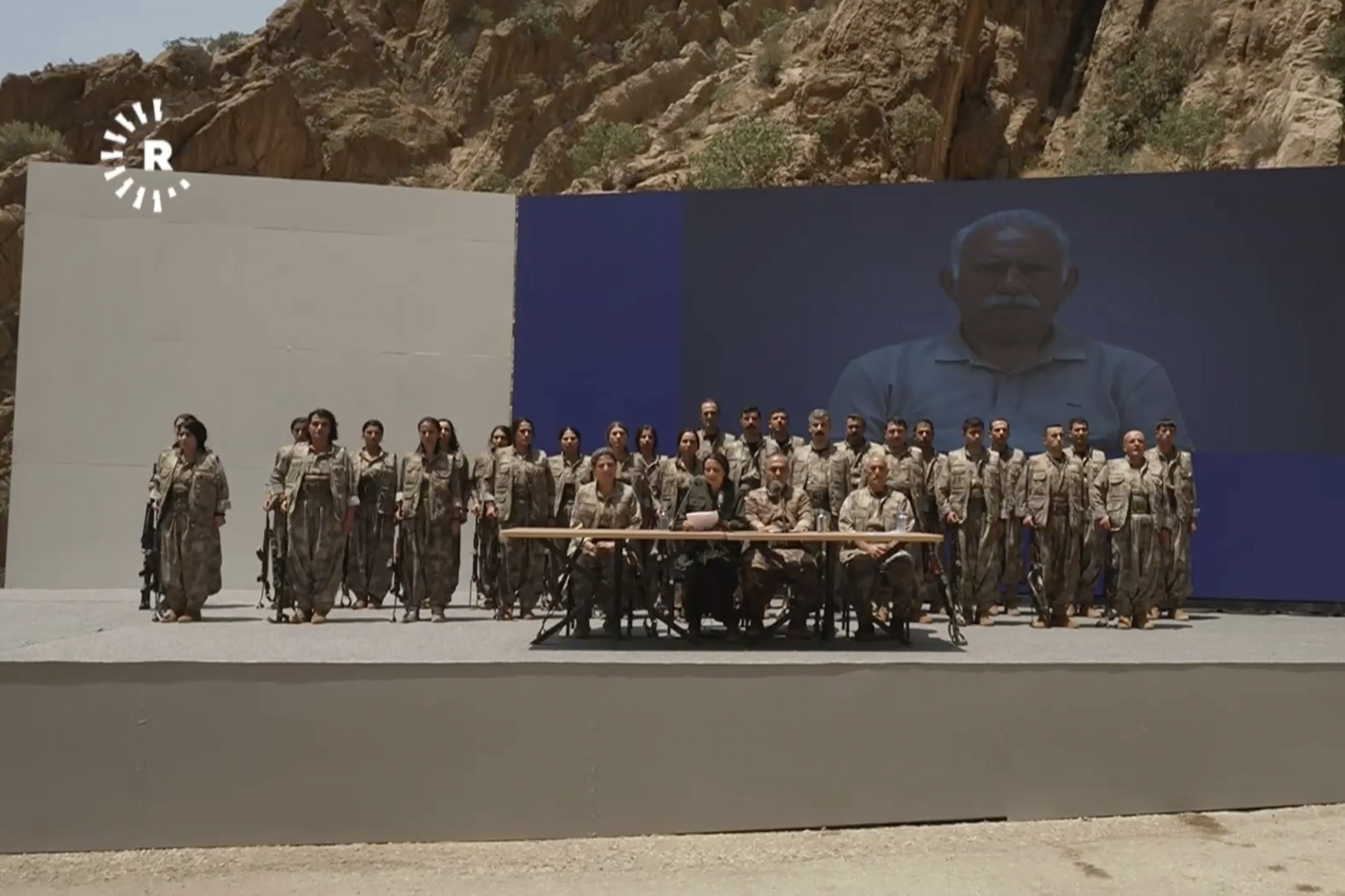
This frame grab from video released by Rudaw TV shows PKK fighters standing next to a photo of their jailed leader Abdullah Ocalan during a symbolic disarmament ceremony. AP
One by one, they walked down to lay their weapons in a cauldron in which a fire was lit. Most were rifles but there was one machine gun and a rocket-propelled grenade launcher.
As they looked on, people in the crowd started cheering while others could be heard weeping
After the ceremony, the fighters returned to the mountains, a PKK commander said.
Speaking to AFP after the ceremony, the PKK's top female commander Bese Hozat said that for the process to succeed, it was essential to release Ocalan — known to his followers as 'Apo' — who has been serving life in solitary confinement since 1999.
"Ensuring Leader Apo's physical freedom via legal guarantees, is essential... he should be able to freely lead and manage this process. This is our primary condition and demand," she said.
"Without this development, it is highly unlikely that the process will continue successfully."
Erdogan hailed the ceremony as an "important step" on the path to a "terror-free Turkey", expressing hope it would lead to "the establishment of lasting peace in our region."
And a senior Turkish official source described it as a "concrete and welcome step." "We view this development as an irreversible turning point," he said, adding that the move to decommission weapons was part of a broader five-stage process.
The following steps would involve the legal reintegration of former fighters into society, the establishment of mechanisms for their lawful return and for justice, ensuring accountability and stability.
Agence France-Presse
PKK disarmament opens new page for Turkey, President Erdogan says
Erdogan said the recent steps to disarm have united Turkey, and now the parliament will help facilitate the disarmament process.
By REUTERS
JULY 12, 2025 12:41
Turkish President Recep Tayyip Erdogan on Saturday called for full support of the disarmament of Kurdish militants that began with a handover of the first batch of weapons by Kurdistan Workers Party (PKK) forces, a step he said opened a new page for the country.
Thirty PKK militants burned their weapons at the mouth of a cave in northern Iraq on Friday, marking a symbolic but significant step toward ending a decades-long insurgency against Turkey.
"As of yesterday, the scourge of terrorism has entered the process of ending. Today is a new day; a new page has opened in history. Today, the doors of a great, powerful Turkey have been flung wide open," Erdogan told members of his AK Party in Ankara.
He said the recent steps have united the nation, and now the parliament will play a critical role in setting up a legal framework for completing the disarmament process.
Turkish President Recep Tayyip Erdogan on Saturday called for full support of the disarmament of Kurdish militants that began with a handover of the first batch of weapons by Kurdistan Workers Party (PKK) forces, a step he said opened a new page for the country.
Thirty PKK militants burned their weapons at the mouth of a cave in northern Iraq on Friday, marking a symbolic but significant step toward ending a decades-long insurgency against Turkey.
"As of yesterday, the scourge of terrorism has entered the process of ending. Today is a new day; a new page has opened in history. Today, the doors of a great, powerful Turkey have been flung wide open," Erdogan told members of his AK Party in Ankara.
He said the recent steps have united the nation, and now the parliament will play a critical role in setting up a legal framework for completing the disarmament process.

An armed PKK fighter places a weapon to be burnt during a disarming ceremony in Sulaimaniya, Iraq, July 11, 2025, in this screengrab obtained from a handout video. (credit: KURDISTAN WORKERS PARTY MEDIA OFFICE/Handout via REUTERS )
Turkey forms parlimentary commission for PKK disarmament"I hope that our parliament will support this process with the broadest possible participation," Erdogan said.
Ankara has taken steps toward forming a parliamentary commission that will oversee the disarmament and PKK's transition into democratic politics.
The PKK, locked in conflict with the Turkish state and outlawed since 1984, decided in May to disband, disarm, and end its separatist struggle after a public call to do so from its long-imprisoned leader Abdullah Ocalan.
What to Know about the Latest Effort to End Türkiye's 40-year Kurdish Conflict

FILED - 02 November 2041, Hesse, Frankfurt_Main: A man displays a flag with the image of imprisoned Kurdish leader Abdullah Ocalan at the Kurdish Newroz celebration in Frankfurt. Photo: Boris Roessler/dpa
Asharq Al Awsat
12 July 2025
FILED - 02 November 2041, Hesse, Frankfurt_Main: A man displays a flag with the image of imprisoned Kurdish leader Abdullah Ocalan at the Kurdish Newroz celebration in Frankfurt. Photo: Boris Roessler/dpa
Asharq Al Awsat
12 July 2025
AD ـ 17 Muharram 1447 AH
A group of 30 Kurdish fighters clad in camouflage fatigues burned their weapons in a large cauldron in northern Iraq on Friday, in a symbolic gesture marking the first concrete step in an effort to end one of the Middle East’s longest-running insurgencies.
The ceremonial laying down of arms by members of the Kurdistan Workers’ Party, or PKK -- including 15 women — comes months after the group’s imprisoned leader, Abdullah Ocalan, called on it to disarm and disband as part of a new peace effort with Türkiye. Ocalan repeated that call in a video message to his fighters this week.
The process in Türkiye was initiated in October by Devlet Bahceli, a firebrand ultranationalist politician who has usually opposed any concessions to Kurdish identity or rights.
While Turkish officials have welcomed the first step toward the PKK’s disarmament, questions remain about the future of Kurdish fighters in Syria.
What is the PKK? The Kurdistan Workers’ Party, or PKK, has waged an armed insurgency against Türkiye since 1984, initially with the aim of establishing a Kurdish state in the southeast of the country. Over time, the objective evolved into a campaign for autonomy and rights for Kurds within Türkiye.
The conflict between militants and state forces, which has spread beyond Türkiye’s borders into Iraq and Syria, has killed tens of thousands of people. The PKK is considered to be a terrorist organization by Türkiye, the United States and the European Union.
Who is Ocalan? Abdullah Ocalan, who as a student of political science in Ankara became deeply involved in leftist movements, formed the PKK in 1978 as a Marxist organization. He fled to Syria in 1979, along with other PKK members, where he remained until 1998, when Syria expelled him under intense pressure from Türkiye.
Ocalan was captured in Kenya in 1999 and imprisoned on Imrali island in the Sea of Marmara, where he remains to this day. His death sentence for treason was commuted to a life term in prison after Türkiye abolished the death penalty.
The 76-year-old endures as a symbol for Kurdish independence and rights and continues to wield influence over the Kurdish movement, with past messages relayed through family members or lawyers resonating beyond Türkiye, in Iraq and Syria.
Push for peace
In October, Bahceli, a close ally of President Recep Tayyip Erdogan, suggested Ocalan could be granted parole if he renounces violence and disbands the PKK.
It was a major shift for the hardline politician who had previously strongly supported the state’s military action against the militant group and its affiliates in neighboring Syria and rejected any notion of negotiation.
In a message delivered through senior officials of the pro-Kurdish People's Equality and Democracy Party, or DEM, Ocalan called on the PKK leadership to take the decision to disband and disarm in February.
The PKK announced a unilateral ceasefire in March in response to Ocalan’s call and later announced its decision to disarm.
It was not immediately clear what concessions, if any, the Kurdish groups would get in return. PKK officials have said they expect former fighters to be given a path to integrate into the political system in Türkiye.
There are also concerns that some splinter groups may emerge within the PKK and that attacks may continue.
Soon after Bahceli's announcement, the PKK claimed an attack on Türkiye’s key aerospace company outside of Ankara that killed several people.
Previous attempts
There have been several peace efforts between the Turkish state and the PKK over the years, including secret negotiations held in Oslo, Norway from 2009 until 2011. However, none have yielded results.
The last attempt to reach a peace deal took place between 2013 and 2015 with a series of talks between Turkish officials and Ocalan, who declared a ceasefire and withdrew fighters to bases in northern Iraq.
Turkish officials took steps to improve Kurdish rights, including allowing Kurdish-language broadcasts. The process collapsed in July 2015, after a series of violent attacks, including one by the ISIS group that killed 33 pro-Kurdish activists.
Since then, Türkiye has cracked down on its pro-Kurdish movement and has jailed thousands of people, including the former leader of the main pro-Kurdish political party, Selahattin Demirtas, over alleged links to the PKK.
Reshaping the region
The latest peace effort comes at a time when Türkiye and the Kurds are both seeking security to face the challenges in the Middle East.
The renewed peace initiative unfolds amid fundamental changes reshaping the region, including the reconfiguration of power in Syria after the toppling of President Bashar Assad, the weakening of the Hezbollah militant movement in Lebanon, and the ongoing Israel-Hamas war in Gaza.
Türkiye strongly supports a deal reached between Syria’s new administration and the Kurdish-led and US backed Syrian Democratic Forces under which the SDF forces would merge with the new Syrian national army. The US envoy to Syria told The Associated Press this week that the sides remain at odds over the merger.
Hamish Kinnear, Senior Middle East and North Africa Analyst at risk intelligence company Verisk Maplecroft, said Ocalan’s decision to abandon the armed struggle coincides with a period when the PKK’s leverage is weak due to military setbacks and regional isolation.
“The PKK’s armed struggle was already faltering in the face of advances by Türkiye’s military, while its popularity among its traditional base was in decline,” Kinnear said. ”Ultimately, the peace talks were a useful off ramp in which improvement of Kurdish rights could still be pursued."
However, some believe the main aim of the reconciliation effort is for Erdogan’s government to garner Kurdish support for a new constitution that would allow him to remain in power beyond 2028, when his term ends.
Bahceli has openly called for a new constitution, saying it was essential to keep Erdogan in power for Türkiye’s future. Erdogan and Bahceli are reportedly seeking parliamentary support from the DEM.
A group of 30 Kurdish fighters clad in camouflage fatigues burned their weapons in a large cauldron in northern Iraq on Friday, in a symbolic gesture marking the first concrete step in an effort to end one of the Middle East’s longest-running insurgencies.
The ceremonial laying down of arms by members of the Kurdistan Workers’ Party, or PKK -- including 15 women — comes months after the group’s imprisoned leader, Abdullah Ocalan, called on it to disarm and disband as part of a new peace effort with Türkiye. Ocalan repeated that call in a video message to his fighters this week.
The process in Türkiye was initiated in October by Devlet Bahceli, a firebrand ultranationalist politician who has usually opposed any concessions to Kurdish identity or rights.
While Turkish officials have welcomed the first step toward the PKK’s disarmament, questions remain about the future of Kurdish fighters in Syria.
What is the PKK? The Kurdistan Workers’ Party, or PKK, has waged an armed insurgency against Türkiye since 1984, initially with the aim of establishing a Kurdish state in the southeast of the country. Over time, the objective evolved into a campaign for autonomy and rights for Kurds within Türkiye.
The conflict between militants and state forces, which has spread beyond Türkiye’s borders into Iraq and Syria, has killed tens of thousands of people. The PKK is considered to be a terrorist organization by Türkiye, the United States and the European Union.
Who is Ocalan? Abdullah Ocalan, who as a student of political science in Ankara became deeply involved in leftist movements, formed the PKK in 1978 as a Marxist organization. He fled to Syria in 1979, along with other PKK members, where he remained until 1998, when Syria expelled him under intense pressure from Türkiye.
Ocalan was captured in Kenya in 1999 and imprisoned on Imrali island in the Sea of Marmara, where he remains to this day. His death sentence for treason was commuted to a life term in prison after Türkiye abolished the death penalty.
The 76-year-old endures as a symbol for Kurdish independence and rights and continues to wield influence over the Kurdish movement, with past messages relayed through family members or lawyers resonating beyond Türkiye, in Iraq and Syria.
Push for peace
In October, Bahceli, a close ally of President Recep Tayyip Erdogan, suggested Ocalan could be granted parole if he renounces violence and disbands the PKK.
It was a major shift for the hardline politician who had previously strongly supported the state’s military action against the militant group and its affiliates in neighboring Syria and rejected any notion of negotiation.
In a message delivered through senior officials of the pro-Kurdish People's Equality and Democracy Party, or DEM, Ocalan called on the PKK leadership to take the decision to disband and disarm in February.
The PKK announced a unilateral ceasefire in March in response to Ocalan’s call and later announced its decision to disarm.
It was not immediately clear what concessions, if any, the Kurdish groups would get in return. PKK officials have said they expect former fighters to be given a path to integrate into the political system in Türkiye.
There are also concerns that some splinter groups may emerge within the PKK and that attacks may continue.
Soon after Bahceli's announcement, the PKK claimed an attack on Türkiye’s key aerospace company outside of Ankara that killed several people.
Previous attempts
There have been several peace efforts between the Turkish state and the PKK over the years, including secret negotiations held in Oslo, Norway from 2009 until 2011. However, none have yielded results.
The last attempt to reach a peace deal took place between 2013 and 2015 with a series of talks between Turkish officials and Ocalan, who declared a ceasefire and withdrew fighters to bases in northern Iraq.
Turkish officials took steps to improve Kurdish rights, including allowing Kurdish-language broadcasts. The process collapsed in July 2015, after a series of violent attacks, including one by the ISIS group that killed 33 pro-Kurdish activists.
Since then, Türkiye has cracked down on its pro-Kurdish movement and has jailed thousands of people, including the former leader of the main pro-Kurdish political party, Selahattin Demirtas, over alleged links to the PKK.
Reshaping the region
The latest peace effort comes at a time when Türkiye and the Kurds are both seeking security to face the challenges in the Middle East.
The renewed peace initiative unfolds amid fundamental changes reshaping the region, including the reconfiguration of power in Syria after the toppling of President Bashar Assad, the weakening of the Hezbollah militant movement in Lebanon, and the ongoing Israel-Hamas war in Gaza.
Türkiye strongly supports a deal reached between Syria’s new administration and the Kurdish-led and US backed Syrian Democratic Forces under which the SDF forces would merge with the new Syrian national army. The US envoy to Syria told The Associated Press this week that the sides remain at odds over the merger.
Hamish Kinnear, Senior Middle East and North Africa Analyst at risk intelligence company Verisk Maplecroft, said Ocalan’s decision to abandon the armed struggle coincides with a period when the PKK’s leverage is weak due to military setbacks and regional isolation.
“The PKK’s armed struggle was already faltering in the face of advances by Türkiye’s military, while its popularity among its traditional base was in decline,” Kinnear said. ”Ultimately, the peace talks were a useful off ramp in which improvement of Kurdish rights could still be pursued."
However, some believe the main aim of the reconciliation effort is for Erdogan’s government to garner Kurdish support for a new constitution that would allow him to remain in power beyond 2028, when his term ends.
Bahceli has openly called for a new constitution, saying it was essential to keep Erdogan in power for Türkiye’s future. Erdogan and Bahceli are reportedly seeking parliamentary support from the DEM.
US envoy urges PKK/YPG to act quickly on integration to avoid issues with Türkiye, Syria
'It's not unthinkable that whoever the constituency is for YPG or SDF has distanced themselves from PKK. So, I don't think it's a derivative. It's another organization,' Tom Barrack tells Anadolu
Serife Cetin and Serdar Dincel
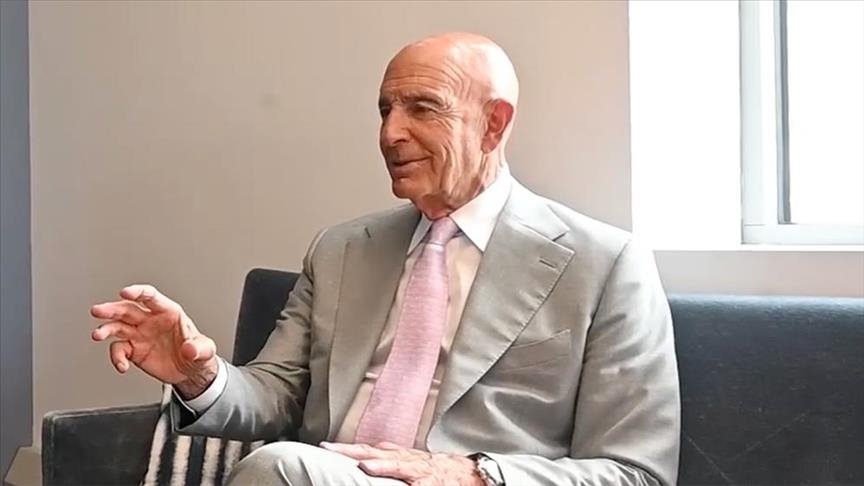
'One country, one nation, one military is dictated by that nation, which we're now recognizing,' Barrack says about Syria
'I think issues that will arise is they're going to have disagreement with the Syrian government, they're going to have disagreement with the Türkiye government,' Barrack says about issues that may arise if PKK/YPG-led SDF does not act quickly on integration process into Syria's state institutions
US envoy says Washington will usher PKK/YPG-led SDF “to the point of vetting all of their issues, and we'll do the best job we can, making sure that there's a fair and accurate decision.”
'Intent is not to keep it (US military presence in Syria) forever,' says Barrack
NEW YORK/ISTANBUL
US Ambassador to Türkiye and Special Envoy for Syria, Tom Barrack, said that if the terrorist organization PKK/YPG in Syria does not act quickly on integration, it will face problems with the Turkish and Syrian governments.
"The US will do its best to ensure a fair and proper decision is made. If they want to come to America and live with us, they can do so." Barrack told Anadolu following his press conference in New York on Friday.
He explained the origins of the groups by saying, “The YPG emerged from various offshoots of the PKK, and the SDF emerged from various offshoots of the YPG.” When reminded of his previous statement that “the SDF is the YPG and the YPG is a derivative of the PKK,” he emphasized, “I have never said that the SDF is a derivative of the PKK.”
"It's not unthinkable that whoever the constituency is for the YPG or the SDF has distanced themselves from the PKK. So, I don't think it's a derivative. It's another organization," Barrack told Anadolu.
When reminded that the terrorist organization PKK/YPG, which uses the name SDF in Syria, has sent messages about the need to use time effectively in the integration process, and asked what problems might arise if they do not, Barrack responded:
“The problems that will arise are disagreements with the Syrian government and the Türkiye government. The US government has stated that it will review all their issues and do its best to ensure a fair and accurate decision. If they want to come to America and live with us, they can do so.”
On March 10, the Syrian presidency announced the signing of an agreement for the integration of the SDF into state institutions, reaffirming the country's territorial unity and rejecting any attempts at division.
Bashar Al-Assad, Syria’s leader for nearly 25 years, fled to Russia on Dec. 8, ending the Baath Party’s regime, which had been in power since 1963.
Ahmed al-Sharaa, who led anti-regime forces to oust Assad, was declared president for a transitional period on Jan. 29.
In its 40-year terror campaign against Türkiye, the PKK -- listed as a terror organization by Türkiye, the US and the EU -- has been responsible for the deaths of more than 40,000 victims, including women, children and infants. The YPG/PYD, which also uses the name SDF, is the PKK’s Syrian offshoot.
PKK terrorists often hide out in northern Iraq to plot cross-border attacks in Türkiye, while the YPG/PYD has tried to establish a terror corridor in northern Syria along Türkiye’s borders.
'One country, one nation, one military is dictated by that nation, which we're now recognizing'
Regarding the reasons why talks between the SDF and the Syrian government have not yielded results, Barrack said the actual issue is whether it will align with the Syrian Arab Republic.
"One country, one nation, one military is dictated by that nation, which we're now recognizing. So that's the issue. Forget about whatever the genetics are from where it came. All of these minority groups might lust for a federalistic environment.
"That's not what's being dictated to them to be invited into. That's not up to us. It's not up to us to referee the intellectual discussion. Is that the right thing? Is that the wrong? Do you want a parliamentary system? Do you want a republic? Do you want a confessional system? How do you blend and protect minority rights?
"All of us, the UN in particular, are cheering and saying this is really important if you want our help. These are the requirements that we want to see," said Barrack.
"We want to see what you're going to do with foreign fighters. Are you integrating them? Are you not integrating them? Are you sending them home or not?"
'Intent is not to keep it (US military presence) forever'
Regarding the US military presence in Syria, Barrack highlighted that the fight against ISIS continues, stating: "The intent is not to keep it forever.
"That as we combat ISIS and counterterrorism, over time we'll decide on reducing those troops, just as all the troops should be reduced if you have a new Syrian government which is going to be independent."
Highlighting the risks regarding the integration process in Syria, Barrack said: "I think it's this transition period where seven months in there's not alignment and there's fear that the vagaries of the past will continue in the future.
"That's what's happening is will there be fairness on the part of the Syrian government?"
He, however, added that Washington is there to "usher" it, not to "enforce" it.
Agreement between Syrian government, SDF not specific enough 'to have made it work'
When asked whether the forces in El Tanf will be integrated into the Syrian army as the Pentagon has requested a budget for the armed groups in the El Tanf region, Barrack said Washington does not intend to establish a permanent presence anywhere in Syria, and US bases have "defensive" purposes.
Noting that Syria needs an extensive military presence "both on the outside and on the inside," the US envoy stated: "So the logical thing to do is incorporate SDF, who are the best of a fighting class."
Barrack said the integration between the SDF and the Syrian government will take time "because there's no trust" between the parties. "There's not enough specifics in the agreement to have made it work."
He noted that the US is trying to "punctuate those specifications so they can come together."
Barrack also said he believes that the parties are going to "come together and that would be a beautiful marriage."
'It's not unthinkable that whoever the constituency is for YPG or SDF has distanced themselves from PKK. So, I don't think it's a derivative. It's another organization,' Tom Barrack tells Anadolu
Serife Cetin and Serdar Dincel
|12.07.2025
'One country, one nation, one military is dictated by that nation, which we're now recognizing,' Barrack says about Syria
'I think issues that will arise is they're going to have disagreement with the Syrian government, they're going to have disagreement with the Türkiye government,' Barrack says about issues that may arise if PKK/YPG-led SDF does not act quickly on integration process into Syria's state institutions
US envoy says Washington will usher PKK/YPG-led SDF “to the point of vetting all of their issues, and we'll do the best job we can, making sure that there's a fair and accurate decision.”
'Intent is not to keep it (US military presence in Syria) forever,' says Barrack
NEW YORK/ISTANBUL
US Ambassador to Türkiye and Special Envoy for Syria, Tom Barrack, said that if the terrorist organization PKK/YPG in Syria does not act quickly on integration, it will face problems with the Turkish and Syrian governments.
"The US will do its best to ensure a fair and proper decision is made. If they want to come to America and live with us, they can do so." Barrack told Anadolu following his press conference in New York on Friday.
He explained the origins of the groups by saying, “The YPG emerged from various offshoots of the PKK, and the SDF emerged from various offshoots of the YPG.” When reminded of his previous statement that “the SDF is the YPG and the YPG is a derivative of the PKK,” he emphasized, “I have never said that the SDF is a derivative of the PKK.”
"It's not unthinkable that whoever the constituency is for the YPG or the SDF has distanced themselves from the PKK. So, I don't think it's a derivative. It's another organization," Barrack told Anadolu.
When reminded that the terrorist organization PKK/YPG, which uses the name SDF in Syria, has sent messages about the need to use time effectively in the integration process, and asked what problems might arise if they do not, Barrack responded:
“The problems that will arise are disagreements with the Syrian government and the Türkiye government. The US government has stated that it will review all their issues and do its best to ensure a fair and accurate decision. If they want to come to America and live with us, they can do so.”
On March 10, the Syrian presidency announced the signing of an agreement for the integration of the SDF into state institutions, reaffirming the country's territorial unity and rejecting any attempts at division.
Bashar Al-Assad, Syria’s leader for nearly 25 years, fled to Russia on Dec. 8, ending the Baath Party’s regime, which had been in power since 1963.
Ahmed al-Sharaa, who led anti-regime forces to oust Assad, was declared president for a transitional period on Jan. 29.
In its 40-year terror campaign against Türkiye, the PKK -- listed as a terror organization by Türkiye, the US and the EU -- has been responsible for the deaths of more than 40,000 victims, including women, children and infants. The YPG/PYD, which also uses the name SDF, is the PKK’s Syrian offshoot.
PKK terrorists often hide out in northern Iraq to plot cross-border attacks in Türkiye, while the YPG/PYD has tried to establish a terror corridor in northern Syria along Türkiye’s borders.
'One country, one nation, one military is dictated by that nation, which we're now recognizing'
Regarding the reasons why talks between the SDF and the Syrian government have not yielded results, Barrack said the actual issue is whether it will align with the Syrian Arab Republic.
"One country, one nation, one military is dictated by that nation, which we're now recognizing. So that's the issue. Forget about whatever the genetics are from where it came. All of these minority groups might lust for a federalistic environment.
"That's not what's being dictated to them to be invited into. That's not up to us. It's not up to us to referee the intellectual discussion. Is that the right thing? Is that the wrong? Do you want a parliamentary system? Do you want a republic? Do you want a confessional system? How do you blend and protect minority rights?
"All of us, the UN in particular, are cheering and saying this is really important if you want our help. These are the requirements that we want to see," said Barrack.
"We want to see what you're going to do with foreign fighters. Are you integrating them? Are you not integrating them? Are you sending them home or not?"
'Intent is not to keep it (US military presence) forever'
Regarding the US military presence in Syria, Barrack highlighted that the fight against ISIS continues, stating: "The intent is not to keep it forever.
"That as we combat ISIS and counterterrorism, over time we'll decide on reducing those troops, just as all the troops should be reduced if you have a new Syrian government which is going to be independent."
Highlighting the risks regarding the integration process in Syria, Barrack said: "I think it's this transition period where seven months in there's not alignment and there's fear that the vagaries of the past will continue in the future.
"That's what's happening is will there be fairness on the part of the Syrian government?"
He, however, added that Washington is there to "usher" it, not to "enforce" it.
Agreement between Syrian government, SDF not specific enough 'to have made it work'
When asked whether the forces in El Tanf will be integrated into the Syrian army as the Pentagon has requested a budget for the armed groups in the El Tanf region, Barrack said Washington does not intend to establish a permanent presence anywhere in Syria, and US bases have "defensive" purposes.
Noting that Syria needs an extensive military presence "both on the outside and on the inside," the US envoy stated: "So the logical thing to do is incorporate SDF, who are the best of a fighting class."
Barrack said the integration between the SDF and the Syrian government will take time "because there's no trust" between the parties. "There's not enough specifics in the agreement to have made it work."
He noted that the US is trying to "punctuate those specifications so they can come together."
Barrack also said he believes that the parties are going to "come together and that would be a beautiful marriage."
US envoy rules out independent SDF state, affirms YPG-PKK ties
ANKARA

U.S. Ambassador to Türkiye and Special Envoy for Syria Tom Barrack has stated that Washington owes no obligation to help establish an independent state for the Syrian Democratic Forces (SDF), while openly acknowledging the group's ties to the YPG, the Syrian branch of the PKK terrorist organization.
Haberin Devamı
In an interview with CNN Türk, Barrack addressed questions on topics ranging from PKK disarmament to broader U.S.-Türkiye relations.
“SDF is YPG. YPG is a derivative of PKK,” Barrack said in response to a question during a press briefing at the Foreign Press Center in New York. “YPG was a spin-off of PKK that we allied with to fight ISIS,” he said, using the alternative name for the ISIL.
“So there’s a big sentiment that, because they were our partners, we owe them. The question is, what do we owe them? We don’t owe them the ability to have their own independent government within a government,” he said.
He said the Syrian government rejects federalism and ruled out the attempts to divide the country along ethnic or sectarian lines as unworkable, adding: “You can’t have a separate Druze force dressed like Druze, separate Alawite force dressed like Alawites, separate Kurd force dressed like Kurds, and on and on. There’s going to be one entity.”
He noted a failed March agreement: "There was an agreement in March. They reached a principled understanding, but it didn't work. Why? Because everyone rushed to an accord without clarifying details. Details matter. Now it's time to clarify details, bring everyone together.
The SDF thinks the U.S. owes them. The U.S. says, 'We owe you reasonableness, but if you're not reasonable, other alternatives come into play.'"
Barrack noted that the U.S. is encouraging dialogue but made clear that it will not remain in Syria “forever.”
“We’ll bring you together, we’ll arbitrate, we’ll mediate, we’ll help, but we’re not going to stick around,” he said, adding: “If you guys don’t agree, don’t agree, but we’re not going to be here forever as the babysitter.”
The Turkish government has repeatedly stressed over the years that the so-called SDF is led by the YPG, the Syrian branch of the PKK, which is designated a terrorist organization by both the U.S. and Türkiye.
Successive U.S. administrations, however—including President Trump’s first term, as well as those of Presidents Obama and Biden—have regarded the SDF as their primary partner in the fight against ISIL in Syria.
Ankara has criticized U.S. support for the YPG under the SDF umbrella, arguing it threatens regional stability and Türkiye's security.
Türkiye's mediation role
Shifting to defense matters, Barrack hailed Türkiye's advancements.
"Türkiye's UAVs are probably the world's best. TB2s are being used in the Ukraine war."
He highlighted Türkiye's key role in Ukraine-Russia and Middle East affairs, crediting strong ties with all actors, including the U.S..
Barrack praised President Recep Tayyip Erdoğan, MİT chief İbrahim Kalın, and Foreign Minister Hakan Fidan for their pivotal contributions.
Barrack underscored Türkiye's constructive efforts in regional crises: "Türkiye played a major role in the Ukraine-Russia grain deal and Gaza ceasefire attempts. Diplomacy in the region couldn't proceed without Türkiye and Qatar. Türkiye became one of our strongest mediators on Gaza."
In closing, he affirmed the Trump administration's emphasis on redefining ties with Türkiye:
"Türkiye has NATO's second-largest army and is central. It has made significant progress in defense industry. If issues like S-400s are resolved, the F-35 process can return. President Trump showed flexibility on this. We believe our forward-looking cooperation with Türkiye will increase."
ANKARA
U.S. Ambassador to Türkiye and Special Envoy for Syria Tom Barrack has stated that Washington owes no obligation to help establish an independent state for the Syrian Democratic Forces (SDF), while openly acknowledging the group's ties to the YPG, the Syrian branch of the PKK terrorist organization.
Haberin Devamı
In an interview with CNN Türk, Barrack addressed questions on topics ranging from PKK disarmament to broader U.S.-Türkiye relations.
“SDF is YPG. YPG is a derivative of PKK,” Barrack said in response to a question during a press briefing at the Foreign Press Center in New York. “YPG was a spin-off of PKK that we allied with to fight ISIS,” he said, using the alternative name for the ISIL.
“So there’s a big sentiment that, because they were our partners, we owe them. The question is, what do we owe them? We don’t owe them the ability to have their own independent government within a government,” he said.
He said the Syrian government rejects federalism and ruled out the attempts to divide the country along ethnic or sectarian lines as unworkable, adding: “You can’t have a separate Druze force dressed like Druze, separate Alawite force dressed like Alawites, separate Kurd force dressed like Kurds, and on and on. There’s going to be one entity.”
He noted a failed March agreement: "There was an agreement in March. They reached a principled understanding, but it didn't work. Why? Because everyone rushed to an accord without clarifying details. Details matter. Now it's time to clarify details, bring everyone together.
The SDF thinks the U.S. owes them. The U.S. says, 'We owe you reasonableness, but if you're not reasonable, other alternatives come into play.'"
Barrack noted that the U.S. is encouraging dialogue but made clear that it will not remain in Syria “forever.”
“We’ll bring you together, we’ll arbitrate, we’ll mediate, we’ll help, but we’re not going to stick around,” he said, adding: “If you guys don’t agree, don’t agree, but we’re not going to be here forever as the babysitter.”
The Turkish government has repeatedly stressed over the years that the so-called SDF is led by the YPG, the Syrian branch of the PKK, which is designated a terrorist organization by both the U.S. and Türkiye.
Successive U.S. administrations, however—including President Trump’s first term, as well as those of Presidents Obama and Biden—have regarded the SDF as their primary partner in the fight against ISIL in Syria.
Ankara has criticized U.S. support for the YPG under the SDF umbrella, arguing it threatens regional stability and Türkiye's security.
Türkiye's mediation role
Shifting to defense matters, Barrack hailed Türkiye's advancements.
"Türkiye's UAVs are probably the world's best. TB2s are being used in the Ukraine war."
He highlighted Türkiye's key role in Ukraine-Russia and Middle East affairs, crediting strong ties with all actors, including the U.S..
Barrack praised President Recep Tayyip Erdoğan, MİT chief İbrahim Kalın, and Foreign Minister Hakan Fidan for their pivotal contributions.
Barrack underscored Türkiye's constructive efforts in regional crises: "Türkiye played a major role in the Ukraine-Russia grain deal and Gaza ceasefire attempts. Diplomacy in the region couldn't proceed without Türkiye and Qatar. Türkiye became one of our strongest mediators on Gaza."
In closing, he affirmed the Trump administration's emphasis on redefining ties with Türkiye:
"Türkiye has NATO's second-largest army and is central. It has made significant progress in defense industry. If issues like S-400s are resolved, the F-35 process can return. President Trump showed flexibility on this. We believe our forward-looking cooperation with Türkiye will increase."
UN welcomes PKK terrorist group disarmament process
11/07/2025, Friday
TRT/AA
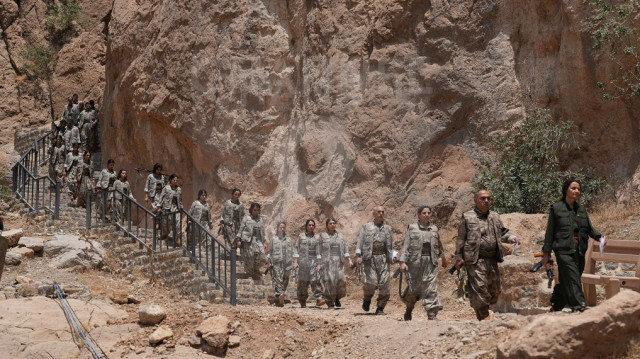
File photo
'We hope that it will encourage further steps towards lasting peace in region,' says spokesperson
The UN on Friday welcomed the start of the PKK terror group's disarmament process.
"I can tell you that we very much welcome the operationalization of the agreement, at least the first step of the operationalization," UN spokesperson Stephane Dujarric said at a news conference.
His remarks came after a group of 30 PKK terrorists, including 15 women, on Friday laid down their weapons and destroyed them in northern Iraq's Sulaymaniyah province.
The group of PKK terrorists gathered in a cave within the boundaries of the Surdas sub-district of Sulaymaniyah, emerged with their weapons, and then proceeded to a site prepared for the disarmament process.
"We hope that it will encourage further steps towards lasting peace in the region," Dujarric said, adding the UN's readiness to "support this in any way that we can, should we be asked."
In May, the terror group PKK decided to dissolve and lay down its arms. The announcement followed a February statement by jailed PKK ringleader Abdullah Ocalan, who called for the dissolution of the PKK and its affiliated groups, urging an end to the armed campaign that has lasted for more than four decades.
In its 40-year terror campaign against Türkiye, the PKK – listed as a terrorist organization by Türkiye, the US, and EU – has been responsible for the deaths of over 40,000 people, including women, children, infants, and the elderly.
PKK terrorists have used northern Iraq, near the Turkish border, to hide out and plan attacks on Türkiye.
TRT/AA
File photo
'We hope that it will encourage further steps towards lasting peace in region,' says spokesperson
The UN on Friday welcomed the start of the PKK terror group's disarmament process.
"I can tell you that we very much welcome the operationalization of the agreement, at least the first step of the operationalization," UN spokesperson Stephane Dujarric said at a news conference.
His remarks came after a group of 30 PKK terrorists, including 15 women, on Friday laid down their weapons and destroyed them in northern Iraq's Sulaymaniyah province.
The group of PKK terrorists gathered in a cave within the boundaries of the Surdas sub-district of Sulaymaniyah, emerged with their weapons, and then proceeded to a site prepared for the disarmament process.
"We hope that it will encourage further steps towards lasting peace in the region," Dujarric said, adding the UN's readiness to "support this in any way that we can, should we be asked."
In May, the terror group PKK decided to dissolve and lay down its arms. The announcement followed a February statement by jailed PKK ringleader Abdullah Ocalan, who called for the dissolution of the PKK and its affiliated groups, urging an end to the armed campaign that has lasted for more than four decades.
In its 40-year terror campaign against Türkiye, the PKK – listed as a terrorist organization by Türkiye, the US, and EU – has been responsible for the deaths of over 40,000 people, including women, children, infants, and the elderly.
PKK terrorists have used northern Iraq, near the Turkish border, to hide out and plan attacks on Türkiye.

No comments:
Post a Comment