Serbian President Pardons Party Activists On Trial For Attacking Student Protesters
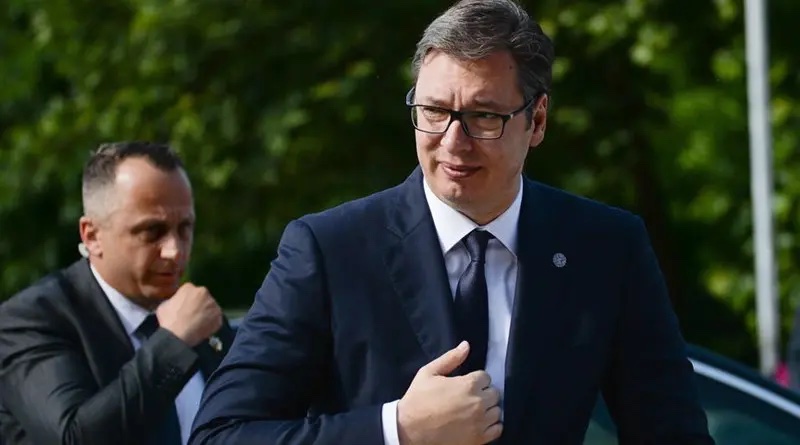
President of Serbia Aleksandar Vucic. Photo Credit: Tasnim News Agency
By Katarina Baletic and Milica Stojanovic
President Aleksandar Vucic on Thursday pardoned four ruling Serbian Progressive Party supporters who were being prosecuted for attacking student anti-government protesters in the city of Novi Sad in January.
The Ministry of Justice delivered the decision to the Basic Court in Novi Sad, exempting the four – one aged 30 and three aged 22 – from criminal prosecution for the offences of causing serious bodily harm and violent behaviour.
This decision to grant the presidential pardon came amid growing tensions in Serbia, marked by daily road blockades and mass arrests of protesting students and other protesters.
The attack happened on January 27, when a female student from Novi Sad ended up in hospital after group of people emerging from the local office of the ruling Serbian Progressive Party assaulted her and her colleagues.
Some of the students were attacked while drawing stencils on a bin in front of the party’s premises, calling for support for protests scheduled to happen in Novi Sad.
The attack in Novi Sad happened only hours after President Vucic held a press conference calling for “dialogue” and announcing a cabinet reshuffle in an attempt to calm the political crisis in the country.
Progressive Party president Milos Vucevic resigned as Prime Minister after the attack, which he sought to downplay, saying that “someone was scribbling on the party premises” and that people inside the office “felt that they should defend it”.
Recently, Vucic has called the defendants “heroes”, claiming that they were “in custody for nothing”. Soon after, the Higher Court in Novi Sad released three of them from custody and transfered the fourth to house arrest.
The house arrest measure was lifted on Thursday after they were pardoned.

Balkan Insight
The Balkan Insight (formerly the Balkin Investigative Reporting Network, BIRN) is a close group of editors and trainers that enables journalists in the region to produce in-depth analytical and investigative journalism on complex political, economic and social themes. BIRN emerged from the Balkan programme of the Institute for War & Peace Reporting, IWPR, in 2005. The original IWPR Balkans team was mandated to localise that programme and make it sustainable, in light of changing realities in the region and the maturity of the IWPR intervention. Since then, its work in publishing, media training and public debate activities has become synonymous with quality, reliability and impartiality. A fully-independent and local network, it is now developing as an efficient and self-sustainable regional institution to enhance the capacity for journalism that pushes for public debate on European-oriented political and economic reform.
Wednesday 2 July 2025, by Tara Mirković
Since Sunday night, a veritable game of cat and mouse has been played out on the streets of Belgrade between citizens and the police. The principle is simple and highly effective: erect improvised barricades, block a street or intersection, wait for the police to arrive, then disperse peacefully before starting again further on. In this ballet of non-violent resistance, each withdrawal is a new opening. While the police dismantle the roadblocks, sometimes violently, others form elsewhere. And this elusive movement is spreading throughout the country.
Despite the uncertainties surrounding the continuation of the protest movement that has been shaking Serbia for seven months now, after the huge demonstration in Vidovdan on Saturday, which brought together almost 140,000 people in the streets of Belgrade, the students have once again pulled off a brilliant coup. On Saturday evening, they gave their ‘green light’ to nationwide civil disobedience. And the public were quick to respond.
At the call of the students, hundreds of people gathered on Sunday evening in front of the Belgrade Palace of Justice to demand the release of the students arrested during the violent clashes of the previous day. Thousands more quickly converged on key points in the capital: the Gazela bridge, the Branko bridge, Zeleni Venac, the Autokomanda motorway interchange, etc.
That same evening, the protests spread well beyond the capital. Roads, bridges and junctions were blocked in Novi Sad, Užice, Čačak, Kragujevac, Zrenjanin and many other towns. Elsewhere, major communication routes were cut off. The Belgrade-Bar railway line was blocked at Lazarevac on Monday evening. Around a hundred residents of Raška blocked the Ibar motorway towards Kosovska Mitrovica and Novi Pazar, where citizens also blocked the main road to Montenegro. The CRTA organisation has counted nearly 100 blockades throughout Serbia in the last 24 hours.
A green light is neither a call to violence nor a signal for war or revenge. It marks a starting point - not a physical one, but a social, political and moral one.
The demonstrators keep reminding us that these are ‘non-violent actions’. While some university plenums seemed divided on the radicalization of the movement in the run-up to 28 June, the students clarified their position in a statement on the scope of the ‘green light’. "A green light is neither a call for violence nor a signal of war or revenge. It marks a starting point - not a physical one, but a social, political and moral one. It means that passivity is no longer tolerable. Despite fear and repression, we must act. This green light is also a demarcation: the red lights, the violence, are on the side of those who seek to suppress dialogue and resistance. Green is on the side of life, change and the future. This green light that we have lit is not an order, but an invitation. An invitation to refuse injustice as if it didn’t exist.
This ‘green light’ embodies a clear line: that of civil resistance, non-violent, joyful and determined. And everywhere in Belgrade, a wind of freedom and hope blew over the city. In the streets of the capital, residents improvised barricades with skips, tyres and sacks of bricks, in what they called ‘controlled, decentralized chaos’. In the middle of the day, despite the sweltering 35-degree heat, the atmosphere remained cheerful and family-friendly.
‘Who wants ice creams?’ shouted a man in the middle of the crowd, several cones in hand, as passers-by crossed the same pedestrian crossing in a loop. Crossing the street for several hours in a group, with children or pets, is well on the way to becoming a summer trend in Belgrade. The humour is there, but so is the mistrust: perhaps this is the ‘Serbianinat’ in practice. On Monday evening, from Vukov spomenik to Slavija, students played volleyball in the middle of the Boulevard, which was closed to traffic, while passers-by walked their dogs between the rubbish bins to the sound of whistles.
Police without badges
The police seem to be waiting until nightfall for their heavy-handed interventions. At around 3am on Monday morning, special units proceeded to dismantle the barricades, in many cases using force against peaceful demonstrators. Videos widely circulated on social networks showed vehicles speeding down an avenue in the city centre towards groups of demonstrators. Immediately afterwards, special units arrived in cars and violently arrested several students.
The appearance of hooded and unidentified officers also provoked a wave of indignation, even though the law requires all uniformed officers to wear a visible badge showing their identification number, rank and name. These ‘policemen’, some of whom were trying to hide tattoos and hastily-fitted equipment, betrayed a cobbled-together appearance and are more reminiscent of ‘Ćaciland’ guards. The police have so far justified the lack of identification by the fact that they were wearing protective equipment as part of the dispersal operations. However, on the morning of Monday 30 June, the officers were not wearing helmets or riot gear, but ordinary uniforms, without the slightest insignia. This raises a crucial question: do the gendarmerie, the special units and the police still have the capacity to deal with mass blockades simultaneously in several towns?
For its part, the Belgrade Human Rights Centre announced that it had lodged several complaints over the last two days against police officers who had acted illegally and used excessive force.
The mice are ahead of the cat
The students of the Faculty of Dramatic Arts have called a general strike from Tuesday 1 July, assuring that the trade unions in solidarity with the people will join their movement. The demands are clear: the immediate release of detainees, the dismantling of ‘Ćaciland’, and above all the calling of early elections. A giant banner carried by students at the demonstration in Vidovdan read ‘Tick tock, tick tock’. Even if victory is not yet assured, the last few days have shown that, after seven months, the protest movement is now mature, horizontal and organized, and above all that citizens and students are moving forward together, driven by common objectives, shared values and deep-rooted solidarity.
Faced with this mobilization, the authorities seem to have run out of answers. Sunday evening’s events probably marked a point of no return, and it would seem that the mice have already beaten the cat.
1 July 2025
Translated by International Viewpoint from Courrier des Balkans.
Attached documentsserbia-controlled-decentralized-chaos-across-the-country_a9071.pdf (PDF - 900.1 KiB)
Extraction PDF [->article9071]
Serbia
Student protest in Serbia: “either we stop or there will be a civil war”
Serbian students cycle to Strasbourg, Macron prefers to receive the autocrat Vučić
Chronology of the struggle in Serbia
Student protests in Serbia: "The movement cannot afford to stop now"
Serbia’s Mass Protests Against a Crony-Capitalist Government
Youth and student movements
The Kenyan Uprising
Protesters in Bangladesh Want an End to State Repression
On the raging student movement in Bangladesh
Palestine Solidarity Student Movement in the USA: An Overview
Amidst Violent Attacks, Pro-Palestine Protests Go On, Disrupting Graduation Ceremonies
Tara Mirkovićis the Belgrade correspondent of Courrier des Balkans.
International Viewpoint is published under the responsibility of the Bureau of the Fourth International. Signed articles do not necessarily reflect editorial policy. Articles can be reprinted with acknowledgement, and a live link if possible.

No comments:
Post a Comment