A killing in US
Charlie Kirk was a poster boy for Christian nationalism.
Rafia Zakaria Published September 13, 2025 DAWN
The writer is a Pakistan attorney teaching constitutional law and political philosophy
ON a sunny Wednesday afternoon at a Utah college campus, the 31-year-old founder of the far-right Turning Point USA was addressing students.
Charlie Kirk was a regular on campuses across the US, where he would try to drum up support for right-wing Christian nationalist causes, debating with students, especially those who disagreed with his far-right take on issues such as race, abortion, religion and guns.
Kirk was responding to a question by a student about gun violence when a gunshot was heard and a bullet hit him in the neck. Blood gushed out and Kirk slumped to the ground. The terrified crowd began to run; no one knew where the bullet had been fired from and how many shots would follow. Kirk was rushed to hospital where he died. Kirk leaves behind a wife and two children.
For anyone interested in the political transformations taking place in the US, understanding who Kirk was and why he was influential is important as it would, among other things, provide insight into the White House’s worldview today and how drastically different it is from the one espoused by preceding administrations.
Turning Point USA brought in hundreds of millions of dollars in funding to mobilise right-wing students on college campuses. On the day that Kirk died, this organisation had more than 850 chapters in campuses around the country. President Donald Trump credited Kirk with delivering the young vote that led to his victory in 2024. Following Trump’s win, Kirk became a regular visitor to the White House, as he had been during the American president’s first term. In fact, Kirk had championed J.D. Vance as the person Trump should pick for vice-president.
Trump announced Kirk’s death in an Oval Office address. He also ordered US flags to be flown at half-mast and decided to award Kirk the Presidential Medal of Freedom posthumously. After Kirk’s assassination, right-wing leaders from Steve Bannon to former FOX host Megyn Kelly to Republican Congressional leaders all took to social media to decry the killing.
MAGA supporters expressed rage against left-wing liberals even though the gunman remained at large. A suspect has been detained though little is known about his possible motives.
Republicans are also angry because Kirk was a poster boy for the Christian nationalist leader they think could have donned the Trump mantle after the president exited. Commentators pointed out that Kirk, a defender of evangelical Christianity, would have one day been a candidate for president. His organisation has been described by some as the most important tool in mobilising the next generation of MAGA and thus the most crucial far-right organisation in the US.
Kirk was a poster boy for Christian nationalism.
There is also an international angle in the chatter around Charlie Kirk’s assassination, which reveals the often paradoxical nature of MAGA and its supporters.
Within minutes of Kirk’s shooting, footage of the gruesome killing was all over X as were rumours about the assassin. While many, including Trump, immediately began to blame the ‘radical left’, others saw more nefarious possibilities. One of these was Israeli involvement in the killing. In a conversation with media host Megyn Kelly, Kirk said that though he defended Israel he did not like the talk about how he was against the US being completely uncritical of Israel’s actions.
Commentators have speculated that the funders of Kirk’s organisation, many of whom are Jewish, were uncomfortable with Kirk holding such a position.
In addition to his chat with Kelly, Kirk also hinted in an interview that he was suspicious of Israel’s own role in the Oct 7, 2023, asserting that he had been to Israel several times and the country was a “fortress” and it was possible to get from Jerusalem to the Gaza border in 45 minutes by helicopter. Given this, Kirk held, it was bizarre how the attack was allowed to go on for six hours.
There is a section of the far-right MAGA that is nationalist enough to be irate at what they see as an Israeli hold over US politics. Kirk was caught between that position and keeping his pro-Israel funders who were integral to his organisation’s success. At least initially, the nature of the shooting was interpreted as an act of a professional rather than a bumbling lone extremist.
Kirk’s death has stunned many in the US, which is rather surprising because political and gun violence is now a frequent occurrence in the country. In fact, some feel that the extreme political polarisation in America is the harbinger of a civil war.
This is just speculation but it is important to remember that the American far right creates, believes and circulates rumours far more fervently than the truth.
rafia.zakaria@gmail.com
Published in Dawn, September 13th, 2025
Rafia Zakaria Published
The writer is a Pakistan attorney teaching constitutional law and political philosophy
ON a sunny Wednesday afternoon at a Utah college campus, the 31-year-old founder of the far-right Turning Point USA was addressing students.
Charlie Kirk was a regular on campuses across the US, where he would try to drum up support for right-wing Christian nationalist causes, debating with students, especially those who disagreed with his far-right take on issues such as race, abortion, religion and guns.
Kirk was responding to a question by a student about gun violence when a gunshot was heard and a bullet hit him in the neck. Blood gushed out and Kirk slumped to the ground. The terrified crowd began to run; no one knew where the bullet had been fired from and how many shots would follow. Kirk was rushed to hospital where he died. Kirk leaves behind a wife and two children.
For anyone interested in the political transformations taking place in the US, understanding who Kirk was and why he was influential is important as it would, among other things, provide insight into the White House’s worldview today and how drastically different it is from the one espoused by preceding administrations.
Turning Point USA brought in hundreds of millions of dollars in funding to mobilise right-wing students on college campuses. On the day that Kirk died, this organisation had more than 850 chapters in campuses around the country. President Donald Trump credited Kirk with delivering the young vote that led to his victory in 2024. Following Trump’s win, Kirk became a regular visitor to the White House, as he had been during the American president’s first term. In fact, Kirk had championed J.D. Vance as the person Trump should pick for vice-president.
Trump announced Kirk’s death in an Oval Office address. He also ordered US flags to be flown at half-mast and decided to award Kirk the Presidential Medal of Freedom posthumously. After Kirk’s assassination, right-wing leaders from Steve Bannon to former FOX host Megyn Kelly to Republican Congressional leaders all took to social media to decry the killing.
MAGA supporters expressed rage against left-wing liberals even though the gunman remained at large. A suspect has been detained though little is known about his possible motives.
Republicans are also angry because Kirk was a poster boy for the Christian nationalist leader they think could have donned the Trump mantle after the president exited. Commentators pointed out that Kirk, a defender of evangelical Christianity, would have one day been a candidate for president. His organisation has been described by some as the most important tool in mobilising the next generation of MAGA and thus the most crucial far-right organisation in the US.
Kirk was a poster boy for Christian nationalism.
There is also an international angle in the chatter around Charlie Kirk’s assassination, which reveals the often paradoxical nature of MAGA and its supporters.
Within minutes of Kirk’s shooting, footage of the gruesome killing was all over X as were rumours about the assassin. While many, including Trump, immediately began to blame the ‘radical left’, others saw more nefarious possibilities. One of these was Israeli involvement in the killing. In a conversation with media host Megyn Kelly, Kirk said that though he defended Israel he did not like the talk about how he was against the US being completely uncritical of Israel’s actions.
Commentators have speculated that the funders of Kirk’s organisation, many of whom are Jewish, were uncomfortable with Kirk holding such a position.
In addition to his chat with Kelly, Kirk also hinted in an interview that he was suspicious of Israel’s own role in the Oct 7, 2023, asserting that he had been to Israel several times and the country was a “fortress” and it was possible to get from Jerusalem to the Gaza border in 45 minutes by helicopter. Given this, Kirk held, it was bizarre how the attack was allowed to go on for six hours.
There is a section of the far-right MAGA that is nationalist enough to be irate at what they see as an Israeli hold over US politics. Kirk was caught between that position and keeping his pro-Israel funders who were integral to his organisation’s success. At least initially, the nature of the shooting was interpreted as an act of a professional rather than a bumbling lone extremist.
Kirk’s death has stunned many in the US, which is rather surprising because political and gun violence is now a frequent occurrence in the country. In fact, some feel that the extreme political polarisation in America is the harbinger of a civil war.
This is just speculation but it is important to remember that the American far right creates, believes and circulates rumours far more fervently than the truth.
rafia.zakaria@gmail.com
Published in Dawn, September 13th, 2025
Charlie Kirk and the Tsunami of U.S. Political
Violence
Right-wing activist Charlie Kirk was shot to death yesterday during a speaking engagement at a university in Utah. A single shot to the neck by a sniper ended the life of the 31-year-old, whose two little children will now have to grow up without him.
President Trump considered Kirk to be the most influential public figure among young men in the country, a key constituency that helped him win the 2024 presidential election.
At the very moment of being assassinated, Kirk was discussing American gun ownership and specifically blaming trans people for “too many” mass shootings, though trans perpetrators have been responsible for only a handful of mass shootings in the last decade, while just in 2024, there were over 500 mass shootings in the United States. While it is certainly fair to say even one mass shooting is too many, it’s not fair to portray trans people as more murderously violent than other groups.
Public figures all along the ideological spectrum condemned Kirk’s murder, which is just the latest in a growing trail of political violence in the U.S., including attempts on the life of President Trump, the attempted assassination of ex-House Speaker Nancy Pelosi’s husband, an arson attack on Pennsylvania Governor Josh Shapiro’s home, and the murder of Minnesota state representative Melissa Hortman.
Ex-Congresswoman Gabby Giffords, victim of a shot to the head that put an end to her career in 2011, urged people not to let the U.S. become a country that attempts to resolve political conflict, which is inherent to democracy, through violence.
Gifford’s naive message, though well-intentioned, comes far too late in the game. For not only is the United States “the greatest purveyor of violence in the world today,” in the words of Martin Luther King Junior, but it was actually founded on the mass extermination of dozens of native peoples and the attempted erasure of their cultural imprint, an effort that is not at all ancient history. As recently as 1970, the forced sterilization of Indian women was still practiced in the United States.
After having murdered and displaced the original inhabitants of the Eastern half of what is today known as the continental U.S., the Euro-American colonists invaded and plundered Mexico, permanently seizing half of its national territory. Upon discovering gold in conquered California, they put a bounty on every murdered Indian’s head, a clear invitation to the rapid eradication of Indian peoples that followed.
After having achieved what very well may be the most thorough mass extermination in history within its violently-established borders, Washington took its mass murder campaigns to the rest of the world, killing millions of Koreans and Vietnamese to prevent any possibility of these peoples becoming self-governing, hundreds of thousands of Guatemalan Indians to hand over their land to the United Fruit Company, more than a million Iraqis and perhaps a quarter million Afghans in fulfillment of neo-con geopolitical designs, as well as hundreds of thousands of Palestinians (with additional millions exiled) to preserve Jewish supremacy in Palestine.
Add to this bitter but very partial U.S. legacy the many other countries invaded by Washington over the years, plus the wide network of bloody dictators it has maintained in power for decades, in addition to two atomic bombings of Japanese civilians in three days, and one sees that the idea that we have only recently descended into political violence is sheer absurdity.
Unless Charlie Kirk’s death turns out not to have been politically motivated, it can only realistically be seen as a microscopic part of a vastly larger problem: the national commitment to murder as an expression of righteous violence, routinely practiced by all administrations and endlessly celebrated in U.S. movies, songs, news coverage, political speeches, and school textbooks.
What we are witnessing is not an isolated act but the manifestation of a wider rot.
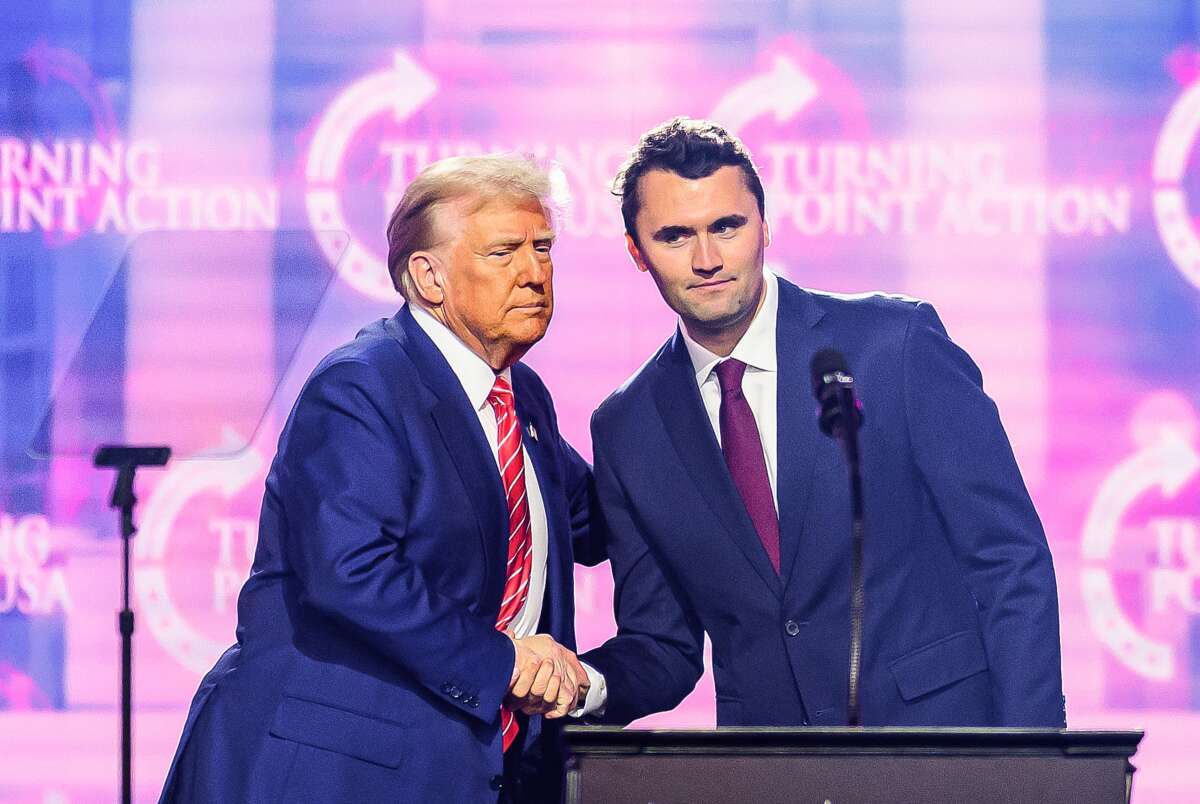
The cruel and horrendous killing of Charlie Kirk was both reprehensible and indefensible. Political assassinations, regardless of the source, are an act of violence against all Americans. Such violence is on the rise, and it is not limited to one ideology: In recent months we have seen attacks against both Republicans and Democrats coming from people with a range of political identities.
A suspect in Kirk’s killing is now in custody in Utah. In a press conference, law enforcement announced that a rifle and bullets found near the scene of the killing were inscribed — some with anti-fascist slogans, and others with what seem to be references to internet memes. While we are still learning about the motivations of the suspect, we do know that the claims made by Trump and his supporters — that political violence is primarily the work of the left, are pure fabrications.
Blaming the left for all political violence is a smear that reproduces a rhetoric of desperation. It functions less as a serious argument than as a pretext for legitimizing state repression. This is quite evident in the fact that Trump and many in the MAGA movement are weaponizing the act of this isolated individual in order to openly call for violence against the left as a whole, seizing on Kirk’s death to peddle accusations that his killing was the work of progressives, as TIME reports. This kind of scapegoating reveals the larger strategy: any event, no matter how tenuous, will be weaponized to justify crackdowns on dissent. What this exposes is not concern for truth or justice but the naked readiness of the Trump regime to unleash violence against critics. This is fascism stripped of disguise, fascism on steroids.
In his address on Kirk’s death on September 10, Trump claimed that the “radical left” was to blame, insisting that rhetoric comparing “wonderful Americans like Charlie to Nazis and the world’s worst mass murderers and criminals” was “directly responsible for the terrorism that we’re seeing in our country today.” The same narrative quickly spread across right-wing media and social platforms. Influential MAGA voices echoed Trump’s framing, stoking resentment toward the left and portraying Kirk’s killing as a call to arms. Far right activist and conspiracy theorist Laura Loomer declared, “The Left are terrorists,” warning that Kirk’s death was only the beginning of “more targeted assassination.” “You could be next,” she wrote, before demanding that “these lunatic leftists” be shut down “once and for all.”
Such rhetoric is part of a broader strategy: to weaponize Kirk’s death as proof that dissent from the left is itself a form of violence that justifies repression.
Related Story
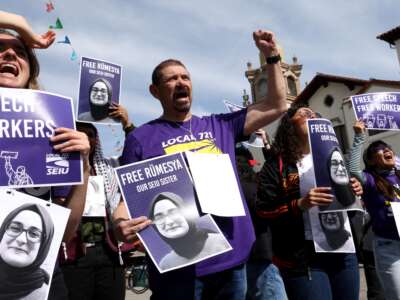
Amid State Abductions, Trump’s Fascism Is No Longer Creeping — It’s Here
Masked plainclothes police abducted a graduate student without filing charges. Her apparent “crime”? Writing an op-ed. By Henry A. Giroux , Truthout April 5, 2025
At this current moment in history, the greatest threat of violence and its normalization comes not only from far right extremists, but also from a government that uses the threat of violence as a tool of political power.
Mainstream media outlets are mostly focusing on Kirk’s death and in doing so rightly condemn his killing as a horrific act of violence. But at the same time, they are ignoring a deeper truth: violence is not an aberration in the United States; rather, it has become central to the politics of Donald Trump and his regime. Moreover, much of the coverage of Kirk reduces him to a sharp debater, a youth organizer, or a rising figure in the far right. What is largely ignored is the substance of his arguments, which helped normalize a culture of hate, white nationalism, authoritarianism, and violence itself.
Kirk’s record is clear. He called George Floyd a “scumbag,” dismissed Martin Luther King Jr. as “awful,” and labeled the Civil Rights Act of 1964 a “mistake.” He claimed the racist “Great Replacement” theory is real, insisted that immigration is a deliberate strategy to erode the white population, and derided the very idea of white privilege as a fabrication. He “compared pandemic vaccine requirements to apartheid during a 2021 interview with Tucker Carlson.” He argued that Israel was not starving Gazans,” in spite of the overwhelming evidence to the contrary. He spread a vicious falsehood about Yusef Salaam of the Central Park Five, wrongly insisting he had taken part in a gang rape, an attack that was not only defamatory but also part of a long pattern of baselessly criminalizing Black men as predators. Kirk smeared wgay people and “encouraged students and parents to report professors whom they suspected of embracing … gender ideology.” He trafficked in antisemitic stereotypes, once claiming that “Jewish dollars” were funding Marxist ideas in education as well as policy that pushed for open borders.
Perhaps most chilling was his defense of mass gun violence. Kirk declared that some gun deaths, (assuming this includes children), are simply the price “of liberty” to protect the Second Amendment. At a time when classrooms have become sites of recurring carnage, such remarks treat murdered children as collateral damage, erasing the human cost of the U.S.’s obsession with guns and elevating ideology over life itself.
These are not isolated remarks; they form a worldview that dehumanizes, divides, and elevates cruelty into a political principle. To remember Kirk only for his debating skills or his reach among young conservatives is to miss the disturbing truth: he championed ideas that normalized hate and legitimized violence as a way of governing.
This kind of scapegoating reveals the larger strategy: any event, no matter how tenuous, will be weaponized to justify crackdowns on dissent.
Kirk’s murder – tragic and senseless – cannot be separated from the broader U.S. landscape in which violence has become the grammar of politics, hatred is given more weight than compassion, and truth itself is sacrificed at the altar of power. In this climate, the needs of ordinary people and the promise of the common good are not only neglected but treated with disdain. To confront this reality is not to deny grief, but to name honestly the world we now inhabit, one in which the struggle for justice and human dignity has never been more urgent. Kirk’s death is not an aberration but a grim marker in the U.S.’s descent, where violence has become the lifeblood of politics and hatred the currency of power. This is not simply a tragedy — it is the death rattle of democracy itself, a notice that the nation is being hollowed out from within by those who thrive on cruelty and contempt.
According to Reuters’ data, the United States is now in its most sustained stretch of political violence since the 1970s: more than 300 politically motivated attacks have erupted since January 6, 2021. In just the first half of 2025, nearly 150 such incidents have been recorded — almost double the number during the same period last year, according to University of Maryland researcher Michael Jensen. This is not simply a wave but a storm.
According to one study that has been referenced by the National Institute of Justice, between 1990 and 2020, the far right was responsible for 227 ideologically motivated attacks that resulted in 523 deaths, while the far left was linked to only 42 such attacks, causing 78 deaths. These figures almost certainly underestimate the extent of far right violence, since U.S. courts have often been reluctant to classify groups on the right as extremist and because law enforcement agencies have historically directed their surveillance and investigative resources toward the left, leaving right-wing violence less scrutinized.
To make matters worse, the Trump administration removed the reference to this study from the National Institute of Justice website, in addition to removing other data that sought to make sense of the numbers behind ideological violence, an erasure that can only be understood as a politically motivated attempt to downplay the threat posed by far right violence.
Soon after the anniversary of 9/11, it is worth recalling that what followed those attacks was not a defense of democracy but an endless reign of state violence: the devastating invasions of Iraq and Afghanistan, torture programs and extraordinary renditions, secret CIA prisons, and the horror of Guantánamo. The lesson is unmistakable: the machinery of political and state violence has long been driven by those in power — not by the left.
This is the climate in which Kirk lived and spoke. To grieve his death honestly is to reckon with the country that made such violence thinkable. Warnings even in the liberal press have too often turned the assassination into a warning aimed not at Trump and his allies but at Democrats, liberals, and the left – cautioning them not to be too harsh in criticizing Kirk’s ideological position lest it fuel Trump’s threat to dismantle democracy. Even worse, some commentators have rushed to defend the abstract principle of free speech while ignoring the substance of Kirk’s far right beliefs and the culture of cruelty he helped to spread. The implicit suggestion is that if liberals and progressives provide “balance” and soften their rhetoric, the cycle of violence will somehow abate.
Such arguments miss the point. They deflect responsibility away from Trump, whose hateful rhetoric has both normalized and legitimized political violence, and place the burden instead on his critics. To imagine that silencing dissent or softening critique will stop the advance of authoritarian violence is not only naïve but dangerous. Trump does not need to weaponize Kirk’s death; he already thrives on scapegoating and making use of tragedy to deepen his culture of fear. The machinery of authoritarian power is already in motion: democracy and the rule of law have been steadily dismantled, the streets militarized, and mass detentions and deportations normalized against those marked by race, origin, or dissenting politics. At the same time, the regime tightens its grip by punishing local officials and judges who resist its illegal edicts. Cities are being militarized as tanks are now rolling through the streets of Washington, D.C., Chicago, and Los Angeles. What is unfolding is not a response to one tragic event but the consolidation of a politics of terror that has been years in the making.
Kirk’s killing is not merely the sorrowful loss of a single life; it stands as a foreboding emblem of a nation in decline. It signals that the atmosphere of U.S. democracy has grown toxic, choked by a politics of violence. What we are witnessing is not an isolated act but the symptom of a wider rot, the erosion of civic bonds, the elevation of cruelty into common sense, and the slow unravelling of a republic that once fashioned itself, however falsely, as a model of freedom. To treat this moment as nothing more than personal grief is to ignore its darker portent: it announces that the pillars of democracy are cracking, and the edifice itself is beginning to crumble.
The current collapse of democracy is neither accidental nor abstract. It has been fueled by Trump’s poisonous rhetoric, which has turned politics into a theatre of humiliation and cruelty. His demonization of opponents has moved from the fringes into the mainstream, shaping a culture where enemies are to be destroyed rather than debated. In this climate, the very air of public life grows toxic, turning grievance into license.
As Robert Pape warns, U.S. politics may be on the brink “of an extremely violent era … The more public support there is for political violence, the more common it is.” When the culture itself becomes a breeding ground for violence — supercharged by the rampant acquisition of guns and the spectacle of cruelty — every killing echoes as more than personal loss. Kirk’s death is not just another entry in the ledger of political violence; it is an omen. It tells us that a republic drunk on resentment and hatred cannot breathe freely, that the poison that a politics of domination has released into the cultural bloodstream cannot be easily contained. If this moment is ignored, if it is seen only as the misfortune of one man rather than the symptom of a larger crisis, then the canary’s warning will have come too late.
Our work is possible thanks to reader support. Help Truthout catalyze change and social justice — make a tax-deductible monthly or one-time donation today.
© Henry A. Giroux
Henry A. Giroux
Henry A. Giroux currently holds the McMaster University Chair for Scholarship in the Public Interest in the English and Cultural Studies Department and is the Paulo Freire Distinguished Scholar in Critical Pedagogy. His most recent books include: The Terror of the Unforeseen (Los Angeles Review of books, 2019), On Critical Pedagogy, 2nd edition (Bloomsbury, 2020); Race, Politics, and Pandemic Pedagogy: Education in a Time of Crisis (Bloomsbury 2021); Pedagogy of Resistance: Against Manufactured Ignorance (Bloomsbury 2022) and Insurrections: Education in the Age of Counter-Revolutionary Politics (Bloomsbury, 2023), and coauthored with Anthony DiMaggio, Fascism on Trial: Education and the Possibility of Democracy (Bloomsbury, 2025). Giroux is also a member of Truthout’s board of directors.

No comments:
Post a Comment