NEW AMERIKAN GESTAPO
Is Martial Law Coming Next?
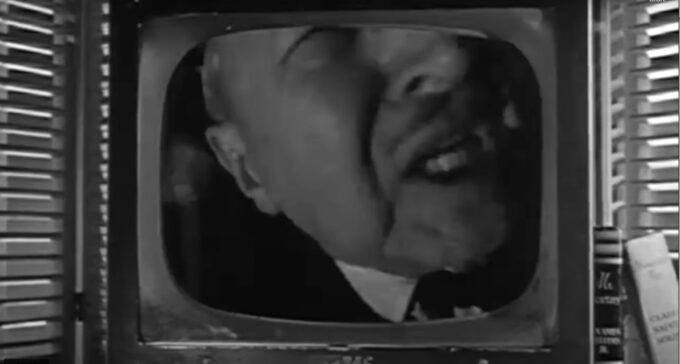
Seven Days in May, John Frankenheimer, dir., Paramount Pictures, 1964. Screenshot.
Stephen Miller is trolling me
Like most other writers for Counterpunch, I’ve written my share of columns about the current president. I’m slightly embarrassed about that fact; attention for a narcissist is like heroin for a junkie, and nobody wants to feed an addiction. But Trump is as liable to read Counterpunch as he is The New England Journal of Medicine, so on that score, my conscience is clear.
I’m less certain about his entourage. Stephen Miller, Trump’s Deputy Chief of Staff and very own Goebbels, is just perverse enough to read Counterpunch to buttress his claims that his boss’s opponents are “communist lunatics.” And that possibility, however remote, gives me pause. Since I started writing for Counterpunch in 2018, almost every awful thing I predicted Trump would do, he did. Almost every cruelty he enacted, I anticipated. Has Miller been trolling me? Have I been feeding him and Trump ideas? I therefore offer the following with trepidation.
A secret hidden in plain sight
Trump has sought to undermine every stabilizing institution of American political or civil society: Congress, the courts, federal agencies, universities, law and medicine. Were his goals not so corrupt and self-aggrandizing, we might call him a revolutionary. Instead, he is simply a greedy bastard who has for reasons unfathomable, hoodwinked a significant minority of Americans into believing he will make them rich or redress their grievances. They are discovering the con, though far too slowly for it to matter. But just in case there’s a major erosion of popular support, or congressional opposition arises, Trump has a back-up plan – so well broadcast it might be called a “front-up” plan: a presidential proclamation of national emergency and declaration of martial law.
National Guard troops and ICE agents, the latter a veritable Gestapo, are already pre-positioned in Los Angles and Washington. They may be sent soon to Chicago, New York, Boston and Baltimore, though public opposition is growing and there is a chance Trump will hold-off for now. What will be the pretext for a declaration of martial law, followed by postponement of midterm elections? What will martial law look like? Can it be stopped? Here’s a brief primer on martial law and its prospects in the U.S.A.
Definition
Martial law is mentioned nowhere in the U.S. Constitution. The nearest reference is Article I, Section 8, Clause 15: “The Congress shall have power . . . to provide for calling forth the Militia to execute the Laws of the Union, suppress Insurrection and repel Invasions.” There’s also Article IV, Section 4: “The United States shall guarantee to every State in this Union a Republican Form of Government and shall protect each of them against Invasion; and on Application of the Legislature, or of the Executive (when the Legislature cannot be convened), against domestic Violence.” In each case, the coercive power of a militia is proposed as remedy to invasion, insurrection, or violence serious enough to threaten the central government or federated states. Only in extremis, in other words, may national armies be deployed within the nation, and then usually by congress. That prohibition was later codified in the marvelously named (shades of Wyatt Erp) Posse Comitatus Act of 1878 which forbids the use of the federal military to enforce laws within the U.S.
Constitutional caution about the use of martial law is reflected in the subsequent body of Supreme Court decisions. In Ex parte Milligan (1866), the court forbade use of military courts while civilian ones were still functioning. In a concurring opinion, Chief Justice Salmon P. Chase wrote that martial law could only be asserted “in time of invasion or insurrection within the limits of the United States…when the public danger requires its exercise.” A decade later, in U.S. v Dielkelman (1876), the Court again declared: “Martial law is the law of military necessity in the actual presence of war.”
Since that time, there have been further limitations upon the power of the executive to suspend habeas corpus (the right to challenge unlawful arrest) and declare martial law, plus one significant expansion, the notorious Korematsu v. United States (1944) which allowed the internment of Japanese Americans during World War II. Though the case was wrongly decided – an injustice that will forever stain the nation — the underlying rationale of the decision was the same as with previous cited cases: Suspension of due process and imposition of martial law is only permissible when danger from war, invasion or insurrection is extreme.
If the internment of Japanese American is tragedy, the current dispatch of National Guard troops to halt a “migrant invasion” is farce. Far from representing a threat, immigrants have brought the U.S. prosperity. They take the hardest, lowest paying jobs that American citizens don’t want, pay federal and state taxes without receiving benefits in return, and stabilize population numbers at a time of very low birth-rates. Immigrants exert little if any downward pressure on wages and contribute significantly to GDP growth. Nevertheless, President Trump has declared illegal immigration a national emergency and commanded the armed forces and national guard to prevent crossings at the Mexican border and apprehend “illegals” everywhere else.
As always with Trump, motives are murky. It’s not clear if the declaration of emergency was pretextual for the expansion of ICE and increased deportations, or if it was an excuse for the nationwide deployment of non-civilian police forces and the eventual imposition of martial law. The result is the same either way: fascist authoritarianism.
“That’s some catch, that Catch-22….”
In a recent column in Counterpunch, John Feffer wrote persuasively about what he called “slow-motion authoritarianism,” the idea that some elected leaders “gradually undermine democratic institutions and accumulate more executive power”, until they become full-blown autocrats, like Putin in Russia and Urban in Hungary. That may be the situation with Trump, Feffer argues, but I want to offer a cavil: authoritarianism can also happen, to quote Hemingway on bankruptcy, “gradually and then suddenly.”
Right now, the U.S. is speeding toward martial law. The fuel is Trump’s narcissism and hunger for power, and congressional Republicans’ will to gratify both. Congress even provided enabling legislation in the form of the One Big Beautiful Bill and Recission Act. The first lowered taxes on the rich, paying for them with reductions in Medicaid and Food Stamps. The second cut 80% of funding for USAID, which mostly supports poor, hungry, and sick people abroad. The politics of both bills is transparent: further accrual of power and the crushing of potential political opposition. Hunger provokes activism and resistance; starvation prevents it.
That martial law will be proclaimed sometime in the next year seems pre-ordained. ICE agents, assisted by state National Guard troops in Los Angeles, Washington, and other Democrat-led cities and states, will round up and arrest undocumented immigrants, dark-skinned and Spanish-speaking legal residents and citizens, and anyone who tries to hinder them. (Suspects may also include anyone holding a submarine sandwich.) If protests grow large or unruly, more troops will be sent, including U.S. Army forces, in direct contravention of the Posse Comitatus Act. In that situation, a national emergency will be proclaimed by executive order, and martial law declared in affected cities, and perhaps nationwide. In other words, absent resistance, city after city will be slowly, gradually governed by military force, as Feffer described. If urban populations offer significant resistance to ICE raids and federal policing, more military forces will quickly be called in, and martial law declared. That’s the national catch-22: Don’t resist and martial law will happen slowly; resist and it will occur quickly.
There’s another circumstance in which martial law may be pronounced, and it too presents itself as a catch 22. If congressional Democrats filibuster the stopgap budget bill to fund the federal government, Trump may declare a national emergency and instruct the treasury pay the nation’s bills anyway. The exercise of spending prerogatives, outside of congressional mandate, would constitute a coup, a de facto “state of emergency,” facilitated by the imposition of martial law. If on the other hand, Democrats join Republicans in passing the budget – one containing recissions and impoundments — they will be complicit in their own disempowerment. They will have created de facto, a government ruled by executive decree. Any public protest will quickly be answered by troops and a declaration of national emergency or state of martial law. Administration officials are no doubt gaming out various scenarios to maximize the chance to postpone or cancel the 2026 midterm elections. If they do, 2028 will also be up for grabs.
And there’s one more situation in which martial law might be declared: political violence targeted against the right. The murder of conservative influencer and Trump-whisperer Charlie Kirk inspired a 4-minute verbal presidential fusillade against the “radical left.” Even in advance of the apprehension of any suspect in the killing, Trump vowed retribution against “each and every one of those who contributed to this atrocity and… the organizations that fund it and support it.” It is easy to imagine this shooting, or similar events (regardless of the predominance of far right political violence in the U.S.) triggering what may be called a “Reichstag moment.” That’s when an arson fire at the German parliament in February 1933 was used by the Chancellor, Adolf Hitler as a pretext for an attack upon the political left and a presidential decree suspending civil liberties, in effect a declaration of martial law.
Can martial law be resisted?
The short answer is yes. Despite extraordinary improvements in electronic eavesdropping, video surveillance, facial recognition software, and online tracking, a genuine mass movement to arrest the descent into fascism can succeed. There simply aren’t enough hounds to catch the vast number of foxes who will seek to challenge or undermine a nascent, fascist polity. No state, not even a police state, can govern without a population willing to do the millions of jobs required to keep it operating. No nation, not even one locked down under martial law, can coerce millions of its citizens to manufacture, trade, buy, repair, heal, teach, travel, or entertain if they don’t want to. A nation of consumers under martial law will slow their buying; a land of tourists will see travel grind to a halt. A country of investors and entrepreneurs will see profit levels plumet. In those circumstances, the government must fall.
The only prophylaxis against fascism therefore, is an engaged and motivated mass. But for that to exist, there needs to be smart leaders as well as energized followers. To call the current Democratic Party leadership sclerotic is to say the least. But there are Democrats, including 84 y.o. Bernie Sanders and 35 y.o. A.O.C., who will help the new leaders that will inevitably emerge from the hundreds of thousands of people who are currently engaged in grassroots activism in support of environmental justice, union organizing, prison reform or abolition, gender rights, animal protection, and community health. All of those endeavors have been threatened or undermined by the Trump regime. A declaration of martial law will coalesce that opposition and loose a whirlwind. I hope Stephen Miller is reading this.
Stephen F. Eisenman is emeritus professor at Northwestern University and Honorary Research Fellow at the University of East Anglia. His latest book, with Sue Coe, is titled “The Young Person’s Illustrated Guide to American Fascism,” (OR Books). He is also co-founder and Director of Strategy at Anthropocene Alliance. He can be reached at s-eisenman@northwestern.edu
Seven Days in May, John Frankenheimer, dir., Paramount Pictures, 1964. Screenshot.
Stephen Miller is trolling me
Like most other writers for Counterpunch, I’ve written my share of columns about the current president. I’m slightly embarrassed about that fact; attention for a narcissist is like heroin for a junkie, and nobody wants to feed an addiction. But Trump is as liable to read Counterpunch as he is The New England Journal of Medicine, so on that score, my conscience is clear.
I’m less certain about his entourage. Stephen Miller, Trump’s Deputy Chief of Staff and very own Goebbels, is just perverse enough to read Counterpunch to buttress his claims that his boss’s opponents are “communist lunatics.” And that possibility, however remote, gives me pause. Since I started writing for Counterpunch in 2018, almost every awful thing I predicted Trump would do, he did. Almost every cruelty he enacted, I anticipated. Has Miller been trolling me? Have I been feeding him and Trump ideas? I therefore offer the following with trepidation.
A secret hidden in plain sight
Trump has sought to undermine every stabilizing institution of American political or civil society: Congress, the courts, federal agencies, universities, law and medicine. Were his goals not so corrupt and self-aggrandizing, we might call him a revolutionary. Instead, he is simply a greedy bastard who has for reasons unfathomable, hoodwinked a significant minority of Americans into believing he will make them rich or redress their grievances. They are discovering the con, though far too slowly for it to matter. But just in case there’s a major erosion of popular support, or congressional opposition arises, Trump has a back-up plan – so well broadcast it might be called a “front-up” plan: a presidential proclamation of national emergency and declaration of martial law.
National Guard troops and ICE agents, the latter a veritable Gestapo, are already pre-positioned in Los Angles and Washington. They may be sent soon to Chicago, New York, Boston and Baltimore, though public opposition is growing and there is a chance Trump will hold-off for now. What will be the pretext for a declaration of martial law, followed by postponement of midterm elections? What will martial law look like? Can it be stopped? Here’s a brief primer on martial law and its prospects in the U.S.A.
Definition
Martial law is mentioned nowhere in the U.S. Constitution. The nearest reference is Article I, Section 8, Clause 15: “The Congress shall have power . . . to provide for calling forth the Militia to execute the Laws of the Union, suppress Insurrection and repel Invasions.” There’s also Article IV, Section 4: “The United States shall guarantee to every State in this Union a Republican Form of Government and shall protect each of them against Invasion; and on Application of the Legislature, or of the Executive (when the Legislature cannot be convened), against domestic Violence.” In each case, the coercive power of a militia is proposed as remedy to invasion, insurrection, or violence serious enough to threaten the central government or federated states. Only in extremis, in other words, may national armies be deployed within the nation, and then usually by congress. That prohibition was later codified in the marvelously named (shades of Wyatt Erp) Posse Comitatus Act of 1878 which forbids the use of the federal military to enforce laws within the U.S.
Constitutional caution about the use of martial law is reflected in the subsequent body of Supreme Court decisions. In Ex parte Milligan (1866), the court forbade use of military courts while civilian ones were still functioning. In a concurring opinion, Chief Justice Salmon P. Chase wrote that martial law could only be asserted “in time of invasion or insurrection within the limits of the United States…when the public danger requires its exercise.” A decade later, in U.S. v Dielkelman (1876), the Court again declared: “Martial law is the law of military necessity in the actual presence of war.”
Since that time, there have been further limitations upon the power of the executive to suspend habeas corpus (the right to challenge unlawful arrest) and declare martial law, plus one significant expansion, the notorious Korematsu v. United States (1944) which allowed the internment of Japanese Americans during World War II. Though the case was wrongly decided – an injustice that will forever stain the nation — the underlying rationale of the decision was the same as with previous cited cases: Suspension of due process and imposition of martial law is only permissible when danger from war, invasion or insurrection is extreme.
If the internment of Japanese American is tragedy, the current dispatch of National Guard troops to halt a “migrant invasion” is farce. Far from representing a threat, immigrants have brought the U.S. prosperity. They take the hardest, lowest paying jobs that American citizens don’t want, pay federal and state taxes without receiving benefits in return, and stabilize population numbers at a time of very low birth-rates. Immigrants exert little if any downward pressure on wages and contribute significantly to GDP growth. Nevertheless, President Trump has declared illegal immigration a national emergency and commanded the armed forces and national guard to prevent crossings at the Mexican border and apprehend “illegals” everywhere else.
As always with Trump, motives are murky. It’s not clear if the declaration of emergency was pretextual for the expansion of ICE and increased deportations, or if it was an excuse for the nationwide deployment of non-civilian police forces and the eventual imposition of martial law. The result is the same either way: fascist authoritarianism.
“That’s some catch, that Catch-22….”
In a recent column in Counterpunch, John Feffer wrote persuasively about what he called “slow-motion authoritarianism,” the idea that some elected leaders “gradually undermine democratic institutions and accumulate more executive power”, until they become full-blown autocrats, like Putin in Russia and Urban in Hungary. That may be the situation with Trump, Feffer argues, but I want to offer a cavil: authoritarianism can also happen, to quote Hemingway on bankruptcy, “gradually and then suddenly.”
Right now, the U.S. is speeding toward martial law. The fuel is Trump’s narcissism and hunger for power, and congressional Republicans’ will to gratify both. Congress even provided enabling legislation in the form of the One Big Beautiful Bill and Recission Act. The first lowered taxes on the rich, paying for them with reductions in Medicaid and Food Stamps. The second cut 80% of funding for USAID, which mostly supports poor, hungry, and sick people abroad. The politics of both bills is transparent: further accrual of power and the crushing of potential political opposition. Hunger provokes activism and resistance; starvation prevents it.
That martial law will be proclaimed sometime in the next year seems pre-ordained. ICE agents, assisted by state National Guard troops in Los Angeles, Washington, and other Democrat-led cities and states, will round up and arrest undocumented immigrants, dark-skinned and Spanish-speaking legal residents and citizens, and anyone who tries to hinder them. (Suspects may also include anyone holding a submarine sandwich.) If protests grow large or unruly, more troops will be sent, including U.S. Army forces, in direct contravention of the Posse Comitatus Act. In that situation, a national emergency will be proclaimed by executive order, and martial law declared in affected cities, and perhaps nationwide. In other words, absent resistance, city after city will be slowly, gradually governed by military force, as Feffer described. If urban populations offer significant resistance to ICE raids and federal policing, more military forces will quickly be called in, and martial law declared. That’s the national catch-22: Don’t resist and martial law will happen slowly; resist and it will occur quickly.
There’s another circumstance in which martial law may be pronounced, and it too presents itself as a catch 22. If congressional Democrats filibuster the stopgap budget bill to fund the federal government, Trump may declare a national emergency and instruct the treasury pay the nation’s bills anyway. The exercise of spending prerogatives, outside of congressional mandate, would constitute a coup, a de facto “state of emergency,” facilitated by the imposition of martial law. If on the other hand, Democrats join Republicans in passing the budget – one containing recissions and impoundments — they will be complicit in their own disempowerment. They will have created de facto, a government ruled by executive decree. Any public protest will quickly be answered by troops and a declaration of national emergency or state of martial law. Administration officials are no doubt gaming out various scenarios to maximize the chance to postpone or cancel the 2026 midterm elections. If they do, 2028 will also be up for grabs.
And there’s one more situation in which martial law might be declared: political violence targeted against the right. The murder of conservative influencer and Trump-whisperer Charlie Kirk inspired a 4-minute verbal presidential fusillade against the “radical left.” Even in advance of the apprehension of any suspect in the killing, Trump vowed retribution against “each and every one of those who contributed to this atrocity and… the organizations that fund it and support it.” It is easy to imagine this shooting, or similar events (regardless of the predominance of far right political violence in the U.S.) triggering what may be called a “Reichstag moment.” That’s when an arson fire at the German parliament in February 1933 was used by the Chancellor, Adolf Hitler as a pretext for an attack upon the political left and a presidential decree suspending civil liberties, in effect a declaration of martial law.
Can martial law be resisted?
The short answer is yes. Despite extraordinary improvements in electronic eavesdropping, video surveillance, facial recognition software, and online tracking, a genuine mass movement to arrest the descent into fascism can succeed. There simply aren’t enough hounds to catch the vast number of foxes who will seek to challenge or undermine a nascent, fascist polity. No state, not even a police state, can govern without a population willing to do the millions of jobs required to keep it operating. No nation, not even one locked down under martial law, can coerce millions of its citizens to manufacture, trade, buy, repair, heal, teach, travel, or entertain if they don’t want to. A nation of consumers under martial law will slow their buying; a land of tourists will see travel grind to a halt. A country of investors and entrepreneurs will see profit levels plumet. In those circumstances, the government must fall.
The only prophylaxis against fascism therefore, is an engaged and motivated mass. But for that to exist, there needs to be smart leaders as well as energized followers. To call the current Democratic Party leadership sclerotic is to say the least. But there are Democrats, including 84 y.o. Bernie Sanders and 35 y.o. A.O.C., who will help the new leaders that will inevitably emerge from the hundreds of thousands of people who are currently engaged in grassroots activism in support of environmental justice, union organizing, prison reform or abolition, gender rights, animal protection, and community health. All of those endeavors have been threatened or undermined by the Trump regime. A declaration of martial law will coalesce that opposition and loose a whirlwind. I hope Stephen Miller is reading this.
Stephen F. Eisenman is emeritus professor at Northwestern University and Honorary Research Fellow at the University of East Anglia. His latest book, with Sue Coe, is titled “The Young Person’s Illustrated Guide to American Fascism,” (OR Books). He is also co-founder and Director of Strategy at Anthropocene Alliance. He can be reached at s-eisenman@northwestern.edu
Miller Says He and Trump Will Use Law Enforcement to ‘Dismantle’ the Left After Kirk Shooting
“Trump explicitly threatened to use the state to target anyone he and MAGA scapegoat for Kirk’s murder,” said New Republic writer Greg Sargeant.
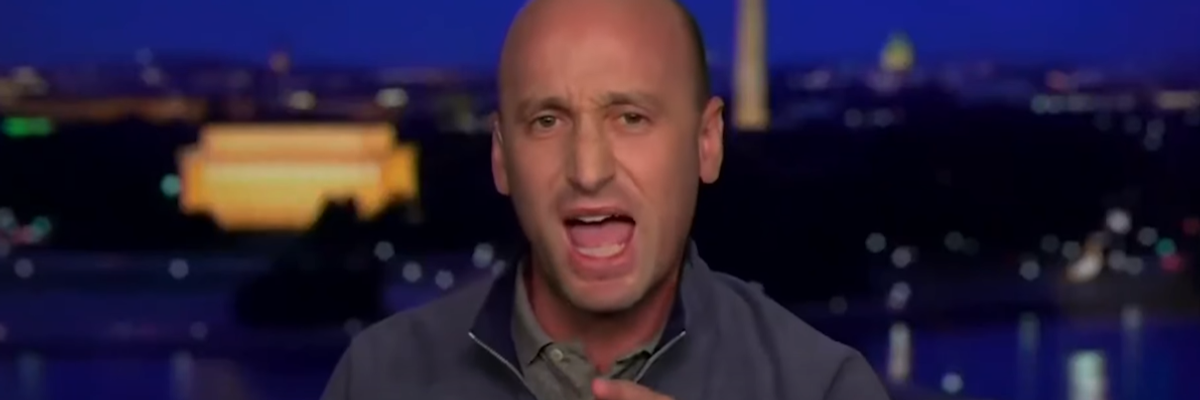
White House Deputy Chief of Staff Stephen Miller in a Fox News appearance days after the assassination of Charlie Kirk, on September 12, 2025.
(Screenshot from Fox News)
Stephen Prager
Sep 13, 2025
COMMON DREAMS
White House Deputy Chief of Staff Stephen Miller vowed Friday that he and President Donald Trump would use this week’s assassination of Charlie Kirk to “dismantle” the organized left using state power.
In a rant on Fox News, Miller—the architect of Trump’s mass roundups and deportations of immigrants—shouted that the best way to honor Kirk’s memory was to carry out a political purge against the left, which he called a “domestic terrorism movement in this country.”
Miller provided few details on what specific left-wing figures or groups he believed were stoking this violence. He claimed the left was waging “doxxing campaigns” against right-wing figures, though he cited no specific examples.
He did, however, cite many examples of harsh, but nevertheless First Amendment-protected, speech that he considered an incitement to violence, including that “the left calls people enemies of the republic, calls them fascists, says they’re Nazis, says they’re evil,” and claimed that many people online were “celebrating” Kirk’s assassination.
“The last message that Charlie Kirk gave to me before he joined his creator in heaven,” Miller said, was, “that we have to dismantle and take on the radical left organizations in this country that are fomenting violence, and we are going to do that.”
“Under President Trump’s leadership,” Miller vowed to shut down these unspecified leftist groups.
“I don’t care how,” he said. “It could be a RICO charge, a conspiracy charge, conspiracy against the United States, insurrection. But we are going to do what it takes to dismantle the organizations and the entities that are fomenting riots, that are doxxing, that are trying to inspire terrorism, that are committing acts of wanton violence.”
RICO refers to the Racketeer Influenced and Corrupt Organizations Act, which the government has traditionally used to prosecute organized crime groups. Trump later said one of his targets for these charges may be the billionaire liberal donor George Soros, the owner of the Open Society Foundations nonprofit, whom Trump accused of funding “riots,” a charge Soros denied.
Miller did not limit his call to destroying those who commit crimes. He also spoke of those “spreading this evil hate,” telling them, “You will live in exile. Because the power of law enforcement under President Trump’s leadership will be used to find you, will be used to take away your money, to take away your power, and if you’ve broken the law, to take away your freedom.”
An official White House account on X reposted a clip of Miller’s comments calling for the “dismantling” of left-wing organizations:
“Trump signaled he intended to use Kirk’s shooting as a pretext for a broad crackdown on the left,” said Jordan Weissman, a journalist at The Argument. “Here’s Stephen Miller being much more explicit. He’s talking about RICO and terrorism charges, echoing right-wing influencers.”
Aaron Reichlin-Melnick, a senior fellow at the American Immigration Council, meanwhile, pointed out the irony of the threat coming from Miller, noting that he “routinely slanders his political opponents with vile language that treats disagreement as if it’s treason.”
Little is still known about what, if any, political ideology precisely motivated Kirk’s alleged shooter, 22-year-old Tyler Robinson, who was apprehended in Utah on Friday. Robinson was not affiliated with any political party, and the scrawlings he left behind at the scene of the crime contain a mishmash of hyper-online but only vaguely political symbols and phrases.
But even before the suspect had been identified or apprehended, efforts had begun on the right to use Kirk’s murder as an excuse to crack down on their left-wing enemies. In an ominous speech Thursday night, Trump blamed the shooting on the “radical left,” saying it was “directly responsible for the terrorism that we’re seeing in our country today, and it must stop right now.”
On Fox News Friday, Trump indicated that he was extending this dragnet to anyone who has expressed harsh words for figures on the right. The president said:
For years those on the radical left have compared wonderful Americans like Charlie to Nazis. This kind of rhetoric is directly responsible for the terrorism that we’re seeing in our country and must stop right now. My administration will find each and every one of those who contributed to this atrocity and to other political violence, including the organizations that fund it and support it, as well as those who go after our judges and law enforcement officials.
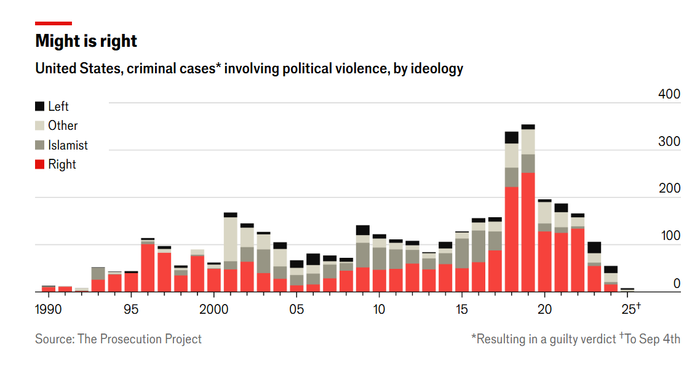
(Graphic by The Economist, data from the Prosecution Project)
The portrayal of the left as a unique “national security threat” is not borne out by data. On Friday, The Economist published an analysis of data from the Prosecution Project, an open-source database that catalogues crimes that seek “a socio-political change or to communicate.”
The findings reaffirm what has been found in previous studies: That “extremists on both left and right commit violence, although more incidents appear to come from right-leaning attackers.”
During the same Fox interview, when a host noted the prevalence of right-wing extremism, Trump said: “I’ll tell you something that’s going to get me in trouble, but I couldn’t care less. The radicals on the right oftentimes are radical because they don’t want to see crime. They’re saying, ‘We don’t want these people coming in. We don’t want you burning our shopping centers. We don’t want you shooting our people in the middle of the street.’”
Trump concluded: “The radicals on the left are the problem.”
The portrayal of the left as a unique “national security threat” is not borne out by data. On Friday, The Economist published an analysis of data from the Prosecution Project, an open-source database that catalogues crimes that seek “a socio-political change or to communicate.”
The findings reaffirm what has been found in previous studies: That “extremists on both left and right commit violence, although more incidents appear to come from right-leaning attackers.”
During the same Fox interview, when a host noted the prevalence of right-wing extremism, Trump said: “I’ll tell you something that’s going to get me in trouble, but I couldn’t care less. The radicals on the right oftentimes are radical because they don’t want to see crime. They’re saying, ‘We don’t want these people coming in. We don’t want you burning our shopping centers. We don’t want you shooting our people in the middle of the street.’”
Trump concluded: “The radicals on the left are the problem.”
Meanwhile, virtually all prominent figures and groups on the left—from politicians like Sen. Bernie Sanders (I-Vt.), Rep. Ilhan Omar (D-Minn.), and New York City mayoral candidate Zohran Mamdani to writers for left-wing publications like Jacobin or The Nation to activist groups like Public Citizen, MoveOn, the ACLU, and Indivisible—have unequivocally condemned violence against Kirk, even while repudiating his views.
“Trump explicitly threatened to use the state to target anyone he and MAGA scapegoat for Kirk’s murder,” said New Republic writer Greg Sargeant. “We really could see Stephen Miller and Kash Patel use the FBI for 60s-style domestic persecution.”
Trump's partisan double standard for assassinations is chilling
Zeeshan Aleem
Sat, September 13, 2025
In his sharply differing reactions to two high-profile assassinations of political figures this year, the president of the United States has effectively encouraged the public to apply a partisan lens to the value of human life.
The two killings in question — a lone wolf assassination of former Minnesota House Speaker Melissa Hortman in June and the shooting of Turning Point USA founder Charlie Kirk at a Utah Valley University speaking event this past week — elicited very different kinds of treatment from the White House. President Donald Trump gave scant attention to Hortman’s killing, while he framed the killing of Kirk as a cataclysmic national tragedy and a political rallying cry for the right.
Republican lives matter more than Democratic lives, Trump is effectively telling his base. And in a shocking comment on “Fox & Friends” on Friday, Trump appeared to use Kirk’s assassination to explicitly designate political violence a partisan issue too, by defending violent right-wing extremists as sharing his political goals of bringing down “crime” and left-wing extremists as “the problem.”
In response to the murder of Hortman, Trump offered a brief, impersonal condemnation of her killing on Truth Social, stating that “such horrific violence will not be tolerated.” He didn’t do much else. He did not offer a substantial eulogy for her, or deliver an address on political violence, as he did after Kirk’s death. Unlike former President Joe Biden, Trump did not attend the funeral. The day after Hortman’s killing, when Trump was asked if he had called Minnesota Gov. Tim Walz, he said, “I could be nice and call, but why waste time?” Trump suggested that part of the reason he didn’t want to call Walz was because he thought Walz was to blame for the killing, or at least the events leading up to it. That claim was nonsense. But peddling that narrative did allow Trump to divert attention from the fact that authorities found the suspected shooter had a hit list that named mostly Democratic politicians or figures tied to abortion rights, and that his close childhood friend said he voted for Trump.
In response to Kirk’s killing, Trump responded with tremendous urgency. He immediately issued an order to lower American flags to half-staff at the White House, all public buildings, U.S. embassies and military posts. He announced he would award Kirk the Presidential Medal of Freedom posthumously. He delivered a wrathful four-minute video address from the White House condemning Kirk’s assassination and promising vengeance against the left. As my colleague Anthony Fisher notes, during that address he made “wildly irresponsible assumptions about the then-unknown suspected killer’s motives. He completely ignored right-wing violence (like the kind he incited in Washington on Jan. 6, 2021), and he explicitly threatened to bring down the force of government on his political opponents.”
It was bad enough that Trump showed such divergent responses to the equally indefensible assassinations of Hortman and Kirk — and used the latter to promote the idea of a political crackdown on the left. But his appearance on Fox News on Friday morning involved what I found to be a genuinely jaw-dropping escalation, as he appeared to suggest that violence from the right was more defensible than violence from the left. Fox News host Ainsley Earhardt noted that there are radicals on both the right and the left and expressed concern about people cheering for Kirk’s death before asking Trump, “How do we fix this country?” He replied:
I’ll tell you something that’s going to get me in trouble, but I couldn’t care less. The radicals on the right oftentimes are radical because they don’t want to see crime. They don't want to see crime. They’re saying, ‘We don’t want these people coming in. We don’t want you burning our shopping centers. We don’t want you shooting our people in the middle of the street.’ The radicals on the left are the problem. And they’re vicious, and they’re horrible, and they’re politically savvy.
What Trump appears to be saying is that left-wing radicals are a problem, while right-wing extremists are, in essence, part of his political project and therefore don’t deserve condemnation — or at least not the kind of condemnation that those on the left do. He is effectively telegraphing the idea that a certain degree of political violence on the right could be acceptable — or at least should be seen as politically sympathetic and well-intentioned. As right-wing extremists are reactivating and rallying around Kirk’s death as a pretext for revenge against the left, Trump’s new statement echoes his “stand back and stand by” order to the Proud Boys in 2020 before they stormed the U.S. Capitol on Jan. 6. It would be reasonable in this context for right-wing extremists to surmise that Trump is again signaling that he could be lax on enforcement or try to offer them some kind of immunity — just as he did by commuting the sentences of Proud Boys and pardoning their leader.
In a democracy, all political violence should be considered entirely unacceptable, no matter the ideology of the person committing the act or on the receiving end of it. Both the deaths of Hortman and Kirk were terrible tragedies and completely unjustifiable. But in his selective mourning and politicization of their deaths, Trump suggested one tragedy — more importantly, one type of tragedy — mattered more.
This article was originally published on MSNBC.com
Zeeshan Aleem
Sat, September 13, 2025
In his sharply differing reactions to two high-profile assassinations of political figures this year, the president of the United States has effectively encouraged the public to apply a partisan lens to the value of human life.
The two killings in question — a lone wolf assassination of former Minnesota House Speaker Melissa Hortman in June and the shooting of Turning Point USA founder Charlie Kirk at a Utah Valley University speaking event this past week — elicited very different kinds of treatment from the White House. President Donald Trump gave scant attention to Hortman’s killing, while he framed the killing of Kirk as a cataclysmic national tragedy and a political rallying cry for the right.
Republican lives matter more than Democratic lives, Trump is effectively telling his base. And in a shocking comment on “Fox & Friends” on Friday, Trump appeared to use Kirk’s assassination to explicitly designate political violence a partisan issue too, by defending violent right-wing extremists as sharing his political goals of bringing down “crime” and left-wing extremists as “the problem.”
In response to the murder of Hortman, Trump offered a brief, impersonal condemnation of her killing on Truth Social, stating that “such horrific violence will not be tolerated.” He didn’t do much else. He did not offer a substantial eulogy for her, or deliver an address on political violence, as he did after Kirk’s death. Unlike former President Joe Biden, Trump did not attend the funeral. The day after Hortman’s killing, when Trump was asked if he had called Minnesota Gov. Tim Walz, he said, “I could be nice and call, but why waste time?” Trump suggested that part of the reason he didn’t want to call Walz was because he thought Walz was to blame for the killing, or at least the events leading up to it. That claim was nonsense. But peddling that narrative did allow Trump to divert attention from the fact that authorities found the suspected shooter had a hit list that named mostly Democratic politicians or figures tied to abortion rights, and that his close childhood friend said he voted for Trump.
In response to Kirk’s killing, Trump responded with tremendous urgency. He immediately issued an order to lower American flags to half-staff at the White House, all public buildings, U.S. embassies and military posts. He announced he would award Kirk the Presidential Medal of Freedom posthumously. He delivered a wrathful four-minute video address from the White House condemning Kirk’s assassination and promising vengeance against the left. As my colleague Anthony Fisher notes, during that address he made “wildly irresponsible assumptions about the then-unknown suspected killer’s motives. He completely ignored right-wing violence (like the kind he incited in Washington on Jan. 6, 2021), and he explicitly threatened to bring down the force of government on his political opponents.”
It was bad enough that Trump showed such divergent responses to the equally indefensible assassinations of Hortman and Kirk — and used the latter to promote the idea of a political crackdown on the left. But his appearance on Fox News on Friday morning involved what I found to be a genuinely jaw-dropping escalation, as he appeared to suggest that violence from the right was more defensible than violence from the left. Fox News host Ainsley Earhardt noted that there are radicals on both the right and the left and expressed concern about people cheering for Kirk’s death before asking Trump, “How do we fix this country?” He replied:
I’ll tell you something that’s going to get me in trouble, but I couldn’t care less. The radicals on the right oftentimes are radical because they don’t want to see crime. They don't want to see crime. They’re saying, ‘We don’t want these people coming in. We don’t want you burning our shopping centers. We don’t want you shooting our people in the middle of the street.’ The radicals on the left are the problem. And they’re vicious, and they’re horrible, and they’re politically savvy.
What Trump appears to be saying is that left-wing radicals are a problem, while right-wing extremists are, in essence, part of his political project and therefore don’t deserve condemnation — or at least not the kind of condemnation that those on the left do. He is effectively telegraphing the idea that a certain degree of political violence on the right could be acceptable — or at least should be seen as politically sympathetic and well-intentioned. As right-wing extremists are reactivating and rallying around Kirk’s death as a pretext for revenge against the left, Trump’s new statement echoes his “stand back and stand by” order to the Proud Boys in 2020 before they stormed the U.S. Capitol on Jan. 6. It would be reasonable in this context for right-wing extremists to surmise that Trump is again signaling that he could be lax on enforcement or try to offer them some kind of immunity — just as he did by commuting the sentences of Proud Boys and pardoning their leader.
In a democracy, all political violence should be considered entirely unacceptable, no matter the ideology of the person committing the act or on the receiving end of it. Both the deaths of Hortman and Kirk were terrible tragedies and completely unjustifiable. But in his selective mourning and politicization of their deaths, Trump suggested one tragedy — more importantly, one type of tragedy — mattered more.
This article was originally published on MSNBC.com
Maddow Blog
Steve Benen
Fri, September 12, 2025
Hours after Americans learned of Charlie Kirk’s death, Donald Trump had an opportunity to demonstrate responsible leadership and deliver a unifying message about the scourge of political violence. The president chose not to take advantage of that opportunity.
In unsettling remarks delivered from the Oval Office, Trump, despite knowing literally nothing about the alleged shooter, pushed a partisan message that condemned “the radical left” while ignoring a wide variety of examples from recent years of far-right radicals committing acts of violence against Democrats.
The scripted remarks made it sound as if the Republican wasn’t just positioning himself as president of half the country, he was also preparing to use Kirk’s death to justify a new offensive against his political opposition.
A day later, Trump on Thursday told reporters that “we have radical left lunatics out there, and we just have to beat the hell out of them.”
On Friday morning, however, the president pushed this line to an even more dramatic level. The New York Times reported:
President Trump said on Friday that the ‘radical left’ was responsible for much of the political violence in the country, and walked to the edge of excusing violence on the right, saying that most on the extreme right of the political spectrum were driven there because ‘they don’t want to see crime.’
During Trump’s latest appearance on Fox News, co-host Ainsley Earhardt acknowledged the fact that there are “radicals” on the right and asked how the nation can be fixed. Instead of answering the question, the president challenged the premise.
“Well, I’ll tell you something that’s gonna get me in trouble, but I couldn’t care less,” he replied. “The radicals on the right oftentimes are radical because they don’t want to see crime. They don’t want to see crime. They’re saying, ‘We don’t want these people coming in. We don’t want you burning our shopping centers. We don’t want you shooting our people in the middle of the street.’
“The radicals on the left are the problem, and they’re vicious and they’re horrible and they’re politically savvy.”
In other words, as the president sees it, far-right radicals have a good reason to be radical. The extremists on the right, Trump believes, only take radical steps because of their eagerness to help.
Why does this matter? Right off the bat, it’s the sort of rhetoric that signals to violent extremists that the incumbent American president is comfortable excusing radicals whom he sees as political allies. It’s an extension of the “stand back and stand by” comments Trump made about the Proud Boys in 2020, which sparked celebration among extremists.
What’s more, the evidence suggests the president is plainly and demonstrably wrong, and that right-wing violence has been more dangerous in the U.S. in recent years than left-wing violence. The New York Times’ David Leonhardt explained in 2022, the American right “has a violence problem that has no equivalent on the left.”
A newly published piece in The New Republic added:
Right-wing attacks and plans accounted for the majority of all terrorist incidents between 1994 and 2020, according to the Center for Strategic and International Studies. Between 1975 and September 2025, individuals motivated by right-wing ideologies such white supremacy, involuntary celibacy, and anti-abortion beliefs committed 391 murders, according to the Cato Institute. Comparatively, people motivated by left-wing ideologies were responsible for 65 deaths.
Finally, there are related concerns about the Trump administration’s focus in the near future. NBC News reported in 2021 that there was a consensus among former Department of Homeland Security officials — from Democratic and Republican administrations — who agreed that Trump’s first administration had failed to focus on “the rise of domestic threats,” leading to a four-year era of “inadequately monitoring and communicating the rising threat of right-wing domestic extremists.”
Around the same time, the New York Times reported that the Trump administration “diverted” federal law enforcement and domestic security agencies, pressuring officials to “uncover a left-wing extremist criminal conspiracy that never materialized,” even as “the threat from the far right was building ominously.”
The report added that the FBI, “in particular, had increasingly expressed concern about the threat from white supremacists, long the top domestic terrorism threat, and well-organized far-right extremist groups that had allied themselves with the president.” Those concerns, however, were not prioritized during the Republican administration.
As Trump justifies right-wing radicals to a national television audience, there’s reason anew to worry about whether recent history will repeat itself on failing to take domestic security threats seriously.
This article was originally published on MSNBC.com

Trump finds a new and unsettling way to excuse ‘radicals on the right’
Steve Benen
Fri, September 12, 2025
Hours after Americans learned of Charlie Kirk’s death, Donald Trump had an opportunity to demonstrate responsible leadership and deliver a unifying message about the scourge of political violence. The president chose not to take advantage of that opportunity.
In unsettling remarks delivered from the Oval Office, Trump, despite knowing literally nothing about the alleged shooter, pushed a partisan message that condemned “the radical left” while ignoring a wide variety of examples from recent years of far-right radicals committing acts of violence against Democrats.
The scripted remarks made it sound as if the Republican wasn’t just positioning himself as president of half the country, he was also preparing to use Kirk’s death to justify a new offensive against his political opposition.
A day later, Trump on Thursday told reporters that “we have radical left lunatics out there, and we just have to beat the hell out of them.”
On Friday morning, however, the president pushed this line to an even more dramatic level. The New York Times reported:
President Trump said on Friday that the ‘radical left’ was responsible for much of the political violence in the country, and walked to the edge of excusing violence on the right, saying that most on the extreme right of the political spectrum were driven there because ‘they don’t want to see crime.’
During Trump’s latest appearance on Fox News, co-host Ainsley Earhardt acknowledged the fact that there are “radicals” on the right and asked how the nation can be fixed. Instead of answering the question, the president challenged the premise.
“Well, I’ll tell you something that’s gonna get me in trouble, but I couldn’t care less,” he replied. “The radicals on the right oftentimes are radical because they don’t want to see crime. They don’t want to see crime. They’re saying, ‘We don’t want these people coming in. We don’t want you burning our shopping centers. We don’t want you shooting our people in the middle of the street.’
“The radicals on the left are the problem, and they’re vicious and they’re horrible and they’re politically savvy.”
In other words, as the president sees it, far-right radicals have a good reason to be radical. The extremists on the right, Trump believes, only take radical steps because of their eagerness to help.
Why does this matter? Right off the bat, it’s the sort of rhetoric that signals to violent extremists that the incumbent American president is comfortable excusing radicals whom he sees as political allies. It’s an extension of the “stand back and stand by” comments Trump made about the Proud Boys in 2020, which sparked celebration among extremists.
What’s more, the evidence suggests the president is plainly and demonstrably wrong, and that right-wing violence has been more dangerous in the U.S. in recent years than left-wing violence. The New York Times’ David Leonhardt explained in 2022, the American right “has a violence problem that has no equivalent on the left.”
A newly published piece in The New Republic added:
Right-wing attacks and plans accounted for the majority of all terrorist incidents between 1994 and 2020, according to the Center for Strategic and International Studies. Between 1975 and September 2025, individuals motivated by right-wing ideologies such white supremacy, involuntary celibacy, and anti-abortion beliefs committed 391 murders, according to the Cato Institute. Comparatively, people motivated by left-wing ideologies were responsible for 65 deaths.
Finally, there are related concerns about the Trump administration’s focus in the near future. NBC News reported in 2021 that there was a consensus among former Department of Homeland Security officials — from Democratic and Republican administrations — who agreed that Trump’s first administration had failed to focus on “the rise of domestic threats,” leading to a four-year era of “inadequately monitoring and communicating the rising threat of right-wing domestic extremists.”
Around the same time, the New York Times reported that the Trump administration “diverted” federal law enforcement and domestic security agencies, pressuring officials to “uncover a left-wing extremist criminal conspiracy that never materialized,” even as “the threat from the far right was building ominously.”
The report added that the FBI, “in particular, had increasingly expressed concern about the threat from white supremacists, long the top domestic terrorism threat, and well-organized far-right extremist groups that had allied themselves with the president.” Those concerns, however, were not prioritized during the Republican administration.
As Trump justifies right-wing radicals to a national television audience, there’s reason anew to worry about whether recent history will repeat itself on failing to take domestic security threats seriously.
This article was originally published on MSNBC.com


No comments:
Post a Comment