Trump isn’t even trying to hide his authoritarianism within social acceptability.
By George Yancy ,
September 13, 2025
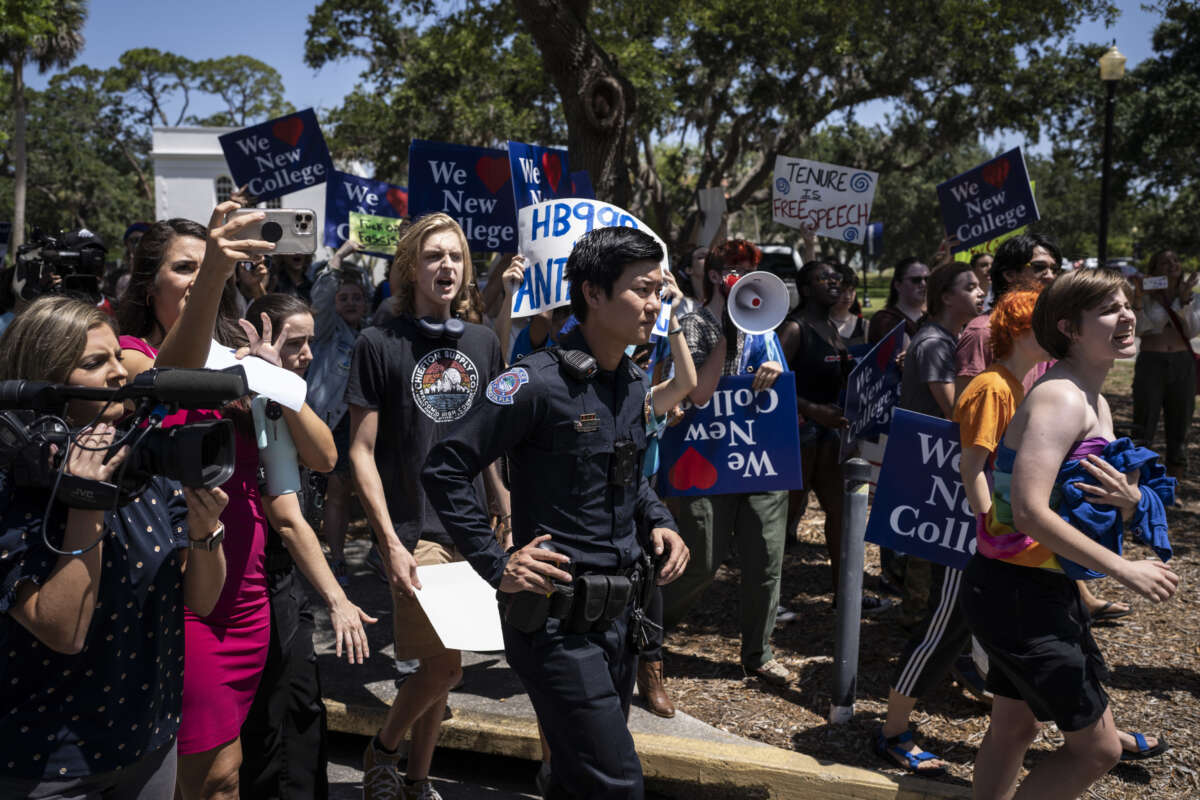
Protestors on the campus of New College of Florida chase after Christopher Rufo, a conservative activist and New College of Florida trustee, after he attended a bill signing event featuring Florida Governor Ron DeSantis, who signed three education bills in Sarasota, Florida, on Monday, May 15, 2023.Thomas Simonetti / The Washington Post via Getty Images
U.S. democracy has always been fragile, and we are now witnessing its dismantlement.
The rising tide of political violence poses one threat to democracy in this country, but another quieter threat is also hard at work via the erosion of free speech and critical thinking, both of which are necessary for a flourishing democracy.
Trump’s book bans and attacks on opposing political ideas, the blocking of independent journalism, the intimidation of news organizations, and the defunding of public media are all part of this erosion. These attacks are neither accidental nor incidental, but systematic and dangerously consequential to this country
Trump’s regime is driven by a form of authoritarian control (both political and military), disinformation, and a blatant disrespect for the U.S. Constitution. He has ushered in policies rooted in forms of fascism, where the act of dominating the people is articulated and enforced as “common sense.”
The concept of hegemony helps to capture what this regime is attempting to accomplish — or is in fact accomplishing. Hegemony, within the current U.S. context, captures what I see as an unmitigated criminal process of domination.
In this exclusive interview, education scholar Stephen Brookfield offers clarity on the concept of hegemony, how it is linked to white supremacy and authoritarianism, and how critical education and educators can mount a necessary form of resistance. Brookfield is an adjunct professor at Columbia University Teachers College in New York and professor emeritus at the University of St. Thomas in Minneapolis-St. Paul. His goal is to help people (including himself) identify and challenge the dominant ideologies they have internalized. Brookfield is the author, co-author, or editor of 21 books, including Becoming a White Antiracist (with Mary Hess), Teaching Race, and The Handbook of Race and Adult Education (with Vanessa Sheared, Juanita Johnson-Bailey, Elizabeth Peterson & Scipio A. J. Colin III). The interview that follows has been lightly edited for clarity and length.
George Yancy: Define hegemony and explain how it is negatively related to processes of education and learning.
Stephen Brookfield: Hegemony exists when a set of ideas that claim to explain how the world works, and the associated practices linked to these, sustain a particular social order. The question to be asked about hegemony is: Whose interests does it serve? Is it an unrepresentative minority whose position is bolstered by the widespread acceptance of these ideas and practices? Or does this hegemony reflect and promote the interests of the wider majority? Hegemony is always being contested as groups within a society constantly try to promote their own interests. When hegemony is most successfully in place, there is no need for paramilitary control because people have internalized the dominant ideology so completely that they police their own conduct. And, as Michel Foucault pointed out, they often take sensuous pleasure in doing so.
In the United States right now, there is a clear attempt to create a hegemony based on particular ideologies. One of these is monopoly capitalism, hidden behind the valorization of free-market enterprise as the best guarantor of freedom and liberty. Another is patriarchy. A third is white supremacy, the belief that European settlers “tamed” and “civilized” a continent, and that their “superior intelligence” and capacity for clear decision-making helped create the greatest nation on Earth. Mixed into this combustible cocktail is authoritarianism, the belief that a strong leader is needed who brooks no dissent from their vision and policies, and whose certainty appeals strongly to those confused by the maelstrom of forces they see swirling around their individual lives. Erich Fromm’s work outlined this dynamic beautifully three-quarters of a century ago.
At the heart of a successful state hegemony is control of what Louis Althusser called ideological state apparatuses. One of these is education. Control the curriculum and you control the range of ideas that people are exposed to. This is why schooling is inherently political. In earlier parts of my career, I had colleagues who disagreed with me on this point. Now I don’t know anyone who disputes it. Early pointers of this hegemony were Florida Gov. Ron DeSantis’s targeting of New College of Florida, and the federal abolition of critical race theory as a term used in federal training programs. As the current administration hits its stride, we have revisionist history in place that erases any analysis of slavery. Add to this the targeted removal of any institutional practice or office that mentions the words diversity, equity, or inclusion (DEI); the ridicule of anything that describes itself as “anti-racist” as “woke”; and targeted lawsuits aimed at any university that resists these restrictions — and we have the clear attempt to install white supremacy as an official, state-approved ideology.
Antonio Gramsci, whose work is usually associated with the term hegemony, was particularly focused on how cultural mechanisms enforce a certain picture of the world. As Fox News moved to occupy an important place in U.S. TV networks and right-wing radio and podcasts gathered steam, white supremacy, patriarchy, and authoritarianism were all fully legitimized and reinforced as “sensible” ways to order society. The betrothal of the Trump administration to right-wing media is consummated by senior cabinet and advisory positions being filled by pundits drawn from these sources.
The overt nature of this attempt to create hegemony is striking. There is no need to hide authoritarian control behind socially acceptable signifiers. The stream of billionaires traveling to kiss the ring of the president shows just how far business has caved.
Black history is under attack. Through a right-wing hegemonic retelling of Black history, where the reality of the brutality of anti-Blackness is being erased, memory is being controlled by those who would rather tell a pleasing lie than face the horrors of truth. While there was important pushback, I recall that a group of Texas educators had proposed to the Texas State Board of Education that slavery should be taught in second grade social studies as “involuntary relocation.” Or think about the Florida Board of Education and its approval to teach middle school students “that enslaved people gained a ‘personal benefit’ from the skills they learned under slavery before the Civil War.” My sense is that partly undergirding this attempt to whitewash and rewrite the brutality of anti-Blackness within the U.S. is the aim to maintain a history and ideology of “white innocence.” Given your important work on whiteness, explain how the meta-narrative of white innocence is part of the core of what Trump is up to.
George W. Bush said that the worst moment of his presidency was not 9/11 or leading the country into an invasion that killed hundreds of thousands in Iraq. Instead, it was being called a racist after his administration’s lackluster response to Hurricane Katrina. This shows the deep-rooted belief held by many white people that we are essentially racially innocent. Sure, our ancestors may have enslaved people, but that was what was considered culturally appropriate at the time, and anyway it has no relation to who we are today. We treat others as we would want to be treated, we don’t make judgments about the content of character based on skin color, and we treat people of color with goodwill. So how can we be racist? This act of self-congratulation is a common signifier of white innocence.
“Control the curriculum and you control the range of ideas that people are exposed to. This is why schooling is inherently political.”
Innocence is a delightfully complex term, something that is often projected as a desirable state to which we should aspire, but also something that suggests a certain childlike naivete. Recently, the protestation of white innocence has become weaponized as a response to the Black Lives Matter movement and the anti-racist momentum that built in the wake of George Floyd’s murder. This weaponization has multiple dimensions. First, there is the reinterpretation of colonialism and imperialism as a generally innocent and beneficent phenomenon in which the supposed improvements conferred (instilling morality, religious conversion, and an adherence to European values) far outweigh any unfortunate mistakes such as genocide and slavery. Second, we have the contemporary claim that even if some bad things were done in the past, that has nothing to do with anything that’s happening today. The strident rejection of white guilt is one aspect of this; as is the belief that referring to the history of slavery and settlement is a “woke” device that folks of color use to blame their situation on the past, thereby ignoring their need to take personal responsibility for their lives and work harder.
A deeper sense of innocence is that which Shannon Sullivan describes as the innocence of “good white people.” This is the innocent belief in our essential humanity, in our commitment to “treating people as we find them,” in our subscription to the color-blind viewpoint, and in our belief that we act out of the best possible motivations. Under white innocence, the sincerity of our actions is what matters the most and “justifies” any unintended harm we might commit.
This describes a worldview that I internalized early on in life and that still resides within me. One way that structural inequity stays in place is by the majority assuming that a level playing field exists so that we interact as equals unaffected by history. In this worldview, the past does not matter, and structural barriers are overcome by exercising goodwill. Under white innocence, words and actions that came from a “good place” cannot be viewed as racist, owing to the purity of their intentions. If we are told that we have behaved or spoken in a racist way, we apologize. But in our hearts lies the unspoken conviction that really the other person was being overly sensitive. Or, that they’ve misinterpreted a beneficent communication and taken offense at imagined slights that were really not there. In this way, innocence regards racism as an unfortunate problem of miscommunication owing to what we call “cultural differences.”
As the current administration systematically defunds any institutional efforts to address racism, those who were made uncomfortable in the past by DEI programs can now breathe a sigh of relief. In their minds, we are back to “normal.” Balance has been restored after a period of whites being unfairly blamed for colluding in white supremacy.
If you recall, in George Orwell’s 1984, the dystopian Party can control what people think and do. In fact, in that book, the belief that “2 + 2 = 5” is taken as true and is indicative of the extent to which political power can be used to brainwash people. Fascism works to create a world where what is blatantly false has become what is deemed “common sense” and “true.” Under Trump’s neo-fascist regime, we must fight against the perpetuation of systematic falsehoods and ideologies of distraction. You argue that the process of “doing ideology critique involves adults learning to become aware of how ideology lives within them as well as understanding how it buttresses the structures of the outside world that works against them.” Understanding and deploying the concept of ideology critique is indispensable at this moment. Explain ways in which teachers in schools and universities might use ideology critique to contest the attempt by the right wing to accept blatant falsehoods as “commonsense wisdom.”
One of the greatest challenges in my teaching has been to work out how to get students to think structurally; that is, how they learn to realize that their individual actions are framed by their social location and that wider economic forces and dominant ideologies constrain the options they consider. The ideology of individualism, so lauded throughout the history of the U.S., is a major barrier to this task. It posits life’s journey as one of grit, determination, and struggle in the face of barriers that are unexpectedly thrown up to block the realization of our full potential.
I am not a rigid economic materialist. I don’t believe that individual choice is purely a comforting myth, and I do believe that individual consciousness is, ultimately, inexplicable. Chance, unpredictability, and serendipity are powerful elements of the human condition. But our choices are fueled by the ideological oxygen we breathe. Ideological state apparatuses such as education and religion, official government policies and statements, and the daily bath in social media present the range of possibilities that we view as both desirable and realistic. When a government controls the flow of information and intimidates schools and media outlets into legitimizing their worldview, then hegemony becomes easier to establish.
The key as an educator is to find a way to interrupt this dominant ideological narrative. In adult education, a great deal of attention has been paid to what the transformative learning theorist Jack Mezirow called “disorienting dilemmas.” These are the moments when our settled expectations about how the world works are thrown into confusion. Examples would be facing an unexpected health crisis and finding care unavailable, being fired after a history of professionalism and assiduously working to achieve institutional goals, or being conscripted to fight in a war. For George W. Bush, it was being called “racist.”
“As the current administration systematically defunds any institutional efforts to address racism, those who were made uncomfortable in the past by DEI programs can now breathe a sigh of relief. In their minds, we are back to ‘normal.’”
As we negotiate our response to being caught in such dilemmas, we are brought face-to-face with our paradigmatic assumptions. As we realize that these assumptions are flawed, we are forced to examine why we believed them to be so accurate in the first place. We seek other, more satisfactory meaning schemes and perspectives that make more sense.
In the classroom, teachers need to create disorienting dilemmas that unsettle and confound our students’ expectations. And, as we do so, we need to judge how much dissonance can be tolerated. Too much, and we risk them dismissing our activities as unrealistic. Too little, and we allow them to stay comfortable. In ideology critique, I present a cultural or institutional action that seems benign and desirable and then ask students to answer several questions about it: What assumptions are embedded in the practice? What is it intended to achieve? Whose interests does the practice serve? Who is most harmed by it? Why do those who benefit not recognize the harm it creates? How could the action be reimagined in ways that were fairer or socially just?
A similar approach is to institute equity pauses as a required element in decision-making across a university. As program changes are made, admissions criteria altered, and curricula revised, we need to pause very deliberately before deciding on a particular course of action and ask the ideology critique questions above.
We also need teachers and institutional leaders to model the practice of critical reflection. White leaders need to talk publicly about their own struggle to recognize that they have a racial identity, and to acknowledge the benefits this brings. This kind of disclosure needs to become normalized, so that discussions of racism are not prefaced by a collective intake of fearful inhalation. Neither should it be confessional, in which whites purge themselves of the sin of racism by asking absolution from colleagues of color. And courses need to be taught by racially mixed teams who can model what a difficult racial conversation looks like — stilted, characterized both by periods of uncomfortable silence, and also displaying strong emotions and feelings.
In my own capacity as a philosopher and a teacher, I have attempted to model what it means to engage in critical reflection. Indeed, critical reflection is inextricably linked to critical pedagogy. But what we are witnessing is the very opposite of critical reflection. In The Power of Critical Theory: Liberating Adult Learning and Teaching, you describe the problematic process of creating what you call “adult educators as professional ideologists.” What will education in the U.S. look like as “adult educators as professional ideologists” continue to gain traction? And what are the larger implications for U.S. democracy?
I have argued that critical reflection focuses on power and hegemony — on understanding how and when an elite group uses power in an authoritarian way to impose its cultural hegemony on the majority of people. It also reveals the tricks of ideological manipulation that result in people voting enthusiastically for politicians whose actions and decisions end up harming those same voters — and then continuing to do it over and over again.
Adult education as political detoxification seeks to remove the addictive chemicals of white innocence from our consciousness. It demonstrates the falsity of believing that we all act on a level playing field, or the naivete of thinking that our actions are motivated solely by a humanist concern for everyone to get along. It unmasks power.
This article is licensed under Creative Commons (CC BY-NC-ND 4.0), and you are free to share and republish under the terms of the license.
U.S. democracy has always been fragile, and we are now witnessing its dismantlement.
The rising tide of political violence poses one threat to democracy in this country, but another quieter threat is also hard at work via the erosion of free speech and critical thinking, both of which are necessary for a flourishing democracy.
Trump’s book bans and attacks on opposing political ideas, the blocking of independent journalism, the intimidation of news organizations, and the defunding of public media are all part of this erosion. These attacks are neither accidental nor incidental, but systematic and dangerously consequential to this country
Trump’s regime is driven by a form of authoritarian control (both political and military), disinformation, and a blatant disrespect for the U.S. Constitution. He has ushered in policies rooted in forms of fascism, where the act of dominating the people is articulated and enforced as “common sense.”
The concept of hegemony helps to capture what this regime is attempting to accomplish — or is in fact accomplishing. Hegemony, within the current U.S. context, captures what I see as an unmitigated criminal process of domination.
In this exclusive interview, education scholar Stephen Brookfield offers clarity on the concept of hegemony, how it is linked to white supremacy and authoritarianism, and how critical education and educators can mount a necessary form of resistance. Brookfield is an adjunct professor at Columbia University Teachers College in New York and professor emeritus at the University of St. Thomas in Minneapolis-St. Paul. His goal is to help people (including himself) identify and challenge the dominant ideologies they have internalized. Brookfield is the author, co-author, or editor of 21 books, including Becoming a White Antiracist (with Mary Hess), Teaching Race, and The Handbook of Race and Adult Education (with Vanessa Sheared, Juanita Johnson-Bailey, Elizabeth Peterson & Scipio A. J. Colin III). The interview that follows has been lightly edited for clarity and length.
George Yancy: Define hegemony and explain how it is negatively related to processes of education and learning.
Stephen Brookfield: Hegemony exists when a set of ideas that claim to explain how the world works, and the associated practices linked to these, sustain a particular social order. The question to be asked about hegemony is: Whose interests does it serve? Is it an unrepresentative minority whose position is bolstered by the widespread acceptance of these ideas and practices? Or does this hegemony reflect and promote the interests of the wider majority? Hegemony is always being contested as groups within a society constantly try to promote their own interests. When hegemony is most successfully in place, there is no need for paramilitary control because people have internalized the dominant ideology so completely that they police their own conduct. And, as Michel Foucault pointed out, they often take sensuous pleasure in doing so.
In the United States right now, there is a clear attempt to create a hegemony based on particular ideologies. One of these is monopoly capitalism, hidden behind the valorization of free-market enterprise as the best guarantor of freedom and liberty. Another is patriarchy. A third is white supremacy, the belief that European settlers “tamed” and “civilized” a continent, and that their “superior intelligence” and capacity for clear decision-making helped create the greatest nation on Earth. Mixed into this combustible cocktail is authoritarianism, the belief that a strong leader is needed who brooks no dissent from their vision and policies, and whose certainty appeals strongly to those confused by the maelstrom of forces they see swirling around their individual lives. Erich Fromm’s work outlined this dynamic beautifully three-quarters of a century ago.
At the heart of a successful state hegemony is control of what Louis Althusser called ideological state apparatuses. One of these is education. Control the curriculum and you control the range of ideas that people are exposed to. This is why schooling is inherently political. In earlier parts of my career, I had colleagues who disagreed with me on this point. Now I don’t know anyone who disputes it. Early pointers of this hegemony were Florida Gov. Ron DeSantis’s targeting of New College of Florida, and the federal abolition of critical race theory as a term used in federal training programs. As the current administration hits its stride, we have revisionist history in place that erases any analysis of slavery. Add to this the targeted removal of any institutional practice or office that mentions the words diversity, equity, or inclusion (DEI); the ridicule of anything that describes itself as “anti-racist” as “woke”; and targeted lawsuits aimed at any university that resists these restrictions — and we have the clear attempt to install white supremacy as an official, state-approved ideology.
Antonio Gramsci, whose work is usually associated with the term hegemony, was particularly focused on how cultural mechanisms enforce a certain picture of the world. As Fox News moved to occupy an important place in U.S. TV networks and right-wing radio and podcasts gathered steam, white supremacy, patriarchy, and authoritarianism were all fully legitimized and reinforced as “sensible” ways to order society. The betrothal of the Trump administration to right-wing media is consummated by senior cabinet and advisory positions being filled by pundits drawn from these sources.
The overt nature of this attempt to create hegemony is striking. There is no need to hide authoritarian control behind socially acceptable signifiers. The stream of billionaires traveling to kiss the ring of the president shows just how far business has caved.
Black history is under attack. Through a right-wing hegemonic retelling of Black history, where the reality of the brutality of anti-Blackness is being erased, memory is being controlled by those who would rather tell a pleasing lie than face the horrors of truth. While there was important pushback, I recall that a group of Texas educators had proposed to the Texas State Board of Education that slavery should be taught in second grade social studies as “involuntary relocation.” Or think about the Florida Board of Education and its approval to teach middle school students “that enslaved people gained a ‘personal benefit’ from the skills they learned under slavery before the Civil War.” My sense is that partly undergirding this attempt to whitewash and rewrite the brutality of anti-Blackness within the U.S. is the aim to maintain a history and ideology of “white innocence.” Given your important work on whiteness, explain how the meta-narrative of white innocence is part of the core of what Trump is up to.
George W. Bush said that the worst moment of his presidency was not 9/11 or leading the country into an invasion that killed hundreds of thousands in Iraq. Instead, it was being called a racist after his administration’s lackluster response to Hurricane Katrina. This shows the deep-rooted belief held by many white people that we are essentially racially innocent. Sure, our ancestors may have enslaved people, but that was what was considered culturally appropriate at the time, and anyway it has no relation to who we are today. We treat others as we would want to be treated, we don’t make judgments about the content of character based on skin color, and we treat people of color with goodwill. So how can we be racist? This act of self-congratulation is a common signifier of white innocence.
“Control the curriculum and you control the range of ideas that people are exposed to. This is why schooling is inherently political.”
Innocence is a delightfully complex term, something that is often projected as a desirable state to which we should aspire, but also something that suggests a certain childlike naivete. Recently, the protestation of white innocence has become weaponized as a response to the Black Lives Matter movement and the anti-racist momentum that built in the wake of George Floyd’s murder. This weaponization has multiple dimensions. First, there is the reinterpretation of colonialism and imperialism as a generally innocent and beneficent phenomenon in which the supposed improvements conferred (instilling morality, religious conversion, and an adherence to European values) far outweigh any unfortunate mistakes such as genocide and slavery. Second, we have the contemporary claim that even if some bad things were done in the past, that has nothing to do with anything that’s happening today. The strident rejection of white guilt is one aspect of this; as is the belief that referring to the history of slavery and settlement is a “woke” device that folks of color use to blame their situation on the past, thereby ignoring their need to take personal responsibility for their lives and work harder.
A deeper sense of innocence is that which Shannon Sullivan describes as the innocence of “good white people.” This is the innocent belief in our essential humanity, in our commitment to “treating people as we find them,” in our subscription to the color-blind viewpoint, and in our belief that we act out of the best possible motivations. Under white innocence, the sincerity of our actions is what matters the most and “justifies” any unintended harm we might commit.
This describes a worldview that I internalized early on in life and that still resides within me. One way that structural inequity stays in place is by the majority assuming that a level playing field exists so that we interact as equals unaffected by history. In this worldview, the past does not matter, and structural barriers are overcome by exercising goodwill. Under white innocence, words and actions that came from a “good place” cannot be viewed as racist, owing to the purity of their intentions. If we are told that we have behaved or spoken in a racist way, we apologize. But in our hearts lies the unspoken conviction that really the other person was being overly sensitive. Or, that they’ve misinterpreted a beneficent communication and taken offense at imagined slights that were really not there. In this way, innocence regards racism as an unfortunate problem of miscommunication owing to what we call “cultural differences.”
As the current administration systematically defunds any institutional efforts to address racism, those who were made uncomfortable in the past by DEI programs can now breathe a sigh of relief. In their minds, we are back to “normal.” Balance has been restored after a period of whites being unfairly blamed for colluding in white supremacy.
If you recall, in George Orwell’s 1984, the dystopian Party can control what people think and do. In fact, in that book, the belief that “2 + 2 = 5” is taken as true and is indicative of the extent to which political power can be used to brainwash people. Fascism works to create a world where what is blatantly false has become what is deemed “common sense” and “true.” Under Trump’s neo-fascist regime, we must fight against the perpetuation of systematic falsehoods and ideologies of distraction. You argue that the process of “doing ideology critique involves adults learning to become aware of how ideology lives within them as well as understanding how it buttresses the structures of the outside world that works against them.” Understanding and deploying the concept of ideology critique is indispensable at this moment. Explain ways in which teachers in schools and universities might use ideology critique to contest the attempt by the right wing to accept blatant falsehoods as “commonsense wisdom.”
One of the greatest challenges in my teaching has been to work out how to get students to think structurally; that is, how they learn to realize that their individual actions are framed by their social location and that wider economic forces and dominant ideologies constrain the options they consider. The ideology of individualism, so lauded throughout the history of the U.S., is a major barrier to this task. It posits life’s journey as one of grit, determination, and struggle in the face of barriers that are unexpectedly thrown up to block the realization of our full potential.
I am not a rigid economic materialist. I don’t believe that individual choice is purely a comforting myth, and I do believe that individual consciousness is, ultimately, inexplicable. Chance, unpredictability, and serendipity are powerful elements of the human condition. But our choices are fueled by the ideological oxygen we breathe. Ideological state apparatuses such as education and religion, official government policies and statements, and the daily bath in social media present the range of possibilities that we view as both desirable and realistic. When a government controls the flow of information and intimidates schools and media outlets into legitimizing their worldview, then hegemony becomes easier to establish.
The key as an educator is to find a way to interrupt this dominant ideological narrative. In adult education, a great deal of attention has been paid to what the transformative learning theorist Jack Mezirow called “disorienting dilemmas.” These are the moments when our settled expectations about how the world works are thrown into confusion. Examples would be facing an unexpected health crisis and finding care unavailable, being fired after a history of professionalism and assiduously working to achieve institutional goals, or being conscripted to fight in a war. For George W. Bush, it was being called “racist.”
“As the current administration systematically defunds any institutional efforts to address racism, those who were made uncomfortable in the past by DEI programs can now breathe a sigh of relief. In their minds, we are back to ‘normal.’”
As we negotiate our response to being caught in such dilemmas, we are brought face-to-face with our paradigmatic assumptions. As we realize that these assumptions are flawed, we are forced to examine why we believed them to be so accurate in the first place. We seek other, more satisfactory meaning schemes and perspectives that make more sense.
In the classroom, teachers need to create disorienting dilemmas that unsettle and confound our students’ expectations. And, as we do so, we need to judge how much dissonance can be tolerated. Too much, and we risk them dismissing our activities as unrealistic. Too little, and we allow them to stay comfortable. In ideology critique, I present a cultural or institutional action that seems benign and desirable and then ask students to answer several questions about it: What assumptions are embedded in the practice? What is it intended to achieve? Whose interests does the practice serve? Who is most harmed by it? Why do those who benefit not recognize the harm it creates? How could the action be reimagined in ways that were fairer or socially just?
A similar approach is to institute equity pauses as a required element in decision-making across a university. As program changes are made, admissions criteria altered, and curricula revised, we need to pause very deliberately before deciding on a particular course of action and ask the ideology critique questions above.
We also need teachers and institutional leaders to model the practice of critical reflection. White leaders need to talk publicly about their own struggle to recognize that they have a racial identity, and to acknowledge the benefits this brings. This kind of disclosure needs to become normalized, so that discussions of racism are not prefaced by a collective intake of fearful inhalation. Neither should it be confessional, in which whites purge themselves of the sin of racism by asking absolution from colleagues of color. And courses need to be taught by racially mixed teams who can model what a difficult racial conversation looks like — stilted, characterized both by periods of uncomfortable silence, and also displaying strong emotions and feelings.
In my own capacity as a philosopher and a teacher, I have attempted to model what it means to engage in critical reflection. Indeed, critical reflection is inextricably linked to critical pedagogy. But what we are witnessing is the very opposite of critical reflection. In The Power of Critical Theory: Liberating Adult Learning and Teaching, you describe the problematic process of creating what you call “adult educators as professional ideologists.” What will education in the U.S. look like as “adult educators as professional ideologists” continue to gain traction? And what are the larger implications for U.S. democracy?
I have argued that critical reflection focuses on power and hegemony — on understanding how and when an elite group uses power in an authoritarian way to impose its cultural hegemony on the majority of people. It also reveals the tricks of ideological manipulation that result in people voting enthusiastically for politicians whose actions and decisions end up harming those same voters — and then continuing to do it over and over again.
Adult education as political detoxification seeks to remove the addictive chemicals of white innocence from our consciousness. It demonstrates the falsity of believing that we all act on a level playing field, or the naivete of thinking that our actions are motivated solely by a humanist concern for everyone to get along. It unmasks power.
This article is licensed under Creative Commons (CC BY-NC-ND 4.0), and you are free to share and republish under the terms of the license.
George Yancy is the Samuel Candler Dobbs professor of philosophy at Emory University and a Montgomery fellow at Dartmouth College. He is also the University of Pennsylvania’s inaugural fellow in the Provost’s Distinguished Faculty Fellowship Program (2019-2020 academic year). He is the author, editor and co-editor of over 25 books, including Black Bodies, White Gazes; Look, A White; Backlash: What Happens When We Talk Honestly about Racism in America; and Across Black Spaces: Essays and Interviews from an American Philosopher published by Rowman & Littlefield in 2020. His most recent books include a collection of critical interviews entitled, Until Our Lungs Give Out: Conversations on Race, Justice, and the Future (Rowman & Littlefield, 2023), and a coedited book (with philosopher Bill Bywater) entitled, In Sheep’s Clothing: The Idolatry of White Christian Nationalism (Roman & Littlefield, 2024).

No comments:
Post a Comment