Social movements and COP 30: transnational alliances against the global extractivist offensive
Tuesday 18 November 2025, by Maureen Zelaya Paredes, Pedro Ramiro
While empty promises are repeated in Belém, a plurality of social, indigenous and environmental movements are promoting an internationalist agenda against extractivism and for climate justice from various meeting spaces.
There’s activity in Belém. On one hand, at the official summit, which opened yesterday [10 November] and where, for two weeks, delegations from various countries will debate whether progress can be made in terms of mitigation, financing, and mechanisms for a just transition. On the other hand, in the various forums and meeting spaces where organisations and social groups from around the world, especially from Latin America, are trying these days to revitalise internationalist alliances to confront the global extractivist offensive.
In reality, not much can be expected from the official summit. For too long, the COPs have become a ritual in which the world’s leading figures parade—this time, not even those from the countries with the highest emissions: China, the United States, India, and Russia—to issue solemn declarations of intent and promote new mechanisms that, when the summit curtain falls, have no effective translation into timelines and budgets. “We don’t want it to be a marketplace of ideological products, we want something very serious and for the decisions to actually be implemented,” said the president of Brazil, acknowledging the ineffectiveness of summits that straddle greenwashing and business as usual.
From the other meeting spaces, however, it is possible to find renewed hope. In parallel to COP 30 —we could also say in opposition to the official summit— a multitude of indigenous, environmental, trade union, feminist and anti-capitalist organisations and movements have come together in Belém to rethink strategies and reactivate international bodies to strengthen the processes of struggle and resistance. Having learned from the World Social Forum and seeking to overcome the contradictions of progressive governments, the goal is to promote community self-organisation processes that rebuild the social fabric and look beyond the constant demands on the State.
The People’s Summits
The People’s Summits have been taking place for thirty years within the framework of the climate summits promoted by the United Nations. This year, after the three COP editions held in countries characterised by the criminalisation of the right to protest and the persecution of activists and organisations critical of governments, there has been a resurgence of interest from social groups in this forum. At the People’s Summit in Belém, representatives from more than 1,200 organisations from around the globe will gather around one objective: “To strengthen popular mobilisation and converge on unified agendas: socio-environmental, anti-patriarchal, anti-capitalist, anti-colonialist, anti-racist and based on human rights,” as the manifesto states.
The People’s Summit will begin tomorrow, November 12, with a river “march” of more than 200 boats carrying some 5,000 people. With this nautical caravan, the movements participating in this alternative summit "unite to make their voices heard, across the waters, in protest against the COP decisions that perpetuate this model of territorial exploitation." As one of the initiative’s spokespeople said, "The waters of the Amazon bring the voices the world needs to hear: those of people who defend life, land and the climate."
The dozens of talks, workshops, and assemblies taking place over four days as part of the People’s Summit will culminate on Saturday, November 15, with a large demonstration, accompanied by decentralised actions in many other countries. On Sunday, November 16, the demands of the People’s Summit will be presented at the COP plenary session.
At this event, the largest of all those that will bring together activists and social organisations around COP 30, one of the topics that will undoubtedly be a subject of debate is the relationship of the various social movements with progressive governments. Just three weeks ago, the state-owned company Petrobras received approval from the Lula government to exploit oil in deep waters about 500 km from the mouth of the Amazon River. In a city decorated for the occasion with thousands of colourful advertising posters highlighting the importance of caring for the Amazon, the gap between the usual rhetoric of green capitalism and the ever-postponed urgency of transforming the primary-export matrix will once again become evident.
But this forum is by no means the only one held in Belém outside of the initiatives sponsored by the Brazilian government. From November 8 to 11, the II Latin American and Caribbean Ecosocialist Meetings took place, in which two hundred grassroots activists from very diverse countries met to reflect, based on the experience of the struggles against land plundering, on strategies to strengthen a common internationalist front that can face the socio-ecological crisis. At the same time, from November 7 to 12, the IV International Meeting of People Affected by Dams took place, the result of an international coordination process of community struggles against large power plants and electricity companies that has been in existence for three decades.
Peoples against extractivism
On a planet mired in climate emergency and extreme inequality generated by the capitalocene (and by policies that greenwash capitalism), voices from different resistances against the extractivist model have joined the Peoples Against Extractivism coalition. This space was established in Belém on November 9 to unite and coordinate movements, communities and organisations that face dispossession and are committed to a profound transformation of the system that threatens life and land.
This international network has integrated experiences primarily from Latin America and Europe, although with a commitment to expanding its presence on the African continent. The coalition is made up of grassroots movements, indigenous peoples, Afro-descendants and peasants, as well as various mass social organisations. They all fight, from different fronts, against the same enemy: the extractivist model that perpetuates the continuous overexploitation of common resources and the expansion of production frontiers into territories considered “unproductive.” It is not limited to mining or oil; it also includes monocultures, agribusiness, biofuels, and energy megaprojects that consolidate a dependent model and generate a return to primary commodity exports in peripheral economies.
For this network, extractivism is not just an economic practice, but a form of the organisation of power within liberal democracies and a mechanism of domination that conditions the lives of communities. In this new phase of capitalist accumulation, the dispossession of peoples and their territories—cynically turned into zones of sacrifice—is imposed, now justified in the name of the energy transition. In “green military capitalism,” the European Union, the United States, and China compete for control of the minerals fundamental to sustaining the economic metabolism of the capitalist centre. In this accelerated race to secure access to critical raw materials, which does not represent any real progress in the ecosocial transition, mining currently stands as the most violent expression of extractivism: militarisation, forced displacement, racism, criminalisation and even murders of those who defend the commons.
The Peoples Against Extractivism alliance argues that protecting habitats and ecosystems is inseparable from the struggle against the neocolonial extractivist offensive. This internationalism begins with supporting the peoples of Ecuador, Panama, and Peru, where state repression has intensified in recent months with arbitrary arrests, militarisation of communities, and judicial persecution of environmental and social leaders and denouncing these actions. At the same time, in the face of the expanding extractive frontier, it is based on building alternatives from the ground up.
Territorial resistances are organised in defense of water, land, land and those who inhabit them, articulating different struggles and demands. In Ecuador, Amazonian communities have halted oil projects; in Panama, after weeks of mobilisation the popular movement succeeded in stopping a mining concession; in Peru, peasant patrols keep alive the collective defense of common resources. These processes reposition the right to resist as a shared practice against extractive neocolonialism.
The planet and its communities cannot continue to wait for the goodwill of governments that promote the extractive frenzy. Faced with the dispossession of land, militarisation, and corporate impunity, this internationalist network aims to strengthen the defense of the land as a living body, because land is not a resource: it is the material basis of the life of the communities and the nature that inhabits it and, in the cases of indigenous peoples, the spiritual basis of life. Additionally, we have the right to resistance, self-defense, and self-determination of peoples, as pillars of environmental and social justice. And the construction of community-based alternatives, such as economies of solidarity, self-governance, feminist and agroecological networks, and many other practices promoted by grassroots organisations are essential.
Strengthening transnational counter-hegemonic networks is key to confronting corporate power and moving towards a future of dignified life and climate justice. As Pueblos contra el Extractivismo (Peoples Against Extractivism) reiterates in its arguments: our territories are not for sale, they must be defended.
11 November 2025
Translated by David Fagan for International Viewpoint from El Salto.
Attached documentssocial-movements-and-cop-30-transnational-alliances-against_a9264.pdf (PDF - 915.2 KiB)
Extraction PDF [->article9264]
Maureen Zelaya Paredes is on the editorial staff of Poder Popular and active in Anticapitalistas and Ecologists in Action.
Pedro Ramiro is a member of the Observatory of Multinationals in Latin America (OMAL).
International Viewpoint is published under the responsibility of the Bureau of the Fourth International. Signed articles do not necessarily reflect editorial policy. Articles can be reprinted with acknowledgement, and a live link if possible.
“A roadmap for delivering on 1.5°C without a credible fossil fuel phaseout at its core is hollow,” said one campaigner.

An Indigenous woman holds a sign reading, “The future belongs to the people” during the “Indigenous People Global March” at the United Nations Climate Change Conference in Belém, Brazil, on November 17, 2025.
(Photo by Pablo Poriuncula/AFP via Getty Images)
Julia Conley
Nov 18, 2025
COMMON DREAMS
Climate justice organizers on Tuesday expressed some cautious optimism that a draft text out of the United Nations Climate Change Conference in Belém, Brazil contained “building blocks” of a climate justice package that is needed to draw down planet-heating fossil fuel emissions and help the poorest and least-polluting countries confront the climate emergency—but advocates said that with just three days to go until the summit is over, the document still falls far short of delivering solutions.
The draft text, released by COP30 President André Corrêa do Lago, includes references to a “transition away from fossil fuels,” and calls for annual reviews of countries’ Nationally Determined Contributions (NDCs), the efforts they pledge to make to reduce their emissions.
‘Against Humanity’: Leaders Denounce Fossil Fuel-Loving Trump as He Skips Out on Global Climate Summit
Amnesty Urges COP30 Attendees to ‘Resist Aligning With’ Trump Climate Crisis Denial
But a day after campaigners expressed optimism about 62 countries and country groups endorsing Brazilian President Luiz Inácio Lula da Silva’s call for a Transition Away From Fossil Fuels (TAFF) Roadmap, 350.org condemned the draft text for mentioning the roadmap only in paragraph 44—and excluding a fossil fuel phaseout from that section of the proposal.
The TAFF Roadmap, according to the draft, would recognize that “finance, capacity-building, and technology transfer are critical enablers of climate action.”
The text also calls for “a high-level ministerial roundtable” where countries would discuss national circumstances, pathways to limiting planetary heating to 1.5°C over preindustrial temperatures, and approaches to supporting government in developing just transition roadmaps, “including to progressively overcome their dependency on fossil fuels and towards halting and reversing deforestation.”
But 350.org condemned that call as an “exceptionally weak,” sole reference to a fossil fuel transition, warning that “a mandated ministerial and a report... offer symbolism, not action.”
“For the decision to carry credibility, the presidency must embed a fossil fuel transition roadmap directly into the 1.5°C response, not relegate it to the margins,” said the group in its analysis of the document. “The roadmap must be placed in the section addressing the 1.5°C ambition gap, where it is currently absent.”
Andreas Sieber, associate director of policy and campaigns for 350.org, said that “the draft text may contain the right ingredients, but it’s been assembled in a way that leaves a bitter aftertaste.”
“For the decision to carry credibility, the presidency must embed a fossil fuel transition roadmap directly into the 1.5°C response, not relegate it to the margins. The roadmap must be placed in the section addressing the 1.5°C ambition gap, where it is currently absent.”
“A roadmap for delivering on 1.5°C without a credible fossil fuel phaseout at its core is hollow. The COP30 presidency must heed the many parties, including President Lula, calling for a clear transition pathway and put it where it belongs: at the center of the 1.5°C response, balanced with adequate finance,” said Sieber. “Without this, the overall effort will fall short.”
The group emphasized that a credible COP30 final text will include “a balanced package that delivers climate finance, strengthened adaptation measures, and a clear road map for phasing out fossil fuels.”
“Without all three pillars in place, a durable and effective agreement will not be possible,” said 350.org
The text mentions climate finance 26 times, the Guardian reported, and urges wealthy countries to clearly lay out their plans to provide financial assistance to the Global South—at a ministerial roundtable in one option included in the document, or through a “Belém Global De-Risking and Project Preparation and Development Facility,” which would “catalyze climate finance and implementation in developing country parties by translating Nationally Determined Contributions and national adaptation plans into project pipelines.”
But 350.org noted that pledges made to a global adaptation fund on Monday “once again fell short with only $133 million secured out of the $300 million target.”
Fanny Petitbon, France team lead for 350.org, warned that “adaptation has long been forgotten in climate finance,” and called on the presidency to ensure it has a central role in the final text.
“Crucially, the call to triple adaptation finance must stay,” said Petitbon. “There is no credible ambition without supporting communities already facing the devastating impacts of the climate emergency. The presidency has begun to respond to strong demands for developed countries to pay their climate debt, which is key for rebuilding trust in all negotiating rooms.”
“But the text still lacks a plan to fully deliver on the collective climate finance goal agreed upon in Baku [at COP29]—ignoring innovative sources of finance like taxing major polluters and the superrich,” Petitibon added, “and fails to guarantee direct access for the most vulnerable, including Indigenous peoples.”
At Oil Change International, global policy leader Romain Ioualalen said the options related to fossil fuels presented in the draft were “wildly unacceptable and a blatant dereliction of duty while the world burns.”
“We don’t need a COP decision to convene a workshop or ministerial roundtable on fossil fuels. What we need is a clear collective direction of travel on how countries intend to phase out fossil fuels based on equity, and how rich Global North countries will provide finance and support to the countries that need it,” said Ioualalen.
“Ministers must fix this mess,” he added, “and deliver the progress that we need to make the fair and funded transition away from fossil fuels they promised in Dubai [at COP28] a reality.”
As ministers arrive in Belém for the final COP30 sprint, the world must move from words to action: That means ending fossil fuel expansion and unlocking the public finance needed to build a fair, fast, and funded energy transition.
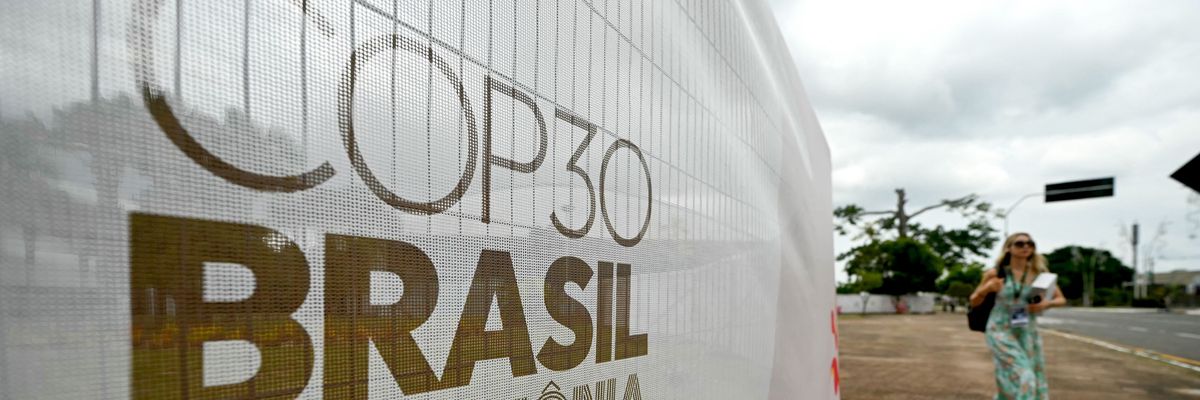
A woman walks past a banner with the COP30 UN Climate Change Conference logo outside the Hangar Convention and Exhibition Center in Belém, Para State, Brazil on November 5, 2025.
(Photo by Mauro Pimentel/ AFP via Getty Images)
Nov 18, 2025
At COP28 in Dubai, countries finally agreed to transition away from fossil fuels. That pledge signaled the beginning of the end of the fossil fuel era. But words alone won’t cool the planet, and in the years since, fossil fuel production has only continued to rise, driven primarily by rich countries.
As ministers arrive in Belém for the final COP30 sprint, the world must move from words to action. That means ending fossil fuel expansion and unlocking the public finance needed to build a fair, fast, and funded energy transition.

Oil Change International’s recent analysis shows that just four countries—the United States, Canada, Australia, and Norway—increased their oil and gas production by nearly 40% since the Paris Agreement, while production in the rest of the world dropped by 2%. These countries, despite their wealth and historic responsibility for the climate crisis, are dragging the world backwards. The impacts are clear: worsening climate disasters, rising energy costs, and growing injustice.
Meanwhile, the finance to support the transition is nowhere near what’s required. A fossil-fuel phaseout isn’t just about avoiding runaway climate change, it’s about making energy cheaper, safer, and more reliable in an increasingly unstable world. Cutting dependence on oil and gas shields countries from price swings, lowers bills, creates jobs, and supports climate-resilient development. But to ensure everyone shares in the benefits, international cooperation, and government planning and funding is key. This is illustrated by today’s fast but unequal renewable energy deployment, the energy access gap, and NDCs lacking concrete plans to phase out oil and gas.
A just transition is the only way to deliver real climate action. And it won’t come from voluntary pledges or corporate-led initiatives.
During the first week of COP two topics were at the center of discussions: Brazilian Environment Minister Marina Silva’s push for a road map to transition away from fossil fuels, and developing countries’ insistence on centering wealthy countries’ legal obligation to deliver public climate finance under Article 9.1. A road map cannot be successful without the latter. Massive investments are needed in grids and storage, energy access and just transition plans, particularly in developing countries, and private finance is poorly suited to meet these needs. It also adds to already unsustainable debt levels, while many Global South countries already spend more on debt repayments than on education, healthcare, or climate action. Rising debt is choking climate action.
And yet, the European Union, United Kingdom, Canada and Japan, among others, are overselling the role of private finance in covering the energy transition bill. This not only disregards their legal obligation to provide public climate finance at a scale that meets needs, affirmed recently by the world’s highest international court. It also sets the world up for energy transition failure.
It does not have to be this way. The public money needed for a fair fossil fuel phaseout, a just transition, and adaptation exists. As rich countries cut overseas aid, while they increase their military spending, it is important to remember that governments have a choice. They can unlock $6.6 trillion every year through fair taxes, ending fossil fuel subsidies, cancelling unjust debts, and supporting reforms to the unfair global financial system.
COP30 offers a chance to course correct. Governments must stop issuing new licenses for fossil fuel extraction and launch a formal process to implement the COP28 decision to transition away from fossil fuels. That means equitable national phaseout plans, support for just transitions, and an end to fossil fuel finance. It also means wealthy countries fulfilling their Article 9.1 obligations, and providing the public money needed for a transformation rooted in justice.
A just transition is the only way to deliver real climate action. And it won’t come from voluntary pledges or corporate-led initiatives. It must be driven by governments and shaped by people on the frontlines of the crisis: workers, Indigenous Peoples, and communities across the Global South.
Movements are rising to demand a fossil-free future that is equitable and achievable. At COP30, world leaders must choose whose side they are on. The choice is clear: Plan a fossil fuel phaseout, pay your fair share, and deliver a just transition for workers and communities, or fuel the fire while the planet burns.
Belem COP30: Implement What?

Image Courtesy: Flickr
The climate summit, COP30, in Belem, Brazil, where the mighty Amazon River drains into the Atlantic Ocean, formally began on November 10, 2025. The summit has been labelled the “implementation COP,” because of a narrative that, whereas so many promises and commitments have been made earlier, it is necessary to focus on implementation and delivery which are widely recognised to be lagging far behind.
It is indeed true that current trends in emissions reduction as committed to in the Nationally Determined Contributions (NDC) of each country, and in financial and technological assistance by developed countries to developing nations for de-carbonisation and adaptation to climate impacts including building longer-term resilience, are way below commitments made under the Paris Agreement (PA) of 2015. They are also far from enabling the internationally agreed target of restricting global average temperature rise to less than 2 degrees Celsius or, preferably, to 1.5C now accepted as the de facto goal, beyond which lie frightening and possibly irreversible climate impacts.
So, implementation is, of course, important. However, such a narrative may also be reflective of a mood of tired resignation, however temporary, in the face of stubbornly slow progress on the PA goals and an international economic and geo-political crisis affecting the developed countries in particular.
Crisis of the Global North
The second term of US President Donald Trump, who again withdrew the US, the world’s second largest emitter, from the Paris Agreement, is proving to be even worse than feared. The US is not merely backing away from the international agreement and its own substantial obligations, but is actively working against it by dismantling US renewable energy, environment and climate regulations and incentives, and pushing a major expansion of oil and other fossil fuels in a crazed “drill baby, drill” drive.
In his speech to the UN General Assembly in September this year, Trump called climate change “the greatest con job ever,” and wrongly attacked the mounting scientific evidence, encouraging other Right-wing governments and political parties to follow his lead.
Ominously, after a rare but long-awaited international agreement on curbing emissions from international maritime shipping, hitherto outside the global climate framework, Trump not only pulled the US out of it, he also threatened sanctions and penal landing fees on any ship arriving on US shores, causing the collapse of the agreement. What is to stop Trump from threatening countries adhering to the Paris Agreement with debilitating tariffs?
Europe is going through weak economic growth, compounded by Trump tariffs, and self-inflicted pain from its costly involvement in the Ukraine War, including an energy crisis prompting a revival of coal-based and nuclear power.
Read Also: Rising Emissions From ‘Benign’ Technologies
The European Union (EU) has responded to its economic crisis by scaling back its emissions reduction pledges, and along with the UK, has reduced their financial assistance to developing countries. Against this background, there appears to be little talk in the lead-up to and at COP30, at least so far, of the deep emission cuts urgently required.
Against this background, it would be unfortunate if the thrust of negotiations at COP30 merely reiterates earlier decisions and mechanically looks at what has been or not been done, but does not arrive at decisions on urgent actions and corresponding responsibilities required to drastically cut emissions and save the world, particularly vulnerable populations, from horrendous disasters already being seen.
Early signs from Belem, currently witnessing heavy rainfall, serious flooding and water-logging of accommodations and even conference venues, appear to mirror this somewhat gloomy atmosphere. Brazilian President Lula da Silva addressed the opening session with very few heads of government present, a clear sign of enthusiasm and low expectations. His proposal for a new fund to reduce deforestation received a cool reception, with the UK going back on its earlier commitment of funds for this, and Germany too going silent on the issue. A dangerously low-key start to COP30.
Way Behind Target
The Paris Agreement committed all countries to an iterative process of commitments, review against the 2C or preferably 1.5C goal, and fresh commitments as necessary. However, this has not been followed, even in the face of severe climate impacts and mounting evidence of accelerating global heating, climate change and lag in emissions reduction.
The UN Environment Programme’s (UNEP) “Emissions Gap Report” or EGR, released on the eve of COP30 as per usual practice, makes grim reading. Global temperatures in the past three years have set records, and have exceeded 1.5C in the past two, a sign of things to come going by recent decadal averages, even though global average temperatures are measured over 10 years. Atmospheric greenhouse gas (GHG) levels rose 2.3% in 2024 compared with 1.6% the previous year, and four times the growth rate over the previous decade.
Even at current levels, forest fires, droughts, floods, heat waves, melting glaciers and polar ice, increasing and more severe cyclones, rising sea levels, have all reached dangerous levels. Loss of glacier ice and of Arctic ice have reached record levels, ocean acidification has risen sharply, as have sea levels. Danger looms if tipping points are breached, beyond which climate changes could be severe and abrupt.
Even with full implementation of all NDCs for 2030, there is an emissions gap of 12 gigatons (12 million tonnes) of CO2 equivalent (normalising all GHGs to the equivalent global warming effect of CO2) for achieving the 2 degree C target and 20 Gt CO2-eq for the 1.5C target. At current emission reduction levels, global average temperatures are likely to reach 2.3-2.5C. Global emissions must reduce by 42% by 2035 compared with 2019 levels in order to achieve the 2C target, while emissions must fall by 57% for the 1.5C target.
The world is very far from that. Only one-third of countries had submitted the obligatory more ambitious revised NDCs for 2035 by September and just over half by the time COP30 began.
At the time of writing, India had failed to table its NDC 3.0. China and the EU had not formally submitted them although both had announced revised but low targets. The EU targets of 55% cut by 2030 from 1990 levels, going up to 90% by 2040 albeit with a 10% leeway for carbon trading are tepid, and much less than, for example the UK which has committed to 81% reduction by 2035 from 1990 levels.
China has made a positive and significant shift to absolute emissions reduction from emission intensity targets, setting an example for India, but its target of 7-10% reduction by 2035, has been assessed as not very different from current trends. The revised NDCs submitted so far, defying expectations, do not appear to have closed this emissions gap much. Yet, there seems little sense of anxiety or urgency at Belem, except among vulnerable small island nations and least developed countries (LDCs), or even pressure from influential developing countries. Will the coming fortnight see that change?
Adaptation and Finance
If mitigation, or emissions reduction, is not top of the agenda, it seems Adaptation and Finance are. In the opinion of this writer, both are uphill battles especially the latter.
Most developing countries and their groupings, notably the Like-Minded Developing Countries (LMDC), LDCs, AOSIS (island states) and BASIC, are pushing for more action and funding for Adaptation, which includes building resilience against climate impacts.
The Global Goal on Adaptation decided on at COP29 is yet to be properly defined, especially its indicators which could be used to decide on finance flows. There is a special dilemma here. Commitments on Emissions reduction or Mitigation by countries require reporting and monitoring internationally since these have global effect and implications. Climate impacts and Adaptation actions by countries, although related to global climate change processes, are national-level actions with little or no global effects. The extant emissions control architecture does not provide for this nor, if funding is provided for this purpose, for international supervision or monitoring, leaving yet another thorny issue to be sorted out.
Financing is getting increasingly complicated and shows clear signs of getting more so under pressure. Financial assistance from developed to developing countries has always been part of the architecture of climate agreements. It started off as encompassing Mitigation and Adaptation, although proportions of either were not defined, and are up for negotiation at COP30. Current targets are $300 billion annually for both, with an aspirational goal of reaching $1.3 trillion, which is currently being pressed. Meanwhile, a separate fund for Loss & Damage was agreed, details still being worked out.
The problem is that while separate buckets are envisaged for Mitigation, Adaptation and Loss & Damage, the developed country coffers from which these are to come are the same!
Given the character of global capitalism, developed countries have tried to dodge their “commitments” by cutting back on public finances and grants in preference to loans including from multilateral institutions and private investments; demanding stringent accounting and monitoring, and strict definitions of climate financing as different from development assistance; and cutting back on development funding, with all OECD countries announcing severe cuts in ODA.
Trump’s recent closing down of USAID, its programmes and funds, has exacerbated the issue. Developed countries have played the finance issue off against their own emissions reduction, preferring to commit on the former and later reneging or redefining as compared to more expensive and painful emissions cuts.
India’s first statement at Belem, made not on its own behalf but on behalf of BASIC and LMDC, merely flagged developing countries’ demands on all the issues up for discussion, such as Adaptation, Finance, Technology Transfer, but surprisingly there was no mention of deeper emission cuts by developed countries, which is the main and underlying issue.
Delegates at Belem must decide on priorities.
The writer is with the Delhi Science Forum and All India Peoples Science Network. The views are personal.
COP 30 Agrizone Exposes Firms Responsible for Climate Crisis

MST activists held a protest on November 11 in the Agrizone at COP 30, an area dedicated to discussions related to agribusiness. The action aimed to denounce agribusiness as the main driver of the environmental crisis in Brazil. Photo: @alain.grao / COP30 Collaborative Coverage
The United Nations Climate Conference COP30, is currently underway in Belém, Brazil and will conclude on November 21. It has become increasingly clear that, just as the Landless Rural Workers’ Movement (MST) and several other organizations, movements, collectives, and groups warned, agribusiness is at the forefront of the supposed search for solutions to the environmental crisis. This, in itself, sheds light on the fact that the Conference has become a large business expo, in which the assets will be our territories, communities, and nature.
According to Embrapa itself (the Brazilian Agricultural Research Corporation, a state entity), Agrizone is “a large showcase of technologies, science, and international cooperation focused on sustainable agriculture and the fight against hunger in a context of climate change.” However, in practice, the space will serve as a stage for agribusiness to do business, promote its image, and increase its profits – at the expense of the destruction of nature, the concentration of land, and the expulsion of peasant communities and traditional peoples. Under the discourse of “sustainability,” what we will see is the old logic of exploitation disguised as green.
Starting with its sponsors. It is unthinkable that a space that claims to combat hunger and the environmental crisis would have Bayer, Nestlé, and OCP among its financiers. These are three companies that directly contribute to the deepening of the environmental crisis. In 2024, Bayer had to pay more than USD 2 billion in compensation to a man in the US who was proven to have contracted cancer because of one of its main products: the pesticide Roundup. The product is no longer sold in that country, but in Brazil it circulates freely. It is estimated that the company faces 170,000 similar lawsuits.
One of the panels that Nestlé will lead at Agrizone is called “Remodeling food in Brazil.” This is a very suggestive title, given that the company is already engaged in this “remodeling” – at the expense of the health of the Brazilian people. According to the company’s own criteria, 54% of its sales are products with very low health ratings. In this context, it has already been proven that the Swiss company adds more sugar to its products destined for Africa and Latin America.
Office Chérifien des Phosphates (OCP) is a Moroccan state-owned company focused on the extraction of phosphate, which is mainly used in the production of pesticides. The company holds 70% of global phosphorus reserves. However, most of its production comes from the Bou Craa mine in Western Sahara, a country under colonial occupation by the Moroccan kingdom. In other words, OCP literally maintains its production at the expense of looting and stealing minerals that belong to the people of the Sahara.
Agrizone panels will be dominated by giants that plunder nature
The giants of agribusiness, the ultra-processed food industry, and mining, in addition to sponsoring Agrizone, will also dominate the debate panels at the event.
Syngenta, together with Itaú Bank, will coordinate the panel “Cooperation for long-term financing in the restoration of degraded areas.”
The question to be asked is whether the transnational corporation is willing to restore areas that it itself degrades? After all, the company is responsible for a quarter of the market for profenofos, an insecticide used mainly on corn, soybean, cotton, and other crops. It turns out that this pesticide “is extremely harmful to aquatic organisms, birds, and bees. It is a powerful neurotoxin (similar to sarin gas) that can affect brain development in humans, especially in children,“ said Laurent Gaberell, head of agriculture and biodiversity at the NGO Public Eye, which published a report on the subject. In Brazil, Syngenta’s largest market, ”profenofos residues are found in the drinking water of millions of people,” the report points out.
It is also worth remembering that Syngenta was responsible for the murder of Keno, an MST activist, in 2015, in Paraná. The murder took place in a field of illegal Syngenta transgenic experiments in the city of Santa Tereza do Oeste, western Paraná, near the Iguaçu National Park. The area was occupied by about 150 members of Via Campesina. The activists were shot at by about 40 agents from NF Segurança, a private company hired by Syngenta. In addition to Keno’s murder, Isabel Nascimento was also shot and lost sight in her right eye.
In addition to Syngenta, Natura will also be at Agrizone. The cosmetics company will lead the panel “from circular carbon to sustainable cooperation.” Natura was fined by Ibama in 2010 for biopiracy. The fine, in the amount of 21 million reais, was imposed “for allegedly irregular access to biodiversity.” In addition, the company was the subject of a complaint to the Parliamentary Inquiry Commission in the Federal Senate in 2023 for exploiting traditional communities in Pará. According to testimony from Indigenous leaders at the time, cooperatives linked to Natura paid three reais per day for harvesting andiroba and copaiba seeds, which are typical of the Amazon. However, the cooperatives sold a liter of seeds for 1,000 reais, and the company further increased this profit margin.
Ultra-processed food giant PepsiCo will be the protagonist in the panel “Every drop counts: growing potatoes in a changing climate.” Residues of the pesticide glyphosate have been identified in several of the company’s products, including Doritos chips. Potential health damage can begin at very low levels, from 0.1 parts per billion (ppb) of glyphosate. But in the company’s products, levels between 289.47 ppb and 1,125.3 ppb were found. The consequences of glyphosate on the body include gastrointestinal disorders, obesity, diabetes, heart disease, depression, autism, infertility, cancer, Alzheimer’s disease, Parkinson’s disease, and gluten intolerance.
Agribusiness controls Agrizone
Although Agrizone was officially conceived by Embrapa, control of the space is, in fact, in the hands of agribusiness. It is no surprise that important players in the sector here in Brazil, such as the Brazilian Agribusiness Association (ABAG), the Brazilian Rural Society (SRB), and Amaggi will be in the spotlight.
There is no way to build concrete solutions to the environmental crisis when the main causes of this scenario are sitting at the table, coordinating the “board room.” In Brazil, agribusiness (and the entire industrial complex surrounding it) is the main cause of this crisis. It is responsible for 74% of greenhouse gas emissions in the country.
All the supposed sustainable discourse maintained by those entities and companies in this sector – which will dominate the Agrizone panels – will actually serve two functions. First, to camouflage the real way agribusiness operates, which is based on the appropriation and destruction of nature’s common goods, in addition to the exploitation of traditional peoples. Second, in the face of the environmental crisis that they themselves have caused, to implement false solutions based on the financialization of nature – as is the case with the carbon market.
For an Embrapa that serves the people, not corporations
Embrapa is a strategic public company for the country. It suffered a profound attack during the Bolsonaro administration. However, it was not agribusiness, which was hand in hand with Bolsonaro, that defended it, but the Brazilian people and their public servants.
Therefore, it is essential that it be effectively focused on the interests of the Brazilian people and not under the control of transnational giants linked to agribusiness. The challenges related to food sovereignty and combating the environmental crisis will not come from those who profit from hunger and diseases caused by ultra-processed foods and pesticides. They will come from those who have been resisting the advance of capital for centuries and cultivating emancipated forms of relationship with nature.
This article was first published on the MST website.
Courtesy: Peoples Dispatch

No comments:
Post a Comment